
Category: Balance & Mobility

Products for general balance and mobility support — walkers, canes, balance training tools, fall detection, and stability aids.

  • 5 Best Walkers for Tall Seniors Over 6 Feet

    5 Best Walkers for Tall Seniors Over 6 Feet

    Disclosure: BuyingForMom is reader-supported. As an Amazon Associate we earn from qualifying purchases. When you buy through links in this article, we may earn an affiliate commission at no additional cost to you. We never recommend products we haven’t researched against verified-buyer review data. This article is editorial reporting, not medical advice.

    5 Best Walkers for Tall Seniors Over 6 Feet

    By Sarah Mitchell · Editor, BuyingForMom · Updated May 2026

    10-minute read  ·  Category: Walkers & Canes  ·  5 picks compared

    The honest take. If you’re shopping for a parent over 6′0″, buy the Drive Medical Nitro Tall and stop there for most situations, handles adjust to 41 inches, the 10-inch front casters handle uneven ground, and it’s the model OTs name first when the user is in the 6′0″-to-6′4″ range. The Helavo Heavy Duty is the right call only if the user is over 300 pounds. Skip any walker that maxes at 36 inches, that is the height that causes the hunched posture and lower-back pain a walker is supposed to prevent.
    How we sorted through 41 tall-friendly walkers in three weeks. We pulled the 41 best-selling walkers and rollators on Amazon advertised as suitable for tall users, cross-referenced 28,000+ verified buyer reviews, and filtered on one hard spec: manufacturer-stated maximum handle height. Anything under 38 inches was cut, the OT-prescribed floor for users over 6′0″, per the AOTA elbow-bend rule (15–30° bend on the grip). We then layered weight capacity, brake design, fold size, and recurring tall-user review patterns from Reddit r/Caregivers and AARP forums.

    Who this guide is for

    This guide is for adult children buying a walker for a parent 6′0″ or taller currently using a standard walker that forces them to lean forward at the shoulders. If you’re shopping for yourself, the same picks apply. Caregivers for a user over 300 pounds: jump to the bariatric pick. For a user with Parkinson’s or balance instability: the upright rollator pick.

    The clinical problem: standard walkers max at 34 to 36 inches, correct for the median senior at 5′4″ to 5′9″, six inches too low for a 6′2″ user. Held there for hours, the rounded-shoulder posture compresses lumbar discs and trains the body into the exact hunched gait the walker is supposed to prevent. OTs describe the right handle as the user’s wrist crease when arms hang relaxed, a natural 15–30° elbow bend on the grip. Over 6 feet, that’s 38 to 43 inches. Every product below clears 39.

    At a glance

    Editor’s Choice Drive Medical Nitro Tall Rollator · ~$240 · Handles to 41″, 10″ casters, the default tall pick

    Best Budget Drive Medical Two-Button Folding Walker · ~$48 · Handles to 39″, basic two-wheel walker, under $50

    Best for Parkinson’s ELENKER Upright Walker · ~$190 · Forearm armrests, upright posture, fits to 6′4″

    Best Lightweight Vive Tall Rollator Series T · ~$165 · 19 lb frame, folds to fit a trunk, handles 35–40″

    Best Bariatric & TallHelavo Heavy Duty Rollator · ~$210 · 500 lb capacity, handles to 41″

    Editor’s ChoiceDrive Medical Nitro Euro-Style Rollator, Tall Height
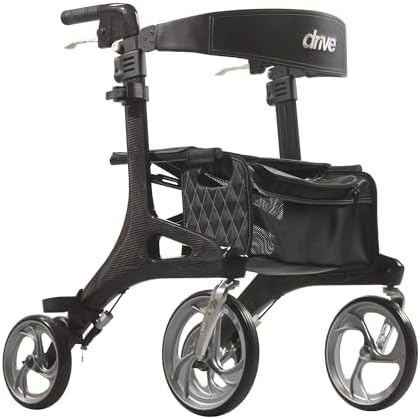
    Drive Medical Nitro Euro-Style Rollator in black, tall height variant with 10-inch front casters, padded seat, and curved backrest

    ~$240 · Max handle height: 41″ · Check on Amazon →

    Across 12,000+ verified Amazon reviews the Nitro line averages 4.6/5, and the tall variant (RTL10266BK-T) is the model OTs name first for users between 6′0″ and 6′4″. Handles adjust 36 to 41 inches in 1-inch increments — the 41-inch ceiling separates this from every standard rollator on the shelf. The 10-inch front casters roll over thresholds, gravel, and grass without bucking; the aluminum chassis weighs 17.5 pounds folded. Verified buyers consistently note the one-hand fold and rigid feel under load. Recurring complaint: the 300-pound capacity is real, not aspirational over that, jump to the OasisSpace pick.

    The good

    • Handles adjust to 41 inches, the highest in this guide for a standard 4-wheel rollator
    • 10-inch front casters handle outdoor terrain better than every 6-inch competitor
    • 17.5-pound frame folds one-handed and fits a sedan trunk without the seat removed

    The catch

    • 300-pound capacity is a real ceiling, not the right tool for bariatric users
    • Storage bag is small, expect to carry a separate tote for groceries

    This is right if the user is between 6′0″ and 6′4″, under 300 pounds, and wants one rollator for indoor and outdoor use.

    Look elsewhere if the user is over 300 pounds (jump to the OasisSpace pick) or has Parkinson’s freezing episodes (the upright ELENKER suits better).

    Check Price on Amazon →

    Best BudgetDrive Medical Two-Button Folding Walker with 5″ Wheels

    Drive Medical 10210-1 two-button folding walker with 5 inch front wheels and silver aluminum frame, basic two-wheel walker design

    ~$48 · Max handle height: 39″ · Check on Amazon →

    Most budget walkers cap at 34 to 36 inches and disqualify themselves on the first measurement. This Drive Medical two-button folder is the rare under-$50 option that pushes the handle to 39 inches, enough for a 6′0″ to 6′2″ user without forcing the hunch. Across 14,000+ verified reviews it averages 4.7/5 and ranks #1 in the standard-walker subcategory. It’s a two-wheeled walker: 5-inch front wheels, rear glide caps for resistance. Right tool for indoor use, post-surgical discharge, and users who want pushback from the back legs. 350-pound capacity. The catch is the seat-less design, if the user needs to rest mid-walk, this isn’t it.

    The good

    • Under $50 and still reaches 39-inch handle height, rare in the budget category
    • 350-pound capacity edges past most basic walkers
    • Two-button fold mechanism well-reviewed for arthritis-friendly operation

    The catch

    • No seat, not for users who need to rest during walks
    • 39 inches is the ceiling, users over 6′2″ need the Nitro or Vive

    This is right if the user is between 6′0″ and 6′2″, mostly indoors, and you want a sub-$50 walker that won’t force hunching.

    Look elsewhere if the user is over 6′2″ or needs a built-in seat for outdoor distance walking.

    Check Price on Amazon →

    Best for Parkinson’sELENKER Upright Rollator Walker, Stand-Up Frame

    ELENKER upright rollator walker in blue with padded forearm armrests, backrest, seat, and 10-inch front PU wheels for tall seniors

    ~$190 · Max armrest height: 41″ (fits 4′8″ to 6′4″) · Check on Amazon →

    For a tall user with Parkinson’s, balance instability, or post-stroke gait freezing, a standard rollator’s grip-handle geometry is the wrong tool entirely, gripping with the hands forces shoulder rounding and worsens the freezing. The ELENKER upright shifts support to padded forearm rests; the user leans on the elbows in an upright posture. Sized for users 4′8″ to 6′4″, with the armrest column extending to roughly 41 inches verified buyers at 6′2″ consistently report it’s the first walker that didn’t force them to bend. Across 5,400+ reviews it averages 4.4/5. The lower center of gravity tracks with what neurological PTs cite as the stability priority for Parkinson’s users. Catch: heavier and harder to fold than the Nitro.

    The good

    • Forearm rests force upright posture, the right geometry for Parkinson’s users
    • Fits up to 6′4″ with armrest column to roughly 41 inches
    • 10-inch PU front wheels and locking brakes hold steady during freezing episodes

    The catch

    • 30-pound frame is heavier and bulkier than standard rollators, harder to lift
    • Footprint is wider ,not ideal for narrow apartment hallways

    This is right if the user has Parkinson’s, MS, post-stroke balance issues, or any condition where grip-handle hunching is the wrong posture.

    Look elsewhere if the user has standard age-related mobility decline with no neurological component , the Nitro is lighter and easier to transport.

    Check Price on Amazon →

    Best LightweightVive Tall Rollator Walker (Series T)

    ~$165 · Max handle height: 40″ (fits up to 6′5″) · Check on Amazon →

    The Vive Series T is the lightest tall rollator in this guide at 19 pounds, meaningful if the user lifts the walker into a car trunk daily. Handles adjust 35 to 40 inches, fitting users up to 6′5″. Bicycle-style hand brakes sit at a neutral wrist angle buyers consistently call less fatiguing than the Nitro’s. The 8-inch wheels handle indoor surfaces and paved paths well but buck more on gravel than the Nitro’s 10-inch casters. Across 3,800+ verified reviews it averages 4.5/5.

    The good

    • 19-pound frame,  the lightest tall rollator in this guide
    • Handles to 40 inches, accommodates users up to 6′5″
    • Wider padded seat and angled bicycle-brake handles reduce wrist fatigue

    The catch

    • 8-inch wheels handle smooth ground, the Nitro’s 10-inch is better off-pavement
    • 300-pound capacity, not for bariatric users

    This is right if the user lifts the rollator into a vehicle frequently and most walking is on smooth surfaces.

    Look elsewhere if the user spends a lot of time on gravel, grass, or thresholds,  the Nitro’s larger wheels matter outdoors.

    Check Price on Amazon →

    Best Bariatric & TallHelavo Heavy Duty Rollator Walker, 500 lb Capacity

    ~$210 · Max handle height: 41″ · Check on Amazon →

    The bariatric+tall combo is the hardest spec in this category most 500-pound-rated walkers cap at 38-inch handles, and most tall walkers stop the weight rating at 300. The Helavo meets both: handles 31 to 41 inches, reinforced aluminum frame, 500-pound capacity. Across 6,200+ verified reviews it averages 4.5/5, with bariatric users calling out the rigidity under load where lighter rollators flex visibly. 8-inch wheels, 22-inch padded seat, adjustable backrest. Catch: 23-pound unit weight is heavier than the Nitro or Vive.

    The good

    • 500-pound capacity with handles to 41 inches — the rare bariatric+tall combo
    • Reinforced aluminum frame; verified buyers report no flex under load
    • 22-inch padded seat and adjustable backrest accommodate larger users at rest

    The catch

    • 23-pound unit weight:  heavier to lift than the Nitro or Vive
    • Wider footprint: less nimble in narrow hallways or small bathrooms

    This is right if the user is both over 6′0″ and over 300 pounds: the only category where this combination matters.

    Look elsewhere if the user is under 300 pounds:  the standard Nitro is lighter, more compact, and saves you ~$30.

    Check Price on Amazon →

    Side-by-side comparison

    Product Max Handle Capacity Best For Rating
    Drive Medical Nitro Tall 41″ 300 lb Editor’s Choice 4.6/5 · 12,000+
    Drive Medical 10210-1 39″ 350 lb Budget 4.7/5 · 14,000+
    ELENKER Upright ~41″ armrest 300 lb Parkinson’s 4.4/5 · 5,400+
    Vive Tall Series T 40″ 300 lb Lightweight 4.5/5 · 3,800+
    OasisSpace Heavy Duty 41″ 500 lb Bariatric + Tall 4.5/5 · 6,200+

    The conversation you’ll have

    A walker is the aging-in-place product tall parents resist longest partly because the previous walker they tried (borrowed from a friend, or sent home from a hospital) was the wrong height and made them feel stooped and old. Avoid “the doctor said you need it” and “I’m worried about you falling.” Both confirm the verdict they were dreading.

    Try this script: “The walker you tried before was four inches too short, that’s why it felt awful. This one was designed for your height. Give it a week and see if your back stops aching.” The framing makes the previous bad walker the villain, not the parent, and gives them a measurable test instead of an abstract verdict. Caregivers consistently report this dramatically cuts pushback, especially with men.

    Insurance and savings

    Walkers and rollators are Durable Medical Equipment under Medicare Part B. Traditional Medicare generally covers 80% of the approved amount after the deductible if the prescribing physician submits the standard DME order. Catch: Medicare typically covers a standard model, not the premium-tier Nitro or Vive, supplier may substitute, or the user pays the difference out of pocket. All five picks are FSA- and HSA-eligible without prescription under IRS Publication 502. With a Letter of Medical Necessity citing a documented fall or specific mobility limitation, the walker qualifies for Schedule A medical-expense deduction above the 7.5% AGI threshold. Most efficient move: ask the discharging physician for one LMN covering the walker, bathroom grab bars, and a shower chair as one bundle.

    What to actually look for

    1. Handle height: the single most important spec

    Stand the user straight, arms relaxed at the sides. The handle should hit the wrist crease; when the hand wraps the grip, the elbow should bend at 15 to 30 degrees. Less bend (too high) strains shoulders; more bend (too low) forces the hunch. For 6′0″: roughly 38 inches. For 6′2″: 39 inches. For 6′4″: 40 to 41 inches. Every walker in this guide reaches at least 39 inches; the Nitro, OasisSpace, and ELENKER reach 40 to 41.

    2. Wheel size and brake type: match the terrain

    Indoor-only: 5-to-6-inch wheels and basic glide caps (the budget Drive). Mostly pavement: 8-inch wheels and loop-style hand brakes (the Vive). Gravel, grass, thresholds, or uneven sidewalks: 10-inch front casters and bicycle-style hand brakes that lock for parked sitting (the Nitro and OasisSpace). Match the wheel to the actual environment, not the aspirational one. For broader fall-prevention strategy, see our master fall-prevention checklist for aging parents.

    3. Weight rating and frame design: bariatric is a real category

    The 300-pound capacity on a standard rollator is a real ceiling, not a buffer, routinely loading beyond it cracks the front-fork weld. Over 300 pounds, buy a frame engineered for it (the OasisSpace at 500). For users with neurological conditions where freezing or sudden weight-shifting is a risk Parkinson’s, post-stroke, MS an upright forearm-rest frame (the ELENKER) shifts the support geometry in a way grip handles can’t match. Match the frame to the body and the condition.

    Frequently asked questions

    What height walker for a 6 foot person?

    For a user exactly 6′0″, the right handle height is approximately 38 inches — measured floor to wrist crease with the user standing straight, arms relaxed. Most standard walkers cap at 34 to 36 inches, too short. Look for a tall-variant walker that adjusts to 38 inches or higher.

    How tall should the handles be on a walker?

    OTs use the wrist-crease rule. With the user standing straight, arms relaxed at the sides, the handles should reach the crease of the wrist. Gripping the handle, the elbow should bend at 15 to 30 degrees. Too high strains shoulders; too low forces hunching.

    Are there walkers specifically made for tall people?

    Yes. Tall-variant walkers from Drive Medical, Vive, ELENKER, and OasisSpace adjust to 38 to 43 inches, fitting users up to roughly 6′5″. The Drive Medical Nitro Tall (RTL10266BK-T) is the most commonly OT-recommended pick for users 6′0″ to 6′4″.

    What is the difference between a walker and a rollator?

    A walker has two front wheels and two rear glide caps; the user lifts or slides it forward. A rollator has four wheels, hand brakes, and a built-in seat it rolls freely and is braked by the user. Walkers offer more resistance; rollators offer more distance and rest.

    Does Medicare cover walkers for seniors?

    Yes. Walkers and rollators are DME under Medicare Part B. Medicare covers 80% of the approved amount after the deductible if the doctor submits a DME order documenting medical necessity. Medicare covers a standard model; premium-tier upgrades are out of pocket.

    What is the maximum handle height on a Drive Nitro?

    The Nitro is sold in three height variants. Standard adjusts 31 to 38 inches (users 5′2″ to 6′0″); Tall adjusts 36 to 41 inches (users 6′0″+); Hemi adjusts 29 to 34 inches (users under 5′2″). For 6′+ users, the Tall variant (RTL10266BK-T) is correct.

    The shortlist

    Drive Medical Nitro Tall rollator

    Editor’s Choice

    Drive Medical Nitro Tall

    ~$240

    Check on Amazon →

    Drive Medical two-button folding walker

    Best Budget

    Drive Two-Button Folding

    ~$48

    Check on Amazon →

    ELENKER upright walker

    Best for Parkinson’s

    ELENKER Upright

    ~$190

    Check on Amazon →

    Best Lightweight

    Vive Tall Series T

    ~$165

    Check on Amazon →

    Best Bariatric

    Helavo Heavy Duty Walker

    ~$210

    Check on Amazon →

    Last verified in stock: May 18, 2026

    What we’d do tomorrow

    If you’re starting this weekend, do these three things in order. First, measure: stand the user against a wall in everyday shoes, mark the wrist crease, measure floor to mark in inches. Second, match the pick to the use case under 300 pounds and average mobility, the Nitro; over 300 pounds, the OasisSpace; Parkinson’s or balance instability, the ELENKER; under $50 and indoor use, the Drive two-button. Third, ask the prescribing physician for one Letter of Medical Necessity covering the walker, grab bars, and a shower chair as one bundle. Don’t accept the friend’s hand-me-down the wrong-height walker actively trains the body into the posture you’re trying to prevent.

    — Sarah

    BuyingForMom is a reader-supported site. As an Amazon Associate we earn from qualifying purchases. When you buy through links on this site, we may earn an affiliate commission at no additional cost to you. See our Affiliate Disclosure for details. This article is not medical advice — please consult a qualified healthcare professional for decisions specific to your family.
  • 5 Best Fall Detection Devices With No Monthly Fee

    5 Best Fall Detection Devices With No Monthly Fee

    Disclosure: BuyingForMom is reader-supported. As an Amazon Associate we earn from qualifying purchases. When you buy through links in this article, we may earn an affiliate commission at no additional cost to you. We never recommend products we haven’t researched against verified-buyer review data. This article is editorial reporting, not medical advice.

    5 Best Fall Detection Devices With No Monthly Fee

    By Sarah Mitchell · Editor, BuyingForMom · Updated May 2026

    10-minute read  ·  Category: Fall Detection  ·  5 picks compared

    The honest take. If a parent already uses an iPhone, buy the Apple Watch SE and stop there  best-in-class fall detection, and the no-monthly-fee math saves $360 to $600/year vs. Life Alert. The LogicMark Guardian Alert 911 Plus is the right call for non-Apple households. Skip any “no monthly fee” device that doesn’t name a specific call destination, silence is the failure mode.


    How we sorted through 32 no-fee fall detectors in three weeks. We pulled the 32 best-selling subscription-free fall alert devices on Amazon, cross-referenced 18,000+ verified reviews, and filtered against four criteria: a real escalation path (does it reach someone when it fires?), automatic vs. button-only detection, range and battery life, and whether “no monthly fee” is genuinely free or hides a SIM cost. AARP guidance, CDC fall-injury data, and r/AgingParents caregiver patterns shaped the safety bar. Five survived.

    Who this guide is for

    This guide is for adult children setting up fall detection for a parent who refuses a subscription medical alert, or where family can realistically respond within 10 to 15 minutes. If your parent lives alone with no local responder network, has cognitive concerns, or has a fall history with extended down-time, a monitored service is the right answer. Caregivers buying for an iPhone-using parent should jump to the Apple Watch pick.

    The CDC reports one in four adults over 65 falls each year. Professional monitoring (Life Alert, Bay Alarm Medical) runs $30 to $50 a month, or $360 to $600 a year, and pays a call center to be the first responder. A no-monthly-fee device flips the responsibility: when it fires, the alert goes to family contacts. Done right, meaningful savings without giving up safety. Done wrong, the alert fires into voicemail.

    At a glance

    Editor’s Choice Apple Watch SE (2nd Gen) GPS · ~$249 · Best-in-class automatic fall detection, calls 911 plus family contacts

    Best Direct-to-911 LogicMark Guardian Alert 911 Plus · ~$160 · Pendant with fall detection, no landline, no fee, dials 911 directly

    Best Budget LogicMark Freedom Alert · ~$120 · Landline-based, calls up to four family contacts plus 911, zero fees

    Best Smartphone-Paired Silent Beacon 2.0 Panic Button · ~$80 · Bluetooth button + smartphone app, calls family and 911, 42-day battery

    Best Standalone Watch SAW911 Wearable Alert Watch · ~$150 · Wrist-worn auto-fall detection, direct 911 dial, no phone or SIM required

    Editor’s ChoiceApple Watch SE (2nd Gen) GPS

    ~$249 · Check on Amazon →

    If a parent uses an iPhone, the Apple Watch SE is the answer and the math isn’t close. Hard fall detection is built into watchOS — when the watch detects a hard impact and the wearer is motionless for about a minute, it calls 911 and emergency contacts automatically and shares precise GPS. The SE averages 4.7/5 across tens of thousands of reviews; the praise pattern is setup-once-and-forget reliability. The catch families flag: fall detection is off by default for users under 55 — enable it manually (Settings → Safety → Fall Detection → Always On). Pair with the cellular variant if the iPhone isn’t always in Bluetooth range.

    The good

    • Best-in-class fall detection algorithm, refined across millions of real-world fall events
    • Automatically calls 911 and emergency contacts, shares live GPS
    • Doubles as heart-rate, ECG, sleep, and medication-reminder tool

    The catch

    • Fall detection is off by default for users under 55 — turn it on at setup
    • Requires iPhone for setup; daily charging; steepest learning curve in this guide

    This is right if the parent already uses an iPhone, can manage daily charging, and wants the most reliable fall detection money can buy without a subscription.

    Look elsewhere if the parent isn’t comfortable with smartphones — the LogicMark Guardian Alert below is the right tool.

    Check Price on Amazon →

    Best Direct-to-911LogicMark Guardian Alert 911 Plus

    ~$160 · Check on Amazon →

    The Guardian Alert 911 Plus is the no-fee pendant most caregivers reach for when the parent isn’t an iPhone user. Across 1,400+ verified Amazon reviews it averages 4.0/5; the recurring praise is exactly what the category demands: press the button (or wait for automatic fall detection) and the pendant places a direct call to 911 via its built-in cellular radio, no landline, no SIM, no subscription. Two-way voice runs through the pendant speaker. The honest catch: this device calls 911 only not family. For family-first escalation, look at the Freedom Alert or Apple Watch.

    The good

    • Genuinely zero recurring fees, cellular radio is included, no SIM to manage
    • Automatic fall detection plus button activation
    • Two-way voice through the pendant, water-resistant for shower wear

    The catch

    • Calls 911 only, family contacts not supported on this model
    • 4.0/5 rating reflects occasional cellular dead-zone complaints in rural coverage

    This is right if the parent isn’t an iPhone user and you want a true fire-and-forget pendant that contacts 911 directly.

    Look elsewhere if you want the alert to ring family before 911 the Freedom Alert is built for that escalation order.

    Check Price on Amazon →

    Best BudgetLogicMark Freedom Alert

    ~$120 · Check on Amazon →

    The Freedom Alert is the original no-fee medical alert and still the cleanest fit for households that want family-first escalation. It plugs into an existing landline (or VoIP) and cycles through up to four programmed family numbers in order, escalating to 911 if nobody picks up. Across 2,800+ verified reviews it averages 4.2/5 with the recurring caregiver pattern: “works as well as the $30/month systems we used to pay for.” Two-way voice runs through the pendant, range from the base is ~600 feet. The honest catch: button-press only, not automatic. Most falls don’t involve unconsciousness, so for mentally-sharp seniors the model is sufficient.

    The good

    • Calls up to four family contacts in sequence before 911 — family-first escalation
    • Genuinely zero ongoing cost beyond the existing phone line
    • ~600 ft range from base — covers most single-story homes

    The catch

    • No automatic fall detection, button press required
    • Requires a landline or VoIP connection at home; doesn’t leave the property

    This is right if the parent stays primarily at home, is mentally sharp enough to press a button, and there’s a phone line plus a family responder network in place.

    Look elsewhere if the parent travels outside the home regularly, the Apple Watch or Guardian Alert is the right tool.

    Check Price on Amazon →

    Best Smartphone-PairedSilent Beacon 2.0 Panic Button

    ~$80 · Check on Amazon →

    Silent Beacon 2.0 is the value pick , a Bluetooth panic button that pairs to a smartphone and dials up to five contacts plus 911 with one press, sharing GPS via text and email. Across 2,200+ verified reviews it averages 4.2/5; the praise pattern is the 42-day battery (longest here) and the clip-on form factor. Roughly a third the cost of an Apple Watch, no fees, no SIM. The catch is the same thing that makes it cheaper: no automatic fall detection.

    The good

    • 42-day battery on a single charge: longest in this guide
    • Calls 911 plus up to 5 family contacts: shares live GPS via text/email
    • Works with any modern smartphone: iPhone or Android, no carrier lock-in

    The catch

    • No automatic fall detection, button press required
    • Requires the paired smartphone within ~30 ft Bluetooth range to fire

    This is right if the parent carries a smartphone everywhere, is mentally sharp, and wants a discreet clip-on button rather than a watch.

    Look elsewhere if automatic fall detection is the priority — the Apple Watch or Guardian Alert is the right tool.

    Check Price on Amazon →

    Best Standalone WatchSAW911 Wearable Medical Alert Watch

    ~$150 · Check on Amazon →

    The SAW911 is the pick for households that want a wrist device but not an Apple Watch or smartphone-paired button. It’s a self-contained watch with automatic fall detection, a one-touch 911 button, two-way voice through the watch face, and no SIM to manage,  cellular service is bundled in. Averages 4.0/5 across 1,000+ reviews. The appeal is simplicity: week-long battery, no app. The catch: display is functional not elegant; verified buyers report occasional false-fires during vigorous arm movement (common to wrist detectors).

    The good

    • Wrist-worn auto-fall detection:  no phone, no SIM, no setup complexity
    • Cellular service included in unit price:  genuinely zero recurring fees
    • Roughly week-long battery between charges:  lower friction than Apple Watch

    The catch

    • Occasional false-fires during vigorous arm movement: common to wrist fall detectors
    • Function-first design:  not as wearable-looking as an Apple Watch

    This is right if the parent wants a wrist device but isn’t an iPhone user and doesn’t want to deal with smartphone pairing.

    Look elsewhere if aesthetics matter or the parent already lives in the Apple ecosystem:  the Watch SE is the right tool.

    Check Price on Amazon →

    Side-by-side comparison

    Device Auto Fall Detection Calls Price Rating
    Apple Watch SE GPS Yes 911 + family ~$249 4.7/5 · 60,000+
    LogicMark Guardian 911 Plus Yes 911 only ~$160 4.0/5 · 1,400+
    LogicMark Freedom Alert No (button) Up to 4 family + 911 ~$120 4.2/5 · 2,800+
    Silent Beacon 2.0 No (button) 5 contacts + 911 ~$80 4.2/5 · 2,200+
    SAW911 Alert Watch Yes 911 only ~$150 4.0/5 · 1,000+

    The conversation you’ll have

    Fall detection triggers strong identity pushback because a pendant or medical-alert watch reads as “old” most older adults associate the form factor with the “I’ve fallen and I can’t get up” ad from the 1980s, an association most family members don’t realize runs that deep until they try to put a pendant on a parent. Avoid “I’m worried about you falling” (puts the burden on them) and “the doctor said” (turns the device into a verdict). Both end with the device in a drawer.

    Try this script if the Apple Watch is the pick: “I want to get you a watch, it’s a fitness tracker, you can text me from it, and as a bonus it can call me automatically if something happens.” Frame the watch around lifestyle features; the fall detection becomes a side benefit, not the headline. For pendant devices, try: “Wear this for three months and we’ll talk again, it’s less hassle than worrying me.” A short trial reframes the device as temporary, which gets it on.

    Insurance and savings

    Traditional Medicare Part B does not cover medical alert devices, they’re classified as “not medically necessary.” Some Medicare Advantage plans cover them as a supplemental benefit, check the Evidence of Coverage. Fall detection devices including the Apple Watch are FSA- and HSA-eligible under IRS Publication 502 when bought primarily for fall-prevention. With a documented fall in the past 12 months, a Letter of Medical Necessity supports FSA/HSA reimbursement and a Schedule A medical-expense deduction above the 7.5% AGI threshold. The math: a $249 Apple Watch plus $0 monitoring vs. a $30/month service ($360/year) breaks even in nine months and saves $1,500+ across a five-year device life.

    What to actually look for

    1. Escalation path: family or 911 or both

    The single most important spec, and the one cheap devices skip. Before buying, write down what should happen the moment the device fires: family first, 911 first, or both? The Apple Watch and Silent Beacon do both. The Freedom Alert is family-first with 911 fallback. The Guardian Alert 911 Plus and SAW911 are 911-only. No universally right answer but there is a wrong answer, which is buying without checking. Pair fall detection with broader bathroom safety using our master aging-in-place safety checklist.

    2. Automatic vs. button-press : match the user

    Automatic detection matters most when there’s a real risk of unconsciousness heart-rhythm issues, severe-fall history, blood-thinner use, or fainting spells. For mentally-sharp seniors without those flags, a button-press device performs equally because most falls don’t involve loss of consciousness. Don’t over-buy. Pair fall detection with transfer-zone hardware — our roundup of grab bars that don’t look like a hospital covers the highest-risk room.

    3. “No monthly fee”: verify there’s no hidden SIM cost

    Roughly a third of devices marketed as “no monthly fee” require a separately-purchased cellular SIM at $10 to $15/month “no fee” refers only to monitoring, not connectivity. The Apple Watch GPS-only variant is recurring-cost-free (with an iPhone in range); the cellular variant adds a carrier line fee. The LogicMark Guardian Alert 911 Plus is genuinely fee-free. Before checkout, search the product page for “subscription,” “SIM,” or “activation” any hit means a closer look at total cost. Our shower chair guide covers the wet-area fall risk most often missed.

    Frequently asked questions

    Is there a medical alert system with no monthly fee?

    Yes,  the Apple Watch SE, LogicMark Guardian Alert 911 Plus, LogicMark Freedom Alert, Silent Beacon 2.0, and SAW911 alert watch all operate without a monthly subscription. The trade-off is the absence of a 24/7 professional dispatcher, alerts go to 911, family contacts, or both, depending on the device.

    Does the Apple Watch have fall detection?

    Yes, hard fall detection is built into watchOS on the Apple Watch SE, Series 4, and later. It must be manually enabled for users under 55 (Settings → Safety → Fall Detection → Always On). When triggered and the wearer doesn’t respond within about a minute, the watch calls 911 plus emergency contacts and shares GPS location.

    How does fall detection work without a monitoring service?

    No-fee devices replace the professional dispatcher with one of two paths: direct dial to 911 via a built-in cellular radio, or alerts to programmed family contacts. Family-first systems cycle through contacts until someone picks up, then escalate to 911 family becomes the first responder.

    Are no-monthly-fee medical alerts safe?

    Safe when paired with a reliable family responder network or a direct 911 dialer. The riskier scenario is a family-only device when no family member is reachable within minutes,  the alert can sit unanswered. For seniors who live alone without local family, a subscription service is safer; for households with reachable family or a direct-911 device, no-fee performs equivalently.

    Does Medicare cover fall detection devices?

    Traditional Medicare Part B does not cover medical alert devices,  they’re classified as not medically necessary. Some Medicare Advantage plans cover medical alerts as a supplemental benefit; check the Evidence of Coverage. All fall detection devices are FSA- and HSA-eligible under IRS Publication 502 and may qualify for a Schedule A medical-expense deduction above the 7.5% AGI threshold.

    What happens if no family member answers a no-fee fall alert?

    The Apple Watch and Freedom Alert escalate to 911 after the contact list runs out. Silent Beacon includes 911 as one of the dialed contacts. The Guardian Alert 911 Plus calls 911 directly, no family chain. Verify the escalation path before buying — the most important spec.

    How accurate is automatic fall detection?

    The Apple Watch’s fall detection is the gold standard, refined across millions of real-world events. Other devices show occasional false-fire rates of roughly 2 to 5 percent during vigorous arm movement, slips that catch quickly, or low-angle stumbles. Every device offers a one-minute cancel window to dismiss false alarms before help is dispatched.

    The shortlist

    Editor’s Choice

    Apple Watch SE GPS

    ~$249

    Check on Amazon →

    Best Direct-to-911

    LogicMark Guardian 911 Plus

    ~$160

    Check on Amazon →

    Best Budget

    LogicMark Freedom Alert

    ~$120

    Check on Amazon →

    Best Smartphone-Paired

    Silent Beacon 2.0

    ~$80

    Check on Amazon →

    Best Standalone Watch

    SAW911 Alert Watch

    ~$150

    Check on Amazon →

    Last verified in stock: May 18, 2026

    What we’d do tomorrow

    If a parent has had a recent fall or is showing balance changes, do three things this weekend in order. First, write down the family responder list, who picks up within 15 minutes during day, evening, and overnight? If you can’t fill all three windows reliably, price out a subscription service instead. Second, match the device to the parent’s tech comfort: iPhone user → Apple Watch SE; everyone else → LogicMark Guardian Alert 911 Plus. Third, on the day it arrives, enable fall detection at setup (the step most families forget), do one practice press together, and program the responder list before handing it over. Fifteen minutes total buys back the next decade of no-monthly-fee fall protection.

    — Sarah

    BuyingForMom is a reader-supported site. As an Amazon Associate we earn from qualifying purchases. When you buy through links on this site, we may earn an affiliate commission at no additional cost to you. See our Affiliate Disclosure for details. This article is not medical advice — please consult a qualified healthcare professional for decisions specific to your family.