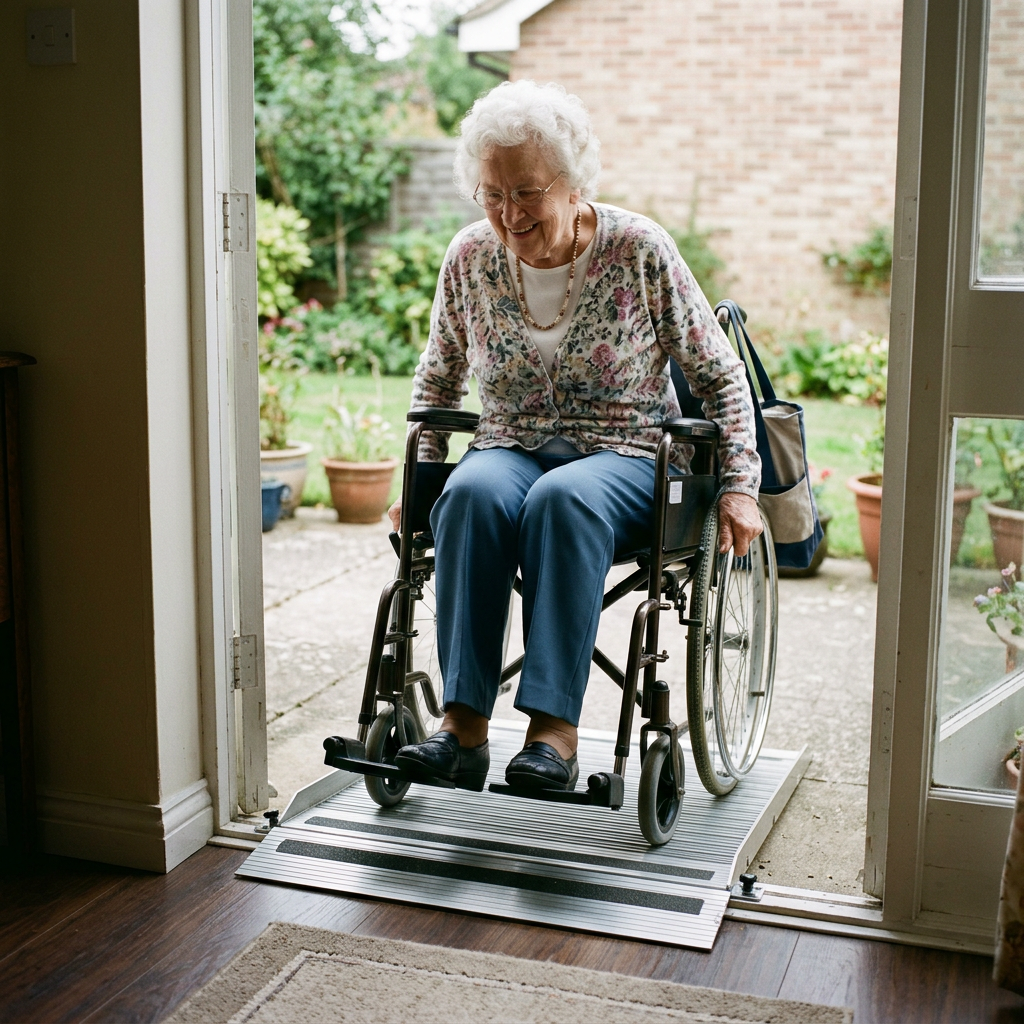
Category: Outdoors & Entryways

Outdoor and entryway safety — threshold ramps, entry handrails, motion lighting, and accessible mailbox/package solutions.

  • 5 Best Threshold Ramps for Walkers (2026)

    5 Best Threshold Ramps for Walkers (2026)

    Disclosure: BuyingForMom is reader-supported. As an Amazon Associate we earn from qualifying purchases. When you buy through links in this article, we may earn an affiliate commission at no additional cost to you. We never recommend products we haven’t researched against verified-buyer review data. This article is editorial reporting, not medical advice.

    5 Best Threshold Ramps for Walkers (2026)

    By Sarah Mitchell · Editor, BuyingForMom · Updated June 2026

    10-min read · Outdoors & Entryways · 5 picks compared

    The honest take: For most walker users, buy the FACHNUO 1″ Rubber Threshold Ramp and stop there, a low rise with a grippy top is exactly what a walker needs, and it’s under $40. Spend up for the EZ-ACCESS TRANSITIONS Angled Entry Mat only if the ramp lives outdoors year-round and you want a lifetime warranty. Skip the heavy 3-channel wheelchair ramps unless your threshold is genuinely 2–3 inches tall they’re built for rolling power chairs, and the bulk just gets in a walker’s way.

    How we sorted through 40-plus threshold ramps in two weeks

    We cross-referenced more than 8,000 verified-buyer reviews across the rubber and aluminum threshold-ramp category, then narrowed the field with a filter most roundups ignore: how the ramp behaves for someone using a walker rather than a wheelchair. A walker user steps onto the ramp; a wheelchair rolls across it. That single difference changes what matters, top-surface grip and a low, predictable rise beat the high weight caps and cable channels that dominate wheelchair-focused listings. We weighted OT guidance on the 1:12 ADA slope rule, manufacturer rise and load specs, and recurring caregiver-review patterns: the trim-to-fit experience, whether the ramp slides on tile, and rubber off-gassing on arrival.

    Who this guide is for

    This guide is for adult children or caregivers buying a threshold ramp for a parent who uses a walker or rollator and catches a toe or the walker’s front legs, on a door sill, sliding-door track, or single raised step. If your parent uses a powered wheelchair or scooter, the same picks work, but prioritize the higher-rise channel models below. Renters, take note: every ramp here is portable and needs zero installation.

    Why thresholds trip walker users specifically

    A standard interior threshold is half an inch to an inch tall, and exterior sills run higher. For someone walking unaided, that lip is invisible. For a walker user it’s a genuine hazard: the front feet catch on the rise while the body keeps moving forward, and the recovery margin a younger person relies on isn’t there. The CDC reports most older-adult falls happen at home, with doorways a recurring location. A threshold ramp removes the lip, turning a sudden vertical catch into a gentle slope the walker crosses in one motion.

    The fix is inexpensive and reversible one of the first modifications we recommend. For where it fits in the bigger picture, see our complete aging-in-place home safety checklist for the priority order of changes worth making first.

    At a glance: the 5 picks

    BEST OVERALL  FACHNUO 1″ Rubber Threshold Ramp: $35 · the low-rise, grippy ramp most walker users actually need.

    BEST PREMIUM  EZ-ACCESS TRANSITIONS Angled Entry Mat: $130 · USA-made recycled rubber with a lifetime warranty for year-round outdoor use.

    BEST FOR TALL SILLS  Ruedamann 2″ Solid Rubber Ramp: $60 · 4.7 stars from 750-plus buyers for higher exterior thresholds.

    BEST FOR TRACKS & CORDS  Silver Spring 3″ 3-Channel Ramp: $85 · channels underneath clear sliding-door tracks, cables, and hoses.

    BEST LOW-PROFILE LOOK  Ruedamann 1″ Modular Wood-Grain Ramp: $65 · aluminum with a wood finish that doesn’t read as medical.

    Best Overall FACHNUO 1″ Rubber Threshold Ramp

    ~$35 · Check price on Amazon →

    For a walker, the FACHNUO does the one thing that matters most: it keeps the rise low (a true 1 inch) with a wide, grooved top to land a foot or walker leg on. At 5 pounds and 35.4 inches wide, it covers a standard doorway and trims with a utility knife for narrower ones. The frame is rated to 3,306 pounds far more than a walker user will ever apply but the real value is the textured tread, which verified buyers repeatedly call grippy even when wet. The one recurring complaint is a rubber smell on arrival that fades within a day or two. For most households, this is the ramp to buy first.

    The good

    • Low 1″ rise is ideal for the step-on motion walker users make
    • Trims to any doorway width with a utility knife
    • Lightweight enough to reposition or take along when visiting

    The catch

    • Arrives with a rubber odor that needs a day or two to fade
    • Only covers rises up to about 1″ taller sills need a different pick

    This is right if… your parent’s threshold is an inch or less and you want the simplest, most affordable fix.

    Look elsewhere if… the sill is 2 inches or taller, where you’ll want the Ruedamann or Silver Spring below.

    Check Price on Amazon →

    Best Premium EZ-ACCESS TRANSITIONS Angled Entry Mat

    ~$130 · Check price on Amazon →

    EZ-ACCESS is the brand occupational therapists name most often, and the TRANSITIONS mat is why. Built from 100% recycled rubber in the USA, it carries an 850-pound capacity and a lifetime limited warranty,  unusual in a category full of unbranded imports. Available in 1.5″ and 2.5″ rises and trimmable to fit, it holds up to weather and daily outdoor use without curling or cracking, and verified buyers note it stays put on concrete. The honest knock is price: at roughly four times the FACHNUO, it’s overkill for an interior doorway. But for a front or patio entrance that sees rain, snow, and years of traffic, the warranty and material quality earn the premium.

    The good

    • USA-made recycled rubber with a lifetime limited warranty
    • Holds its shape outdoors through rain, snow, and sun
    • Trims and notches cleanly for an exact doorway fit

    The catch

    • Roughly 3–4× the price of a comparable import ramp
    • Heavy, not the one you’ll move around the house

    This is right if… the ramp lives at an exterior door and you want a buy-it-once, warranty-backed option.

    Look elsewhere if… you’re covering a low interior threshold, where the FACHNUO does the same job for far less.

    Check Price on Amazon →

    Best for Tall Sills Ruedamann 2″ Solid Rubber Threshold Ramp

    ~$60 · Check price on Amazon →

    When the threshold is taller, a raised exterior sill or a sliding-door track near 2 inches the FACHNUO runs out of rise. The Ruedamann 2″ is the category’s quiet workhorse here, carrying a 4.7-star average across more than 750 verified reviews. It’s solid rubber rated to 2,200 pounds, with a non-skid top and a base that grips most hard floors without sliding. Buyers who trimmed it report the cut edge stays clean and the ramp seats flush against the frame. The trade-off is weight: at 2 inches of solid rubber, it’s not something a frail user repositions easily, so place it once and leave it.

    The good

    • Handles taller 2″ sills the low-rise ramps can’t
    • 4.7-star average across 750-plus verified buyers
    • Cuts to fit and seats flush against the frame

    The catch

    • Heavy solid rubber, set it and leave it
    • 2″ rise still needs adequate floor space for a safe slope

    This is right if… the threshold is around 2 inches and you have room for the ramp to run out.

    Look elsewhere if… you need to clear a sliding-door track with cables, the Silver Spring’s channels handle that better.

    Check Price on Amazon →

    Best for Tracks & Cords Silver Spring 3″ 3-Channel Threshold Ramp

    ~$85 · Check price on Amazon →

    The Silver Spring DH-UP-83 solves a specific problem: a tall threshold that also has something running across it, a sliding-door track, a heating cable, or a garden hose. Three channels molded into the underside let those obstructions pass through while the top stays a smooth, slip-resistant ramp. It covers rises up to 3 inches across a generous 42-inch width, rated to 600 pounds plenty for an occupied walker or scooter. For a walker user the value is that wide landing: both the walker’s feet and the user’s feet get a stable surface. It’s the heaviest, most “equipment”-looking pick here, so it suits a garage or patio more than a front hall.

    The good

    • Underside channels clear door tracks, cables, and hoses
    • Wide 42″ surface gives the walker and feet a stable landing
    • Handles rises up to a full 3 inches

    The catch

    • Heaviest, bulkiest ramp on the list
    • Industrial look fits a garage or patio more than a front entry

    This is right if… the threshold is tall and has a track, cable, or hose crossing it.

    Look elsewhere if… you want something that blends into a finished entryway, see the wood-grain Ruedamann next.

    Check Price on Amazon →

    Best Low-Profile Look Ruedamann 1″ Modular Wood-Grain Ramp

    ~$65 · Check price on Amazon →

    The resistance many older adults feel about safety equipment is real, and a black rubber wedge in the front hall announces “I’m declining.” The Ruedamann modular ramp answers that with an aluminum body in a warm wood-grain finish that reads as a transition strip, not a medical device. It’s a two-piece design, one 15-5/8″ section or both joined for a 31.5″ doorway rated to 2,200 pounds with a non-slip surface. The firm aluminum deck gives a confident, no-flex step, and the looks make it far more likely a parent leaves it in place. The trade-off: aluminum can be slick when wet, so this is a better indoor or covered-entry choice than an exposed outdoor one.

    The good

    • Wood-grain finish blends into a finished entry
    • Modular: one section or two for a wider doorway
    • Firm aluminum deck gives a confident step

    The catch

    • Aluminum can be slick when wet, keep it covered or indoors
    • 1″ rise only; not for tall exterior sills

    This is right if… appearance is what’s keeping your parent from accepting a ramp.

    Look elsewhere if… the ramp will sit in the open weather, where rubber grips better wet.

    Check Price on Amazon →

    Side-by-side comparison

    Ramp Max rise Material Best for Price
    FACHNUO 1″ 1″ Rubber Low interior thresholds ~$35
    EZ-ACCESS TRANSITIONS 1.5″–2.5″ Recycled rubber Year-round outdoor use ~$130
    Ruedamann 2″ 2″ Solid rubber Tall sills ~$60
    Silver Spring 3-Channel 3″ Rubber Tracks & cords ~$85
    Ruedamann Wood-Grain 1″ Aluminum Discreet looks ~$65

    The conversation you’ll have

    Many older adults hear “ramp” and picture a hospital hallway or a sign they’re losing independence, so the resistance is usually about identity, not the product. The move that works is to frame the ramp as protecting the floor and the door, not the person. Try saying “This strip stops the walker from scuffing the door frame — and it makes the doorway look more finished” instead of “This will keep you from tripping.” The first version is about the house; the second spotlights decline.

    It also helps to install it without ceremony: set it down, mention it once, and let it become invisible. The wood-grain Ruedamann exists precisely for the parent who would pull a black rubber wedge out of the doorway the moment you left.

    Insurance and savings

    Original Medicare (Parts A and B) generally does not cover threshold ramps, it treats home modifications differently from durable medical equipment used inside the home for a medical purpose. Some Medicare Advantage plans now include home safety modifications as a supplemental benefit under recent CMS allowances; check the plan documents or call the number on the card. Threshold ramps are also commonly FSA- or HSA-eligible with a doctor’s letter of medical necessity, and the IRS allows a Section 213(d) medical-expense deduction for home modifications that don’t increase property value, subject to the 7.5%-of-income threshold. A $35 ramp rarely moves the tax needle, but a full entryway project can. Confirm specifics with the plan administrator or a tax professional.

    What to actually look for

    Match the rise to the threshold, then check the slope

    Measure the threshold height first, most interior sills are half an inch to an inch, exterior ones one to three inches. Buy a ramp whose maximum rise matches; one that’s too tall just creates a new bump. The ADA’s 1:12 slope rule (a foot of ramp per inch of rise) keeps the incline gentle enough that a walker won’t tip backward. Rubber ramps build this into their molded length, but a taller rise needs a longer footprint, so measure your floor space too. The room-by-room aging-in-place modification guide walks through measuring each transition in the home.

    Prioritize top-surface grip over weight capacity

    Listings lead with load ratings 1,500, 2,200, 3,300 pounds because they sell to wheelchair and scooter buyers. A walker user weighs a fraction of that, so any ramp here is strong enough. What you should actually scrutinize is the tread: a grooved or textured top that grips a shoe and a walker foot, especially wet. This is the spec wheelchair-first roundups skip, and it’s the one that matters most for someone who steps rather than rolls.

    Confirm it stays put and won’t mar the floor

    A ramp that slides is worse than no ramp. Rubber models rely on weight and a textured underside; aluminum ones sometimes include optional screws. On tile or polished wood, look for reviews confirming the base grips, or add a strip of double-sided rug tape. Threshold ramps pair naturally with the rest of a fall-prevention plan our no-drill senior safety upgrades for renters covers other reversible fixes that need no installation.

    Frequently asked questions

    How steep should a threshold ramp be for a walker?

    Follow the ADA 1:12 rule: one foot of ramp length for every inch of rise, which is gentle enough that a walker won’t tip backward. Manufactured rubber threshold ramps are molded to a safe slope, so you mainly need to match the ramp’s maximum rise to your actual threshold height and leave floor space for it.

    Do threshold ramps need to be bolted down?

    Usually not. Most rubber threshold ramps stay in place through their own weight and a textured, non-marring underside, you simply set them down. Some aluminum ramps include optional screws for extra security. On slick tile, a strip of double-sided tape adds grip without permanent installation, which keeps the setup renter-friendly.

    Can you cut a rubber threshold ramp to fit a doorway?

    Yes, Most rubber threshold ramps, including the FACHNUO and Ruedamann picks here, are designed to be trimmed with a sharp utility knife to match a narrower doorway. Caregiver reviews consistently report clean cut edges that still seat flush against the frame. Measure twice and trim conservatively, since you can always take off more.

    Are rubber or aluminum threshold ramps better for walkers?

    Rubber is the safer default for walker users because it grips well even when wet and absorbs sound and vibration. Aluminum is firmer underfoot and often looks more finished, but it can be slick when wet, so it’s best indoors or under cover. For an exposed outdoor entrance, choose rubber; for a discreet indoor doorway, aluminum is fine.

    What is the maximum threshold height a ramp can cover?

    Single-piece threshold ramps typically cover rises up to about 3 inches, like the Silver Spring 3-channel model. Above that, you move into folding or modular ramp territory designed for full steps. For walker users specifically, lower is better a 1- to 2-inch rise with a gentle slope is far easier to step across than a tall ramp.

    Will a threshold ramp damage my floor or door frame?

    Quality ramps are designed with a non-marring underside that won’t scratch hardwood or tile, and because most aren’t fastened down, there’s nothing drilled into the frame. If you’re placing one on a delicate floor, check reviews for the specific model and consider a thin protective mat underneath. This is part of why threshold ramps work well in rentals.

    The shortlist

    Best Overall

    FACHNUO 1″

    ~$35

    Check on Amazon →

    Best Premium

    EZ-ACCESS TRANSITIONS

    ~$130

    Check on Amazon →

    Best for Tall Sills

    Ruedamann 2″

    ~$60

    Check on Amazon →

    Best for Tracks

    Silver Spring 3-Channel

    ~$85

    Check on Amazon →

    Best Looks

    Ruedamann Wood-Grain

    ~$65

    Check on Amazon →

    Last verified in stock: June 14, 2026

    What we’d do tomorrow

    If you’re starting this weekend, do three things in order. First, walk the house with a tape measure and record the height of every threshold the walker catches on. Second, for any sill an inch or under, order the FACHNUO; for taller exterior sills, size up to the Ruedamann 2″, or the Silver Spring if a track or cable crosses it. Third, place it without fanfare, mention it once as a scuff-protector, and check a week later that it hasn’t shifted. One $35 ramp at the busiest doorway is the highest-value first move in this category.

    — Sarah

    BuyingForMom is a reader-supported site. As an Amazon Associate we earn from qualifying purchases. When you buy through links on this site, we may earn an affiliate commission at no additional cost to you. See our Affiliate Disclosure for details. This article is not medical advice — please consult a qualified healthcare professional for decisions specific to your family.
  • 5 Best Front Door Locks for Arthritic Hands (2026)

    5 Best Front Door Locks for Arthritic Hands (2026)

    Disclosure: BuyingForMom is reader-supported. As an Amazon Associate we earn from qualifying purchases. When you buy through links in this article, we may earn an affiliate commission at no additional cost to you. We never recommend products we haven’t researched against verified-buyer review data. This article is editorial reporting, not medical advice.

    5 Best Front Door Locks for Arthritic Hands (Smart + Manual, 2026)

    By Sarah Mitchell · Editor, BuyingForMom · Updated June 2026

    9-minute read · Smart Home & Entryways · 5 picks compared

    The honest take: For most arthritic hands, buy the Schlage Camelot Keypad Lever and stop there, it kills both problems at once, the twisting key and the round knob, for around $150. Go fingerprint with the Ultraloq U-Bolt Pro only if punching a code is itself painful or memory is slipping. And don’t overspend on a smart lock if the real fix is a $45 Schlage Latitude lever for plenty of seniors, swapping the knob is the whole solution.

    How we sorted through 30+ entry locks in two weeks. We started with every keypad, fingerprint, and lever lock currently stocked on Amazon in the senior-accessibility category, then cut the list against the three things arthritis actually fights: grip force to operate the handle, pinch force to turn a key, and the fine-motor precision a small keypad demands. We cross-referenced 40,000+ verified-buyer reviews across Schlage, Yale, Kwikset, and Ultraloq, the occupational-therapy guidance that favors levers over knobs, and the recurring caregiver complaint that fingerprint readers can drop to roughly 80% reliability on older, drier skin. The five below survived all three filters and are in stock as of publication.

    Who this guide is for

    This guide is for adult children buying a front- or side-door lock for a parent whose hands have started to fail them, the key that won’t turn, the deadbolt thumb-turn that’s become a daily fight, the knob that slips. If you’re shopping for yourself, the same picks apply; just skip the “conversation” section near the end. We assume a standard residential door and a parent who wants to keep coming and going without help.

    At a glance: the 5 picks

    BEST OVERALL  Schlage Camelot Keypad Lever · ~$150 · keypad + lever, no key, no twist, auto-locks

    SEVERE ARTHRITIS  Ultraloq U-Bolt Pro · ~$170 · one-touch fingerprint, keypad + app backup

    SIMPLEST FIX  Schlage Latitude Lever · ~$45 · pure mechanical lever, no batteries, lowest cost

    BEST TOUCHSCREEN  Yale Assure Lock 2 · ~$180 · large backlit touchscreen, key-free, no moving parts to grip

    BEST BUDGET KEYPAD  Kwikset SmartCode 909 · ~$100 · one-touch motorized deadbolt, big backlit buttons

    Arthritis turns an ordinary front door into a barrier in two separate ways, and most lock roundups blur them together. The first is the grip problem: a round knob or a key both demand a pinch-and-twist that inflamed finger joints can no longer produce. The second is the tech problem: a fix that requires an app, a charger, or a tiny touchscreen can defeat the very person it’s meant to help. The right lock solves the grip problem without creating a new one — and which lock that is depends on how far the arthritis has progressed and how comfortable your parent is with electronics.

    BEST OVERALL  Schlage Camelot Keypad Entry Lever

    ~$150 · Check price on Amazon →

    This is the lock we’d put on most arthritic parents’ doors, because it solves both problems at once without asking anyone to download anything. You press a code on a large backlit pad and push the lever down — no key to align, no knob to twist, no phone required. Across 1,800+ verified reviews it holds a 4.9-star average, with buyers praising how easy it is to program and how the finish survives weather. The built-in Flex-Lock auto-relock covers a parent who forgets to lock up, and it runs on one included 9-volt battery. For a household that wants “no more keys” without “now learn an app,” it’s the path of least resistance.

    The good

    • Keypad and lever — eliminates the key-twist and the knob-grip in one fixture
    • No app, no Wi-Fi, no account; the simplest “smart” option a tech-wary parent will accept
    • 4.9/5 across 1,800+ reviews, with a finish reviewers say holds up outdoors

    The catch

    • Pressing individual buttons still needs some fingertip precision — not ideal if hands also tremor
    • No smartphone alerts or remote unlock; it’s deliberately offline

    This is right if… your parent can still press buttons but can no longer manage a key or knob, and won’t touch an app.

    Look elsewhere if… fine-motor control is so reduced that even a keypad is a struggle — go fingerprint instead.

    Check Price on Amazon →

    SEVERE ARTHRITIS  Ultraloq U-Bolt Pro

    ~$170 · Check price on Amazon →

    When even a keypad is too much, severe flare-ups, significant tremor, or early memory loss that makes codes unreliable, a fingerprint reader is the most forgiving entry method there is. The U-Bolt Pro’s 360-degree sensor reads a print from any angle with one touch, stores up to 100 fingerprints, and falls back to a keypad, the app, or a physical key if the reader balks. That fallback matters, because the recurring honest complaint in reviews is that fingerprint accuracy can dip to around 80% on dry or aging skin,  livable for most, but set the backup codes up before you need them. Caregivers gravitate to it because it removes keys, codes, and grip all at once; just enroll each finger twice for the best read rate.

    The good

    • One-touch fingerprint, no grip, no pinch, no code to remember
    • Stores 100 prints and keeps keypad, app, and physical-key backups
    • Auto-lock and IP65 weather rating for an exposed front door

    The catch

    • Fingerprint reliability can fall to ~80% on dry/aging skin — enroll prints carefully and set a backup code
    • More setup than a mechanical lock; an adult child usually does the install and enrollment

    This is right if… turning a key or punching a code is painful or unreliable, and someone can handle the one-time setup.

    Look elsewhere if… your parent distrusts electronics and would rather have nothing to charge or update.

    Check Price on Amazon →

    SIMPLEST FIX  Schlage Latitude Keyed Entry Lever

    ~$45 · Check price on Amazon →

    Before anyone spends $170, ask whether the real problem is just the round knob because if your parent can still manage a key but can’t grip a knob, a plain lever is the entire solution for about $45. Occupational therapists favor levers over knobs for exactly this reason: a lever opens with a push of the forearm, wrist, or even an elbow, no grip strength required. The Latitude is Schlage’s clean, flat-lined keyed-entry lever, field-reversible for left- or right-handed doors. It’s the most honest pick here: no batteries, no menu, nothing to fail. Pair it with an existing deadbolt and the knob barrier is gone, with nothing new to learn.

    The good

    • Opens with wrist, forearm, or elbow, the OT-preferred fix for grip loss
    • No batteries or electronics to maintain or explain
    • Around $45 and field-reversible for any standard door

    The catch

    • It’s still a keyed lock, if turning the key is the painful part, this doesn’t fix it
    • No auto-lock; locking up is still a manual step

    This is right if… the knob is the obstacle and the key is still manageable the cheapest, most reliable fix available.

    Look elsewhere if… pinching and turning the key is itself the pain point go keyless.

    Check Price on Amazon →

    BEST TOUCHSCREEN  Yale Assure Lock 2 Touchscreen

    ~$180 · Check price on Amazon →

    Some arthritic hands do better with a flat touchscreen than with raised buttons, there’s no individual key to depress, just a light tap on a large backlit surface. The Assure Lock 2 is Yale’s key-free deadbolt with exactly that: a smooth touchscreen, no keyway to pick or jam, and a slim profile reviewers call the most modern-looking on the market. This Bluetooth version (no Wi-Fi) is the simpler, lower-cost configuration, it pairs to a phone if you want it but works fine as a standalone code lock if you don’t. Because it’s a deadbolt, it pairs naturally with the Latitude lever above: lever for the handle, touchscreen for the bolt. The trade-off is that a touchscreen can be fussy with very dry fingertips, a snag several owners fix with a dab of hand lotion before stepping out.

    The good

    • Flat backlit touchscreen, tap instead of press, easier for some stiff fingers
    • Key-free deadbolt with no keyway to fumble or jam
    • Works standalone or pairs to a phone, you choose the complexity

    The catch

    • Touchscreens can misread very dry fingertips,  a little hand lotion helps
    • Bluetooth-only model has no remote/Wi-Fi unlock unless you add Yale’s adapter

    This is right if… your parent finds tapping a flat screen easier than pressing buttons and wants a sleek deadbolt.

    Look elsewhere if… dry skin is a constant issue, a physical-button or fingerprint lock will read more dependably.

    Check Price on Amazon →

    BEST BUDGET KEYPAD  Kwikset SmartCode 909

    ~$100 · Check price on Amazon →

    If you want keyless entry on a budget and your parent already has a workable handle, a standalone keypad deadbolt is the efficient move — and the SmartCode 909 has been the reliable default in this slot for years. Its large, well-spaced backlit buttons forgive imprecise presses, and it’s the keypad deadbolt with genuine one-touch motorized locking: a single press throws the bolt, no thumb-turn required, which is the exact motion arthritis makes hardest. It runs on four AA batteries. Verified buyers consistently call out the button size and simple programming as why it works for older relatives. It’s not the prettiest lock here, but at around $100 it delivers the no-twist deadbolt action that matters.

    The good

    • Large, well-spaced backlit buttons that tolerate imprecise presses
    • One-touch motorized locking — no thumb-turn, the hardest deadbolt motion for arthritis
    • Around $100 and pairs with any existing handle

    The catch

    • Deadbolt only — it doesn’t replace a hard-to-grip handle, just the bolt
    • Styling is dated next to the Yale and Ultraloq

    This is right if… the handle is fine but the deadbolt thumb-turn is the daily fight, and you want to spend less.

    Look elsewhere if… the knob itself is the problem — you need a lever, not a deadbolt.

    Check Price on Amazon →

    How the five compare

    Lock Entry method ~Price Best for
    Schlage Camelot Keypad Lever Code + lever $150 Most arthritic hands; no app wanted
    Ultraloq U-Bolt Pro Fingerprint + code + app $170 Severe arthritis, tremor, or memory loss
    Schlage Latitude Lever Key + lever $45 Knob is the problem, key still OK
    Yale Assure Lock 2 Touchscreen code $180 Prefers tapping a flat screen
    Kwikset SmartCode 909 Code deadbolt $100 Budget keyless bolt; handle is fine

    The conversation you’ll have

    Locks are quietly loaded. To an aging parent, “I’m changing your front door lock” can land as “I don’t trust you to manage your own home” — and resistance to that is reasonable, not stubborn. The move that works is to frame the lock as convenience, not decline. Instead of “this is so you don’t get locked out and hurt yourself,” try “I’m so tired of carrying keys — I put one of these on my place and never fumble with grocery bags at the door anymore. Want me to set one up so you can ditch the keychain too?”

    Let your parent choose the entry method if they can — codes versus fingerprint versus a simple lever is a real preference, and a lock they picked is a lock they’ll use. Keep one old key working during the transition; the goal is to add an easier option, not strip away the familiar one overnight.

    Insurance and savings

    Here’s where honesty matters: Original Medicare does not pay for door locks of any kind — they’re classed as home modifications, not durable medical equipment. For tax-advantaged accounts the picture splits by product type. Lever door handles like the Schlage Latitude are commonly listed as HSA/FSA-eligible home-safety items, since their purpose is accommodating reduced hand function. Smart and keypad locks usually are not automatically eligible, because they have everyday security and convenience uses beyond medical need — but they can qualify with a doctor’s Letter of Medical Necessity tied to a diagnosis like rheumatoid arthritis. If your parent has a Medicare Advantage plan, check the 2026 supplemental-benefits list; a growing number include modest home-safety allowances. Qualifying modifications may also count toward the IRS medical-expense deduction once costs clear 7.5% of adjusted gross income. Keep the receipt either way.

    What to actually look for

    1. Match the lock to the exact motion that hurts

    Diagnose before you buy. If twisting the knob is the barrier, a lever fixes it for $45. If turning the key is the barrier, you need keyless — code, touchscreen, or fingerprint. If the deadbolt thumb-turn is the fight, a one-touch motorized deadbolt is the answer. Buying a $170 smart lock to solve a $45 knob problem is the most common money waste we see. Our complete aging-in-place home safety checklist walks the whole house through this same lens.

    2. Always have a backup entry method

    Every keyless lock should keep a second way in — a physical key, a backup code, or app access — and the batteries should warn you before they die, not after. Set up the backup the day you install, not the day you’re stranded. It’s the same belt-and-suspenders thinking behind the grip-friendly fixtures in our guide to lever bathroom faucets for arthritic hands: the accessible option should never become a single point of failure.

    3. Confirm you’re allowed to change it

    If your parent rents, the deadbolt usually belongs to the landlord — get written permission and keep the original hardware to reinstall at move-out. An over-the-existing-deadbolt smart retrofit can sidestep the issue entirely. Our roundup of renter-friendly senior safety upgrades you can install without drilling covers the lease-safe versions of all of this.

    Frequently asked questions

    Which is better for an elderly parent — fingerprint or a PIN code?
    For most seniors, a large backlit PIN keypad is the easier and more reliable choice, since fingerprint accuracy can drop on dry or aging skin. Reserve fingerprint locks for cases where pressing buttons is itself painful or codes get forgotten — and always enable a backup code.

    Are lever handles really better than knobs for arthritis?
    Yes. Occupational therapists consistently recommend levers because they open with a downward push of the wrist, forearm, or even an elbow, requiring no grip or pinch strength. A round knob demands exactly the grip-and-twist motion that inflamed finger and thumb joints lose first.

    Do fingerprint locks work on older, arthritic fingers?
    Mostly, but not perfectly. Modern 360-degree sensors read partial and dry prints far better than older readers, yet caregivers report reliability around 80% on some aging skin. Enroll each finger twice and keep a keypad or key backup active.

    Can a lock relock itself if my parent forgets?
    Yes. Most keypad and smart locks here, including the Schlage Camelot’s Flex-Lock and the Ultraloq’s auto-lock, can be set to relock automatically after a delay. It’s one of the strongest reasons to choose a keyless lock for someone with memory changes.

    Will Medicare or my parent’s FSA pay for any of these?
    Medicare won’t — locks are home modifications, not medical equipment. Lever handles are often HSA/FSA-eligible; smart and keypad locks usually need a doctor’s Letter of Medical Necessity to qualify. Some 2026 Medicare Advantage plans include small home-safety allowances, so check the supplemental benefits.

    The shortlist

    Best Overall

    Schlage Camelot Keypad Lever

    ~$150

    Check on Amazon →

    Severe Arthritis

    Ultraloq U-Bolt Pro

    ~$170

    Check on Amazon →

    Simplest Fix

    Schlage Latitude Lever

    ~$45

    Check on Amazon →

    Best Touchscreen

    Yale Assure Lock 2

    ~$180

    Check on Amazon →

    Best Budget Keypad

    Kwikset SmartCode 909

    ~$100

    Check on Amazon →

    Last verified in stock: June 14, 2026

    What we’d do tomorrow

    If you’re starting this weekend, do three things in order. First, stand at your parent’s door and watch them open it — note whether the pain is the knob, the key, or the deadbolt, because that one observation decides everything. Second, if it’s the knob and only the knob, order the $45 Schlage Latitude lever and you may be done. Third, if a key or deadbolt is the fight, default to the Schlage Camelot keypad lever — or the Ultraloq fingerprint lock if buttons are too much — set up a backup code the same day, and keep one old key working through the switch.

    — Sarah

    BuyingForMom is a reader-supported site. As an Amazon Associate we earn from qualifying purchases. When you buy through links on this site, we may earn an affiliate commission at no additional cost to you. See our Affiliate Disclosure for details. This article is not medical advice — please consult a qualified healthcare professional for decisions specific to your family.