5 Best Bathroom Nightlights for Older Adults
By Sarah Mitchell · Editor, BuyingForMom · Updated May 2026
8-minute read · Category: Lighting · 5 picks compared

Who this guide is for
This guide is written for adult children buying a nightlight for a parent who wakes once or more per night to use the bathroom, lives independently or with light support, and either has had a near-fall or you’d like to keep it that way. If you’re shopping for yourself, the same picks apply but you can skip “The conversation you’ll have” section further down.
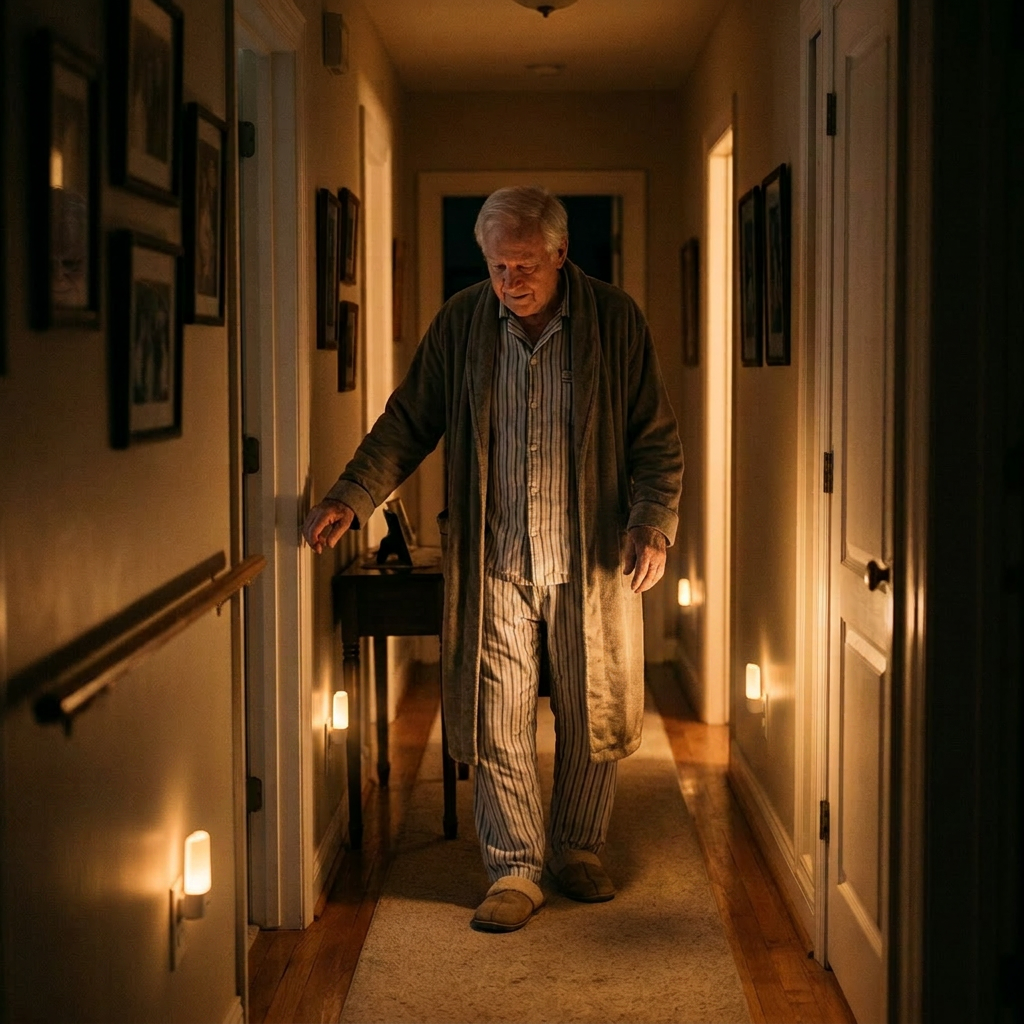
The CDC places roughly 80% of older-adult falls in the bathroom, with a meaningful share happening at night during the bedroom-to-bathroom trip. A bathroom nightlight is the cheapest, fastest, lowest-friction fall-prevention upgrade in the aging-in-place playbook usually under $20, no tools, no contractor. The wrong color temperature, though, suppresses melatonin and worsens the sleep problem that triggered the bathroom trip. The wrong placement creates shadow gaps. Below are the five we’d send this week.
At a glance
Best Overall MAZ-TEK Motion-Sensor Plug-in · ~$13 · The one we’d send if we could only send one
Best Budget GE LED Dusk-to-Dawn 30966 (2-Pack) · ~$8 · Always-on simplicity, no settings, two units
Best Multi-Room Value Vont ‘Aura’ LED (4-Pack) · ~$16 · Four units to cover the full path at once
Best for Sleep Quality AUVON Amber LED Motion-Sensor · ~$24 · True amber under 1800K, melatonin-safe
Best Toilet-Specific Chunace Toilet Bowl Light · ~$12 · Targets the actual hazard — the toilet itself
Best OverallMAZ-TEK Plug-in Motion Sensor Dimmable Night Light

~$13 · Check on Amazon →
Across 12,000+ verified Amazon reviews, the MAZ-TEK averages 4.6/5 and the recurring praise pattern is what the senior-bathroom use case demands: warm-white output around 3000K, a dimmable wheel from “barely glowing” to “comfortable navigation,” and a motion sensor that fires at ~10 feet and shuts off cleanly after 30 seconds. It plugs directly into a standard outlet (no cord, no batteries, nothing for a parent to manage). Most occupational therapists cite a motion-activated plug-in with dimming as the default first purchase, and this is the one that keeps surfacing in caregiver threads on r/AgingParents and AgingCare. Its one real weakness is depth: it sticks roughly 1.5 inches out from the wall, which can interfere with furniture pushed flush against an outlet.
The good
- Warm 3000K light with full dimming wheel: won’t shock older eyes at 3 a.m.
- Motion sensor fires reliably at ~10 feet, 30-second auto-off
- Plug-and-forget: no batteries, no app, no settings to relearn
The catch
- Protrudes ~1.5 inches from the wall: can interfere with flush-mounted furniture
- Single unit only; pricier per-light than the four-packs below
This is right if you want one product that solves the bedroom-outlet-or-bathroom-outlet problem without any setup or maintenance.
Look elsewhere if the parent has a documented sleep disorder — the amber AUVON below is gentler on melatonin.
Best BudgetGE LED Dusk-to-Dawn 30966 (2-Pack)

~$8 for 2-pack · Check on Amazon →
The GE 30966 is the nightlight grandparents have plugged into hallways since the 1990s, now in an LED two-pack that pulls about $1 of electricity per year per unit. No motion sensor, it simply comes on at dusk and off at dawn, which sounds like a downside until you read the dementia-care threads. Verified buyers consistently note that always-on dusk-to-dawn lights remove a class of confusion that motion-activated ones create (“why does the hallway keep going dark?”). Soft warm-white ~2700K, slim flat profile, four dollars per unit. The catch is brightness: it’s noticeably dimmer than the MAZ-TEK — a hallway-and-outlet light, not a primary bathroom light.
The good
- Two units for under $10: the cheapest credible option on Amazon
- Always-on dusk-to-dawn: no confusion for a parent with mild cognitive decline
- Slim flat profile, doesn’t block adjacent outlets
The catch
- Noticeably dimmer than the MAZ-TEK : works as a hallway light, not a primary bathroom light
- No dimming or motion control: what you plug in is what you get
This is right if the parent prefers always-on lighting and you want to cover multiple outlets cheaply.
Look elsewhere if the bathroom is dark enough that you need a motion-activated brighter source.
Best Multi-Room ValueVont ‘Aura’ LED Night Light (4-Pack)

~$16 for 4-pack · Check on Amazon →
If you’re following the OT placement protocol, bedside, hallway, bathroom, plus a backup, the Vont four-pack is the cleanest way to do it in one order. Across 30,000+ verified reviews, the recurring pattern is “we bought one and immediately ordered four more”: unusually solid build for the price, accurate dusk-to-dawn sensor, warm-white closer to 2700K than the cool-white most budget multi-packs ship with. Buyers consistently report that placing them along the bedroom-to-bathroom path eliminated the shadow gap their previous single nightlight left. Always-on, not motion-activated, the right tradeoff for continuous path lighting, the wrong one for minimizing total light exposure.
The good
- Four units for $16: covers the entire bedroom-to-bathroom path in one purchase
- Warm-white ~2700K output, not the harsh cool-white that plagues budget multipacks
- Build quality holds up: buyers report years of continuous use without failure
The catch
- No motion sensor and no dimming: always-on only
- Slightly dimmer than the MAZ-TEK; better as a path light than a bathroom primary
This is right if you’re outfitting a full bedroom-to-bathroom path in one order and want a continuous light line.
Look elsewhere if the parent is sensitive to any always-on bedroom light disturbing sleep.
Best for Sleep QualityAUVON Amber LED Motion Sensor Night Light

~$24 for 4-pack · Check on Amazon →
Sleep researchers have been clear for a decade: blue-spectrum light suppresses melatonin, and the warm-yellow-to-amber range below 2000K does not. The AUVON is the only widely available motion-activated plug-in we found that delivers true amber output around 1800K — close to candlelight, well below the melatonin-disruption threshold. Across 8,000+ verified reviews, the recurring caregiver praise is that the light “doesn’t wake them up the way the white ones did,” and several note morning fatigue improved within a week of switching. Motion sensor at ~10 feet, 30-second auto-off. The tradeoff is aesthetic — amber reads as orange-yellow, which some buyers initially find off-putting.
The good
- True amber ~1800K — below the melatonin-suppression threshold
- Four motion-activated units in one order — covers the full path with sleep-safe light
- Caregivers consistently report better morning energy in the parent within a week
The catch
- Amber glow reads “orange” — some buyers find it visually unfamiliar at first
- ~$24 list is the highest per-unit price in this guide
This is right if the parent has a sleep disorder, takes melatonin, or wakes more than twice a night.
Look elsewhere if they prefer crisp-white light and sleep is not the primary concern.
Best Toilet-SpecificChunace Motion-Sensor Toilet Bowl Night Light

~$12 · Check on Amazon →
Most of the toilet-bowl light category is gag-gift positioning, sixteen rainbow colors, party-mode framing. The Chunace is the rare option that takes the use case seriously. It clips to the underside of the rim, runs on three AAA batteries, and fires a motion-activated glow inside the bowl from ~7 feet. The point is not bathroom navigation, the MAZ-TEK solves that, it’s the final 18 inches: locating the bowl in the dark. Across 15,000+ verified reviews, older buyers and caregivers consistently report it solves a night-aim problem they hadn’t articulated until they fixed it. Lock it to a single warm color and ignore the rainbow marketing. The catch is batteries, four to six months per set, and someone has to remember to change them.
The good
- Solves the night-aim problem nothing else addresses, locating the bowl in the dark
- Motion-activated at ~7 feet; no overhead light needed
- Pairs perfectly with a plug-in nightlight for layered bathroom coverage
The catch
- 3 AAA batteries every 4–6 months, someone has to remember to change them
- 16-color cycling needs to be locked to a single warm setting; default rainbow mode is the wrong choice
This is right if you’re layering it with a plug-in nightlight and want full bathroom coverage including the bowl itself.
Look elsewhere if battery maintenance is unrealistic, choose a second plug-in instead.
Side-by-side comparison
| Product | Price | Type | Best For | Rating |
|---|---|---|---|---|
| MAZ-TEK Motion Plug-in | ~$13 | Motion, dimmable | Best overall | 4.6/5 · 12,000+ |
| GE 30966 (2-pack) | ~$8 | Dusk-to-dawn | Budget | 4.7/5 · 25,000+ |
| Vont Aura (4-pack) | ~$16 | Dusk-to-dawn | Path coverage | 4.6/5 · 30,000+ |
| AUVON Amber (4-pack) | ~$24 | Motion, amber | Sleep quality | 4.5/5 · 8,000+ |
| Chunace Toilet Bowl | ~$12 | Motion, bowl-clip | Toilet-specific | 4.5/5 · 15,000+ |
The conversation you’ll have
Older parents resist safety products the same way teenagers resist seatbelts not because they don’t see the value, but because accepting one feels like accepting a category they don’t want to belong to yet. A nightlight is the easiest entry point in the aging-in-place catalog because it is, in fact, just a nightlight. Many adults of any age have one. The framing matters: don’t say “I’m worried about you falling” or “the doctor said you need this.” Both will get the package quietly stashed in a drawer.
Try this script instead: “I found this thing, it turns on when you walk in so you don’t have to fumble for the switch at night. Grabbed an extra and figured I’d send it your way.” The product becomes a gadget you’re sharing, not a concession you’re imposing. Plug it in yourself on the next visit, or include a brief note. Caregivers consistently report this framing leaves room for the next product, a grab bar, a shower chair, without setting up resistance now.
Insurance and savings
Bathroom nightlights aren’t covered by traditional Medicare and almost never by Medicare Advantage as a standalone purchase. They are, however, FSA- and HSA-eligible when prescribed as a fall-prevention measure, IRS Publication 502 includes home modifications for medical care as qualifying expenses, and most FSA administrators accept a Letter of Medical Necessity from a primary care doctor or OT. If a parent has had a documented fall in the past 12 months, ask the doctor for one letter covering nightlights, grab bars, and shower seating together. The same letter can support a Schedule A medical-expense deduction if total medical expenses exceed 7.5% of AGI. Worth a five-minute ask.
What to actually look for
1. Color temperature at or below 3000K
This is the most important spec and the one cheap nightlights ignore. Anything cooler than 3000K suppresses melatonin — the wrong outcome for a product designed to support sleep. Look for “warm white,” “soft white,” or explicit Kelvin numbers. For sleep-disordered seniors, amber at ~1800K is gentler still. More on senior-bedroom lighting in our room-by-room aging-in-place guide.
2. Motion-sensor vs. dusk-to-dawn — match the sleep pattern
Motion-activated wins for parents who sleep deeply and wake only when needed — fires on entry, off after 30 seconds, minimizes total light exposure. Dusk-to-dawn wins for parents with mild cognitive decline who find “sometimes-on” lights confusing, and for continuous hallway path coverage. Match the product to the sleep pattern. See our master fall-prevention checklist for full-home layering.
3. Placement — three lights, not one
OT-recommended protocols place three nightlights along the path: one at the bedside outlet, one in the hallway, one inside the bathroom near floor level. A single nightlight creates shadow gaps; three creates a continuous light line. The Vont four-pack exists for this. Add the Chunace bowl light for layered final-step coverage. Our bathroom shower chair guide covers the rest of the path.
Frequently asked questions
What color night light is best for seniors?
Warm white at 3000K or lower, trending amber. Cooler color temperatures suppress melatonin and worsen the sleep problem the nightlight is meant to support. True amber around 1800K, like the AUVON, is gentlest for seniors with diagnosed sleep disorders.
Should you leave a night light on all night for elderly?
It depends. Always-on dusk-to-dawn lights help seniors with mild cognitive decline who find motion-activated lights confusing. Motion-activated wins for seniors who sleep deeply and want minimal total light exposure. For sleep-disordered seniors, motion-activated amber is usually right.
Where should night lights be placed for elderly?
Occupational therapists typically recommend three: one at the bedside outlet to mark the starting point, one in the hallway to remove the shadow gap, and one inside the bathroom near floor level. A single nightlight is rarely enough, the goal is a continuous light path from bed to toilet without dark zones in between.
Are motion sensor night lights better than dusk-to-dawn?
For most senior bathroom use cases, yes, motion-activated minimizes total melatonin-disrupting light exposure and fires only when needed. The exception is a parent with mild dementia, who often finds “sometimes-on” lights confusing. For hallway path coverage, dusk-to-dawn provides a continuous reference line that motion-activated cannot.
Do bathroom nightlights actually prevent falls?
CDC data places roughly 80% of older-adult falls in the bathroom, with a meaningful share occurring during nighttime bedroom-to-bathroom trips. Adequate path lighting is consistently cited by occupational therapists as the cheapest and highest-leverage fall-prevention intervention. The evidence is observational, not randomized, but the cost-benefit is overwhelming.
What is the safest night light for elderly with dementia?
A warm-white always-on dusk-to-dawn unit such as the GE 30966 or Vont Aura. Motion-activated lights can cause confusion in dementia patients (“why does the hallway keep going dark?”). The goal for dementia care is a continuous, predictable, low-intensity light reference at all times after sundown.
How bright should a bathroom night light be?
Bright enough to safely navigate without turning on the overhead light, dim enough to not fully wake the parent. Most well-rated bathroom nightlights output between 0.5 and 5 lumens. A dimmable option like the MAZ-TEK lets the user tune the level after seeing it in their actual bathroom — the right answer for most situations.
The shortlist


Last verified in stock: May 18, 2026
What we’d do tomorrow
If you’re starting this weekend, do these three things in this order. First, order the MAZ-TEK and a Vont four-pack together, about $29 total, arrives in two days, covers the full bedroom-to-bathroom path the way OTs draw it up. Second, plug them in yourself the next time you visit, or include a one-line note with the package framing it as a gadget you found, not a safety intervention. Third, set a calendar reminder for six months out to swap to an AUVON amber set if the parent reports waking more often than they used to, that’s the upgrade trigger. Done. The single highest-leverage fall-prevention purchase in the catalog, finished by Sunday.
— Sarah