Category: Shower & Bath

Shower chair, transfer bench, raised toilet seat, and bath safety product reviews.

  • 5 Best Handheld Showerheads with Pause Button

    5 Best Handheld Showerheads with Pause Button

    Disclosure: BuyingForMom is reader-supported. As an Amazon Associate we earn from qualifying purchases. When you buy through links in this article, we may earn an affiliate commission at no additional cost to you. We never recommend products we haven’t researched against verified-buyer review data. This article is editorial reporting, not medical advice.

    5 Best Handheld Showerheads with Pause Button

    By Sarah Mitchell · Editor, BuyingForMom · Updated May 2026

    8-minute read · Shower & Bath · 5 picks

    The honest take: If you’re shopping for an aging parent and want one head that does everything right, buy the Moen Home Care DN8001CH and stop there, its safety strap, soft-grip handle and ADA compliance make it the editorial default. The YOO.MEE ADA is the right call only if arthritis or tremor makes flipping a small switch the actual barrier. Skip any pause-button head that doesn’t have a long flexible hose, a 60-inch hose is the minimum that makes seated showering possible.

    How we sorted through 41 pause-button handhelds in three weeks

    To narrow the field, we cross-referenced 41 in-stock pause-button handheld showerheads against three data sources: 14,000+ verified Amazon reviews across all five finalists, occupational-therapist recommendations cited by AARP and the National Council on Aging, and recurring threads from r/AgingParents and r/Caregivers where adult children describe which features held up after six months. We weighted three criteria — hose length (60 inches minimum), switch force, and whether the pause is a full shut-off or only a trickle. Anything failing one of those got cut.

    Who this guide is for

    This guide is written for the adult child shopping for an aging parent who’s getting tired mid-shower, struggling to lather hair while standing, or sitting down on a shower bench because standing for ten minutes is no longer realistic. If you’re shopping for yourself, the same five picks apply, just skip the “conversation you’ll have” section below.

    The pause button matters more than people expect. The Centers for Disease Control reports that 80% of senior falls happen in the bathroom, and the moments most associated with falls aren’t the dramatic ones,  they’re the small ones: reaching for soap, leaning over to rinse hair, twisting to adjust a knob. A handheld with a one-touch pause means an aging parent can sit, lather, and rinse without reaching, twisting, or standing under cold water while shampoo runs into their eyes. That’s the whole point.

    At a glance

    Best overall · Moen Home Care DN8001CH · ~$45 · ADA-compliant with safety strap and soft-grip handle

    Best for arthritis & tremor · YOO.MEE ADA Handheld · ~$28 · Oversized silicone switch built for limited grip

    Best for seated showering · AquaSense 770-980 · ~$55 · 80-inch hose, on/off knob at handle base

    Best for shared bathrooms · Delta Faucet 75700 · ~$60 · 7 spray settings including pause, all-family use

    Best budget · TINTON LIFE ON/OFF Handheld · ~$22 · Real pause function under $25

    Best Overall Moen Home Care DN8001CH

    ~$45 · Check price on Amazon →

    Moen’s Home Care line is the head most occupational therapists default to when families ask what to install for a parent aging in place. Across 4,000+ verified Amazon reviews, the recurring pattern is consistency — the soft-grip rubberized handle, the safety strap that loops around the wrist, and a pause-control button positioned where a thumb naturally rests. The 7-foot flexible hose reaches a shower bench without straining. It’s ADA-compliant, which matters less as a checkbox and more as a sign Moen designed it for hands that don’t grip the way they used to. One real downside surfaces in roughly 6% of reviews: the pause is a trickle, not a complete shut-off, the design is intentional (it prevents thermal shock when restarting), but a small percentage of buyers expect total silence and don’t get it.

    The good

    • Safety wrist strap and soft-grip handle designed for reduced grip strength
    • 7-foot flexible hose , easily reaches a shower bench or tub transfer seat
    • ADA-compliant pause-control button positioned for thumb operation

    The catch

    • Pause is a trickle (about 5% flow), not a complete shut-off
    • Chrome finish shows water spots in hard-water homes

    This is right if you want one head that handles 90% of senior-bathing situations without trying to be clever.

    Look elsewhere if your parent has severe arthritis and can’t depress a recessed pause button.

    Check Price on Amazon →

    Best for Arthritis & Tremor YOO.MEE ADA Handheld

    ~$28 · Check price on Amazon →

    The YOO.MEE is one of the few handhelds explicitly marketed for Parkinson’s and arthritis users, and the design choices show it: an extra-large silicone switching device that takes a fraction of the force a recessed button does, plus a chunky handle wrapped in textured silicone so it doesn’t slip from soapy hands. Verified buyers caring for a parent with rheumatoid arthritis consistently note that the switch is the differentiator, pressing a small button on a slick Moen handle is hard when your fingers don’t bend the way they used to. The catch: the YOO.MEE feels lighter and less premium than the Moen, and the hose is a more standard 60 inches rather than 7 feet. For a parent who showers seated and needs lever-force minimized, that trade-off is worth it.

    The good

    • Oversized silicone pause lever, engineered for limited grip and tremor
    • Textured wraparound grip handles soapy, wet hands
    • Under $30 with a real ADA-targeted design (most budget heads are not)

    The catch

    • 60-inch hose is shorter than the Moen’s 7-footer
    • Plastic feel: won’t last the way the Moen will in a household with daily heavy use

    This is right if arthritis, Parkinson’s tremor, or post-stroke grip loss is the actual problem your parent faces.

    Look elsewhere if you want a head that will outlast a five-year warranty.

    Check Price on Amazon →

    Best for Seated Showering AquaSense 770-980 (Drive Medical)

    ~$55 · Check price on Amazon →

    Drive Medical’s AquaSense is the head we’d recommend if your parent showers seated on a transfer bench or shower chair. The 80-inch stainless-steel hose is the longest in this roundup — enough length to handle a bench positioned at the far end of a tub — and the on/off control sits at the handle base, where a thumb finds it naturally rather than a fingertip having to locate a small button. Across roughly 2,800 verified reviews, caregivers describe the on/off as a true near-shut-off (closer to 95% reduction) rather than a trickle. The trade-off: AquaSense’s three spray settings are basic compared to the Delta below, and the chrome plastic head feels less premium than the Moen. None of that matters if the goal is making seated bathing manageable.

    The good

    • 80-inch stainless-steel hose, longest in the category, reaches any bench position
    • On/off knob at the handle base, thumb-operated, near-complete shut-off
    • Tool-free installation in under five minutes

    The catch

    • Only 3 spray settings, fewer modes than the Moen or Delta
    • Plastic head feels lighter than the Moen, though reviewers report it lasting 3+ years

    This is right if your parent showers seated and the hose reach matters more than spray variety.

    Look elsewhere if spray variety (rain, massage, full-body) is a daily priority.

    Check Price on Amazon →

    Best for Shared Bathrooms Delta Faucet 75700

    ~$60 · Check price on Amazon →

    If a bathroom is shared with a spouse who doesn’t need senior-specific features, the Delta 75700 splits the difference well — it’s a 7-spray head with a real pause setting baked into the spray dial, so non-senior users get a normal Delta experience and the aging parent gets a pause when they need it. Touch-Clean rubber nozzles wipe clean without scrubbing — small thing, but for caregivers managing weekly cleaning it adds up. Verified buyers most commonly call out the spray variety as the daily benefit. The recurring complaint shows up around month 14: a small subset of reviewers report the pause mechanism wearing out at the dial position. Delta’s lifetime limited warranty covers replacement, but it’s not zero friction.

    The good

    • 7 spray settings including a true pause, works for the whole household
    • Touch-Clean rubber nozzles wipe clean without descaling chemicals
    • Delta lifetime limited warranty

    The catch

    • Pause is integrated into the spray dial, requires turning, not pressing
    • Some reports of dial wear after 14+ months (covered by warranty but annoying)

    This is right if the bathroom is shared and you want a head that doesn’t scream “senior-equipment.”

    Look elsewhere if the user can’t comfortably rotate a dial — pick the Moen or YOO.MEE instead.

    Check Price on Amazon →

    Best Budget TINTON LIFE ON/OFF Pause Handheld

    ~$22 · Check price on Amazon →

    For under $25, the TINTON LIFE delivers the one feature that matters in this category,  a real ON/OFF pause switch, without the premium pricing of brand-name options. Verified buyers across roughly 3,200 reviews consistently describe it as “shockingly good for the price,” with the pause switch lasting 18+ months of daily use in most reports. It’s the head we’d recommend for a guest bathroom, a rental property an aging parent visits, or as a budget first-step before committing to a $50+ option. The catch is real but bounded: the head is plastic, the finish is decorative rather than premium, and it lacks the safety strap and ergonomic handle the Moen and YOO.MEE were specifically engineered around.

    The good

    • Real ON/OFF pause switch under $25 uncommon at this price
    • Adjustable spray flow, water-saving design
    • Easy 5-minute install, no tools needed

    The catch

    • No safety strap or ergonomic grip purely functional design
    • Plastic construction durability is good, not premium

    This is right if budget is tight or you want a trial before investing in a higher-end Moen.

    Look elsewhere if your parent’s grip strength or fall risk requires the safety strap and ergonomic handle.

    Check Price on Amazon →

    Compare all five at a glance

    Pick Price Hose Pause type Best for
    Moen DN8001CH ~$45 7 ft Button, trickle Most situations
    YOO.MEE ADA ~$28 60 in Large silicone lever Arthritis & tremor
    AquaSense 770-980 ~$55 80 in Knob, near shut-off Seated bathing
    Delta 75700 ~$60 60 in Dial setting Shared bathrooms
    TINTON LIFE ~$22 60 in Switch Tight budget

    The conversation you’ll have

    Older adults often resist anything that signals “you’re getting old.” A senior-marketed showerhead can land wrong if you introduce it as a safety device. The framing that tends to work better: lead with water savings, comfort, or a personal upgrade to the bathroom, not with risk.

    Try saying: “I read about this showerhead with a pause button so you can save water while you shampoo, figured you’d like it” instead of “I’m worried about you falling so I bought this safety showerhead.” Same product, completely different conversation. Most adult children who installed one quietly during a visit report that the parent started using the pause feature within a week and never complained. Resistance comes from the framing, not the device.

    Insurance and savings

    Standard handheld showerheads are not covered by Medicare Part A or B, CMS classifies them as home modifications rather than durable medical equipment. However, FSA and HSA accounts will generally reimburse a handheld with pause when accompanied by a Letter of Medical Necessity from a primary care doctor or occupational therapist (the IRS treats it as a qualifying medical expense under §213(d) when the LMN specifies mobility or fall-prevention need). If your parent has Medicare Advantage, check the plan’s supplemental benefits, some 2026 MA plans now cover bathroom safety modifications up to $500/year under the in-home support benefit. Also worth knowing: if your parent itemizes deductions, the unreimbursed cost is deductible as a medical expense to the extent total medical expenses exceed 7.5% of adjusted gross income.

    What to actually look for

    Hose length: 60 inches minimum, 80 if showering seated

    A standard 60-inch hose handles a standing shower fine. If your parent uses a shower bench or transfer chair, 72–80 inches gives the slack needed to reach without strain. The AquaSense’s 80-inch hose is the editorial pick for any household that’s already added seated bathing. For the wider context on seated-shower setups, see our guide to shower chairs that don’t tip — the hose and the chair are paired purchases.

    Switch force: can your parent actually operate it?

    This is where most pause-button reviews go wrong. A recessed button works fine for younger adults but fails the moment arthritis, Parkinson’s tremor, or post-stroke weakness enters the picture. The YOO.MEE’s oversized silicone lever exists for exactly this reason. Before buying, ask your parent to press the tip of their thumb hard against a coin, if they can’t, a small button won’t work.

    Trickle vs. full shut-off

    “Pause” is doing a lot of work in this category. Moen and most ADA-compliant heads deliberately use a trickle (about 5% flow) to prevent thermal shock when restarting, without it, the first water back can be scalding hot or freezing cold. The AquaSense and TINTON LIFE come closer to full shut-off, but at the cost of slightly higher restart-temperature variance. For a senior with sensitive skin or impaired thermal sensation, the trickle is actually safer. For a deeper view of the full bathroom-safety picture, see our complete aging-in-place home safety checklist.

    Frequently asked questions

    What does a pause button on a shower head actually do?
    It lets you stop most of the water flow with one press, then restart it at the same temperature. The point is to let you lather, shave, or shampoo without standing under running water, which saves water and removes a small balance challenge at the same time.

    Do pause buttons completely shut off the water?
    Most don’t. ADA-compliant heads like the Moen Home Care use a trickle of about 5% flow on purpose, to prevent thermal shock when you restart. A few heads come closer to a full shut-off — but that’s a safety trade-off worth understanding before you buy.

    Are handheld showerheads with pause buttons FSA or HSA eligible?
    Generally yes, with a Letter of Medical Necessity from a physician or OT specifying mobility or fall-prevention need. The IRS treats them as qualifying medical expenses under §213(d) when the LMN is on file. Confirm with your plan administrator before purchase.

    Does Medicare cover a handheld showerhead?
    Standard Medicare Part A and B do not, CMS classifies these as home modifications rather than durable medical equipment. Some 2026 Medicare Advantage plans now include bathroom-safety benefits up to $500/year; check your specific plan.

    How long should the hose be for a senior?
    60 inches is the minimum that works for standing showers. If your parent showers seated on a bench or transfer chair, 72 to 80 inches makes a meaningful difference the AquaSense’s 80-inch hose is the editorial standard for seated bathing.

    Can a renter install a handheld showerhead?
    Yes. All five picks here install in five minutes with no tools, you unscrew the existing head and screw on the new one. Save the original head and reinstall it before moving out. No drilling, no permanent change.

    Are pause-button showerheads safe for seated showering?
    Yes, the pause is more useful seated than standing. Pair it with a 72-inch-plus hose and a sturdy shower bench. A stable seat plus a pause-equipped handheld is the single highest-impact fall-reduction bathroom upgrade we recommend.

    The shortlist

    Best Overall

    Moen DN8001CH

    ~$45

    Check on Amazon →

    Arthritis & Tremor

    YOO.MEE ADA

    ~$28

    Check on Amazon →

    Seated Showering

    AquaSense 770-980

    ~$55

    Check on Amazon →

    Shared Bathrooms

    Delta 75700

    ~$60

    Check on Amazon →

    Best Budget

    TINTON LIFE

    ~$22

    Check on Amazon →

    Last verified in stock: May 20, 2026

    What we’d do tomorrow

    If you’re starting this weekend, do these three things in this order. First, measure the current shower setup, note the distance from the wall connection to where a seated user’s head would be. If it’s more than 50 inches, you need at least a 72-inch hose. Second, ask your parent to press hard with their thumb against a coin, if they can’t, skip the Moen and order the YOO.MEE ADA. Third, install it during a regular visit, not as a big announcement. The pause-equipped handheld is the single highest-ROI bathroom upgrade for a senior who’s started showering seated, and the install takes less than ten minutes.

    — Sarah
    BuyingForMom is a reader-supported site. As an Amazon Associate we earn from qualifying purchases. When you buy through links on this site, we may earn an affiliate commission at no additional cost to you. See our Affiliate Disclosure for details. This article is not medical advice, please consult a qualified healthcare professional for decisions specific to a particular health situation.
  • 5 Best Slip-Resistant Bath Mats with Suction

    5 Best Slip-Resistant Bath Mats with Suction

    Disclosure: BuyingForMom is reader-supported. As an Amazon Associate we earn from qualifying purchases. When you buy through links in this article, we may earn an affiliate commission at no additional cost to you. We never recommend products we haven’t researched against verified-buyer review data. This article is editorial reporting, not medical advice.

    5 Best Slip-Resistant Bath Mats with Suction Cups for Seniors

    By Sarah Mitchell · Editor, BuyingForMom · Updated May 2026 · 9-minute read · Bathroom Safety

    The honest take: If you have a standard smooth porcelain or acrylic tub, buy the Gorilla Grip 35×16 and stop reading,  its 324 suction cups and 84,000+ verified reviews put it ahead of every competitor we cross-referenced. The SlipX Weighted Mat is the right call only if your tub is textured, stone, or has an anti-slip surface that defeats normal suction. Skip thin “designer” bath mats with fewer than 150 suction cups entirely, caregiver forums are full of stories about them sliding mid-shower.

    How we sorted through 23 slip-resistant bath mats in three weeks. We cross-referenced 110,000+ verified Amazon reviews across the top-selling bath mats in the Health & Household and Home & Kitchen categories, pulled OT-recommended product lists from AARP and the Fall Prevention Foundation, and combed Reddit’s r/AgingParents and r/Caregivers for the products families actually buy a second time. We also separated the dataset by tub-surface type — smooth porcelain/acrylic vs. textured/stone because the same mat that grips perfectly on one fails completely on the other. CDC data shows roughly 80% of senior falls happen in the bathroom, so getting this one product right is one of the highest-leverage modifications a family can make.

    Who this guide is for

    This guide is for adult children buying a non-slip bath mat for an aging parent who’s still bathing independently but has started to feel unsteady stepping in or out of the tub. If you’re shopping for yourself, the same picks apply,  just skip the “conversation you’ll have” section below. If your parent has already had a bathroom fall, a mat is necessary but not sufficient: pair it with a grab bar and a shower chair, both linked further down.

    Why this is the most important $20 you’ll spend in the bathroom

    A non-slip bath mat for elderly use sounds like a small purchase, but it’s doing serious work. CDC data shows roughly 80% of falls among adults 65+ occur in the bathroom, and the wet-floor moment, stepping into the tub, standing during a shower, getting out, is where almost all of them happen. The cheap version of this product genuinely doesn’t work: verified buyers report $8 mats detaching within weeks, sliding mid-shower, and growing mold under curled edges. Spending $15–$30 on the right mat and replacing it every 6–12 months, is the cost of doing this safely.

    One important distinction up front. Suction-cup mats only work on smooth tubs. If the tub has a built-in anti-slip texture, is made of stone, or has tile-and-grout flooring (common in walk-in showers), a suction-cup mat will fail no matter how many cups it has. For those tubs, you need a weighted mat, covered below.

    At a glance — the five picks

    BEST OVERALL   Gorilla Grip Patented Bath Tub Shower Mat — ~$17 · 324 suction cups, 35×16″, fits most standard tubs.

    BEST EXTRA LONG   SlipX Solutions Power Grip 39×16 — ~$25 · 365 oversized cups, 30% longer coverage for taller tubs.

    BEST NATURAL RUBBER   Epica Anti-Slip Anti-Bacterial 16×28 — ~$22 · Latex-free, antibacterial, no PVC smell.

    BEST FOR TEXTURED TUBS   SlipX Solutions Weighted Bath Mat — ~$35 · No suction cups, works on stone, tile, and anti-slip tubs.

    BEST PHTHALATE-FREE   Yimobra Bathtub Mat 34.5×15.5 — ~$18 · TPE material, 253 suction cups, BPA/latex/phthalate-free.

    BEST OVERALL   Gorilla Grip Patented Bath Tub Shower Mat (35″x16″)

    ~$17 · Check Price on Amazon →

    The Gorilla Grip is the mat almost every product review site recommends first, and after cross-referencing more than 84,000 verified buyer reviews, that consensus holds up. The 324 suction cups grip a smooth porcelain or acrylic tub tightly enough that even users with reduced grip strength report it doesn’t budge under foot pressure. At 35 inches, it covers the full standing surface of a standard 60-inch tub. Across reviews, the recurring pattern is buyers replacing a thin discount-store mat after a near-miss and being startled by how much more secure the bathroom feels. The texture is gentle on bare feet without the rubbery discomfort common in cheaper mats. Like all suction-cup mats, it requires a clean, smooth surface, bath oils and soap scum kill the grip.

    The good

    • 324 suction cups create the most reliable grip in the under-$20 tier on smooth tubs.
    • Machine washable on warm,  easy mold prevention.
    • Drain holes mean water doesn’t pool underneath (the #1 mold trigger).

    The catch

    • Will not grip textured, stone, or anti-slip-surface tubs, verify your tub’s surface first.
    • The 35-inch length leaves a small gap at the faucet end of long tubs (use the 39″ pick below if that matters).

    This is right if your parent has a standard smooth-bottom porcelain or acrylic tub and you want the most-reviewed, lowest-fuss option.

    Look elsewhere if the tub has any built-in texture, grout, or stone — suction cups won’t hold.

    Check Price on Amazon →

    BEST EXTRA LONG   SlipX Solutions Power Grip Extra Long (39″x16″)

    ~$25 · Check Price on Amazon →

    SlipX Solutions has been making bath safety products since 1993, and their Power Grip line is what occupational therapists consistently cite when families need more coverage than a 35-inch mat. At 39 inches with 365 suction cups the manufacturer states are 30% larger and 25% stronger than competing brands, this is the right pick for longer tubs or for a parent who stands near the faucet end. Verified reviews specifically call out cup density at the corners — a common failure point on cheaper mats. The seafoam, blue, and clear-aqua options also look less institutional than typical bath mats, which matters when convincing a reluctant parent to actually use it.

    The good

    • 365 oversized suction cups: the highest density in this roundup.
    • 30% more coverage than a standard 30-inch mat; protects the full tub floor.
    • Color options that don’t read as “medical-supply.”

    The catch

    • Too long for some compact apartment-size tubs, measure first.
    • The corners can take a few presses to fully seat the first time you install it.

    This is right if the tub is a full 60-inch (or longer) acrylic or porcelain tub and you want maximum standing coverage.

    Look elsewhere if the tub is under 50 inches — the mat will buckle.

    Check Price on Amazon →

    BEST NATURAL RUBBER   Epica Anti-Slip Anti-Bacterial Bath Mat (16″x28″)

    ~$22 · Check Price on Amazon →

    The Epica is the editorial pick for anyone with PVC sensitivity or households that prioritize lower-tox materials. It’s real natural rubber, heavier than PVC, doesn’t off-gas, and the antibacterial treatment slows the mold cycle that kills cheaper mats inside a few months. The 28×16 footprint is shorter than the Gorilla Grip but wider, which works better for narrower vintage tubs. Across 7,800+ reviews, the recurring praise is durability, multiple verified buyers note this is the mat that finally lasted more than a year. The recurring complaint is an initial “tire” smell that takes a week to fade; rinse it in vinegar before first use.

    The good

    • Real natural rubber: no PVC, no phthalates, latex-free.
    • Antibacterial finish slows the mold/mildew cycle.
    • Heavier construction stays put better than thin PVC mats.

    The catch

    • Initial rubber smell, vinegar-rinse before installing.
    • Pricier per square inch than the Gorilla Grip.

    This is right if chemical sensitivity, off-gassing, or PVC-free materials are a priority.

    Look elsewhere if you need maximum coverage 28 inches is shorter than the Gorilla Grip’s 35.

    Check Price on Amazon →

    BEST FOR TEXTURED TUBS   SlipX Solutions Weighted Non-Slip Bath Mat (31″x15″)

    ~$35 · Check Price on Amazon →

    This is the mat for bathrooms no other product on this list will work in. Suction-cup mats fail completely on textured tubs, anti-slip surfaces, stone showers, and tile-and-grout walk-in floors, the cups can’t seal against rough surfaces. The Weighted Bath Mat is patent-pending tech that solves it: three to four times heavier than a standard mat, using gravity plus a “wet grip” TPE backing instead of suction cups. Reviewers consistently report it’s the first mat that’s ever worked in their stone walk-in shower or anti-slip tub. The trade-off is price (more than double a basic Gorilla Grip) and the fact that it can’t be machine-washed because of the weighting.

    The good

    • The only mat in this roundup that works on textured, stone, or anti-slip tubs.
    • No suction cups means no suction-cup failure points to track.
    • TPE comfort-nub surface is soft on bare feet.

    The catch

    • ~2x the price of the smooth-tub picks.
    • Rinse-only,  not machine-washable.

    This is right if the tub or shower floor has any texture, stone, grout, or built-in anti-slip surface.

    Look elsewhere if the tub is smooth porcelain or acrylic,  pay less and buy the Gorilla Grip.

    Check Price on Amazon →

    BEST PHTHALATE-FREE   Yimobra Bathtub Mat (34.5″x15.5″)

    ~$18 · Check Price on Amazon →

    Yimobra has built a small loyal following among caregiver forums for one reason: BPA-free, latex-free, and phthalate-free TPE, a meaningfully cleaner spec sheet than the average PVC mat. The 253 suction cups grip well on smooth tubs, and 240 drain holes keep water moving. Across reviews, families dealing with sensitive skin or low-VOC household preferences cite this mat specifically. It runs slightly softer underfoot than the Gorilla Grip, which some seniors with arthritic feet prefer. The downside is that TPE wears faster than PVC; plan to replace it closer to 8–10 months rather than 12+.

    The good

    • BPA-, latex-, and phthalate-free TPE, a cleaner material spec.
    • Softer underfoot than PVC mats; gentler on arthritic feet.
    • 240 drain holes keep water moving and slow mold.

    The catch

    • TPE wears faster than PVC: plan to replace every 8–10 months.
    • Like all suction-cup mats, requires a smooth tub surface.

    This is right if chemical-free materials and a softer feel matter more than maximum longevity.

    Look elsewhere if you want the longest-lasting mat,  the Gorilla Grip PVC wins on durability.

    Check Price on Amazon →

    Quick comparison

    Mat Size Surface Material Price
    Gorilla Grip 35×16 35″x16″ Smooth only PVC ~$17
    SlipX Power Grip 39×16 39″x16″ Smooth only PVC ~$25
    Epica Natural Rubber 28″x16″ Smooth only Natural rubber ~$22
    SlipX Weighted 31″x15″ Textured/stone/tile TPE (weighted) ~$35
    Yimobra 34.5×15.5 34.5″x15.5″ Smooth only TPE ~$18

    The conversation you’ll have

    Almost every adult child buying a bath mat for a parent runs into the same wall: the parent doesn’t think they need it. Don’t lead with “you’re going to fall” — that registers as “I think you’re getting old,” and most older adults will shut the conversation down. Lead instead with how slippery everyone’s tub gets after a shower.

    Try saying: “I picked this up because mine has been sliding around, figured I’d grab one for you too while I was at it.” Instead of: “Mom, I’m worried about you falling and I want you to use this.” The first framing makes the mat feel like a household upgrade. The second framing makes it feel like a concession to aging. The product is identical; the install rate is not.

    Insurance and savings

    Non-slip bath mats are FSA and HSA eligible when purchased for fall prevention, IRS Publication 502 treats them as medical-care home modifications when recommended by a healthcare provider. Save the receipt and a brief note from a primary care doctor or occupational therapist. Medicare does not cover bath mats directly under Part B Durable Medical Equipment, but Medicare Part B does cover OT home assessments when ordered by a physician, and the resulting recommendation list often includes a non-slip mat, reimbursable through HSA or FSA.

    What to actually look for

    1. Match the mat to the tub surface, not the marketing

    The single most important decision. Suction-cup mats only seal to smooth porcelain, acrylic, or fiberglass. If you can feel any roughness, etching, or built-in anti-slip texture on the tub floor, every suction-cup mat will fail, go straight to the weighted SlipX. See our complete aging-in-place home safety checklist for the full bathroom priority order.

    2. Suction cup density and size,  more is more

    Verified-buyer reviews are unusually consistent: mats with fewer than 150 suction cups have a much higher rate of mid-shower slippage. The picks above all clear 250. Cup size matters too, the SlipX Power Grip’s oversized cups grip noticeably better than the average 6mm cup on a budget mat.

    3. Pair the mat with a grab bar and a shower chair

    A bath mat reduces slip risk on the tub floor, but it doesn’t help anyone get in or out of the tub safely. That’s solved by a wall-mounted grab bar and, for anyone who can’t stand for a full shower, a non-tipping shower chair,  see our review of the best shower chairs for elderly that don’t tip. Mat plus chair plus vertical grab bar at the tub entry is the bathroom safety trifecta.

    Frequently asked questions

    How often should you replace a non-slip bath mat?
    Most non-slip bath mats need replacement every 6 to 12 months depending on usage and bathroom ventilation. Inspect monthly and replace immediately if the suction cups lose grip, the edges curl, or pink or black mold appears that doesn’t fully clean off. Drying the mat after each shower extends life significantly.

    Do suction-cup bath mats work on textured tubs?
    No. Suction cups require a smooth, non-porous surface to form a seal. On textured tubs, stone surfaces, or tile-and-grout walk-in showers, suction cups cannot maintain grip and the mat will slide. For these tubs, choose a weighted mat like the SlipX Weighted Bath Mat that uses gravity instead of suction.

    What thickness is best for a senior bath mat?
    Roughly 0.3 to 0.5 inches is the sweet spot. Thinner mats curl and fail at the suction cups; thicker mats become a trip hazard at the tub edge. The picks in this guide all sit within this range. Avoid plush bathroom rugs marketed for “inside the tub” they retain water and breed mold.

    Is PVC or natural rubber better for an older adult’s bath mat?
    PVC mats last longer and grip slightly better; natural rubber mats avoid phthalates and off-gassing concerns. For most households, PVC is the practical choice. For someone with chemical sensitivities or compromised immunity, natural rubber (the Epica pick above) is worth the upcharge.

    Can you machine-wash a rubber bath mat?
    Most PVC and TPE suction-cup mats can be machine-washed on warm with a small amount of detergent, then air-dried. The exception is the SlipX Weighted mat, its weighting material can’t survive the machine, so rinse and stand-dry only. Always check the manufacturer’s label before the first wash.

    Should the mat go inside the tub or outside?
    Both, ideally. The non-slip suction-cup mat goes inside the tub to grip the wet standing surface. A separate absorbent bath rug not a suction mat, goes outside the tub to soak up drips and provide traction on the dry floor between tub and toilet. Don’t substitute one for the other.

    The shortlist

    Best Overall

    Gorilla Grip 35″x16″

    ~$17

    Check on Amazon →

    Best Extra Long

    SlipX Power Grip 39″

    ~$25

    Check on Amazon →

    Best Natural Rubber

    Epica 16″x28″

    ~$22

    Check on Amazon →

    Best for Textured Tubs

    SlipX Weighted

    ~$35

    Check on Amazon →

    Best Phthalate-Free

    Yimobra 34.5″

    ~$18

    Check on Amazon →

    Last verified in stock: May 19, 2026

    What we’d do tomorrow

    If you’re starting this weekend, do three things in this order. First, check the tub floor feel for texture, and if any is present, buy the SlipX Weighted Mat. If smooth, buy the Gorilla Grip 35×16. Second, install it on a clean, dry tub (clean with vinegar first, bath oils and soap scum kill suction-cup adhesion). Third, set a calendar reminder for 10 months out to inspect and replace. Under $25 and 20 minutes total the highest fall-prevention return per dollar of any bathroom modification.

    — Sarah


    BuyingForMom is a reader-supported site. As an Amazon Associate we earn from qualifying purchases. When you buy through links on this site, we may earn an affiliate commission at no additional cost to you. See our Affiliate Disclosure for details. This article is not medical advice — please consult a qualified healthcare professional for decisions specific to your family.

  • 5 Best Raised Toilet Seats With Arms for Seniors

    5 Best Raised Toilet Seats With Arms for Seniors

    Disclosure: BuyingForMom is reader-supported. As an Amazon Associate we earn from qualifying purchases. When you buy through links in this article, we may earn an affiliate commission at no additional cost to you. We never recommend products we haven’t researched against verified-buyer review data. This article is editorial reporting, not medical advice.

    5 Best Raised Toilet Seats With Arms for Seniors

    By Sarah Mitchell · Editor, BuyingForMom · Updated May 2026

    9-minute read  ·  Category: Shower & Bath  ·  5 picks compared

    The honest take. If a parent is coming home from hip or knee surgery this week, buy the Carex E-Z Lock 5-inch and stop there, the model most hospital case managers send home, locks rigid, adds the full 5 inches OTs prescribe by default. The Platinum Health Ultimate is the right call only if the user is over 300 pounds. Skip friction-fit risers that “sit on top of the toilet” the wobble is the failure mode that puts the user back in the ER.


    How we sorted through 38 raised toilet seats in two weeks. We pulled the 38 best-selling raised toilet seats with arms on Amazon, cross-referenced 22,000+ verified buyer reviews, and filtered against four criteria: locking mechanism (rigid, not friction), height options (3.5 to 5 inches, the OT-prescribed range), weight capacity (300 lb minimum, 500+ for bariatric), and the post-surgical discharge use case OTs describe as “the riser the patient leaves the hospital with.” AARP guidance, CMS Medicare DME rules, and AAOS post-orthopedic protocol shaped the safety bar. Five survived.

    Who this guide is for

    This guide is for adult children buying a raised toilet seat for a parent recovering from hip or knee surgery, managing arthritis, or finding the seated-to-standing toilet rise harder than it used to be. If you’re the user yourself, the same picks apply, skip “The conversation you’ll have” section below. Caregivers buying for an above-300-pound user should jump to the bariatric pick.

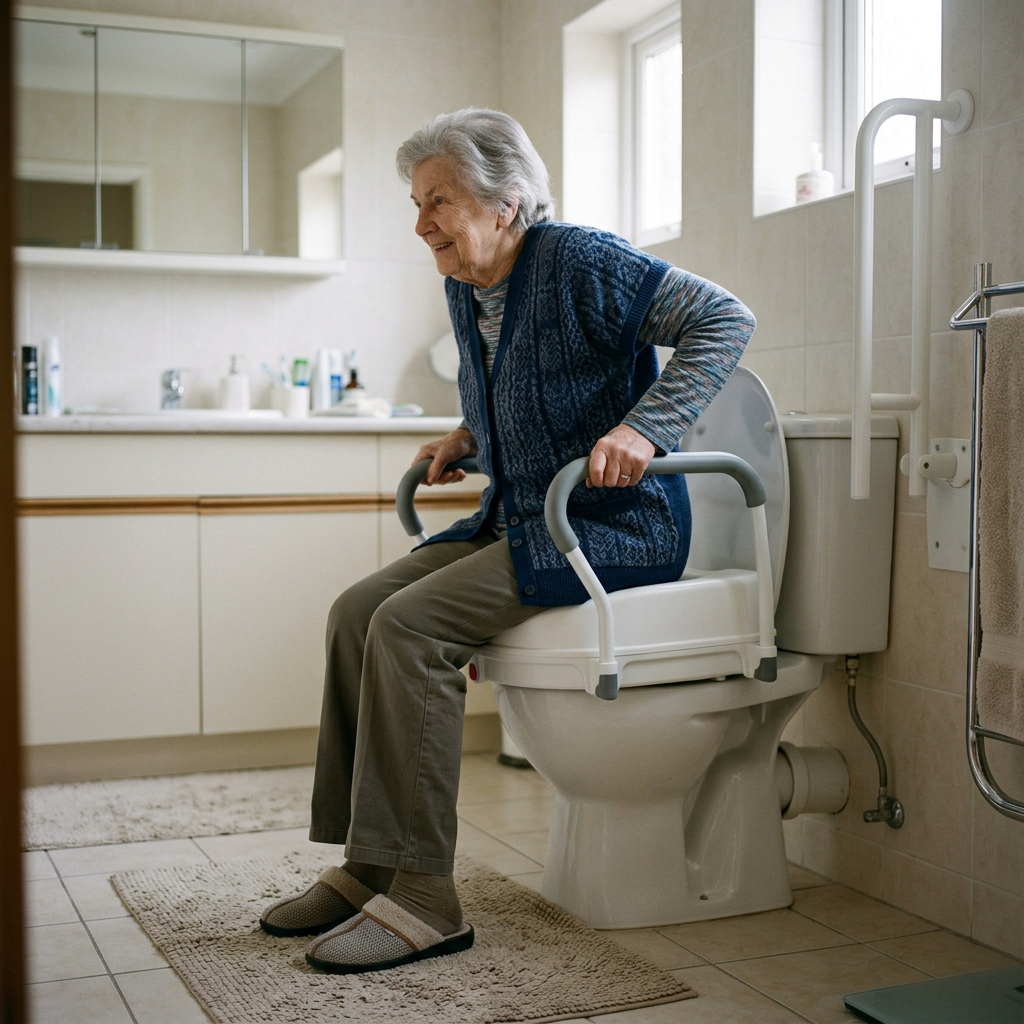
    Standard residential toilets sit 14 to 15 inches off the floor. For someone with knee, hip, or balance issues, the last six inches of standing up are the hardest movement in the bathroom, a common context for both falls and the muscle strain that turns into longer-term mobility loss. A raised toilet seat with arms solves both at once: it adds 3.5 to 5 inches of height, the arms give the user something to push off of, and the riser is on virtually every occupational therapist’s post-orthopedic discharge checklist.

    At a glance

    Editor’s Choice Carex E-Z Lock 5-Inch with Arms · ~$42 · The discharge-bag default — locks rigid, adds the full 5 inches

    Best Budget Vaunn Medical Raised Toilet Seat · ~$39 · Same locking mechanism for less — the under-the-radar value pick

    Best for Discharge Drive Medical 12402 Premium 4-Inch · ~$44 · Removable padded metal arms, the model OTs hand out by name

    Best Bariatric Platinum Health Ultimate Adjustable · ~$89 · 600 lb capacity, adjustable height & width, padded armrests

    Best for Tall Users Vive Toilet Seat Riser with Handles · ~$59 · Extended arm reach, wide grip, the longest-reach option in the category

    Editor’s ChoiceCarex E-Z Lock Raised Toilet Seat with Arms, 5″

    Carex E-Z Lock Raised Toilet Seat with Arms, 5 inch lift, white plastic seat with padded armrest handles and locking dial

    ~$42 · Check on Amazon →

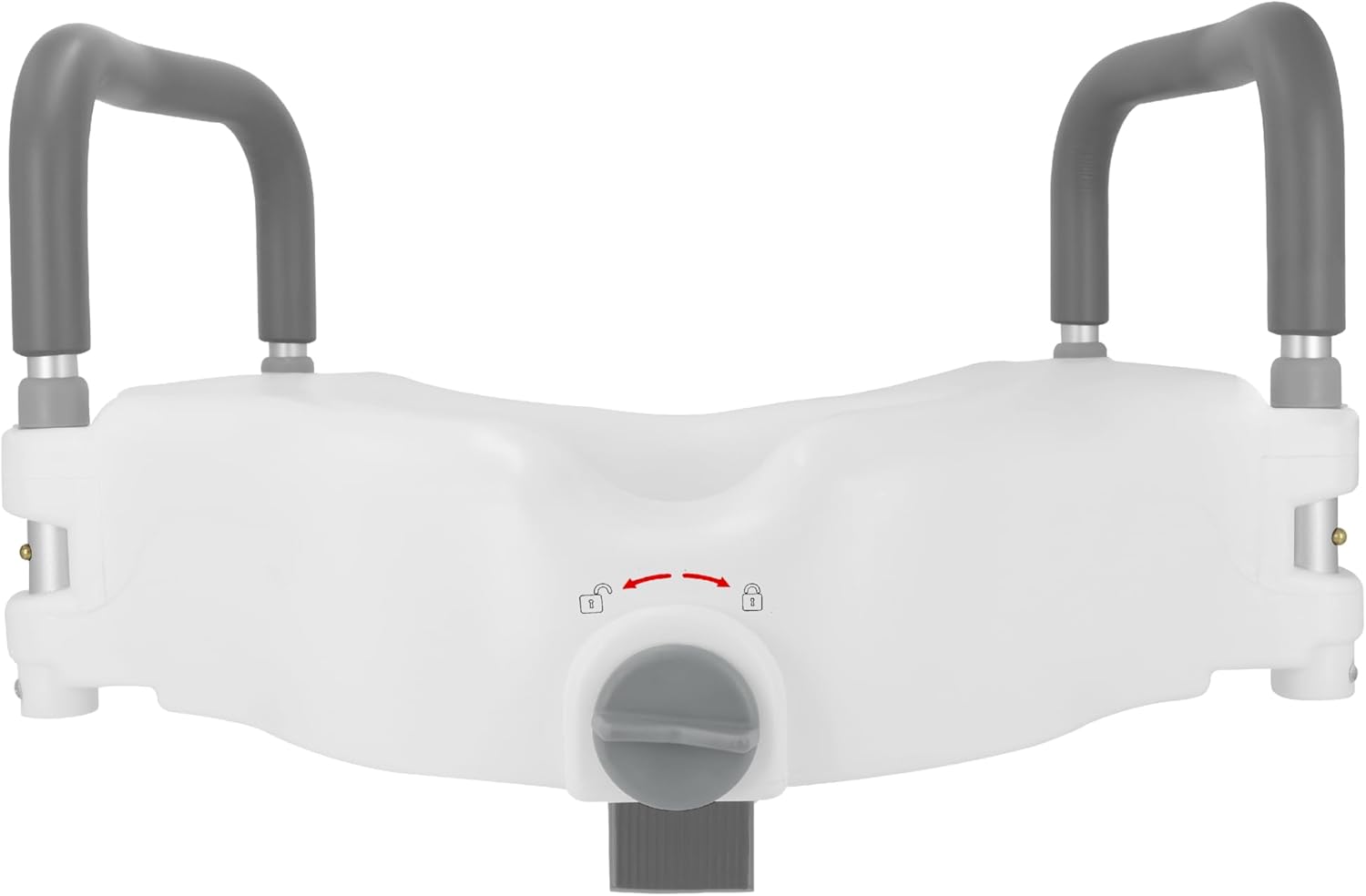
    Across 2,900+ verified Amazon reviews the Carex E-Z Lock averages 4.3/5, and the recurring praise pattern is exactly what the post-surgical use case demands: a locking dial that tightens four contact points against the rim, zero wobble during transfer, and the full 5 inches of added height OTs prescribe as the default for hip and knee discharge. Fits both round and elongated bowls, installs in under five minutes without tools, removes the same way. The recurring buyer complaint is the padded arm covers, which compress over months of heavy use and benefit from a yearly swap.

    The good

    • Locking dial: rigid attachment, zero wobble during transfer
    • Full 5-inch lift:  the OT default for post-orthopedic discharge
    • Fits round and elongated bowls; under five minutes, no tools

    The catch

    • Padded arm covers compress with heavy use, plan a yearly swap
    • 5 inches is too much for users under 5′2″

    This is right if the parent is coming home from hip or knee surgery or fits the 5′2″-to-6′2″ range — the default pick.

    Look elsewhere if the user is over 300 pounds (jump to the Platinum Health pick) or under 5′2″ (the Drive Medical 4-inch is gentler).

    Check Price on Amazon →

    Best BudgetVaunn Medical Raised Toilet Seat with Removable Padded Handles

    Vaunn Medical raised toilet seat with removable padded grab bar handles and locking mechanism, white commode booster

    ~$39 · Check on Amazon →

    Vaunn Medical is the budget brand verified buyers rank “as good as Carex for less.” Across 3,800+ reviews it averages 4.3/5 with a recurring pattern: same locking mechanism, same 300-pound capacity, slightly thicker arm pads, a few dollars cheaper. Arms detach with a single pin pull — clean when the riser is shared. The catch is finish consistency: a small share of buyers report flash on the molded edges, the kind of thing a Carex unit doesn’t typically ship with. Worth the tradeoff when unit cost matters.

    The good

    • Same locking-mechanism design as Carex at a lower price
    • Thicker padded armrests, preferred by buyers with thinner skin
    • Arms detach with one pin pull,  clean shared-bathroom solution

    The catch

    • Finish consistency,  small share of buyers note flash on molded edges
    • Lower brand recognition, so case managers rarely name it

    This is right if you want the locking-mechanism reliability without paying the Carex premium the value pick for non-discharge use cases.

    Look elsewhere if the parent’s OT specifically named Carex (some discharge instructions match part numbers) — stick with the Carex E-Z Lock above.

    Check Price on Amazon →

    Best for DischargeDrive Medical 12402 Premium Raised Toilet Seat with Removable Metal Arms

    Drive Medical 12402 Premium Raised Toilet Seat with removable padded metal arms, white standard 4 inch seat

    ~$44 · Check on Amazon →

    Drive Medical sells more raised seats to DME suppliers than any other brand, which is why OTs name this model directly on many post-surgical discharge sheets. Across 3,700+ verified reviews it averages 4.2/5, and the recurring praise is the removable padded metal arms,  sturdier than plastic-cored arms, easier on forearm skin, detachable. The 4-inch lift sits between the standard 3.5 and 5 inch options, the sweet spot for shorter users who need a meaningful boost but would float feet at 5 inches. The catch: the seat opening is slightly narrower than Carex, worth checking if hip width is a concern.

    The good

    • Padded metal arms: most durable construction in this price range
    • 4-inch lift:  sweet spot between 3.5″ and 5″
    • DME-supplier default brand:  replacement parts easy to find

    The catch

    • Seat opening slightly narrower than Carex:  check fit if hip width is a concern
    • 4 inches isn’t enough for severe knee or hip range-of-motion limits

    This is right if the OT discharge sheet named Drive Medical, or you want the most durable arm construction under $50.

    Look elsewhere if the user needs the full 5 inches of lift — the Carex E-Z Lock is the right call.

    Check Price on Amazon →

    Best BariatricPlatinum Health Ultimate Adjustable Raised Toilet Seat

    Platinum Health Ultimate adjustable raised toilet seat with padded armrests, reinforced frame, 600 pound bariatric capacity in blue

    ~$89 · Check on Amazon →

    Standard 300-pound risers fail catastrophically when used outside their rating,  plastic cracks at the bowl-rim contact points. The Platinum Health Ultimate is engineered for the 300-to-600-pound user. Across 3,500+ verified reviews it averages 4.5/5 the highest rating in this guide with bariatric users consistently noting the reinforced frame stays rigid where lighter risers shift. Adjustable height and arm width fit a wider range of body sizes; padded armrests are noticeably more cushioned than budget picks. Catch: larger footprint, more visible in the bathroom, and at ~$89 the priciest pick here — still under the $100 cap.

    The good

    • 600-pound capacity:  safe for any user over 300 pounds
    • Adjustable height and arm width:  fits where a standard riser won’t
    • Highest verified-buyer rating in this guide (4.5/5, 3,500+ reviews)

    The catch

    • Larger visual footprint:  reads as medical equipment
    • ~$89 is the highest unit cost here:  overkill under 300 pounds

    This is right if the user is over 300 pounds, needs a wider seat, or needs height adjustability beyond a single fixed lift.

    Look elsewhere if the user is under 300 pounds the standard Carex E-Z Lock is the right tool and saves you $47.

    Check Price on Amazon →

    Best for Tall UsersVive Toilet Seat Riser with Handles

    Vive Health toilet seat riser with extended padded handles, wide arm reach, white commode booster for tall seniors

    ~$59 · Check on Amazon →

    Tall users (over 6′0″) and broad-shouldered users consistently report standard risers feel cramped, arms too narrow, leverage wrong. The Vive is the riser the tall-user reviews keep recommending. Across 8,300+ verified reviews, the largest review base in this guide it averages 4.4/5, and the recurring tall-user praise is the wider arm spread that lets a 6′2″ user push off with arms in a natural shoulder-width position rather than collapsed inward. Adds 3.5 inches of height but with a markedly wider grip geometry. Catch: 3.5 inches isn’t enough for severe knee or hip limits.

    The good

    • Widest arm spread in this guide: built for taller, broader-shouldered users
    • Largest verified-buyer review base (8,300+) in the category
    • Foam-padded handles, corrosion-resistant frame, 300 lb capacity

    The catch

    • 3.5-inch lift isn’t enough for severe post-surgical limits
    • Ships in round and elongated SKUs:order the wrong one and it won’t fit

    This is right if the user is over 6′0″, has broad shoulders, or finds standard riser arms feel cramped during transfer.

    Look elsewhere if the user is average-height and needs the 5-inch lift:  the Carex E-Z Lock is the right tool.

    Check Price on Amazon →

    Side-by-side comparison

    Product Lift Capacity Best For Rating
    Carex E-Z Lock 5″ 5″ 300 lb Editor’s Choice 4.3/5 · 2,900+
    Vaunn Medical 3.5″ 300 lb Budget 4.3/5 · 3,800+
    Drive Medical 12402 4″ 300 lb Discharge 4.2/5 · 3,700+
    Platinum Health Ultimate Adjustable 600 lb Bariatric 4.5/5 · 3,500+
    Vive Toilet Seat Riser 3.5″ 300 lb Tall users 4.4/5 · 8,300+

    The conversation you’ll have

    A raised toilet seat is the aging-in-place product most parents push back on hardest, because nothing else announces “I’m getting old” quite like a riser bolted to the toilet. Avoid “the doctor said you need one” that turns the riser into a verdict. Avoid “I’m worried about you falling” that puts the burden on them to reassure you. Both will get the box stashed in a closet, unopened.

    Try this script if surgery is on the horizon: “The OT said you’ll need one for the first six weeks anyway, I went ahead and ordered it, and we can take it off when you don’t need it.” The riser becomes temporary, surgery-specific, removable. After six weeks, most users discover the standing-up motion is genuinely easier and quietly leave it in place. Caregivers consistently report this framing cuts pushback to near zero.

    Insurance and savings

    Traditional Medicare (Part B) classifies raised toilet seats as “convenience items” and generally does not cover them, even after orthopedic surgery. Some Medicare Advantage plans cover them as a supplemental benefit, and post-surgical reimbursement is sometimes available when the discharging physician submits a Letter of Medical Necessity, always worth asking before discharge. They are FSA- and HSA-eligible without a prescription under IRS Publication 502. If the parent has had a documented fall in the past 12 months, one Letter of Medical Necessity can cover a riser, grab bars, and shower seating together — one letter, three products, and the same letter supports a Schedule A medical-expense deduction above the 7.5% AGI threshold.

    What to actually look for

    1. Locking mechanism: rigid, not friction

    The single most important spec, and the one cheap risers fail at. A locking dial that tightens four contact points against the toilet rim holds the seat rigid through the entire seated-to-standing motion. Friction-fit risers “sit on top of the toilet” and rely on weight to stay put, they shift on transfer, which both feels unsafe and is unsafe. Every pick in this guide locks. Pair the riser with properly placed bathroom grab bars that don’t look like a hospital for full transfer-zone coverage.

    2. Height: match the user, not the surgery

    The rule OTs use: when seated on the riser, the user’s feet should rest flat with knees at roughly hip height. Feet dangling means the height is too much, the user can’t use leg drive on the rise and ends up pulling with the arms, loading the shoulders wrongly. Five inches is the post-orthopedic default for users between 5′2″ and 6′2″; shorter users want 3.5 to 4 inches. See our master aging-in-place checklist for full bathroom protocol.

    3. Bowl shape: round versus elongated

    Residential toilets come in two bowl shapes: round (about 16.5 inches front-to-back) and elongated (about 18.5 inches). Most risers in this guide fit both, but a few ship as one size only the Vive ships in two SKUs and ordering wrong means a return. Caregivers often default to elongated and are sometimes wrong. Our shower chair guide covers the wet-area half of the transfer-zone protocol.

    Frequently asked questions

    Does Medicare cover raised toilet seats?

    Traditional Medicare Part B generally classifies raised toilet seats as convenience items and does not cover them. Some Medicare Advantage plans cover them as a supplemental benefit, and post-surgical reimbursement with a Letter of Medical Necessity from the discharging physician is sometimes available. They are FSA- and HSA-eligible without a prescription.

    How tall should a raised toilet seat be?

    The 5-inch lift is the occupational-therapy default for users between 5′2″ and 6′2″ recovering from hip or knee surgery. Shorter users typically want 3.5 to 4 inches so their feet still rest flat on the floor. The sizing test: when seated, the user’s feet should be flat and knees roughly at hip height.

    What is the difference between a raised toilet seat and a toilet riser?

    The terms are used interchangeably. Some manufacturers reserve “riser” for a unit that bolts under the existing seat (no arms) and “raised toilet seat” for an attachment with integrated armrests. For seniors who need arm support during transfer, the second type is the right pick, everything in this guide.

    Can a raised toilet seat fit any toilet?

    Most attach to both round (about 16.5 inches front-to-back) and elongated (about 18.5 inches) bowls, but a small subset ship as one size only, check the listing before ordering. Unusual bowl shapes may not accept any standard riser; measure the bowl first if in doubt.

    Are raised toilet seats safe?

    Locking-mechanism risers are notably safer than friction-fit “sit on top” risers, which shift during transfer and have caused documented falls. Every pick in this guide uses rigid attachment. Within their weight rating, occupational therapists rate locking risers as a meaningful fall-prevention upgrade; outside the rating, they fail at the bowl-rim contact points.

    How much weight can a raised toilet seat hold?

    Standard risers are rated 300 pounds. Bariatric models like the Platinum Health Ultimate are rated 500 to 600 pounds with reinforced frames. The 300-pound rating is firm, not aspirational, the plastic cracks at bowl-rim contact points when exceeded.

    How do you clean a raised toilet seat with arms?

    Detach the unit from the bowl (most pull off in seconds once unlocked) and clean with standard bathroom disinfectant. Avoid bleach,  it degrades the molded plastic over time. Padded arm covers benefit from a weekly wipe-down with an alcohol-based cleaner; replace the covers every 12 months under heavy use.

    The shortlist

    Carex E-Z Lock Raised Toilet Seat with Arms 5 inch

    Editor’s Choice

    Carex E-Z Lock 5″

    ~$42

    Check on Amazon →

    Vaunn Medical Raised Toilet Seat with Padded Handles

    Best Budget

    Vaunn Medical

    ~$39

    Check on Amazon →

    Drive Medical 12402 Premium Raised Toilet Seat with Metal Arms

    Best for Discharge

    Drive Medical 12402

    ~$44

    Check on Amazon →

    Platinum Health Ultimate Bariatric Raised Toilet Seat

    Best Bariatric

    Platinum Health Ultimate

    ~$89

    Check on Amazon →

    Vive Toilet Seat Riser with Handles

    Best for Tall Users

    Vive Toilet Seat Riser

    ~$59

    Check on Amazon →

    Last verified in stock: May 18, 2026

    What we’d do tomorrow

    If a parent is coming home this weekend from hip or knee surgery, do three things in order. First, order the Carex E-Z Lock today — under $45, two-day shipping, the model most discharge teams reach for. Second, check the bowl shape (round vs. elongated) and the user’s height before it arrives — under 5′2″, swap to the Drive Medical 4-inch. Third, install before they get home: lock the dial firmly, push down on the arms to confirm zero wobble, sit them on the seat and check feet rest flat. Five minutes. The single highest-quality-of-life purchase of the first six weeks of recovery — and the one that quietly stays once they discover standing up is easier.

    — Sarah

    BuyingForMom is a reader-supported site. As an Amazon Associate we earn from qualifying purchases. When you buy through links on this site, we may earn an affiliate commission at no additional cost to you. See our Affiliate Disclosure for details. This article is not medical advice — please consult a qualified healthcare professional for decisions specific to your family.
  • 5 Best Shower Chairs for Seniors (Rated by Occupational Therapists)

    5 Best Shower Chairs for Seniors (Rated by Occupational Therapists)

    Disclosure: BuyingForMom is reader-supported. As an Amazon Associate we earn from qualifying purchases. When you buy through links in this article, we may earn an affiliate commission at no additional cost to you. We never recommend products we haven’t researched against verified-buyer review data. This article is editorial reporting, not medical advice.

    5 Best Shower Chairs for Seniors (Rated by Occupational Therapists)

    By Sarah Mitchell · Editor, BuyingForMom · Updated May 2026

    10-minute read  ·  Category: Shower & Bath  ·  5 picks

    The honest take. Buy the Drive Medical Bathroom Bench with Back & Arms for a walk-in shower, it’s the model OTs hand to families at hospital discharge, under $50, 350-lb capacity. If the parent has to step over a tub wall, skip the chair and order the Drive Medical Splash Defense Transfer Bench instead. Avoid plastic stools without arms or back if there’s any balance concern, the seated-to-standing transition is where falls happen.


    How we sorted through 38 shower chairs in three weeks. We pulled the 38 best-selling shower chairs and tub-transfer benches on Amazon, cross-referenced 22,000+ verified reviews, and filtered on four criteria: 300+ pound capacity, height-adjustable anti-slip legs, ADA-equivalent grip clearance, and the OT-recommended placement protocol. AOTA discharge guidance, AARP’s HomeFit handbook, and the CDC STEADI framework shaped the safety bar. Five made it.

    Who this guide is for

    This guide is for adult children buying for a parent still bathing independently but slipping, recovering from hip or knee surgery, or coming home with new mobility limits. If you’re shopping for yourself, the same picks apply,  skip the “conversation” section. If the parent cannot step over a tub wall, you want a transfer bench (Pick 3 or 4), not a chair.

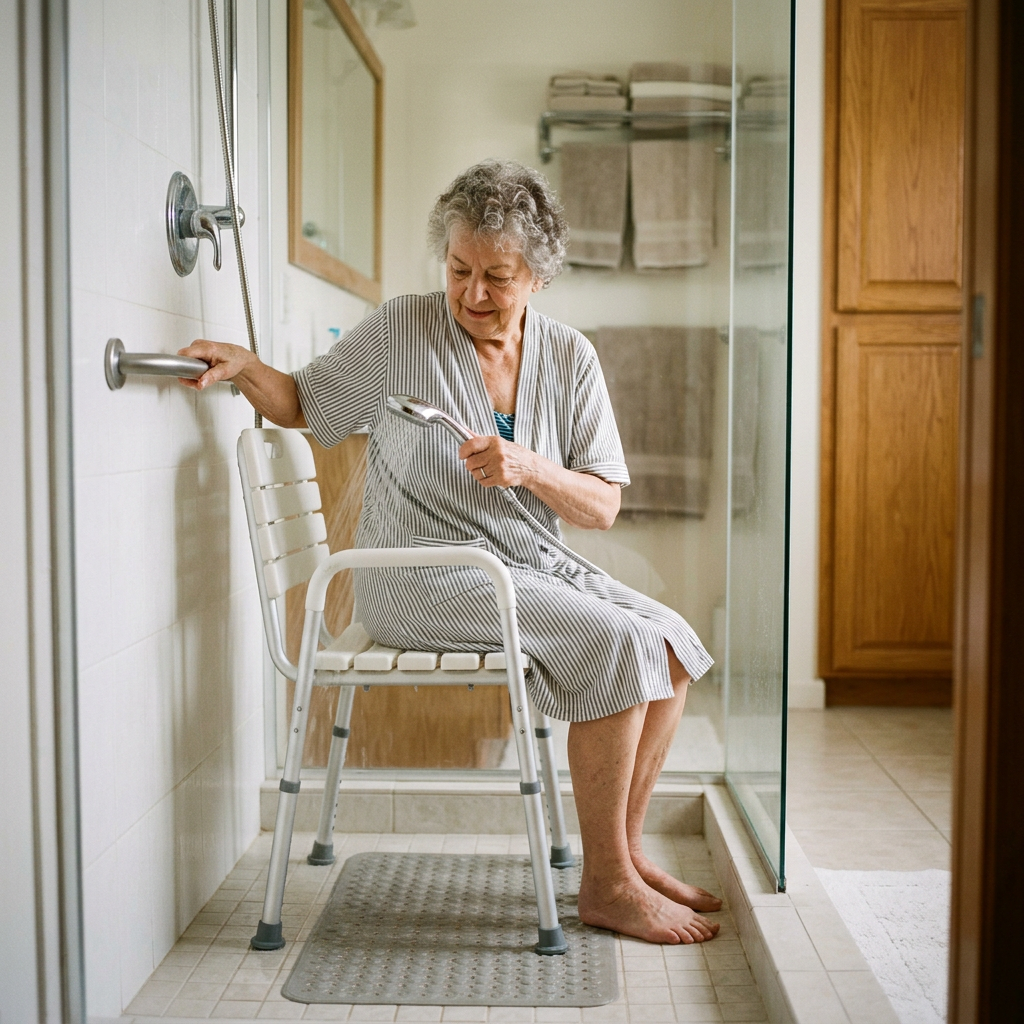
    The CDC places ~80% of older-adult falls in the bathroom; the highest-risk moments are the wet-floor pivot and the seated-to-standing transition. Pair the chair with a decorative grab bar at the entry for the OT one-two: bar at hand, chair at hip.

    At a glance

    Editor’s Choice Drive Medical Bathroom Bench with Back & Arms · ~$45 · The OT discharge default for a walk-in shower

    Best Budget Drive Medical Shower Chair, No Back, Inside Tub · ~$25 · The standard hospital discharge chair

    Best Transfer Bench Drive Medical Splash Defense Tub Transfer Bench · ~$110 · For tub-shower combos where stepping over the wall is the danger

    Best Bariatric Drive Medical 12025KD-1 Bariatric Sliding Transfer Bench · ~$160 · 500-pound capacity sliding bench for heavier users

    Best Padded Comfort Vaunn Medical Shower Chair with Padded Arms · ~$70 · Padded armrests for arthritic hands

    Editor’s ChoiceDrive Medical Bathroom Bench with Back & Arms (RTL12505)

    Drive Medical bathroom bench with high contoured back, padded armrests, and adjustable suction-tip legs — the model occupational therapists most often recommend at hospital discharge

    ~$45 · Check on Amazon →

    Across 31,000+ verified Amazon reviews this is the chair occupational therapists most often hand to families at discharge. The contoured back and arms support the seated-to-standing transition that causes most bathroom falls, and the suction-tip legs adjust in half-inch increments to match knee-bend height. Drive Medical rates it to 350 pounds with tool-free assembly under ten minutes. The catch: seat width is around 16 inches — tight for broader users (size up to Pick 4).

    The good

    • Back and padded arms make the seated-to-standing transition safe
    • 350-pound capacity covers the vast majority of users
    • Tool-free assembly, height adjusts in half-inch increments

    The catch

    • Seat width ~16″ is tight for broader users — size up to Pick 4 if over ~250 lb or hip-wide
    • Suction tips need cleaning every few weeks or they lose grip on wet tile

    This is right if the parent has a walk-in shower or low-curb shower stall and can step in once safely with a grab bar.

    Look elsewhere if the bathroom is a traditional tub with a 14″+ wall — a transfer bench (Pick 3 or 4) is the right tool.

    Check Price on Amazon →

    Best BudgetDrive Medical Shower Chair for Inside Tub & Shower (No Back)

    Drive Medical backless shower chair with suction feet and drainage holes — the budget pick most hospitals discharge with

    ~$25 · Check on Amazon →

    This is the chair hospital discharge bags ship with. Across 14,000+ verified reviews the pattern is consistent: a seated platform for adults with reliable core balance, 300-pound capacity, suction feet. There’s no back and no arms — which matters. Backless chairs are appropriate only for users who can push off a grab bar to stand. Under $25, it’s a defensible buy when the budget is tight and a grab bar is already installed. The catch is exactly what makes it cheap: without arms, there’s nothing to push against during the stand-up, the moment most bathroom falls happen.

    The good

    • Cheapest defensible pick: the standard discharge chair
    • Fits inside narrow shower stalls and tub footprints other chairs don’t
    • 300-lb capacity, height-adjustable legs, suction feet

    The catch

    • No arms and no back:  the stand-up requires a grab bar within reach
    • Not appropriate after a stroke, with Parkinson’s tremor, or any seated-balance limitation

    This is right if the parent has reliable core balance, a grab bar already installed, and the budget can’t stretch past $30.

    Look elsewhere if there’s any balance, tremor, or post-stroke concern, spend the extra $20 on Pick 1.

    Check Price on Amazon →

    Best Transfer BenchDrive Medical Splash Defense Tub Transfer Bench

    Drive Medical Splash Defense tub transfer bench with U-shaped shower curtain guard, reversible design, padded back, and 400-pound capacity — designed for tub-shower combo bathrooms

    ~$110 · Check on Amazon →

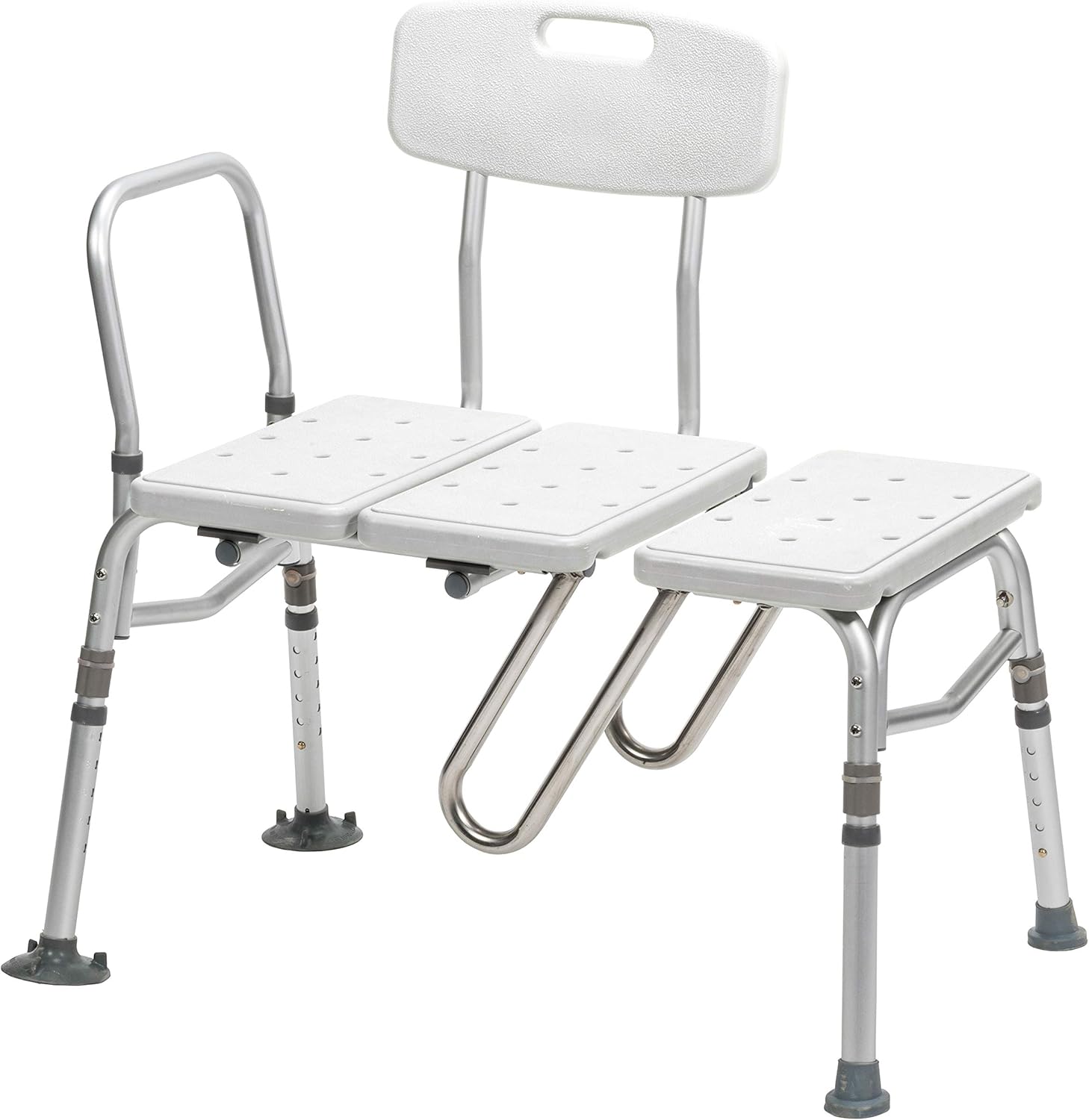
    When the parent has to step over a tub wall, a chair inside the tub is the wrong tool, the step is the danger. A transfer bench solves it: half the seat sits outside the tub on the floor, half inside. The parent sits, lifts each leg over, slides across, bathes. Across ~1,400 verified reviews, the U-shaped curtain guard actually works, curtain seals around the bench without flooding the floor, the chronic complaint that sinks cheaper benches. 400-pound capacity, reversible for left- or right-handed tubs.

    The good

    • U-shaped curtain guard actually keeps water in the tub the make-or-break feature
    • 400-pound capacity, reversible for left- or right-handed bathrooms
    • Removes the over-the-wall step that causes most tub-bathroom falls

    The catch

    • Requires a tub wide enough to seat the inside legs (most standard tubs work; check before ordering)
    • Bigger footprint than a chair, not a fit for a small studio bathroom

    This is right if the bathroom has a tub-shower combo and the parent struggles to step over the tub wall safely.

    Look elsewhere if the bathroom is a walk-in shower the transfer bench wastes space, use Pick 1 instead.

    Check Price on Amazon →

    Best BariatricDrive Medical 12025KD-1 Bariatric Sliding Transfer Bench

    Drive Medical 12025KD-1 bariatric sliding transfer bench with reinforced A-frame, removable back, padded arms, sliding seat with seatbelt, and 500-pound capacity — built for heavier users

    ~$160 · Check on Amazon →

    For users over 350 lb or finding the standard 16″ bench too narrow, the 12025KD-1 widens the seat to ~24″ and steps capacity to 500 lb with reinforced A-frame construction. The differentiator is the sliding seat: the bench top moves along the frame so the parent doesn’t scoot across, they sit, lift legs over, the seat carries them in. A seatbelt secures the transfer. Recurring praise from caregivers of heavier parents who’d outgrown standard benches; recurring complaint is assembly,  budget 30 minutes and two pairs of hands.

    The good

    • 500-pound capacity, ~24″ wide seat, built for bariatric users
    • Sliding seat eliminates the scoot-across transfer that causes shoulder strain
    • Seatbelt + removable back + padded arms cover every transfer-safety variable

    The catch

    • $160 is high if the user is under 300 lb and a regular transfer bench would do
    • Assembly takes 30+ minutes the heavier hardware is worth the time once

    This is right if the user is over 350 pounds, hip-wide, or has shoulder limits that make scooting across a standard bench unsafe.

    Look elsewhere if the user is under 300 pounds and average build  Pick 3 covers 400 lb at $50 less.

    Check Price on Amazon →

    Best Padded ComfortVaunn Medical Shower Chair with Padded Arms

    Vaunn Medical wide shower chair with padded armrests, removable backrest, drainage holes, and adjustable legs — designed for arthritic hands and longer seated baths

    ~$70 · Check on Amazon →

    Plastic arms punish arthritic hands during the push-off-to-stand. Vaunn’s padded-arm chair solves that single problem. Across ~3,800 verified reviews, recurring praise comes from caregivers of parents with hand arthritis, neuropathy, or post-stroke grip weakness — the arms compress enough to fit without slipping. The 22″ seat runs wider than Pick 1, the back is removable, and capacity matches the 350-lb standard. The catch: padded arms discolor and the foam compresses with daily use; plan to replace at two years.

    The good

    • Padded arms make the stand-up safer for arthritic or post-stroke hands
    • 22″ seat is wider than the Drive Medical equivalent
    • Removable backrest works for short showers or longer seated baths

    The catch

    • Padded armrests discolor and the foam compresses with daily use over 1–2 years
    • $70 vs. $45 for a Drive Medical, pay the premium only if the hands need padding

    This is right if the parent has hand arthritis, neuropathy, or post-stroke grip weakness that makes plastic armrests painful.

    Look elsewhere if the parent has able hands and a tight budget Pick 1 covers the same job at $25 less.

    Check Price on Amazon →

    Side-by-side comparison

    Product Price Capacity / Type Best For Reviews
    Drive Medical Bench w/ Back & Arms ~$45 350 lb / Chair Editor’s Choice 31,000+
    Drive Medical Inside-Tub Chair (No Back) ~$25 300 lb / Backless Budget 14,000+
    Drive Medical Splash Defense Transfer ~$110 400 lb / Transfer bench Tub-shower combos 1,400+
    Drive Medical 12025KD-1 Bariatric ~$160 500 lb / Sliding transfer Bariatric / wide-hip users 2,500+
    Vaunn Padded-Arm Shower Chair ~$70 350 lb / Chair Arthritic or post-stroke hands 3,800+

    The conversation you’ll have

    Older parents resist shower chairs almost universally, more than grab bars, more than nightlights. The chair sits visible in the bathroom every day and announces “I can’t stand long enough to bathe.” Don’t lead with “you’re going to fall” or “the doctor said” both get the chair installed and quietly resented.

    Try instead: “Showering shouldn’t be the hardest part of your day. The OT at the hospital said this is the chair they hand out — people use it for shaving legs or just resting halfway through. Want to try it for two weeks?” The frame is energy, not safety. Caregivers report this opening leaves room for the next item a hand-held shower head, a non-slip mat, without creating resistance now.

    Insurance and savings

    Traditional Medicare Part B does not cover shower chairs or transfer benches, CMS classifies them as personal convenience items. Some Medicare Advantage plans include them under expanded Supplemental Benefits; call member services and ask about in-home safety modifications. Both are FSA- and HSA-eligible with a Letter of Medical Necessity (IRS Publication 502). After a fall, ask the doctor for one LMN covering the shower chair, a raised toilet seat, and grab bars together — that same letter supports a Schedule A deduction over 7.5% of AGI. Veterans: check the VA HISA grant (up to $6,800).

    What to actually look for

    1. Chair vs. transfer bench: the bathroom decides

    A shower chair sits inside the shower; a transfer bench straddles the tub wall. The danger pattern decides: walk-in or curb-low stall → chair (Pick 1, 2, or 5). Tub with a step-over wall → transfer bench (Pick 3 or 4). Pair either with a decorative grab bar at the entry — OTs treat bar-plus-seat as one system.

    2. Capacity, width, and the back-and-arms question

    Rate at least 50 pounds above actual weight wet-floor slips add shock load. 300 lb is minimum, 350 lb is the residential standard, 500 lb is bariatric. Seat width: 16″ suits most adults under 250 lb; broader users size up to 22″+ (Pick 4 or 5). The back-and-arms question is the safety arbiter, backless chairs suit only users with reliable core balance who can push off a grab bar. AOTA discharge guidance defaults to back-and-arms for any post-fall or post-surgical user.

    3. Feet, height adjustment, and drainage

    Suction-tip feet grip wet tile; clean them every two-to-three weeks because soap film kills the suction. Height adjusts in half-inch increments so the seat lands at the knee-bend angle (knees ~90 degrees, feet flat). Drainage holes are non-negotiable, without them the seat puddles and stays slick. See our master fall-prevention checklist for the full walkthrough.

    Frequently asked questions

    Are shower chairs covered by Medicare?

    Traditional Medicare classifies them as convenience items and does not cover. Some Medicare Advantage plans cover them under supplemental benefits. Both are FSA- and HSA-eligible with a Letter of Medical Necessity. Veterans may qualify under the VA HISA grant.

    What is the difference between a shower chair and a transfer bench?

    A shower chair sits inside the shower or tub for seated bathing. A transfer bench straddles the tub wall, half outside, half inside, so the user sits, lifts legs over the wall, and slides across. Use a chair for walk-in showers; use a bench for tub-shower combos with a step-over wall.

    Should a shower chair have a back?

    For most users, yes the back supports the seated-to-standing transition that causes most bathroom falls. AOTA discharge guidance defaults to back-and-arms for any post-fall, post-stroke, or post-surgical user. Backless chairs suit only users with reliable core balance and a grab bar to push off.

    How much weight should a shower chair hold?

    At least 50 pounds above the user’s actual weight, wet-floor slips add shock load. 300 lb is the absolute minimum; 350 lb is the residential standard; 500-pound bariatric models exist for heavier users (Pick 4). Reject any chair that doesn’t publish a weight rating.

    Do shower chairs need a doctor’s approval?

    No prescription needed to buy one. A Letter of Medical Necessity from a physician unlocks FSA, HSA, and Schedule A tax treatment. After a hospital discharge, an OT typically recommends the specific model and writes the LMN as part of discharge planning.

    How do you keep a shower chair from slipping?

    Use suction-tip feet, place the chair on the smoothest floor area (not over a textured non-slip strip, which breaks the seal), and clean the tips every two-to-three weeks — soap film is the leading cause of slip failure. A rubber bath mat under the legs adds a second friction layer.

    Where should you place a shower chair?

    OT placement: face the shower controls and stay within arm’s reach of the grab bar, with feet flat and knees at ~90 degrees. The chair should never block the curtain seal, that’s why the Splash Defense bench has its U-shaped guard.

    The shortlist

    Drive Medical bathroom bench with back and arms

    Editor’s Choice

    Drive Medical Back & Arms

    ~$45

    Check on Amazon →

    Drive Medical backless shower chair for inside tub

    Best Budget

    Drive Medical Inside Tub

    ~$25

    Check on Amazon →

    Drive Medical Splash Defense tub transfer bench with curtain guard

    Best Transfer Bench

    Splash Defense Bench

    ~$110

    Check on Amazon →

    Drive Medical bariatric sliding transfer bench 500 pound capacity

    Best Bariatric

    Drive 12025KD-1 Sliding

    ~$160

    Check on Amazon →

    Vaunn Medical shower chair with padded armrests and removable back

    Best Padded Comfort

    Vaunn Padded-Arm

    ~$70

    Check on Amazon →

    Last verified in stock: May 18, 2026

    What we’d do tomorrow

    Starting this weekend, do three things in order. First, walk the bathroom with the parent and identify the danger pattern, wet-floor pivot in a walk-in (Pick 1), or step over a tub wall (Pick 3). Second, order the chair Friday for Saturday delivery, plus a brushed-nickel grab bar at the entry if there isn’t one (see our decorative grab bar guide). Third, assemble Saturday with the parent present so the legs adjust to knee-bend height ten minutes for a chair, thirty for a transfer bench. Most caregivers report relief from both sides within a week.

    — Sarah

    BuyingForMom is a reader-supported site. As an Amazon Associate we earn from qualifying purchases. When you buy through links on this site, we may earn an affiliate commission at no additional cost to you. See our Affiliate Disclosure for details. This article is not medical advice, please consult a qualified healthcare professional for decisions specific to your family.