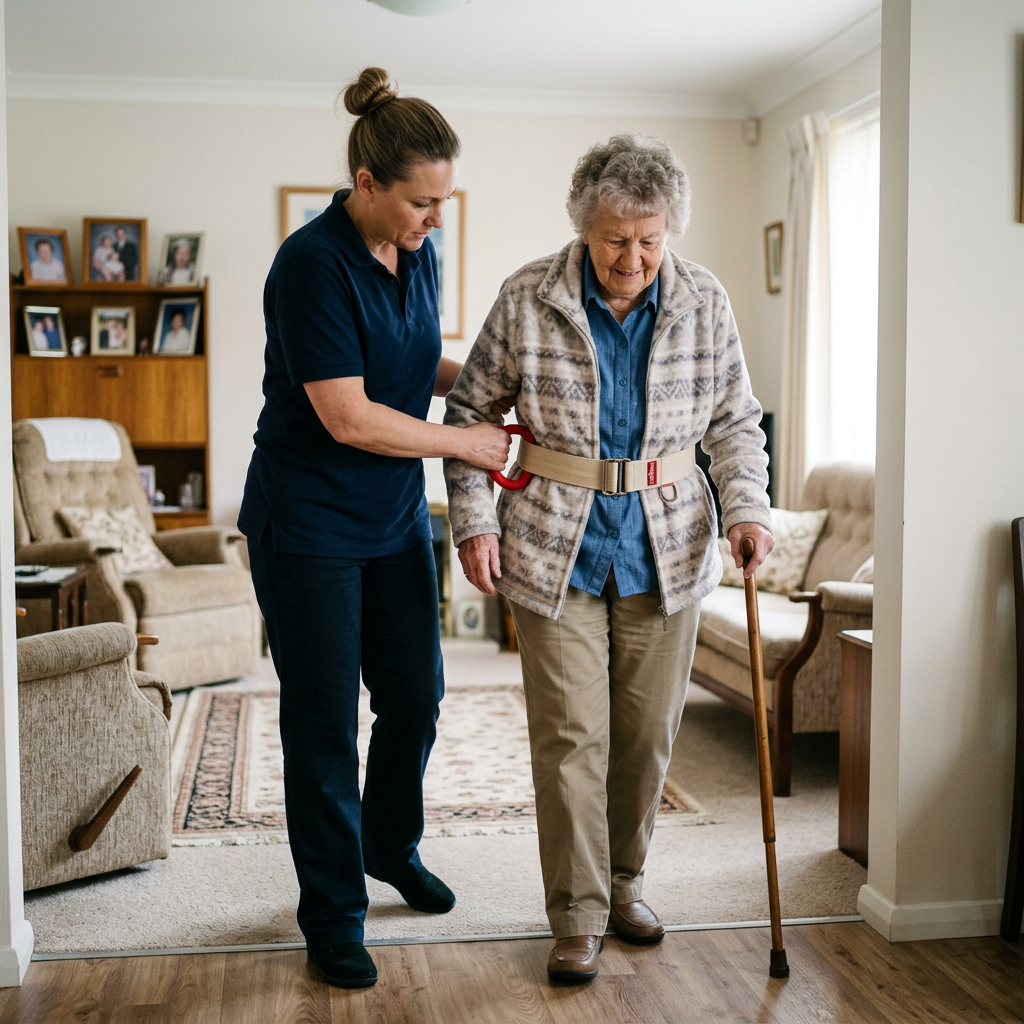
5 Best Gait Belts & Transfer Belts for Seniors
By Sarah Mitchell · Editor, BuyingForMom · Updated August 2026
8-minute read · Balance & Mobility · 5 caregiver-tested picks compared

How we sorted through 40+ gait belts in two weeks
We cross-referenced more than 8,000 verified Amazon reviews across 40-plus gait and transfer belts, then narrowed by the criteria physical and occupational therapists actually name: buckle security, handle placement, webbing width, and weight rating. We weighed caregiver-forum patterns from r/AgingParents and r/CaregiverSupport against manufacturer-stated specs, and we cross-checked each pick’s buckle style against the way real home caregivers describe using it solo, one-handed, over clothing. Every belt below was confirmed as a live, in-stock Amazon listing in August 2026.
Who this guide is for
This guide is for adult children and family caregivers who help a parent rise from a chair, steady themselves at the sink, or walk a few steps to the bathroom — and who want a safer handhold than a grabbed sleeve or forearm. If your parent can no longer bear any weight on their legs, a gait belt is the wrong tool; you need a mechanical or sit-to-stand lift instead, and we say so plainly below.
A gait belt (also sold as a “transfer belt”) is a simple strap that buckles snugly around a person’s waist over their clothing, giving the caregiver a sturdy handhold at the body’s center of gravity. Done right, it protects two people at once: your parent from a fall, and your own back from the twisting reach that sends so many caregivers to the doctor. The catch is that the belts are not interchangeable the buckle and the width should match your specific situation, and that’s where most roundups go quiet.
At a glance
BEST OVERALL Vive Transfer Belt with Handles (~$25) — 4-inch padded webbing, quick-release metal buckle, 350 lb. Best all-round pick for home caregivers.
MOST GRIP POINTS NYOrtho 6-Handle Gait Belt (~$20) — six handles, easy-fasten buckle. Best when you transfer from several angles.
BEST QUICK-RELEASE Secure 6-Handle Gait Belt (~$22) — one-press side-release clip, 350 lb. Best for solo, one-handed caregivers.
BEST PADDED COW&COW Padded Gait Belt (~$20) — wide cushioned band with handles. Best for fragile ribs or osteoporosis.
BEST BUDGET NYOrtho Metal-Buckle Gait Belt (~$11) — 2-inch cotton webbing, no handles. Best for trained caregivers on a budget.
BEST OVERALL Vive Transfer Belt with Handles
~$25 · Check price on Amazon →

The Vive is the belt we point most families to first, and the reason is the extra-wide 4-inch webbing paired with padded grab handles. Across several thousand verified reviews, the recurring praise is that the wide band spreads pressure so it doesn’t dig in during a slow stand, and caregivers consistently note the handles give a confident hold without reaching for clothing. The quick-release metal buckle uses grabbing teeth that lock at any length up to a 51-inch waist and hold a rated 350 pounds, so it suits heavier parents that lighter belts can’t. It’s also listed as FSA/HSA-eligible. The most common complaint is simply that the belt is stiff out of the package and softens after a few uses — worth knowing, not a dealbreaker.
The good
- 4-inch padded band spreads pressure, comfortable for slow transfers
- Padded handles give a secure hold without grabbing clothing
- 350 lb rating and 51-inch fit handle heavier parents
The catch
- Webbing is stiff at first and needs a few uses to soften
- The wide band can feel bulky under a fitted waistband
This is right if… you want one dependable belt for daily stand-and-steady help at home.
Look elsewhere if… your parent has fragile ribs, a padded belt sits gentler (see the COW&COW below).
MOST GRIP POINTS NYOrtho Gait Belt with 6 Heavy Handles
~$20 · Check price on Amazon →

NYOrtho is a name that turns up repeatedly in occupational-therapy supply lists, and this belt earns it with four vertical and two horizontal handles spaced around the band. That layout lets you pick the best leverage point depending on whether you’re behind, beside, or in front of your parent — the pattern caregivers describe most is grabbing a vertical handle at the hip for a sit-to-stand, then switching to a horizontal one for walking. The easy-fasten buckle threads and cinches without a metal lock to fight, which reviewers with arthritic hands appreciate. The honest limit: it’s rated to 275 pounds, lower than the 350-pound belts here, so confirm the fit for a heavier parent before ordering.
The good
- Six handles let you choose leverage from any angle
- Easy-fasten buckle is gentle on arthritic hands
- Adjusts 28 to 55 inches; therapist-favored brand
The catch
- 275 lb rating, lower than the Vive and Secure
- Non-padded band; less cushioned than the COW&COW
This is right if… you transfer from different positions and want handle options.
Look elsewhere if… your parent is over ~250 lb step up to a 350 lb belt.
BEST QUICK-RELEASE Secure Gait Belt with 6 Handles & Quick-Release Clip
~$22 · Check price on Amazon →

If you’re the only person doing transfers, the buckle is the whole decision — and the Secure’s one-press side-release clip is the one solo caregivers reach for. It snaps shut and pops open with a single hand, so you’re not wrestling a metal buckle while steadying a parent with the other arm. Verified buyers repeatedly call it fast and foolproof, and the six-handle band gives the same four-vertical, two-horizontal grip options as the NYOrtho, at a rated 350 pounds. The trade-off is inherent to plastic clips: they’re less bomb-proof than a metal buckle under sudden load, so this belt is best for guided standing and walking, not for catching a hard fall. Some reviewers also wish the clip clicked more audibly to confirm it’s locked — always tug-test it before you rely on it.
The good
- One-handed press-and-release — ideal for solo caregivers
- Six handles and a 350 lb rating
- Simple to teach a spouse or rotating helper
The catch
- Plastic clip is less rugged than a metal buckle under shock load
- Confirm the clip is fully seated — tug-test every time
This is right if… you transfer alone and need a buckle you can work one-handed.
Look elsewhere if… you want the maximum-security lock of a metal buckle.
BEST PADDED COW&COW Padded Gait Belt with Handles
~$20 · Check price on Amazon →

For a parent with osteoporosis, a recent rib injury, or simply very little padding of their own, a standard 2-inch strap can bite. The COW&COW solves that with a wide, cushioned band and a soft inner layer that disperses pressure across the waist rather than concentrating it on a thin line. Its handful of verified reviews skew strongly positive — buyers describe it as noticeably gentler than a plain webbing belt while still giving handles and a quick-release buckle for control. It’s the belt we’d choose when comfort is the deciding factor and the transfer is a supported stand rather than a heavy lift. The catch is that the extra cushioning adds bulk, and the review count is smaller than the big brands’, so there’s less long-term durability data.
The good
- Wide cushioned band is gentle on fragile ribs and thin skin
- Keeps handles and a quick-release buckle
- Soft inner layer disperses pressure evenly
The catch
- Padding adds bulk under clothing
- Fewer reviews, so less long-term durability data
This is right if… comfort matters most osteoporosis, fragile ribs, or thin skin.
Look elsewhere if… you want the largest verified-review track record (choose the Vive).
BEST BUDGET NYOrtho Metal-Buckle Gait Belt
~$11 · Check price on Amazon →

This is the belt you see in hospitals and rehab gyms: 2-inch cotton webbing, a nickel-plated metal buckle, no handles, and a price around eleven dollars. Threaded and cinched correctly, the metal buckle is the most secure lock of any style here, which is exactly why therapists trust it — the flip side is that it takes both hands and a bit of practice to fasten and adjust. Reviewers who’ve been shown the technique love the simplicity and the machine-washable cotton; those who buy it cold often wish it had handles. That’s the honest divide: this belt rewards training. If a physical therapist has shown you the two-handed grip, it’s all you need. If not, spend the extra few dollars on a handled belt above.
The good
- Metal buckle is the most secure lock here
- Machine-washable cotton; clinic-standard simplicity
- Lowest price of any pick around $11
The catch
- No handles, you hold the belt itself, which needs technique
- Two-handed buckle takes practice to fasten quickly
This is right if… a therapist has trained you and you want the clinic standard.
Look elsewhere if… you’re new to transfers, handles make a solo caregiver far safer.
Quick comparison
| Belt | Buckle | Width / handles | Rating | Best for |
|---|---|---|---|---|
| Vive (~$25) | Quick-release metal | 4″ padded, handles | 350 lb | Everyday home use |
| NYOrtho 6-Handle (~$20) | Easy-fasten | 6 handles | 275 lb | Multi-angle transfers |
| Secure (~$22) | Side-release clip | 6 handles | 350 lb | Solo caregivers |
| COW&COW (~$20) | Quick-release | Wide padded, handles | — | Fragile ribs |
| NYOrtho Metal (~$11) | Metal buckle | 2″, no handles | — | Trained caregivers |
The conversation you’ll have
A gait belt can feel loaded with meaning to a parent, it can read as “you think I’m going to fall,” which is exactly the thing they’re trying not to admit. The resistance is rarely about the strap; it’s about what agreeing to wear it says. So don’t frame it as a safety device for them. Frame it as one for you.
Try saying: “My back’s been bothering me when I help you up the therapist said if you wear this belt, I can help without hurting myself.” That reframes the belt as protecting your body, not signaling their decline, and most parents will accept a tool that keeps you from getting hurt long before they’ll accept one that labels them a fall risk. It also happens to be true. If a home-health physical therapist is involved, ask them to demonstrate the belt on a good day — parents almost always trust the strap more coming from a clinician than from an adult child.
Insurance and savings
Original Medicare (Part B) generally does not cover gait belts, at roughly $11 to $25 they fall below the durable-medical-equipment threshold and are treated as low-cost convenience items rather than DME. There are still real ways to save. Gait belts are widely FSA- and HSA-eligible (the Vive is explicitly listed as such), so you can buy one with pre-tax dollars. If you itemize deductions and total medical costs clear the 7.5%-of-AGI floor, a belt can count toward the IRS Publication 502 medical-expense deduction. Many Medicare Advantage plans also carry an over-the-counter or home-safety allowance that a gait belt can fit under — worth a two-minute call to the plan. And if your parent has home-health services, the visiting physical therapist often supplies a belt and, just as valuable, trains you to use it correctly.
What to actually look for
Match the buckle to who’s doing the transfer
This is the decision that matters most and the one nobody explains. A metal buckle is the most secure lock but needs two hands and training. It’s built for clinical caregivers and trained family members. A quick-release side clip opens one-handed, which is what a solo home caregiver actually needs when the other arm is busy steadying a parent. Pick the buckle for your real situation, not the belt’s star rating. Our complete aging-in-place safety checklist walks through where transfer aids fit in the bigger home-safety picture.
Match the width to your parent’s frailty
A 2-inch belt is standard and fine for most people. But for a parent with osteoporosis, fragile ribs, or very thin skin, a 4-inch padded band spreads the load and prevents the digging-in that makes a belt hurt — and a belt that hurts gets left in a drawer. Handles matter too: they let you hold the belt, not clothing, which is the difference between control and a fistful of shirt. If falls are already a worry, pair the belt with a no-monthly-fee fall detection device for the moments you’re not in the room.
Know what a gait belt is not
A gait belt is a guide-and-steady tool: you use it to help a parent who can bear some weight rise, balance, and walk. It is not a sling for hoisting someone who can’t support themselves. Trying to dead-lift a full-weight transfer with a belt injures both of you. If your parent can’t reliably stand, you’ve outgrown the belt and need a sit-to-stand aid or mechanical lift. A stand-assist floor-to-ceiling pole can bridge the gap for a parent who needs something firm to pull up on between transfers.
Frequently asked questions
What’s the difference between a gait belt and a transfer belt?
Technically a gait belt assists walking and a transfer belt helps move someone between surfaces, like bed to wheelchair. In practice, nearly every modern belt does both, and the two terms are used interchangeably. Choose based on buckle, width, and handles rather than the label on the package.
Where should a gait belt be placed on the body?
Around the waist, over clothing, never against bare skin. It should sit at the natural waistline the body’s center of gravity .Not up over the ribs or down on the hips. Keep the buckle centered in front and the tag facing out so you can find the release quickly.
How tight should a gait belt be?
Snug enough that you can slide two fingers flat between the belt and your parent’s body, and no looser. A loose belt slides up under the arms during a stand and loses all control; too tight restricts breathing. Two fingers is the standard therapists teach.
Can one person use a gait belt to transfer someone alone?
Yes, for a parent who can bear weight and follow simple cues. That’s exactly what a solo caregiver belt with handles and a one-handed quick-release buckle is for. If your parent can’t reliably support their own weight, a single person should not attempt the transfer; use a mechanical or sit-to-stand lift instead.
Does Medicare cover gait belts?
Original Medicare generally does not, since gait belts fall below the durable-medical-equipment cost threshold. They are, however, usually FSA- and HSA-eligible, and some Medicare Advantage plans reimburse them under an over-the-counter or home-safety allowance. Ask your plan directly before buying.
When should you not use a gait belt?
Avoid it after recent abdominal or back surgery, with certain hernias, feeding tubes, or fragile skin conditions, and for anyone who can’t bear weight at all. When in doubt, ask a physical or occupational therapist whether a belt is appropriate for your parent’s specific condition before you rely on it.
The shortlist


Last verified in stock: August 9, 2026
What we’d do tomorrow
If you’re starting this weekend, do three things in order. First, buy the Vive Transfer Belt with Handles — it’s the safest default for a home caregiver, and if your parent’s ribs are fragile, add the COW&COW padded belt instead. Second, before you use it for real, practice fastening it to the two-finger snugness and doing one slow sit-to-stand while your parent is fresh and steady. Third, if there’s any home-health visit on the calendar, ask the physical therapist to watch you use it once — five minutes of coaching prevents the most common mistakes. A ten-dollar strap and a little practice is one of the highest-value safety upgrades in the whole house.
— Sarah

