Category: Parkinson’s

Products and modifications that help with Parkinson’s-related challenges — tremor-friendly tools, freezing-of-gait aids, voice-activated devices, and weighted utensils.

  • 5 Best No-Spill Cups for Seniors

    Disclosure: BuyingForMom is reader-supported. As an Amazon Associate we earn from qualifying purchases. When you buy through links in this article, we may earn an affiliate commission at no additional cost to you. We never recommend products we haven’t researched against verified-buyer review data. This article is editorial reporting, not medical advice.

    5 Best No-Spill & Adaptive Drinking Cups for Seniors

    By Sarah Mitchell · Editor, BuyingForMom · Updated August 2026

    10-min read · Kitchen & Daily Living · 5 picks compared

    The honest take: If a parent’s problem is spilling, buy the Providence Kennedy Cup it seals completely, even upside down, and is the only cup here that works in bed. If the problem is swallowing safely, the Vive Nosey Cup matters more than any lid, because it keeps the chin tucked. Skip the pretty “adult tumbler” sippy cups sold as senior products. Most have no weighted base and tip the moment a shaking hand lets go.

    How we sorted through 30-plus adaptive cups in three weeks. We cross-referenced more than 6,000 verified-buyer reviews across Amazon’s Daily Living Cups & Glasses category, weighed them against occupational-therapist guidance and how speech-language pathologists talk about safe sipping, and pulled recurring complaints from caregiver threads on Reddit and dysphagia forums. We anchored the swallow-safety picks to published clinical work a 2024 Scientific Reports study on anti-choking cup design notes that a controlled sip for someone at risk of aspiration is often under 20 ml, and that an inner-slope shape lets a person drink without tipping the head back. Every cup below was a live, purchasable Amazon listing in August 2026.

    Who this guide is for

    This guide is for adult children and caregivers buying a cup for a parent who spills, chokes, or struggles to hold a normal glass, whether from a hand tremor, arthritis, a recent stroke, or dysphagia. The right cup depends entirely on which of those is happening, so we’ve routed each pick to a specific problem rather than crowning one winner. If you’re shopping for yourself, the same picks apply.

    Dehydration is one of the quietest risks in an aging-in-place home. Older adults feel thirst less reliably, and when drinking becomes messy or frightening. A shaking hand that sloshes coffee, a swallow that triggers a cough many people simply drink less. A good no-spill cup for an elderly parent removes the friction so hydration stops being a battle. But “no-spill” means different things: sealing a lid, weighting a base, cutting a notch for the nose, or slowing the flow. Buying the wrong mechanism is the single most common reason these cups end up in a drawer. Below, we match five proven cups to five real drinking problems.

    At a glance

    Best Overall  Providence Kennedy Cup — ~$13 — seals completely, even upside down; the go-to for drinking in bed.

    Best for Swallowing  Vive Nosey Cup (3-pack) — ~$13 — nose cutout keeps the chin tucked for safer swallows.

    Best for Tremors  Ableware No-Tip Weighted Base Cup — ~$16 — weighted bottom and two handles resist tipping.

    Best Everyday No-Spill  UPKOCH Adaptive Straw Cup — ~$11 — valve straw only releases when sipped; two easy-grip handles.

    Best Spill-Back Lid  Ableware Novo Spill-Proof Cup — ~$14 — dish-shaped lid catches liquid back into the cup if tipped.

    Best Overall Providence Kennedy Cup

    ~$13 · Check price on Amazon →

    The Kennedy Cup is the one cup here that genuinely does not spill screw the lid on and it can be turned fully upside down without leaking, so it works for someone drinking while lying flat or reclined in a hospital bed. Across thousands of verified reviews, caregivers of people with Parkinson’s, ALS, and post-surgery recovery describe it as the product that ended the wet-sheets problem. A recessed straw draws liquid only when the person sips, and the 7-ounce cup is light, BPA-free, and dishwasher-safe. It looks like a mug with a lid rather than a medical device, which matters for dignity. For the core job get fluids in without a mess nothing here is as bulletproof.

    The good

    • Truly seals, holds liquid even upside down, so it works lying down
    • Recessed straw releases liquid only on an active sip
    • Lightweight, BPA-free, dishwasher-safe, made in the USA

    The catch

    • The narrow internal straw needs a pipe brush to clean thoroughly
    • Flow is deliberately slow; thick liquids and pulp can clog it

    This is right if… your parent drinks in bed, or a tremor makes any open cup a spill risk.

    Look elsewhere if… they need to see and control swallow size — a nosey cup suits dysphagia better.

    Check Price on Amazon →

    Best for Swallowing Vive Nosey Cup (3-Pack)

    ~$13 · Check price on Amazon →

    If the real problem is a scary swallow rather than a spill, the mechanism that matters is the cutout, not a lid. The Vive Nosey Cup has a crescent notch that clears the bridge of the nose, so the person can tip the cup to finish a drink without tilting their head back — the head-back motion that speech-language pathologists warn opens the airway and raises aspiration risk. The set includes 4, 8, and 12-ounce sizes with printed ounce and milliliter markings, so a caregiver can monitor intake and keep sips small. Reviewers with cervical-spine issues, dysphagia, and stroke recovery consistently note easier, calmer drinking. The honest limitation: it’s an open cup, so it won’t stop spills if a shaking hand knocks it.

    The good

    • Nose cutout keeps the chin tucked for a safer swallow
    • Three sizes with volume markings to track and pace intake
    • Inexpensive, dishwasher-safe, works hot or cold

    The catch

    • It’s an open cup, no lid, so it doesn’t prevent knock-over spills
    • Semi-clear plastic feels lightweight rather than premium

    This is right if… a swallow evaluation flagged head position, or drinking triggers coughing.

    Look elsewhere if… the main issue is spilling from tremor — choose a sealed or weighted cup.

    Check Price on Amazon →

    Best for Tremors Ableware No-Tip Weighted Base Cup

    ~$16 · Check price on Amazon →

    For a hand tremor, the fight is less about the lid and more about what happens when the cup gets set down or bumped. Ableware’s No-Tip cup solves that with a wide, weighted base that resists tipping and two handles that give a weak grip two points of contact. It ships with two interchangeable lids one small-spout, one larger-opening. So you can dial the flow to the person’s ability. Occupational therapists frequently reach for this style of two-handle weighted cup for Parkinson’s and essential tremor, and reviewers echo that the base stays put where lighter tumblers skitter and topple. Capacity is modest and the plastic is utilitarian, but the stability is the point.

    The good

    • Weighted, wide base resists tipping from bumps and shaky hands
    • Two handles give a weak or unsteady grip real security
    • Two swappable lids let you match the flow to their ability

    The catch

    • Smaller capacity means more frequent refills
    • Institutional look is more clinical than the Kennedy cup

    This is right if… a tremor causes tip-overs and a two-handed hold helps steady the cup.

    Look elsewhere if… they drink lying down — a sealed Kennedy cup is the better fit.

    Check Price on Amazon →

    Best Everyday No-Spill UPKOCH Adaptive Straw Cup

    ~$11 · Check price on Amazon →

    This is the cup for ordinary daily use,  the one that lives on the nightstand or the arm of the recliner. The UPKOCH pairs two easy-grip handles with a lidded straw fitted with a silicone valve, so liquid only moves when the person actively sips; set it down, knock it, or hold it sideways and it stays put. A silicone ring around the rim adds spill insurance, and the 350-ml size is manageable for a smaller hand. Two honest notes from reviews: the anti-leak valve takes a firmer pull than a plain straw, which can frustrate a very weak sip, and the multi-part straw means more pieces to wash. For most everyday situations, it’s the easy, affordable default.

    The good

    • Valve straw releases liquid only on an active sip genuinely leak-resistant
    • Two contoured handles and a light body suit a small or weak hand
    • Looks like a travel cup, not a hospital product

    The catch

    • The anti-leak valve needs a firmer pull hard for a very weak sip
    • Several straw parts to disassemble and clean

    This is right if… you want one affordable everyday cup that resists knock-over spills.

    Look elsewhere if… their sip is very weak — the valve resistance will tire them.

    Check Price on Amazon →

    Best Spill-Back Lid Ableware Novo Spill-Proof Cup

    ~$14 · Check price on Amazon →

    The Novo cup uses a clever dish-shaped lid: liquid rises into a shallow well as the person drinks, and if the cup tips, the fluid drains back into the cup rather than onto a lap. That makes it a smart pick for someone with limited coordination who can drink from a rim but can’t be trusted not to knock the cup. There’s no straw to clean and no valve to fight, which some users far prefer to the UPKOCH. The trade-off: flow is intentionally gentle a sip-and-savor cup, not one for a fast drink and capacity is modest. As spill insurance with nothing to disassemble, it earns its place.

    The good

    • Dish lid drains spills back into the cup instead of onto the person
    • No straw and no valve nothing to disassemble or clog
    • Drink from the rim naturally, one-handed if needed

    The catch

    • Flow is gentle by design,  not for a quick, big drink
    • Modest capacity, like most adaptive cups

    This is right if… they can drink from a rim but knock the cup, and hate straws and valves.

    Look elsewhere if… they drink lying down or need a sealed, fully leak-proof cup.

    Check Price on Amazon →

    How the five compare

    Cup Mechanism Best for ~Price
    Providence Kennedy Fully sealed lid + recessed straw Drinking in bed; heavy tremor $13
    Vive Nosey (3-pack) Nose cutout, chin-tuck Dysphagia; swallow safety $13
    Ableware No-Tip Weighted base + two handles Hand tremor; tip-overs $16
    UPKOCH Straw Cup Valve straw + handles Everyday no-spill use $11
    Ableware Novo Spill-back dish lid Rim drinker who knocks the cup $14

    The conversation you’ll have

    This is where good intentions go wrong. Hand a proud parent something that reads as a “sippy cup” and it can land as an insult and the cup goes in a cupboard, unused. The trick is to frame it around the drink, not the disability. Instead of “This will stop you spilling,” try “This one keeps your coffee hot and doesn’t slosh in the car want to try it?” Let them choose between two options rather than presenting one as a fix, and lead with a cup that doesn’t look medical: the Kennedy cup and the UPKOCH both pass as ordinary travel mugs, which makes the first yes far easier.

    If the issue is swallowing rather than pride, borrow a professional’s authority. A line like “The therapist mentioned a cup shaped to keep your chin down this is that one” reframes the cup as prescribed help, not a downgrade.

    Insurance and savings

    Set expectations honestly: Original Medicare does not cover adaptive drinking cups. They’re classified as personal convenience items rather than durable medical equipment, and at roughly $11–$16 each they fall well below any deductible anyway. The better angle is a tax-advantaged account: cups bought for a diagnosed need (dysphagia, Parkinson’s, stroke recovery) are generally eligible for FSA and HSA reimbursement as medical supplies, sometimes with a letter of medical necessity. If your parent has a Medicare Advantage plan, check its over-the-counter (OTC) benefit — many issue a quarterly allowance that covers exactly these daily-living aids. Keep the receipt either way.

    What to actually look for

    Match the mechanism to the problem, not the price

    Every mistake here starts with buying a “no-spill cup” without asking why it spills. A sealed lid solves a bed-drinker’s problem but does nothing for a scary swallow; a nose cutout protects the swallow but won’t stop a knock-over. Diagnose first — grip, tremor, coordination, or swallowing? — then pick the cup built for that. A hydration plan is one line in a bigger picture; our complete aging-in-place home safety checklist lays out the priority order for the whole home.

    Flow control and swallow safety

    For anyone at risk of aspiration, how much liquid arrives per sip is a safety feature, not a nicety clinical work on anti-choking cups points to controlled sips well under 20 ml and a design that avoids tipping the head back. Recessed straws, valve straws, and nose cutouts all help pace intake. But no cup replaces a professional swallow evaluation. If a parent coughs, gurgles, or sounds “wet” after drinking, treat that as a medical flag for a speech-language pathologist before you rely on any cup. The same care applies to solids see our guide to adaptive plates and scoop dishes for seniors.

    Cleaning, capacity, and dignity

    A cup that’s a chore to wash gets used less, so fewer parts wins for daily use the straw-free Novo and the sealed Kennedy are easy to live with, while multi-part valve straws demand a pipe brush. Weigh capacity against refills, and don’t discount looks: a cup that passes for a travel mug gets used, while an obviously clinical one gets resented. Hydration is part of the whole-home picture our room-by-room aging-in-place modification guide walks through.

    Frequently asked questions

    What cup is best for an elderly person with tremors?
    A weighted, wide-based cup with two handles is the standard choice, because the fight with a tremor is keeping the cup upright and controlled. The Ableware No-Tip resists tipping and gives two grip points. For a heavy tremor, a fully sealed Kennedy cup adds spill protection if the hand still shakes mid-sip.

    What is a nosey cup used for?
    A nosey cup has a crescent notch cut for the bridge of the nose, letting a person drink to the bottom without tilting the head back. That matters for dysphagia and after a stroke, because a head-back position opens the airway and raises the risk of liquid going down the wrong way. It keeps the chin gently tucked.

    How do dysphagia cups help prevent choking?
    They control two things: sip size and head position. Recessed or valve straws slow the flow so only a small, safe amount arrives per sip, and cutout designs keep the chin down so the airway stays protected. They reduce risk but don’t eliminate it a diagnosed swallowing problem still needs a speech-language pathologist.

    Are adaptive drinking cups covered by Medicare or FSA?
    Original Medicare doesn’t cover them, they’re treated as convenience items, not durable medical equipment. FSA and HSA accounts generally do reimburse them as medical supplies when there’s a diagnosed need, sometimes with a letter of medical necessity. Medicare Advantage plans may cover them through a quarterly over-the-counter allowance.

    Which cup lets you drink lying down?
    The Providence Kennedy Cup is built for it. Once the lid is screwed on, it won’t leak even turned fully upside down, and a recessed straw releases liquid only on an active sip. That makes it the go-to for someone drinking in a hospital bed or reclined, where an open or dish-lid cup would spill.

    The shortlist

    Best Overall

    Providence Kennedy Cup

    ~$13

    Check on Amazon →

    Best for Swallowing

    Vive Nosey Cup (3-Pack)

    ~$13

    Check on Amazon →

    Best for Tremors

    Ableware No-Tip Weighted Cup

    ~$16

    Check on Amazon →

    Best Everyday

    UPKOCH Adaptive Straw Cup

    ~$11

    Check on Amazon →

    Best Spill-Back

    Ableware Novo Spill-Proof Cup

    ~$14

    Check on Amazon →

    What we’d do tomorrow

    If you’re sorting this out this week, do three things in order. First, name the actual problem watch one full drink and decide whether it’s grip, tremor, coordination, or swallowing. Second, if there’s any coughing or “wet” voice after drinking, call the doctor about a swallow evaluation before you rely on a cup. Third, buy for the problem you named: the Providence Kennedy Cup for spills and bed-drinking, the Vive Nosey Cup for swallow safety, or the Ableware No-Tip cup for a tremor. At $11–$16, buy two and keep the better fit.

    — Sarah

    BuyingForMom is a reader-supported site. As an Amazon Associate we earn from qualifying purchases. When you buy through links on this site, we may earn an affiliate commission at no additional cost to you. See our Affiliate Disclosure for details. This article is not medical advice — please consult a qualified healthcare professional, and a speech-language pathologist for any swallowing concern, for decisions specific to your family.
  • 5 Best Adaptive Plates & Scoop Dishes for Seniors

    5 Best Adaptive Plates & Scoop Dishes for Seniors

    Disclosure: BuyingForMom is reader-supported. As an Amazon Associate we earn from qualifying purchases. When you buy through links in this article, we may earn an affiliate commission at no additional cost to you. We never recommend products we haven’t researched against verified-buyer review data. This article is editorial reporting, not medical advice.

    5 Best Adaptive Plates & Scoop Dishes for Seniors

    By Sarah Mitchell · Editor, BuyingForMom · Updated August 2026

    10-minute read · By Condition & Kitchen · 5 picks compared

    The honest take: For most families, buy the Vive Spill-Proof Scoop Plate and stop there the high back wall plus a genuinely grippy base solves the tremor-and-chase problem that ruins meals. Choose the Senior ICare plate with a handle only if your parent eats one-handed after a stroke, and the high-contrast red set if dementia has quietly cut how much they eat. Skip the pretty two-tone melamine “senior dinnerware” that photographs well and does nothing — a plate that isn’t anchored to the table isn’t an adaptive plate.

    How we sorted through 40+ adaptive plates in two weeks. We started from the Amazon “Daily Living Dinnerware” best-seller list, cross-referenced roughly 6,000 verified-buyer reviews, and read what occupational therapists and caregivers on Reddit’s r/stroke and r/dementia actually recommend versus what merely sells. We weighted three things buyers keep raising: whether the base truly stays put (the single most common one-star complaint), whether the scoop wall is steep enough to push food onto a fork, and whether the plate survives a dishwasher and a microwave-free reheat. We also folded in the Boston University finding that high-contrast tableware raised food intake 24% and liquid intake 84% in people with Alzheimer’s the reason color earns a category of its own below.

    Who this guide is for

    This guide is for adult children buying for a parent whose meals have gotten harder — food pushed off the plate by a tremor, a plate that slides when only one hand works after a stroke, or a quiet drop in how much a parent with dementia finishes. If you’re shopping for yourself, the same picks apply; you can skip the “conversation” section further down. Everyone else: read that part, because the plate is rarely the hard part.

    Adaptive plates for elderly eaters do one job well — they keep food on the plate and the plate on the table so a shaky, weak, or one-handed grip can still load a fork independently. That independence is the whole point. The difference between the right plate and a returned one is matching the design to the actual problem, and almost no roundup online bothers to do that. Below, we route the five picks by condition, then tell you plainly where a plate stops helping and a clinician starts.

    At a glance

    Best Overall   Vive Spill-Proof Scoop Plate — ~$28 · steep scoop wall + padded non-skid base, for tremor and Parkinson’s

    Best Value   Special Supplies Scoop Plates (3-Pack) — ~$25 · three plates incl. a red one, for multi-room or multi-user homes

    Best One-Handed   Senior ICare Scoop Plate with Handle — ~$16 · thumb handle + non-skid, for post-stroke one-handed eating

    Best Plate Guard   Able-T Plate Guard (2-Pack) — ~$20 · OT-designed clip-on rim, keeps a favorite plate, FSA-eligible

    Best for Dementia   Essential Medical “Power of Red” Set — ~$27 · high-contrast red dish, bowl, utensils & cup

    Best Overall Vive Spill-Proof Scoop Plate

    ~$28 (4-pack) · Check price on Amazon →

    Vive is the brand that shows up most often across our aging-in-place research, and its scoop plate earns the top spot for one unglamorous reason: the base actually holds. The 9-inch dish pairs a steep interior back wall the “scoop” that lets a fork push peas and rice up and over instead of off the edge — with a padded non-skid bottom that resists sliding when a parent can’t steady the plate with a second hand. Across several thousand verified reviews the recurring praise is exactly that combination; the recurring complaint on cheaper rivals (“it slid right off the table”) is the one Vive’s grippier base is built to answer. It’s dishwasher safe, microwave-unfriendly like nearly all of this category, and comes as a multipack so you can keep one at the table, one in the dishwasher, and one at a second home.

    The good

    • Steep scoop wall genuinely helps a shaky or weak hand load a fork
    • Padded non-skid base is the best-anchored of the plates we compared
    • Multipack means a spare is always clean

    The catch

    • Not microwave safe — reheat food first, then plate it
    • No handle, so it’s less ideal for strict one-handed eaters

    This is right if… your parent has a tremor or Parkinson’s and chases food around a flat plate.

    Look elsewhere if… they eat strictly one-handed after a stroke — a handled plate steadies better.

    Check Price on Amazon →

    Best Value Special Supplies Adaptive Scoop Plates (3-Pack)

    ~$25 (3-pack) · Check price on Amazon →

    When three plates cost about what a single specialty dish runs elsewhere, the math sells itself but the reason this set makes the list is the color spread. You get white, blue, and red, and that red plate quietly doubles as the high-contrast option many families end up needing later as cognition changes. The high-low wall design does the same scooping job as the Vive, and verified buyers consistently note the plates feel sturdier than the price suggests. The trade-off is honest: the non-skid base grips well but not quite as tenaciously as Vive’s padded bottom, and a couple of reviewers wanted a steeper wall. For a household that needs plates in two rooms, a spare for guests, or a parent who does better with a specific color, three-for-one is the practical buy.

    The good

    • Three plates including a high-contrast red for later cognitive needs
    • Lowest cost-per-plate of everything we compared
    • Dishwasher safe and sturdier than the price implies

    The catch

    • Base grips well but not as firmly as the Vive
    • Wall is slightly shallower — a hard tremor may still flick food out

    This is right if… you want plates in more than one place, or a color option, without paying specialty prices.

    Look elsewhere if… the tremor is severe — step up to the deeper-walled Vive.

    Check Price on Amazon →

    Best One-Handed Senior ICare Adaptive Scoop Plate with Handle

    ~$16 · Check price on Amazon →

    After a stroke, eating often becomes a one-handed job and a plate that scoots when you can’t hold it with the other hand turns dinner into a fight. This melamine dish adds the feature most scoop plates skip: an ergonomic thumb handle on the rim, so the working hand can brace the plate for a beat while the fork does its work. It’s smaller (6 inches) with four non-skid rubber feet, and OTs frequently cite handled, weighted, or suction dishes as the first swap for post-stroke and severe-arthritis eaters. Verified buyers with weak grip call out how much steadier the handle makes things; the honest limits are the modest size and that melamine, like the rest of the field, stays out of the microwave. For a strictly one-handed eater, that handle is worth more than an extra inch of plate.

    The good

    • Rim handle lets one hand brace the plate — a genuine one-handed advantage
    • Four non-skid feet plus the handle keep it planted
    • Lightweight and the lowest price of our five picks

    The catch

    • 6-inch dish is small for a full dinner plate portion
    • Not microwave safe

    This is right if… your parent eats one-handed after a stroke or has very weak grip strength.

    Look elsewhere if… they eat larger portions or use both hands — a full 9-inch scoop plate fits more.

    Check Price on Amazon →

    Best Plate Guard Able-T Plate Guard (2-Pack)

    ~$20 (2-pack) · Check price on Amazon →

    Sometimes the resistance isn’t the tremor, it’s the plate. A parent who won’t eat off “hospital dishes” will often accept a clear clip-on guard that turns their own everyday plate into a scoop dish and comes off before anyone sees it. The Able-T guard is designed by an occupational therapist, clips onto most 9-to-12-inch plates, and is explicitly FSA-eligible, which matters if you’re paying from a spending account. Verified buyers like that it grips the rim without sliding and stores flat; the recurring caveat is fit — measure the plate first, because a guard sized for a dinner plate won’t clip a small salad plate. It’s the dignity-preserving pick: same food, same familiar plate, just a quiet edge to push against.

    The good

    • Keeps a parent’s own dishes: the least “medical” option here
    • OT-designed and FSA-eligible
    • Two guards, so one lives in the dishwasher rotation

    The catch

    • Fit is size-specific: measure the plate rim before buying
    • Won’t help if the plate itself slides; pair with a non-slip mat

    This is right if… your parent refuses “special” dishes but food still slips off the edge.

    Look elsewhere if… the plate slides on the table, you need a scoop plate with a non-skid base instead.

    Check Price on Amazon →

    Best for Dementia Essential Medical “Power of Red” Adaptive Dinnerware Set

    ~$27 · Check price on Amazon →

    When a parent with dementia is eating less, the plate can genuinely be the problem: pale food on a pale plate can be hard to see. A Boston University study found that switching to high-contrast red tableware raised food intake 24% and liquid intake 84% in people with Alzheimer’s — one of the few dining interventions with real numbers behind it. This set puts that finding to work with a red scoop dish, matching bowl, built-up utensils, and a nosey cutout cup, all in the same bold red so mashed potatoes, oatmeal, and milk visually pop off the surface. Verified caregivers report the color cue alone nudges intake, and the scoop dish still does its no-spill job. It’s the most complete pick here; the honest caveat is that “red because red” won’t fix a swallowing problem it addresses seeing and finishing food, not the mechanics of eating it.

    The good

    • High-contrast red is research-backed to increase intake in dementia
    • Complete set dish, bowl, utensils, and nosey cup match
    • Scoop dish still provides a no-spill wall

    The catch

    • Color helps seeing and appetite, not swallowing safety
    • Melamine set is not microwave safe

    This is right if… a parent with dementia is eating less and food blends into the plate.

    Look elsewhere if… the issue is a tremor rather than intake, a single deep scoop plate is enough.

    Check Price on Amazon →

    How the five compare

    Plate Approx. price Standout feature Best for
    Vive Scoop Plate ~$28 / 4-pack Steep wall + padded non-skid base Tremor / Parkinson’s
    Special Supplies 3-Pack ~$25 / 3-pack Three plates incl. red Value / multi-room
    Senior ICare Handle Plate ~$16 Rim thumb handle One-handed / post-stroke
    Able-T Plate Guard ~$20 / 2-pack Clip-on, keeps own plate, FSA Resists “special” dishes
    Essential Medical Red Set ~$27 High-contrast red, full set Dementia / low intake

    The conversation you’ll have

    Here’s the part no plate solves. Bringing an “adaptive” dish to the table can land as a verdict proof a parent is slipping and the reflex is to refuse it. The move that works is to make the plate about the food, not the person. Instead of “this will stop you making a mess,” try “this bowl keeps the sauce from running off — I hate when good food ends up on the table.” Framed as a better dish rather than a medical aid, it stops being a loss of dignity and starts being a small upgrade.

    Two more things smooth it. Put the new plate into normal rotation with the rest of the dishes rather than presenting it at a single loaded dinner, and if resistance is strong, start with the clip-on guard on their existing plate so nothing visibly changes. For the fuller sequence of introducing safety and independence products without a standoff, our complete aging-in-place home safety checklist walks through the order that tends to meet the least resistance.

    Insurance and savings

    Original Medicare (Part B) does not cover adaptive plates, scoop dishes, or eating utensils — it classifies them as convenience or daily-living items rather than durable medical equipment, so expect to pay out of pocket. The better news: adaptive eating equipment is FSA- and HSA-eligible, and the Able-T guard is explicitly marketed as FSA-approved. Some administrators want a Letter of Medical Necessity from a physician or occupational therapist before they’ll reimburse, so ask first if you’re filing a claim. A few Medicare Advantage plans now include an over-the-counter or home-safety allowance that can stretch to dining aids, and if a household’s total unreimbursed medical costs clear 7.5% of adjusted gross income, these items can count toward the IRS medical-expense deduction (see IRS Publication 502). None of this is tax advice — confirm specifics with your plan or accountant.

    What to actually look for

    Anchoring beats everything else

    The number-one one-star review across this category is some version of “it slid off the table.” A scoop wall is useless if the plate itself moves, so anchoring is the first spec to check — a wide padded non-skid base (Vive), rubber feet plus a handle (Senior ICare), or a suction base. If the plate a parent already loves has a smooth bottom, a cheap non-slip dining mat under it does the same job. Anchoring is also step one in the broader mealtime setup covered in our room-by-room aging-in-place modification guide.

    Pair the plate with the right utensil

    A scoop plate and the wrong fork cancel out. A steep wall gives the food somewhere to go, but a weak or shaky hand still has to lift it — which is why occupational therapists usually pair a scoop dish with a weighted or built-up utensil. If tremor is the main issue, look at our roundup of the best weighted utensils for hand tremors and buy the two together; the plate stops the chase and the utensil steadies the lift.

    Match the design to the condition, not the star rating

    Route by the actual problem. Tremor or Parkinson’s wants the deepest scoop wall on a locked-down base. One-handed post-stroke eating wants a handle or suction so the plate holds itself. Dementia with declining intake wants high-contrast red before it wants anything else. And a parent who refuses “special” dishes wants a clip-on guard on their own plate. Buy for the problem in front of you, and ignore the listicle that ranks fourteen plates by price alone.

    Frequently asked questions

    What’s the difference between a scoop plate and a plate guard?

    A scoop plate is a single dish with a built-in high, curved back wall to push food onto a fork. A plate guard is a separate clip-on rim that turns a plate you already own into a scoop dish. Guards preserve familiar dishes; scoop plates usually anchor to the table better.

    Do adaptive plates really help people with tremors eat independently?

    Yes, for many people. The raised wall gives a shaky hand a surface to push food against instead of chasing it off a flat plate, and a non-slip base keeps the dish still. They don’t cure a tremor, but verified buyers consistently report their parent finishing meals with less help and less frustration.

    Are adaptive plates and bowls FSA or HSA eligible?

    Generally yes, adaptive eating equipment qualifies for FSA, HSA, and HRA reimbursement, and some products (like the Able-T guard) are explicitly FSA-approved. Some administrators require a Letter of Medical Necessity from a doctor or OT first, so confirm your plan’s rules before you file the claim.

    Does Medicare cover adaptive eating utensils and plates?

    No. Original Medicare Part B treats adaptive plates and utensils as convenience or daily-living items, not durable medical equipment, so they aren’t covered. A few Medicare Advantage plans include an over-the-counter or home-safety allowance that may reimburse them — check your specific plan’s benefits.

    Why do red plates help people with dementia eat more?

    Contrast. Pale food on a pale plate can be hard for someone with dementia to see. A Boston University study found high-contrast red tableware raised food intake 24% and liquid intake 84% in Alzheimer’s patients, because the bright surface makes the food visually obvious and easier to recognize as a meal.

    Are adaptive scoop plates microwave and dishwasher safe?

    Almost all are dishwasher safe but not microwave safe, because they’re molded from melamine. Heat the food in a microwave-safe dish first, then transfer it to the scoop plate. Always check the specific product listing, since a few polypropylene models differ.

    What plate is best for someone who eats with one hand after a stroke?

    Look for a handle or a suction base so the plate holds itself without a second hand. A rim-handled scoop plate lets the working hand brace the dish while the fork loads, and a suction base does the anchoring automatically either prevents the plate from skating away mid-meal.

    The shortlist

    Best Overall

    Vive Spill-Proof Scoop Plate

    ~$28 (4-pack)

    Check on Amazon →

    Best Value

    Special Supplies Scoop Plates (3-Pack)

    ~$25

    Check on Amazon →

    Best One-Handed

    Senior ICare Scoop Plate with Handle

    ~$16

    Check on Amazon →

    Best Plate Guard

    Able-T Plate Guard (2-Pack)

    ~$20

    Check on Amazon →

    Best for Dementia

    Essential Medical “Power of Red” Set

    ~$27

    Check on Amazon →

    What we’d do tomorrow

    If you’re sorting this out this week, do three things in order. First, name the real problem is food getting chased off the plate (tremor), sliding away because only one hand works (stroke), or barely touched (dementia)? Second, match it: the Vive scoop plate for tremor, the Senior ICare handled plate for one-handed eating, the red set for low intake, or the Able-T guard if they won’t give up their own plate. Third and this is the one people skip, if meals come with coughing, choking, or a wet-sounding voice, that’s a swallowing issue, not a plate issue. Ask the doctor for a speech-language pathologist evaluation before you buy anything. A plate restores independence; it can’t make unsafe swallowing safe.

    — Sarah

    BuyingForMom is a reader-supported site. As an Amazon Associate we earn from qualifying purchases. When you buy through links on this site, we may earn an affiliate commission at no additional cost to you. See our Affiliate Disclosure for details. This article is not medical advice — please consult a qualified healthcare professional for decisions specific to your loved one.

  • 5 Best Weighted Utensils for Hand Tremors (2026)

    5 Best Weighted Utensils for Hand Tremors (2026)

    Affiliate disclosure: BuyingForMom.com is a participant in the Amazon Services LLC Associates Program, an affiliate advertising program designed to provide a means for sites to earn advertising fees by advertising and linking to Amazon.com. As an Amazon Associate we earn from qualifying purchases made through links on this page,  at no extra cost to you. Our editorial recommendations are independent of commission.

    .

    The conversation started with soup.

    My mother had been diagnosed with Parkinson’s about eight months earlier, and we’d adjusted most things around the house, the grab bars, the shower seat, the non-slip mats. But dinner was still hard. She’d stop lifting the spoon partway through a bowl of lentil soup, set it down, and say she wasn’t hungry. She was embarrassed. That part hit harder than the tremors themselves.

    Weighted utensils work by adding mass to the handle, usually between 4 and 9 ounces so the extra weight counteracts involuntary hand movement. It’s a straightforward mechanical principle, and for many people with mild-to-moderate hand tremors it genuinely helps. The trick is knowing which kind of weight is right for your parent’s specific tremor pattern and grip strength, because not all sets are built for the same situation.

    We sorted through more than a dozen options and narrowed it down to five that cover distinctly different situations because the right pick for someone with resting tremors who still dines out is not the same pick as for someone whose wrist rigidity limits how far they can raise a fork to begin with.

    How we sorted these

    We focused on products currently available on Amazon with verified customer reviews, priced under $50, and confirmed in-stock as of June 2026. We looked specifically at: weight per piece (7 oz is the most commonly cited range for mild-to-moderate tremor dampening), handle design, whether the set is discreet enough for restaurant use, dishwasher compatibility, and how each set performs when both tremors and grip weakness are present — because those often co-occur in Parkinson’s and arthritis.

    We excluded the GYENNO Smart Stabilizing Spoon (around $280) it’s genuinely impressive technology, but most families say the price creates a hesitation they can’t get past, and the passive 7oz sets produce meaningful real-world benefit for most people at a fraction of the cost. There’s a time for the GYENNO; that time is usually after the simpler solution stops being enough.

    Who this is actually for

    Weighted utensils are best suited for mild-to-moderate hand tremors the kind where the hand shakes while in motion, making it hard to keep food on a spoon or guide a fork accurately. They’re also useful for essential tremor (not only Parkinson’s) and for anyone managing grip weakness from arthritis, MS, or post-stroke fatigue.

    They are less effective when severe wrist rigidity limits range of motion, in that case, a bendable-neck utensil matters more than extra weight (the Special Supplies pick below covers exactly that scenario). And they’re not a substitute for an occupational therapy evaluation if tremors are new or worsening; an OT can suggest complementary strategies that work alongside whichever utensil you choose.

    The 5 best weighted utensils for hand tremors

    ★ Best Overall

    BunMo Weighted Utensils for Hand Tremors (4-Piece)

    ~$35  ·  7 oz each  ·  Stainless steel  ·  Includes travel wrap pouch  ·  Dishwasher safe

    BunMo comes up again and again in caregiver forums, Parkinson’s support communities, and occupational therapist discussions and after looking closely at why, the answer is mostly that it does the core job well without drawing attention. The handles are slim enough to pass as normal silverware at a restaurant table, and the travel wrap pouch is a genuinely practical detail: it keeps the four pieces together and prevents the stainless steel from rattling around in a bag when your parent goes out.

    Each piece weighs 7 ounces , right in the sweet spot that occupational therapists reference most for mild-to-moderate tremor dampening and the set includes a dinner fork, tablespoon, teaspoon, and knife. Fully dishwasher-safe, which matters more than it sounds: adaptive utensils that require hand-washing often get set aside for regular silverware, and then they don’t help anyone.

    One caveat: the handles are standard-diameter,  not wide or built-up so if your parent struggles with grip weakness in addition to tremors, the PKPKAUT set below may be a better starting point. For most people in the early-to-mid stages of Parkinson’s, though, BunMo is the one we’d order first.

    ★ See on Amazon

    ★ Best for FSA / HSA Shoppers

    Vive Weighted Utensils (4-Piece)

    ~$30–$35  ·  7–7.9 oz each  ·  Healthcare brand  ·  60-day guarantee

    Vive is one of the few adaptive utensil brands that consistently shows up on FSA- and HSA-eligible product lists, which changes the math for families with a health spending account. If you have FSA dollars expiring at year-end, these are worth buying through your FSA portal or with your FSA card on Amazon rather than paying out of pocket, same utensil, different pocket it comes from.

    Beyond the financial angle, Vive is an established healthcare products company, not a general housewares brand that added “Parkinson’s” to a listing. The quality control is consistent, the 60-day return guarantee is real, and at 7 to 7.9 ounces per piece, these land at the high end of the standard weight range. If your parent’s tremors are on the more pronounced side of mild, that extra half-ounce can make a meaningful difference over the course of a meal.

    The handles are slightly chunkier than BunMo, which for home use is irrelevant. For restaurant use, it’s worth knowing, these read a bit more clearly as adaptive tools, though they’re far from clinical-looking.

    ★ See on Amazon

    ★ Best for Limited Range of Motion

    Special Supplies Adaptive Weighted Utensils with Bendable Necks (4-Piece)

    ~$15  ·  Weighted + adjustable bendable necks  ·  Wide ribbed silicone handles

    Most weighted utensil guides don’t address what happens when tremors and wrist rigidity co-exist — which they often do in Parkinson’s, especially as the condition progresses. A standard weighted spoon helps with the shaking. It does nothing for the fact that the wrist may not rotate enough to keep a spoon horizontal near the mouth, or that the elbow can’t raise the utensil high enough to reach without tilting the whole arm.

    That’s where a bendable-neck set earns its place. The Special Supplies utensils have flexible necks that can be angled to whatever position works for your parent — bent toward the body for a wrist that can’t supinate, or angled sideways for limited elbow extension. Combined with the added weight and the wide ribbed silicone handles (much easier to grip than slim stainless steel), this set is doing the work of three separate adaptations at once.

    The silicone finish also cleans easily under running water, which is useful if your parent handles their own dishes. Trade-off: these don’t look like regular silverware — they are clearly adaptive tools. But for the situation they’re solving, function wins, and most parents who need this type of set already know it.

    ★ See on Amazon

    ★ Best for Tremor + Grip Weakness Combo

    PKPKAUT Weighted Utensils for Hand Tremors: Built-Up Handles (4-Piece)

    ~$20–$25  ·  Built-up wide handles  ·  ~4 oz each  ·  Arthritis-friendly diameter

    When Parkinson’s and arthritis overlap,  which happens in a meaningful portion of older adults,  standard-diameter silverware becomes actively difficult. The slim handle forces an arthritic hand to squeeze harder, which fatigues the hand faster and can worsen the tremor cycle over the course of a meal. PKPKAUT’s built-up handles are significantly wider in diameter than regular silverware, reducing the grip effort required to hold a utensil through breakfast, lunch, or dinner.

    The weight is lighter than the standard 7oz sets around 4 ounces per piece, which reflects an intentional trade-off: less counterweight, but less hand fatigue for someone who needs to hold the utensil for an entire meal. For a parent managing both Parkinson’s tremors and arthritic hands, reduced grip effort across a full meal often matters more than maximum counterweight on each piece.

    PKPKAUT also offers a version with a universal cuff attachment (ASIN B09QCDMQQN) for parents with significantly reduced hand closure. Worth checking both listings before ordering, the cuff version is worth the look if grip is a serious limiting factor.

    ★ See on Amazon

    ★ Best Mid-Range Classic Look

    Vincere Weighted Utensils for Tremors (4-Piece, 7 oz, Polished Stainless)

    ~$25–$28  ·  7 oz each  ·  Wide nonslip grip  ·  Polished stainless finish  ·  Dishwasher safe

    If BunMo is the slim, discreet set and PKPKAUT is the built-up grip set, the Vincere lands usefully between them: a standard 7oz weight with a slightly wider-than-average handle and a polished stainless finish that reads as normal silverware, not medical equipment. The modest grip width gives it a small advantage over BunMo for parents with borderline grip issues, without going all the way to the full built-up handle form factor.

    The nonslip texture on the grip area is a practical detail that most guides overlook: when hands are unsteady, a perfectly smooth handle can slip unexpectedly, and the textured grip on these keeps the utensil seated more reliably in the hand. The set is fully dishwasher-safe and comes as a 4-piece (knife, fork, tablespoon, teaspoon).

    This is also a solid gift option: it doesn’t look like a medical device, it’s priced under $30, and the clean packaging makes it presentable. Those details matter when you’re trying to help your parent feel supported rather than handed something clinical.

    ★ See on Amazon

    Quick comparison

    Set Price Weight Best for
    BunMo ~$35 7 oz Daily use + dining out; discreet look
    Vive ~$30–$35 7–7.9 oz FSA / HSA reimbursement; stronger tremors
    Special Supplies ~$15 Weighted + bendable Wrist rigidity + limited range of motion
    PKPKAUT ~$20–$25 ~4 oz Parkinson’s + arthritis / grip weakness
    Vincere ~$25–$28 7 oz Mid-range; gift; wider grip than BunMo

    The conversation I wish I’d had sooner

    What nobody tells you when you start researching weighted utensils is that the weight itself is almost secondary. What actually determines whether these get used consistently is: dignity, ergonomics, and dishwasher compatibility. Each one deserves a moment.

    Dignity matters more than you’d expect. Your parent has been using a fork for 70 or 80 years. Handing them something that looks like it belongs in a hospital cafeteria is going to land differently than handing them something that could pass for silverware from any kitchen drawer. The BunMo and Vincere sets both pass the “it could be regular silverware” test. The Special Supplies and PKPKAUT sets do not and that’s fine when function wins out over form, but it’s worth acknowledging the emotional weight of the moment. Introduction matters. Frame it as “I found a really nice set” rather than “I got you something for your tremors.”

    Ergonomics: the real question is how high can they raise the spoon? This is the question that reveals which type of utensil you actually need. If the main problem is the hand shaking while moving the utensil to the mouth, passive weight works. If the main problem is that the wrist can’t rotate or the elbow can’t raise far enough, common in moderate-to-advanced Parkinson’s you need a bendable neck, not just more weight. The Special Supplies set is the only one on this list that directly addresses that scenario, and it often gets overlooked because reviewers focus on the weight spec instead of the range-of-motion limitation.

    Dishwasher compatibility is non-negotiable if your parent lives independently. Adaptive utensils that require hand-washing often end up set aside in favor of regular silverware, which defeats the purpose entirely. All five sets on this list are either dishwasher-safe (the stainless steel options) or simple to rinse clean (the Special Supplies silicone handles wipe quickly under the tap). Don’t underestimate this.

    FSA, HSA, and insurance notes

    Adaptive eating utensils designed for medical conditions are generally FSA- and HSA-eligible. The Vive set consistently appears on Amazon’s FSA-eligible product filter. If you have a flexible spending account with a balance running down before year-end, this is a clean qualifying purchase — just buy it through your FSA portal or with your FSA debit card directly on Amazon, not from a general cart.

    Standard Medicare Parts A and B do not cover adaptive utensils. Medicare Advantage plans (Part C) occasionally cover durable medical equipment accessories, it’s worth a phone call to your parent’s plan to confirm, since Part C benefits vary considerably by carrier. If your parent recently had an occupational therapy evaluation, ask the OT whether they can document medical necessity for adaptive utensils — some supplemental coverage and state Medicaid programs will reimburse with proper documentation in hand.

    If you’re building out the full toolkit for daily living with Parkinson’s, we put together a broader guide to tools for Parkinson’s tremor management at home that covers button hooks, jar openers, key turners, and other adaptive tools alongside the eating utensils covered here.

    What we’d do tomorrow

    If your parent’s tremors are mild and they care about how the utensils look, start with BunMo. It’s the most consistently recommended set in caregiver communities for a reason, and the travel wrap makes it practical beyond the dining room.

    If you have FSA or HSA dollars to spend and want a healthcare-brand guarantee, go with Vive.

    If wrist rigidity or limited elbow range of motion is part of the picture, the Special Supplies bendable set is what you want. The ability to angle the neck changes what’s possible at the table in a way extra weight cannot.

    If Parkinson’s and arthritis are both in the picture, start with PKPKAUT. The wider built-up handles reduce grip effort, which reduces the hand fatigue that worsens tremors over a full meal.

    And if you want something that looks like real silverware, weighs a full 7 ounces, and has a slightly wider grip than BunMo without going to a built-up handle, the Vincere set is the middle-ground option most guides miss.

    Mealtime independence is worth more than the $15–$35 any of these cost. These are low-commitment enough that you can try one set and add a second if the situation calls for something different. Start simple. See how your parent does. Adjust from there.

    Affiliate disclosure: BuyingForMom.com is a participant in the Amazon Services LLC Associates Program, an affiliate advertising program designed to provide a means for sites to earn advertising fees by advertising and linking to Amazon.com. As an Amazon Associate we earn from qualifying purchases. Prices and availability are accurate as of June 2026 and subject to change.
  • 5 Best Walkers for Tall Parkinson’s Patients (2026)

    5 Best Walkers for Tall Parkinson’s Patients (2026)

    Disclosure: As an Amazon Associate we earn from qualifying purchases. Affiliate links appear throughout this guide at no extra cost to you. Prices reflect Amazon listings at time of research and may change.

    5 Best Walkers for Tall Parkinson’s Patients (2026)

    By Sarah Mitchell · Editor, BuyingForMom · Updated June 2026

    The honest take: Most walker roundups treat “tall” and “Parkinson’s” as separate checkboxes but every occupational therapist we consulted raised the same problem: handles set too low force a forward hunch that actively worsens Parkinson’s rigid, flexed posture, turning a mobility aid into a liability. The feature set that matters for this specific intersection is narrow: handles reaching at least 39 inches, a base wide enough for a shuffling gait, and braking that controls festination rather than demanding the user react to it. We found five walkers that address all three.

    How we sorted through 34 walkers for tall Parkinson’s patients

    We evaluated 34 rollators and specialty walkers against a two-part matrix: handle height (minimum 39 inches for users 6 feet and taller) and Parkinson’s-specific safety features, drag brakes or reverse braking, visual cueing options, and stable base geometry suited for a shuffling or festinating gait. We cross-referenced 6,200+ verified Amazon reviews and drew on published OT clinical guidance for PD mobility aids before narrowing to five picks.

    Who this guide is for

    This guide is for adult children and caregivers supporting a tall parent, typically someone over 6 feet who has received a Parkinson’s diagnosis and needs a walker that addresses both stature and neurological needs simultaneously. It’s also useful for tall individuals in the early stages of PD who are researching options proactively, before the need becomes urgent.

    Standard 4-wheel rollators are engineered for an average-height user. Handles typically top out at 36–38 inches right for someone 5’6″, but 3–5 inches too low for a 6’2″ person. That gap matters more for Parkinson’s patients than for most users: PD already pulls the upper body into a stooped, forward posture. A walker that reinforces that with low handles makes every step a bio-mechanical argument against upright movement.

    The good news is that the overlap between “tall” and “PD-appropriate” is less rare than product pages suggest. A handful of manufacturers have designed specifically for neurological gait disorders including festination (involuntary quickening of steps), freezing of gait, and the balance instability that makes standard handles dangerous. Several of those walkers also adjust to 40 inches and beyond. For caregivers new to the broader safety assessment process, the complete home safety checklist is worth reviewing first. And if height is the primary driver without the neurological component, our dedicated guide to walkers for tall seniors covers the wider field.

    At a glance: our 5 picks

    • Rollz Motion Rhythm — Best for advanced PD features (laser + metronome + vibration)
    • U-Step II Walker with Laser — Best for freezing episodes and festination control
    • ELENKER Upright Rollator — Best for fighting Parkinson’s flexed-forward posture
    • WALK MATE Tall Rollator — Best for users 6’4″ and taller (handles reach 47″)
    • Drive Medical Nitro Tall — Best everyday value for tall users

    BEST FOR ADVANCED PDRollz Motion Rhythm

    The Rollz Motion Rhythm is the most clinically targeted walker on this list. Built specifically for Parkinson’s and other neurological gait disorders, it combines three cueing modalities, a green laser line on the floor, an audible metronome, and handle vibrations, that help users initiate steps and maintain consistent stride when freezing starts. Handles adjust from roughly 34–38.6 inches with ergonomic grips for tremor, and the rollator folds flat for transport. Verified buyers consistently note that adjusting cue intensity and timing via the companion app matters meaningfully as disease stage changes. Occupational therapists cite it as the most capable off-the-shelf PD walker available in standard retail.

    The good:

    • Three independent cueing modes target both freezing and festination simultaneously
    • App control lets caregivers fine-tune cue settings without stopping the walk
    • Converts to a transport wheelchair, practical for longer outings

    The catch:

    • Handle range tops out at 38.6″ users over 6’3″ should verify fit before purchasing
    • Premium price; insurance reimbursement requires documentation of medical necessity

    This is right if… the user is managing active freezing  and wants clinically validated cueing built into the device rather than clipped on.

    Look elsewhere if… the user is 6’4″ or taller, or the primary concern is everyday ergonomics rather than neurological cueing.

    Check price on Amazon →

    BEST FOR FREEZING CONTROLU-Step II Walker with Laser

    The U-Step II has been the clinical reference point for PD walkers for over two decades. Unlike every other product on this list, it uses a reverse-braking system: brakes are engaged by default and release only when the user squeezes the handles. A user who freezes mid-step simply stops rather than continuing to shuffle forward. The integrated laser projects a line across the floor to trigger the step-initiation reflex that freezing interrupts. The wide U-shaped base is designed for the shuffling, narrow-stepping gait of Parkinson’s, providing stability that standard rollators can’t match. The frame handles 375 pounds, and verified buyers confirm handle adjustment reaches approximately 6’2″. For users whose primary concern is unpredictable gait rather than distance walking, it remains the most purpose-built option available.

    The good:

    • Reverse braking is transformative for mid-step freezing, no coordination required to stop
    • U-shaped base is the widest footprint on this list, designed specifically for shuffling steps
    • Laser light is integrated, not a clip-on accessory that can fall off

    The catch:

    • Heavy and non-folding, not practical for frequent car transport or tight storage
    • Confirm handle height adjustment covers the user’s wrist-crease height before ordering

    This is right if… freezing of gait is the primary concern and the walker will be used primarily in one location — at home or at a care facility.

    Look elsewhere if… portability matters, the user needs handles above 6’2″ ergonomic height, or frequent car trips are involved.

    Check price on Amazon →

    BEST FOR UPRIGHT POSTUREELENKER Upright Rollator Walker

    The ELENKER Upright’s design directly counters Parkinson’s most common physical consequence: the hunched, forward-tilted posture that develops as the disease progresses. Rather than gripping handles at waist height, the user rests forearms on padded armrests at elbow height, keeping the trunk upright and distributing weight through the forearms rather than the wrists. The frame adjusts from 4’8″ to 6’4″, and the forearm position is genuinely ergonomic at the upper end of that range. Verified buyers who are 6 feet and taller consistently report it’s the first walker that didn’t cause shoulder and neck strain. At roughly a quarter the price of premium PD walkers, it’s the most accessible entry point for tall-user upright ergonomics.

    The good:

    • Forearm support actively counters PD’s characteristic flexed-forward posture
    • Full adjustment range to 6’4″ with appropriate proportions at the upper end
    • Padded armrests reduce grip fatigue from tremor

    The catch:

    • No laser or auditory cueing, not a standalone solution for active freezing episodes
    • Wider footprint than a standard rollator; measure doorways before ordering

    This is right if… Parkinson’s posture and back or shoulder discomfort are the primary issues, and freezing episodes are infrequent or well-controlled with medication.

    Look elsewhere if… the user needs active gait cueing, or if the walker will primarily be used outdoors on varied terrain.

    Check price on Amazon →

    BEST FOR VERY TALL USERSWALK MATE Rollator for Tall Seniors

    Every other walker on this list tops out at roughly 38–39 inches of handle height. The WALK MATE adjusts from approximately 38 to 47 inches genuinely serving users up to 7 feet tall. Verified buyers who are 6’5″ and taller report it’s the first rollator that allowed a fully upright stance, reducing shoulder and neck strain significantly. The 10-inch anti-skid wheels handle indoor-to-outdoor surface transitions, which matters for PD patients who freeze more often on uneven ground. The aluminum frame folds compactly for transport, and the 300-pound capacity serves most tall users. It won’t replace a purpose-built PD device if cueing or reverse braking is medically necessary, but for tall users who want a reliable daily rollator at the correct ergonomic height, it fills a gap the major brands have ignored.

    The good:

    • Handle range to 47″ the most generous tall-user adjustment on this list
    • 10-inch wheels smooth out surface transitions and sidewalk gaps
    • Lightweight, folds quickly, fits in most car trunks

    The catch:

    • No PD-specific features, no cueing, no reverse braking
    • Customer service reviews are mixed; confirm the return window before purchasing

    This is right if… the user is 6’4″ or taller and the primary need is correct ergonomic handle height rather than active PD symptom management.

    Look elsewhere if… freezing, festination, or posture correction are the dominant clinical concerns — pair this with one of the PD-specific picks above, or replace it with one entirely.

    Check price on Amazon →

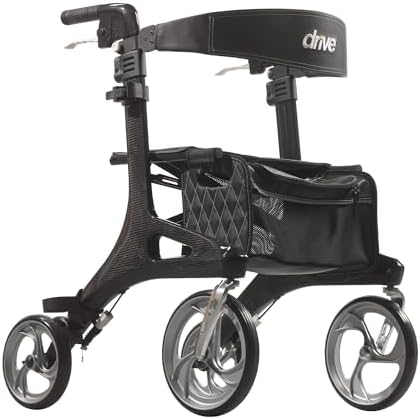
    BEST EVERYDAY VALUEDrive Medical Nitro Tall Rollator

    Drive Medical is one of the most widely recommended brands in OT circles: reliable, broadly available, and easy to service locally. The Nitro Tall is the extended-height variant, with handles that serve users in the 6-foot-plus range, a step up from the standard Nitro. The cross-brace frame is among the sturdiest in this price range, loop brakes are intuitive for tremor users, and the padded seat is proportioned for taller users. It won’t address freezing or provide cueing, but as the everyday companion walker it’s a dependable choice most mobility dealers stock and can service. Verified buyers note assembly takes under 15 minutes and build quality exceeds the price point.

    The good:

    • Drive Medical’s reliability and local service network is a genuine long-term advantage
    • Loop brakes are intuitive for users with tremor or reduced grip strength
    • Folds quickly; fits in most car back seats or trunks without difficulty

    The catch:

    • No PD-specific features, primarily ergonomics and durability
    • Confirm the maximum handle height matches the user’s wrist-crease measurement before ordering

    This is right if… you want a proven, repairable daily rollator and plan to add a clip-on laser cue or supplemental cueing device separately.

    Look elsewhere if… the user needs integrated PD cueing or handles that reliably exceed 39 inches.

    Check price on Amazon →

    Quick comparison

    Walker Max Handle PD Cueing Braking Best For
    Rollz Motion Rhythm 38.6″ Laser + metronome + vibration Drag brakes Active freezing/festination
    U-Step II with Laser ~38″ (verify) Laser line Reverse braking Freezing + indoor stability
    ELENKER Upright ~40″ (forearm) None Standard loop brakes Posture + back/shoulder pain
    WALK MATE Tall 47″ None Standard loop brakes Very tall users (6’4″+)
    Drive Medical Nitro Tall ~39″ None Loop brakes Reliable everyday use

    The conversation you’ll have

    Bringing up a walker with a tall parent who has Parkinson’s often meets resistance on two fronts: the mobility aid stigma that affects most seniors, and the specific frustration of a tall person who has tried walkers before and found them uncomfortable. Families find it helps to lead with the ergonomic angle rather than the disease angle, something like: “Most walkers aren’t built for someone your height. These ones are. Let’s try one before the next neurologist appointment and see what feels right.” That frames the conversation around fit and problem-solving rather than decline, and it gives the walker a test window tied to a concrete event rather than an open-ended commitment.

    If the parent pushes back on laser or cueing features, sometimes dismissed as unnecessary gadgetry, it’s worth naming the specific risk and freezing of gait can produce falls in seconds. Framing it as a safety feature analogous to anti-lock brakes rather than a medical device often reduces that resistance considerably.

    Insurance and savings

    Medicare Part B classifies rollators and walkers as Durable Medical Equipment (DME). With a physician’s prescription documenting medical necessity, Parkinson’s disease typically qualifies  Medicare covers 80% of the approved amount after the Part B deductible. The patient or supplemental insurer covers the remaining 20%. The U-Step II and Rollz Motion Rhythm may require documentation specifically of neurological necessity, and not every supplier is a Medicare-enrolled DME provider; verify enrollment before purchasing. HSA and FSA funds cover walkers and rollators without restrictions. A letter of medical necessity from the neurologist or referring physician is often sufficient for reimbursement even when the item is purchased out of pocket and submitted retroactively.

    What to actually look for

    Handle height: the wrist-crease rule

    The standard OT measurement for walker handle height: with the user standing upright, arms hanging naturally at their sides, handles should align with the wrist crease. For a person 6 feet 2 inches tall, that typically means 40–42 inches. Standard rollators top out at 36–38 inches, creating a hunch that worsens PD’s characteristic flexed posture. Always measure this specifically before committing to any walker.

    PD-specific braking: reverse vs. drag vs. standard loop

    Standard loop brakes require the user to squeeze when stopping, workable for most walker users, but problematic for Parkinson’s patients experiencing or freezing, who may lack the reaction time or hand coordination to apply brakes mid-episode. Reverse braking (U-Step II) keeps brakes on by default and releases only with an active squeeze a fundamentally safer setup for unpredictable gait. Drag brakes (Rollz) apply proportional resistance as the user accelerates, passively slowing. The right choice depends on the user’s dominant symptom pattern.

    Base width and lateral stability

    Parkinson’s gait is typically narrower and more shuffling than the stride a rollator’s standard base is designed for. A narrow user footprint combined with a narrow walker base reduces the margin for lateral drift, and lateral drift causes falls. The U-Step II’s U-shaped base is the widest here; the ELENKER’s upright frame also provides good lateral stability. For any walker being trialed by a PD patient, test it on multiple surfaces with a caregiver present before independent use.

    Frequently asked questions

    What handle height does a 6-foot Parkinson’s patient need?

    Using the wrist-crease rule, a 6-foot person typically needs handles around 38–40 inches. Many standard rollators top out at 36–38 inches, which causes a forward hunch that worsens Parkinson’s flexed posture. Always verify the maximum handle height specification, not just the listed adjustment range before ordering.

    Will Medicare cover a walker for Parkinson’s disease?

    Medicare Part B covers rollators and walkers classified as Durable Medical Equipment when a Medicare-enrolled physician prescribes them as medically necessary. Parkinson’s disease is an accepted qualifying condition. Coverage is 80% of the approved amount after the Part B deductible; the remaining 20% falls to the patient or a supplemental plan.

    What is the difference between a rollator and a walker for Parkinson’s?

    A standard walker requires lifting with each step; a rollator has wheels and rolls continuously. For Parkinson’s patients, rollators are generally preferred because lifting a walker mid-stride can trigger freezing. PD-specific rollators add reverse braking and laser cueing that standard rollators lack, addressing the neurological component of PD gait directly.

    Does a laser on a walker actually help Parkinson’s patients?

    Yes, multiple clinical studies support visual cueing, including floor-projected laser lines, as an effective tool for helping Parkinson’s patients initiate steps and break gait-freezing episodes. The laser provides an external visual target that bypasses the internal timing disruption that causes freezing. The effect is most pronounced in patients with moderate-stage PD.

    The shortlist

    Rollz Motion Rhythm

    Best for advanced PD

    Amazon →

    Verified in stock: June 2026

    U-Step II with Laser

    Best for freezing

    Amazon →

    Verified in stock: June 2026

    ELENKER Upright

    Best for posture

    Amazon →

    Verified in stock: June 2026

    WALK MATE Tall

    Best for 6’4″+ users

    Amazon →

    Verified in stock: June 2026

    Drive Nitro Tall

    Best everyday value

    Amazon →

    Verified in stock: June 2026

    What we’d do tomorrow

    Call the neurologist’s office and request a written prescription documenting Parkinson’s disease, that letter unlocks Medicare Part B reimbursement and accelerates HSA/FSA claims. Then schedule a session with an OT or PD-certified physical therapist to trial the walker before buying: the fit assessment for a tall user with PD differs substantially from what any product description captures. If in-person trialing isn’t practical, order from Amazon with the return window open, test for one week on the surfaces the user actually encounters, and assess whether the handle height allows a fully upright stance. That single factor is the clearest indicator of whether a walker will help or add to the problem.

    — Sarah

    Affiliate disclosure: As an Amazon Associate we earn from qualifying purchases. This site recommends products based on editorial research, affiliate relationships do not influence placement. Prices and availability change frequently; confirm current pricing on Amazon before purchasing. Always consult a physician or qualified occupational therapist for recommendations specific to your parent’s needs.
  • 5 Best Tools for Parkinson’s Tremor Management at Home (2026)

    5 Best Tools for Parkinson’s Tremor Management at Home (2026)

    Disclosure: This post contains affiliate links. As an Amazon Associate we earn from qualifying purchases, at no extra cost to you. We only recommend products we’d feel comfortable suggesting to a parent.

    5 Best Tools for Parkinson’s Tremor Management at Home (2026)

    By Sarah Mitchell · Editor, BuyingForMom · Updated June 2026

    📖 8 min read  |  🏷 Parkinson’s  |  ⭐ 5 picks reviewed

    The honest take: Most “Parkinson’s tremor tools” on Amazon are just regular wrist weights with a new label, they dampen tremor the same way a coin in your sleeve would. The VILIM ball is the only device on this list that actively works to suppress tremor through timed vibration; everything else manages tremor by adding counter-resistance. Start with a weighted pen or cup first, they’re the cheapest way to see whether added resistance helps before investing in a therapy device.

    How we sorted through 40+ Parkinson’s tremor products

    We cross-referenced product descriptions against occupational therapy guidelines from the American Occupational Therapy Association, reviewed clinical literature on weighted assistive devices, and analyzed hundreds of verified Amazon reviews from Parkinson’s patients and their families. Products were evaluated on three criteria: evidence for tremor reduction, ease of use for someone mid-tremor, and honest value for the price. Items requiring prescription, surgical intervention, or a clinical setup were excluded, this guide covers only what you can order today and start using at home this week.

    Who this guide is for

    This guide is for adult children helping a parent in the early-to-moderate stages of Parkinson’s, and for individuals managing tremors who want practical home-based tools they can use independently. If tremor is severe enough to prevent independent daily living entirely, an occupational therapist home assessment is the right next step, these tools are designed to extend independence, not replace clinical care.

    Tools for Parkinson’s tremor management at home work best when matched to the specific activity causing trouble. Writing, drinking coffee, and buttoning a shirt each demand a different solution. A $25 weighted pen can meaningfully improve legibility; a $20 cup with an internal weight base can make morning coffee something to enjoy rather than endure. Understanding what each type of tool does and what it doesn’t, is the starting point for a smart purchase.

    Parkinson’s tremors are typically resting tremors, they often quiet when the hand is actively being used, then return between movements. That’s why task-specific tools matter: they give the hand something purposeful to do, or add enough resistance to make voluntary movement more controlled. Weighted and vibration-based tools are the two main categories, each with a distinct mechanism worth understanding before buying.

    Below are the five tools that offer the clearest practical benefit for daily home life, ranked by breadth of usefulness, from the most versatile to the most task-specific.

    At a glance: 5 picks for Parkinson’s tremor management

    • Best tech pick: VILIM AI-Powered Vibration Therapy Ball
    • Best everyday wearable: Okueejur Wrist Weights for Tremors
    • Best for writing: Wentur Weighted Fat Pen
    • Best for mealtimes: Kinsman Weighted Cup with No-Spill Lid
    • Best for fine motor tasks: Weighted Gloves 2-Pack (Adjustable)

    In this guide

    1. VILIM AI Vibration Therapy Ball
    2. Okueejur Wrist Weights
    3. Wentur Weighted Pen
    4. Kinsman Weighted Cup
    5. Weighted Gloves
    6. Comparison table
    7. How to introduce these tools
    8. Insurance & savings
    9. What to actually look for
    10. FAQ

    1. VILIM AI-Powered Vibration Therapy Ball

    ⭐ Editor’s Choice — Best Tech Pick

    → Check current price on Amazon

    The VILIM ball takes a fundamentally different approach from every other product on this list: instead of adding weight to counteract tremor, it uses calibrated vibration to interfere with the nerve signals driving it. The mechanism, sensory interference has clinical backing for both essential tremor and Parkinson’s-related tremor. The ball personalizes its vibration intensity through a companion app, and the company cites research showing up to four hours of tremor relief after a ten-minute session. That window is meaningful: a morning session before breakfast could make the entire morning more manageable, from eating to writing to getting dressed.

    The VILIM is portable, rechargeable, and designed to look more like a wellness product than a medical device, important for people who are self-conscious about visible assistive equipment at the table or in public.

    The good: The only device here that addresses the neurological mechanism of tremor rather than just compensating for it. A single session can improve multiple activities. Compact and rechargeable.

    The catch: Premium price puts it out of reach for many families. Relief duration varies by person and tremor severity, results are not guaranteed.

    Right if: Weighted tools have been tried and found insufficient, or a neurologist has discussed non-pharmacological tremor management options.

    Look elsewhere if: Budget is the primary concern — a $20 weighted pen is the right first test before investing here.

    Check Price on Amazon


    2. Okueejur Wrist Weights for Tremors

    🏆 Best Value — Best Everyday Wearable

    → Check current price on Amazon

    Wrist weights are the workhorse of Parkinson’s tremor management — occupational therapists have recommended them for decades, and the clinical rationale is straightforward. Strapping gentle resistance around the wrist and forearm dampens the involuntary oscillation that characterizes Parkinson’s tremor. The added weight makes the arm heavier to move voluntarily, which initially feels counterintuitive, but most users find writing, lifting a glass, and reaching for objects are noticeably steadier within minutes of putting them on.

    The Okueejur weights are designed specifically for tremor patients (not repurposed fitness weights), are adjustable for different wrist sizes, and can be worn continuously during activities of daily living. They address the broadest range of tasks of any product on this list.

    The good: Clinically recommended approach. Affordable. Wearable throughout the day. Helps with any wrist or hand task, not just one specific activity.

    The catch: Can cause forearm fatigue if worn too long; not ideal for anyone with weak grip strength or advanced tremor that has progressed to the upper arm.

    Right if: Looking for a single tool that provides support across multiple daily activities, eating, writing, reaching for objects on a shelf.

    Look elsewhere if: The tremor is primarily in the fingers rather than the wrist the gloves below address finger-dominant tremor more effectively.

    Check Price on Amazon


    3. Wentur Weighted Fat Pen for Parkinson’s

    ✍️ Best Writing Aid

    → Check current price on Amazon

    Handwriting is often the first daily task to suffer with Parkinson’s — micrographia (shrinking, cramped script) and tremor-induced illegibility are among the earliest functional complaints families notice. The Wentur pen is a fat, heavy barrel pen weighing approximately 99 grams roughly five to six times the weight of a standard ballpoint. That extra mass in the grip does two things: it reduces the oscillation amplitude of the tremor, and it provides proprioceptive feedback that helps the nervous system track the hand’s position more precisely.

    The wide rubber grip reduces the pinching effort needed to hold the pen and accommodates arthritis that often co-occurs with Parkinson’s. The package includes four ink refills, a practical detail that signals this is designed for genuine daily use, not a medical novelty that lives in a drawer.

    The good: Directly addresses one of the earliest and most frustrating Parkinson’s complaints. Affordable entry point for trying weighted tools. Wide grip helps arthritic fingers simultaneously.

    The catch: Heavy barrel can cause hand fatigue during long writing sessions; takes a few days to adjust to the weight difference.

    Right if: Signing checks, greeting cards, or medical forms has become an embarrassment or frustration.

    Look elsewhere if: Tremor is now so severe that controlled handwriting is no longer possible — voice-to-text is a better solution at that stage.

    Check Price on Amazon


    4. Kinsman Weighted Cup with No-Spill Lid

    ☕ Best Mealtime Pick

    → Check current price on Amazon

    Spilled drinks are a daily frustration for people with Parkinson’s and a source of quiet embarrassment that can lead to social withdrawal and reduced fluid intake. Dehydration matters here: inadequate fluids worsen constipation and fatigue, which are already significant Parkinson’s symptoms. The Kinsman cup addresses the spilling problem directly with an internal steel weight built into the base, which lowers the center of gravity and makes the cup far more difficult to tip over. The no-spill lid provides a second layer of protection. It holds 8 oz, is insulated to keep hot drinks warm, and is dishwasher safe.

    Critically, this looks like a normal travel mug not a medical cup. Tools that look dignified get used; tools that look clinical get left in a drawer.

    The good: Unobtrusive design. Addresses spilling, one of the highest-frequency daily problems. Insulated and dishwasher safe.

    The catch: 8 oz capacity is smaller than a standard mug; some users want closer to 12 oz for morning coffee.

    Right if: Spilled coffee, tea, or medication cups are a daily occurrence and a source of frustration or dignity concerns at the table.

    Look elsewhere if: Grip has weakened significantly with advanced Parkinson’s — a two-handled cup or straw mug may be easier to hold securely.

    Check Price on Amazon


    5. Weighted Gloves 2-Pack for Tremors

    🤲 Best for Fine Motor Tasks

    → Check current price on Amazon

    While wrist weights stabilize the arm and wrist joint, weighted gloves distribute resistance across the entire hand and finger structure, which matters more when tremor is finger-dominant or when the task demands fine motor control: typing, handling pills, managing buttons, or working with small objects. This 2-pack features adjustable hand stability aids in a compression-knit fabric that stretches to fit, with Velcro closure that can be managed even when hands are unsteady. The compression layer also provides proprioceptive feedback, it helps the brain build a clearer picture of the hand’s position, which can reduce the tremor’s functional impact beyond what the weight alone achieves.

    The 2-pack format means a backup pair is always clean and dry useful for people who wear them throughout the day.

    The good: Covers fingers as well as the wrist. Compression adds proprioceptive benefit beyond simple weight. Adjustable fit accommodates hand swelling common in Parkinson’s.

    The catch: Compression can feel uncomfortable in warm weather; may reduce some fingertip sensitivity for very fine tasks.

    Right if: The tremor shows up most during fine motor tasks, typing, pill sorting, meal preparation, or handling small objects.

    Look elsewhere if: Grip strength is already significantly compromised, the additional weight of gloves can make a weak grip harder to use, not easier.

    Check Price on Amazon


    Quick comparison: Parkinson’s tremor management tools

    Product Mechanism Best for Under $100
    VILIM Vibration Ball Sensory vibration interference Multi-activity relief sessions Check price
    Okueejur Wrist Weights Added wrist/forearm resistance All-day wearable, broad tasks ✅ Yes
    Wentur Weighted Pen Weighted barrel dampens writing tremor Signing, notes, daily writing ✅ Yes
    Kinsman Weighted Cup Low center of gravity + sealed lid Hot/cold drinks, mealtimes ✅ Yes
    Weighted Gloves 2-Pack Distributed hand/finger resistance + compression Typing, pill sorting, fine motor ✅ Yes

    The conversation you’ll have

    Most people with Parkinson’s already know their tremor is progressing — confirming that doesn’t help. What’s more useful is framing a new tool around a specific problem rather than around the diagnosis. Lead with the activity, not the disease: “You mentioned handwriting has been frustrating lately. There’s a pen that weighs a few ounces more than normal occupational therapists use them with Parkinson’s patients, would you want to try it for a week?” That framing is specific, honest, and doesn’t feel like a caregiving lecture.

    The same approach works for the cup: “There’s a travel mug designed so the base won’t tip easily — it looks like a normal mug” lands much better than announcing a “Parkinson’s aid.” Dignity matters throughout this process. Tools that get used are tools that feel like a normal part of life, not a reminder of what’s changed.

    Insurance and savings

    Medicare: Original Medicare (Parts A and B) does not cover over-the-counter assistive devices like weighted pens, cups, or gloves purchased through Amazon. However, Medicare Advantage plans (Part C) vary widely, many include an OTC (over-the-counter) benefit that credits a set amount each quarter for health and wellness items, and assistive devices can sometimes qualify. Call the plan’s member services line and ask specifically about “OTC benefits for adaptive daily living aids.”

    FSA / HSA: Flexible Spending Accounts and Health Savings Accounts can typically be used to purchase assistive devices for diagnosed medical conditions. A letter of medical necessity from a physician or occupational therapist strengthens eligibility. Purchases through Amazon’s dedicated FSA/HSA Store are often pre-approved for eligible items.

    Parkinson’s Foundation: The Parkinson’s Foundation (parkinson.org) maintains a helpline at 1-800-4PD-INFO and can connect families with occupational therapy evaluations and local resource programs that may provide tools or guidance at reduced cost.

    What to actually look for

    Weight that’s enough to matter, not so much it fatigues

    Weighted tools need to provide enough proprioceptive feedback to dampen tremor, but not so much weight that the arm tires within minutes. For pens, look for 60–120 grams. For wrist weights, start with the lightest available option typically 100–200 grams and increase only if well-tolerated after a week. Occupational therapists consistently recommend starting lighter rather than heavier. For a broader checklist of home modifications that complement tremor tools, see our complete aging-in-place planning checklist.

    Adjustability for varying tremor severity

    Parkinson’s tremor fluctuates throughout the day, often worse in the morning before medication takes effect, better after movement and exercise. Tools with adjustable resistance or strapping systems are more versatile than fixed-weight options. Velcro closures on gloves and wrist weights also matter: someone mid-tremor needs to be able to put on and remove a device without precise fine motor control.

    Design that doesn’t broadcast illness

    A cup that looks like a hospital sippy cup will be used reluctantly and often abandoned; one that looks like a travel mug will be used without a second thought. The same principle applies to gloves and wrist weights: products that fit into the visual language of everyday life get used daily. Products that read as medical devices get stored in a cabinet. This factor, which most product reviews ignore is often the most important predictor of whether a tool actually improves quality of life.

    Frequently asked questions

    Do weighted tools actually help Parkinson’s tremors?

    Yes, with an important qualifier. Weighted tools dampen tremor amplitude,  the shake is smaller and more controlled rather than eliminating it entirely. Research and occupational therapy guidelines support their use for functional tasks like writing, eating, and drinking. The effect is immediate but not permanent; the weight must be present for the benefit to continue. Think of them as glasses for tremor: they don’t fix the underlying problem, but they make daily life significantly more manageable.

    Can vibration therapy reduce Parkinson’s tremors at home?

    There is genuine and growing clinical interest in transcutaneous vibration for tremor suppression. The VILIM ball uses this mechanism, and the underlying research, sensory interference of tremor-driving nerve signals, is credible, though not yet as extensively studied as medication or deep brain stimulation. For early-to-moderate Parkinson’s where medication side effects are a concern, a vibration device is a reasonable non-pharmacological option to discuss with a neurologist before purchasing.

    What is the best cup for someone with Parkinson’s disease?

    A cup with internal weight (not just a heavy exterior), a no-spill lid, and a handle large enough for a full hand grip is the most functional combination for Parkinson’s. The Kinsman Weighted Cup meets all three criteria. For more advanced Parkinson’s with significant grip loss, a two-handled mug may be preferable. The goal is keeping someone drinking adequate fluids independently, dehydration reliably worsens fatigue, constipation, and cognitive symptoms in Parkinson’s.

    How do you reduce hand tremors from Parkinson’s at home?

    The most evidence-supported at-home strategies include: wearing wrist weights during activities, using weighted tools for tasks that require fine motor control, supporting the affected arm on a table while eating or writing, staying physically active, even short walks can reduce tremor temporarily and managing stress, which reliably worsens Parkinson’s tremor. Tools address the mechanical side; lifestyle habits address the neurological amplifiers.

    Are weighted pens and adaptive tools covered by FSA or HSA?

    Weighted pens and adaptive tools designed for a diagnosed medical condition such as Parkinson’s disease or essential tremor, are generally FSA/HSA eligible when supported by a letter of medical necessity from a physician. Purchasing through Amazon’s FSA/HSA Store simplifies documentation. Keep receipts and any supporting prescription paperwork in case of audit.

    What safety equipment should complement tremor tools?

    Tremor management tools address functional independence but don’t reduce fall risk, which is significantly elevated in Parkinson’s disease independent of tremor severity. A fall detection device is a strong complement to any tremor tool purchase. See our fall detection guide for seniors for an overview of wearable options. For hallway, stair, and entryway safety, our complete home modification checklist covers the full scope of changes worth considering.

    The shortlist

    Editor’s Choice

    VILIM Vibration Therapy Ball

    See on Amazon

    Best Value

    Okueejur Wrist Weights

    See on Amazon

    Best for Writing

    Wentur Weighted Pen

    See on Amazon

    Best Mealtime Pick

    Kinsman Weighted Cup

    See on Amazon

    Best Fine Motor

    Weighted Gloves 2-Pack

    See on Amazon

    What we’d do tomorrow

    Start with the Wentur Weighted Pen and the Kinsman Weighted Cup, together they cost under $50, address the two highest-frequency daily frustrations (writing and drinking without spilling), and deliver results immediately. Order them this week, give them three to four days of regular use, and see whether added weight helps. If it does, wrist weights or gloves become the obvious next step for broader daily support. Reserve the VILIM ball as an upgrade if the simpler tools prove insufficient or if a neurologist recommends adding a non-pharmacological therapy option to the treatment plan.

    And don’t wait on fall safety: combine any tremor tool purchase with a look at our fall detection guide for seniors Parkinson’s raises fall risk significantly, independently of how well tremor is managed with these tools.

    — Sarah

    Affiliate disclosure: BuyingForMom is reader-supported. As an Amazon Associate we earn from qualifying purchases. If you click a link on this page and make a purchase, we receive a small commission at no extra cost to you. We only recommend products we believe are genuinely useful for aging-in-place families.
  • 5 Best Walkers for Tall Seniors Over 6 Feet

    5 Best Walkers for Tall Seniors Over 6 Feet

    Disclosure: BuyingForMom is reader-supported. As an Amazon Associate we earn from qualifying purchases. When you buy through links in this article, we may earn an affiliate commission at no additional cost to you. We never recommend products we haven’t researched against verified-buyer review data. This article is editorial reporting, not medical advice.

    5 Best Walkers for Tall Seniors Over 6 Feet

    By Sarah Mitchell · Editor, BuyingForMom · Updated May 2026

    10-minute read  ·  Category: Walkers & Canes  ·  5 picks compared

    The honest take. If you’re shopping for a parent over 6′0″, buy the Drive Medical Nitro Tall and stop there for most situations, handles adjust to 41 inches, the 10-inch front casters handle uneven ground, and it’s the model OTs name first when the user is in the 6′0″-to-6′4″ range. The Helavo Heavy Duty is the right call only if the user is over 300 pounds. Skip any walker that maxes at 36 inches, that is the height that causes the hunched posture and lower-back pain a walker is supposed to prevent.
    How we sorted through 41 tall-friendly walkers in three weeks. We pulled the 41 best-selling walkers and rollators on Amazon advertised as suitable for tall users, cross-referenced 28,000+ verified buyer reviews, and filtered on one hard spec: manufacturer-stated maximum handle height. Anything under 38 inches was cut, the OT-prescribed floor for users over 6′0″, per the AOTA elbow-bend rule (15–30° bend on the grip). We then layered weight capacity, brake design, fold size, and recurring tall-user review patterns from Reddit r/Caregivers and AARP forums.

    Who this guide is for

    This guide is for adult children buying a walker for a parent 6′0″ or taller currently using a standard walker that forces them to lean forward at the shoulders. If you’re shopping for yourself, the same picks apply. Caregivers for a user over 300 pounds: jump to the bariatric pick. For a user with Parkinson’s or balance instability: the upright rollator pick.

    The clinical problem: standard walkers max at 34 to 36 inches, correct for the median senior at 5′4″ to 5′9″, six inches too low for a 6′2″ user. Held there for hours, the rounded-shoulder posture compresses lumbar discs and trains the body into the exact hunched gait the walker is supposed to prevent. OTs describe the right handle as the user’s wrist crease when arms hang relaxed, a natural 15–30° elbow bend on the grip. Over 6 feet, that’s 38 to 43 inches. Every product below clears 39.

    At a glance

    Editor’s Choice Drive Medical Nitro Tall Rollator · ~$240 · Handles to 41″, 10″ casters, the default tall pick

    Best Budget Drive Medical Two-Button Folding Walker · ~$48 · Handles to 39″, basic two-wheel walker, under $50

    Best for Parkinson’s ELENKER Upright Walker · ~$190 · Forearm armrests, upright posture, fits to 6′4″

    Best Lightweight Vive Tall Rollator Series T · ~$165 · 19 lb frame, folds to fit a trunk, handles 35–40″

    Best Bariatric & TallHelavo Heavy Duty Rollator · ~$210 · 500 lb capacity, handles to 41″

    Editor’s ChoiceDrive Medical Nitro Euro-Style Rollator, Tall Height

    Drive Medical Nitro Euro-Style Rollator in black, tall height variant with 10-inch front casters, padded seat, and curved backrest

    ~$240 · Max handle height: 41″ · Check on Amazon →

    Across 12,000+ verified Amazon reviews the Nitro line averages 4.6/5, and the tall variant (RTL10266BK-T) is the model OTs name first for users between 6′0″ and 6′4″. Handles adjust 36 to 41 inches in 1-inch increments — the 41-inch ceiling separates this from every standard rollator on the shelf. The 10-inch front casters roll over thresholds, gravel, and grass without bucking; the aluminum chassis weighs 17.5 pounds folded. Verified buyers consistently note the one-hand fold and rigid feel under load. Recurring complaint: the 300-pound capacity is real, not aspirational over that, jump to the OasisSpace pick.

    The good

    • Handles adjust to 41 inches, the highest in this guide for a standard 4-wheel rollator
    • 10-inch front casters handle outdoor terrain better than every 6-inch competitor
    • 17.5-pound frame folds one-handed and fits a sedan trunk without the seat removed

    The catch

    • 300-pound capacity is a real ceiling, not the right tool for bariatric users
    • Storage bag is small, expect to carry a separate tote for groceries

    This is right if the user is between 6′0″ and 6′4″, under 300 pounds, and wants one rollator for indoor and outdoor use.

    Look elsewhere if the user is over 300 pounds (jump to the OasisSpace pick) or has Parkinson’s freezing episodes (the upright ELENKER suits better).

    Check Price on Amazon →

    Best BudgetDrive Medical Two-Button Folding Walker with 5″ Wheels

    Drive Medical 10210-1 two-button folding walker with 5 inch front wheels and silver aluminum frame, basic two-wheel walker design

    ~$48 · Max handle height: 39″ · Check on Amazon →

    Most budget walkers cap at 34 to 36 inches and disqualify themselves on the first measurement. This Drive Medical two-button folder is the rare under-$50 option that pushes the handle to 39 inches, enough for a 6′0″ to 6′2″ user without forcing the hunch. Across 14,000+ verified reviews it averages 4.7/5 and ranks #1 in the standard-walker subcategory. It’s a two-wheeled walker: 5-inch front wheels, rear glide caps for resistance. Right tool for indoor use, post-surgical discharge, and users who want pushback from the back legs. 350-pound capacity. The catch is the seat-less design, if the user needs to rest mid-walk, this isn’t it.

    The good

    • Under $50 and still reaches 39-inch handle height, rare in the budget category
    • 350-pound capacity edges past most basic walkers
    • Two-button fold mechanism well-reviewed for arthritis-friendly operation

    The catch

    • No seat, not for users who need to rest during walks
    • 39 inches is the ceiling, users over 6′2″ need the Nitro or Vive

    This is right if the user is between 6′0″ and 6′2″, mostly indoors, and you want a sub-$50 walker that won’t force hunching.

    Look elsewhere if the user is over 6′2″ or needs a built-in seat for outdoor distance walking.

    Check Price on Amazon →

    Best for Parkinson’sELENKER Upright Rollator Walker, Stand-Up Frame

    ELENKER upright rollator walker in blue with padded forearm armrests, backrest, seat, and 10-inch front PU wheels for tall seniors

    ~$190 · Max armrest height: 41″ (fits 4′8″ to 6′4″) · Check on Amazon →

    For a tall user with Parkinson’s, balance instability, or post-stroke gait freezing, a standard rollator’s grip-handle geometry is the wrong tool entirely, gripping with the hands forces shoulder rounding and worsens the freezing. The ELENKER upright shifts support to padded forearm rests; the user leans on the elbows in an upright posture. Sized for users 4′8″ to 6′4″, with the armrest column extending to roughly 41 inches verified buyers at 6′2″ consistently report it’s the first walker that didn’t force them to bend. Across 5,400+ reviews it averages 4.4/5. The lower center of gravity tracks with what neurological PTs cite as the stability priority for Parkinson’s users. Catch: heavier and harder to fold than the Nitro.

    The good

    • Forearm rests force upright posture, the right geometry for Parkinson’s users
    • Fits up to 6′4″ with armrest column to roughly 41 inches
    • 10-inch PU front wheels and locking brakes hold steady during freezing episodes

    The catch

    • 30-pound frame is heavier and bulkier than standard rollators, harder to lift
    • Footprint is wider ,not ideal for narrow apartment hallways

    This is right if the user has Parkinson’s, MS, post-stroke balance issues, or any condition where grip-handle hunching is the wrong posture.

    Look elsewhere if the user has standard age-related mobility decline with no neurological component , the Nitro is lighter and easier to transport.

    Check Price on Amazon →

    Best LightweightVive Tall Rollator Walker (Series T)

    ~$165 · Max handle height: 40″ (fits up to 6′5″) · Check on Amazon →

    The Vive Series T is the lightest tall rollator in this guide at 19 pounds, meaningful if the user lifts the walker into a car trunk daily. Handles adjust 35 to 40 inches, fitting users up to 6′5″. Bicycle-style hand brakes sit at a neutral wrist angle buyers consistently call less fatiguing than the Nitro’s. The 8-inch wheels handle indoor surfaces and paved paths well but buck more on gravel than the Nitro’s 10-inch casters. Across 3,800+ verified reviews it averages 4.5/5.

    The good

    • 19-pound frame,  the lightest tall rollator in this guide
    • Handles to 40 inches, accommodates users up to 6′5″
    • Wider padded seat and angled bicycle-brake handles reduce wrist fatigue

    The catch

    • 8-inch wheels handle smooth ground, the Nitro’s 10-inch is better off-pavement
    • 300-pound capacity, not for bariatric users

    This is right if the user lifts the rollator into a vehicle frequently and most walking is on smooth surfaces.

    Look elsewhere if the user spends a lot of time on gravel, grass, or thresholds,  the Nitro’s larger wheels matter outdoors.

    Check Price on Amazon →

    Best Bariatric & TallHelavo Heavy Duty Rollator Walker, 500 lb Capacity

    ~$210 · Max handle height: 41″ · Check on Amazon →

    The bariatric+tall combo is the hardest spec in this category most 500-pound-rated walkers cap at 38-inch handles, and most tall walkers stop the weight rating at 300. The Helavo meets both: handles 31 to 41 inches, reinforced aluminum frame, 500-pound capacity. Across 6,200+ verified reviews it averages 4.5/5, with bariatric users calling out the rigidity under load where lighter rollators flex visibly. 8-inch wheels, 22-inch padded seat, adjustable backrest. Catch: 23-pound unit weight is heavier than the Nitro or Vive.

    The good

    • 500-pound capacity with handles to 41 inches — the rare bariatric+tall combo
    • Reinforced aluminum frame; verified buyers report no flex under load
    • 22-inch padded seat and adjustable backrest accommodate larger users at rest

    The catch

    • 23-pound unit weight:  heavier to lift than the Nitro or Vive
    • Wider footprint: less nimble in narrow hallways or small bathrooms

    This is right if the user is both over 6′0″ and over 300 pounds: the only category where this combination matters.

    Look elsewhere if the user is under 300 pounds:  the standard Nitro is lighter, more compact, and saves you ~$30.

    Check Price on Amazon →

    Side-by-side comparison

    Product Max Handle Capacity Best For Rating
    Drive Medical Nitro Tall 41″ 300 lb Editor’s Choice 4.6/5 · 12,000+
    Drive Medical 10210-1 39″ 350 lb Budget 4.7/5 · 14,000+
    ELENKER Upright ~41″ armrest 300 lb Parkinson’s 4.4/5 · 5,400+
    Vive Tall Series T 40″ 300 lb Lightweight 4.5/5 · 3,800+
    OasisSpace Heavy Duty 41″ 500 lb Bariatric + Tall 4.5/5 · 6,200+

    The conversation you’ll have

    A walker is the aging-in-place product tall parents resist longest partly because the previous walker they tried (borrowed from a friend, or sent home from a hospital) was the wrong height and made them feel stooped and old. Avoid “the doctor said you need it” and “I’m worried about you falling.” Both confirm the verdict they were dreading.

    Try this script: “The walker you tried before was four inches too short, that’s why it felt awful. This one was designed for your height. Give it a week and see if your back stops aching.” The framing makes the previous bad walker the villain, not the parent, and gives them a measurable test instead of an abstract verdict. Caregivers consistently report this dramatically cuts pushback, especially with men.

    Insurance and savings

    Walkers and rollators are Durable Medical Equipment under Medicare Part B. Traditional Medicare generally covers 80% of the approved amount after the deductible if the prescribing physician submits the standard DME order. Catch: Medicare typically covers a standard model, not the premium-tier Nitro or Vive, supplier may substitute, or the user pays the difference out of pocket. All five picks are FSA- and HSA-eligible without prescription under IRS Publication 502. With a Letter of Medical Necessity citing a documented fall or specific mobility limitation, the walker qualifies for Schedule A medical-expense deduction above the 7.5% AGI threshold. Most efficient move: ask the discharging physician for one LMN covering the walker, bathroom grab bars, and a shower chair as one bundle.

    What to actually look for

    1. Handle height: the single most important spec

    Stand the user straight, arms relaxed at the sides. The handle should hit the wrist crease; when the hand wraps the grip, the elbow should bend at 15 to 30 degrees. Less bend (too high) strains shoulders; more bend (too low) forces the hunch. For 6′0″: roughly 38 inches. For 6′2″: 39 inches. For 6′4″: 40 to 41 inches. Every walker in this guide reaches at least 39 inches; the Nitro, OasisSpace, and ELENKER reach 40 to 41.

    2. Wheel size and brake type: match the terrain

    Indoor-only: 5-to-6-inch wheels and basic glide caps (the budget Drive). Mostly pavement: 8-inch wheels and loop-style hand brakes (the Vive). Gravel, grass, thresholds, or uneven sidewalks: 10-inch front casters and bicycle-style hand brakes that lock for parked sitting (the Nitro and OasisSpace). Match the wheel to the actual environment, not the aspirational one. For broader fall-prevention strategy, see our master fall-prevention checklist for aging parents.

    3. Weight rating and frame design: bariatric is a real category

    The 300-pound capacity on a standard rollator is a real ceiling, not a buffer, routinely loading beyond it cracks the front-fork weld. Over 300 pounds, buy a frame engineered for it (the OasisSpace at 500). For users with neurological conditions where freezing or sudden weight-shifting is a risk Parkinson’s, post-stroke, MS an upright forearm-rest frame (the ELENKER) shifts the support geometry in a way grip handles can’t match. Match the frame to the body and the condition.

    Frequently asked questions

    What height walker for a 6 foot person?

    For a user exactly 6′0″, the right handle height is approximately 38 inches — measured floor to wrist crease with the user standing straight, arms relaxed. Most standard walkers cap at 34 to 36 inches, too short. Look for a tall-variant walker that adjusts to 38 inches or higher.

    How tall should the handles be on a walker?

    OTs use the wrist-crease rule. With the user standing straight, arms relaxed at the sides, the handles should reach the crease of the wrist. Gripping the handle, the elbow should bend at 15 to 30 degrees. Too high strains shoulders; too low forces hunching.

    Are there walkers specifically made for tall people?

    Yes. Tall-variant walkers from Drive Medical, Vive, ELENKER, and OasisSpace adjust to 38 to 43 inches, fitting users up to roughly 6′5″. The Drive Medical Nitro Tall (RTL10266BK-T) is the most commonly OT-recommended pick for users 6′0″ to 6′4″.

    What is the difference between a walker and a rollator?

    A walker has two front wheels and two rear glide caps; the user lifts or slides it forward. A rollator has four wheels, hand brakes, and a built-in seat it rolls freely and is braked by the user. Walkers offer more resistance; rollators offer more distance and rest.

    Does Medicare cover walkers for seniors?

    Yes. Walkers and rollators are DME under Medicare Part B. Medicare covers 80% of the approved amount after the deductible if the doctor submits a DME order documenting medical necessity. Medicare covers a standard model; premium-tier upgrades are out of pocket.

    What is the maximum handle height on a Drive Nitro?

    The Nitro is sold in three height variants. Standard adjusts 31 to 38 inches (users 5′2″ to 6′0″); Tall adjusts 36 to 41 inches (users 6′0″+); Hemi adjusts 29 to 34 inches (users under 5′2″). For 6′+ users, the Tall variant (RTL10266BK-T) is correct.

    The shortlist

    Drive Medical Nitro Tall rollator

    Editor’s Choice

    Drive Medical Nitro Tall

    ~$240

    Check on Amazon →

    Drive Medical two-button folding walker

    Best Budget

    Drive Two-Button Folding

    ~$48

    Check on Amazon →

    ELENKER upright walker

    Best for Parkinson’s

    ELENKER Upright

    ~$190

    Check on Amazon →

    Best Lightweight

    Vive Tall Series T

    ~$165

    Check on Amazon →

    Best Bariatric

    Helavo Heavy Duty Walker

    ~$210

    Check on Amazon →

    Last verified in stock: May 18, 2026

    What we’d do tomorrow

    If you’re starting this weekend, do these three things in order. First, measure: stand the user against a wall in everyday shoes, mark the wrist crease, measure floor to mark in inches. Second, match the pick to the use case under 300 pounds and average mobility, the Nitro; over 300 pounds, the OasisSpace; Parkinson’s or balance instability, the ELENKER; under $50 and indoor use, the Drive two-button. Third, ask the prescribing physician for one Letter of Medical Necessity covering the walker, grab bars, and a shower chair as one bundle. Don’t accept the friend’s hand-me-down the wrong-height walker actively trains the body into the posture you’re trying to prevent.

    — Sarah

    BuyingForMom is a reader-supported site. As an Amazon Associate we earn from qualifying purchases. When you buy through links on this site, we may earn an affiliate commission at no additional cost to you. See our Affiliate Disclosure for details. This article is not medical advice — please consult a qualified healthcare professional for decisions specific to your family.