Category: Post-Stroke

Products that support stroke recovery and rehabilitation at home — one-handed tools, transfer aids, and dressing/grooming accessibility devices.

  • 5 Best Transfer Boards for Seniors

    5 Best Transfer Boards for Seniors

    Disclosure: BuyingForMom is reader-supported. As an Amazon Associate we earn from qualifying purchases. When you buy through links in this article, we may earn an affiliate commission at no additional cost to you. We never recommend products we haven’t researched against verified-buyer review data. This article is editorial reporting, not medical advice.

    5 Best Transfer Boards for Seniors in 2026

    By Sarah Mitchell · Editor, BuyingForMom · Updated August 2026

    10-min read · Balance & Mobility · 5 picks compared

    The honest take: For most families, the sealed-wood Vive Transfer Board is the one to buy and stop shopping firm, notched, and priced right. Go curved plastic only if a fixed wheelchair armrest is in the way, or bariatric wood if your parent is over about 300 pounds. And skip the board entirely if your parent can’t bear any weight or push up with their arms at that point you need a lift, not a bridge.

    How we sorted through 40+ transfer boards in three weeks

    We started with every transfer and slide board carrying a verifiable Amazon listing roughly forty across wood, plastic, curved, and bariatric styles — and narrowed by three things that predict a safe transfer: real weight rating, whether the ends taper thin enough to tuck under a seated hip, and how the board behaves on the two hardest moves (wheelchair-to-bed and wheelchair-to-car). We cross-referenced more than 6,000 verified-buyer reviews, transfer-technique guidance from UMass Memorial Health and the caregiver-training group Trualta, and the patterns caregivers describe on Reddit’s r/AgingParents. The point every OT makes is the one we lead with: the board is only half the equation — the person still has to bridge across it with their arms, so match the board to the strength that’s actually left.

    Who this guide is for

    This is for adult children and family caregivers helping a parent who can no longer safely stand and pivot between a wheelchair, bed, chair, toilet, or car seat — often after a stroke, hip surgery, or hospital discharge — but who still has enough upper-body strength to scoot. If your parent can pivot on their feet with a gait belt, you may not need a board yet; if they can’t bear any weight, see the note below on when a board is the wrong tool.

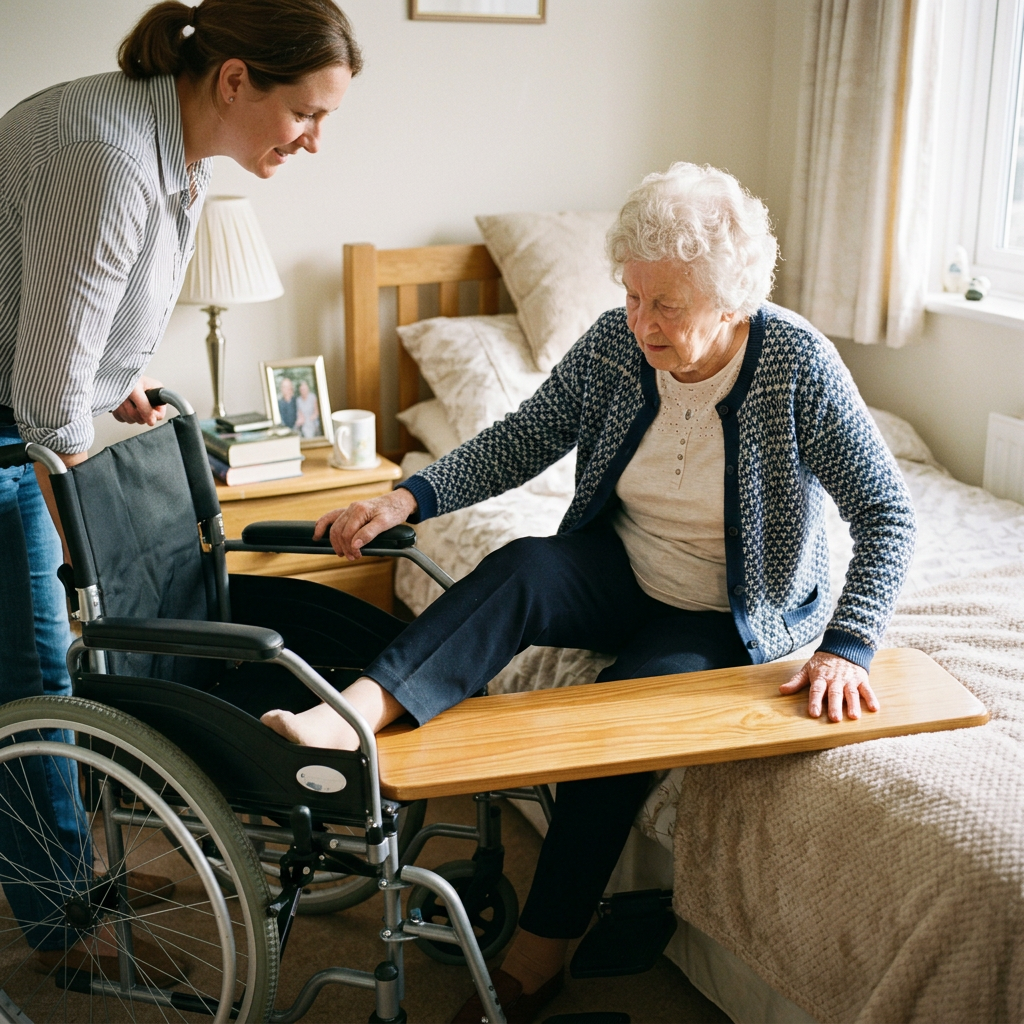
    A transfer board (also called a slide board) is a smooth, tapered plank that bridges two surfaces so a seated person slides across in short scoots instead of standing. Get the wrong one — too short for the gap, too flimsy for the weight, or too thick to tuck under a hip — and it sits in a closet while everyone goes back to risky lifting. The picks below cover the honest range, from a $22 budget board to a 735-pound bariatric plank.

    At a glance

    Best Overall  Vive Transfer Board (30″) — ~$40 · sealed wood, notched ends, the safe default for most transfers.

    Best Budget  DMI Wood Transfer Board (24″) — ~$22 · FSA-eligible Scotch pine, 440 lb, shortest gaps.

    Best Heavy-Duty  DMI Bariatric Board (32″×10″) — ~$45 · 735 lb capacity, two cut-out handles.

    Best Handholds  Drive Medical Lifestyle Board (30″) — ~$50 · lacquered birch with two hand grips for control.

    Best Curved  KRT Curved Transfer Board — ~$50 · flared polyethylene that clears a fixed wheelchair arm.

    Best Overall  Vive Transfer Board (30″)

    ~$40 · Check price on Amazon →

    If you buy one board without an OT in the room to advise you, make it this one. Vive’s 30-inch sealed-wood board hits the geometry most home transfers need: long enough to bridge a wheelchair to a bed or car seat, with notched, tapered ends thin enough to slide under a seated hip. Across more than 4,000 verified reviews the praise is consistent — it’s rigid and doesn’t flex mid-scoot the way cheap plastic does. The common complaint is honest: at roughly five pounds it’s heavier than plastic, and the surface feels cold on bare skin (a pillowcase over it fixes that).

    The good

    • Rigid sealed wood that doesn’t flex under real weight
    • Tapered, notched ends tuck cleanly under a hip
    • 30-inch length bridges the hardest gaps (bed, car)

    The catch

    • Heavier than plastic — noticeable for a caregiver lifting it repeatedly
    • Wood surface feels cold on bare skin; a pillowcase over it helps

    This is right if… your parent has decent arm strength and you want the safe, do-everything default.

    Look elsewhere if… a fixed wheelchair armrest blocks the board’s path — you’ll want the curved pick below.

    Check Price on Amazon →

    Best Budget  DMI Wood Transfer Board (24″)

    ~$22 · Check price on Amazon →

    The cheapest board we’d actually trust. DMI’s 24-inch solid Scotch-pine board is FSA- and HSA-eligible, rated to 440 pounds, and does one job well: short, same-height transfers like wheelchair-to-toilet or wheelchair-to-shower-bench. Verified buyers using it for tight bathroom transfers consistently call it sturdy for the money; nearly all the disappointment comes from people who bought the 24-inch to reach a bed and found it too short. Match the length to your gap and it’s a genuine value — just note there are no hand cut-outs, so a caregiver grips the edges.

    The good

    • Lowest price of any board we’d recommend
    • FSA/HSA eligible — spend pre-tax dollars
    • Solid 440 lb rating in a compact 24-inch length

    The catch

    • 24 inches is too short for a wide wheelchair-to-bed gap
    • No cut-out handles, so it’s harder to reposition

    This is right if… your transfers are short and same-height, like chair-to-toilet in a small bathroom.

    Look elsewhere if… you’re bridging to a bed or car — size up to the 30-inch Vive.

    Check Price on Amazon →

    Best Heavy-Duty  DMI Bariatric Board (32″×10″)

    ~$45 · Check price on Amazon →

    Standard boards top out around 400 to 440 pounds, and exceeding that rating is exactly the shortcut that ends a transfer on the floor. This DMI bariatric board is built for it: a wider 10-inch platform, an extra-thick Scotch-pine plank, two cut-out handles, and 735-pound capacity. Reviewers who bought it for a heavier parent note the same relief — it doesn’t creak or bow the way a standard board did. The width is the point and the trade-off: 10 inches feels stable but is harder to tuck under a hip, so it’s overkill for a lighter parent. Buy it for the capacity, not because bigger sounds safer.

    The good

    • 735 lb capacity genuine bariatric headroom
    • Wider 10-inch platform feels stable mid-transfer
    • Two cut-out handles make it easier to place and carry

    The catch

    • Heavy and bulky overkill for a lighter parent
    • The 10-inch width is harder to slide under a hip

    This is right if… your parent is over about 300 pounds or a standard board has flexed under them.

    Look elsewhere if… your parent is lighter — the extra size just makes transfers harder.

    Check Price on Amazon →

    Best Handholds  Drive Medical Lifestyle Board (30″)

    ~$50 · Check price on Amazon →

    Drive Medical’s lacquered-birch board is the one to reach for when control matters more than saving a few dollars. Rated to 440 pounds, it adds two hand cut-outs that give both caregiver and person something to grip — useful for guiding a scoot in controlled increments instead of one long slide. OTs often point families toward a handled board when a parent has one strong side after a stroke, since they can use the strong-side grip to pull themselves across. Reviewers note the lacquer is smoother than raw wood — a plus for sliding, but never use it on a wet surface without a towel down.

    The good

    • Two hand grips for controlled, incremental scoots
    • Smooth lacquered birch slides easily
    • Great for one-strong-side (post-stroke) transfers

    The catch

    • Slicker lacquer needs a towel on any damp surface
    • Slightly pricier than the Vive for a similar length

    This is right if… your parent has one strong side or you want handholds for control.

    Look elsewhere if… you mainly do wet-bathroom transfers — the lacquer needs a towel there.

    Check Price on Amazon →

    Best Curved  KRT Curved Transfer Board

    ~$50 · Check price on Amazon →

    Straight boards assume you can lay the board flat between two surfaces but many wheelchairs have fixed armrests sitting right in the path, and that’s where a curved board earns its keep. KRT’s polyethylene board has an arched shape and flared ends that route the transfer around an obstacle instead of fighting it, and the plastic is far lighter than any wood board here — a real plus for caregivers with wrist or back issues. Buyers who transfer in and out of a car especially favor the curve. The honest trade-off: plastic feels less solid than wood to some users, and curved boards take practice to position this is the pick where an OT’s coaching pays off most.

    The good

    • Curved shape clears a fixed wheelchair armrest
    • Much lighter than wood — easy on a caregiver’s wrists
    • Follows the natural arc of a car transfer

    The catch

    • Plastic feels less solid than wood to some users
    • Curved boards take practice to position right

    This is right if… a fixed armrest is in the way or car transfers are your main use.

    Look elsewhere if… your transfers are simple, flat, and same-height — a straight wood board is simpler.

    Check Price on Amazon →

    Transfer boards compared at a glance

    Board Price Type & capacity Best for
    Vive 30″ ~$40 Sealed wood · ~400+ lb The safe do-everything default
    DMI 24″ Wood ~$22 Scotch pine · 440 lb Short same-height transfers, budget
    DMI Bariatric 32″×10″ ~$45 Heavy wood · 735 lb Heavier parents, max capacity
    Drive Medical 30″ ~$50 Birch, hand grips · 440 lb One-strong-side / post-stroke control
    KRT Curved ~$50 Curved plastic · ~400 lb Fixed armrests, car transfers

    The conversation you’ll have

    A transfer board can land badly if it’s framed as proof your parent can’t stand anymore — for many older adults, standing to move is tied up with dignity, and a board that says “you’re a person who slides now” gets left in the box. The reframe that works is about conserving energy, not conceding it. Instead of “you can’t stand safely anymore,” try “let’s save your standing for walking to the kitchen — this just takes the scary sit-to-sit part off your legs.” You’re not taking standing away; you’re spending it where it matters.

    It also helps to make the first transfers about your back, not their weakness: “the doctor said I’ll hurt myself lifting you the old way humor me.” And borrow a professional’s authority: when an OT recommends and demonstrates the board, it stops being a family argument and becomes doctor’s orders.

    Insurance and savings

    Here’s the money reality most families get wrong. Original Medicare (Part B) covers reusable, “primarily medical” durable equipment, but low-cost transfer boards are generally treated as inexpensive convenience items and rarely approved on their own — Medicare is far more likely to authorize a patient lift for someone who truly can’t assist. Don’t count on it paying for a $40 board. The reliable path is your FSA or HSA: transfer and slide boards are widely eligible medical expenses (the DMI wood board lists FSA/HSA eligibility outright), so you can buy one pre-tax. If your out-of-pocket medical costs are high enough to itemize, a medically necessary board can also count toward the IRS medical-expense deduction under Publication 502. When in doubt, ask the OT to write the recommendation.

    What to actually look for

    Match the board type to the transfer, not the price

    The biggest mistake is buying by price instead of geometry. A straight wood board is the right default for flat, same-height moves; a curved plastic board earns its cost only when a fixed armrest or car door is in the way; and a bariatric board is about capacity, not “more is safer.” Measure your gap wheelchair-to-bed is usually the widest and buy a length that clearly bridges it. Our complete aging-in-place home safety checklist shows how transfers fit the bigger fall-prevention picture.

    Weight rating, edges, and surface

    Never buy a board rated close to your parent’s weight — leave a real margin, because a transfer puts dynamic, shifting load on the plank. Look for tapered, notched ends thin enough to slip under a seated hip; a thick, blunt end is the reason many boards never get used. Consider surface, too: sealed or lacquered wood slides well but is cold and slick when wet, while textured plastic grips more. Whatever you choose, the room matters as much as the board — see our room-by-room aging-in-place modification guide for clearing the path and anchoring the surfaces you transfer between.

    Know when a board is the wrong tool

    This is the part the listicles skip. A transfer board is a bridge, not a lift — it only works if your parent can bear some weight through their arms and bridge across in short scoots. If they can’t push up with their arms or hold themselves upright once seated, no board is safe, and you’re into lift or sling territory. A proper transfer belt for the standing-pivot moves you can still do safely is often the better middle step; our guide to gait and transfer belts for seniors covers when a belt beats a board. And whatever you buy, have a therapist demonstrate the first transfers — every credible source, ours included, treats that as non-negotiable.

    Frequently asked questions

    How do you use a transfer board?

    Position the two surfaces close, with the destination ideally slightly lower. Tuck one end of the board under the person’s hip and rest the other on the target seat. With a gait belt on, they push up on their fists and scoot across in several short moves rather than one long slide, keeping fingers off the edges.

    What is the weight limit of a transfer board?

    Standard boards are typically rated 200 to 500 pounds, with most quality wood boards at 400 to 440 pounds. Bariatric boards go higher — the DMI board here holds 735 pounds. Always leave a comfortable margin above your parent’s weight, since a transfer applies shifting, dynamic load rather than a still one.

    What’s the difference between a transfer board and a slide board?

    The terms overlap. “Transfer board” usually means a rigid plank you scoot across; “slide board” is often used the same way, though it can also describe one paired with a low-friction slide sheet for the weakest users. For home use, most people mean the rigid board reviewed here.

    Does Medicare pay for a transfer board?

    Usually not. Medicare Part B covers durable medical equipment, but inexpensive transfer boards are typically treated as low-cost convenience items and rarely approved alone; a patient lift is more likely to be authorized for someone who can’t assist. The dependable savings route is an FSA or HSA, where boards are generally eligible.

    Can a senior use a transfer board alone?

    Some can, after training, if they have good arm strength and sitting balance — but the safe default is caregiver assistance, especially at first. Nearly every clinical source recommends learning the technique with a physical or occupational therapist and wearing a gait belt before anyone attempts an independent transfer.

    The shortlist

    Best Overall

    Vive Transfer Board 30″

    ~$40

    Check on Amazon →

    Best Budget

    DMI Wood Board 24″

    ~$22

    Check on Amazon →

    Best Heavy-Duty

    DMI Bariatric 32″×10″

    ~$45

    Check on Amazon →

    Best Handholds

    Drive Medical 30″

    ~$50

    Check on Amazon →

    Best Curved

    KRT Curved Board

    ~$50

    Check on Amazon →

    Last verified in stock: August 23, 2026

    What we’d do tomorrow

    If you’re starting this weekend, do three things in order. First, measure the widest gap your parent actually crosses almost always wheelchair-to-bed and buy a board that clearly bridges it; for most families that’s the 30-inch Vive board, or the curved KRT if a fixed armrest is in the way. Second, buy a gait belt at the same time so you never transfer without one. Third, the step that makes the board actually get used ask your parent’s doctor for an occupational-therapy referral and have the OT demonstrate the first few transfers in the real rooms of the house. The board is cheap; the training is what keeps everyone off the floor.

    — Sarah

    BuyingForMom is a reader-supported site. As an Amazon Associate we earn from qualifying purchases. When you buy through links on this site, we may earn an affiliate commission at no additional cost to you. See our Affiliate Disclosure for details. This article is not medical advice, please consult a qualified healthcare professional, such as a physical or occupational therapist, for decisions specific to your parent’s situation.
  • 5 Best Adaptive Plates & Scoop Dishes for Seniors

    5 Best Adaptive Plates & Scoop Dishes for Seniors

    Disclosure: BuyingForMom is reader-supported. As an Amazon Associate we earn from qualifying purchases. When you buy through links in this article, we may earn an affiliate commission at no additional cost to you. We never recommend products we haven’t researched against verified-buyer review data. This article is editorial reporting, not medical advice.

    5 Best Adaptive Plates & Scoop Dishes for Seniors

    By Sarah Mitchell · Editor, BuyingForMom · Updated August 2026

    10-minute read · By Condition & Kitchen · 5 picks compared

    The honest take: For most families, buy the Vive Spill-Proof Scoop Plate and stop there the high back wall plus a genuinely grippy base solves the tremor-and-chase problem that ruins meals. Choose the Senior ICare plate with a handle only if your parent eats one-handed after a stroke, and the high-contrast red set if dementia has quietly cut how much they eat. Skip the pretty two-tone melamine “senior dinnerware” that photographs well and does nothing — a plate that isn’t anchored to the table isn’t an adaptive plate.

    How we sorted through 40+ adaptive plates in two weeks. We started from the Amazon “Daily Living Dinnerware” best-seller list, cross-referenced roughly 6,000 verified-buyer reviews, and read what occupational therapists and caregivers on Reddit’s r/stroke and r/dementia actually recommend versus what merely sells. We weighted three things buyers keep raising: whether the base truly stays put (the single most common one-star complaint), whether the scoop wall is steep enough to push food onto a fork, and whether the plate survives a dishwasher and a microwave-free reheat. We also folded in the Boston University finding that high-contrast tableware raised food intake 24% and liquid intake 84% in people with Alzheimer’s the reason color earns a category of its own below.

    Who this guide is for

    This guide is for adult children buying for a parent whose meals have gotten harder — food pushed off the plate by a tremor, a plate that slides when only one hand works after a stroke, or a quiet drop in how much a parent with dementia finishes. If you’re shopping for yourself, the same picks apply; you can skip the “conversation” section further down. Everyone else: read that part, because the plate is rarely the hard part.

    Adaptive plates for elderly eaters do one job well — they keep food on the plate and the plate on the table so a shaky, weak, or one-handed grip can still load a fork independently. That independence is the whole point. The difference between the right plate and a returned one is matching the design to the actual problem, and almost no roundup online bothers to do that. Below, we route the five picks by condition, then tell you plainly where a plate stops helping and a clinician starts.

    At a glance

    Best Overall   Vive Spill-Proof Scoop Plate — ~$28 · steep scoop wall + padded non-skid base, for tremor and Parkinson’s

    Best Value   Special Supplies Scoop Plates (3-Pack) — ~$25 · three plates incl. a red one, for multi-room or multi-user homes

    Best One-Handed   Senior ICare Scoop Plate with Handle — ~$16 · thumb handle + non-skid, for post-stroke one-handed eating

    Best Plate Guard   Able-T Plate Guard (2-Pack) — ~$20 · OT-designed clip-on rim, keeps a favorite plate, FSA-eligible

    Best for Dementia   Essential Medical “Power of Red” Set — ~$27 · high-contrast red dish, bowl, utensils & cup

    Best Overall Vive Spill-Proof Scoop Plate

    ~$28 (4-pack) · Check price on Amazon →

    Vive is the brand that shows up most often across our aging-in-place research, and its scoop plate earns the top spot for one unglamorous reason: the base actually holds. The 9-inch dish pairs a steep interior back wall the “scoop” that lets a fork push peas and rice up and over instead of off the edge — with a padded non-skid bottom that resists sliding when a parent can’t steady the plate with a second hand. Across several thousand verified reviews the recurring praise is exactly that combination; the recurring complaint on cheaper rivals (“it slid right off the table”) is the one Vive’s grippier base is built to answer. It’s dishwasher safe, microwave-unfriendly like nearly all of this category, and comes as a multipack so you can keep one at the table, one in the dishwasher, and one at a second home.

    The good

    • Steep scoop wall genuinely helps a shaky or weak hand load a fork
    • Padded non-skid base is the best-anchored of the plates we compared
    • Multipack means a spare is always clean

    The catch

    • Not microwave safe — reheat food first, then plate it
    • No handle, so it’s less ideal for strict one-handed eaters

    This is right if… your parent has a tremor or Parkinson’s and chases food around a flat plate.

    Look elsewhere if… they eat strictly one-handed after a stroke — a handled plate steadies better.

    Check Price on Amazon →

    Best Value Special Supplies Adaptive Scoop Plates (3-Pack)

    ~$25 (3-pack) · Check price on Amazon →

    When three plates cost about what a single specialty dish runs elsewhere, the math sells itself but the reason this set makes the list is the color spread. You get white, blue, and red, and that red plate quietly doubles as the high-contrast option many families end up needing later as cognition changes. The high-low wall design does the same scooping job as the Vive, and verified buyers consistently note the plates feel sturdier than the price suggests. The trade-off is honest: the non-skid base grips well but not quite as tenaciously as Vive’s padded bottom, and a couple of reviewers wanted a steeper wall. For a household that needs plates in two rooms, a spare for guests, or a parent who does better with a specific color, three-for-one is the practical buy.

    The good

    • Three plates including a high-contrast red for later cognitive needs
    • Lowest cost-per-plate of everything we compared
    • Dishwasher safe and sturdier than the price implies

    The catch

    • Base grips well but not as firmly as the Vive
    • Wall is slightly shallower — a hard tremor may still flick food out

    This is right if… you want plates in more than one place, or a color option, without paying specialty prices.

    Look elsewhere if… the tremor is severe — step up to the deeper-walled Vive.

    Check Price on Amazon →

    Best One-Handed Senior ICare Adaptive Scoop Plate with Handle

    ~$16 · Check price on Amazon →

    After a stroke, eating often becomes a one-handed job and a plate that scoots when you can’t hold it with the other hand turns dinner into a fight. This melamine dish adds the feature most scoop plates skip: an ergonomic thumb handle on the rim, so the working hand can brace the plate for a beat while the fork does its work. It’s smaller (6 inches) with four non-skid rubber feet, and OTs frequently cite handled, weighted, or suction dishes as the first swap for post-stroke and severe-arthritis eaters. Verified buyers with weak grip call out how much steadier the handle makes things; the honest limits are the modest size and that melamine, like the rest of the field, stays out of the microwave. For a strictly one-handed eater, that handle is worth more than an extra inch of plate.

    The good

    • Rim handle lets one hand brace the plate — a genuine one-handed advantage
    • Four non-skid feet plus the handle keep it planted
    • Lightweight and the lowest price of our five picks

    The catch

    • 6-inch dish is small for a full dinner plate portion
    • Not microwave safe

    This is right if… your parent eats one-handed after a stroke or has very weak grip strength.

    Look elsewhere if… they eat larger portions or use both hands — a full 9-inch scoop plate fits more.

    Check Price on Amazon →

    Best Plate Guard Able-T Plate Guard (2-Pack)

    ~$20 (2-pack) · Check price on Amazon →

    Sometimes the resistance isn’t the tremor, it’s the plate. A parent who won’t eat off “hospital dishes” will often accept a clear clip-on guard that turns their own everyday plate into a scoop dish and comes off before anyone sees it. The Able-T guard is designed by an occupational therapist, clips onto most 9-to-12-inch plates, and is explicitly FSA-eligible, which matters if you’re paying from a spending account. Verified buyers like that it grips the rim without sliding and stores flat; the recurring caveat is fit — measure the plate first, because a guard sized for a dinner plate won’t clip a small salad plate. It’s the dignity-preserving pick: same food, same familiar plate, just a quiet edge to push against.

    The good

    • Keeps a parent’s own dishes: the least “medical” option here
    • OT-designed and FSA-eligible
    • Two guards, so one lives in the dishwasher rotation

    The catch

    • Fit is size-specific: measure the plate rim before buying
    • Won’t help if the plate itself slides; pair with a non-slip mat

    This is right if… your parent refuses “special” dishes but food still slips off the edge.

    Look elsewhere if… the plate slides on the table, you need a scoop plate with a non-skid base instead.

    Check Price on Amazon →

    Best for Dementia Essential Medical “Power of Red” Adaptive Dinnerware Set

    ~$27 · Check price on Amazon →

    When a parent with dementia is eating less, the plate can genuinely be the problem: pale food on a pale plate can be hard to see. A Boston University study found that switching to high-contrast red tableware raised food intake 24% and liquid intake 84% in people with Alzheimer’s — one of the few dining interventions with real numbers behind it. This set puts that finding to work with a red scoop dish, matching bowl, built-up utensils, and a nosey cutout cup, all in the same bold red so mashed potatoes, oatmeal, and milk visually pop off the surface. Verified caregivers report the color cue alone nudges intake, and the scoop dish still does its no-spill job. It’s the most complete pick here; the honest caveat is that “red because red” won’t fix a swallowing problem it addresses seeing and finishing food, not the mechanics of eating it.

    The good

    • High-contrast red is research-backed to increase intake in dementia
    • Complete set dish, bowl, utensils, and nosey cup match
    • Scoop dish still provides a no-spill wall

    The catch

    • Color helps seeing and appetite, not swallowing safety
    • Melamine set is not microwave safe

    This is right if… a parent with dementia is eating less and food blends into the plate.

    Look elsewhere if… the issue is a tremor rather than intake, a single deep scoop plate is enough.

    Check Price on Amazon →

    How the five compare

    Plate Approx. price Standout feature Best for
    Vive Scoop Plate ~$28 / 4-pack Steep wall + padded non-skid base Tremor / Parkinson’s
    Special Supplies 3-Pack ~$25 / 3-pack Three plates incl. red Value / multi-room
    Senior ICare Handle Plate ~$16 Rim thumb handle One-handed / post-stroke
    Able-T Plate Guard ~$20 / 2-pack Clip-on, keeps own plate, FSA Resists “special” dishes
    Essential Medical Red Set ~$27 High-contrast red, full set Dementia / low intake

    The conversation you’ll have

    Here’s the part no plate solves. Bringing an “adaptive” dish to the table can land as a verdict proof a parent is slipping and the reflex is to refuse it. The move that works is to make the plate about the food, not the person. Instead of “this will stop you making a mess,” try “this bowl keeps the sauce from running off — I hate when good food ends up on the table.” Framed as a better dish rather than a medical aid, it stops being a loss of dignity and starts being a small upgrade.

    Two more things smooth it. Put the new plate into normal rotation with the rest of the dishes rather than presenting it at a single loaded dinner, and if resistance is strong, start with the clip-on guard on their existing plate so nothing visibly changes. For the fuller sequence of introducing safety and independence products without a standoff, our complete aging-in-place home safety checklist walks through the order that tends to meet the least resistance.

    Insurance and savings

    Original Medicare (Part B) does not cover adaptive plates, scoop dishes, or eating utensils — it classifies them as convenience or daily-living items rather than durable medical equipment, so expect to pay out of pocket. The better news: adaptive eating equipment is FSA- and HSA-eligible, and the Able-T guard is explicitly marketed as FSA-approved. Some administrators want a Letter of Medical Necessity from a physician or occupational therapist before they’ll reimburse, so ask first if you’re filing a claim. A few Medicare Advantage plans now include an over-the-counter or home-safety allowance that can stretch to dining aids, and if a household’s total unreimbursed medical costs clear 7.5% of adjusted gross income, these items can count toward the IRS medical-expense deduction (see IRS Publication 502). None of this is tax advice — confirm specifics with your plan or accountant.

    What to actually look for

    Anchoring beats everything else

    The number-one one-star review across this category is some version of “it slid off the table.” A scoop wall is useless if the plate itself moves, so anchoring is the first spec to check — a wide padded non-skid base (Vive), rubber feet plus a handle (Senior ICare), or a suction base. If the plate a parent already loves has a smooth bottom, a cheap non-slip dining mat under it does the same job. Anchoring is also step one in the broader mealtime setup covered in our room-by-room aging-in-place modification guide.

    Pair the plate with the right utensil

    A scoop plate and the wrong fork cancel out. A steep wall gives the food somewhere to go, but a weak or shaky hand still has to lift it — which is why occupational therapists usually pair a scoop dish with a weighted or built-up utensil. If tremor is the main issue, look at our roundup of the best weighted utensils for hand tremors and buy the two together; the plate stops the chase and the utensil steadies the lift.

    Match the design to the condition, not the star rating

    Route by the actual problem. Tremor or Parkinson’s wants the deepest scoop wall on a locked-down base. One-handed post-stroke eating wants a handle or suction so the plate holds itself. Dementia with declining intake wants high-contrast red before it wants anything else. And a parent who refuses “special” dishes wants a clip-on guard on their own plate. Buy for the problem in front of you, and ignore the listicle that ranks fourteen plates by price alone.

    Frequently asked questions

    What’s the difference between a scoop plate and a plate guard?

    A scoop plate is a single dish with a built-in high, curved back wall to push food onto a fork. A plate guard is a separate clip-on rim that turns a plate you already own into a scoop dish. Guards preserve familiar dishes; scoop plates usually anchor to the table better.

    Do adaptive plates really help people with tremors eat independently?

    Yes, for many people. The raised wall gives a shaky hand a surface to push food against instead of chasing it off a flat plate, and a non-slip base keeps the dish still. They don’t cure a tremor, but verified buyers consistently report their parent finishing meals with less help and less frustration.

    Are adaptive plates and bowls FSA or HSA eligible?

    Generally yes, adaptive eating equipment qualifies for FSA, HSA, and HRA reimbursement, and some products (like the Able-T guard) are explicitly FSA-approved. Some administrators require a Letter of Medical Necessity from a doctor or OT first, so confirm your plan’s rules before you file the claim.

    Does Medicare cover adaptive eating utensils and plates?

    No. Original Medicare Part B treats adaptive plates and utensils as convenience or daily-living items, not durable medical equipment, so they aren’t covered. A few Medicare Advantage plans include an over-the-counter or home-safety allowance that may reimburse them — check your specific plan’s benefits.

    Why do red plates help people with dementia eat more?

    Contrast. Pale food on a pale plate can be hard for someone with dementia to see. A Boston University study found high-contrast red tableware raised food intake 24% and liquid intake 84% in Alzheimer’s patients, because the bright surface makes the food visually obvious and easier to recognize as a meal.

    Are adaptive scoop plates microwave and dishwasher safe?

    Almost all are dishwasher safe but not microwave safe, because they’re molded from melamine. Heat the food in a microwave-safe dish first, then transfer it to the scoop plate. Always check the specific product listing, since a few polypropylene models differ.

    What plate is best for someone who eats with one hand after a stroke?

    Look for a handle or a suction base so the plate holds itself without a second hand. A rim-handled scoop plate lets the working hand brace the dish while the fork loads, and a suction base does the anchoring automatically either prevents the plate from skating away mid-meal.

    The shortlist

    Best Overall

    Vive Spill-Proof Scoop Plate

    ~$28 (4-pack)

    Check on Amazon →

    Best Value

    Special Supplies Scoop Plates (3-Pack)

    ~$25

    Check on Amazon →

    Best One-Handed

    Senior ICare Scoop Plate with Handle

    ~$16

    Check on Amazon →

    Best Plate Guard

    Able-T Plate Guard (2-Pack)

    ~$20

    Check on Amazon →

    Best for Dementia

    Essential Medical “Power of Red” Set

    ~$27

    Check on Amazon →

    What we’d do tomorrow

    If you’re sorting this out this week, do three things in order. First, name the real problem is food getting chased off the plate (tremor), sliding away because only one hand works (stroke), or barely touched (dementia)? Second, match it: the Vive scoop plate for tremor, the Senior ICare handled plate for one-handed eating, the red set for low intake, or the Able-T guard if they won’t give up their own plate. Third and this is the one people skip, if meals come with coughing, choking, or a wet-sounding voice, that’s a swallowing issue, not a plate issue. Ask the doctor for a speech-language pathologist evaluation before you buy anything. A plate restores independence; it can’t make unsafe swallowing safe.

    — Sarah

    BuyingForMom is a reader-supported site. As an Amazon Associate we earn from qualifying purchases. When you buy through links on this site, we may earn an affiliate commission at no additional cost to you. See our Affiliate Disclosure for details. This article is not medical advice — please consult a qualified healthcare professional for decisions specific to your loved one.

  • The Best Bed Ladder Assist Straps for Seniors

    The Best Bed Ladder Assist Straps for Seniors

    Disclosure: BuyingForMom is reader-supported. As an Amazon Associate we earn from qualifying purchases. When you buy through links in this article, we may earn an affiliate commission at no additional cost to you. We never recommend products we haven’t researched against verified-buyer review data. This article is editorial reporting, not medical advice.

    5 Best Bed Ladder Assist Straps for Seniors

    By Sarah Mitchell · Editor, BuyingForMom · Updated August 2026

    9 min read · Bedroom & Mobility · 5 picks compared

    The honest take: For most people who can still grip and pull with their arms, the Vive Bed Ladder Assist is the one to buy and stop there. The padded rungs and heavy webbing do the job for about twenty dollars. Step up to the Stander BedCaddie only if you want a longer track record and a slightly longer strap for a deep or adjustable frame. And skip a bed ladder entirely if the person can’t pull with their arms without shoulder pain a rail they push against is the safer tool, and no strap changes that.

    How we sorted through 20+ bed ladder straps in two weeks. We compared more than twenty pull-up strap ladders on Amazon against three things: verified-buyer reviews (thousands across the major listings), how occupational therapists describe who these devices actually help, and recurring caregiver questions on Reddit’s r/AgingParents and r/stroke. The pattern was consistent the straps are nearly identical, so the real decision isn’t brand. It’s matching the number of rungs to the person’s arm and grip strength, and being honest about whether a ladder is even the right tool versus a rail. Every pick below is verified in stock on Amazon as of August 2026.

    Who this guide is for

    This guide is for adult children and caregivers helping a parent who has trouble sitting up in bed — often after surgery, a stroke, or a stretch of weakness but who still has reasonable arm and grip strength. If the person can’t pull with their arms, see “What to actually look for” below, where we explain the safer alternative. If you’re shopping for yourself during a recovery, the same picks apply.

    Getting from lying flat to sitting upright is one of the first everyday movements people lose after surgery, a stroke, or a run of deconditioning. A bed ladder assist strap, sometimes called a bed pull-up strap — is one of the least expensive aging-in-place tools that exists, usually under twenty-five dollars, and one of the most quietly dignity-preserving. It loops around the foot of the bed frame and gives the person rungs to pull hand-over-hand, so they raise themselves a little at a time instead of straining their back or calling for help at 3 a.m.

    The catch is that a bed ladder only works if the person can pull. It rewards arm and grip strength and does nothing for someone who needs to push up against something solid. That distinction, pull versus push is what most roundups skip, and it runs through everything below.

    At a glance

    Best overall
    Vive Bed Ladder Assist — ~$20 · padded rungs, 300 lb, HSA/FSA — the safe default for most buyers.

    Best established brand
    Stander BedCaddie — ~$28 · 48–84″ adjustable, longest track record.

    Best budget
    3-Handle Bed Ladder Assist — ~$14 · three rungs, quick-release buckle.

    Best for long & adjustable beds
    4-Handle 160″ Bed Ladder — ~$16 · extra length for deep or adjustable frames.

    Best for limited strength
    KkaFFe 6-Handle Bed Ladder — ~$18 · six rungs, smallest pulls between grips.

    In this guide

    1. The five picks  ·  2. Comparison table  ·  3. The conversation you’ll have  ·  4. Insurance and savings  ·  5. What to actually look for  ·  6. FAQ  ·  7. The shortlist

    Best OverallVive Bed Ladder Assist

    ~$20 · Check price on Amazon →

    Vive is one of the most recognized names in low-cost home mobility, and its bed ladder is the pick we’d hand almost anyone starting from scratch. Across several thousand verified reviews the praise is consistent: the webbing is genuinely heavy-duty, the padded grips don’t bite into arthritic palms the way bare nylon rungs do, and the slide buckle holds its adjustment instead of creeping loose overnight. It supports up to 300 pounds, loops tool-free around the frame, and is listed as HSA/FSA eligible. The common complaint is that on very tall footboards the strap can sit a touch short — which is why we list a longer option below.

    The good

    • Padded rungs are easier on arthritic hands than bare webbing
    • Buckle holds its adjustment; reviewers report no overnight slipping
    • HSA/FSA eligible and backed by a responsive brand

    The catch

    • Can run short on unusually tall or deep footboards
    • Four rungs means larger pulls than a six-rung ladder

    This is right if… the person has decent arm strength and you want a proven, no-guesswork strap.

    Look elsewhere if… your footboard is very deep or the bed is a tall adjustable frame — size up in length.

    Best Established BrandStander BedCaddie

    ~$28 · Check price on Amazon →

    The BedCaddie has been on the market longer than almost any strap in this category, and occupational therapists still name it more often than the newer generics — Stander is a familiar rehab-supply brand, and its reinforced nylon and sewn seams have a long, boring, trouble-free review history. It adjusts from 48 to 84 inches, clearing deep footboards and most adjustable beds without the shortness complaint that dogs cheaper straps, and its three non-slip handles are spaced for incremental pulls. It rates for 300 pounds and needs no assembly. Buyers do note it costs a few dollars more, and the handles are firm rather than plushly padded, so very sensitive hands may prefer the Vive.

    The good

    • Longest, most reassuring review history in the category
    • 48–84″ range fits deep footboards and adjustable beds
    • Established rehab brand OTs already recognize

    The catch

    • A few dollars more than generic equivalents
    • Handles are firm, not heavily padded

    This is right if… you want a name a therapist will recognize and a strap sized for a deeper bed.

    Look elsewhere if… you’re on the tightest budget or want the softest possible grips.

    Best Budget3-Handle Bed Ladder Assist

    ~$14 · Check price on Amazon →

    When money is tight or you want to see whether a ladder works for a parent before committing, this three-handle strap does the same core job for roughly the price of two coffees. The grips sit about 10.6 inches apart, and the quick-release buckle makes it easy to unclip and stash when company comes. Reviewers say it does exactly what it promises; the honest limitation is that three rungs means bigger gaps between pulls, so it suits someone with a bit more arm strength. Stitching is a notch below the Vive and Stander, the trade you accept at this price.

    The good

    • Lowest-cost way to test whether a ladder helps
    • Quick-release buckle for easy removal and storage
    • Same tool-free loop-around-the-frame setup

    The catch

    • Only three rungs larger pulls, needs more arm strength
    • Stitching is a step below the premium picks

    This is right if… you want an inexpensive trial or a backup for a second bed.

    Look elsewhere if… the person tires quickly and needs the gentlest possible increments.

    Best for Long & Adjustable Beds4-Handle 160″ Bed Ladder

    ~$16 · Check price on Amazon →

    The most common one-star reason across every bed ladder listing is “too short for my bed,” and this 160-inch, four-handle strap exists to solve exactly that. The extra length clears deep footboards on many adjustable and platform beds while keeping the top handle within reach at the waist. Four grips give more incremental pulls than a three-rung ladder without the bulk of six. Buyers with king and adjustable frames are the happiest reviewers; the flip side is that on a standard twin the surplus strap dangles and needs tidying so it isn’t a trip point.

    The good

    • 160″ length clears deep and adjustable footboards
    • Four rungs balance reach and incremental pulls
    • Fits frames where standard straps fall short

    The catch

    • Excess strap dangles on smaller beds — tuck it away
    • Generic brand with a shorter review history

    This is right if… the bed is a king, platform, or adjustable frame with a deep footboard.

    Look elsewhere if… it’s a standard twin or full — the extra length is just clutter.

    Best for Limited StrengthKkaFFe 6-Handle Bed Ladder

    ~$18 · Check price on Amazon →

    More rungs mean smaller pulls, and for a parent whose arms tire fast that difference is the whole ballgame. The KkaFFe packs six handles into its ladder, so the person advances a few inches at a time and can rest between grips rather than committing to one big haul. Reviewers recovering from surgery or managing post-stroke weakness are the ones who single it out, and the closer rung spacing is the reason. It uses the same tool-free loop setup as the others. The downside: six handles add more strap to manage, and a few buyers wanted heavier padding, so add a grip towel if hands are very tender.

    The good

    • Six rungs allow the smallest, gentlest increments
    • Lets a tiring user rest between pulls
    • Favored by post-surgery and post-stroke reviewers

    The catch

    • More strap length to keep tidy
    • Grips are firm; tender hands may want extra padding

    This is right if… the person’s arms fatigue quickly and needs to climb up in small stages.

    Look elsewhere if… they have solid arm strength — fewer rungs are simpler to manage.

    How the five compare

    Strap Rungs Approx. price Best for
    Vive Bed Ladder 4 (padded) ~$20 Most buyers; arthritic hands
    Stander BedCaddie 3 ~$28 Deep/adjustable beds; brand trust
    3-Handle Assist 3 ~$14 Budget / trial
    4-Handle 160″ 4 ~$16 King, platform, adjustable frames
    KkaFFe 6-Handle 6 ~$18 Limited / tiring arm strength

    The conversation you’ll have

    Bed aids carry a sting that a new kettle or lamp never does they announce that the body is failing, and a proud parent can hear “you’re becoming helpless” in a twenty-dollar strap. The way in is to frame it as independence, not decline, because that’s what it literally is. Instead of “this will help you when you can’t get up,” try: “This just means you don’t have to wake anyone to sit up you pull yourself up on your own schedule.” One restores control; the other confirms a fear.

    It also helps to make it temporary and shared. “The therapist suggested we try one while you’re getting your strength back” lands better than a permanent-sounding fixture, and testing it together the first morning turns it into a small project rather than a verdict. If the resistance is about how it looks, point out that it unclips in two seconds and disappears when guests come — a bed ladder leaves no trace, unlike a rail bolted to the frame.

    Insurance and savings

    Original Medicare (Part B) generally will not reimburse a bed ladder strap, it isn’t classified as durable medical equipment the way a hospital bed or walker is, so plan to pay out of pocket. The tax side is friendlier: these straps are widely HSA- and FSA-eligible as a medical mobility aid (Vive markets its ladder as HSA/FSA approved), so you can buy with pre-tax dollars, and unreimbursed amounts may count toward the medical-expense deduction under IRS Publication 502 if you itemize. Some Medicare Advantage plans now offer a small supplemental allowance that can cover inexpensive safety aids — worth a two-minute check of your parent’s plan. Keep the receipt either way.

    What to actually look for

    Match the rung count to arm strength

    This is the decision that matters most and the one every generic listicle ignores. Fewer rungs (three) mean bigger pulls and suit someone with solid arm strength; more rungs (six) mean small, restful increments for arms that tire fast. Be honest about where your parent sits today, not where they were a year ago. If you’re mapping out several changes at once, our complete aging-in-place home safety checklist puts bedroom mobility in its priority order.

    Confirm length and a compatible frame

    A bed ladder loops around a solid foot-of-bed frame, so it needs something to anchor to — many platform and storage beds without a true footboard rail won’t work, and that’s the number-one return reason. Measure before you buy and size up in length for deep or adjustable frames. Our room-by-room aging-in-place modification guide walks through fitting the bedroom as a whole.

    Know when a rail beats a ladder

    A ladder rewards pulling; a rail rewards pushing. If the person has weak or painful shoulders, or leans on their hands to rise, a firm rail is safer and more stable than any strap — and it also helps with getting in and out of bed, which a ladder does not. See our guide to bed-assist rails that don’t look medical for that route. Many families end up using both: a rail on the exit side, a ladder at the foot.

    Frequently asked questions

    How does a bed ladder assist strap work?

    It’s a fabric strap with padded rungs that loops around the foot of the bed frame. Lying down, the person grips the lowest rung and pulls hand-over-hand up the ladder, raising themselves to a seated position a little at a time instead of straining their stomach and back muscles or pushing off the mattress.

    Who should not use a bed ladder?

    Anyone who can’t pull with their arms — including people with significant shoulder pain, very weak grip, or limited upper-body strength. A bed ladder rewards pulling, so if the person relies on pushing up against something solid, a bed rail is the safer, more stable choice for them.

    How do you attach one to an adjustable bed?

    Loop the strap around the fixed foot rail of the frame, snap the buckle, and adjust so the top handle sits near the waist when lying flat. Choose a longer model (the 84-inch or 160-inch options) for deep footboards, and keep the ladder clear of the moving hinge on an adjustable base.

    What is the weight limit?

    Most quality bed ladders, including the Vive and Stander picks here, are rated to support up to 300 pounds thanks to reinforced nylon webbing and sewn seams. Always check the specific listing, and confirm the strap is pulled tight and the buckle is fully snapped before the first use.

    Bed ladder or bed rail — which is better?

    They solve different problems. A ladder helps a person pull themselves upright and is compact and removable; a rail gives something firm to push against and also helps with getting in and out of bed. Choose by which motion the person can do safely — many households use both.

    Does Medicare or FSA cover a bed ladder?

    Original Medicare generally does not cover bed ladder straps, as they aren’t classed as durable medical equipment. They are, however, commonly HSA- and FSA-eligible, and some Medicare Advantage plans include a small supplemental allowance for low-cost safety aids. Keep your receipt for possible medical-expense deductions.

    Can you use a bed ladder strap by yourself?

    Yes — that’s the point. It’s designed for independent, solo use so the person can sit up without waking a caregiver. The only requirement is enough arm and grip strength to pull hand-over-hand; if that’s borderline, have someone nearby for the first few tries.

    The shortlist

    Best Overall

    Vive Bed Ladder Assist

    ~$20

    Check on Amazon →

    Best Brand

    Stander BedCaddie

    ~$28

    Check on Amazon →

    Best Budget

    3-Handle Bed Ladder

    ~$14

    Check on Amazon →

    Best for Long Beds

    4-Handle 160″ Ladder

    ~$16

    Check on Amazon →

    Best for Weak Arms

    KkaFFe 6-Handle Ladder

    ~$18

    Check on Amazon →

    Last verified in stock: August 14, 2026

    What we’d do tomorrow

    If you’re setting this up this weekend, do three things in order. First, check the bed has a solid foot rail to loop around — a rail-free platform bed won’t anchor a ladder, so you’d want a bed-assist rail instead. Second, be honest about arm strength and match the rung count: four for most, six if arms tire fast, three only if strength is solid. Third, buy the Vive for almost anyone, size up to the 160-inch model for a deep or adjustable frame, and test it together the first morning so it feels like a shared win. It’s twenty dollars and two minutes to install — one of the highest returns on dignity you can buy for a bedroom.

    — Sarah

    BuyingForMom is a reader-supported site. As an Amazon Associate we earn from qualifying purchases. When you buy through links on this site, we may earn an affiliate commission at no additional cost to you. See our Affiliate Disclosure for details. This article is not medical advice — please consult a qualified healthcare professional for decisions specific to your parent’s situation.
  • 5 Best One-Handed Tools for Post-Stroke Recovery

    5 Best One-Handed Tools for Post-Stroke Recovery

    Affiliate disclosure: As an Amazon Associate we earn from qualifying purchases. Links below go to Amazon at no extra cost to you. Products were selected based on OT-aligned criteria, not commission rate.

    5 Best One-Handed Tools for Post-Stroke Recovery

    By Sarah Mitchell · Updated June 21, 2026 · 5 products reviewed

    After a stroke, one of the most disorienting realizations is how many ordinary tasks assume two functioning hands. Opening a jar, buttoning a shirt, lifting a plate, none of these feel difficult until hemiplegia or significant arm weakness makes each one a negotiation. Occupational therapists spend much of early stroke rehabilitation addressing exactly this: not just exercises to restore function, but adaptive tools that restore independence while that function is still returning.

    The adaptive equipment market is enormous, which makes it genuinely hard to navigate. Most roundup lists online contain twenty or more items with no clear rationale for which to buy first or why. This guide takes a different approach: five tools, each mapped to a specific daily task post-stroke survivors commonly struggle with, each verified in stock on Amazon as of June 2026.

    At a glance

    • Best kitchen prep: Fanwer Adaptive One-Handed Cutting Board (~$32, B0D7L792P4)
    • Best reaching aid: DMI 32″ Reacher Grabber Tool (~$18, B0009STNME)
    • Best dressing aid: Sock Aid + Button Hook + Dressing Stick Kit (~$22, B0FFZYLP75)
    • Best grip stabilizer: Dycem Non-Slip Round Mat 7.5″ (~$12, B00BRCG5K4)
    • Best mealtime aid: Modaliv Scooper Bowl with Suction Base (~$22, B06XJXG3DJ)

    The honest take

    The most important thing to understand about one-handed adaptive tools is that they fall into two philosophies and mixing them up is the most common buying mistake families make.

    Compensatory tools let the person do the task right now, without waiting for recovery. A one-handed cutting board, a sock aid, a reacher: these do not require practice. They restore independence on day one home from the hospital.

    Remedial tools grip strengtheners, therapy putty, hand exercise devices, are designed to rebuild the affected hand. These are also valuable, but they serve a different purpose and are typically prescribed by an occupational therapist based on where someone is in their recovery arc.

    This guide covers compensatory tools only. If the person you are buying for has just returned home from a hospital or inpatient rehab stay, these are the tools that will make the most immediate difference. An OT evaluation will guide the remedial plan in parallel.

    How we sorted through the options

    We organized the search around the five daily tasks that stroke survivors most commonly report as immediately disruptive: kitchen meal prep, reaching for dropped or distant objects, dressing the lower body, stabilizing items during one-handed use, and eating independently. For each task, we screened Amazon’s catalog for products genuinely designed for one-handed operation — not “senior-friendly” tools that still require two hands for the critical step. We also excluded products with unavailable or discontinued flags, and focused on items with meaningful review counts confirming real-world usability over time.

    Pick 1: Best Kitchen Prep: Fanwer Adaptive One-Handed Cutting Board

    ~$32 · ASIN: B0D7L792P4

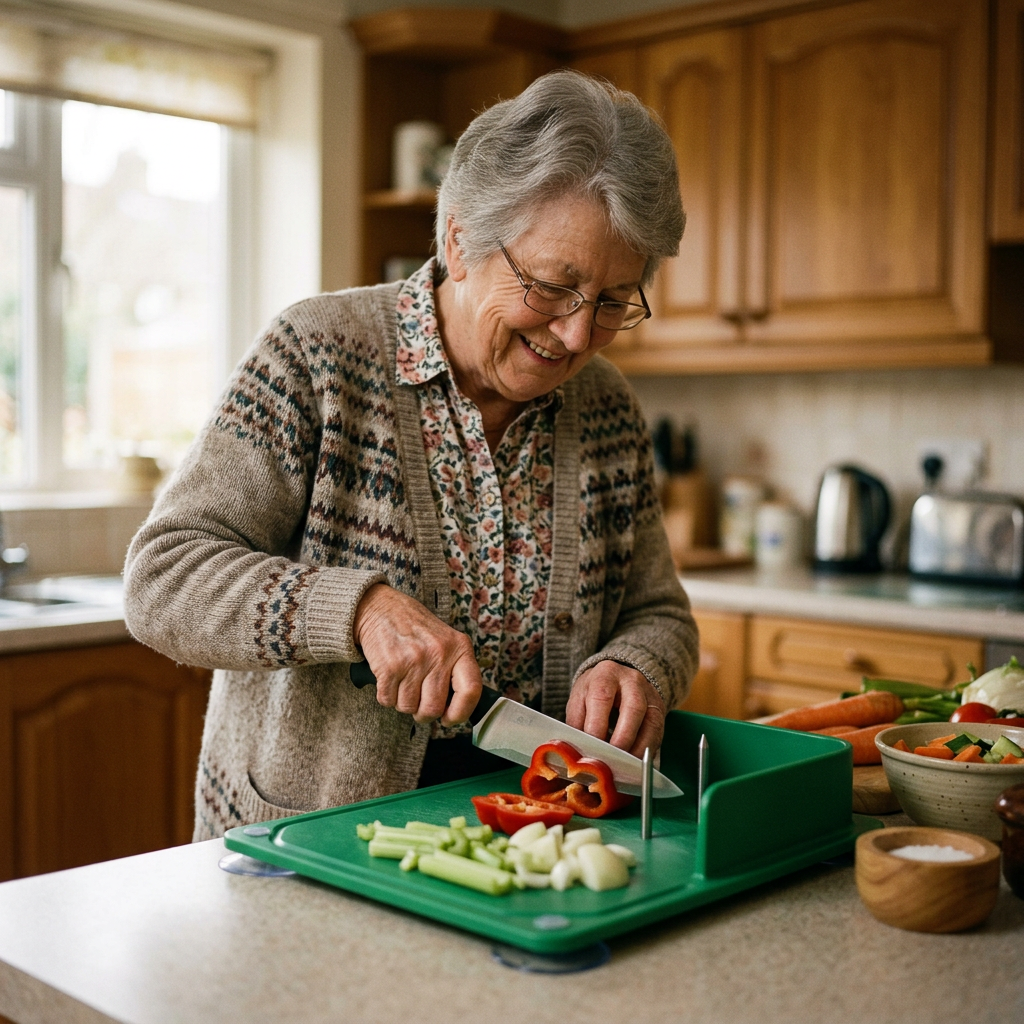
    Cutting food is one of the first kitchen tasks that stops working after a stroke, it is the exact action that requires the non-dominant hand to hold, stabilize, and brace while the dominant hand cuts. The Fanwer board replaces that second hand with engineering: stainless steel spikes impale food to hold it stationary, adjustable bread and food stops on two sides block rolling or sliding, and suction cups on the underside lock the board to the counter surface.

    The board is large enough for most slicing tasks, vegetables, fruit, bread and without needing to reposition mid-cut. The spikes fold flat for washing, and the board is dishwasher safe. At approximately $32, it is one of the more affordable pieces of post-stroke kitchen adaptive equipment, and it requires no instruction or practice to start: food goes on, the spike holds it, and you cut with one hand.

    One honest caveat: the spikes are designed for soft-to-medium density foods. Very hard root vegetables, raw sweet potato, dense beets, winter squash and may resist the spike enough that the board lifts rather than holding. For most everyday meal prep, this is not a limiting factor in practice.

    Check on Amazon →

    Pick 2: Best Reaching Aid: DMI 32″ Reacher Grabber Tool

    ~$18 · ASIN: B0009STNME

    The reacher and grabber is the Swiss Army knife of post-stroke adaptive tools. It extends reach by 32 inches enough to recover something dropped on the floor without bending or losing balance, pull a shirt off a hook, nudge a light switch, and assist with pulling on loose-fitting clothing. For someone with balance concerns, which commonly co-occur with stroke, avoiding bending and extended reaching is a genuine fall-prevention strategy, not just a convenience.

    The DMI model has been on the market long enough to accumulate thousands of verified reviews, which is meaningful in a category where newer entrants often sacrifice jaw durability. The magnetic tip picks up metal objects, medication lids, dropped pens, coins and the jaw has a full 180-degree range. The trigger handle is designed for single-handed operation without requiring a strong grip, which is relevant for someone whose unaffected hand is doing all the work while the affected side is still recovering.

    Worth knowing: this is a non-folding model, which makes it slightly less portable than collapsible versions but significantly more durable at the jaw-hinge joint. For home use, which is what early post-stroke recovery mostly involves and the non-folding design is the correct trade-off.

    Check on Amazon →

    Pick 3: Best Dressing Aid: Sock Aid + Button Hook + Dressing Stick Kit

    ~$22 · ASIN: B0FFZYLP75

    Getting dressed is one of the tasks that most affects stroke survivors’ sense of dignity and independence early in recovery. Lower-body dressing, pulling on socks, shoes, and pants, requires either deep bending or two-handed coordination, both of which may be unavailable immediately after a stroke. Upper-body dressing involves buttons, zippers, and fasteners designed with two hands in mind.

    This kit addresses both categories in one package. A rigid sock aid with foam handles eliminates the need to bend or reach the foot, the sock loads onto the cradle, the cradle is lowered by the handles, and the foot slides in. A dressing stick assists with pulling clothing over the affected shoulder and pushing it over the hips without reaching across the body. A combined button hook and zipper pull handles standard-size shirt buttons with a single pull-through motion rather than requiring fine pinch grip.

    Of all five tools in this guide, the dressing kit has the steepest learning curve. There is a small technique component, especially with the sock aid and in getting the approach right initially. Most occupational therapists will teach the correct method during inpatient or outpatient rehab. If a home health OT visit is available post-discharge, asking them to demonstrate the dressing stick and sock aid technique makes a significant difference in early success.

    Check on Amazon →

    Pick 4: Best Grip Stabilizer: Dycem Non-Slip Round Mat 7.5″

    ~$12 · ASIN: B00BRCG5K4

    Dycem is not a gadget, it is a material. The circular mat is made from a proprietary polymer that creates extremely high friction with smooth surfaces without being sticky in the conventional sense. Place it under a bowl, plate, cutting board, phone, water bottle, or medication bottle, and the object stays precisely where you set it when you apply one-handed lateral force. Remove the mat and nothing leaves a residue on the surface below or the object above.

    Occupational therapists have recommended Dycem for one-handed use. For decades,  it is one of those products where the catalog is essentially unchanged because the underlying function is genuinely excellent. The 7.5″ round size handles most bowls and plates. The material is machine washable, regains its grip after washing, and does not deteriorate quickly with normal daily use.

    At twelve dollars, the Dycem mat delivers the highest independence-per-dollar of anything in this guide. Many families order a second one to keep in another room. The use case extends well beyond mealtimes: under a book that slides, under a laptop that shifts, under a water glass on a nightstand one-handed life reveals how many objects we normally stabilize passively with the other hand without registering the effort. The Dycem mat quietly handles all of those situations.

    Check on Amazon →

    Pick 5 : Best Mealtime Aid: Modaliv Scooper Bowl with Suction Base

    ~$22 · ASIN: B06XJXG3DJ

    Eating independently after a stroke involves two distinct challenges: keeping the bowl or plate from sliding while the person applies one-handed pressure, and being able to scoop food onto a utensil using one hand against the bowl’s interior edge without pushing food over the rim. Standard bowls are not designed for the second task, the curved wall works against a lateral scooping motion. The Modaliv scooper bowl addresses it with a straight interior wall section that gives the utensil a surface to scoop against effectively with one hand.

    The bowl includes an integrated silicone suction base that forms a vacuum seal on smooth, flat surfaces — so the Dycem mat may not even be necessary at mealtimes if the table or placemat surface is smooth. The bowl is 34 ounces, microwave safe, and dishwasher safe. The design is clean enough that it does not look clinical at the dinner table, which matters for the person’s comfort in social eating situations.

    Honest note on surface compatibility: the suction base requires a smooth, non-porous surface, glass, lacquered wood and solid stone countertops all work well. Textured placemats, rough wooden tables, or porous surfaces will break the seal. If the dining surface is textured, place a Dycem mat under the bowl rather than relying on the suction base alone; the two work well in combination.

    Check on Amazon →

    Quick comparison

    Tool Task it addresses Price ASIN
    Fanwer Cutting Board Kitchen prep / cutting food ~$32 B0D7L792P4
    DMI Reacher 32″ Reaching, dressing assist, drops ~$18 B0009STNME
    Dressing Aid Kit Socks, buttons, zippers ~$22 B0FFZYLP75
    Dycem Mat 7.5″ Stabilizing everything, everywhere ~$12 B00BRCG5K4
    Modaliv Scooper Bowl Independent eating / mealtime ~$22 B06XJXG3DJ

    Who this guide is for

    This guide is written for stroke survivors in the early-to-mid recovery phase — typically the first three to twelve months after a stroke, where one-sided weakness, hemiplegia, or significant reduction in fine motor control is still affecting daily life. It is also useful for the family members and caregivers who are setting up the home environment before or shortly after hospital discharge.

    If you are also setting up the broader home safety environment, the Master Home Safety Checklist covers fall prevention and room-by-room modifications that support post-stroke independence beyond the adaptive tools covered here. Because falls are a leading risk in early stroke recovery, you may also want to review the fall detection device guide many families put a fall alert system in place during the period when the stroke survivor is first moving around the home independently.

    The conversation you will have

    Introducing adaptive equipment to a stroke survivor requires some care. Many people experience their stroke as a sudden loss of identity — someone who managed their own home and routine now being offered tools designed for “disabled” use. The framing matters considerably.

    The most effective approach is to lead with the task, not the diagnosis. “The cutting board makes it easier to prep food with one hand” lands very differently than “this is for people who can not use both hands.” The goal is to reconnect the person with the activity they want to do and not to highlight the limitation preventing it.

    If there is resistance to trying adaptive tools, occupational therapists are often more persuasive than family members — they present these tools as standard components of the recovery process, which they are. Framing the Dycem mat or dressing stick as “what the OT recommended” rather than “what we thought you needed” often makes them significantly easier to accept. If formal OT has not begun yet, requesting an evaluation is one of the highest-leverage asks at the first follow-up appointment.

    What to look for in one-handed adaptive tools

    Single-handed operation at every step. The most common failure mode in adaptive products is that they require two hands for one step in the process — usually setup or cleanup. Before purchasing, trace through each step of using the tool and confirm the affected hand is genuinely not needed at any point.

    A stable base. Anything that tips, slides, or requires stabilization with the second hand undermines the entire purpose. Suction cups, Dycem, and weighted bases are the three reliable stabilization mechanisms. Friction feet alone are typically not sufficient for someone applying one-handed lateral force during actual use.

    Easy cleaning. A tool that requires two hands to disassemble or wash will not be used consistently. Dishwasher-safe products with smooth surfaces and minimal crevices are significantly more realistic for ongoing daily use than hand-wash-only designs with small interlocking parts.

    Recognition from OT practice. Products that occupational therapists commonly recommend carry a meaningful advantage: the technique has already been validated and the therapist can teach proper use. Dycem, dressing aids, reachers, and suction-base bowls appear in OT practice guidelines because they work reliably — not because they are new or technically impressive.

    Insurance and savings

    Medicare Parts A and B cover occupational therapy services — including the OT evaluation and treatment that guides adaptive equipment selection — but generally exclude the adaptive tools themselves. Reachers, dressing aids, non-slip mats, and adaptive bowls are classified as convenience items or daily living aids rather than durable medical equipment, and fall outside standard Medicare coverage. However, if durable adaptive equipment is specifically prescribed by a physician or OT as medically necessary, an FSA or HSA can typically be used to purchase it.

    FSA and HSA coverage for adaptive daily living aids generally requires a Letter of Medical Necessity from the treating physician or OT, documenting the stroke diagnosis and the functional limitation the equipment addresses. With an LMN, items like adaptive cutting boards and dressing aids fall under IRS Publication 502’s “equipment to help a person with a disability” category, which qualifies as a medical expense under Section 213(d).

    Medicare Advantage plans under the 2024 and 2025 supplemental benefits expansions may include home-safety or assistive-device allowances, depending on the specific plan. Many 2026 MA plans include an OTC or home-safety benefit that can cover adaptive equipment explicitly. Check the plan’s Summary of Benefits or call member services with the specific product name before purchasing.

    The total cost of all five tools in this guide is approximately $106 — under the annual OTC allowance of many Medicare Advantage plans, and clearly within the range where FSA or HSA reimbursement is worth documenting.

    The shortlist

    Best Kitchen Prep

    Fanwer One-Handed Cutting Board

    ~$32

    Check on Amazon →

    Best Reaching Aid

    DMI 32″ Reacher Grabber

    ~$18

    Check on Amazon →

    Best Dressing Aid

    Sock Aid + Button Hook Kit

    ~$22

    Check on Amazon →

    Best Grip Stabilizer

    Dycem Non-Slip Round Mat

    ~$12

    Check on Amazon →

    Best Mealtime Aid

    Modaliv Scooper Bowl

    ~$22

    Check on Amazon →

    Frequently asked questions

    What tools help stroke survivors with one-sided weakness?

    The most immediately useful tools for hemiplegia or one-sided weakness are: a reacher and grabber for extending reach without balance compromise, a one-handed cutting board for kitchen prep, a dressing aid kit for independent dressing, and a non-slip surface like Dycem for stabilizing objects during one-handed use. These compensatory tools restore independence for specific daily tasks while recovery continues in parallel with OT-guided rehab.

    Can someone recover hand function after a stroke?

    Many stroke survivors do regain significant hand and arm function, particularly with consistent occupational and physical therapy started early. Neuroplasticity — the brain’s ability to form new neural pathways around damaged tissue — underpins recovery, and the research on intensive early rehabilitation is encouraging. The adaptive compensatory tools in this guide are designed to support independence during recovery, not instead of it. An OT evaluation is the most important first step in building both the adaptive equipment plan and the recovery exercise program.

    When can stroke survivors start using adaptive tools at home?

    Adaptive equipment can typically be introduced as soon as the person arrives home from the hospital or rehabilitation facility. In many cases, the inpatient OT team will have already begun teaching the use of reachers, dressing aids, and similar tools during the hospital stay. Having them available at home — on the nightstand, in the kitchen, at the dining table — removes one barrier to independent activity on the first day back.

    Does Medicare cover adaptive equipment for stroke recovery?

    Standard Medicare Parts A and B cover occupational therapy services but generally exclude most daily living adaptive tools, which are classified as convenience items rather than durable medical equipment. FSA and HSA funds can typically cover these items with a Letter of Medical Necessity from the treating physician or OT. Medicare Advantage plans may include a home-safety or OTC supplement benefit that explicitly covers adaptive equipment — check the plan’s 2026 Summary of Benefits or call member services directly.

    Are the tools in this guide the same ones OTs recommend?

    The product categories covered here — reachers, dressing aids, Dycem mats, suction-base bowls, and one-handed cutting boards — are all standard OT-recommended tools for hemiplegia and post-stroke ADL support. The specific brands chosen represent currently available, in-stock Amazon options within each category as of June 2026. An OT may recommend a specific variant based on the individual’s hand function, grip strength, or cognitive status — this guide is a starting point and reference for families, not a substitute for a professional OT evaluation.

    What we’d do tomorrow

    If you are setting up for someone coming home from stroke rehabilitation, start with two purchases: the DMI reacher and the Dycem non-slip mat. Together they cost about $30, ship quickly, and address the two most immediately disruptive problems of one-handed life at home: things that are out of reach and things that will not stay still. Add the dressing kit before the first morning back.

    Once the person is settled and you have observed which specific tasks are the most frustrating, the cutting board and scooper bowl can follow based on priority. If tremor is also part of the picture — which sometimes co-occurs with stroke-related fine motor changes — the tools covered in the Parkinson’s tremor management guide overlap meaningfully with post-stroke fine motor challenges and are worth reviewing.


    As an Amazon Associate we earn from qualifying purchases. Prices and availability are accurate as of June 21, 2026 and subject to change. Recommendations reflect independent editorial judgment — not commission rate. Always consult a licensed occupational therapist for adaptive equipment guidance specific to the individual’s medical situation and functional status.