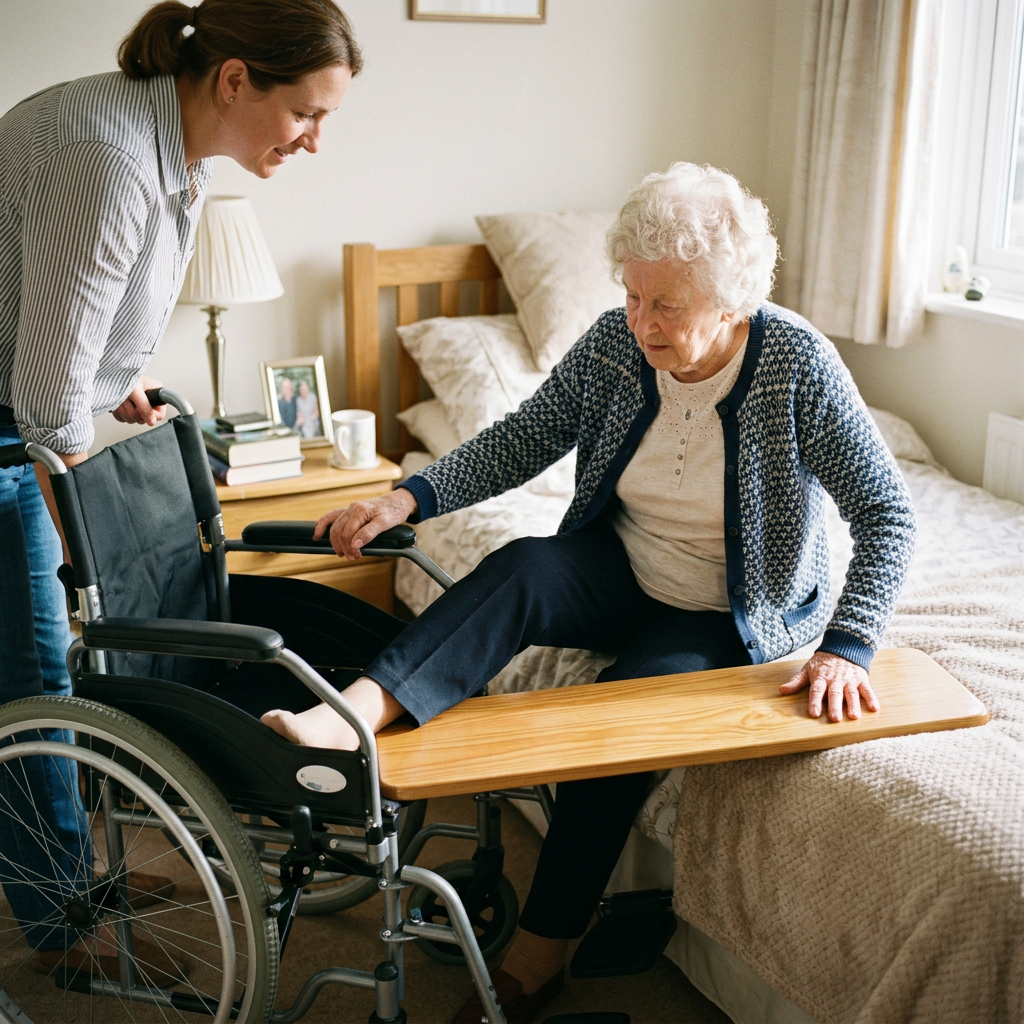
5 Best Transfer Boards for Seniors in 2026
By Sarah Mitchell · Editor, BuyingForMom · Updated August 2026
10-min read · Balance & Mobility · 5 picks compared

How we sorted through 40+ transfer boards in three weeks
We started with every transfer and slide board carrying a verifiable Amazon listing roughly forty across wood, plastic, curved, and bariatric styles — and narrowed by three things that predict a safe transfer: real weight rating, whether the ends taper thin enough to tuck under a seated hip, and how the board behaves on the two hardest moves (wheelchair-to-bed and wheelchair-to-car). We cross-referenced more than 6,000 verified-buyer reviews, transfer-technique guidance from UMass Memorial Health and the caregiver-training group Trualta, and the patterns caregivers describe on Reddit’s r/AgingParents. The point every OT makes is the one we lead with: the board is only half the equation — the person still has to bridge across it with their arms, so match the board to the strength that’s actually left.
Who this guide is for
This is for adult children and family caregivers helping a parent who can no longer safely stand and pivot between a wheelchair, bed, chair, toilet, or car seat — often after a stroke, hip surgery, or hospital discharge — but who still has enough upper-body strength to scoot. If your parent can pivot on their feet with a gait belt, you may not need a board yet; if they can’t bear any weight, see the note below on when a board is the wrong tool.
A transfer board (also called a slide board) is a smooth, tapered plank that bridges two surfaces so a seated person slides across in short scoots instead of standing. Get the wrong one — too short for the gap, too flimsy for the weight, or too thick to tuck under a hip — and it sits in a closet while everyone goes back to risky lifting. The picks below cover the honest range, from a $22 budget board to a 735-pound bariatric plank.
At a glance
Best Overall Vive Transfer Board (30″) — ~$40 · sealed wood, notched ends, the safe default for most transfers.
Best Budget DMI Wood Transfer Board (24″) — ~$22 · FSA-eligible Scotch pine, 440 lb, shortest gaps.
Best Heavy-Duty DMI Bariatric Board (32″×10″) — ~$45 · 735 lb capacity, two cut-out handles.
Best Handholds Drive Medical Lifestyle Board (30″) — ~$50 · lacquered birch with two hand grips for control.
Best Curved KRT Curved Transfer Board — ~$50 · flared polyethylene that clears a fixed wheelchair arm.
Best Overall Vive Transfer Board (30″)
~$40 · Check price on Amazon →

If you buy one board without an OT in the room to advise you, make it this one. Vive’s 30-inch sealed-wood board hits the geometry most home transfers need: long enough to bridge a wheelchair to a bed or car seat, with notched, tapered ends thin enough to slide under a seated hip. Across more than 4,000 verified reviews the praise is consistent — it’s rigid and doesn’t flex mid-scoot the way cheap plastic does. The common complaint is honest: at roughly five pounds it’s heavier than plastic, and the surface feels cold on bare skin (a pillowcase over it fixes that).
The good
- Rigid sealed wood that doesn’t flex under real weight
- Tapered, notched ends tuck cleanly under a hip
- 30-inch length bridges the hardest gaps (bed, car)
The catch
- Heavier than plastic — noticeable for a caregiver lifting it repeatedly
- Wood surface feels cold on bare skin; a pillowcase over it helps
This is right if… your parent has decent arm strength and you want the safe, do-everything default.
Look elsewhere if… a fixed wheelchair armrest blocks the board’s path — you’ll want the curved pick below.
Best Budget DMI Wood Transfer Board (24″)
~$22 · Check price on Amazon →

The cheapest board we’d actually trust. DMI’s 24-inch solid Scotch-pine board is FSA- and HSA-eligible, rated to 440 pounds, and does one job well: short, same-height transfers like wheelchair-to-toilet or wheelchair-to-shower-bench. Verified buyers using it for tight bathroom transfers consistently call it sturdy for the money; nearly all the disappointment comes from people who bought the 24-inch to reach a bed and found it too short. Match the length to your gap and it’s a genuine value — just note there are no hand cut-outs, so a caregiver grips the edges.
The good
- Lowest price of any board we’d recommend
- FSA/HSA eligible — spend pre-tax dollars
- Solid 440 lb rating in a compact 24-inch length
The catch
- 24 inches is too short for a wide wheelchair-to-bed gap
- No cut-out handles, so it’s harder to reposition
This is right if… your transfers are short and same-height, like chair-to-toilet in a small bathroom.
Look elsewhere if… you’re bridging to a bed or car — size up to the 30-inch Vive.
Best Heavy-Duty DMI Bariatric Board (32″×10″)
~$45 · Check price on Amazon →

Standard boards top out around 400 to 440 pounds, and exceeding that rating is exactly the shortcut that ends a transfer on the floor. This DMI bariatric board is built for it: a wider 10-inch platform, an extra-thick Scotch-pine plank, two cut-out handles, and 735-pound capacity. Reviewers who bought it for a heavier parent note the same relief — it doesn’t creak or bow the way a standard board did. The width is the point and the trade-off: 10 inches feels stable but is harder to tuck under a hip, so it’s overkill for a lighter parent. Buy it for the capacity, not because bigger sounds safer.
The good
- 735 lb capacity genuine bariatric headroom
- Wider 10-inch platform feels stable mid-transfer
- Two cut-out handles make it easier to place and carry
The catch
- Heavy and bulky overkill for a lighter parent
- The 10-inch width is harder to slide under a hip
This is right if… your parent is over about 300 pounds or a standard board has flexed under them.
Look elsewhere if… your parent is lighter — the extra size just makes transfers harder.
Best Handholds Drive Medical Lifestyle Board (30″)
~$50 · Check price on Amazon →

Drive Medical’s lacquered-birch board is the one to reach for when control matters more than saving a few dollars. Rated to 440 pounds, it adds two hand cut-outs that give both caregiver and person something to grip — useful for guiding a scoot in controlled increments instead of one long slide. OTs often point families toward a handled board when a parent has one strong side after a stroke, since they can use the strong-side grip to pull themselves across. Reviewers note the lacquer is smoother than raw wood — a plus for sliding, but never use it on a wet surface without a towel down.
The good
- Two hand grips for controlled, incremental scoots
- Smooth lacquered birch slides easily
- Great for one-strong-side (post-stroke) transfers
The catch
- Slicker lacquer needs a towel on any damp surface
- Slightly pricier than the Vive for a similar length
This is right if… your parent has one strong side or you want handholds for control.
Look elsewhere if… you mainly do wet-bathroom transfers — the lacquer needs a towel there.
Best Curved KRT Curved Transfer Board
~$50 · Check price on Amazon →

Straight boards assume you can lay the board flat between two surfaces but many wheelchairs have fixed armrests sitting right in the path, and that’s where a curved board earns its keep. KRT’s polyethylene board has an arched shape and flared ends that route the transfer around an obstacle instead of fighting it, and the plastic is far lighter than any wood board here — a real plus for caregivers with wrist or back issues. Buyers who transfer in and out of a car especially favor the curve. The honest trade-off: plastic feels less solid than wood to some users, and curved boards take practice to position this is the pick where an OT’s coaching pays off most.
The good
- Curved shape clears a fixed wheelchair armrest
- Much lighter than wood — easy on a caregiver’s wrists
- Follows the natural arc of a car transfer
The catch
- Plastic feels less solid than wood to some users
- Curved boards take practice to position right
This is right if… a fixed armrest is in the way or car transfers are your main use.
Look elsewhere if… your transfers are simple, flat, and same-height — a straight wood board is simpler.
Transfer boards compared at a glance
| Board | Price | Type & capacity | Best for |
|---|---|---|---|
| Vive 30″ | ~$40 | Sealed wood · ~400+ lb | The safe do-everything default |
| DMI 24″ Wood | ~$22 | Scotch pine · 440 lb | Short same-height transfers, budget |
| DMI Bariatric 32″×10″ | ~$45 | Heavy wood · 735 lb | Heavier parents, max capacity |
| Drive Medical 30″ | ~$50 | Birch, hand grips · 440 lb | One-strong-side / post-stroke control |
| KRT Curved | ~$50 | Curved plastic · ~400 lb | Fixed armrests, car transfers |
The conversation you’ll have
A transfer board can land badly if it’s framed as proof your parent can’t stand anymore — for many older adults, standing to move is tied up with dignity, and a board that says “you’re a person who slides now” gets left in the box. The reframe that works is about conserving energy, not conceding it. Instead of “you can’t stand safely anymore,” try “let’s save your standing for walking to the kitchen — this just takes the scary sit-to-sit part off your legs.” You’re not taking standing away; you’re spending it where it matters.
It also helps to make the first transfers about your back, not their weakness: “the doctor said I’ll hurt myself lifting you the old way humor me.” And borrow a professional’s authority: when an OT recommends and demonstrates the board, it stops being a family argument and becomes doctor’s orders.
Insurance and savings
Here’s the money reality most families get wrong. Original Medicare (Part B) covers reusable, “primarily medical” durable equipment, but low-cost transfer boards are generally treated as inexpensive convenience items and rarely approved on their own — Medicare is far more likely to authorize a patient lift for someone who truly can’t assist. Don’t count on it paying for a $40 board. The reliable path is your FSA or HSA: transfer and slide boards are widely eligible medical expenses (the DMI wood board lists FSA/HSA eligibility outright), so you can buy one pre-tax. If your out-of-pocket medical costs are high enough to itemize, a medically necessary board can also count toward the IRS medical-expense deduction under Publication 502. When in doubt, ask the OT to write the recommendation.
What to actually look for
Match the board type to the transfer, not the price
The biggest mistake is buying by price instead of geometry. A straight wood board is the right default for flat, same-height moves; a curved plastic board earns its cost only when a fixed armrest or car door is in the way; and a bariatric board is about capacity, not “more is safer.” Measure your gap wheelchair-to-bed is usually the widest and buy a length that clearly bridges it. Our complete aging-in-place home safety checklist shows how transfers fit the bigger fall-prevention picture.
Weight rating, edges, and surface
Never buy a board rated close to your parent’s weight — leave a real margin, because a transfer puts dynamic, shifting load on the plank. Look for tapered, notched ends thin enough to slip under a seated hip; a thick, blunt end is the reason many boards never get used. Consider surface, too: sealed or lacquered wood slides well but is cold and slick when wet, while textured plastic grips more. Whatever you choose, the room matters as much as the board — see our room-by-room aging-in-place modification guide for clearing the path and anchoring the surfaces you transfer between.
Know when a board is the wrong tool
This is the part the listicles skip. A transfer board is a bridge, not a lift — it only works if your parent can bear some weight through their arms and bridge across in short scoots. If they can’t push up with their arms or hold themselves upright once seated, no board is safe, and you’re into lift or sling territory. A proper transfer belt for the standing-pivot moves you can still do safely is often the better middle step; our guide to gait and transfer belts for seniors covers when a belt beats a board. And whatever you buy, have a therapist demonstrate the first transfers — every credible source, ours included, treats that as non-negotiable.
Frequently asked questions
How do you use a transfer board?
Position the two surfaces close, with the destination ideally slightly lower. Tuck one end of the board under the person’s hip and rest the other on the target seat. With a gait belt on, they push up on their fists and scoot across in several short moves rather than one long slide, keeping fingers off the edges.
What is the weight limit of a transfer board?
Standard boards are typically rated 200 to 500 pounds, with most quality wood boards at 400 to 440 pounds. Bariatric boards go higher — the DMI board here holds 735 pounds. Always leave a comfortable margin above your parent’s weight, since a transfer applies shifting, dynamic load rather than a still one.
What’s the difference between a transfer board and a slide board?
The terms overlap. “Transfer board” usually means a rigid plank you scoot across; “slide board” is often used the same way, though it can also describe one paired with a low-friction slide sheet for the weakest users. For home use, most people mean the rigid board reviewed here.
Does Medicare pay for a transfer board?
Usually not. Medicare Part B covers durable medical equipment, but inexpensive transfer boards are typically treated as low-cost convenience items and rarely approved alone; a patient lift is more likely to be authorized for someone who can’t assist. The dependable savings route is an FSA or HSA, where boards are generally eligible.
Can a senior use a transfer board alone?
Some can, after training, if they have good arm strength and sitting balance — but the safe default is caregiver assistance, especially at first. Nearly every clinical source recommends learning the technique with a physical or occupational therapist and wearing a gait belt before anyone attempts an independent transfer.
The shortlist


Last verified in stock: August 23, 2026
What we’d do tomorrow
If you’re starting this weekend, do three things in order. First, measure the widest gap your parent actually crosses almost always wheelchair-to-bed and buy a board that clearly bridges it; for most families that’s the 30-inch Vive board, or the curved KRT if a fixed armrest is in the way. Second, buy a gait belt at the same time so you never transfer without one. Third, the step that makes the board actually get used ask your parent’s doctor for an occupational-therapy referral and have the OT demonstrate the first few transfers in the real rooms of the house. The board is cheap; the training is what keeps everyone off the floor.
— Sarah
Leave a Reply