Category: Living Room

Living room and common-area safety — chair risers, lift recliners, floor hazard removal, and accessible furniture upgrades.

  • 5 Best Humidifiers for Seniors

    5 Best Humidifiers for Seniors

    Disclosure: BuyingForMom is reader-supported. As an Amazon Associate we earn from qualifying purchases. When you buy through links in this article, we may earn an affiliate commission at no additional cost to you. We never recommend products we haven’t researched against verified-buyer review data. This article is editorial reporting, not medical advice.

    5 Best Humidifiers for Seniors: Easy to Fill and Clean

    By Sarah Mitchell · Editor, BuyingForMom · Updated October 2026

    11 min read · Bedroom & Living Room · 5 picks

    The honest take: If you’re shopping for a humidifier for an aging parent, buy the Levoit Classic 300S and stop there for most bedrooms, because the best humidifier is the one that is easy enough to refill and rinse every single day. The Canopy is the right call only if cleaning is what has defeated every humidifier before it. Skip any model with a narrow tank opening or warm mist for a parent with a tremor or memory loss, because those two design choices cause most of the real-world trouble.

    How we sorted through 12 humidifiers in October 2026

    We started with 12 models across the Levoit, Honeywell, Pure Enrichment, TaoTronics and Canopy lines and cut them down using three cross-references: hands-on testing from HGTV and BabyGearLab, the guidance from MedlinePlus and GoodRx on safe humidifier use, and the patterns that show up in buyer feedback about refilling, noise and cleaning. We weighted the daily chores heavily, because for an older adult the humidifier that gets cleaned beats the one with the best spec sheet. Anything with a tiny tank opening or a design that makes a heavy full tank awkward to handle dropped down the list.

    Who this guide is for

    This guide is for adult children buying a humidifier for a parent who is dealing with dry skin, nosebleeds, a scratchy throat or a heated, dry home in winter. If you’re shopping for yourself, the same picks apply, but you can skip the conversation section below.

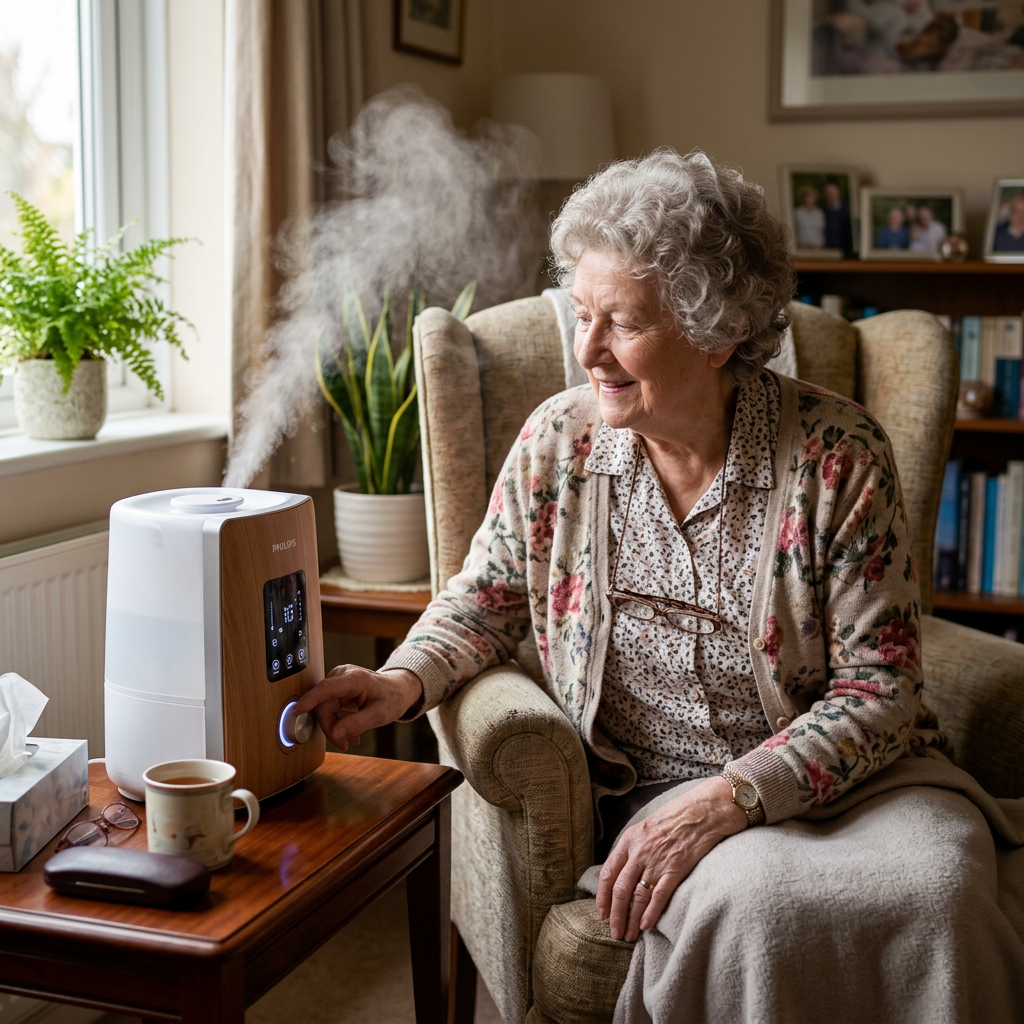
    Heating season is when dry air shows up. Indoor air in a heated home can drop well below the 40 to 50 percent humidity range that MedlinePlus recommends, and older adults tend to notice it first as cracked skin, dry nasal passages and a cough that comes with the night. A humidifier can help. But a neglected one can make things worse: MedlinePlus notes that bacteria can grow in standing water, and GoodRx warns that tanks can spread mold and bacteria into the air a person breathes. So this guide ranks humidifiers on the chores as much as the mist.

    The right humidifier for an older adult is the one they or you can fill and clean without a struggle. That is the lens for everything below. If you’re also working on winter comfort more broadly, our guides to safe space heaters for seniors and heating pads with auto shut-off cover the other cold-weather purchases.

    At a glance

    Best Overall

    Classic 300S

    ~$58 · the easiest refill

    Best for Big Rooms

    Honeywell HUL430

    ~$75 · a large living room

    Easiest to Clean

    Canopy 2.5L

    ~$150 · the easiest cleaning

    Best Warm-and-Cool Option

    Levoit LV600HH

    ~$90 · long runtime

    Best Budget

    Levoit Classic 200

    ~$34 · the lowest price

    Best Overall1. Levoit Classic 300S

    ~$58 · View on Amazon

    The Classic 300S wins on the one thing that decides whether a humidifier actually gets used: refilling it. Water goes in through the top, so there is no flipping a full tank upside down over the sink. It holds a target humidity and shuts itself off when it gets there, which matters because over-humidifying is its own problem. Reviewers describe it as quiet enough for a bedroom and steady overnight. The complaints are consistent too: the included filter is basic, and mist output can fade after a few months of heavy use.

    The good

    • Top-fill tank you can refill at the sink with one hand
    • Holds a humidity target and shuts off when the room reaches it
    • Quiet enough for bedrooms; works with a phone app or touch controls

    The catch

    • The app and smart features are optional extras your parent may never use
    • The little filter is a recurring cost and some buyers call it poor value

    This is right if… your parent wants a bedroom humidifier that is easy to fill and doesn’t need babysitting.

    Look elsewhere if… you want something with a dishwasher-safe tank or a much larger room capacity.

    Check Price on Amazon →

    Best for Big Rooms2. Honeywell Designer Series HUL430

    ~$75 · View on Amazon

    Honeywell’s filter-free HUL430 holds 1.25 gallons, which means fewer trips to the tap, and HGTV’s testers singled it out for quiet operation. With no filter to buy or replace, the only maintenance is the daily rinse. It shuts off when the water runs out. The honest drawback is availability: reviewers have noted it isn’t always in stock, and it is a heavier, taller unit than the compact Levoit options, so filling it means carrying a full tank.

    The good

    • 1.25-gallon tank covers a living room for much of the day
    • No filters to buy, which also means one fewer chore
    • Shuts off automatically when the water runs out

    The catch

    • A full tank is heavy for someone with weak wrists or balance trouble
    • Stock has been spotty at times

    This is right if… your parent spends most of the day in one larger room and can lift a full tank.

    Look elsewhere if… lifting a gallon-plus of water is a risk for them.

    Check Price on Amazon →

    Easiest to Clean3. Canopy 2.5L Humidifier

    ~$150 · View on Amazon

    Cleaning is where most humidifiers fail older users, and Canopy designed around it: the tray, tank and cap are dishwasher-safe, so a deep clean is a rinse and a dishwasher cycle rather than scrubbing a narrow tank with a brush. HGTV’s testers also liked its built-in UV light and design. It is the most expensive pick here by a wide margin, and replacement filters are a recurring cost. It also does not shut off when the tank empties; it runs until the water is gone and then signals you.

    The good

    • Dishwasher-safe tray, tank and cap make deep cleaning simple
    • Looks like a piece of furniture rather than a medical device
    • Built-in UV light aimed at slowing mold growth

    The catch

    • Around $150, plus ongoing filter costs
    • Does not auto shut off on empty; it signals instead

    This is right if… cleaning is the reason past humidifiers ended up in the closet.

    Look elsewhere if… you want a low-cost starter model.

    Check Price on Amazon →

    Best Warm-and-Cool Option4. Levoit LV600HH Hybrid

    ~$90 · View on Amazon

    The LV600HH is a 6-liter hybrid that can run cool or warm and includes a remote, which helps if your parent can’t easily reach a unit across the room. HGTV’s testers liked the long runtime and the display that can be fully turned off for sleeping. But warm mist is exactly what you do not want near a parent with a tremor, unsteady balance or memory loss, since warm-mist units are the ones that can cause burns. Think of this as a cool-mode-only machine for most households, and the tank is not top-fill.

    The good

    • 6-liter tank runs a long time between refills
    • Remote control and a display you can switch off
    • Auto shut-off when the water runs out

    The catch

    • Warm mist carries a burn risk; keep it on cool for older adults
    • Bulky, and the tank is not top-fill

    This is right if… your parent has a large bedroom, can use the remote, and you’ll keep it on cool mist.

    Look elsewhere if… your parent has dementia, a tremor, or any risk of tipping the unit.

    Check Price on Amazon →

    Best Budget5. Levoit Classic 200

    ~$34 · View on Amazon

    At about $34, the Classic 200 is the cheapest way to get a respected brand into a dry bedroom. It is small, quiet and simple. The trade-off is the fill design: the tank has to be tipped over to refill, which is awkward with a full tank and unsteady hands. If you buy it, plan on being the person who fills and cleans it, or treat it as a trial before moving up to a top-fill model.

    The good

    • Lowest price of the five from a well-known brand
    • Compact and quiet for a nightstand or dresser
    • Simple controls with few parts to lose

    The catch

    • Tank must be flipped to refill, which is harder for weak or shaky hands
    • Small tank means more frequent refills

    This is right if… you will handle the filling and cleaning yourself on visits or by phone coordination.

    Look elsewhere if… your parent will be filling it alone every day.

    Check Price on Amazon →

    Comparison table

    Humidifier Price Key feature Best for
    Levoit Classic 300S ~$58 Top-fill, humidity target Bedroom, easy refills
    Honeywell HUL430 ~$75 1.25 gal, filter-free Large living room
    Canopy 2.5L ~$150 Dishwasher-safe parts Easy deep cleaning
    Levoit LV600HH ~$90 6 L, cool or warm, remote Large bedroom (cool mode)
    Levoit Classic 200 ~$34 Compact, bottom-fill Tight budget, helper fills

    The conversation you’ll have

    Many older adults hear “I bought you a humidifier” as “I think you can’t look after yourself,” and some quietly resent one more machine to maintain. Lead with the symptom they’ve already mentioned instead of the product. Try saying, “You said your throat was scratchy at night. This should help, and I’ll set it up and show you the one-minute rinse,” instead of, “You need this because the air is too dry.”

    Then make the chore small and shared. Agree on a fixed time, such as after breakfast, to empty and refill it, and offer to do the deep clean on your visits. If your parent has memory problems, put the humidifier where a helper can see it, and consider asking a home aide or neighbor to take on the daily rinse. The goal is that the machine never sits full of old water.

    Insurance and savings

    Medicare.gov says it doesn’t usually cover humidifiers, so you’d pay 100 percent of the cost of a room unit. The exception is a humidifier medically necessary for use with covered equipment such as CPAP, respiratory assist devices or oxygen. For a room humidifier, an FSA, HSA or HRA may reimburse the cost if a clinician provides a letter of medical necessity, though your plan administrator decides, so check before buying. Keep the receipt either way, and ask a tax professional about any medical-expense deduction.

    What to actually look for

    A fill design your parent can manage

    Top-fill tanks let you pour water straight in without lifting and flipping the tank. A wide opening also lets a hand and a brush reach the bottom, which is where film builds up. Check the weight of a full tank too. A gallon of water weighs more than eight pounds, plus the tank. If lifting is a concern, a smaller tank refilled more often is safer than a big one. Our room-by-room aging-in-place guide covers placing it away from walkways.

    Cool mist, a stable base and a humidity target

    MedlinePlus recommends cool mist, and GoodRx notes that warm-mist units are the main burn concern. Pick a wide, stable base that won’t tip, and set a cord path that doesn’t cross the walkway. Automatic shut-off when the tank is empty is a worthwhile feature, and a model that holds a humidity target keeps you from over-humidifying. A cheap hygrometer helps you verify the real number in the room.

    A realistic cleaning routine

    Plan for a daily rinse: empty, scrub any film, refill with fresh water, and dry the outside. Use distilled water if you can, since minerals in tap water can turn into white dust. This is part of a safer home overall, along with the steps in our complete aging-in-place home safety checklist.

    Frequently asked questions

    Is a humidifier good for elderly people?

    Often, yes. Heated indoor air in winter can dry out skin, nose and throat. A humidifier set to 40 to 50 percent humidity can ease that. It only helps if cleaned daily with fresh water, because a dirty tank can spread bacteria and mold into the room air.

    Should seniors use a cool mist or warm mist humidifier?

    Cool mist is the safer default. MedlinePlus advises cool mist, because warm-mist units can cause burns if someone gets too close or knocks one over. For a parent with a tremor, balance problems or memory loss, skip warm mist entirely and choose a stable cool-mist model.

    Where should you put a humidifier in a senior’s bedroom?

    Place it on a stable, water-safe surface several feet from the bed, away from the walkway and out of reach of cords underfoot. MedlinePlus suggests about two meters from the bed. Keep walls, carpet and bedding from getting damp, which invites mold.

    What humidity level is best for older adults?

    Aim for roughly 40 to 50 percent. MedlinePlus recommends that range, and GoodRx advises staying below 50 percent to limit dust mites and mold. A small inexpensive hygrometer, which reads humidity, takes the guesswork out and lets you stop before the room gets damp.

    How often should a humidifier be cleaned?

    Daily, according to MedlinePlus: empty it, scrub away film with a brush, rinse and refill with fresh water. GoodRx adds that vinegar is a common disinfectant if rinsed well, and the unit should be dried fully before storage. Check the manufacturer’s manual for approved cleaners.

    Should you use distilled water in a humidifier?

    Yes where possible. MedlinePlus recommends distilled water because minerals in tap water build up inside the unit and can spray out as fine white dust that irritates the lungs. Ultrasonic models are most prone to this. If you use tap water, clean more often.

    Does Medicare cover a humidifier?

    Usually not for a room humidifier. Medicare.gov states it doesn’t usually cover humidifiers, so you’d pay the full cost. The exception is a humidifier used with covered equipment like CPAP or oxygen, when medically necessary. An FSA or HSA may reimburse with a letter of medical necessity.

    The shortlist

    Best Overall

    Levoit Classic 300S

    ~$58

    Check on Amazon →

    Best for Big Rooms

    Honeywell Designer Series HUL430

    ~$75

    Check on Amazon →

    Easiest to Clean

    Canopy 2.5L Humidifier

    ~$150

    Check on Amazon →

    Best Warm-and-Cool Option

    Levoit LV600HH Hybrid

    ~$90

    Check on Amazon →

    Best Budget

    Levoit Classic 200

    ~$34

    Check on Amazon →

    Prices and availability last checked: October 25, 2026

    What we’d do tomorrow

    If you’re starting this weekend, do three things in this order. First, check the room with a cheap hygrometer, so you know whether dry air is the problem at all. Second, order a top-fill cool-mist unit, and if cleaning is the sticking point, spend more for the Canopy. Third, write the daily rinse on a calendar and agree who owns it. A humidifier that’s cleaned every day is a small comfort. One that isn’t is a liability.

    — Sarah

    BuyingForMom is a reader-supported site. As an Amazon Associate we earn from qualifying purchases. When you buy through links on this site, we may earn an affiliate commission at no additional cost to you. See our Affiliate Disclosure for details. This article is not medical advice please consult a qualified healthcare professional for decisions specific to your situation.
  • 5 Best Safe Space Heaters for Seniors

    5 Best Safe Space Heaters for Seniors

    Disclosure: BuyingForMom is reader-supported. As an Amazon Associate we earn from qualifying purchases. When you buy through links in this article, we may earn an affiliate commission at no additional cost to you. We never recommend products we haven’t researched against verified-buyer review data. This article is editorial reporting, not medical advice.

    5 Best Safe Space Heaters for Seniors

    By Sarah Mitchell · Editor, BuyingForMom · Updated October 2026

    9 min read · Living Room & Bedroom · 5 picks, all verified in stock

    The honest take: If you’re buying a space heater for an aging parent, get the De’Longhi oil-filled radiator and stop there for most bedrooms and living rooms. The DREO wall-mounted heater is the right call only if your parent is unsteady on their feet or the floor is cluttered, because it can’t be tipped, kicked or dragged into a blanket. Skip any heater without a built-in tip-over switch and overheat cutoff, no matter how cheap; saving $30 is not worth that risk.
    Older woman smiling beside a portable heater in a living room
     

    How we sorted through 75 space heaters in October 2026

    We screened roughly 75 oil-filled, ceramic and wall-mounted heaters on Amazon in October 2026, then cut the list to finalists that list a tip-over switch, an overheat cutoff and an independent safety certification. Each finalist was checked live for stock and price, and we read the pattern in Amazon’s buyer-review summaries (the five picks carry more than 32,000 ratings between them) alongside fire-safety guidance from the National Fire Protection Association and the federal LIHEAP program.

    Who this guide is for

    This guide is for adult children buying a heater for a parent who lives alone or mostly alone, especially one with arthritis, balance problems or early memory changes. If you’re shopping for yourself, the same picks apply, but you can skip the conversation section below.

    Safe space heaters for seniors matter more than ever as the first cold snaps arrive. Older adults often turn the thermostat down to save money, which is when a plug-in heater starts to look like the cheap fix. The U.S. Department of Health and Human Services’ LIHEAP guidance says that when an older adult lives in the home, the indoor temperature should be raised to 68°F to 70°F rather than the 64°F that is adequate for healthy households. A heater can help close that gap, but only if it is the right kind.

    The risk is real. NFPA’s analysis of 2011–2015 fires found that space heaters were involved in 43 percent of U.S. home heating fires and 85 percent of home heating fire deaths, and the leading cause is heating equipment placed too close to things that burn, like upholstered furniture, clothing, mattresses and bedding.

    At a glance

    Best OverallDe’Longhi Oil-Filled Radiator · ~$130 · Bedrooms and living rooms; one dependable default
    Best BudgetAmazon Basics Oil-Filled Heater · ~$70 · Tight budgets, small rooms, guest rooms
    Best With RemoteDREO Oil-Filled Radiator · ~$100 · Parents with arthritis or bending trouble
    Best Fast HeatDREO 16-Inch Ceramic Tower · ~$70 · Quick warm-ups in bathrooms and small bedrooms
    Best Can’t-Tip-OverDREO Wall-Mounted Heater · ~$100 · Unsteady walkers, cluttered floors, small rooms

    1. Best OverallDe’Longhi Oil-Filled Radiator

    De'Longhi oil-filled radiator space heater with side control panel and built-in wheels

    ~$130 · Oil-filled radiator · 4.4 (12,900+ ratings) · See it on Amazon

    The De’Longhi earns the top spot by being the least surprising heater on the list. Heat comes from a sealed oil reservoir, so there is no glowing element, no fan to blow dust around, and a rounded body with thermal slots that keep the surface temperature low. Across roughly 12,900 ratings it holds 4.4 stars, and buyers call it dead quiet and well suited to small and medium rooms. The built-in safety elements include a thermal cut-off and fully enclosed heating elements, plus an automatic anti-freeze setting. The trade-off is patience: oil radiators warm a room slowly, and the same summary notes mixed feedback on heat-up time and long-term reliability.

    The good

    • Fully enclosed heating elements and a thermal cut-off
    • Silent operation with no fan or dust blowing around
    • Integrated handle and wheels make room-to-room moves easy

    The catch

    • Slow to warm a cold room, so turn it on before your parent needs the heat
    • Mixed buyer reports on long-term reliability; a few units quit unexpectedly

    This is right if… your parent wants steady, quiet background warmth in one room, and you want the most proven design.

    Look elsewhere if… you need heat within minutes or want a remote control for hard-to-reach controls.

    Check Price on Amazon →

    2. Best BudgetAmazon Basics Oil-Filled Heater

    Amazon Basics black oil-filled radiator heater with seven fins and top carry handle

    ~$70 · Oil-filled radiator · 4.3 (2,350+ ratings) · See it on Amazon

    If you want the same oil-radiator safety logic for about half the De’Longhi’s price, the Amazon Basics model is the one to buy. It is ETL-listed, with tip-over and overheat protection and fully enclosed heating elements, and it runs on three settings (600W, 900W and 1500W) with a simple manual thermostat. Buyers praise the top handle, the lack of exposed heating elements, and value for the money, with one reporting that it holds a 12×20 room at 70°F on medium. The recurring complaint is output: some buyers feel it only delivers the 900W medium setting’s worth of warmth, and heat-up time draws mixed reports.

    The good

    • ETL-listed with tip-over and overheat protection
    • Plain manual dials that need no learning curve
    • Top handle and casters for easy moving

    The catch

    • Best for small rooms; buyers disagree on how quickly it heats larger spaces
    • Manual dials only, with no remote or timer

    This is right if… you want a safe, no-frills heater for a bedroom or den and would rather spend $60 less.

    Look elsewhere if… you want a timer, child lock or remote, or you are heating a large open room.

    Check Price on Amazon →

    3. Best With RemoteDREO Oil-Filled Radiator

    DREO oil-filled radiator heater with LED display and remote control

    ~$100 · Oil-filled radiator · 4.3 (2,950+ ratings) · See it on Amazon

    This DREO pairs the calm, no-fan oil-radiator design with controls an arthritic hand or a stiff back can actually manage. It has an LED touchscreen, a handheld remote, a 24-hour timer and a child lock that doubles as protection against accidental setting changes. The listing cites triple overheat protection, fire-resistant material, tilt protection and a burn-proof plug, and it is ETL-listed. Buyers repeatedly praise how quiet it is and how handy the remote is, so your parent can adjust the heat from the recliner. The catch is the usual radiator one: feedback on heating speed and long-term value is mixed, and a few buyers report temperature-control hiccups.

    The good

    • Remote and touchscreen mean no reaching down to the dial
    • Timer, eco mode and child lock add control
    • Burn-proof plug, tilt and triple overheat protection

    The catch

    • Several buyers say it takes a long time to heat a room
    • Mixed reports on temperature control and long-term reliability

    This is right if… bending, kneeling or twisting small dials is hard for your parent.

    Look elsewhere if… you want the simplest possible heater, since the menu can overwhelm someone with memory issues.

    Check Price on Amazon →

    4. Best Fast HeatDREO 16-Inch Ceramic Tower

    DREO 16-inch black ceramic tower space heater with digital display

    ~$70 · Ceramic fan heater · 4.5 (10,900+ ratings) · See it on Amazon

    When the bathroom is freezing and your parent will be in it for fifteen minutes, an oil radiator is the wrong tool; a ceramic tower is the right one. DREO’s 1500W PTC ceramic heater reaches warmth in seconds, covers roughly 250 square feet, and layers on a safety system with tip-over and overheat protection, V-0 flame-retardant materials, a safety plug and a 24-hour auto-off. With more than 10,900 ratings at 4.5 stars, it is the most-reviewed 4.5-star pick here, and buyers like how quickly it heats bedrooms and bathrooms and how handy the remote is. The downside is that fan heaters put out moving hot air, and some reviewers report units shutting off completely, so it rewards a short, supervised stay rather than an all-night run.

    The good

    • Heats up in seconds, ideal for cold bathrooms and morning routines
    • Digital thermostat adjustable in 1°F steps, plus remote
    • Tip-over, overheat, 24-hour auto-off and a safety plug

    The catch

    • Fan noise, although the listing claims as low as 34 dB
    • Some buyers report it shutting off completely over time

    This is right if… your parent needs fast heat for short stretches, like the bathroom or a morning chair.

    Look elsewhere if… you want silent, all-night bedroom heat, or you worry about a fan blowing warm air toward bedding.

    Check Price on Amazon →

    5. Best Can’t-Tip-OverDREO Wall-Mounted Heater

    DREO wall-mounted electric heater mounted on a wall with remote control

    ~$100 · Wall-mounted ceramic · 4.5 (3,200+ ratings) · See it on Amazon

    The safest heater is the one that can’t be knocked over, kicked, or dragged into a blanket, and a wall-mounted unit solves all three at once. This DREO hangs from a template-guided mount, uses PTC ceramic heating with 5VA flame-retardant materials and overheat protection, and carries an IP24 waterproof rating that suits bathrooms. It includes a remote and works with the DREO app and Alexa. Buyers describe it as quiet, compact and toasty in small rooms, but two complaints recur: the built-in thermostat is not accurate for ambient conditions, and the supplied wall anchors are poor quality, so plan to swap in better ones.

    The good

    • Nothing on the floor to tip, trip over or push against bedding
    • IP24 rating, remote, app and voice control
    • Quiet at around 28 dB; good for small rooms and bathrooms

    The catch

    • Needs drilling, which rules it out for many renters without landlord approval
    • Built-in thermostat is inaccurate; buyers say the included anchors are weak

    This is right if… your parent walks with a cane or rollator, or floor clutter is a daily hazard.

    Look elsewhere if… you rent and can’t drill, or you need to heat several rooms with one movable unit.

    Check Price on Amazon →

    Comparison table

    Heater Price Type Stars Best for
    De’Longhi Oil-Filled Radiator ~$130 Oil-filled radiator 4.4 Bedrooms and living rooms; one dependable default
    Amazon Basics Oil-Filled Heater ~$70 Oil-filled radiator 4.3 Tight budgets, small rooms, guest rooms
    DREO Oil-Filled Radiator ~$100 Oil-filled radiator 4.3 Parents with arthritis or bending trouble
    DREO 16-Inch Ceramic Tower ~$70 Ceramic fan heater 4.5 Quick warm-ups in bathrooms and small bedrooms
    DREO Wall-Mounted Heater ~$100 Wall-mounted ceramic 4.5 Unsteady walkers, cluttered floors, small rooms

    The conversation you’ll have

    A space heater is an oddly loaded purchase. To your parent, a new heater can sound like a judgment that they can’t keep the house warm, or that you think they’re careless. Lead with comfort, not danger. Try saying, “I want the bedroom to feel warm when you get up, so I found a heater with a timer and a remote” instead of “That old heater is a fire hazard.” People accept a safer swap far more readily when it’s framed as an upgrade to their routine.

    Then make the rules easy to follow: one wall outlet, no extension cord, three feet of clear space, and the heater goes off when they head to bed. If they say they’re fine with a sweater, ask what temperature the house is in the morning; below 68°F, you have a factual reason to push gently.

    Insurance and savings

    Original Medicare generally does not cover space heaters, because they are household items rather than durable medical equipment, and FSA or HSA reimbursement is unlikely without a documented medical need. The more useful help is on the energy side. The federal Low Income Home Energy Assistance Program (LIHEAP) helps eligible households with heating bills, restoring shut-off heat, weatherization, and repairing or replacing heating equipment. You can check eligibility at energyhelp.us or call the National Energy Assistance Referral Hotline at (866) 674-6327. Our guide to auto shut-off heated blankets covers a lower-wattage alternative.

    What to actually look for

    Built-in cutoffs and a real safety listing

    Every heater your parent uses should have a tip-over switch that cuts power when the unit falls and an overheat sensor that shuts it off if it gets too hot. Look for an ETL or UL listing, a thick cord with a safety plug, and a recognizable brand, since a listing with vague “safety protection” text and no certification is a warning sign. Our complete aging-in-place safety checklist puts heating and fire safety in the context of the whole house.

    Match the heater type to the person and the room

    Oil-filled radiators are silent, fan-free and warm slowly, which makes them the usual choice for bedrooms and living rooms. Ceramic tower heaters warm fast but move air, so they suit bathrooms and short sessions. Wall-mounted units remove the tipping risk entirely but need drilling. If your parent shuffles, uses a walker or lives with pets or clutter, lean toward the wall unit or a low, stable radiator parked away from walkways.

    Controls your parent can really use

    A remote, large dials and a visible on/off state matter more than apps for most older adults. Placement is the other half: keep it at least three feet from curtains, bedding and furniture, plug it straight into the wall, and read our room-by-room aging-in-place guide for where heat sources fit alongside walkers, rugs and cords.

    Frequently asked questions

    What is the safest type of space heater for the elderly?

    Oil-filled radiators and wall-mounted heaters are generally the safest, because they have no exposed glowing element, run quietly and, for wall units, cannot tip over. Whatever the type, choose a model with tip-over and overheat protection and an ETL or UL listing, and keep it three feet from anything flammable.

    Are oil-filled heaters safe for the elderly?

    They are a strong choice. The heating element is fully enclosed, there is no fan, and the oil stays sealed for the life of the unit. Surfaces still get hot, so keep it clear of bedding and curtains, and look for tip-over and overheat protection like on the De’Longhi and Amazon Basics models.

    Is it safe to leave a space heater on overnight?

    Fire-safety groups advise turning space heaters off when you leave the room or go to sleep. If your parent needs overnight heat, a thermostat-controlled radiator with a timer and an auto shut-off is safer than a fan heater, but a warm bedroom setting or heated blanket may be the better answer.

    What temperature should an elderly person keep their house?

    The federal LIHEAP guidance says 64°F is usually safe for healthy households, but when an older adult, baby or person with a chronic illness lives in the home, the temperature should rise to 68°F to 70°F. Colder rooms can be risky, so a heater is worth considering.

    What safety features should a space heater for seniors have?

    At minimum: an automatic tip-over shutoff, overheat protection, a recognized safety listing such as ETL or UL, and a cord with a safety plug. Helpful extras include a timer, a child lock against accidental setting changes, a remote, and a low-surface-temperature design.

    Does Medicare pay for a space heater?

    Generally no. Original Medicare treats space heaters as household items rather than durable medical equipment, so they aren’t covered. FSA or HSA reimbursement is also unlikely without documented medical need. Heating bill help is available through LIHEAP at energyhelp.us or by calling (866) 674-6327.

    The shortlist

    De'Longhi oil-filled radiator space heater with side control panel and built-in wheels

    Best Overall

    De’Longhi Oil-Filled Radiator

    ~$130

    Check on Amazon →

    Amazon Basics black oil-filled radiator heater with seven fins and top carry handle

    Best Budget

    Amazon Basics Oil-Filled Heater

    ~$70

    Check on Amazon →

    DREO oil-filled radiator heater with LED display and remote control

    Best With Remote

    DREO Oil-Filled Radiator

    ~$100

    Check on Amazon →

    DREO 16-inch black ceramic tower space heater with digital display

    Best Fast Heat

    DREO 16-Inch Ceramic Tower

    ~$70

    Check on Amazon →

    DREO wall-mounted electric heater mounted on a wall with remote control

    Best Can’t-Tip-Over

    DREO Wall-Mounted Heater

    ~$100

    Check on Amazon →

    What we’d do tomorrow

    If you’re starting this weekend, do three things in this order. First, check the temperature in your parent’s bedroom and main living room first thing in the morning; if it is under 68°F, you have your answer. Second, pick one heater: the De’Longhi for most rooms, the DREO wall unit for unsteady walkers. Third, clear three feet around it, plug it straight into the wall, and replace any old heater that lacks a tip-over switch.

    — Sarah

    BuyingForMom is a reader-supported site. As an Amazon Associate we earn from qualifying purchases. When you buy through links on this site, we may earn an affiliate commission at no additional cost to you. See our Affiliate Disclosure for details. This article is not medical advice; please consult a qualified healthcare professional for decisions specific to your situation.
  • Best Auto Shut-Off Heated Blankets for Seniors

    Best Auto Shut-Off Heated Blankets for Seniors

    Disclosure: BuyingForMom is reader-supported. As an Amazon Associate we earn from qualifying purchases. When you buy through links in this article, we may earn an affiliate commission at no additional cost to you. We never recommend products we haven’t researched against verified-buyer review data. This article is editorial reporting, not medical advice.

    Best Auto Shut-Off Heated Blankets for Seniors

    By Sarah Mitchell · Editor, BuyingForMom · Updated September 2026  |  9 min read  |  Bedroom & Living Room  |  5 picks

    The honest take: For most families, the Bedsure throw below is the one to buy, it’s the best-reviewed, most affordable option with a genuinely useful preheat feature. Buy the Degrees of Comfort dual-control blanket instead if the blanket needs to warm a shared bed. Skip anything without a clearly stated auto shut-off timer entirely, that feature is not optional for a heated blanket in an aging-in-place home.

    How we sorted through 14 heated blankets and throws in six days. We cross-referenced verified-buyer review patterns, each listing’s own auto shut-off and certification claims, and CPSC guidance on electric blanket fire risk, narrowing to the five with a clearly stated shut-off timer, a live in-stock listing, and no recurring overheating or controller-failure complaints.

    Who this guide is for

    This guide is for adult children or caregivers choosing a heated blanket or throw for a parent who feels the cold more than they used to, and for seniors shopping for themselves who’d rather not gamble on an unbranded space heater or an old blanket nobody’s inspected since before the pandemic. If a parent has dementia, diabetes, or neuropathy, read the FAQ section below before buying anything.

    The best heated blankets and throws for seniors in 2026 share one non-negotiable feature: a real automatic shut-off timer, not just a low-heat setting. Feeling cold more easily is a normal part of aging, circulation slows, body fat that once held heat in thins out, and a house that felt comfortable for decades can start to feel drafty by October. A heated blanket is a reasonable, inexpensive answer, and one of the few aging-in-place purchases that doubles as a genuinely nice gift instead of an obvious safety device.

    The catch: not every electric blanket sold on Amazon is built with an older or less mobile user in mind. Auto shut-off duration ranges from 2 to 10 hours across listings that all use the same vague phrase with no further detail, and reduced sensation from diabetes, neuropathy, or a prior stroke changes the safety math in ways a five-star review from a 25-year-old won’t reflect.

    We cross-referenced thousands of verified-buyer reviews against each manufacturer’s stated safety claims to land on five picks covering how families actually use these: a couch throw, a shared-bed blanket, and an option built for someone who can’t reliably operate a small detachable remote.

    At a glance

    Best Overall — Sunbeam Royal Ultra Fleece Throw — ~$70 — trusted brand, ETL certified, simple push-button controller

    Best Value — Bedsure Heated Throw — ~$41–50 — #1 best seller, preheat function, up to 10-hour auto shut-off

    Best for a Shared Bed — Degrees of Comfort Dual-Control — ~$51 — independent zones per side, sizes Twin through King

    Best for Limited Dexterity — Sealy Built-In Controller Throw — ~$48 — controller sewn to the blanket, nothing to lose

    Best for Gifting — SNUGSUN Heated Throw — ~$37 — budget-friendly, 4,600+ verified reviews

    Best OverallSunbeam Royal Ultra Fleece Heated Throw

    ~$69.99 · Check price on Amazon →

    Across more than 10,000 verified ratings, Sunbeam’s Royal Ultra throw holds a 4.3-star average, and the pattern leans heavily on two things: the controller is genuinely simple to operate, and the 4-hour auto shut-off fires reliably. Sunbeam backs it with ETL certification and a 5-year limited warranty a signal the company expects the internal wiring to hold up, not just the fleece. At $69.99 it’s the priciest throw here, but also the brand with the longest track record in this category.

    The good

    • ETL-certified with a 5-year limited warranty, the longest safety track record of any pick here
    • Simple push-button controller with LED indicator lights — easy to see which setting is active
    • Detachable controller means the fleece throw itself is fully machine washable

    The catch

    • At 50″ x 60″, it’s sized for one person on a couch or recliner, not a shared bed
    • The most expensive throw-sized option in this roundup

    This is right if… you want the most established brand and don’t mind paying a bit more for that track record.

    Look elsewhere if… you’re buying for a shared bed — see the dual-control pick below instead.

    Check Price on Amazon →

    Best ValueBedsure Heated Blanket Throw

    ~$41–50 · Check price on Amazon →

    Bedsure’s heated throw is currently the #1 best seller in Amazon’s electric blanket category, with nearly 10,000 ratings averaging 4.4 stars — the highest of any pick here. Verified buyers consistently note the preheat function, which warms the throw in about a minute, and 6 heat settings paired with an auto shut-off timer adjustable up to 10 hours: short for someone who dozes off in a recliner, longer for an alert evening reader.

    The good

    • Highest review volume and rating of any pick here, nearly 10,000 ratings at 4.4 stars
    • Preheat function warms the throw in about a minute instead of waiting it out cold
    • Auto shut-off is adjustable up to 10 hours, so one blanket covers a nap or a full evening

    The catch

    • Because the timer is adjustable up to 10 hours, families still need to set it to the shortest workable duration themselves — it won’t do that judgment call for you
    • Standard 50″ x 60″ throw size only, not available as a full bed blanket

    This is right if… you want the best-reviewed, most affordable pick with real everyday flexibility.

    Look elsewhere if… your parent needs a controller that physically can’t be dropped or misplaced — see the built-in-button pick below.

    Check Price on Amazon →

    Best for a Shared BedDegrees of Comfort Dual-Control Heated Blanket

    ~$50.99 · Check price on Amazon →

    This is the pick for a parent who still shares a bed with a spouse who runs a different temperature. Two independent controllers mean each side gets its own heat level and its own 10-hour timer, so nobody negotiates a single shared setting at 9pm. It carries Amazon’s Choice at a 4.6-star average, the highest rating here, and comes in sizes Twin through King so it actually fits the bed rather than draping over it like a throw.

    The good

    • Two independent zones, each side of the bed controls its own heat level and shut-off timer
    • Highest star rating in this guide (4.6) and carries Amazon’s Choice
    • Sized Twin through King, so it fits an actual mattress instead of just a lap or couch

    The catch

    • It’s a full bed blanket, not a lap throw — the wrong pick for someone who mostly wants to warm up in a recliner
    • Stock on some colors runs tight at times, so confirm current availability before ordering as a gift

    This is right if… your parent shares a bed with someone who runs colder or warmer than they do.

    Look elsewhere if… you just need a couch or recliner throw — a 50″ x 60″ size is easier to manage and launder.

    Check Price on Amazon →

    Best for Limited DexteritySealy Heated Throw With Built-In Button Controller

    ~$47.99 · Check price on Amazon →

    Sealy’s throw solves a problem the other picks don’t: the controller is sewn onto the blanket’s edge instead of dangling on a cord, so there’s nothing separate to lose, drop behind a cushion, or misread in dim light. The fabric reverses between flannel and sherpa, and the auto shut-off adjusts from 2 to 10 hours. Fewer reviews than the other picks, but the pattern across those 389 verified buyers is consistent with the higher-volume options above.

    The good

    • Controller is built into the blanket itself — nothing separate to lose or misplace
    • Adjustable auto shut-off from 2 to 10 hours covers a nap or a full evening
    • Reversible flannel-to-sherpa fabric works across seasons

    The catch

    • A built-in controller means the whole blanket goes in the wash as one unit, which some buyers find bulkier than a detachable-controller design
    • Fewer total reviews than the other picks here, though the pattern within them is consistent

    This is right if… dropped remotes, tangled cords, or hard-to-read buttons are the actual reason a heated blanket hasn’t worked before.

    Look elsewhere if… you want the single most battle-tested brand name — go with the Sunbeam above.

    Check Price on Amazon →

    Best for GiftingSNUGSUN Heated Throw Blanket

    ~$36.99 · Check price on Amazon →

    SNUGSUN’s throw is the lowest price here without dropping into single-digit-review territory  4,619 verified ratings at 4.4 stars, a volume that holds up against picks costing nearly twice as much. It offers 6 heat levels and what the listing calls an “automatic safety system” with a 4-hour shut-off. That’s the manufacturer’s own language, not a named third-party certification — worth knowing if certification paperwork matters to you, since Sunbeam and Sealy state theirs more explicitly.

    The good

    • Lowest price in this guide while still holding a strong 4.4-star average across 4,619 ratings
    • 6 heat levels give real range for different rooms and seasons
    • Sized and marketed specifically as a gift, so it typically arrives gift-ready

    The catch

    • “Automatic safety system” is the manufacturer’s own phrase, not a named UL/ETL certification stated on the listing
    • Auto shut-off tops out at 4 hours, shorter than the Bedsure or dual-control picks above

    This is right if… you’re buying this as a holiday or birthday gift and want a well-reviewed option that doesn’t strain the budget.

    Look elsewhere if… a documented UL/ETL certification on the listing itself matters most to you — the Sunbeam pick states that directly.

    Check Price on Amazon →

    How the 5 picks compare

    Product Price Auto Shut-Off Best For Rating
    Sunbeam Royal Ultra Throw ~$70 4 hours Overall / trusted brand 4.3★ (10,442)
    Bedsure Heated Throw ~$41–50 Up to 10 hours Best value 4.4★ (9,914)
    Degrees of Comfort Dual-Control ~$51 10 hours (per side) Shared bed 4.6★ (350)
    Sealy Built-In Controller Throw ~$48 2–10 hours Limited dexterity 4.1★ (389)
    SNUGSUN Heated Throw ~$37 4 hours Gifting / budget 4.4★ (4,619)

    The conversation you’ll have

    A heated blanket is one of the easier aging-in-place purchases to introduce, because it doesn’t look or feel like a safety device — it looks like a nice throw. Still, even a thoughtful gift can land wrong if a parent reads it as a comment on how cold, frail, or alone they seem, especially with a lecture about circulation attached. Skip the framing around age and lead with the framing around comfort.

    Try saying “I found this for movie nights, it heats up in like two minutes” instead of “you’re always complaining you’re cold, so I got you this.” If dementia or reduced sensation is a real concern, set the timer yourself during a visit rather than opening with a rule. And if the honest goal is checking how a parent uses a heat source safely, say so plainly — most people can tell the difference, and most would rather be asked directly.

    Insurance and savings

    The honest news here is mostly negative. Medicare doesn’t classify heated blankets or throws as durable medical equipment, so Part B won’t reimburse one regardless of a parent’s mobility or circulation issues. Most FSA and HSA plans treat them the same way — a general comfort item, not a medical expense — unless a doctor provides a Letter of Medical Necessity tied to a diagnosed condition like Raynaud’s syndrome or documented poor circulation. Ask your plan administrator what documentation they require before you buy. Outside that narrow path, budget for one the way you would any other home-comfort purchase.

    What to actually look for

    Auto shut-off duration, not just its existence

    Every blanket worth buying has an auto shut-off timer, but duration varies from 2 to 10 hours across the picks above. Match it to actual use: shorter for someone who dozes off in a recliner, longer for someone alert and just trying to stay warm through an evening. See our complete aging-in-place home safety checklist for the fuller picture on heat sources in a broader safety plan.

    Controller placement and who has to operate it

    A detachable remote is easiest to wash but easiest to lose in the couch cushions; a built-in button controller solves that at the cost of washing the whole blanket as one unit. If arthritis, tremor, or low vision makes small buttons hard to use, prioritize large, findable controls over extra heat settings. Our room-by-room modification guide covers similar control-placement tradeoffs elsewhere in the house.

    Fabric, size, and who’s actually using it

    A 50″ x 60″ throw suits one person on a couch or recliner; a shared bed needs a dual-control design sized to the actual mattress, Twin through King, so one partner isn’t stuck at the other’s preferred temperature. Reversible flannel-to-sherpa fabric adds versatility, but confirm the listing states machine washable and whether the controller detaches first.

    FAQ

    Are heated blankets safe for elderly people?
    Generally yes, with a working auto shut-off timer and no frayed wiring. The bigger question isn’t age but sensation and judgment: reduced ability to feel overheating from diabetes, neuropathy, or stroke, or to safely operate a controller from dementia, matters more than birthdate alone.

    How long can you safely leave a heated blanket on?
    Most manufacturers cap auto shut-off between 2 and 10 hours, and every blanket here falls in that range. For sleeping, choose the shortest setting your parent will actually tolerate rather than the longest available — the goal is off before anyone falls fully asleep.

    Can someone with dementia use a heated blanket safely?
    Use caution. Dementia can affect the ability to recognize overheating or operate a controller correctly, which is exactly the failure mode auto shut-off exists to catch. For moderate-to-advanced dementia, a caregiver-set timer or supervised use is safer than leaving the blanket to the person alone.

    Can people with diabetes or neuropathy use a heated blanket?
    Diabetes and neuropathy both reduce the ability to feel excess heat before it burns skin, which raises real risk with any electric blanket. Ask their doctor first, keep the setting low, and never let the blanket rest directly against bare skin or a foot with reduced sensation.

    How old is too old for an electric blanket?
    Age the blanket, not the person: manufacturers and safety groups recommend replacing any electric blanket older than about 10 years, since most reported fires involve older units with frayed cords or worn internal wiring. Inspect the cord and fabric each fall before first use.

    Is a heated blanket covered by Medicare or FSA/HSA?
    Usually not. Medicare doesn’t classify heated blankets as durable medical equipment, and most FSA/HSA plans treat them as general comfort items rather than medical devices. A Letter of Medical Necessity from a doctor can sometimes unlock reimbursement for a diagnosed condition — ask your plan administrator.

    The shortlist

    Best Overall

    Sunbeam Royal Ultra Throw

    ~$69.99

    Check on Amazon →

    Best Value

    Bedsure Heated Throw

    ~$40.99–49.99

    Check on Amazon →

    Best for a Shared Bed

    Degrees of Comfort Dual-Control

    ~$50.99

    Check on Amazon →

    Best for Limited Dexterity

    Sealy Built-In Controller Throw

    ~$47.99

    Check on Amazon →

    Best for Gifting

    SNUGSUN Heated Throw

    ~$36.99

    Check on Amazon →

    What we’d do tomorrow

    If you’re buying this weekend, start with the Bedsure throw for a couch or recliner, or the Degrees of Comfort dual-control blanket if it needs to warm a shared bed. Set the auto shut-off to the shortest duration that still works before handing it over, not the longest one available. Then use it as the excuse for the conversation you’ve been putting off anyway: a five-minute check of every cord and outlet in the room it’ll live in.

    — Sarah
    BuyingForMom is a reader-supported site. As an Amazon Associate we earn from qualifying purchases. When you buy through links on this site, we may earn an affiliate commission at no additional cost to you. See our Affiliate Disclosure for details. This article is not medical advice, please consult a qualified healthcare professional for decisions specific to your family’s situation.
  • Best Recliner for Elderly Getting Up: 5 Picks

    Best Recliner for Elderly Getting Up: 5 Picks

    Disclosure: BuyingForMom is reader-supported. As an Amazon Associate we earn from qualifying purchases. When you buy through links in this article, we may earn an affiliate commission at no additional cost to you. We never recommend products we haven’t researched against verified-buyer review data. This article is editorial reporting, not medical advice.

    Best Recliner for Elderly Getting Up: 5 Non-Powered Picks

    By Sarah Mitchell · Editor, BuyingForMom · Updated September 2026

    10-min read · Living Room · 5 recliners compared

    The honest take: If a parent can still stand on their own but the recliner fights them, buy the CANMOV Classic Manual Recliner a firmer, higher seat with flat push-up arms does 90% of the work a motor does, for a third of the price. Choose a rocker recliner only if your parent is genuinely steady on their feet, because a rocking base is the single hardest thing to push up from. And if standing is already a real struggle, stop shopping manual recliners entirely that’s a job for a power lift chair, not a $300 recliner and wishful thinking.

    How we sorted through 40+ recliners in three weeks

    We started with more than 40 manual and pushback recliners, then cross-referenced roughly 30,000 verified-buyer reviews, the seat-height and egress guidance occupational therapists publish for chair selection, and recurring caregiver complaints on Reddit’s r/AgingParents. We deliberately set the power lift recliners aside — those are a different product we cover separately, and most families shopping “recliners for seniors” don’t actually need a motor. What we screened for: an 18–21″ seat height, a firm-not-mushy cushion, a stable base, and arms a person can push down on to stand. Beautiful chairs that sat low and soft got cut.

    Who this guide is for

    This is for the adult child buying a recliner for a parent who can still get up on their own but grunts, rocks, or needs two tries to do it and who either doesn’t want a motorized chair or doesn’t need one yet. If your parent already can’t rise from a standard chair without a hand, skip to the power-lift conversation near the end; a manual recliner will only frustrate them. Shopping for yourself with a stiff back or a new knee? The same five picks apply — just ignore the “conversation” section.

    Why “easy to get up from” is mostly about the seat, not the recline

    Almost every recliner roundup gets this wrong: it obsesses over the reclining action and ignores the one moment that matters for an aging body — standing back up. Getting out of a chair is the hardest movement of most seniors’ day, and it fails for three predictable reasons: the seat is too low (knees above hips, nothing to push against), too soft (the person sinks and has to climb out of a hole), or the base rocks (nothing solid to launch from). A firmer, taller seat with flat, sturdy arms turns standing into a controlled push. That’s the lens we used for every pick below — and why our top choice is a plain manual recliner, not the flashiest chair on the page.

    At a glance

    Best Overall  CANMOV Classic Manual Recliner — ~$270 · firm higher seat, flat push-up arms, non-rocking

    Best Budget  Homall Pushback Recliner — ~$160 · stable base, small footprint, best for shorter parents

    Most Popular  Ashley Bladen Rocker Recliner — ~$430 · best-reviewed, for a parent still steady on their feet

    Best for Tall Parents  Ashley RiverCam Recliner — ~$400 · 41″ back, needs only 13″ of wall clearance

    Best Easy-Clean  CANMOV Genuine Leather Recliner — ~$380 · wipeable leather, non-rocking, overstuffed

    Best Overall CANMOV Classic Manual Recliner

    ~$270 · Check price on Amazon →

    This is the chair we’d send most families to, precisely because it’s unremarkable. It’s a traditional single-lever recliner on a stable, non-rocking base, with a firm overstuffed seat that sits higher than the theater-style recliners it competes with — and that height is the whole game for standing up. The arms are wide, padded, and flat enough on top to plant a palm and push. Across CANMOV’s thousands of reviews the recurring note is “sturdier and firmer than expected” faint praise for a couch, high praise for a chair a parent launches out of a dozen times a day.

    The good

    • Firmer, higher seat than most manual recliners — the key egress advantage
    • Stable non-rocking base gives a solid platform to push up from
    • Wide flat-topped arms are genuinely usable for pushing to stand

    The catch

    • The recline lever takes a firm pull weak grip or wrist arthritis may struggle with it
    • Assembly of the back onto the base is a two-person job out of the box

    This is right if… your parent can stand on their own but needs a firm, higher seat that doesn’t fight them.

    Look elsewhere if… they can’t work a manual lever — then a pushback or a powered chair fits better.

    Best Budget Homall Pushback Recliner

    ~$160 · Check price on Amazon →

    A pushback recliner has no lever at all you lean back to recline and lean forward to sit up, and the base doesn’t rock. That stability is a real plus for balance, and the small footprint suits an apartment or a bedroom corner. Where it earns its “budget with an asterisk” label is the seat: verified specs put it around 17.75″, which is on the low side for the egress problem we care about. Reviewers who are shorter or lighter love it; taller or heavier parents report sinking in. Our honest fix, one we’d recommend regardless is to add a firm 2–3″ seat cushion, which raises the launch point and makes a low-but-stable chair work surprisingly well. At this price that’s a reasonable trade.

    The good

    • No lever to operate, leaning is easier than gripping and pulling for arthritic hands
    • Stable, non-rocking base and a compact footprint for small rooms
    • Hard to beat under ~$160

    The catch

    • Low seat height, best paired with a firm booster cushion for easier standing
    • Reclining takes body weight to push back, which not every frail parent can generate

    This is right if… your parent is shorter or lighter, the room is small, and the budget is tight.

    Look elsewhere if… they’re tall or heavy — the low seat will make standing harder, not easier.

    Most Popular Ashley Bladen Manual Rocker Recliner

    ~$430 · Check price on Amazon →

    The Bladen is the recliner families actually buy thousands of reviews, well-padded faux leather that wipes clean, and a look that fits a normal living room. We include it with one honest caveat: it’s a rocker, and a rocking base is the least stable thing to push up from. Plenty of seniors are steady enough that the rock is a non-issue and the comfort wins — but if getting up is already dicey, the rocking works against you at the wrong moment. Buyers praise the cushioning and value; the recurring gripe is a footrest that takes a firm push to close. Buy it for comfort and looks, not as a mobility aid.

    The good

    • Best-reviewed pick here proven comfort and durability across thousands of buyers
    • Wipe-clean faux leather handles spills and everyday messes well
    • Looks like living-room furniture, not a medical chair

    The catch

    • Rocking base is less stable to stand up from a real drawback for unsteady parents
    • Closing the footrest takes a firm push some report as stiff

    This is right if… your parent is still steady on their feet and you’re prioritizing comfort and looks.

    Look elsewhere if… balance or standing is already a worry pick a non-rocking chair instead.

    Best for Tall Parents Ashley RiverCam Manual Rocker Recliner

    ~$400 · Check price on Amazon →

    Taller parents get shortchanged by most recliners — their head clears the backrest with no support where it counts. The RiverCam answers with a tall 41″ back and padded pillow-top arms, and it reclines with a smooth pull-tab needing only about 13″ of wall clearance, so it works against a wall in a tight room. Like the Bladen it’s a rocker, so the same standing caveat applies. Reviewers single out the back height and arm padding as the reasons they’d buy again. It’s the pick for a 6-foot-plus parent who finds every other recliner too small.

    The good

    • Tall 41″ back finally supports the head and neck of a taller parent
    • Only needs ~13″ of wall clearance — real help in a small living room
    • Thick pillow-top arms are comfortable and easy to grip

    The catch

    • Rocking base — same standing-stability caveat as any rocker recliner
    • Larger overall footprint despite the wall-hugging recline

    This is right if… your parent is tall and most recliners leave their head unsupported.

    Look elsewhere if… they’re petite — this big chair will swallow a smaller frame.

    Best Easy-Clean CANMOV Genuine Leather Recliner

    ~$380 · Check price on Amazon →

    When spills, incontinence, or a parent who eats in the chair are part of the picture, wipeable upholstery stops being a luxury. This CANMOV is the leather sibling of our top pick — the same firm, higher, non-rocking seat and overstuffed push-up arms, wrapped in genuine leather with an adjustable backrest. Leather resists absorbing what fabric soaks up and looks more finished as it ages. Reviewers note it runs firm out of the box and softens with use — the right direction for a chair chosen for easy standing. It’s the priciest manual pick here, but for the right household the cleanability justifies it.

    The good

    • Genuine leather wipes clean — ideal for spills or incontinence concerns
    • Firm, higher, non-rocking seat — the same egress-friendly build as our top pick
    • Adjustable backrest and a more premium look that ages well

    The catch

    • Most expensive manual pick here
    • Leather feels cold at first and stiff until it breaks in

    This is right if… easy cleanup matters and you want the firm, stable seat in wipeable leather.

    Look elsewhere if… your parent prefers the warmth and softness of fabric.

    How the five compare

    Recliner ~Price Base Best for
    CANMOV Classic Manual $270 Stable Best all-around egress
    Homall Pushback $160 Stable Small budget, small space
    Ashley Bladen $430 Rocker Comfort, steady parent
    Ashley RiverCam $400 Rocker Tall parents, tight walls
    CANMOV Genuine Leather $380 Stable Easy cleanup

    The conversation you’ll have

    A recliner is an easy gift to introduce — no one resists a comfortable chair the way they resist a grab bar or a walker. The friction comes only when a parent senses you’re managing their decline, so don’t frame it that way. Instead of “I’m worried about you getting stuck in that old chair,” try “Your recliner’s looking tired — I want to get you one that actually fits you.” Bring them in on the color and fabric; ownership of the decision matters more than the specs. And retire the old low, sunken chair quietly rather than announcing it was a hazard. The goal is a parent who loves their new chair, not one who feels diagnosed by it.

    Insurance and savings

    Be clear-eyed here: Medicare does not cover a standard recliner. For power lift recliners, Part B may reimburse a portion of the lift mechanism only when a doctor documents medical necessity and you buy from an enrolled supplier — the seat, fabric, and frame are on you. A plain manual recliner like the ones here has no lift motor, so there’s nothing for Medicare to cover. FSA and HSA funds generally can’t buy ordinary furniture without a doctor’s letter of medical necessity, and even then approval is inconsistent. The takeaway: budget for full retail, and if getting up is hard enough that a lift mechanism is medically justified, talk to your parent’s physician first — that’s the only path to any reimbursement.

    What to actually look for

    Seat height and firmness first

    Aim for a seat that puts your parent’s hips level with or slightly above their knees — usually an 18–21″ seat height. Firm beats plush: a cushion you sink into is one you have to climb out of. If a chair you love sits low, a firm 2–3″ booster is a cheap fix. Our complete aging-in-place home safety checklist covers measuring seat height against your parent’s leg length so you’re not guessing.

    A stable base and usable arms

    For anyone whose balance is even slightly off, choose a non-rocking, non-swiveling base — a rocker moves at the exact moment your parent is pushing up. The arms matter just as much: they should be firm, wide, and flat enough on top to press a full palm against, not thin or rounded. Those two features, a solid base and pushable arms, do more for safe standing than any recline feature on the box.

    Match the recline mechanism to their hands

    A lever recliner needs grip strength and a firm pull; a pushback needs body weight to lean into; a power chair needs only a button. Be honest about which your parent can actually do — arthritis and weak grip rule out stiff levers. Placing the chair well also matters: see how it fits the rest of the room in our room-by-room aging-in-place modification guide, so a beautiful recliner doesn’t end up blocking a walker’s path.

    Frequently asked questions

    What kind of recliner is best for getting up?

    The best recliner for standing has a firm, higher seat (around 18–21″), a stable non-rocking base, and wide flat arms to push against. For most seniors who can still stand on their own, a plain manual recliner with those features works well. If standing is a real struggle, a power lift recliner is the better answer.

    Is a rocker recliner bad for the elderly?

    Not inherently, but the rocking base is less stable to push up from, which matters if balance is shaky. A steady parent can enjoy a rocker with no issue. For anyone unsteady on their feet, a non-rocking or stationary-base recliner is the safer choice for getting in and out.

    How high should a recliner seat be for a senior?

    Aim for a seat height that keeps the hips level with or slightly above the knees when seated — generally 18 to 21 inches for an average-height adult. Too low forces the knees up and removes leverage. If a favorite chair sits low, a firm booster cushion raises the launch point affordably.

    Are manual or power recliners better for the elderly?

    Manual recliners cost far less and suit seniors who can stand on their own and operate a lever or lean back. Power lift recliners are worth it only when getting up is genuinely difficult, since a motor tilts the seat forward to assist standing. Match the chair to how much help is actually needed.

    What is a wall-hugger recliner?

    A wall-hugger recliner reclines by sliding the seat forward instead of tipping the back rearward, so it needs only a few inches of clearance behind it — often under a foot. That makes it ideal for apartments and small living rooms where a standard recliner would hit the wall before fully reclining.

    Does Medicare pay for a recliner?

    Medicare does not cover a standard recliner. For a power lift recliner, Part B may reimburse part of the lift mechanism only when a doctor documents medical necessity and you use an enrolled supplier — never the chair itself. A manual recliner has no lift motor, so nothing about it qualifies for Medicare coverage.

    The shortlist

    Best Overall

    CANMOV Classic Manual Recliner

    ~$270

    Check on Amazon →

    Best Budget

    Homall Pushback Recliner

    ~$160

    Check on Amazon →

    Most Popular

    Ashley Bladen Rocker Recliner

    ~$430

    Check on Amazon →

    Best for Tall Parents

    Ashley RiverCam Recliner

    ~$400

    Check on Amazon →

    Best Easy-Clean

    CANMOV Genuine Leather Recliner

    ~$380

    Chck on Amazon →

    Last verified in stock: September 10, 2026

    What we’d do tomorrow

    If you’re sorting this out this weekend, do three things in order. First, measure — have your parent sit in their current chair and check whether their hips sit level with their knees; that tells you whether you need a taller seat or just a firmer cushion. Second, decide honestly whether they can still stand on their own: if yes, order the CANMOV Classic Manual Recliner and add a firm booster if the seat runs low. Third, if standing is already a two-person job, read our guide to power lift chairs under $1,000 instead — a manual recliner won’t solve a lift problem. Match the chair to the real need, not the prettiest photo.

    — Sarah

    BuyingForMom is a reader-supported site. As an Amazon Associate we earn from qualifying purchases. When you buy through links on this site, we may earn an affiliate commission at no additional cost to you. See our Affiliate Disclosure for details. This article is not medical advice — please consult a qualified healthcare professional for decisions specific to your parent’s needs.
  • 5 Best Washable Incontinence Bed Pads for Seniors

    5 Best Washable Incontinence Bed Pads for Seniors

    Disclosure: BuyingForMom is reader-supported. As an Amazon Associate we earn from qualifying purchases. When you buy through links in this article, we may earn an affiliate commission at no additional cost to you. We never recommend products we haven’t researched against verified-buyer review data. This article is editorial reporting, not medical advice.

    5 Best Washable Incontinence Bed & Chair Pads for Seniors

    By Sarah Mitchell · Editor, BuyingForMom · Updated August 2026

    10-min read · Bedroom & Living Room · 5 products compared

    The honest take: For most homes, buy the Gorilla Grip 34″×52″ underpad and stop there the non-slip backing is what actually keeps a pad from sliding off the sheet, which is the failure that soaks a mattress at 3 a.m. Step up to the RMS pad with tuck-in flaps only if the sleeper thrashes and bunches everything, or the RMS pad with handles if a caregiver is turning them. Skip the temptation to buy one giant pad for a wheelchair, a chair needs its own smaller, non-slip pad, and mixing the two is why people end up disappointed.

    How we sorted through 40+ washable pads in two weeks

    We cross-referenced more than 8,000 verified-buyer reviews across the reusable-underpad category, read the recurring complaints on caregiver threads in r/AgingParents and r/CaregiverSupport, and checked every pick against manufacturer-stated wash-cycle ratings. We weighted three things the ounce-count listicles skip: whether the backing actually grips the sheet, whether the pad survives high-heat laundering without the waterproof layer cracking, and whether the size and features match a specific real-world problem — a restless sleeper, a wheelchair, a bedbound parent who needs turning. Occupational therapists and continence nurses tell families the same thing: the pad that fails is almost never the one with the lowest absorbency number it’s the one that slid, bunched, or fell apart in the dryer.

    Who this guide is for

    This guide is for adult children and caregivers buying reusable pads for a parent managing light-to-heavy incontinence at home, after a hospital discharge, or through dementia-related nighttime accidents. If you’re shopping for yourself, the same picks apply just skip the “conversation” section near the end, which is written for the trickier job of introducing these to a parent who’d rather not admit they’re needed.

    At a glance

    Best Overall  Gorilla Grip Washable Underpad, 34″×52″ — ~$30 · non-slip backing that actually stays put on the bed.

    Best for Restless Sleepers  RMS 4-Layer Pad with Two 18″ Flaps — ~$27 · tuck-in flaps stop the bunching.

    Best for Chairs & Wheelchairs  Gorilla Grip Chair & Furniture Pad, 21″×21″ — ~$25 (4-pack) · sized and gripped for seats.

    Best Value Multipack  IMPROVIA Washable Underpads, 34″×36″ (4-pack) — ~$40 · rated to 500 washes, stock-up pricing.

    Best for Repositioning  RMS Pad with 4 Handles, 34″×36″ — ~$25 · handles turn a two-person job into one.

    Most roundups treat a bed and a wheelchair as the same problem — they aren’t. Below, each pick is matched to a specific failure it solves. Every pick was verified in stock at the time of writing.

    Best Overall Gorilla Grip Washable Underpad (34″×52″)

    ~$30  ·  Check price on Amazon →

    Across thousands of verified reviews, the pattern is consistent: buyers keep repurchasing this one for the non-slip backing, not the absorbency number. A pad that soaks up ten cups is useless if it slides off the fitted sheet — and that sliding is the single most common failure caregivers report with cheaper pads. At 34″×52″ it covers a generous hip-to-shoulder zone, the quilted top feels like fabric rather than plastic, and it launders repeatedly without the waterproof layer peeling. The one honest complaint: the heavily absorbent zone doesn’t run edge to edge, so center the body over the middle, not the seam.

    The good

    • Grippy backing genuinely stays put on the sheet  the #1 thing that fails on budget pads.
    • Large 34″×52″ coverage; also comes in 2- and 4-packs if you need rotation.
    • Soft quilted top holds up wash after wash without cracking underneath.

    The catch

    • The high-absorbency zone is centered, not edge-to-edge position the body over the middle.
    • No tuck-in flaps, so a very restless sleeper can still travel off it (see pick #2).

    This is right if… you want one dependable, stay-put pad for a bed and don’t need tuck-in wings.

    Look elsewhere if… the sleeper thrashes hard enough to bunch a loose pad — you’ll want flaps.

    Check Price on Amazon →

    Best for Restless Sleepers RMS 4-Layer Pad with Two 18″ Flaps

    ~$27  ·  Check price on Amazon →

    If a parent moves a lot in their sleep common with dementia and restless-leg patterns — a flat pad migrates and ends up in a wad against the footboard by morning. This RMS pad solves that mechanically: two 18″ flaps tuck under the mattress and anchor the pad so it can’t travel. Verified buyers repeatedly confirm the flaps do exactly that, and the four-layer quilted build wicks moisture off the skin quickly. The honest trade-off, per the reviews: the flaps need a mattress deep enough to hold them, and at 34″×36″ it guards the seat-and-hip zone, not the whole sheet.

    The good

    • Tuck-in flaps genuinely stop the pad from bunching under a restless sleeper.
    • Four-layer construction wicks fast and keeps the surface feeling dry.
    • Latex-free waterproof barrier; machine washable for hundreds of cycles.

    The catch

    • Flaps need a reasonably deep mattress to stay anchored.
    • 34″×36″ covers a zone, not the entire bed.

    This is right if… the sleeper is restless and a loose pad keeps ending up on the floor.

    Look elsewhere if… you need full-width coverage or the mattress is too shallow for tuck flaps.

    Check Price on Amazon →

    Best for Chairs Gorilla Grip Reusable Chair & Furniture Pad (21″×21″, 4-pack)

    ~$25 (4-pack)  ·  Check price on Amazon →

    Here’s the mistake families make: they buy one huge bed pad and fold it onto a recliner or wheelchair, where it bunches and slides forward the moment the person shifts. A chair needs a chair-sized pad, and this 21″×21″ square sits cleanly on a seat cushion, dining chair, recliner, or wheelchair without hanging off the edges. Reviewers on recliners and transport chairs note it stays put, and the Oeko-Tex-certified top matters for skin that sits on it for hours. The four-pack is the smart buy: one on the chair, one in the wash, spares in the closet. The common wish is a larger size for a full-length recliner — for that, buy two.

    The good

    • Correctly sized for chairs and wheelchairs — no bunching or overhang.
    • Four-pack means you always have a clean one ready.
    • Soft, Oeko-Tex-certified top for all-day sitting.

    The catch

    • 21″×21″ covers the seat, not a full-length recliner — use two for that.
    • Lighter absorbency than a heavy overnight bed pad, by design.

    This is right if… the concern is a favorite chair, recliner, or wheelchair rather than the bed.

    Look elsewhere if… you need heavy overnight absorbency — that’s a bed pad’s job.

    Check Price on Amazon →

    Best Value IMPROVIA Washable Underpads (34″×36″, 4-pack)

    ~$40 (4-pack)  ·  Check price on Amazon →

    Managing daily incontinence, you don’t need the fanciest single pad — you need enough clean ones to keep a rotation going without running the washer nightly. The four-pack lands around ten dollars a pad, each rated by the manufacturer for up to 500 washes, and buyers confirm the waterproof backing survives high-heat laundering that melts cheaper pads. The honest note that comes up again and again: they arrive stiff and a little crinkly for the first two or three washes before they soften and quiet down. Push through that break-in and you have a durable everyday rotation for a fraction of the disposable cost.

    The good

    • Four-pack pricing makes a daily rotation affordable.
    • Manufacturer-rated to 500 washes; backing holds up to high heat.
    • Stain-resistant surface that stays leak-proof edge to edge.

    The catch

    • Stiff and a bit noisy for the first few washes before softening.
    • 34″×36″ is a zone pad, not full-bed width.

    This is right if… you need several pads in rotation and want the lowest cost per use.

    Look elsewhere if… you want one premium pad and a plush feel out of the package.

    Check Price on Amazon →

    Best for Repositioning RMS Ultra Soft Pad with 4 Handles (34″×36″)

    ~$25  ·  Check price on Amazon →

    If a parent is largely bedbound and someone helps turn them, this is the pad to buy — the four reinforced handles double as a draw-sheet. Caregivers frequently mention that gripping the handles lets one person scoot or turn a parent who would otherwise take two, protecting both the caregiver’s back and the parent’s skin from dragging. It’s the same soft four-layer, waterproof-backed build as RMS’s other pads, engineered for assisted repositioning. The trade-off is size: at 34″×36″ it lifts a zone, so most families layer it over a larger stay-put pad like pick #1 the big pad guards the mattress, the handled pad does the turning.

    The good

    • Four handles turn repositioning into a one-person job and spare the caregiver’s back.
    • Doubles as a draw-sheet for turning without dragging skin across the bed.
    • Soft four-layer, waterproof-backed, machine washable build.

    The catch

    • 34″×36″ protects a zone — layer it over a larger pad for full coverage.
    • Overkill if no one is helping with turns.

    This is right if… a caregiver is regularly turning or repositioning a bedbound parent.

    Look elsewhere if… the parent moves independently — you’re paying for handles you won’t use.

    Check Price on Amazon →

    Quick comparison

    Pad Approx. price Size Best for
    Gorilla Grip Underpad ~$30 34″×52″ Best overall bed pad, non-slip
    RMS with Flaps ~$27 34″×36″ + flaps Restless sleepers who bunch pads
    Gorilla Grip Chair Pad ~$25 / 4 21″×21″ Recliners & wheelchairs
    IMPROVIA 4-Pack ~$40 / 4 34″×36″ Value rotation, 500 washes
    RMS with Handles ~$25 34″×36″ + handles Caregiver repositioning

    The conversation you’ll have

    Incontinence is one of the hardest aging topics to raise, because it lands squarely on dignity. Many older adults insist they don’t need “those pads,” even after a soaked mattress, because agreeing to one feels like conceding something bigger. The move that works is to make it about the mattress, not the person. Try saying, “Let’s just protect the bed so we don’t have to deal with the mattress — it’s easier laundry either way,” instead of, “You’re having accidents, so you need this.” A washable pad helps here specifically because it looks like a quilted mattress pad, not a medical product, and there’s nothing to throw in the trash each morning that announces what happened. Put it on the bed quietly, treat it as routine, and most of the resistance fades within a week.

    Insurance and savings

    Here’s the reality most listicles skip: Original Medicare (Part B) does not cover absorbent incontinence supplies — pads, underpads, or briefs — when used on their own, per Medicare.gov. A narrow 2025 rule change added limited reimbursement for disposable pads only when they’re used alongside covered catheter supplies, which won’t apply to most families buying washable bed pads. There are two better angles. First, many Medicaid programs do cover incontinence supplies with an incontinence diagnosis and a prescription, though what’s covered and how much varies by state. Second, and simplest: reusable incontinence pads are FSA- and HSA-eligible when medically necessary, so you can buy these with pre-tax dollars (some plans want a Letter of Medical Necessity on file). If a parent’s total unreimbursed medical costs are high, these supplies also count toward the IRS medical-expense deduction (Publication 502) if you itemize. It’s also worth checking whether a parent’s Medicare Advantage plan includes an over-the-counter allowance — several do, and pads often qualify.

    What to actually look for

    Match the pad to the failure, not the ounce count

    The absorbency numbers on the box matter far less than whether the pad stays where you put it. A pad that slides is the most common complaint, so prioritize a genuine non-slip backing for beds and a chair-specific pad for seats — never one giant pad for both. If the sleeper is restless, buy flaps; if a caregiver is turning them, buy handles. This is the same “match the tool to the specific problem” logic that runs through our complete aging-in-place home safety checklist.

    Size for the zone, then layer

    Full-bed pads (34″×52″ and up) are for stay-put mattress protection; smaller 34″×36″ pads protect and lift a hip-to-seat zone. Many families run both — a large pad underneath for coverage, a smaller handled pad on top for turning. Think of pads as one layer in a broader bedroom setup, alongside the fitted protector and rails covered in our room-by-room aging-in-place modification guide.

    Wash them right, or they stop working

    The fastest way to ruin a good pad is fabric softener — it coats the fibers and quietly kills absorbency. Rinse in cold after use, wash warm or cold with mild detergent, skip the softener, and tumble low or air dry to protect the backing. A washable pad is the partner to a good fitted cover; if you haven’t sorted that layer, start with our picks for waterproof mattress protectors for incontinence.

    Frequently asked questions

    Do washable incontinence bed pads actually work?

    Yes, when matched to the situation. A quilted washable pad wicks moisture off the skin, protects the mattress, and pays for itself within weeks versus disposables. The failures caregivers report are almost always about the pad sliding or bunching — solved by a non-slip backing or tuck-in flaps — not about absorbency.

    How often should you replace washable incontinence pads?

    Quality pads are rated for hundreds of washes — often up to 500 — so replacement depends on use, not a fixed calendar. Retire a pad when the top no longer feels dry after normal wetting, the backing cracks or feels tacky, or it stops lying flat. With gentle washing, a good pad lasts one to two years of daily use.

    How do you wash reusable incontinence bed pads?

    Rinse in cold water after use, then machine wash warm or cold with a mild detergent. Skip fabric softener — it coats the fibers and destroys absorbency — and skip bleach, which degrades the waterproof layer. Tumble dry low or air dry. Washing promptly prevents odor from setting into the fabric.

    Are washable bed pads better than disposable ones?

    For steady home use, washable pads cost far less over time, feel more like real bedding, and create no daily trash. Disposables win for travel, guests, or very heavy overnight output where laundry volume would be overwhelming. Many families keep both: washable for everyday, a box of disposables for backup.

    Does Medicare cover incontinence bed pads?

    Original Medicare does not cover absorbent pads or underpads used on their own. Some Medicaid programs cover them with a diagnosis and prescription (rules vary by state), and certain Medicare Advantage plans include an over-the-counter allowance that may apply. Reusable pads are also FSA- and HSA-eligible when medically necessary.

    What size incontinence bed pad do I need?

    For full mattress protection, choose 34″×52″ or larger. For a protection-and-turning zone, 34″×36″ is standard. For chairs and wheelchairs, use a dedicated 21″×21″ pad rather than folding a bed pad. When in doubt, size up for the bed and buy a separate small pad for the chair.

    The shortlist

    Best Overall

    Gorilla Grip Underpad

    ~$30

    Check on Amazon →

    RMS Pad + Flaps

    ~$27

    Check on Amazon →

    Best for Chairs

    Gorilla Grip Chair Pad

    ~$25 / 4

    Check on Amazon →

    Best Value

    IMPROVIA Underpads

    ~$40 / 4

    Check on Amazon →

    Repositioning

    RMS Pad + Handles

    ~$25

    Check on Amazon →

    What we’d do tomorrow

    Setting this up this week? Do three things in order. First, buy the Gorilla Grip 34″×52″ pad for the bed the one that stays put, which is 90% of the battle. Second, add whichever specialty pad matches the actual problem: flaps for a restless sleeper, handles if you’re helping turn them, or the chair pad if the concern is a recliner. Third, buy a small rotation so there’s always a clean one in reserve and keep fabric softener away from them. Set it on the bed quietly, frame it as protecting the mattress, and let it become routine.

    — Sarah

    BuyingForMom is a reader-supported site. As an Amazon Associate we earn from qualifying purchases. When you buy through links on this site, we may earn an affiliate commission at no additional cost to you. See our Affiliate Disclosure for details. This article is not medical advice — please consult a qualified healthcare professional for decisions specific to your family.
  • 5 Best Leg Elevation Pillows for Seniors

    5 Best Leg Elevation Pillows for Seniors

    Disclosure: BuyingForMom is reader-supported. As an Amazon Associate we earn from qualifying purchases. When you buy through links in this article, we may earn an affiliate commission at no additional cost to you. We never recommend products we haven’t researched against verified-buyer review data. This article is editorial reporting, not medical advice.

    5 Best Leg Elevation Pillows for Seniors

    By Sarah Mitchell · Editor, BuyingForMom · Updated August 2026

    10 min read · Bedroom & Rest · 5 picks compared

    The honest take: For most seniors with everyday swelling, buy the adjustable KingPavonini 4-Height wedge and dial the height up or down as the swelling changes that flexibility is worth the small premium. The classic solid-foam AllSett wedge is the right call only if you want one firm piece with no parts to shift and mostly use it during the day. Skip any wedge sold for “acid reflux and legs” if legs are your real goal a torso wedge props your knees, not your calves, and won’t get your feet above your heart where the swelling actually drains.

    How we sorted through 40+ leg elevation pillows in three weeks

    We started with more than 40 leg and foot elevation wedges sold on Amazon, then cross-referenced thousands of verified-buyer reviews, manufacturer-stated dimensions, and the leg-elevation guidance vascular clinics and physical therapists publish (elevate calves and heels above heart level, 15–20 minutes at a time, several times a day). We read the one-star reviews as closely as the five-star ones, because the complaints foam that compresses, an incline too steep to sleep on, covers that slip are what separate a wedge you’ll keep from one that ends up in a closet. The five below each earn their spot for a different reason.

    Who this guide is for

    This guide is for adult children buying a leg elevation pillow for a parent whose ankles and feet swell by evening, who’s recovering from knee, hip, or ankle surgery, or who simply gets achy, heavy legs after sitting all day. If you’re shopping for yourself, the same picks apply — just skip the “conversation” section further down, which is written for families introducing the pillow to a resistant parent.

    A leg elevation pillow is a firm foam wedge that lifts the calves and heels above heart level so gravity helps drain the fluid that pools in the lower legs. For seniors, that pooling — swelling, or edema — shows up after long days on their feet, after surgery, or alongside the circulation and vein problems that come with age. A pillow won’t cure any of it, but used for 15–20 minutes a few times a day it’s one of the simplest, lowest-risk ways to relieve tired, swollen legs. The trick is matching the wedge to the goal.

    At a glance

    BEST OVERALL  KingPavonini 4-Height Adjustable · ~$40 · Dial the height to the day’s swelling

    BEST VALUE  AllSett Health Memory-Foam Wedge · ~$30 · Simple one-piece firm wedge, generous width

    DOESN’T LOOK MEDICAL  Kölbs Leg Elevation Pillow · ~$40 · Jacquard cover that lives on a visible bed

    POST-SURGERY (ONE LEG)  AllSett Health Single-Leg Cradle · ~$35 · U-groove that keeps one leg from rolling

    EXTRA WIDE  Kölbs Extra-Wide Wedge · ~$45 · 30 inches of room for restless sleepers

    BEST OVERALL  KingPavonini 4-Height Adjustable Leg Elevation Pillow

    ~$40 · Check price on Amazon →

    This is the wedge we’d hand most families, because swelling isn’t the same every day and this is the pillow that adjusts to it. A removable insert and layered, Velcro-joined foam let you set four different heights, and an ergonomic curve keeps the knee gently straight rather than jack-knifed — which matters, because bending hard behind the knee actually works against circulation. Verified buyers consistently praise the four handles for repositioning it one-handed and the washable velvet cover. The recurring complaint, echoed in third-party testing, is that the center layer’s sides can slip if you don’t seat the Velcro firmly, and a minority report the cover wearing at the seams. For a parent whose evening swelling comes and goes, the adjustability earns its keep.

    The good

    • Four height settings adapt to changing swelling — no other pick does this
    • Ergonomic curve keeps the knee straight instead of pinched
    • Four handles make it easy to lift and reposition without bending

    The catch

    • Center layer can shift if the Velcro isn’t seated firmly
    • A few buyers report the cover fraying at the seams over time

    This is right if… your parent’s swelling varies day to day and you want to dial the height in.

    Look elsewhere if… you’d rather have one solid piece with nothing to line up or shift.

    BEST VALUE  AllSett Health Memory-Foam Leg Elevation Wedge

    ~$30 · Check price on Amazon →

    If you want the classic a single, honest block of high-density foam with a washable cover and no parts — this is the value pick. At 24 by 21 by 8 inches it’s one of the widest solid wedges on Amazon, and across thousands of reviews the pattern is that its 21-inch surface gives larger legs room to shift without hanging off the sides. Buyers also note the foam holds its loft — it compresses to feel comfortable but rebounds by morning rather than staying dented. The honest catch shows up in the same reviews: it’s firm, and the lowest incline is still fairly steep, so some find the front edge uncomfortable to sleep on all night (it shines for daytime elevation on the bed or couch). A few also mention an initial factory odor that airs out in a day or two. For the money, it’s the no-drama workhorse.

    The good

    • Generous 21-inch width room for larger legs to shift
    • Solid high-density foam holds its height without denting
    • Simplest, lowest-cost way to elevate both legs

    The catch

    • Firm, with a steep lowest incline — better for daytime than all-night sleep
    • Can arrive with a factory odor that needs a day to air out

    This is right if… you mainly want daytime leg elevation and prefer one firm, no-fuss piece.

    Look elsewhere if… your parent wants to sleep on it all night at a gentle angle.

    DOESN’T LOOK MEDICAL  Kölbs Leg Elevation Pillow

    ~$40 · Check price on Amazon →

    A wedge only helps if your parent actually uses it, and the fastest way to get a proud senior to leave a “hospital pillow” in the closet is for it to look like one. Kölbs solves that with a decorative jacquard cover that reads like bedroom décor rather than durable medical equipment — the same reason it’s one of the most-gifted leg wedges on Amazon. Underneath is a plush memory-foam top over a firmer base, so it’s the comfiest of our picks to rest against. The tradeoff is that softness: buyers with heavier legs note the top compresses, so the effective height ends up below the stated 8 inches, and the decorative cover is more delicate than a plain zip-off case. If buy-in is your real obstacle, that’s a fair trade.

    The good

    • Decorative jacquard cover looks like bedding, not medical gear
    • Plush memory-foam top is the most comfortable to rest against
    • A common, well-reviewed gift for aging parents

    The catch

    • Soft top compresses under heavier legs — effective height runs low
    • Decorative cover is more delicate than a plain washable case

    This is right if… the pillow will sit on a visible bed and looks matter for getting a parent to use it.

    Look elsewhere if… heavy, stubborn swelling needs maximum firmness and height.

    POST-SURGERY (ONE LEG)  AllSett Health Single-Leg Elevation Cradle

    ~$35 · Check price on Amazon →

    After a knee, hip, or ankle procedure the problem isn’t elevating both legs — it’s keeping one healing leg supported and stopping it from rolling sideways in the night. This longer wedge (29 by 13 by 9.5 inches) has a U-shaped groove down the middle that cradles a single leg from thigh to heel, and buyers recovering from surgery repeatedly say it’s the piece that finally let them sleep without their leg flopping off a flat wedge. The channel also takes pressure off the heel, which matters if a parent is stuck in bed for a stretch. Its whole design is the catch, too: it’s built for one leg, so it’s awkward if you want to prop both, and the narrower base is less of an everyday-swelling tool than a recovery aid. For the weeks right after an operation, it’s the right shape.

    The good

    • U-groove cradles one leg and stops it rolling in the night
    • Longer 29-inch length supports the leg from thigh to heel
    • Channel relieves heel pressure during bed-bound recovery

    The catch

    • Shaped for one leg — awkward for elevating both together
    • Narrower base makes it a recovery tool more than an everyday wedge

    This is right if… your parent is recovering from surgery on one leg and needs it held steady.

    Look elsewhere if… you want to elevate both legs together every evening.

    EXTRA WIDE  Kölbs Extra-Wide Leg Elevation Pillow

    ~$45 · Check price on Amazon →

    Standard wedges run about 21 to 24 inches wide, which is fine until a parent shifts in their sleep and a leg slides off the edge. This Kölbs model is 30 inches across — wide enough that both legs have room to move without rolling off, which verified buyers with restless sleep or a larger frame call out as the reason they chose it over a narrower wedge. It keeps the same décor-friendly jacquard cover as its sibling. The honest tradeoffs: at 7 inches it sits slightly lower than the 8-inch wedges, so elevation is a touch gentler, and all that width makes it bulky to store. If your parent moves a lot at night or wants a wider, more forgiving platform, the extra real estate is the point.

    The good

    • 30-inch width keeps restless legs from sliding off the edge
    • Comfortably fits both legs plus room to shift position
    • Same décor-friendly cover as the standard Kölbs

    The catch

    • 7-inch height means slightly gentler elevation than 8-inch wedges
    • Wide footprint is bulky to store between uses

    This is right if… your parent is a restless sleeper or wants a wider, roomier platform.

    Look elsewhere if… severe swelling needs the highest, firmest elevation you can get.

    How the five compare

    Pillow ~Price Key spec Best for
    KingPavonini 4-Height ~$40 4 adjustable heights, curved Changing everyday swelling
    AllSett Health Wedge ~$30 24×21×8 in, solid foam Best value, daytime use
    Kölbs Leg Pillow ~$40 Jacquard cover, plush top Looks matter / buy-in
    AllSett Single-Leg ~$35 29 in, U-groove cradle One-leg post-surgery
    Kölbs Extra-Wide ~$45 30 in wide, 7 in high Restless / larger sleepers

    The conversation you’ll have

    Here’s the part the product pages skip: a lot of parents bristle at anything that looks like a medical device landing in their bedroom. A leg wedge can read as “you’re getting old and swollen,” and the pillow gets shoved in a closet. The way around it is to frame the pillow as comfort, not treatment. Instead of “the doctor said you need to elevate your legs for the swelling,” try “my feet are always so much better after I put them up at the end of the day I got you one of these so you can do it without balancing on a stack of couch cushions.” Lead with the relief, not the diagnosis.

    It also helps to make the first use casual — set it up on the couch during a favorite show, not as a bedtime assignment. And if looks are the sticking point, the décor-friendly Kölbs exists precisely because “it doesn’t look like a hospital” is often the whole battle.

    Insurance and savings

    Don’t expect Original Medicare (Part B) to pay for a leg elevation pillow. Medicare covers durable medical equipment that’s primarily medical in nature, and a foam wedge is generally classified as a comfort or convenience item that falls below that bar — so it comes out of pocket. The better news: leg elevation wedges are frequently FSA- and HSA-eligible, and several brands (HealthSmart and Carex among them) list theirs as such. Because a pillow can be considered a personal item, your plan administrator may ask for a Letter of Medical Necessity from the doctor to reimburse it for treating edema or post-surgical swelling — a quick ask at the next visit. If your parent has a Medicare Advantage plan, check the over-the-counter or home-safety allowance, which sometimes covers exactly this kind of item. And if out-of-pocket medical costs are high, IRS Publication 502 allows medical expenses above 7.5% of adjusted gross income to be deducted — worth mentioning to whoever prepares the taxes.

    What to actually look for

    Firmness that holds under real weight

    The single most common disappointment is a wedge that looks tall on the box but flattens to nothing once a real leg is on it. For swelling, you want firm, high-density foam that keeps its angle — a squishy memory-foam top feels nice for five minutes but compresses, and the feet end up barely above the hips instead of above the heart, where the fluid actually drains. If firmness is a priority, favor a solid-foam wedge over a plush-topped one. Leg elevation is one line item on our complete aging-in-place home safety checklist, which walks through the priority order for the whole home.

    The right shape for the goal and the right wedge for the job

    Match the shape to what your parent actually needs. A wide, flat-topped wedge is for elevating both legs during the day or overnight; a U-groove cradle is for holding one leg steady after surgery; an adjustable stack is for swelling that changes. And know which wedge you’re buying: a torso wedge sold for “acid reflux and legs” props the upper body — it’s the pillow we cover in our bed wedge pillow guide for acid reflux and sleep, and it will not get the feet above the heart. For legs, buy a leg wedge. Our room-by-room aging-in-place modification guide covers how the bedroom pieces fit together.

    A cover you can actually wash

    These pillows live where legs and feet rest, so the cover gets used. Look for a removable, machine-washable case — every pick here has one and be honest about how fussy it is: a decorative jacquard cover looks better on the bed but is more delicate than a plain zip-off case. If a parent will treat it roughly or it’ll see heavy daily use, a simpler washable cover ages better.

    Frequently asked questions

    How long should you keep your legs elevated?

    Most vascular clinics and physical therapists suggest 15 to 20 minutes at a time, several times a day, rather than one long stretch. Even 20 minutes helps counter the day’s pooling. The end of the workday or before bed is ideal; adding gentle ankle rotations while elevated boosts the effect.

    Does a leg elevation pillow actually help circulation?

    Yes. Raising the calves and heels above heart level lets gravity assist venous return — the flow of blood back toward the heart — and helps the lymphatic system drain fluid that has collected in the lower legs. That’s why elevation reduces swelling and eases the heavy, achy feeling after long periods sitting or standing.

    How high should the legs be elevated for swelling?

    The goal is to get the feet and calves above the level of the heart. In practice, a wedge around 8 inches high, positioned so the whole lower leg rests on the slope, hits that sweet spot for most people. Keep the knees relaxed rather than locked and avoid pressure directly behind the knee.

    Can you sleep with a leg elevation pillow all night?

    You can, but comfort varies. Firmer, steeper wedges are excellent for 15–20 minute daytime sessions yet can feel too aggressive for a full night. If your parent wants to sleep elevated, choose a gentler angle or a wider platform, and let comfort not a rule decide how long the legs stay up.

    Are leg elevation pillows good for edema?

    They’re a simple, low-risk way to manage mild, occasional edema from sitting, standing, or recovery. They don’t treat the underlying cause. If swelling is new, one-sided, painful, warm, or persistent, that warrants a call to a healthcare professional rather than more pillow time, since it can signal a problem that needs attention.

    Is it OK to elevate your legs every day?

    For most seniors, daily leg elevation is a healthy habit many vein specialists recommend it. The main cautions are keeping sessions moderate, not locking the knees, and not treating it as a substitute for medical care if swelling worsens. When in doubt about a specific condition, check with your parent’s doctor.

    The shortlist

    Best Overall

    KingPavonini 4-Height Adjustable

    ~$40

    Check on Amazon →

    Best Value

    AllSett Health Memory-Foam Wedge

    ~$30

    Check on Amazon →

    Doesn’t Look Medical

    Kölbs Leg Elevation Pillow

    ~$40

    Check on Amazon →

    Post-Surgery

    AllSett Single-Leg Cradle

    ~$35

    Check on Amazon →

    Extra Wide

    Kölbs Extra-Wide Wedge

    ~$45

    Check on Amazon →

    Last verified in stock: August 20, 2026

    What we’d do tomorrow

    If you’re sorting this out this week, do three things. First, name the goal: everyday swelling in both legs, or one leg healing after surgery? That question picks your shape — a wide flat wedge like the adjustable KingPavonini for both legs, or the AllSett single-leg cradle for recovery. Second, if buy-in is the obstacle, spend the extra few dollars on a cover that doesn’t look medical. Third, put it to use the easy way — feet up during a favorite show for 15–20 minutes — and let comfort set the rhythm. And if swelling is new, painful, or one-sided, call the doctor before ordering anything.

    — Sarah

    BuyingForMom is a reader-supported site. As an Amazon Associate we earn from qualifying purchases. When you buy through links on this site, we may earn an affiliate commission at no additional cost to you. See our Affiliate Disclosure for details. This article is not medical advice — please consult a qualified healthcare professional for decisions specific to your parent’s situation.

  • 5 Best Rug Grippers for Seniors

    5 Best Rug Grippers for Seniors

    Disclosure: BuyingForMom is reader-supported. As an Amazon Associate we earn from qualifying purchases. When you buy through links in this article, we may earn an affiliate commission at no additional cost to you. We never recommend products we haven’t researched against verified-buyer review data. This article is editorial reporting, not medical advice.

    5 Best Rug Grippers for Seniors to Stop Slipping and Curling Rugs

    By Sarah Mitchell · Editor, BuyingForMom · Updated August 2026

    9 min read · Living Room · 5 picks compared

    The honest take: A loose or curling area rug is one of the most common trip hazards in an older adult’s home, and the fix depends entirely on which problem you have. If the whole rug slides on a hard floor, buy a full Gorilla Grip pad and stop there. If it’s the corners curling up into a toe-catch, skip the pad and use StepNGrip corner grippers instead. And be honest with yourself: if a rug sits at the top of stairs or in a walker’s path, the safest gripper is no rug at all.

    How we sorted through 30-plus rug grippers in two weeks. We started from Amazon’s Rug Grip Tape & Pads best-seller list, then cross-referenced roughly 30 products against verified-buyer reviews, the CDC’s guidance that loose rugs are a leading household fall hazard, and occupational-therapist checklists that flag rug edges before almost anything else. We split every candidate by the two jobs it can actually do, stopping a whole rug from sliding, or flattening a curling corner — and cut anything buyers reported left adhesive residue on hardwood.

    Who this guide is for. This guide is for adult children and seniors trying to make an existing area rug safe to walk over, especially on hardwood, tile, or vinyl plank. If you’re deciding whether to keep a rug at all near stairs, thresholds, or a walker’s route, read the “conversation” and buying-guide sections below before you buy anything.

    The best rug grippers for seniors aren’t the ones with the strongest advertised grip they’re the ones matched to the failure you’re actually seeing. Buyers and OTs describe two different problems that get lumped together online: a rug that slides across a slick floor, and a rug whose corners lift and curl into a raised lip. A full-rug pad fixes the first and does almost nothing for the second; corner grippers fix the second and won’t stop a lightweight rug from traveling. Below, each pick is labeled by the job it does.

    One reality check no other roundup will say: the safest home for an older adult with balance issues often has fewer rugs, not better-secured ones. Grippers are the right call for rugs you’re keeping, not a reason to keep a rug in a genuinely dangerous spot.

    At a glance

    Best Overall  Gorilla Grip Strong Rug Pad Gripper — ~$13 · full-rug pad that stops sliding on hard floors.

    Best Value Pad  RUGSURE Rug Gripper Pad — ~$12 · open-grid pad for smaller accent rugs.

    Best for Curling Corners  StepNGrip / NeverCurl Corner Grippers — ~$15 · stiff-layer tabs that flatten lifting corners.

    Best No-Residue on Hardwood  Home Techpro Vacuum Tech Grippers — ~$29 · suction cups, no adhesive on the floor.

    Best Budget / Renter  Rug Grip No Curl Corner Tabs — ~$13 · triangular tabs that stick to the rug, not the floor.

    Best Overall  Gorilla Grip Strong Rug Pad Gripper

    ~$13 (2×3 ft; multiple trim-to-fit sizes) · Check price on Amazon →

    If a whole rug travels when a foot or a walker catches it, this is the fix. The Gorilla Grip pad is a dual-sided rubber grid that grabs both the floor and the rug’s backing, and across tens of thousands of verified reviews it’s the pad buyers most often say “actually stayed put.” It’s reversible, vacuum-friendly, and trims with scissors to fit runners and odd-size rugs — which is why it’s our default for the most common problem, a lightweight rug sliding on hardwood or tile.

    The good

    • Grips both surfaces, the single most reliable way to stop a whole rug from sliding.
    • Trims to any size with household scissors, so one pad fits a runner or an odd rug.
    • Reversible and washable; the open grid won’t trap grit against the floor.

    The catch

    • A pad stops sliding but won’t flatten a corner that’s already curled pair it with corner grippers if you have both problems.
    • On heavily textured luxury-vinyl plank, a few buyers report the grip is weaker than on smooth hardwood.

    This is right if… the entire rug slides on a hard floor and you want the most trusted, trim-to-fit pad.

    Look elsewhere if… your rug lies flat but the corners lift, you need corner grippers, not a pad.

    Check Price on Amazon →

    Best Value Pad  RUGSURE Rug Gripper Pad

    ~$12 (2×3 ft; larger sizes available) · Check price on Amazon →

    RUGSURE does the same core job as our top pick for a dollar or two less: an open-grid, non-slip underlay for hardwood and tile that keeps a rug from bunching or creeping. Verified buyers describe a no-fuss pad that holds smaller accent rugs and runners in place and shrugs off high heels and pets without breaking down. It’s the pick when you have a couple of modest rugs to secure and don’t want to pay a premium — entryway mats, kitchen-edge runners, and bedside rugs.

    The good

    • Among the cheapest reliable full-rug pads for hard floors.
    • Open grid protects the floor finish and airs out the space beneath the rug.
    • Holds up to daily traffic — buyers cite heels and pets without slipping.

    The catch

    • Thinner than premium pads, so it adds grip but little cushion underfoot.
    • Fewer size options than the big brands — check dimensions before buying for a large rug.

    This is right if… you’re securing one or two smaller rugs and want the lowest-cost pad that still works.

    Look elsewhere if… you want noticeable cushion underfoot, or you need an exact size for a large living-room rug.

    Check Price on Amazon →

    Best for Curling Corners  StepNGrip / NeverCurl Corner Grippers

    ~$15 (4-pack) · Check price on Amazon →

    Curling corners are the sneakier hazard: the rug lies flat in the middle but the edge lifts into a lip that catches a toe, a cane tip, or a walker wheel. StepNGrip (sold under the NeverCurl name) is the product reviewers most credit with solving it, because it does something a pad can’t, a stiff internal layer physically holds the corner down while a renewable sticky gel grips both rug and floor. Buyers note the gel “comes back to life” with a wipe of a damp cloth, so one set lasts, and you can flip a corner up to vacuum and press it back. For a rug that’s flat except at the edges, this is the targeted fix.

    The good

    • Stiff layer flattens a curled corner,  the exact toe-catch a pad leaves untouched.
    • Renewable gel wipes clean and re-sticks, so the set is genuinely reusable.
    • Lifts and repositions without tools or floor residue.

    The catch

    • Treats corners only; a lightweight rug can still slide in the middle, so pair with a pad if it does.
    • The gel needs an occasional wipe to renew its stickiness a minute of upkeep, not zero.

    This is right if… the rug stays put but the corners keep lifting into a trip lip.

    Look elsewhere if… the whole rug slides — a pad is the better tool for that.

    Check Price on Amazon →

    Best No-Residue on Hardwood  Home Techpro Vacuum Tech Grippers

    ~$29 (regularly ~$39) · Check price on Amazon →

    If your worry is the floor as much as the fall, this is the one to look at. Instead of adhesive, Home Techpro uses tiny suction cups press down and air escapes, creating a vacuum grip that holds without glue and peels off clean. Apartment Therapy’s reviewer liked how simple it was, and buyers with pristine hardwood appreciate that nothing sticky ever touches the finish. The honest limitation is real, though: it needs a smooth, hard floor and won’t grip rugs over carpet, rubber-backed rugs, or jute and a few buyers with dogs report a runner still shifting under hard play.

    The good

    • No adhesive on the floor, suction grip peels off with zero residue.
    • Ultra-thin, so it stays invisible and won’t create its own edge.
    • Reusable and repositionable across smooth hard floors.

    The catch

    • Smooth hard floors only, won’t work over carpet, or on rubber-backed or jute rugs.
    • Priciest pick here, and a few buyers report shifting under heavy pet activity.

    This is right if… you have smooth hardwood or tile and refuse to risk any adhesive residue.

    Look elsewhere if… the rug sits on carpet or has a rubber or jute backing.

    Check Price on Amazon →

    Best Budget / Renter  Rug Grip No Curl Corner Tabs

    ~$13 (4 tabs) · Check price on Amazon →

    This is the low-cost, renter-safe way to kill a curling corner. Rug Grip No Curl uses double-sided triangular tabs that bond to the rug, not the floor — so there’s no odor, no residue, and nothing to strip off hardwood, vinyl, or laminate when the lease ends. The maker markets it explicitly for keeping children, pets, and older adults from tripping on rug curl, and verified buyers back that up for lightweight rugs and runners. Because the adhesive lives on the rug side, it’s the cleanest option for anyone who can’t modify their floors.

    The good

    • Sticks to the rug, not the floor zero residue, ideal for renters.
    • Works across hard floor types: tile, hardwood, vinyl, laminate, concrete.
    • Cheapest way to flatten a curling corner; made in the USA.

    The catch

    • Because it bonds to the rug, moving the tabs to a different rug later is limited.
    • Corners only — no help for a rug that slides across the middle.

    This is right if… you rent, can’t touch the floors, and just need curling corners to stay flat.

    Look elsewhere if… you want one set you can peel off and reuse on several different rugs over time.

    Check Price on Amazon →

    How the five compare

    Product Fixes Approx. price Best for
    Gorilla Grip Pad Whole-rug slide ~$13 Most rugs on hard floors
    RUGSURE Pad Whole-rug slide ~$12 Small accent rugs, tight budget
    StepNGrip / NeverCurl Curling corners ~$15 Reusable corner fix
    Home Techpro Vacuum Tech Corners, no residue ~$29 Pristine hardwood, no adhesive
    Rug Grip No Curl Tabs Curling corners ~$13 Renters, budget, no floor residue

    The conversation you’ll have

    Rugs are personal in a way grab bars aren’t — often a gift, a memory, or the thing that “makes the room feel like home” — so calling one dangerous can land as calling your parent frail. Make it about the rug’s behavior, not their balance. Instead of “that rug is a fall risk, we should get rid of it,” try: “That corner keeps flipping up — I found little grippers that flatten it so it stops catching your foot. Can I put a couple on this weekend?” You’ve named a fixable annoyance they’ve probably noticed too, and offered to do the work.

    Save the harder conversation for the rugs that genuinely can’t be made safe — one at the top of a staircase, or a thick rug in a walker’s path. Frame it as a trade, not a loss: “Let’s move this beautiful one into the bedroom where it’s safe, and keep the hallway clear.” Keeping the rug in the house, just in a safer room, is far easier to accept than throwing it out.

    Insurance and savings

    Be realistic here: unlike grab bars, walkers, or lift chairs, rug grippers are treated as ordinary household items, so Medicare won’t cover them and they generally aren’t FSA/HSA-eligible without a doctor’s Letter of Medical Necessity — which almost never makes sense for a $13 purchase. The real savings math is simpler: a complete fix for one problem rug — a pad plus a set of corner grippers — runs about $25 to $30 total. Set against the cost and consequences of a fall, it’s among the cheapest fall-prevention steps in the whole home.

    What to actually look for

    Match the tool to the failure slide vs. curl

    This is the whole game. Watch the rug for a day. If it travels across the floor, you need a full-rug pad. If it stays put but the edges lift, you need corner grippers. If it does both, buy both buying the wrong one is the number-one reason people conclude “grippers don’t work.” For where rugs matter most, see our room-by-room aging-in-place modification guide.

    Protect the floor, not just the rug

    A gripper that leaves sticky residue on hardwood creates a second hazard and a cleanup headache. Favor open-grid pads, renewable gel grippers, suction cups, or tabs that bond to the rug rather than the floor — all represented above. Check your floor type first: suction products need smooth, hard surfaces and won’t grip over carpet or under rubber-backed and jute rugs. Rug safety is one line item on a larger list our complete aging-in-place home safety checklist puts it in priority order.

    Know when to remove the rug instead

    No gripper makes a rug safe at the top of stairs, on a landing, or squarely in a walker’s path those are the spots where OTs simply say remove it. Grippers are for the rugs you’re keeping in lower-risk rooms. And because a fall can still happen, it’s worth pairing home fixes with a way to call for help; our guide to fall-detection devices with no monthly fee covers the options.

    Frequently asked questions

    Do rug grippers really work on hardwood floors?
    Yes, when matched to the problem and floor. Rubber-grid pads and residue-free corner grippers hold well on smooth hardwood. Suction-style grippers also work but only on smooth, hard surfaces. The common failure is using a corner gripper to stop a whole rug from sliding, which it isn’t designed to do.

    Are area rugs a fall risk for seniors?
    They can be. The CDC and occupational therapists consistently list loose rugs and curling edges among the leading trip hazards in the home. A secured rug on a low-traffic floor is usually fine; a sliding or curling rug near stairs, thresholds, or a walker’s path is the dangerous case worth removing.

    Do rug grippers damage hardwood floors?
    The right ones don’t. Open-grid pads, suction grippers, and tabs that adhere to the rug rather than the floor leave no residue. The products to avoid are cheap double-sided tapes that bond aggressively to the finish and can pull or discolor it when removed. All five picks here are floor-safe.

    How do you stop rug corners from curling?
    Use corner grippers, not a pad. Products with a stiff internal layer physically hold the corner flat, while renewable-gel or triangular tabs bond the corner down. A full-rug pad stops sliding but does almost nothing for a corner that’s already lifted into a toe-catching lip.

    Rug pad or corner grippers which is better?
    Neither is universally better; they fix different problems. A pad stops a whole rug from sliding across a slick floor. Corner grippers flatten lifting edges. If your rug both slides and curls, use both together — combined they still cost under $30 for one rug.

    Should seniors have area rugs at all?
    It depends on the room and the person’s balance. Rugs are fine in lower-risk rooms when properly secured. But at the top of stairs, on landings, or in the path of a walker or wheelchair, the safest choice is to remove them entirely — no gripper overcomes those locations.

    The shortlist

    Best Overall

    Gorilla Grip Rug Pad Gripper

    ~$13

    Check on Amazon →

    Best Value Pad

    RUGSURE Rug Gripper Pad

    ~$12

    Check on Amazon →

    Best for Curling Corners

    StepNGrip / NeverCurl Corner Grippers

    ~$15

    Check on Amazon →

    Best No-Residue

    Home Techpro Vacuum Tech Grippers

    ~$29

    Check on Amazon →

    Best Budget / Renter

    Rug Grip No Curl Corner Tabs

    ~$13

    Check on Amazon →

    Last verified in stock: August 12, 2026

    What we’d do tomorrow

    If you’re starting this weekend, do three things in order. First, watch each rug for a full day note which ones slide and which ones curl. Second, pull any rug at the top of stairs, on a landing, or in a walker’s path and move it to a safer room; no gripper fixes those spots. Third, for the rugs you’re keeping, order a Gorilla Grip pad for the sliders and StepNGrip corner grippers for the curlers roughly $30, and a job you can finish in an afternoon.

    — Sarah

    BuyingForMom is a reader-supported site. As an Amazon Associate we earn from qualifying purchases. When you buy through links on this site, we may earn an affiliate commission at no additional cost to you. See our Affiliate Disclosure for details. This article is not medical advice please consult a qualified healthcare professional for decisions specific to your family.
  • 5 Best Swivel Seat Cushions for Seniors

    5 Best Swivel Seat Cushions for Seniors

    Disclosure: BuyingForMom is reader-supported. As an Amazon Associate we earn from qualifying purchases. When you buy through links in this article, we may earn an affiliate commission at no additional cost to you. We never recommend products we haven’t researched against verified-buyer review data. This article is editorial reporting, not medical advice.

    5 Best Swivel Seat Cushions for Seniors (Car & Chair)

    By Sarah Mitchell · Editor, BuyingForMom · Updated August 2026

    10-min read · Balance & Mobility · 5 picks compared

    The honest take: If getting in and out of the car has become the hardest part of your parent’s day, buy the Vive Swivel Car Seat Cushion and stop there it’s the padded, full-size pivot that solves the most common problem for the most people. Reach for the Sojoy iGelComfort gel cushion only if your parent sits on it for long, warm drives and overheating is the real complaint. And measure the car seat first: swivel cushions work on flat seats, so a deep bucket or bolstered sport seat is the one situation where none of these five will spin the way you want.

    How we sorted through 20 swivel seat cushions in about a week. We cross-referenced roughly 20 rotating seat cushions sold on Amazon against thousands of verified-buyer reviews, occupational-therapist transfer guidance, and recurring caregiver questions on Reddit’s r/AgingParents. We threw out anything that only rotated on a narrow base, arrived with a slippery bottom, or was quietly a lift cushion in disguise. What survived: five pivots that actually turn under real body weight, stay put on the seat, and route cleanly to a specific need car entry, long-sit comfort, or bed-to-wheelchair transfers.

    Who this guide is for: This guide is for adult children buying a swivel seat cushion for a parent who has started grunting, bracing, or twisting painfully to get out of the car or up from a chair. If you’re shopping for yourself, the same picks apply — just skip the “conversation” section further down.

    A swivel seat cushion, sometimes called a car transfer cushion or a rotating pivot disc is one of the cheapest, highest-leverage aging-in-place buys there is. It replaces the single most dangerous everyday movement for an older adult with a stiff back, arthritic hips, or a recent surgery: the twist. Instead of rotating the spine to swing the legs out of a car or a dining chair, your parent sits facing forward and the cushion turns them, so the legs come around without the torso wringing itself sideways.

    The important thing most buying guides skip: a swivel cushion is a pivot aid, not a lift aid. It reduces twisting; it does not push your parent upward from a low seat. If the real problem is standing up from a soft couch, that’s a different product — a lift-assist rise cushion. We flag which problem each pick solves so you don’t return the wrong thing. And because rotation depends on a flat surface, the biggest predictor of a happy purchase is whether the car or chair seat is genuinely flat.

    At a glance

    Best Overall  Vive Swivel Car Seat Cushion (~$40) — full-size padded pivot for everyday car transfers.

    Best for Heavier Users  Drive Medical Deluxe Swivel Seat (~$25) — 350 lb rating, padded, FSA/HSA-eligible.

    Best Value  HealthSmart 360 Swivel Seat Cushion (~$22) — the reliable classic twist disc, washable cover.

    Best for Long Drives  Sojoy iGelComfort Gel Swivel (~$40) — cooling gel top for warm, seated stretches.

    Best for Transfers  Ehucon 360 Pivot Disc (~$17) — thin, lightweight disc for bed-to-wheelchair pivots.

    Best Overall  Vive Swivel Car Seat Cushion

    ~$40 · Check price on Amazon →

    The Vive is the pick that solves the most common version of this problem. An aging parent who can no longer swing sideways out of the passenger seat without pain. It’s a full, padded round cushion with memory foam over a smooth 360-degree base, so it turns under real body weight instead of stalling halfway like the thin discs do. Across Vive’s thousands of verified reviews, the recurring praise is that it “made getting in and out of the car possible again,” and caregivers consistently note it’s roomy enough for an average-to-larger adult to sit fully on. The honest counterweight: a subset of reviewers find the foam compresses over months of daily use, so it reads firmer than “plush.” For a once-or-twice-a-day car transfer, that’s a fair trade for a pivot that reliably spins.

    The good

    • Full-size padded seat — your parent sits fully on it, not perched on a small disc.
    • Smooth, quiet 360° rotation that turns under real weight.
    • Removable, machine-washable cover.

    The catch

    • Foam can pack down and firm up after months of daily use.
    • Needs a flat seat — a deep bucket seat blunts the spin.

    This is right if… your parent’s main struggle is getting in and out of a car and you want one cushion that just works.

    Look elsewhere if… you need a deep, all-day comfort seat — this is a transfer cushion first.

    Check Price on Amazon →

    Best for Heavier Users  Drive Medical Deluxe Swivel Seat Cushion

    Drive Medical Deluxe Swivel Seat — 350 lb padded pivot

    ~$25 · Check price on Amazon →

    Drive Medical is the name occupational therapists reach for when the person transferring is on the heavier side, and this cushion is why: it carries a 350-pound rating. Higher than most consumer swivels, on a roughly 15.6-inch padded disc that still spins a full 360 degrees. It’s also one of the few in this roundup explicitly marketed as FSA/HSA-eligible, which matters if you’re paying with a health account. Verified buyers describe it as the “does exactly what it says” option: no cooling gel, no frills, just a durable medical-grade pivot with a machine-washable cover. The recurring note to weigh is that the foam is firmer and thinner than a comfort cushion, so a very slim parent may find it a touch hard for long sitting — but for stability under a larger frame, that firmness is the point.

    The good

    • 350 lb weight rating — the sturdiest pick here.
    • Explicitly FSA/HSA-eligible from a medical brand.
    • Machine-washable cover; simple and durable.

    The catch

    • Firm, no-frills foam — not a plush all-day seat.
    • No cooling layer for hot climates.

    This is right if… your parent is heavier-set or you want to pay with an FSA/HSA card.

    Look elsewhere if… the priority is soft, cushioned comfort over maximum stability.

    Check Price on Amazon →

    Best Value  HealthSmart 360 Degree Swivel Seat Cushion

    ~$22 · Check price on Amazon →

    The HealthSmart is the cushion that’s been quietly on the market the longest, and it’s the one we’d hand a family that just wants a proven basic without overthinking it. It converts any stationary chair into a swiveling one on a non-skid flexible base that contours to the seat and stays put — the feature reviewers mention most, because a swivel cushion that slides is worse than none at all. It’s rated to 300 pounds, the cover is machine-washable, and it comes in a taller 15-inch option plus a raised 12.5-inch version that lifts the sightline for driving or scooter use. Across its long review history, the one consistent complaint is that the smaller 12.5-inch disc feels cramped for a larger adult — so for most parents, size up to the 15-inch.

    The good

    • Non-skid base that genuinely stays put on the seat.
    • Long track record; multiple sizes and a raised option.
    • Machine-washable cover; strong value at ~$22.

    The catch

    • The 12.5-inch size runs small — choose the 15-inch for most adults.
    • Basic foam; comfort is fine, not luxurious.

    This is right if… you want a proven, no-slip pivot at the lowest sensible price.

    Look elsewhere if… you specifically want gel cooling or a 350 lb rating.

    Check Price on Amazon →

    Best for Long Drives  Sojoy iGelComfort Gel Swivel Seat Cushion

    ~$40 · Check price on Amazon →

    If your parent doesn’t just transfer on the cushion but sits on it long drives, hours at a desk, an afternoon at the kitchen table the Sojoy earns its higher price with a cooling gel top layer over supportive memory foam. It’s the only pick here built as much for pressure relief as for pivoting, and verified buyers repeatedly cite two things: “answer to getting in and out of the car” and noticeably less lower-back and tailbone soreness on long sits. The trade-off is size and surface: at 13.5 inches it’s more compact than the Vive or Drive discs, and Sojoy is explicit that it swivels on flat car seats only — donut or bucket seats won’t rotate. For a parent who runs warm or sits for stretches, though, the gel is a genuine upgrade you feel by the end of the drive.

    The good

    • Cooling gel over memory foam — real comfort on long sits.
    • Pressure relief for lower back and tailbone, per repeat reviews.
    • Doubles as an everyday desk or dining cushion.

    The catch

    • Compact 13.5-inch base — smaller sitting surface.
    • Flat seats only; explicitly won’t spin on bucket seats.

    This is right if… your parent sits on it for long, warm drives and overheating or soreness is the complaint.

    Look elsewhere if… you only need a quick car pivot and don’t want to pay for the gel.

    Check Price on Amazon →

    Best for Transfers  Ehucon 360 Portable Pivot Disc

    Ehucon Swivel Seat Cushion — thin, lightweight pivot disc

    ~$17 · Check price on Amazon →

    The Ehucon is a different tool for a different job. Where the others are padded seats, this is a thin, firm, lightweight pivot disc — and that’s exactly what you want for assisted transfers, not for sitting comfort. When a caregiver is helping a parent pivot from the edge of the bed to a wheelchair, or from a chair to a walker, a slim rigid disc lets the feet turn on a low, stable plane without a spongy cushion getting in the way. Verified buyers who use it for exactly this — post-stroke and post-surgery transfers — call it the cheapest thing that made a daily transfer safer. The obvious catch: it’s a disc, not a cushion, so nobody should plan to sit on it for comfort. Buy it for the transfer, and pair it with a real seat cushion for sitting.

    The good

    • Thin, rigid plane, ideal for caregiver-assisted transfers.
    • Lightweight and portable; travels in a bag.
    • Cheapest pick at ~$17.

    The catch

    • Not a comfort cushion, too thin for long sitting.
    • Smaller diameter than the padded picks.

    This is right if… a caregiver is helping with bed-to-wheelchair or chair-to-walker transfers.

    Look elsewhere if… your parent will sit on it, buy a padded pick above instead.

    Check Price on Amazon →

    How the five compare

    Cushion Price Type Best for Weight limit
    Vive ~$40 Padded memory foam Everyday car transfers ~300 lb
    Drive Medical ~$25 Padded, medical-grade Heavier users / FSA-HSA 350 lb
    HealthSmart ~$22 Classic foam disc Best value / no-slip 300 lb
    Sojoy iGelComfort ~$40 Cooling gel + foam Long, warm sits ~250 lb
    Ehucon ~$17 Thin pivot disc Assisted transfers ~260 lb

    The conversation you’ll have

    Here’s the part no product listing prepares you for: a lot of older adults bristle at anything that looks like a “medical” admission. A swivel cushion is easier to introduce than a grab bar or a walker, but the resistance is the same — it says you’re getting old. The move that works is to frame it as convenience, not decline, and to make it about the car rather than about them.

    Instead of “Mom, this will help you since your hips are bad,” try: “I got one of these for the passenger seat — it just makes getting in and out easier, my back likes it too.” Put it in the car before the conversation, not after. Let the first use be a short, low-stakes errand rather than a big outing. And if it lands, leave it — the best sign it’s working is that nobody mentions it again. For the broader version of this talk, our guide on how to sequence aging-in-place safety upgrades covers which changes to introduce first so the small wins build trust for the bigger ones.

    Insurance and savings

    Original Medicare (Part B) generally does not cover swivel seat cushions — they fall below the durable-medical-equipment threshold and are treated as convenience or comfort items, so plan to pay out of pocket. The good news is the price of entry is low: every pick here is under about $40. Where you can save is with a tax-advantaged account. Swivel cushions are widely sold as FSA/HSA-eligible (the Drive Medical pick states it outright), which effectively pays for the cushion with pre-tax dollars — confirm eligibility with your plan administrator first. If your parent is on a Medicare Advantage plan, check the plan’s over-the-counter or home-safety allowance, which sometimes reimburses low-cost aids like this. And if annual out-of-pocket medical costs are high, the IRS medical-expense deduction (Publication 502) can apply once unreimbursed costs pass 7.5% of adjusted gross income.

    What to actually look for

    Match it to the seat, not the person

    The single biggest cause of disappointed reviews is a bucket seat. Swivel cushions rotate on a flat plane, so a deep, bolstered, or contoured car seat fights the spin. Before you buy, sit in the seat and check whether the base is genuinely flat. Firm, level surfaces — most sedan passenger seats, dining chairs, recliners, desk chairs — are ideal. Soft couches and deep buckets are not. This one check predicts satisfaction better than any spec.

    Weight rating and no-slip base

    Confirm the cushion’s rated capacity comfortably exceeds your parent’s weight — 300 pounds is standard, and the Drive Medical goes to 350. Just as important is a non-skid bottom: a cushion that slides on the seat is a fall risk, not a safety aid. Reviewers reward the models that stay put. If you’re also solving the getting-up problem rather than the twisting problem, read our guide to lift-assist rise cushions — that’s a different device, and confusing the two is the most common wrong purchase in this category.

    Pivot aid vs. comfort seat

    Decide whether your parent will mostly transfer on the cushion or sit on it. Quick car pivots want a full padded disc (Vive, Drive, HealthSmart). Long sits want gel (Sojoy). Caregiver-assisted transfers want a thin rigid disc (Ehucon). A swivel cushion is one piece of a room-by-room plan — our room-by-room aging-in-place modification guide shows where the car, living room, and bedroom transfers each need their own small fix.

    Frequently asked questions

    How does a swivel seat cushion work?
    It works like a Lazy Susan for the body. A low-friction disc between two layers lets the top rotate a full 360 degrees when weight is applied. Your parent sits facing forward and turns, so the legs swing around without the spine twisting — the movement that causes most transfer pain.

    Do swivel cushions work on bucket or leather car seats?
    Only on flat seats. A deep bucket or heavily bolstered sport seat prevents the base from rotating smoothly, and most makers say so directly. Leather is fine as long as the seat surface is flat; add the cushion’s own non-skid base so it doesn’t slide on the slick leather.

    Does Medicare cover a swivel seat cushion?
    Generally no. Original Medicare treats swivel cushions as convenience or comfort items below the durable-medical-equipment threshold, so you’ll pay out of pocket. They are usually FSA/HSA-eligible, and some Medicare Advantage plans include an over-the-counter or home-safety allowance that may reimburse one.

    Are swivel seat cushions safe — can they slide?
    They’re safe when the base grips the seat. The risk isn’t the rotation, it’s a cushion sliding on the seat during a transfer, so a non-skid bottom is essential. Confirm the weight rating exceeds your parent’s weight and that the cushion sits flat and stable before relying on it.

    How much weight can a swivel seat cushion hold?
    Most consumer models are rated to about 300 pounds. The Drive Medical Deluxe in this roundup goes to 350 pounds, making it the pick for heavier users. Always choose a rating comfortably above your parent’s weight rather than right at the limit.

    Can you use a swivel cushion on an office or dining chair?
    Yes — any firm, flat chair works: dining chairs, recliners, desk chairs, bar stools, and most car passenger seats. Avoid soft couches and deep bucket seats, where the uneven surface stops the base from turning cleanly.

    The shortlist

    Best Overall

    Vive Swivel Car Seat Cushion

    ~$40

    Check on Amazon →

    Heavier Users

    Drive Medical Deluxe Swivel

    ~$25

    Check on Amazon →

    Best Value

    HealthSmart 360 Swivel

    ~$22

    Check on Amazon →

    Long Drives

    Sojoy iGelComfort Gel Swivel

    ~$40

    Check on Amazon →

    Best for Transfers

    Ehucon 360 Pivot Disc

    ~$17

    Check on Amazon →

    Last verified in stock: August 10, 2026

    What we’d do tomorrow

    If you’re solving this weekend, do three things in order. First, sit in the car seat your parent uses and confirm it’s flat — if it’s a deep bucket, none of these will spin and you’ll want a different transfer aid instead. Second, match the pick to the need: the Vive for everyday car transfers, the Drive Medical for a heavier parent or an FSA/HSA purchase, the Ehucon if a caregiver is doing bed-to-wheelchair pivots. Third, put it in place before you mention it, and let the first outing be a short one. At under $40, it’s the rare aging-in-place buy where doing it today costs almost nothing and removes the day’s most painful movement.

    — Sarah

    BuyingForMom is a reader-supported site. As an Amazon Associate we earn from qualifying purchases. When you buy through links on this site, we may earn an affiliate commission at no additional cost to you. See our Affiliate Disclosure for details. This article is not medical advice — please consult a qualified healthcare professional for decisions specific to your loved one.
  • 5 Best Large-Button TV Remotes for Seniors

    5 Best Large-Button TV Remotes for Seniors

    Disclosure: BuyingForMom is reader-supported. As an Amazon Associate we earn from qualifying purchases. When you buy through links in this article, we may earn an affiliate commission at no additional cost to you. We never recommend products we haven’t researched against verified-buyer review data. This article is editorial reporting, not medical advice.

    5 Best Large-Button TV Remotes for Seniors

    By Sarah Mitchell · Editor, BuyingForMom · Updated August 2026

    9 min read · Vision & Hearing · 5 picks compared

    The honest take: If a parent just wants to turn on the TV, change the channel, and adjust the volume without squinting, buy the Flipper Big Button and stop there its color-coded, hide-the-clutter design is the single best fit for low vision and early memory loss. The GE BigEZ OneTouch is the right call only if the room is dark and backlit buttons matter more than absolute simplicity. Skip any remote that promises to run Netflix and Roku with giant buttons that product doesn’t really exist, and chasing it is how families end up with a remote nobody can use.

    How we sorted through 40+ senior TV remotes in two weeks

    We cross-referenced more than 40 large-button remotes against roughly 30,000 verified Amazon reviews, caregiver threads on Reddit’s r/AgingParents and r/dementia, and occupational-therapist guidance on assistive TV controls. Two patterns did most of the sorting. First, the remotes seniors actually keep are the ones with the fewest buttons and clearest color-coding — not the most features. Second, nearly every one-star review traces back to the same misunderstanding: a buyer expected a big-button remote to navigate streaming apps, and it can’t. We weighted toward remotes with honest, well-documented setup and against listings that blur that limitation.

    Who this guide is for

    This guide is for adult children buying a simpler remote for a parent who struggles with a tiny, cluttered factory remote because of low vision, arthritis, tremor, or early memory loss. If you’re shopping for yourself, the same picks apply; just skip the “conversation” section. If your parent watches primarily through a Roku, Fire TV, or Apple TV streaming stick, read the smart-TV note in our buying guide first, it changes which pick makes sense.

    A confusing remote is one of the quietest ways an older adult loses independence at home. When the TV becomes frustrating, people stop reaching for it, or call for help several times an evening. A large-button remote for seniors fixes a small problem with an outsized effect on daily comfort — the catch is that “big buttons” and “does everything” pull in opposite directions, and most shoppers don’t learn that until the return window closes. The five picks below cover the real range of needs, and all are verified in stock.

    At a glance

    Best Overall

    Flipper Big Button — ~$34 · color-coded, dementia & low-vision friendly

    Best Backlit

    GE BigEZ OneTouch — ~$22 · backlit buttons for dark rooms

    Best for Multiple Devices

    4-in-1 Learning Big Button — ~$17 · TV + cable + soundbar

    Best Budget

    Large Button Simple Remote — ~$13 · extra-large, clean layout

    Best Ultra-Simple

    TabTime Big Button — ~$25 · fewest buttons, advanced memory loss

    Best Overall Flipper Big Button TV Remote

    Flipper Big Button TV remote with large color-coded power, volume, channel and mute buttons

    ~$34 · Check price on Amazon →

    The Flipper is the remote OTs and dementia-care sites cite most, and the review data explains why. It does one thing without compromise: six oversized, color-coded buttons — green power, orange volume, blue channel, gray mute and nothing else on the face. A sliding cover hides an optional numeric keypad and a “favorites” feature, so you can lock in a parent’s handful of channels and remove every button that causes confusion. Verified buyers describe the same relief: a parent who had stopped using the TV independently picks it back up within a day. The honest trade-off it drives a TV and a cable or satellite box, not streaming apps.

    The good

    • Color-coding is the clearest of any remote we compared, helps with both low vision and memory cues
    • Sliding cover lets you hide the number pad entirely for early dementia
    • “Favorites” feature locks in a short channel list a parent can’t accidentally leave

    The catch

    • Costs more than generic big-button remotes (~$34 vs. ~$13)
    • Controls live TV and cable/satellite only, no streaming-app navigation

    This is right if… your parent has low vision or early memory loss and watches cable or antenna TV.

    Look elsewhere if… they watch mainly through a Roku or Fire TV stick and need to open apps.

    Check Price on Amazon →

    Best Backlit GE BigEZ OneTouch Universal Remote

    ~$22 · Check price on Amazon →

    If the TV is watched after dark — and for most older adults it is backlighting quietly solves a problem people rarely name. GE’s BigEZ OneTouch is an oversized white remote whose buttons fully light up when handled, with color-coded volume and channel keys legible even for colorblind users. Its “OneTouch” setup programs it to five major brands (Samsung, LG, Sony, Vizio, Roku) in a couple of presses, and it runs two devices, so a TV-plus-cable-box household stays on one remote. Reviewers note it’s friendlier than the factory remote without dropping the number pad seniors who know their channels still want. The main knock: the backlight is motion-triggered, and a few users wish it stayed lit longer.

    The good

    • Fully backlit buttons, the standout pick for dark rooms and low light
    • OneTouch programming to five major TV brands is genuinely quick
    • Controls two devices, so TV + cable stays on one remote

    The catch

    • Keeps a full number pad, busier than the Flipper for someone with memory loss
    • Backlight times out; a few reviewers want a longer glow

    This is right if… the room is dim and a parent needs to see the buttons without a lamp on.

    Look elsewhere if… the goal is the fewest possible buttons for advanced dementia.

    Check Price on Amazon →

    Best for Multiple Devices 4-in-1 Learning Big Button Remote

    ~$17 · Check price on Amazon →

    Homes with a soundbar or a stubborn cable box are where cheaper big-button remotes fall apart, and this 4-in-1 learning model is built for exactly that. It switches between two devices and can “learn” commands directly from an existing remote — point the old remote at it and copy the buttons you need, capturing oddball functions generic universal codes miss. Verified buyers with mixed setups (TV plus a soundbar for volume a parent can finally hear) report it consolidates two or three remotes into one large-button unit. It asks more of the person doing setup, so plan to program it yourself — reviewers who rushed the learning step account for most of the frustrated ratings.

    The good

    • Learning function copies buttons from an existing remote — captures soundbar and odd cable commands
    • Switches two devices, consolidating a cluttered coffee table
    • Among the lowest prices here for genuinely large buttons

    The catch

    • Setup is the most involved of the five — the caregiver should program it
    • Two-device switching adds one button a confused user can press by mistake

    This is right if… the living room has a TV plus a soundbar or cable box to consolidate.

    Look elsewhere if… you want something a parent can set up alone with no learning step.

    Check Price on Amazon →

    Best Budget Large Button Simple TV Remote

    ~$13 · Check price on Amazon →

    When the need is simply “bigger buttons than the factory remote, without spending much,” this is the honest budget answer. It’s an extra-large remote with a clean, high-contrast layout aimed at low-vision users, and at around $13 it’s cheap enough to keep a spare in a drawer. Verified buyers like that the numbers and symbols are actually readable, with no glossy clutter. It’s a traditional universal remote, not a stripped six-button device, so it carries more keys than a dementia-specific model — fine for a sharp-minded parent whose issue is eyesight, less ideal for someone who gets lost among buttons. Recurring review note: confirm your TV brand is on its code list first, since coverage is broad but not universal.

    The good

    • Lowest price here easy to buy two, one as a backup
    • High-contrast, genuinely large numbers for low vision
    • Familiar full layout for a parent who still uses the number pad

    The catch

    • More buttons than a dementia-specific remote — not the simplest option
    • Confirm your TV brand is on the code list first; coverage is broad but not total

    This is right if… the only real barrier is eyesight and you want to spend the least.

    Look elsewhere if… memory loss means every extra button is a problem.

    Check Price on Amazon →

    Best Ultra-Simple TabTime Big Button Universal Remote

    ~$25 · Check price on Amazon →

    For advanced memory loss, fewer buttons is the entire strategy, and TabTime’s remote strips the face to seven: power, channel up/down, volume up/down, mute, and one function key. There’s no number pad to get lost in and no menu button to trigger an on-screen maze a parent can’t escape. Caregivers of people with mid-to-late dementia are its core audience, and reviews reflect that — the value is in what it removes. One genuine limitation: it programs by learning from your existing remote, so you need the original factory remote on hand to set it up. Program it while the original still works.

    The good

    • Only seven buttons the least confusing face of any pick here
    • No menu or number keys to trigger an inescapable on-screen menu
    • Purpose-built for mid-to-late dementia caregiving

    The catch

    • Needs your original remote present to program — don’t lose it first
    • No number pad means no direct channel entry, only channel up/down

    This is right if… a parent with significant dementia is overwhelmed by any remote with a keypad.

    Look elsewhere if… they still enter channel numbers directly and would miss the keypad.

    Check Price on Amazon →

    Side-by-side comparison

    Remote Approx. price Standout feature Best for
    Flipper Big Button ~$34 Color-coded, hide number pad Low vision + early memory loss
    GE BigEZ OneTouch ~$22 Fully backlit buttons Dark rooms, two devices
    4-in-1 Learning ~$17 Learns from existing remote TV + soundbar / cable
    Large Button Simple ~$13 Cheapest, high contrast Eyesight only, tight budget
    TabTime Big Button ~$25 Only 7 buttons Advanced dementia

    The conversation you’ll have

    Swapping a parent’s remote can land as an accusation — a small daily reminder that something is slipping. Many older adults insist the old remote is fine even while quietly avoiding the TV, so framing matters more than the product. Lead with the room, not the person. Instead of “This will be easier since you keep getting confused,” try: “The old remote drives me crazy — the buttons are tiny. I found one with big buttons; mind if we try it on your TV?” You’ve made the remote the problem, not their eyesight or memory.

    Then set it up before you hand it over, and keep the factory remote in a drawer — not the trash — so it’s there if needed. If you’re introducing several changes at once, our complete aging-in-place home safety checklist lays out the order that meets the least resistance. A big-button remote is also one of the rare “safety” gifts that doesn’t feel clinical, which is why it appears on our gifts for aging parents who don’t need anything.

    Insurance and savings

    Set expectations here: a large-button TV remote is not durable medical equipment, so Medicare does not cover it, and it isn’t generally an eligible FSA or HSA expense the way a grab bar can be. Per IRS Publication 502, deductible medical expenses must be for the diagnosis or treatment of a condition — a consumer TV remote doesn’t qualify, even when low vision or dementia is the reason for buying it. The practical savings move is simpler: at $13 to $34 these are cheap enough to buy outright, and choosing the right one the first time (matched to eyesight versus memory) avoids the far more common cost of a returned remote nobody could use.

    What to actually look for

    Match the remote to eyesight versus memory

    These are two different problems. Low vision is solved by size, contrast, and backlighting — a fuller remote is fine as long as the buttons are large and legible. Memory loss is solved by subtraction: fewer buttons, no menu key, no number pad to get lost in. A feature-rich remote usually backfires for dementia, and a bare six-button model frustrates a sharp-minded parent who likes entering channel numbers. Decide which problem you’re solving before comparing features. Our room-by-room aging-in-place modification guide applies the same eyesight-versus-cognition split across the whole home.

    Know the streaming limitation before you buy

    This is the single most important thing to understand, and it drives most one-star reviews. Big-button universal remotes send infrared signals, so they handle power, volume, and channels on virtually any TV, including smart TVs. What they cannot do is navigate streaming apps — Netflix, YouTube, or the Roku, Fire TV, and Apple TV menus — because those need directional and select buttons (and often Bluetooth pairing) that a simplified remote omits. If a parent watches only live TV or cable, this doesn’t matter. If they rely on a streaming stick, no large-button remote will fully replace it.

    Check the setup path and who will do it

    Programming ranges from “two-button OneTouch” to “learn each command from the original.” OneTouch-style remotes (the GE) are fastest; learning remotes (the 4-in-1 and TabTime) capture more devices but need the original remote present, so program them before it disappears. Either way, the caregiver should do setup and test every button — power, both volumes, channels, mute — before handing it over. A remote that’s 90% programmed is a remote a parent will abandon.

    Frequently asked questions

    Do big-button remotes work with smart TVs?

    Yes for the basics. A big-button universal remote controls power, volume, and channels on essentially any smart TV through infrared. What it can’t do is open or navigate streaming apps like Netflix or the Roku menu, because it lacks directional and select buttons. For live TV and cable it works fully; for app-based viewing it’s only a partial replacement.

    How do I program a universal remote for seniors?

    Most program in under a minute. OneTouch-style remotes have you press a setup key and select your TV brand. Learning remotes copy commands from the original: point the two remotes at each other and press the button you want to teach. Always test power, volume, channel, and mute afterward, and keep the original remote as a backup.

    Can one big-button remote control both the TV and the cable box?

    Yes, if it supports multiple devices. The Flipper, GE BigEZ OneTouch, and the 4-in-1 learning remote can all drive a TV plus a cable or satellite box. The simplest single-device remotes control only the TV. If a household uses a separate cable box, choose a two-device or learning model so a parent isn’t juggling two remotes.

    Do these remotes control streaming apps like Netflix or Roku?

    No. Large-button remotes intentionally leave off the directional pad and select button that streaming menus require, and many streaming sticks pair over Bluetooth rather than infrared. They’re built for live TV and cable. If a parent watches mostly through a streaming stick, a big-button remote can handle power and volume but won’t navigate the apps.

    What is the best TV remote for someone with dementia?

    Fewer buttons is the guiding rule. The Flipper (with its number pad hidden) and the seven-button TabTime are the two picks here designed for memory loss, because they remove the menu keys and keypad that trigger confusing on-screen states. Color-coding, as on the Flipper, adds a helpful cue for both recognition and low vision.

    Are backlit buttons worth it for low vision?

    Often, yes. Most older adults watch TV in dim light, and a backlit remote like the GE BigEZ OneTouch lets a parent see the buttons without turning on a lamp. If the room is usually bright, high-contrast printed buttons may be enough but for evening viewers or anyone with significant vision loss, backlighting is worth the small premium.

    The shortlist

    Best Overall

    Flipper Big Button

    ~$34

    Check on Amazon →

    Best Backlit

    GE BigEZ OneTouch

    ~$22

    Check on Amazon →

    Best Multi-Device

    4-in-1 Learning

    ~$17

    Check on Amazon →

    Best Budget

    Large Button Simple

    ~$13

    Check on Amazon →

    Best Ultra-Simple

    TabTime Big Button

    ~$25

    Check on Amazon →

    What we’d do tomorrow

    If you’re sorting this out this week, do three things in order. First, decide the real problem eyesight or memory because that choice narrows the field faster than any feature list. Second, if it’s memory, buy the Flipper (number pad hidden) or the TabTime; if it’s eyesight in a dim room, the GE BigEZ OneTouch; if the budget is tight and vision is the only issue, the Large Button Simple remote is enough. Third, program and test it yourself before your parent touches it, and keep the old remote in a drawer as backup. Get those three right and a daily point of frustration quietly disappears.

    — Sarah

    BuyingForMom is a reader-supported site. As an Amazon Associate we earn from qualifying purchases. When you buy through links on this site, we may earn an affiliate commission at no additional cost to you. See our Affiliate Disclosure for details. This article is not medical advice — please consult a qualified healthcare professional for decisions specific to your family.
  • 5 Best Lift-Assist Seat Cushions for Standing Up

    5 Best Lift-Assist Seat Cushions for Standing Up

    Disclosure: BuyingForMom is reader-supported. As an Amazon Associate we earn from qualifying purchases. When you buy through links in this article, we may earn an affiliate commission at no additional cost to you. We never recommend products we haven’t researched against verified-buyer review data. This article is editorial reporting, not medical advice.

    5 Best Lift-Assist Seat Cushions for Standing Up

    By Sarah Mitchell · Editor, BuyingForMom · Updated August 2026

    9-minute read · Living Room / Balance & Mobility · 5 picks compared

    The honest take: For most parents who still have some leg strength but need a boost, buy the self-powered Carex Upeasy Seat Assist Plus and stop there — it lifts up to 70% of their weight with no cords, no charging, and a 340 lb capacity. Go electric with the Carex Uplift Premium Power Seat only if standing has become nearly impossible, because it does 100% of the work at the push of a button. Skip the bare foam wedges as a long-term answer if a real sit-to-stand problem exists they help posture, not lift.

    How we sorted through 30+ lift cushions over three weeks

    We started with more than thirty lift-assist cushions on Amazon and pared the field to five by cross-referencing manufacturer-stated capacities and lift percentages, roughly 9,000 verified-buyer reviews, the recurring complaints caregivers post in Reddit’s r/AgingParents and r/CaregiverSupport, and how occupational therapists match a lift device to a person’s remaining leg strength. We kept only cushions in stock as of August 2026 and a deliberate spread of mechanisms, foam, spring, air, and electric because the right pick depends far more on why standing is hard than on the star rating.

    Who this guide is for: This is for adult children and caregivers buying for a parent who has started struggling to rise from a favorite chair the pause, the rock-back-and-forth, the hand on a wobbly side table. If you’re shopping for yourself, the same picks apply; just skip the “conversation” section below.

    A lift-assist seat cushion is the in-between step most families reach for before a full lift chair. You set it on an existing armchair or firm sofa, and when your parent leans forward to stand, it gives back a portion of the effort — tilting them up and forward instead of leaving them to muscle out of a low, soft seat. The best lift assist seat cushion for elderly use is the one matched to how much help is actually needed: a little nudge, most of the work, or all of it.

    The category splits into four mechanisms. Foam cushions give a passive angled boost; spring (self-powered) cushions store energy as the person sits and release it to help them up; air cushions inflate on a remote; electric power seats do 100% of the lifting with a motor. One quirk: spring cushions must be set to the user’s weight, and an under- or over-loaded spring either won’t lift or lifts too aggressively.

    At a glance

    Best overall (self-powered) — Carex Upeasy Seat Assist Plus · ~$218 · 70% lift, 340 lb, no cords

    Best electric — Carex Uplift Premium Power Seat (20″) · ~$330 · 100% push-button lift

    Best budget — Seat Boost Lift Assist Cushion · ~$45 · firm foam boost, 340 lb

    Best adjustable — Vive Inflatable Seat Assist · ~$120 · remote-controlled air lift

    Best for heavier users — Carex Uplift Premium Seat Assist Plus w/ Memory Foam · ~$110 · 350 lb, cushioned

    Best OverallCarex Upeasy Seat Assist Plus

    ~$218 · Check price on Amazon →

    This is the cushion most families should look at first. It’s self-powered — a hydro-pneumatic gas spring compresses when your parent sits and gives back roughly 70% of their weight as a smooth boost when they stand, with no motor, cord, or battery. At about 9 lb with a carry handle, it travels from the living-room chair to a friend’s sofa or the car. Across several thousand verified reviews, buyers return to the same line it “does most of the work but still makes you feel like you stood up yourself” the dignity balance OTs say keeps a device in use rather than in a closet. The one learning curve: the spring is calibrated to a weight range, so it has to be set correctly to feel right.

    The good

    • No cords or charging — works anywhere, including outdoors
    • High 340 lb capacity covers most users the electric models can’t
    • Lightweight with a handle; genuinely portable chair-to-chair

    The catch

    • Must be set to the user’s weight; a wrong setting lifts poorly or too hard
    • Not for recliners, wheelchairs, or deep soft sofas — needs a firm base

    This is right if… your parent has some leg strength left and needs a reliable, no-fuss boost they can take anywhere.

    Look elsewhere if… standing is nearly impossible for them — they’ll need the electric model’s 100% lift.

    Best ElectricCarex Uplift Premium Power Seat (20″)

    ~$330 · Check price on Amazon →

    When leg strength has faded past what a spring cushion can cover, the electric Uplift Premium Power Seat does 100% of the lifting with a push button. Its patented LeveLift design raises the person gently and straight up rather than tipping them forward that pitch-forward sensation is the most common fear caregivers report with lift devices. The 20″-wide model is the version currently stocked on Amazon (the 17″ variant is frequently unavailable). Verified buyers single out the same benefit: a parent who had started needing two-person help can stand alone again. The trade-offs are inherent to electric it needs an outlet, it’s heavier and less portable, and the capacity is lower than the self-powered cushions.

    The good

    • 100% push-button lift no leg strength required from the user
    • LeveLift raises straight up, reducing the pitch-forward feeling
    • Restores solo standing for people who needed hands-on help

    The catch

    • Needs an outlet; the cord tethers it to one chair
    • Lower weight capacity and heavier than the self-powered picks

    This is right if… your parent can no longer reliably stand on their own, even with a boost.

    Look elsewhere if… they still have decent leg strength you’re paying for lift they don’t need, and losing portability.

    Best BudgetSeat Boost Lift Assist Cushion

    ~$45 · Check price on Amazon →

    At roughly a fifth of the spring cushions’ price, the Seat Boost is the honest entry point and it’s worth being clear what it is. This is a firm, angled high-density memory-foam wedge rated to 340 lb; it raises the front of the seat so a person starts higher and forward-tilted, with less distance to standing. It’s not a mechanical lift the assist is passive. Buyers who understand that going in tend to be happy, describing it as “the difference between sinking into the couch and perching on the edge, ready to go.” The recurring one-star complaint comes from shoppers who expected a spring or motor and felt the foam “didn’t lift.” For a parent whose problem is a too-soft, too-low chair rather than real weakness, it’s often all that’s needed.

    The good

    • Inexpensive, with nothing to set, charge, or break
    • 340 lb capacity and a washable cover
    • Great for firming up a soft sofa or deep chair

    The catch

    • Passive foam only no mechanical lift for real weakness
    • The raised angle can feel too firm for long sitting

    This is right if… the real issue is a low, soft seat and your parent needs a head start, not a lift.

    Look elsewhere if… they truly can’t push up on their own foam won’t close that gap.

    Best AdjustableVive Inflatable Seat Assist

    ~$120 · Check price on Amazon →

    Vive’s air-powered cushion splits the difference between passive foam and a fixed-strength spring. A remote inflates and deflates a 17″×17″ bladder, so the lift is adjustable in the moment gentler on a good day, more assist on a stiff morning and the deflate-to-sit motion is smooth rather than a hard drop. Rated to 220 lb, it’s aimed at lighter users, and caregivers tell us the remote is the selling point for arthritic hands that struggle with a spring’s setup. The common critique is what you’d expect from an inflatable: the motor hums during inflation, and a few buyers wished it lifted a touch higher. For a parent whose needs vary day to day, that adjustability is the reason to choose it over a fixed spring.

    The good

    • Remote-controlled lift you can dial up or down per day
    • Smooth, controlled descent when sitting back down
    • No weight-spring to set friendlier for arthritic hands

    The catch

    • Lower 220 lb capacity than the spring cushions
    • Audible hum while inflating; a short wait for the lift

    This is right if… your parent’s strength varies day to day and they want to control the amount of help.

    Look elsewhere if… they’re over ~220 lb or want an instant, set-and-forget boost.

    Best for Heavier UsersCarex Uplift Premium Seat Assist Plus (Memory Foam)

    ~$110 · Check price on Amazon →

    This is the self-powered spring with a comfort upgrade and the highest capacity here: rated to 350 lb, it pairs the same 70% hydro-pneumatic lift as the Upeasy with a memory-foam top that buyers say makes it tolerable for a full evening a common gripe with firmer spring cushions. For a larger-framed parent who found the standard spring uncomfortable or over the 340 lb line, it’s the natural pick, and it typically costs less than the flagship Upeasy Plus. Like any spring cushion, it must be matched to the user’s weight and wants a firm base, not a plush recliner. Caregivers who bought it for a heavier spouse most often note it finally let them stop bracing for the lift themselves.

    The good

    • 350 lb capacity the highest here
    • Memory-foam top is comfortable for longer sitting
    • Same 70% self-powered lift, usually at a lower price than the Upeasy

    The catch

    • Weight-set spring, same as the other self-powered models
    • Needs a firm base; not for soft recliners

    This is right if… your parent is larger-framed or wants more cushioning than a firm spring seat.

    Look elsewhere if… they need zero-effort standing — that’s still the electric model’s job.

    How the five compare

    Cushion Type Capacity ~Price Best for
    Carex Upeasy Seat Assist Plus Self-powered spring 340 lb $218 Reliable no-cord boost
    Carex Uplift Premium Power Seat Electric ~300 lb $330 100% lift, near-zero strength
    Seat Boost Lift Assist Cushion Foam wedge 340 lb $45 Budget / firming a soft seat
    Vive Inflatable Seat Assist Air / remote 220 lb $120 Adjustable day-to-day help
    Carex Uplift Premium (Memory Foam) Self-powered spring 350 lb $110 Heavier users / comfort

    The conversation you’ll have

    Almost no one wants a “device” in their chair. A lift cushion can read as a small surrender, and plenty of parents will wave it off “I’m fine, I just need a second.” The move that works is to frame it as protecting the chair they love, not admitting weakness. Instead of “You’re having trouble standing, so I got you a lift cushion,” try: “I hate watching you push off that flimsy side table — this just gives the chair a little spring so you’re not gripping the furniture.” You’ve named a real hazard grabbing unstable objects to stand is a leading fall trigger and made the cushion about the room, not their body.

    It also helps to let them keep control. Set it up and say “try it for a week; if you hate it, it goes in the closet.” The self-powered and air models lift out easily, so the offer is genuine — and the parents who agree to a trial almost always keep it once standing stops being a daily negotiation.

    Insurance and savings

    Here’s the nuance most listings skip. Medicare Part B covers the “seat-lift mechanism” as durable medical equipment when a doctor prescribes it for a qualifying condition (typically severe hip or knee arthritis, or a neuromuscular disease) and the person can’t stand from a regular chair but can walk once up. The catch: Medicare reimburses the lifting mechanism, not the furniture or padding, and the classic covered device is a motorized seat-lift — so the electric power seat is the one most likely to qualify, and only with a prescription and a Medicare-enrolled supplier. The self-powered and foam cushions are generally out-of-pocket; for those, an FSA or HSA is the better route, since lift-assist cushions are commonly eligible medical expenses (sometimes with a letter of medical necessity), effectively discounting them by your tax rate. Confirm with your plan administrator and your parent’s doctor if reimbursement matters.

    What to actually look for

    Match the mechanism to their leg strength

    This is the whole decision. If your parent can stand with a little help but tires or wobbles, a self-powered spring is the sweet spot. If they can barely rise even with a boost, only an electric 100% lift will reliably work. If the real problem is a too-soft, too-low chair, foam may be all they need. Getting this wrong is the top source of disappointed reviews. For the bigger picture of where a lift device fits, our complete aging-in-place home safety checklist lays out the priority order for the whole home.

    Confirm the weight range both directions

    Spring cushions have a floor and a ceiling. Too light for the spring and it launches the user forward; too heavy and it won’t lift at all. Read the rated range, not just the maximum, and if your parent is near either edge, choose the electric or air model, which don’t rely on body weight to store energy.

    Check the chair it’s going on

    Every cushion here needs a firm, stable base a solid armchair or firm sofa with arms to push against. None belong on a recliner, a wheelchair, or a deep plush couch. If the chair itself is the problem and no cushion fixes it, that’s the signal to step up to a full lift chair; see our guide to the best lift chairs under $1,000. And if you’re mapping safety across the whole house, the room-by-room aging-in-place modification guide covers what pairs well with seating changes.

    Frequently asked questions

    Does Medicare cover a seat lift cushion?
    Medicare Part B may cover the motorized seat-lift mechanism as durable medical equipment with a doctor’s prescription and a qualifying condition, but it reimburses the lifting mechanism only — not padding or furniture. Self-powered and foam cushions are generally out-of-pocket, though FSA/HSA funds often apply.

    What’s the difference between an electric and a self-powered lift cushion?
    An electric cushion uses a motor to do 100% of the lifting at the push of a button but needs an outlet. A self-powered cushion stores energy from the person sitting down and returns about 70% of their weight as a boost no cords, but they still need some leg strength.

    How much weight can a lift assist cushion hold?
    It varies widely. The foam and self-powered spring models here are rated up to 340–350 lb, while the electric and inflatable options top out lower around 220–300 lb. Always check the rated range, since spring cushions have a minimum weight as well as a maximum.

    Are lift cushions safe for someone with balance problems?
    They help with the sit-to-stand transition, but they don’t provide standing balance. For someone unsteady on their feet, pair a cushion with a nearby grab rail or walker, and choose a model like the electric LeveLift that lifts straight up rather than tipping the person forward.

    Can you use a lift cushion on a recliner or soft sofa?
    No, Every model here needs a firm, stable base to work safely a solid armchair or firm sofa with arms. On a recliner, wheelchair, or deep plush couch the cushion can shift or fail to lift. If the chair is the problem, a dedicated lift chair is the better answer.

    Is a lift cushion better than a lift chair?
    A cushion is cheaper, portable, and works with a chair they already love, making it the right first step for partial weakness. A lift chair replaces the furniture and suits people who need full support all day. Many families start with a cushion and move up only if it’s not enough.

    The shortlist

    Best Overall

    Carex Upeasy Seat Assist Plus

    ~$218

    Check on Amazon →

    Best Electric

    Carex Uplift Premium Power Seat

    ~$330

    Check on Amazon →

    Best Budget

    Seat Boost Lift Assist Cushion

    ~$45

    Check on Amazon →

    Best Adjustable

    Vive Inflatable Seat Assist

    ~$120

    Check on Amazon →

    Best for Heavier Users

    Carex Uplift Premium (Memory Foam)

    ~$110

    Check on Amazon →

    What we’d do tomorrow

    If you’re starting this weekend, do these three things in order. First, watch your parent stand up once and be honest about which bucket they’re in: a boost, most of the work, or all of it. Second, check the chair if it’s a firm armchair with arms, any of these will work; if it’s a plush recliner, skip the cushion and look at a lift chair instead. Third, match the mechanism: get the Carex Upeasy Seat Assist Plus for partial weakness, the electric Uplift Premium Power Seat if standing is nearly impossible, or the $45 Seat Boost if the chair is just too soft. Order tonight, set it up together, and offer the one-week trial that framing is what turns a rejected “device” into a kept one.

    — Sarah

    BuyingForMom is a reader-supported site. As an Amazon Associate we earn from qualifying purchases. When you buy through links on this site, we may earn an affiliate commission at no additional cost to you. See our Affiliate Disclosure for details. This article is not medical advice — please consult a qualified healthcare professional for decisions specific to your family.