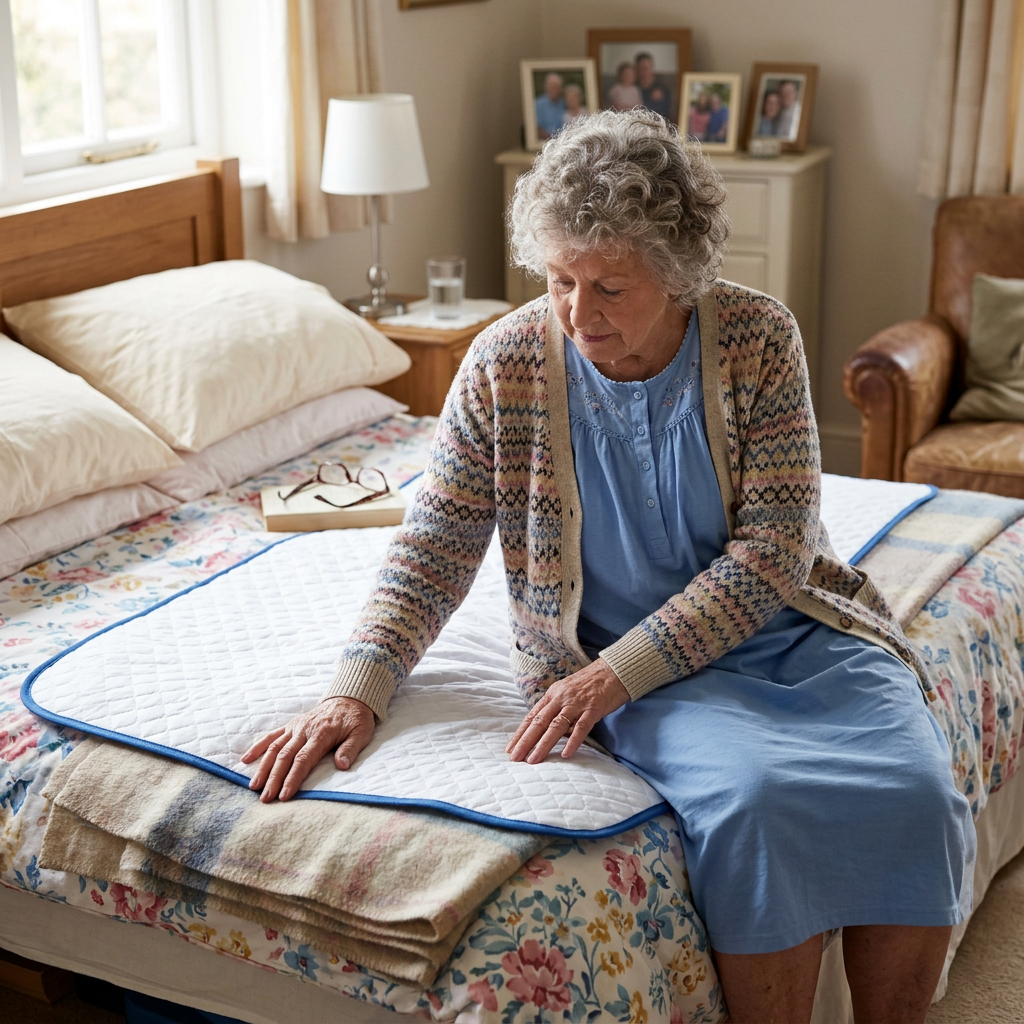
5 Best Washable Incontinence Bed & Chair Pads for Seniors
By Sarah Mitchell · Editor, BuyingForMom · Updated August 2026
10-min read · Bedroom & Living Room · 5 products compared

How we sorted through 40+ washable pads in two weeks
We cross-referenced more than 8,000 verified-buyer reviews across the reusable-underpad category, read the recurring complaints on caregiver threads in r/AgingParents and r/CaregiverSupport, and checked every pick against manufacturer-stated wash-cycle ratings. We weighted three things the ounce-count listicles skip: whether the backing actually grips the sheet, whether the pad survives high-heat laundering without the waterproof layer cracking, and whether the size and features match a specific real-world problem — a restless sleeper, a wheelchair, a bedbound parent who needs turning. Occupational therapists and continence nurses tell families the same thing: the pad that fails is almost never the one with the lowest absorbency number it’s the one that slid, bunched, or fell apart in the dryer.
Who this guide is for
This guide is for adult children and caregivers buying reusable pads for a parent managing light-to-heavy incontinence at home, after a hospital discharge, or through dementia-related nighttime accidents. If you’re shopping for yourself, the same picks apply just skip the “conversation” section near the end, which is written for the trickier job of introducing these to a parent who’d rather not admit they’re needed.
At a glance
Best Overall Gorilla Grip Washable Underpad, 34″×52″ — ~$30 · non-slip backing that actually stays put on the bed.
Best for Restless Sleepers RMS 4-Layer Pad with Two 18″ Flaps — ~$27 · tuck-in flaps stop the bunching.
Best for Chairs & Wheelchairs Gorilla Grip Chair & Furniture Pad, 21″×21″ — ~$25 (4-pack) · sized and gripped for seats.
Best Value Multipack IMPROVIA Washable Underpads, 34″×36″ (4-pack) — ~$40 · rated to 500 washes, stock-up pricing.
Best for Repositioning RMS Pad with 4 Handles, 34″×36″ — ~$25 · handles turn a two-person job into one.
Most roundups treat a bed and a wheelchair as the same problem — they aren’t. Below, each pick is matched to a specific failure it solves. Every pick was verified in stock at the time of writing.
Best Overall Gorilla Grip Washable Underpad (34″×52″)
~$30 · Check price on Amazon →

Across thousands of verified reviews, the pattern is consistent: buyers keep repurchasing this one for the non-slip backing, not the absorbency number. A pad that soaks up ten cups is useless if it slides off the fitted sheet — and that sliding is the single most common failure caregivers report with cheaper pads. At 34″×52″ it covers a generous hip-to-shoulder zone, the quilted top feels like fabric rather than plastic, and it launders repeatedly without the waterproof layer peeling. The one honest complaint: the heavily absorbent zone doesn’t run edge to edge, so center the body over the middle, not the seam.
The good
- Grippy backing genuinely stays put on the sheet the #1 thing that fails on budget pads.
- Large 34″×52″ coverage; also comes in 2- and 4-packs if you need rotation.
- Soft quilted top holds up wash after wash without cracking underneath.
The catch
- The high-absorbency zone is centered, not edge-to-edge position the body over the middle.
- No tuck-in flaps, so a very restless sleeper can still travel off it (see pick #2).
This is right if… you want one dependable, stay-put pad for a bed and don’t need tuck-in wings.
Look elsewhere if… the sleeper thrashes hard enough to bunch a loose pad — you’ll want flaps.
Best for Restless Sleepers RMS 4-Layer Pad with Two 18″ Flaps
~$27 · Check price on Amazon →

If a parent moves a lot in their sleep common with dementia and restless-leg patterns — a flat pad migrates and ends up in a wad against the footboard by morning. This RMS pad solves that mechanically: two 18″ flaps tuck under the mattress and anchor the pad so it can’t travel. Verified buyers repeatedly confirm the flaps do exactly that, and the four-layer quilted build wicks moisture off the skin quickly. The honest trade-off, per the reviews: the flaps need a mattress deep enough to hold them, and at 34″×36″ it guards the seat-and-hip zone, not the whole sheet.
The good
- Tuck-in flaps genuinely stop the pad from bunching under a restless sleeper.
- Four-layer construction wicks fast and keeps the surface feeling dry.
- Latex-free waterproof barrier; machine washable for hundreds of cycles.
The catch
- Flaps need a reasonably deep mattress to stay anchored.
- 34″×36″ covers a zone, not the entire bed.
This is right if… the sleeper is restless and a loose pad keeps ending up on the floor.
Look elsewhere if… you need full-width coverage or the mattress is too shallow for tuck flaps.
Best for Chairs Gorilla Grip Reusable Chair & Furniture Pad (21″×21″, 4-pack)
~$25 (4-pack) · Check price on Amazon →

Here’s the mistake families make: they buy one huge bed pad and fold it onto a recliner or wheelchair, where it bunches and slides forward the moment the person shifts. A chair needs a chair-sized pad, and this 21″×21″ square sits cleanly on a seat cushion, dining chair, recliner, or wheelchair without hanging off the edges. Reviewers on recliners and transport chairs note it stays put, and the Oeko-Tex-certified top matters for skin that sits on it for hours. The four-pack is the smart buy: one on the chair, one in the wash, spares in the closet. The common wish is a larger size for a full-length recliner — for that, buy two.
The good
- Correctly sized for chairs and wheelchairs — no bunching or overhang.
- Four-pack means you always have a clean one ready.
- Soft, Oeko-Tex-certified top for all-day sitting.
The catch
- 21″×21″ covers the seat, not a full-length recliner — use two for that.
- Lighter absorbency than a heavy overnight bed pad, by design.
This is right if… the concern is a favorite chair, recliner, or wheelchair rather than the bed.
Look elsewhere if… you need heavy overnight absorbency — that’s a bed pad’s job.
Best Value IMPROVIA Washable Underpads (34″×36″, 4-pack)
~$40 (4-pack) · Check price on Amazon →

Managing daily incontinence, you don’t need the fanciest single pad — you need enough clean ones to keep a rotation going without running the washer nightly. The four-pack lands around ten dollars a pad, each rated by the manufacturer for up to 500 washes, and buyers confirm the waterproof backing survives high-heat laundering that melts cheaper pads. The honest note that comes up again and again: they arrive stiff and a little crinkly for the first two or three washes before they soften and quiet down. Push through that break-in and you have a durable everyday rotation for a fraction of the disposable cost.
The good
- Four-pack pricing makes a daily rotation affordable.
- Manufacturer-rated to 500 washes; backing holds up to high heat.
- Stain-resistant surface that stays leak-proof edge to edge.
The catch
- Stiff and a bit noisy for the first few washes before softening.
- 34″×36″ is a zone pad, not full-bed width.
This is right if… you need several pads in rotation and want the lowest cost per use.
Look elsewhere if… you want one premium pad and a plush feel out of the package.
Best for Repositioning RMS Ultra Soft Pad with 4 Handles (34″×36″)
~$25 · Check price on Amazon →

If a parent is largely bedbound and someone helps turn them, this is the pad to buy — the four reinforced handles double as a draw-sheet. Caregivers frequently mention that gripping the handles lets one person scoot or turn a parent who would otherwise take two, protecting both the caregiver’s back and the parent’s skin from dragging. It’s the same soft four-layer, waterproof-backed build as RMS’s other pads, engineered for assisted repositioning. The trade-off is size: at 34″×36″ it lifts a zone, so most families layer it over a larger stay-put pad like pick #1 the big pad guards the mattress, the handled pad does the turning.
The good
- Four handles turn repositioning into a one-person job and spare the caregiver’s back.
- Doubles as a draw-sheet for turning without dragging skin across the bed.
- Soft four-layer, waterproof-backed, machine washable build.
The catch
- 34″×36″ protects a zone — layer it over a larger pad for full coverage.
- Overkill if no one is helping with turns.
This is right if… a caregiver is regularly turning or repositioning a bedbound parent.
Look elsewhere if… the parent moves independently — you’re paying for handles you won’t use.
Quick comparison
| Pad | Approx. price | Size | Best for |
|---|---|---|---|
| Gorilla Grip Underpad | ~$30 | 34″×52″ | Best overall bed pad, non-slip |
| RMS with Flaps | ~$27 | 34″×36″ + flaps | Restless sleepers who bunch pads |
| Gorilla Grip Chair Pad | ~$25 / 4 | 21″×21″ | Recliners & wheelchairs |
| IMPROVIA 4-Pack | ~$40 / 4 | 34″×36″ | Value rotation, 500 washes |
| RMS with Handles | ~$25 | 34″×36″ + handles | Caregiver repositioning |
The conversation you’ll have
Incontinence is one of the hardest aging topics to raise, because it lands squarely on dignity. Many older adults insist they don’t need “those pads,” even after a soaked mattress, because agreeing to one feels like conceding something bigger. The move that works is to make it about the mattress, not the person. Try saying, “Let’s just protect the bed so we don’t have to deal with the mattress — it’s easier laundry either way,” instead of, “You’re having accidents, so you need this.” A washable pad helps here specifically because it looks like a quilted mattress pad, not a medical product, and there’s nothing to throw in the trash each morning that announces what happened. Put it on the bed quietly, treat it as routine, and most of the resistance fades within a week.
Insurance and savings
Here’s the reality most listicles skip: Original Medicare (Part B) does not cover absorbent incontinence supplies — pads, underpads, or briefs — when used on their own, per Medicare.gov. A narrow 2025 rule change added limited reimbursement for disposable pads only when they’re used alongside covered catheter supplies, which won’t apply to most families buying washable bed pads. There are two better angles. First, many Medicaid programs do cover incontinence supplies with an incontinence diagnosis and a prescription, though what’s covered and how much varies by state. Second, and simplest: reusable incontinence pads are FSA- and HSA-eligible when medically necessary, so you can buy these with pre-tax dollars (some plans want a Letter of Medical Necessity on file). If a parent’s total unreimbursed medical costs are high, these supplies also count toward the IRS medical-expense deduction (Publication 502) if you itemize. It’s also worth checking whether a parent’s Medicare Advantage plan includes an over-the-counter allowance — several do, and pads often qualify.
What to actually look for
Match the pad to the failure, not the ounce count
The absorbency numbers on the box matter far less than whether the pad stays where you put it. A pad that slides is the most common complaint, so prioritize a genuine non-slip backing for beds and a chair-specific pad for seats — never one giant pad for both. If the sleeper is restless, buy flaps; if a caregiver is turning them, buy handles. This is the same “match the tool to the specific problem” logic that runs through our complete aging-in-place home safety checklist.
Size for the zone, then layer
Full-bed pads (34″×52″ and up) are for stay-put mattress protection; smaller 34″×36″ pads protect and lift a hip-to-seat zone. Many families run both — a large pad underneath for coverage, a smaller handled pad on top for turning. Think of pads as one layer in a broader bedroom setup, alongside the fitted protector and rails covered in our room-by-room aging-in-place modification guide.
Wash them right, or they stop working
The fastest way to ruin a good pad is fabric softener — it coats the fibers and quietly kills absorbency. Rinse in cold after use, wash warm or cold with mild detergent, skip the softener, and tumble low or air dry to protect the backing. A washable pad is the partner to a good fitted cover; if you haven’t sorted that layer, start with our picks for waterproof mattress protectors for incontinence.
Frequently asked questions
Do washable incontinence bed pads actually work?
Yes, when matched to the situation. A quilted washable pad wicks moisture off the skin, protects the mattress, and pays for itself within weeks versus disposables. The failures caregivers report are almost always about the pad sliding or bunching — solved by a non-slip backing or tuck-in flaps — not about absorbency.
How often should you replace washable incontinence pads?
Quality pads are rated for hundreds of washes — often up to 500 — so replacement depends on use, not a fixed calendar. Retire a pad when the top no longer feels dry after normal wetting, the backing cracks or feels tacky, or it stops lying flat. With gentle washing, a good pad lasts one to two years of daily use.
How do you wash reusable incontinence bed pads?
Rinse in cold water after use, then machine wash warm or cold with a mild detergent. Skip fabric softener — it coats the fibers and destroys absorbency — and skip bleach, which degrades the waterproof layer. Tumble dry low or air dry. Washing promptly prevents odor from setting into the fabric.
Are washable bed pads better than disposable ones?
For steady home use, washable pads cost far less over time, feel more like real bedding, and create no daily trash. Disposables win for travel, guests, or very heavy overnight output where laundry volume would be overwhelming. Many families keep both: washable for everyday, a box of disposables for backup.
Does Medicare cover incontinence bed pads?
Original Medicare does not cover absorbent pads or underpads used on their own. Some Medicaid programs cover them with a diagnosis and prescription (rules vary by state), and certain Medicare Advantage plans include an over-the-counter allowance that may apply. Reusable pads are also FSA- and HSA-eligible when medically necessary.
What size incontinence bed pad do I need?
For full mattress protection, choose 34″×52″ or larger. For a protection-and-turning zone, 34″×36″ is standard. For chairs and wheelchairs, use a dedicated 21″×21″ pad rather than folding a bed pad. When in doubt, size up for the bed and buy a separate small pad for the chair.
The shortlist


What we’d do tomorrow
Setting this up this week? Do three things in order. First, buy the Gorilla Grip 34″×52″ pad for the bed the one that stays put, which is 90% of the battle. Second, add whichever specialty pad matches the actual problem: flaps for a restless sleeper, handles if you’re helping turn them, or the chair pad if the concern is a recliner. Third, buy a small rotation so there’s always a clean one in reserve and keep fabric softener away from them. Set it on the bed quietly, frame it as protecting the mattress, and let it become routine.
— Sarah
Leave a Reply