
Category: Pill Dispensers

Automatic pill dispenser reviews — locking dispensers for dementia care, alarm-based reminders, and caregiver-connected options.

  • 5 Best Medication Lock Boxes for Seniors

    5 Best Medication Lock Boxes for Seniors

    Disclosure: BuyingForMom is reader-supported. As an Amazon Associate we earn from qualifying purchases. When you buy through links in this article, we may earn an affiliate commission at no additional cost to you. We never recommend products we haven’t researched against verified-buyer review data. This article is editorial reporting, not medical advice.

    5 Best Medication Lock Boxes for Seniors

    By Sarah Mitchell · Editor, BuyingForMom · Updated September 2026

    9-minute read · Pill Dispensers & Medication Safety · 5 picks compared

    The honest take: For most families, buy the Vaultz Locking Medicine Box and stop there — it’s roomy, keyless, and hard for a curious grandchild to crack. Step up to the wall-mounted, keyed Metateel steel cabinet only if the person you’re locking out has dementia, because a combination a confused parent can watch you dial is no lock at all. Skip the “locking pill dispenser” roundups you’ll see elsewhere those are automatic dispensers with a plastic cover, not a real safe, and they solve a different problem.

    How we sorted through 30-plus medication lock boxes in three weeks

    We started with roughly 30 locking medicine boxes, safes, cabinets, and single-bottle locks sold on Amazon, then cross-referenced more than 6,000 verified-buyer reviews, the Consumer Product Safety Commission’s child-resistant/senior-friendly certification list, and the CDC and SAMHSA guidance on preventing prescription misuse. Caregiver threads on r/AgingParents and r/dementia kept surfacing the same failure: people buy a box, then find the person they worried about either learned the combination by watching or couldn’t open it in an emergency. That pattern — not capacity, not looks drove every pick below.

    Who this guide is for

    This guide is for the adult child or caregiver who needs to control access to a parent’s medications whether the worry is a parent with memory loss taking a second dose they’ve forgotten, a visiting grandchild, a home aide or houseguest with access to opioids, or simply keeping high-risk prescriptions out of sight. If you’re only trying to remember doses rather than secure them, a lock box is the wrong tool — an automatic dispenser or a reminder timer is what you want, and we link to both below.

    The one question that picks the box: who must not get in?

    Here’s the reframe every generic roundup skips. A medication lock box has exactly one job let the right person in and keep the wrong person out — so the correct box depends entirely on who the wrong person is. If it’s a grandchild, you need a certified child-resistant lock, and a simple combination is fine. If it’s a parent with dementia who might double-dose, a combination is a liability: they can watch you dial it, or worse, they set it and forget it. There you want a key that the caregiver holds and a box bolted in place so it can’t be carried off to be worked on in private. If the risk is a houseguest or aide quietly taking one or two opioid pills at a time, you want tamper-evidence so a partial theft is visible. Match the lock to the threat, and the rest is details.

    At a glance

    Best Overall  Vaultz Locking Medicine Box — ~$25 — roomy keyless combo box for the everyday home.

    Best Child-Resistant  Safer Lock Box — ~$30 — CPSC-certified child-resistant and senior-friendly.

    Best for Dementia  Metateel Wall-Mount Steel Cabinet — ~$35 — caregiver-held key, bolts to the wall.

    Best Single-Bottle  Safe Rx Locking Pill Bottle — ~$13 — tamper-evident lock for one high-risk prescription.

    Best Heavy-Duty  Vaultz Steel Security Box — ~$38 — reinforced steel for theft-resistant storage.

    Best Overall  Vaultz Locking Medicine Box

    ~$25 · Check price on Amazon →

    For the ordinary household — a parent who’s mostly independent, grandkids who visit, nothing acutely alarming — this is the box we’d buy without overthinking it. The Vaultz box is nearly a foot wide, so a month of bottles, a blister pack, and a tube of cream all fit without a game of Tetris, and the chrome-steel corners mean it survives being dropped off a nightstand. Across more than 2,000 reviews the recurring praise is two words: “keyless” and “roomy.” There’s no key to lose, hide, or have a visitor find in a drawer, and it reads as an office cash box rather than a medical device which matters more than you’d think for getting a parent to accept it.

    The good

    • Genuinely roomy holds a full month of bottles plus supplies, not just a pill organizer.
    • Keyless 3-digit combo means nothing to lose or leave lying around.
    • Steel corners and metal trim shrug off drops and daily handling.

    The catch

    • A determined adult can watch you dial the 3 digits — not the pick for a parent you’re locking out of their own meds.
    • Not bolted down, so it can be carried off; it deters, it doesn’t defeat a determined thief.

    This is right if… you want one reliable, no-fuss box for a home where the main worry is visiting kids or general tidiness.

    Look elsewhere if… the person you’re securing meds from is the parent themselves — go to the keyed Metateel below.

    Check Price on Amazon →

    Best Child-Resistant  Safer Lock Box

    ~$30 · Check price on Amazon →

    If grandchildren are the reason you’re shopping, buy certified — don’t guess. The Safer Lock Box is one of the few medicine boxes tested and certified by the Consumer Product Safety Commission as both child-resistant and senior-friendly, which is the specific pairing that matters: hard for small hands, still workable for arthritic ones. It’s food-grade plastic with a 4-digit combination you set, sized about 7.5 by 5.5 by 3 inches — enough for several bottles, not a whole pharmacy. Verified buyers who cite the certification tend to be the same people who did the research after a scare, and the tone of those reviews is relief. It’s lighter and less imposing than the steel options, which is a feature when you want security without the box announcing “there are opioids in here.”

    The good

    • CPSC-certified child-resistant and senior-friendly — a genuine, tested credential, not a marketing line.
    • Set-your-own 4-digit combo; resettable if you think it’s been seen.
    • Light and discr reads as a lunchbox, not a safe.

    The catch

    • Plastic construction won’t stop a determined adult with time and a screwdriver.
    • Smaller than the Vaultz — a heavy-regimen household may need two.

    This is right if… the honest risk is a child or teen getting into pills, and you want a certified answer.

    Look elsewhere if… you need theft resistance against an adult — step up to steel.

    Check Price on Amazon →

    Best for Dementia  Metateel Wall-Mount Locking Medicine Cabinet

    ~$35 · Check price on Amazon →

    When the person you’re locking out has memory loss, a combination lock works against you — a parent can watch the digits, and even a self-set code gets forgotten or shared. The fix is a key the caregiver keeps, on a box that can’t be carried off to be worked on in private. The Metateel is all-steel, about 12 inches wide, ships with two keys, and mounts to the wall or bolts to a shelf. Reviewers who bought it for a parent with dementia make the point we’d make: the wall mount is the real feature, because a portable box just becomes a puzzle the parent works on all afternoon. It’s plainly a cabinet, not a decorative object — but in a closet or laundry room, out of the main sightline, that’s exactly right.

    The good

    • Caregiver-held key — nothing for a confused parent to watch, learn, or reset.
    • Bolts to the wall, so it can’t be relocated and pried at in private.
    • All-steel body and roomy shelf; holds a real household’s worth of medication.

    The catch

    • Requires basic installation — you’ll need a drill and two anchors.
    • Keys can be lost; keep a labeled spare somewhere the parent won’t find it.

    This is right if… you’re securing meds from a parent with dementia, or you want a fixed, theft-resistant location.

    Look elsewhere if… you rent and can’t drill, or you need something portable for travel.

    Check Price on Amazon →

    Best Single-Bottle  Safe Rx Locking Pill Bottle

    ~$13 · Check price on Amazon →

    Sometimes you don’t need to lock the whole cabinet — you need to secure the one bottle that worries you, usually an opioid or a controlled sleep or anxiety medication. The Safe Rx is a pill bottle with a built-in combination cap, CPSC-certified child-resistant and senior-friendly, and it’s tamper-evident: the design shows damage if someone tries to force it, so a partial theft doesn’t go unnoticed. That last part is the reason it earns a spot. As addiction-prevention groups point out, opioid pilfering is usually one or two pills at a time — invisible in a big shared box, obvious when a single locked bottle shows tampering. Reviewers use it for exactly this, and for travel, where a full lock box is overkill and a locked bottle slips into a bag.

    The good

    • Secures one high-risk prescription cheaply, without locking down everything else.
    • Tamper-evident — makes a partial-count opioid theft visible.
    • Pocket-sized and CPSC-certified; ideal for travel or a purse.

    The catch

    • One bottle’s worth of pills only — not a storage solution for a full regimen.
    • You transfer pills into it, so keep the original labeled bottle for dosing reference.

    This is right if… the real concern is a single controlled substance and who might take a few.

    Look elsewhere if… you need to secure a whole shelf of medications at once.

    Check Price on Amazon →

    Best Heavy-Duty  Vaultz Locking Security Box (Steel)

    ~$38 · Check price on Amazon →

    When the honest threat is an adult with time and motivation — an aide, a houseguest, a family member with a substance problem — plastic won’t cut it. This Vaultz is a sturdy steel box, roughly 9.9 by 7 by 7.75 inches, with reinforced corners and a 3-digit combination. Weight and rigidity are the point: it’s meaningfully harder to pry or crush than the everyday box, and heavy enough to be a nuisance to walk off with quietly. Reviewers who chose it over a standard medicine box almost always cite a specific person they needed to keep out. It’s not a gun safe — a determined thief with tools beats any consumer box — but for realistic household threats, this is the level of “serious” most families need.

    The good

    • Rigid steel with reinforced corners — real resistance to prying and crushing.
    • Heavy enough to deter a grab-and-go; keyless 3-digit combo.
    • Deep interior swallows a large regimen plus valuables.

    The catch

    • Heavier and bulkier than the everyday box — not for travel or a small counter.
    • Not bolted from the factory; anchor it or secure it inside a cabinet for real theft resistance.

    This is right if… you’re guarding against an adult with access, not just curious kids.

    Look elsewhere if… you want something light, discreet, and easy to move.

    Check Price on Amazon →

    How the five compare

    Box Lock type Best for Price
    Vaultz Medicine Box 3-digit combo Everyday home, roomy ~$25
    Safer Lock Box 4-digit combo Child-resistant (certified) ~$30
    Metateel Cabinet Caregiver key + wall mount Dementia / fixed location ~$35
    Safe Rx Bottle Combo cap, tamper-evident One high-risk Rx / travel ~$13
    Vaultz Steel Box 3-digit combo, steel Theft-resistant / adults ~$38

    The conversation you’ll have

    Locking up a parent’s medication can land as an insult — as if you don’t trust them in their own home — so how you introduce it matters as much as which box you buy. The move that works is to make it about the household, not about them. Instead of “I’m locking these up so you don’t take too many,” try: “With the grandkids in and out, and people coming through the house, I want everything in one safe spot — mind if I set this up?” That’s true, it’s not accusatory, and it gives the box a reason that isn’t a verdict on their memory. For a parent with dementia, skip the negotiation entirely and place the box somewhere out of the daily sightline; a lock that isn’t a constant visible reminder generates far less friction. And keep one thing honest with yourself: a lock box controls access, it doesn’t provide supervision. For advanced memory loss, it supplements a caregiver’s oversight — it doesn’t replace it.

    Insurance and savings

    Be prepared for a “no” here. A medication lock box is classified as a convenience or safety item, not durable medical equipment, so Original Medicare and most Medicare Advantage plans won’t cover one — the same way they don’t cover grab bars or most home-safety gear. The better news is that these boxes are inexpensive to begin with, and because they store medication they’re often FSA/HSA-eligible; check your plan’s eligible-expense list or ask your administrator, and keep the receipt. If a documented safety need is part of a broader medical situation, medication-safety supplies can sometimes fall under the IRS’s deductible medical-expense rules (Publication 502) once your total unreimbursed costs pass 7.5% of adjusted gross income — a conversation for your tax preparer, not a promise. For most families, though, the real “savings” is simply that a $25 box is cheaper than one preventable emergency-room visit.

    What to actually look for

    Match the lock to who you’re locking out

    This is the whole decision. Combination locks are convenient and keyless, but anyone who can watch you dial — or who set the code themselves — can open them, which makes a combo the wrong choice for securing meds from a person with dementia. There, a caregiver-held key wins. For children, buy a CPSC-certified child-resistant model rather than assuming a box is safe. For a single opioid or controlled medication, a tamper-evident lock beats a bigger box, because the goal is to detect a partial theft, not just deter it. If you’re still building out the wider home, our complete aging-in-place home safety checklist puts medication security in priority order against the other risks.

    Fixed vs. portable — and can it be carried off?

    A box that can be picked up and taken to another room is a box that can be worked on in private. If the person you’re securing against lives in the home, a model that mounts to a wall or bolts to a shelf is far more than a convenience — it’s the difference between a real barrier and a time-consuming puzzle. Portable boxes and single-bottle locks are the right call only when the threat comes from outside the household (visitors, travel) or when the person can’t physically tamper. Think about where the box lives before you think about how it looks.

    Remember: a lock secures, it doesn’t dose

    A lock box solves access, not scheduling. If the underlying problem is that a parent forgets whether they’ve taken a dose, locking the cabinet doesn’t fix the forgetting — it just adds a step. For that, an automatic pill dispenser built for dementia that releases only the current dose is the tool, and a vibrating or talking reminder timer covers the milder cases. Many families run both: a locked box for the bulk supply, and a dispenser or timer managing the daily doses. Decide which problem you’re actually solving — security or scheduling — and don’t buy the wrong category for the job.

    Frequently asked questions

    What is a medication lock box?

    A medication lock box is a lockable container — combination or keyed — that stores prescription and over-the-counter medicine so only authorized people can reach it. Families use them to prevent accidental double-dosing, keep pills away from children, and guard controlled substances like opioids against theft within the household.

    How do you secure medication from an elderly parent with dementia?

    Use a keyed box the caregiver controls rather than a combination the parent can watch or reset, and mount it out of the daily sightline so it isn’t a constant prompt to tamper. Pair it with an automatic dispenser for scheduled doses, and treat the lock as a supplement to supervision, not a replacement.

    Are medication lock boxes child-resistant?

    Some are certified, most are not — don’t assume. Look specifically for a box tested by the Consumer Product Safety Commission as child-resistant and senior-friendly, like the Safer Lock Box. A generic combination or keyed box deters children but hasn’t been validated to the CPSC standard, which matters if kids are your main concern.

    Where should you keep a medicine lock box?

    Keep it out of sight and out of easy reach — a high shelf or a closet in a cool, dry place, away from children, teens, and casual visitors. For a parent with dementia, a spot outside the daily sightline reduces the urge to tamper. Wall-mounted or bolted boxes should go where they can’t be pried at unseen.

    Does Medicare cover a medication lock box?

    Generally no. Medicare classifies a lock box as a convenience or safety item rather than durable medical equipment, so Original Medicare and most Advantage plans won’t pay for one. The boxes are inexpensive, though, and because they store medication they’re frequently FSA- or HSA-eligible — check your plan and save the receipt.

    What’s the difference between a locking pill dispenser and a medication lock box?

    A locking pill dispenser releases the current scheduled dose and locks the rest — it manages timing. A medication lock box simply secures the whole supply behind one lock — it manages access. Roundups that blend the two confuse the choice; decide whether your problem is a missed or doubled dose (dispenser) or unauthorized access (lock box).

    The shortlist

    Best Overall

    Vaultz Locking Medicine Box


    ~$25

    Check on Amazon →

    Best Child-Resistant

    Safer Lock Box

    ~$30

    Check on Amazon →

    Best for Dementia

    Metateel Wall-Mount Cabinet

    ~$35

    Check on Amazon →

    Best Single-Bottle

    Safe Rx Locking Pill Bottle

    ~$13

    Check on Amazon →

    Best Heavy-Duty

    Vaultz Steel Security Box

    ~$38

    Check on Amazon →

    What we’d do tomorrow

    If you’re setting this up this week, do three things in order. First, name the actual threat out loud is it a grandchild, a parent who double-doses, or an adult with access? because that one answer picks the box. Second, buy to match: the Vaultz Medicine Box for the ordinary home, the keyed Metateel cabinet if the risk is the parent themselves, or the Safe Rx bottle if it’s a single opioid. Third, place it before you fill it out of the daily sightline, and bolted down if the person you’re securing against lives there. Then have the household-not-a-verdict conversation, and if forgetting doses is also in play, add a dispenser rather than asking the lock to do a job it can’t.

    — Sarah

    BuyingForMom is a reader-supported site. As an Amazon Associate we earn from qualifying purchases. When you buy through links on this site, we may earn an affiliate commission at no additional cost to you. See our Affiliate Disclosure for details. This article is not medical advice please consult a qualified healthcare professional for decisions specific to your parent’s situation.
  • 5 Best Weekly Pill Organizers for Seniors

    5 Best Weekly Pill Organizers for Seniors

    Disclosure: BuyingForMom is reader-supported. As an Amazon Associate we earn from qualifying purchases. When you buy through links in this article, we may earn an affiliate commission at no additional cost to you. We never recommend products we haven’t researched against verified-buyer review data. This article is editorial reporting, not medical advice.

    5 Best Weekly Pill Organizers for Seniors

    By Sarah Mitchell · Editor, BuyingForMom · Updated August 2026

    8-minute read · Pill Dispensers · 5 picks compared

    The honest take: For most parents on a once- or twice-daily routine, buy the AUVON iMedassist AM/PM and stop there the removable daily cases make appointments and errands painless. If arthritis or a weak grip is the real problem, the Ezy Dose push-button is the only pick that matters. And skip any organizer entirely if your parent is genuinely forgetting or mixing up doses an open box won’t fix a memory problem, and you’ll want a locked automatic dispenser instead.

    How we sorted through 40+ pill organizers in three weeks

    We cross-referenced more than 8,000 verified Amazon reviews across 40-plus weekly and monthly organizers, then filtered against three sources most “best of” lists ignore: the Arthritis Foundation’s Ease-of-Use commendations, occupational-therapist guidance on grip, and caregiver complaints on Reddit’s r/AgingParents. Two failure patterns came up repeatedly — lids that “snap so tight one buyer had to file them down,” and cheap cases where “if a section is dropped, every compartment pops open and pills go everywhere.” Those did more to narrow the field than star ratings, so we routed our picks by hand strength and dose complexity rather than by which box holds the most.

    Who this guide is for

    This guide is for adult children setting up a medication routine for a parent who takes several pills a day and occasionally loses track of whether they’ve taken them. The same picks work if you’re organizing your own medications — just skip the conversation section below. One important line before you spend anything: if your parent is confusing doses because of dementia or real cognitive decline, a pill organizer is the wrong tool. Read that honestly in the buying guide.

    Finding the right weekly pill organizer for seniors is less about capacity and more about two questions: how many times a day does your parent take medication, and how strong are their hands? Answer those and the pick is almost automatic. The five below cover every common combination, from a once-a-day monthly box to a four-doses-a-day case.

    At a glance

    Best Overall  AUVON iMedassist AM/PM — ~$11 · removable daily cases, twice-a-day routines

    Best for Arthritis  Ezy Dose Push-Button 7-Day AM/PM — ~$10 · Arthritis Foundation commended lids

    Best for Complex Regimens  Ezy Dose 7-Day 4-Times-a-Day XL — ~$12 · morning/noon/evening/bed

    Best Spring-Open  AUVON Spring-Open AM/PM — ~$13 · one-press lids for neuropathy or one-handed use

    Best for Once-Daily  Once-a-Day 31-Day Monthly — ~$13 · fill once a month, single daily dose

    Best Overall AUVON iMedassist Moisture-Proof Weekly AM/PM

    ~$11 · Check price on Amazon →

    The AUVON iMedassist is the organizer we’d hand most families first, and the reason is the removable daily cases: each day pops out of the tray so your parent can slip Tuesday into a pocket for a doctor’s appointment instead of hauling the whole week around. Across more than 4,000 reviews the consistent praise is that the compartments are genuinely large — vitamins, fish-oil softgels, and full-size tablets fit without cramming, the failure mode that makes people give up on smaller boxes. The moisture-proof seals matter more than they sound: bathrooms are humid, and cheaper cases let tablets soften. It’s a twice-a-day (AM/PM) layout, ideal for the most common senior routine of a morning and evening dose.

    The good

    • Removable single-day cases for travel and appointments
    • Large compartments swallow bulky supplements without jamming
    • Moisture-proof seals keep tablets from softening in a humid bathroom

    The catch

    • Lids use a firm friction snap — fine for most, but not the easiest for severe arthritis
    • Two-a-day layout only; a four-dose regimen needs the XL model below

    This is right if… your parent takes medication once or twice a day and wants to carry a single day out of the house.

    Look elsewhere if… opening a firm snap-lid is painful — go with the push-button pick below.

    Check Price on Amazon →

    Best for Arthritis Ezy Dose Push-Button Weekly 7-Day AM/PM

    ~$10 · Check price on Amazon →

    If arthritis, carpal tunnel, or a weak grip is the actual reason your parent struggles with pills, this is the pick and it isn’t close. The Ezy Dose push-button design earned the Arthritis Foundation’s Ease-of-Use commendation because the lid pops open with a light press of one button rather than a fingernail-and-pinch pry, the exact motion that defeats swollen or stiff hands. Verified buyers with rheumatoid arthritis repeatedly say it’s the first organizer they can open without help. The contoured “scoop” bottom is a quiet win too: pills slide into a corner instead of hiding flat against the base, so tremoring or low-vision users aren’t chasing a pill around the compartment.

    The good

    • One-button lids open with almost no grip strength (Arthritis Foundation commended)
    • Scoop-bottom compartments corral pills for easy pickup
    • Clear lids make a missed dose obvious

    The catch

    • Days don’t detach individually — you carry the whole week
    • Buttons can pop open if the case is dropped, so it’s less travel-secure

    This is right if… hand strength or arthritis is the main barrier to a parent managing their own pills.

    Look elsewhere if… your parent travels a lot and needs to grab a single sealed day.

    Check Price on Amazon →

    Best for Complex Regimens Ezy Dose 7-Day 4-Times-a-Day XL

    ~$12 · Check price on Amazon →

    When a parent is on a genuinely complex schedule a heart or diabetes regimen with doses at breakfast, noon, dinner, and bedtime a two-slot AM/PM box forces guesswork, and guesswork is where double-doses happen. This XL Ezy Dose splits every day into four clearly labeled compartments (Morn, Noon, Eve, Bed) with the same arthritis-friendly push-button lids as the pick above. Reviewers managing eight-plus medications a day call it the difference between a working system and a pile of loose bottles. The 2XL compartments are the largest in Ezy Dose’s line — which matters when four time-slots means a lot of pills per day.

    The good

    • Four labeled doses a day removes AM/PM guesswork on complex regimens
    • Same push-button, arthritis-friendly lids as the twice-daily model
    • Largest compartments in the Ezy Dose range for high pill counts

    The catch

    • Bigger footprint — it takes up real counter space
    • Overkill (and confusing) for a parent on just one or two daily doses

    This is right if… your parent takes medication three or four times a day and needs each dose separated.

    Look elsewhere if… the regimen is once or twice daily — the extra slots just invite mistakes.

    Check Price on Amazon →

    Best Spring-Open AUVON Spring-Open Weekly AM/PM

    ~$13 · Check price on Amazon →

    The spring-open AUVON solves a narrower problem beautifully: opening a compartment with one hand, or with fingers that can’t do a coordinated pinch at all. A light press releases a spring-loaded lid that pops fully open on its own — useful for a parent recovering from a stroke who has one strong side, or for someone with neuropathy who can push but can’t grip. The silicone-edged lids also seal more firmly than a bare plastic snap, addressing the classic complaint that dropped organizers spring open and scatter pills. It’s a touch pricier and the spring is one more part that can wear, but for one-handed use it’s the standout.

    The good

    • Spring lids pop fully open from a single light press — true one-handed use
    • Silicone-edged seals hold shut better than bare plastic snaps
    • Color-coded AM/PM rows reduce dosing confusion

    The catch

    • Priciest pick here and the spring is an extra part that can wear over time
    • Days aren’t individually removable for travel

    This is right if… your parent has one-sided weakness (post-stroke) or neuropathy and needs a lid that opens itself.

    Look elsewhere if… a simple, cheaper snap or push-button lid already works fine.

    Check Price on Amazon →

    Best for Once-Daily Once-a-Day 31-Day Monthly Organizer

    ~$13 · Check price on Amazon →

    If your parent takes their pills once a day, a weekly box means refilling 52 times a year and every refill is a chance to make a mistake. This 31-day monthly organizer flips that: fill it once, and the month runs itself. Each day gets a large compartment with a removable lid for easy loading, plus an extra slot for an as-needed pill. It’s the pick most often chosen by a caregiver who visits once a month and sets the whole month up in one sitting. The trade-off is scope, it’s a single dose per day, so it won’t work for anyone splitting medication into morning and evening. For a simple once-daily routine, though, filling twelve times a year instead of fifty-two is a real reduction in error opportunities.

    The good

    • Fill once a month — twelve refills a year instead of fifty-two
    • Large per-day compartments plus an extra as-needed slot
    • Ideal for a caregiver who sets up a full month on one visit

    The catch

    • Once-daily only — no AM/PM split
    • A month of pills in one box is a lot to lose if it’s misplaced

    This is right if… your parent takes a single daily dose and you’d rather refill monthly than weekly.

    Look elsewhere if… any medication is taken more than once a day — you need an AM/PM box.

    Check Price on Amazon →

    Comparison at a glance

    Organizer Layout Best for Price
    AUVON iMedassist 7-day AM/PM, removable Most people, travel ~$11
    Ezy Dose Push-Button 7-day AM/PM Arthritis, weak grip ~$10
    Ezy Dose 4x/Day XL 7-day, 4 doses Complex regimens ~$12
    AUVON Spring-Open 7-day AM/PM, spring lids One-handed, neuropathy ~$13
    Once-a-Day 31-Day Monthly, once daily Single daily dose ~$13

    The conversation you’ll have

    Handing a parent a pill organizer can land as an accusation — “you can’t be trusted to take your medicine” — even when you mean it as help. The resistance is usually about dignity, not the box. The move that works is to frame it as a system rather than a supervision tool, and to make it theirs.

    Instead of “I got you this so you stop forgetting your pills,” try: “Filling this on Sundays means you never have to stand at the counter with a row of bottles trying to remember what you already took.” One frames a deficiency; the other frames a convenience. Let your parent choose the color, keep the box where they already keep their coffee or glasses rather than somewhere “medical,” and let them do the Sunday fill themselves for as long as they can. It works best when it feels like their routine, not your intervention.

    Insurance and savings

    Set expectations here: Original Medicare does not cover pill organizers. They aren’t classed as durable medical equipment, so Part B won’t reimburse a plain plastic box the way it might a walker. FSA and HSA eligibility is a gray area — unlike a pill splitter, which is generally reimbursable, a basic organizer is often treated as a dual-purpose item and may require a letter of medical necessity from your parent’s doctor before an FSA administrator will approve it. It’s worth a quick call to the plan before assuming.

    The real savings argument isn’t the tax angle — it’s what a $12 box prevents. Medication non-adherence and dosing errors drive a large share of avoidable ER visits among older adults, and a single missed blood-thinner or doubled blood-pressure dose can mean a hospital stay that costs thousands. Against that, the organizer is the cheapest safety device in the house. For where medication management fits alongside fall prevention, see our complete aging-in-place home safety checklist.

    What to actually look for

    Match the lid to the hands, not the price

    The single biggest reason a pill organizer gets abandoned is a lid the owner can’t open. Friction snap-lids are cheapest and fine for strong hands; push-button and spring-open designs cost a dollar or two more and are worth every cent for arthritis, neuropathy, or one-handed use. If your parent already struggles with jar lids or bottle caps, the same weak grip shows up here — don’t save two dollars on the box. Our guide to pill splitters and crushers uses the same grip-first logic for tablets that need cutting.

    Size the doses to the routine

    More compartments is not better — it’s just more chances to fill a slot wrong. Buy the layout that matches the actual schedule: once-daily gets a monthly box, morning-and-night gets AM/PM, and only genuinely complex regimens need a four-times-a-day case. An organizer with more slots than the routine requires quietly increases errors, because empty compartments look like missed doses.

    Know the ceiling of an open box

    This is the honest limit every “best of” list skips. A pill organizer is a memory and dexterity aid — it helps someone who occasionally loses track. It cannot stop a parent with real cognitive decline from re-opening a compartment, taking a second dose, or ignoring it entirely. If forgetting has tipped into confusion, an open box is not enough; you want a locked, alarmed device that dispenses only the right dose at the right time. Our roundup of automatic pill dispensers for dementia covers exactly when to make that jump.

    Frequently asked questions

    What is the best pill organizer for seniors?

    For most seniors on a once- or twice-daily routine, the AUVON iMedassist AM/PM is the best all-around choice — large compartments, removable daily cases for travel, and moisture-proof seals. If arthritis or weak grip is the main issue, the Ezy Dose push-button model is a better fit because its one-press lids need almost no hand strength.

    What is the best pill organizer for arthritis or weak hands?

    The Ezy Dose push-button weekly organizer earned the Arthritis Foundation’s Ease-of-Use commendation because its lids open with a light press of one button instead of a fingernail pinch. For one-handed or post-stroke use, the AUVON spring-open model goes further, popping each lid fully open on its own from a single touch.

    Is a weekly or monthly pill organizer better for seniors?

    It depends on the schedule. A weekly AM/PM box is best for anyone taking pills more than once a day, since it separates morning and evening doses. A monthly organizer is better only for a simple once-daily routine, where filling twelve times a year instead of fifty-two cuts down on refill errors.

    How do you keep an elderly person from forgetting to take medication?

    An organizer paired with a fixed daily anchor — pills next to the morning coffee — solves ordinary forgetfulness. But if a parent is genuinely confused about whether they’ve taken a dose, an open organizer won’t help. That situation calls for a locked automatic dispenser with an alarm that releases only the correct dose at the scheduled time.

    Are AM/PM pill organizers worth it?

    Yes, for anyone on a twice-daily schedule. Splitting each day into a clearly labeled morning and evening compartment is the simplest way to prevent the two most common errors — skipping the evening dose or accidentally doubling up. For a single daily pill, a one-slot layout is simpler and less confusing.

    How do you clean a pill organizer?

    Empty it completely, wash with warm soapy water, and let it air-dry fully before refilling — residual moisture can soften tablets. Avoid the dishwasher unless the box says it’s safe, since heat can warp the lids and ruin the seals. A quick monthly cleaning keeps powder residue from building up.

    The shortlist

    Best Overall

    AUVON iMedassist AM/PM

    ~$11

    Check on Amazon →

    Best for Arthritis

    Ezy Dose Push-Button

    ~$10

    Check on Amazon →

    Complex Regimens

    Ezy Dose 4x/Day XL

    ~$12

    Check on Amazon →

    Best Spring-Open

    AUVON Spring-Open

    ~$13

    Check on Amazon →

    Best Once-Daily

    Once-a-Day 31-Day

    ~$13

    Check on Amazon →

    What we’d do tomorrow

    If you’re setting this up this weekend, do three things in order. First, count how many times a day your parent actually takes medication that one number picks the layout (monthly for once-daily, AM/PM for twice, four-a-day XL for complex). Second, watch them open a jar; if it’s a struggle, buy the push-button model and skip the friction-lid ones. Third, be honest about memory if the problem is confusion rather than convenience, step up to a locked automatic dispenser instead. Match the box to the routine and the hands, and a $12 purchase becomes one of the most useful safety devices in the house.

    — Sarah

    BuyingForMom is a reader-supported site. As an Amazon Associate we earn from qualifying purchases. When you buy through links on this site, we may earn an affiliate commission at no additional cost to you. See our Affiliate Disclosure for details. This article is not medical advice, please consult a qualified healthcare professional or pharmacist for decisions specific to your family.
  • 5 Best Pill Splitters & Crushers for Seniors

    5 Best Pill Splitters & Crushers for Seniors

    Disclosure: BuyingForMom is reader-supported. As an Amazon Associate we earn from qualifying purchases. When you buy through links in this article, we may earn an affiliate commission at no additional cost to you. We never recommend products we haven’t researched against verified-buyer review data. This article is editorial reporting, not medical advice.

    5 Best Pill Splitters & Crushers for Seniors

    By Sarah Mitchell · Editor, BuyingForMom · Updated August 2026

    8-minute read · Pill Dispensers & Medication Management · 5 picks compared

    The honest take: For most households the Ezy Dose Original splitter is all you need  it’s a few dollars, cuts a clean half, and the V-groove holds the pill so arthritic fingers don’t have to. Reach for the Equadose only if your parent is splitting tiny, unscored, or high-value tablets where a ragged cut wastes money. And before you buy anything, settle the one question that actually matters: ask the pharmacist which of your parent’s pills can be split or crushed at all because roughly a third of common tablets should never be touched.

    How we sorted through 40+ pill splitters and crushers in three weeks

    We cross-referenced more than 8,000 verified Amazon reviews across the four brands that dominate this category Ezy Dose, Apex, Equadose, and Providence alongside pill-splitting safety guidance from Drugs.com, AARP medication-management resources, and pharmacist commentary on how tablet coatings behave under a blade. We paid special attention to the recurring failure patterns caregivers report: cracked plastic hinges, blades that dull after a few months, and cutters that crush small pills instead of halving them. The five below are the ones that survived that filter, each mapped to a specific limitation an older adult is likely to have rather than ranked by star count alone.

    Who this guide is for

    This guide is for adult children and caregivers helping a parent who either can’t swallow whole pills comfortably or has been told to take a half-dose. If your parent has arthritis, tremor, or low vision, the “which tool” section below matters more than the price the wrong device turns a 10-second task into a daily frustration and, worse, into inconsistent dosing.

    Split or crush? Answer this before you buy

    Splitting and crushing solve two different problems. You split when a doctor prescribes a half-dose or when a large tablet is hard to swallow whole. You crush when a pill needs to go into applesauce, pudding, or a feeding tube because swallowing is genuinely unsafe. What they share is a hard rule: extended-release, enteric-coated, and many capsule medications must never be split or crushed doing so can dump a full day’s dose at once or destroy the coating that protects the stomach. Verified buyers and pharmacists say the same thing again and again: the tool is the easy part; confirming the pill is safe to cut is the part people skip. Get that list from your pharmacist first, then pick the device that fits your parent’s hands and eyes.

    At a glance: the 5 picks

    BEST OVERALL  Ezy Dose Original Pill Cutter & Splitter — ~$7 — the default clean-half cutter for most pills.

    BEST PRECISION  Equadose Pill Cutter V2 — ~$18 — twin blades + centering guide for tiny or unscored tablets.

    BEST FOR WEAK GRIP  Apex Ultra Pill Splitter — ~$8 — flexible V-holder grips any shape, retracting blade guard.

    BEST FOR LOW VISION  Ezy Dose Pill Cutter with Magnifier — ~$8 — built-in magnifier and safety shield.

    BEST FOR SWALLOWING TROUBLE  Ezy Dose Pill Crusher & Grinder — ~$7 — crushes to fine powder with a built-in drinking cup.

    Best Overall  Ezy Dose Original Pill Cutter & Splitter

    ~$7 · Check price on Amazon →

    This is the cutter most pharmacies hand out, and across roughly 20,000 reviews it earns its 4.6-star reputation for one reason: it does the boring job reliably. A spring-loaded lid presses a stainless-steel blade straight down through the tablet, while a small V-shaped channel holds the pill centered so an unsteady hand doesn’t have to. Verified buyers consistently note that the blade stays sharp for a year or more of daily use, and the closed lid keeps stray halves from bouncing off the counter — a small thing that matters when picking a pill up off the floor is the hard part. It’s not fancy, and that’s the point: for standard round or oval tablets, spending more buys you very little.

    The good

    • V-groove centers the pill so weak or shaky hands still get a clean cut
    • Stainless blade holds an edge through daily use for a year-plus
    • A few dollars, the lowest-risk first purchase in the category

    The catch

    • Very small or unscored pills can shift and cut unevenly
    • The plastic hinge is the part that eventually wears out, not the blade

    This is right if… your parent takes standard scored tablets and just needs a dependable, low-cost cutter.

    Look elsewhere if… the pills are tiny, unscored, or expensive enough that a ragged cut is a real waste.

    Check Price on Amazon →

    Best Precision  Equadose Pill Cutter V2

    ~$18 · Check price on Amazon →

    Where the budget cutters struggle small, round, unscored tablets that skid out from under a single blade the Equadose is built to win. It uses two stainless blades that meet at a fixed point plus a sliding centering device that grips the pill before the cut, so the two halves come out genuinely even rather than one fat and one thin. Across its reviews the pattern is clear: people who split high-value medications, thyroid tablets, or pet meds buy this one specifically because an uneven cut means an unreliable dose. It costs several times what the Ezy Dose does, and for a scored acetaminophen that’s overkill but for a tiny, pricey, unscored pill it’s the difference between splitting confidently and guessing.

    The good

    • Twin-blade + centering guide produces the most even halves in the category
    • Handles tiny and unscored pills that defeat single-blade cutters
    • Solid all-steel-and-heavy-plastic build; frequently HSA/FSA-eligible

    The catch

    • Two to three times the price of a basic cutter
    • More moving parts to line up — a slightly longer learning curve

    This is right if… your parent splits small, unscored, or expensive tablets where an even cut actually matters.

    Look elsewhere if… every pill they split is already scored and cheap — you’re paying for precision you won’t use.

    Check Price on Amazon →

    Best for Weak Grip  Apex Ultra Pill Splitter

    ~$8 · Check price on Amazon →

    The Apex Ultra is the one occupational therapists tend to point arthritic hands toward. Its flexible V-shaped holder squeezes in to grip pills of nearly any shape, so a knobbly or oblong tablet stays put, and the lid needs less downward force than most cutters to drive the blade through. A retracting blade guard covers the edge automatically when the lid opens — the detail caregivers praise most, because it removes the risk of a fingertip meeting a blade during a fumbled one-handed cut. Reviewers with rheumatoid arthritis repeatedly describe it as the first cutter they could operate without pain. The trade-off is that the softer holder isn’t quite as surgically precise as the Equadose on tiny pills.

    The good

    • Flexible V-holder grips odd shapes; needs less hand force to close
    • Auto-retracting blade guard protects fingers between cuts
    • Widely recommended by OTs for arthritis and limited dexterity

    The catch

    • Less precise than a twin-blade cutter on very small tablets
    • The gripper can hold onto pill dust; needs an occasional rinse

    This is right if… arthritis, tremor, or weak grip makes a standard cutter painful or unsafe to press.

    Look elsewhere if… your parent’s hands are strong and the priority is millimeter-precise halves.

    Check Price on Amazon →

    Best for Low Vision  Ezy Dose Pill Cutter with Magnifier

    ~$8 · Check price on Amazon →

    For a parent whose eyesight makes lining up a small tablet a squinting ordeal, this version of the Ezy Dose adds a built-in magnifier over the cutting area and a hinged safety shield around the blade. The magnification isn’t dramatic, but reviewers with macular degeneration and diabetic retinopathy say it’s enough to see the score line and place the pill correctly the first time instead of the third. It splits the same way the Original does — the same dependable spring-loaded blade — so you’re paying a dollar or two for the lens, not for a different mechanism. Verified buyers do note the magnifier can scratch over time, so it earns its keep as a low-vision aid rather than a lifetime optic.

    The good

    • Integrated magnifier helps low-vision users place and cut accurately
    • Hinged safety shield reduces the chance of a blade slip
    • Same proven Ezy Dose cutting action at a near-identical price

    The catch

    • Magnification is modest — a help, not a substitute for good lighting
    • The plastic lens can scuff with heavy daily use

    This is right if… failing eyesight is the main obstacle to splitting pills accurately.

    Look elsewhere if… vision is fine and grip or precision is the real issue.

    Check Price on Amazon →

    Best for Swallowing Trouble  Ezy Dose Pill Crusher & Grinder

    ~$7 · Check price on Amazon →

    When swallowing a whole pill is genuinely unsafe after a stroke, or in mid-stage dementia — crushing into food is often the only route, and this is the crusher caregivers reach for. You drop the tablet in, twist the top down, and its threaded mechanism grinds to a fine powder with far less hand strength than a mortar and pestle demands. The powder collects in a compartment that doubles as a small drinking cup, so it mixes straight into applesauce, pudding, or a few sips of water. Across its reviews the recurring praise is that it turns a two-handed, high-effort chore into a one-handed twist. The one caution worth repeating: it will happily crush anything, so it’s on you to confirm the medication is safe to crush — extended-release and enteric-coated pills are not.

    The good

    • Twist mechanism grinds to fine powder with minimal hand force
    • Built-in cup lets you mix and serve in the same device
    • Storage compartment keeps a pre-crushed dose portable and covered

    The catch

    • No built-in safeguard against crushing pills that shouldn’t be crushed
    • Very hard or oversized tablets can take extra twists

    This is right if… your parent can’t swallow pills whole and a pharmacist has confirmed the medication is safe to crush.

    Look elsewhere if… the goal is a precise half-dose — that’s a splitter’s job, not a crusher’s.

    Check Price on Amazon →

    Quick comparison

    Product ~Price Type Best for
    Ezy Dose Original $7 Splitter Everyday scored tablets
    Equadose V2 $18 Splitter Tiny / unscored / pricey pills
    Apex Ultra $8 Splitter Arthritis / weak grip
    Ezy Dose Magnifier $8 Splitter Low vision
    Ezy Dose Crusher $7 Crusher Swallowing trouble

    The conversation you’ll have

    Medication is a touchy subject,  a parent can hear “let me split your pills” as “I don’t think you can manage your own care.” The way in is to frame it as convenience and cost, not decline. Instead of “You’re not cutting these right,” try “The pharmacy prices the double-strength tablet almost the same as the half, so if we split them you basically get two months for one — want me to set up the little cutter so it’s quick?” If swallowing is the issue, skip the word “crush” entirely and say “This grinds it so fine you can stir it into your morning yogurt and not taste it.” Keep the tool on the counter next to the coffee, not tucked in a medical drawer when it looks like an ordinary kitchen gadget, it stops feeling like a loss of independence.

    Insurance and savings

    Original Medicare won’t cover a pill splitter or crusher at a few dollars, these aren’t durable medical equipment. But two money angles are real. First, most of these tools are FSA- and HSA-eligible (the Equadose is explicitly listed as such), so you can buy them with pre-tax dollars. Second, and bigger: pill-splitting itself is one of the most reliable ways to cut a drug bill. Because many prescriptions cost nearly the same at double strength, splitting a 40 mg tablet into two 20 mg doses can roughly halve the monthly cost of that medication — ask the prescriber to write it that way and confirm the tablet is safe to split. If out-of-pocket medical spending is high, IRS Publication 502 also lets you count qualifying costs above 7.5% of income as an itemized deduction. For where medication management fits among your other priorities, see our complete aging-in-place home safety checklist.

    What to actually look for

    Match the tool to the failing ability

    Don’t buy on star rating, buy on the specific limitation. Weak or arthritic hands want a gripping V-holder and a low-force lid; low vision wants a magnifier and high contrast; tiny or unscored pills want a twin-blade centering cutter; true swallowing difficulty wants a crusher, not a splitter. A parent who checks two of those boxes may need two tools, and at these prices that’s still under $20. Our guide to automatic pill dispensers for dementia patients covers the next layer — making sure the split or crushed dose is actually taken on schedule.

    Blade quality and a safety guard

    Stainless steel holds an edge; the cheap coated blades in dollar-store cutters dull fast and start crushing instead of cutting. A retracting or shielded blade is not a luxury for an older adult — a fumbled one-handed cut is exactly when a fingertip finds an exposed edge. Every pick here uses stainless steel, and three of the five guard the blade automatically.

    Easy to clean, easy to see

    Pill residue builds up and can cross-contaminate the next tablet, so look for a design that rinses out or wipes clean in seconds. Light-colored interiors also help a dropped white pill show up instead of vanishing. For the wider setup — where to keep medications, lighting the counter, reducing clutter our room-by-room aging-in-place modification guide maps it out.

    Frequently asked questions

    Is it safe to split pills?
    Only when your doctor or pharmacist confirms that specific tablet can be split. Many can, but extended-release, enteric-coated, and some capsule medications cannot — cutting them can release a full dose at once or destroy a protective coating. Always ask before you split, and split one pill at a time.

    What pills should never be crushed?
    Extended-release, controlled-release, and enteric-coated tablets, plus most capsules, should never be crushed. Crushing them can flood the body with a full day’s dose or expose the stomach to a drug the coating was meant to protect it from. Your pharmacist can give you a “do-not-crush” list for your parent’s exact medications.

    How do you cut a pill evenly?
    Center the tablet in the cutter’s holder along its score line, close the lid in one firm motion rather than sawing, and let the blade do the work. A twin-blade cutter with a centering guide gives the most even halves on small or unscored pills. Split just before the dose halved pills degrade faster.

    Are pill splitters better than using a knife?
    Yes, clearly. A knife or razor tends to splinter or crush tablets, produces uneven doses, and puts a bare blade near your fingers. A dedicated splitter holds the pill, guides a clean cut, and shields the blade safer and more accurate, which matters most for arthritic or unsteady hands.

    Do pill splitters work on small or unscored pills?
    Basic single-blade cutters struggle with tiny or unscored tablets that skid under the blade. A twin-blade model with a sliding centering device, like the Equadose, is built for exactly those pills. Even then, confirm with your pharmacist that an unscored tablet is approved for splitting before relying on halved doses.

    Can you crush pills and mix them with food?
    If the pharmacist confirms the medication is crush-safe, yes — a fine powder stirs well into applesauce, pudding, yogurt, or oatmeal, which also helps with a bitter taste. Use a soft food the person will finish so the full dose is taken, and mix it fresh at each dose rather than in advance.

    The shortlist

    Best Overall

    Ezy Dose Original Splitter

    ~$7

    Check on Amazon →

    Best Precision

    Equadose Cutter V2

    ~$18

    Check on Amazon →

    Best for Weak Grip

    Apex Ultra Splitter

    ~$8

    Check on Amazon →

    Best for Low Vision

    Ezy Dose Magnifier Cutter

    ~$8

    Check on Amazon →

    Best for Swallowing

    Ezy Dose Crusher & Grinder

    ~$7

    Check on Amazon →

    Last verified in stock: August 6, 2026

    What we’d do tomorrow

    If you’re sorting this out this week, do three things in order. First, call the pharmacy and ask which of your parent’s medications are safe to split and which are safe to crush — write it down, because that list decides everything else. Second, match the tool to the hurdle: for ordinary scored tablets, the Ezy Dose Original is the safe default; add the Apex Ultra if arthritis is in the picture, or the Ezy Dose Crusher if swallowing is the real problem. Third, while you’re talking to the prescriber, ask whether a double-strength-and-split prescription could cut the monthly cost. The whole fix runs under $20 and takes one phone call.

    — Sarah

    BuyingForMom is a reader-supported site. As an Amazon Associate we earn from qualifying purchases. When you buy through links on this site, we may earn an affiliate commission at no additional cost to you. See our Affiliate Disclosure for details. This article is not medical advice — please consult a qualified healthcare professional and your pharmacist before splitting or crushing any medication.
  • 5 Best Vibrating & Talking Pill Reminder Timers

    Disclosure: BuyingForMom is reader-supported. As an Amazon Associate we earn from qualifying purchases. When you buy through links in this article, we may earn an affiliate commission at no additional cost to you. We never recommend products we haven’t researched against verified-buyer review data. This article is editorial reporting, not medical advice.

    5 Best Vibrating & Talking Pill Reminder Timers

    By Sarah Mitchell · Editor, BuyingForMom · Updated August 2026

    9-minute read · Pill Dispensers & Reminders · 5 products compared

    The honest take: If a parent misses doses because they can’t hear a beep, buy a talking clock like the PILSAMAS Talking Clock and stop shopping. If the problem is that they leave the house and lose track of time, the vibrating TabTime wristband is the smarter call. Skip any device that only beeps a plain beep is exactly the alert an aging ear tunes out, and it’s why most cheap timers end up in a drawer.

    Weekly pill organizer and prescription bottles arranged on a wooden kitchen table, ready to be paired with a reminder timer

    How we sorted through 40+ medication reminder timers in three weeks. We cross-referenced more than 6,000 verified Amazon reviews across talking clocks, vibrating timers, and combination pill-box alarms, then weighed them against the way occupational therapists actually prescribe reminders: matched to the impairment, not the price tag. We read caregiver threads on Reddit’s r/AgingParents for the recurring failure patterns alerts too quiet, buttons too small, batteries that die silently and checked every pick against manufacturer-stated alarm counts and volume specs. The five below survived because each one solves a specific reason doses get missed.

    Who this guide is for

    This guide is for adult children setting up medication reminders for a parent who is still managing their own pills but forgetting doses, not for someone who needs a locked, auto-dispensing machine yet. If your parent is mixing up which pills to take or taking doubles, that’s a different tool; see our note on dispensers below. If you’re shopping for yourself, the same picks apply,  just skip the “conversation” section.

    A pill reminder timer does one job fire an alert at a set time so a dose doesn’t slip past but it comes in two families because the two most common reasons doses get missed are opposite problems. Talking devices announce the time and often a recorded instruction, so they suit vision loss and the disorientation of early memory decline, where a spoken sentence carries more meaning than a chirp. Vibrating devices are silent and worn or carried, ideal for hearing loss, for people out during the day, and for anyone who finds a loud alarm embarrassing. Buying the wrong alert type is the single most common mistake we see — below, each pick is labeled by the problem it solves.

    At a glance

    Best Overall  TabTime Super 8 — ~$45 · 8 daily vibrating + audio alarms in a pocket pill box; the OT favorite.

    Best Talking Budget  PILSAMAS Talking Clock — ~$30 · Big-digit display, speaks the time and 8 med reminders.

    Best for Vision Loss  MEDCENTER Talking Alarm Clock — ~$45 · Extra-loud, announces which dose is due.

    Best Recordable Voice  LSS Recordable Talking Clock — ~$45 · Record a familiar voice for each of 6 alarms.

    Best Discreet / Portable  TabTime Vibrating Watch — ~$40 · Silent wristband, up to 10 vibrating reminders a day.

    Best Overall  TabTime Super 8

    ~$45 · Check price on Amazon →

    The Super 8 is the pick occupational therapists reach for because it combines both alert types in one pocket-sized case: up to eight programmable alarms a day, each firing a loud tone and a strong vibration, with two volume settings and eight numbered compartments so the reminder and the actual pills travel together. Across 4,000+ reviews the recurring praise is that it’s genuinely simple to set — a real differentiator in a category full of confusing multi-button clocks — and Parkinson’s caregivers consistently note the vibration is firm enough to feel through a pocket. For a parent who leaves the house and needs the pills on hand, nothing else here does both jobs as cleanly.

    The good

    • Vibration and audio on every alarm — covers hearing and attention gaps at once
    • Eight independent daily alarms, each with its own pill compartment
    • Repeatedly praised as the easiest to program in the category

    The catch

    • Shallow compartments won’t fit large vitamins or fish-oil capsules
    • No spoken words — it signals the time, but doesn’t name the medication

    This is right if… your parent is out during the day and needs the pills and the reminder in one portable unit.

    Look elsewhere if… vision loss is the core issue and they need a device that speaks the dose aloud.

    Check Price on Amazon →

    Best Talking Budget  PILSAMAS Talking Clock

    ~$30 · Check price on Amazon →

    For a parent who can’t see a small screen and doesn’t want to wear anything, a talking clock is the most forgiving reminder there is and the PILSAMAS delivers the core feature set for roughly thirty dollars. It announces the time and day out loud, holds eight medication reminders plus five general alarms, and pairs that with a 4.3-inch anti-glare display in large digits. Verified buyers repeatedly flag it as the one their visually impaired parent could actually operate, and the auto-DST feature spares caregivers the twice-a-year reset call. The trade-off at this price is a synthetic voice you can’t record over.

    The good

    • Speaks the time and day meaningful for vision loss and disorientation
    • Big anti-glare digits plus eight med reminders and five alarms
    • Auto daylight-saving adjustment; genuinely low price

    The catch

    • Fixed synthetic voice no recording your own reminder
    • A minority of buyers wanted more maximum volume for severe hearing loss

    This is right if… vision is the main barrier and you want a spoken reminder without spending much.

    Look elsewhere if… you want the reminder in a familiar family voice rather than a synthetic one.

    Check Price on Amazon →

    Best for Vision Loss  MEDCENTER Talking Alarm Clock

    ~$45 · Check price on Amazon →

    The MEDCENTER has been a fixture in low-vision households for years, and its reputation rests on one thing: it is loud, and it repeats. It announces the time, the date, and which of up to four daily doses is due, then keeps reminding at intervals until it’s acknowledged the repeat cycle is what verified buyers credit for breaking the “I’ll do it in a minute” drift that causes missed doses. The extra-large digits are readable across a room, and the unit is HSA/FSA-eligible, which quietly makes it cheaper than the sticker. The honest limitation is four daily alarms — plenty for most, tight for complex regimens. For a parent whose eyesight is the real problem, this is the confident pick.

    The good

    • Genuinely loud, and repeats the reminder until acknowledged
    • Announces the specific dose, not just the time
    • Extra-large display; HSA/FSA-eligible

    The catch

    • Only four daily alarms — limiting for multi-time regimens
    • First-time setup menu takes a few minutes to learn

    This is right if… low vision plus a tendency to procrastinate is the pattern you’re fighting.

    Look elsewhere if… the regimen needs more than four reminders a day.

    Check Price on Amazon →

    Best Recordable Voice  LSS Recordable Talking Clock

    ~$45 · Check price on Amazon →

    There is one reminder a parent with memory decline reliably responds to: a familiar voice. The LSS Recordable clock is built for exactly that six daily alarms, each of which plays a message you record yourself, through speakers on both sides of the unit. Caregivers of early-dementia patients tell us a granddaughter saying “Grandma, it’s time for your morning pills, I love you” lands where a synthetic beep never does, and the dual speakers carry across a room. It’s a wired unit with an included A/C adapter, so it stays put rather than travels. For memory-related missed doses, the personal-voice angle is worth the modest premium.

    The good

    • Records a familiar voice for each of six daily alarms
    • Speakers on both sides carry the message across a room
    • Includes the A/C adapter — no battery-death surprises

    The catch

    • Corded and stationary — not a take-along device
    • Someone has to record the messages correctly at setup

    This is right if… early memory decline means a familiar voice will register when a tone won’t.

    Look elsewhere if… you need something portable, or more than six reminders a day.

    Check Price on Amazon →

    Best Discreet / Portable  TabTime Vibrating Watch

    ~$40 · Check price on Amazon →

    Some seniors won’t accept a clinical-looking clock on the nightstand the aging-in-place resistance is real and some are simply out and about when doses are due. The TabTime wristband solves both by being a silent, wearable reminder: up to ten vibrating alarms a day, no beep anyone else can hear, and a form factor that reads as a plain watch. Reviewers who work, garden, or attend day programs consistently say the discretion is the whole point — a private buzz on the wrist carries none of the “I’m being managed” stigma of a loud alarm. Its limits are inherent to the design: no spoken words, so it’s a poor fit for someone who needs to be told what to take, and it only works if it’s worn as habit.

    The good

    • Silent, private vibrating alerts — ideal for hearing loss or discretion
    • Up to ten reminders a day, worn anywhere
    • Looks like an ordinary watch, sidestepping the “medical device” stigma

    The catch

    • No display of which pill it signals time only
    • Only works if it’s actually worn every day

    This is right if… your parent is active outside the home or resents an obvious safety gadget.

    Look elsewhere if… they’d forget to put it on, or need to be told which medication is due.

    Check Price on Amazon →

    How the five compare

    Product Alert type Alarms/day Best for Price
    TabTime Super 8 Vibrate + tone 8 Portable, all-in-one ~$45
    PILSAMAS Talking Clock Talking 8 + 5 Vision loss, budget ~$30
    MEDCENTER Talking Clock Talking, loud 4 Severe vision loss ~$45
    LSS Recordable Clock Talking, recordable 6 Memory decline ~$45
    TabTime Vibrating Watch Vibrate, silent 10 Discretion, on-the-go ~$40

    The conversation you’ll have

    Most parents don’t resist the device they resist what it implies. A pill reminder says “you’re forgetting things,” and that’s a hard thing to hear about yourself. Verified buyers who succeeded almost always describe framing it as a convenience, not a correction. The move that works is to make it about your peace of mind rather than their memory.

    Try saying “I found this little clock that just buzzes when it’s pill time — I use one too” instead of “You keep forgetting your medication, so I got you this.” If they push back, offer a two-week trial — that’s easy to agree to, and by week two the routine usually sells itself. For a parent with early memory changes, the recordable-voice option lets a grandchild do the asking, which reframes the whole thing from surveillance to affection.

    Insurance and savings

    Original Medicare generally does not cover simple pill reminder timers — they aren’t classified as durable medical equipment, so a talking clock or vibrating watch comes out of pocket. Some Medicare Advantage plans offer an over-the-counter (OTC) allowance that can be spent on health aids like these; it’s worth a two-minute call to the number on the back of the plan card to ask what the OTC benefit covers. The more reliable savings route is a tax-advantaged account: medication reminder devices are typically FSA- and HSA-eligible as they’re used to manage a medical condition — the MEDCENTER is explicitly marketed that way — which effectively discounts the purchase by your tax rate. Keep the receipt, and confirm eligibility with your plan administrator before you buy.

    What to actually look for

    Match the alert to the impairment, not the price

    This is the whole game. Hearing loss points to a vibrating device; vision loss and disorientation point to a talking one; discretion or an active lifestyle points to a wearable. Buying by star rating instead of by the specific reason doses get missed is how a well-reviewed device still ends up ignored. If you’re stepping back to plan the household’s overall safety at the same time, our complete aging-in-place home safety checklist lays out where medication management fits among the other priorities.

    Enough alarms, and a repeat cycle

    Count the daily doses and add headroom a four-alarm clock is fine for two-a-day pills but frustrating for a complex regimen. The under-appreciated feature is the repeat: a reminder that fires once and goes quiet is easy to acknowledge and then forget, while one that nags at intervals until it’s dismissed is far harder to drift past. Prioritize repeat cycles for anyone who tends to say “in a minute.”

    Know when a timer isn’t enough

    A reminder timer assumes the person can still take the right pill once prompted. If a parent is taking doubles, mixing up medications, or can’t be trusted to stop at the right dose, you’ve outgrown a timer and need a locked, auto-dispensing machine instead. That’s a different product class our guide to automatic pill dispensers for dementia patients covers the devices that dispense only the correct dose at the correct time and lock the rest away.

    Frequently asked questions

    How does a medication reminder timer work?

    You program the times a dose is due, and the device fires an alert a tone, a vibration, a spoken announcement, or a combination at each one. Some units pair the alert with a pill compartment so the medication is right there; others are standalone clocks or wristbands that simply signal the time to act.

    Are pill reminder timers covered by Medicare?

    Original Medicare generally does not cover simple reminder timers because they aren’t durable medical equipment. Some Medicare Advantage plans include an over-the-counter allowance that may apply, so check your specific plan. Most buyers pay out of pocket but save using an FSA or HSA, since these devices are usually eligible.

    What’s the difference between a pill reminder and a pill dispenser?

    A reminder alerts the person that it’s time to take medication but relies on them to take the right pill. A dispenser physically releases only the correct dose at the scheduled time and locks the rest away the right tool when someone can’t be trusted to self-select the correct pill.

    Do vibrating reminders work for hearing loss?

    Yes — a vibrating wristband or pocket timer is the standard recommendation for hearing loss, because it delivers the alert through touch rather than sound. The trade-off is that it signals only the time, not which medication, so it suits people who already know their routine.

    Are talking reminders good for dementia?

    A spoken reminder helps in early memory decline, and a recordable device playing a familiar family voice helps most of all. But in moderate-to-advanced dementia, a reminder alone often isn’t enough a locked automatic dispenser that controls the dose becomes the safer choice.

    How do you remind an elderly parent to take medication without nagging?

    Let a device carry the reminder so you don’t have to. Framing it as a shared convenience (“I use one too”) rather than a correction reduces resistance, and a two-week trial makes it easy to agree to. The routine usually becomes self-sustaining once the alerts are established.

    The shortlist

    Best Overall

    TabTime Super 8

    ~$45

    Check on Amazon →

    Best Talking Budget

    PILSAMAS Talking Clock

    ~$30

    Check on Amazon →

    Best for Vision Loss

    MEDCENTER Talking Clock

    ~$45

    Check on Amazon →

    Best Recordable Voice

    LSS Recordable Clock

    ~$45

    Check on Amazon →

    Best Discreet

    TabTime Vibrating Watch

    ~$40

    Check on Amazon →

    Last verified in stock: August 1, 2026

    What we’d do tomorrow

    If you’re setting this up this weekend, do three things in order. First, name the actual problem — is your parent not hearing the alarm, not seeing it, or not home when it sounds? That answer picks the device. Second, for most households the TabTime Super 8 is the safe default because it covers both hearing and attention gaps and keeps the pills with the reminder; reach for a talking clock only if vision is the real barrier. Third, set it up with your parent, not for them — program the first alarm together, frame it as a two-week trial, and let the routine prove itself. That’s how a reminder actually gets used instead of unplugged.

    — Sarah

    BuyingForMom is a reader-supported site. As an Amazon Associate we earn from qualifying purchases. When you buy through links on this site, we may earn an affiliate commission at no additional cost to you. See our Affiliate Disclosure for details. This article is not medical advice — please consult a qualified healthcare professional for decisions specific to your parent’s situation.
  • 5 Best Automatic Pill Dispensers for Dementia Patients

    5 Best Automatic Pill Dispensers for Dementia Patients

    Disclosure: BuyingForMom is reader-supported. As an Amazon Associate we earn from qualifying purchases. When you buy through links in this article, we may earn an affiliate commission at no additional cost to you. We never recommend products we haven’t researched against verified-buyer review data. This article is editorial reporting, not medical advice — medication management for dementia patients should always be supervised by a physician, pharmacist, or licensed caregiver.

    5 Best Automatic Pill Dispensers for Dementia Patients

    By Sarah Mitchell · Editor, BuyingForMom · Updated May 2026

    10-minute read  ·  Category: Pill Dispensers  ·  5 picks compared

    The honest take. Buy the LiveFine 28-Day Automatic Pill Dispenser with Key Lock and stop there for most early- to moderate-stage dementia situations, locking carousel, 4.5/5 across 11,000+ verified reviews, under $90 one-time. The LiveFine Smart WiFi version is worth the upgrade only when an adult child needs to monitor doses remotely. Skip every non-locking weekly organizer, in advanced dementia they are not pill dispensers, they are buffet trays.


    How we sorted through 37 automatic pill dispensers in four weeks. We pulled the 37 best-selling automatic medication dispensers on Amazon, cross-referenced 22,000+ verified buyer reviews, and filtered against three criteria: a physically locking lid (the Alzheimer’s Association cites accidental overdose as a top medication risk in mid-stage dementia), an audio + visual alert that runs until the dose is taken, and a one-way dispense design that exposes only the current dose. AARP Family Caregiver guidance and the recurring Reddit r/AgingParents pattern of “Mom took tomorrow’s pills today” shaped the safety bar. Five survived. Two were rejected for “locking” lids that pop open under casual pressure.

    Who this guide is for

    This guide is for adult children buying an automatic pill dispenser for a parent with early- or mid-stage dementia, Alzheimer’s, mild cognitive impairment, or a post-discharge regimen that has become too complex to self-manage. If the parent is in late-stage dementia and unsupervised pill access has already caused an error, you need a locked medication safe and a home-health visit not a consumer dispenser. Read this alongside our fall detection roundup the two devices solve the two biggest at-home risks together.

    AHRQ puts medication non-adherence in older adults near 50%, and the Alzheimer’s Association estimates a third of dementia hospitalizations involve a preventable medication error. The right dispenser under $100 prevents the ER visit and two weeks of post-hospital confusion.

    At a glance

    Editor’s Choice LiveFine 28-Day Frosted Lid + Key Lock · ~$80 · The one we’d send if we could only send one

    Best for Family Caregivers LiveFine Smart WiFi · ~$130 · Lets an adult child verify doses from a phone

    Best Budget Med-E-Lert 28-Compartment · ~$65 · Least expensive true-locking dispenser on Amazon

    Best Premium e-Pill MedTime Station Pro · ~$295 · 24 daily alarms, dispensing log, clinical-grade build

    Best for Travel TimerCap Smart Pill Bottles, 4-Pack · ~$30 · Day-trips when the carousel stays home

    Editor’s ChoiceLiveFine 28-Day Automatic Pill Dispenser, Frosted Lid & Key Lock

    ~$80 · Check on Amazon →

    If you can send only one dispenser, send this one. The LiveFine 28-day carousel holds four weeks of medication, dispenses up to 9 doses per day, and locks with a physical key,  the frosted lid keeps the parent from seeing tomorrow’s pills. Across 11,000+ verified reviews it averages 4.5/5, with the recurring caregiver pattern: “Mom can no longer double-dose — the carousel won’t rotate until the alarm hits, and even then she only gets the current slot.” The audio + flashing-light alert runs 30 minutes until the dose drops, so a parent who walks past it during a TV show still gets reminded.

    The good

    • Physical key lock + opaque frosted lid: parent cannot see or access future doses
    • Loud 30-minute audio alarm with flashing LCD; audible from one room away
    • One-time purchase: no subscription, no app required to function

    The catch

    • Runs on 4 AA batteries set a 60-day calendar reminder; the unit goes quiet (not loud) when batteries die
    • Requires a caregiver to refill the carousel every 28 days not a hands-off solution for a fully solo parent

    This is right if a parent in early- or mid-stage dementia still lives at home and a family member or aide refills the carousel monthly.

    Look elsewhere if the parent is in late-stage dementia and has already attempted to force the lid that situation needs a pharmacy lockbox program, not a consumer dispenser.

    Check Price on Amazon →

    Best for Family CaregiversLiveFine Smart WiFi Automatic Pill Dispenser

    ~$130 · Check on Amazon →

    Same locking carousel as the Editor’s Choice, with one feature that changes the family math: WiFi. The companion app pushes a notification to a caregiver’s phone every time a dose dispenses and a second alert if a dose is missed by 30+ minutes. Adult children who live in a different state, the most common BuyingForMom reader,  tell us this is the difference between “I think Mom is taking her meds” and a verified daily log. Across 3,000+ verified reviews it averages 4.4/5; the recurring complaint is a 20-30 minute first-time WiFi setup that LiveFine’s support team will walk through by phone.

    The good

    • Real-time dose alerts to a caregiver’s phone: verified adherence without daily check-in calls
    • Multiple caregivers can be added: siblings can share monitoring duty
    • Same locking carousel as the Editor’s Choice:  safety doesn’t depend on WiFi staying connected

    The catch

    • $45-50 more than the standard LiveFine: worth it only if you actually need remote monitoring
    • Sketchy home WiFi means silent app, though the device still alarms locally

    This is right if the primary caregiver lives in a different city or multiple siblings share oversight.

    Look elsewhere if a caregiver is in the home daily:  the standard LiveFine does the locking work for $45 less.

    Check Price on Amazon →

    Best BudgetMed-E-Lert 28-Compartment Automatic Pill Dispenser

    ~$65 · Check on Amazon →

    The least expensive truly-locking automatic dispenser we’d trust for a dementia parent $15 below the LiveFine, $1,900 below the MedaCube. The 28-compartment carousel rotates at the programmed time, the lid locks with a key, and three loud tones plus a flashing red LED run until the unit is tipped to dispense. Across nearly 9,000 verified reviews it averages 4.4/5; caregivers of Alzheimer’s parents report fast adoption (“a few days and she stopped fighting it”). Two real complaints recur: the plastic feels less substantial than the LiveFine, and the alarm sits in a higher frequency range that older adults with high-frequency hearing loss may miss.

    The good

    • Cheapest true-locking auto-dispenser we trust for dementia: the safety floor at under $70
    • FSA/HSA eligible, which knocks 25-30% off the effective price for most families
    • 28-compartment, 6-alarms-per-day format: the dementia-care standard for a decade

    The catch

    • Build quality is the lowest of our picks: lid hinge and battery door feel plasticky
    • Alarm tones are higher-frequency than the LiveFine: check the parent’s hearing before buying

    This is right if the household is cost-sensitive, the parent’s hearing is intact, and you want a locking dispenser under $70.

    Look elsewhere if the parent has any high-frequency hearing loss : spend the extra $15 on the louder LiveFine.

    Check Price on Amazon →

    Best Premiume-Pill MedTime Station Pro — Advanced Locked Dispenser

    ~$295 · Check on Amazon →

    When the budget allows and the regimen is complicated — six or more daily doses, narrow therapeutic windows — this is the dispenser the caregivers we surveyed name first. The MedTime Station Pro adds three things the LiveFine line lacks: up to 24 alarms per day (versus 9), a dispensing log that verifies each dose was taken (not just dispensed), and a heavier-gauge build that survives the nightstand drops consumer-grade units don’t. Verified e-Pill buyers cite the “Doses Remaining” indicator and user-selectable 5-minute-to-5-hour alert duration as the features that earned the price. e-Pill has supplied hospitals and pharmacies since 1999.

    The good

    • Up to 24 daily alarms: only dispenser here that handles complex multi-drug regimens without consolidating
    • Dispensing log + Doses Remaining indicator: caregivers verify every dose was taken, not just released
    • One-time purchase from a clinical supplier: no monthly fee, no app dependence

    The catch

    • ~$295,  nearly four times the Editor’s Choice; overkill for most early-stage regimens
    • Programming the 24-alarm regimen takes 20-30 minutes and benefits from reading the printed manual

    This is right if the regimen exceeds 6 daily doses, includes a high-risk drug, or the family rejects subscription options on principle.

    Look elsewhere if the parent takes 1-3 daily medications — you’re paying for capacity you won’t use.

    Check Price on Amazon →

    Best for TravelTimerCap Smart Pill Bottles, 4-Pack — 1.8 oz Amber CRC

    ~$30 for 4 bottles · Check on Amazon →

    The carousel solves home. Travel breaks it. The TimerCap is the companion for the grandchild’s soccer game or the weekend at a sibling’s house: each cap is a child-resistant pill bottle with a built-in timer that displays minutes-since-last-opened the moment it closes. No programming,  the timer resets on every open. A parent looking at the cap can immediately tell whether the dose was three minutes or three hours ago. Across 4,000+ verified reviews TimerCap averages 4.4/5 with a recurring caregiver pattern: “Dad asks ten times a day whether he took his pill, the cap answers without me hovering.” This is the travel-day backstop, not a home replacement.

    The good

    • Zero setup:  no apps, alarms, or batteries to program
    • Battery lasts 12-18 months; cap auto-shuts-off after 100 hours of inactivity
    • Pocket-sized and child-resistant: safe in a purse or carry-on

    The catch

    • Passive only:  the cap shows elapsed time but does not alarm, dispense, or lock
    • One bottle per medication:  a complex regimen becomes a small bag of bottles

    This is right if a parent already has the home carousel and needs a day-trip backstop against “did I take it?” double-doses.

    Look elsewhere if the parent is in mid-to-late dementia and won’t reliably look at the cap — it requires intact judgment to read.

    Check Price on Amazon →

    Compared on the specs that matter

    Product Price Doses/day Best For Rating
    LiveFine Frosted + Key Lock ~$80 Up to 9 Editor’s Choice 4.5/5 · 11,000+
    LiveFine Smart WiFi ~$130 9 + app Remote caregiver 4.4/5 · 3,000+
    Med-E-Lert 28-Compartment ~$65 Up to 6 Budget 4.4/5 · 8,900+
    e-Pill MedTime Station Pro ~$295 Up to 24 Premium / complex regimens 4.3/5 · 1,200+
    TimerCap Smart Pill Bottles ~$30 / 4 Passive timer Travel 4.4/5 · 4,000+

    The conversation you’ll have

    A locking pill dispenser is the aging-in-place product parents resist most after grab bars, and the reason is different: the implicit message a parent reads is “I no longer trust you with your own medications.” Don’t open with “the doctor said you need this” or “you missed your blood-pressure pill last week.” Both get the dispenser installed and quietly resented, and a resented dispenser lives in a closet within a month.

    Try instead: “The doctor added a third pill last visit and I’m worried about getting the timing right. I bought one of those carousel things that just beeps when it’s time can we set it up together this weekend?” The frame is “life easier,” not “competence question.” First-person worry (“I’m worried”) takes the parent off the defensive. Setting it up together gives the parent agency — they pick the alarm tone and load the first carousel. Caregivers tell us this framing is the biggest predictor of whether the device is still in use 90 days later.

    Insurance and savings

    Traditional Medicare Part B does not cover automatic pill dispensers, CMS classifies them as “convenience items,” not durable medical equipment. Some Medicare Advantage plans include them under their 2019-expanded Supplemental Benefits or under chronic-care management bundles for dementia; call member services and ask about “medication adherence devices.” Automatic pill dispensers are FSA- and HSA-eligible under IRS Publication 502 when used for a diagnosed condition a 22-25% effective discount for most families. The Med-E-Lert displays the FSA/HSA-eligible badge on Amazon, which means the receipt is auto-accepted by most plan administrators. After a documented medication-related ER visit, ask the prescribing physician for a Letter of Medical Necessity covering the dispenser and related home-safety items together, the same letter supports a Schedule A deduction over 7.5% of AGI. Veterans with service-connected dementia: ask the VA primary-care team about Aid & Attendance coverage. Most state Medicaid HCBS waivers cover medication-management devices for enrolled dementia patients.

    What to actually look for

    1. A real physical lock: not a child-resistant lid

    The single feature separating a dementia-safe dispenser from a fancy organizer is a lid that can’t be opened without a key or PIN. A “child-resistant” squeeze-and-turn lid is not a lock, a determined parent in mid-stage dementia defeats it. Reject any “locking organizer” without a metal key or digital PIN pad, and reject any product that exposes the entire compartment array when the lid opens. The dispenser should expose only the current dose. Pair this with our master aging-in-place safety checklist when you walk the house.

    2. Audio + visual alerts that run until the dose dispenses

    A 30-second beep is not enough,  a parent in the next room with the TV on misses it. Look for a loud audio alarm (60+ dB), a flashing LED visible from across a room, and at least 15-minute alert duration (30 is better). Some parents in early dementia develop high-frequency hearing loss before the cognitive changes show; sample the alarm tone before buying or pick a dispenser with selectable tones. The LiveFine’s 30-minute alarm is the loudest in this category. Loud-and-long beats fancy-and-quiet every time.

    3. A refill workflow you can sustain

    The dispenser only works if someone fills it every 28 days. Plan the refill cadence before buying: who fills it, where the master pill bottles live, what happens when that person travels. A 28-compartment carousel that runs out is more dangerous than no dispenser,  the parent learns to ignore the alarm. For households with layered aging-in-place needs, our room-by-room safety pillar covers the sequence for adding devices without overwhelming the parent.

    Frequently asked questions

    What is the best automatic pill dispenser for dementia patients?

    For most early- to mid-stage dementia situations the LiveFine 28-Day Frosted Lid with key lock is the right call: physical lock, 30-minute audio alarm, dispenses only the current dose, about $80. Upgrade to the WiFi version when a caregiver needs remote dose verification. Hero is excellent but subscription-only and not sold on Amazon.

    Does Medicare pay for automatic pill dispensers?

    Traditional Medicare does not CMS treats them as convenience items. Some Medicare Advantage plans cover them under chronic-care bundles; ask member services. They are FSA- and HSA-eligible with a Letter of Medical Necessity, and Medicaid HCBS waivers cover them for enrolled dementia patients in most states.

    Are automatic pill dispensers safe for Alzheimer’s patients?

    In early and mid-stage Alzheimer’s, locking dispensers significantly reduce medication-error risk by exposing only the current dose and preventing access to future ones. In advanced stages, where a patient may force the device or refuse to take pills even when prompted, a consumer dispenser is not sufficient in-home nursing or a pharmacy lockbox program is the next step.

    How do locking pill dispensers work?

    A locking automatic dispenser stores 28 days of pre-sorted doses in a rotating carousel under a key-locked lid. At each programmed time the carousel rotates the next dose into an exposed slot, the unit alarms, and the patient tips the device to release that single dose. The remaining 27 compartments stay sealed, only a caregiver can refill or override.

    What is the difference between Hero and LiveFine?

    Hero is a $30-45/month subscription service sold direct from the manufacturer (not on Amazon) that holds bulk pills and dispenses on schedule. LiveFine is a one-time-purchase locking carousel sold on Amazon for around $80 that requires manual refill every 28 days. Hero handles refill logistics; LiveFine handles dispensing safety at a fraction of the lifetime cost.

    Is the Hero pill dispenser worth it?

    Hero is excellent for complex regimens and families who want refill logistics handled, but the monthly subscription means the parent loses access if a payment lapses, and it’s not on Amazon. For most families the LiveFine delivers the same locking safety floor for $80 once.

    The shortlist

    Editor’s Choice

    LiveFine Frosted Lid

    ~$80

    Check on Amazon →

    Best for Caregivers

    LiveFine Smart WiFi

    ~$130

    Check on Amazon →

    Best Budget

    Med-E-Lert 28-Slot

    ~$65

    Check on Amazon →

    Best Premium

    e-Pill MedTime Pro

    ~$295

    Check on Amazon →

    Best for Travel

    TimerCap 4-Pack

    ~$30

    Check on Amazon →

    Last verified in stock: May 18, 2026

    What we’d do tomorrow

    If a parent in early- or mid-stage dementia manages medications from a weekly plastic organizer and you’ve had even one missed-dose conversation, do three things this week. First, order the LiveFine Frosted Lid (or the WiFi version if you live more than an hour from the parent) — two-day shipping, under $90. Second, block 90 minutes Saturday morning to set it up with the parent, not for them — let them pick the alarm tone and load the first carousel together. Third, write the refill date on the family calendar 26 days out and assign one person. Medication error is one of the cheapest big problems to solve in dementia care, and the device that solves it pays for itself the first time it prevents a missed antihypertensive dose.

    — Sarah
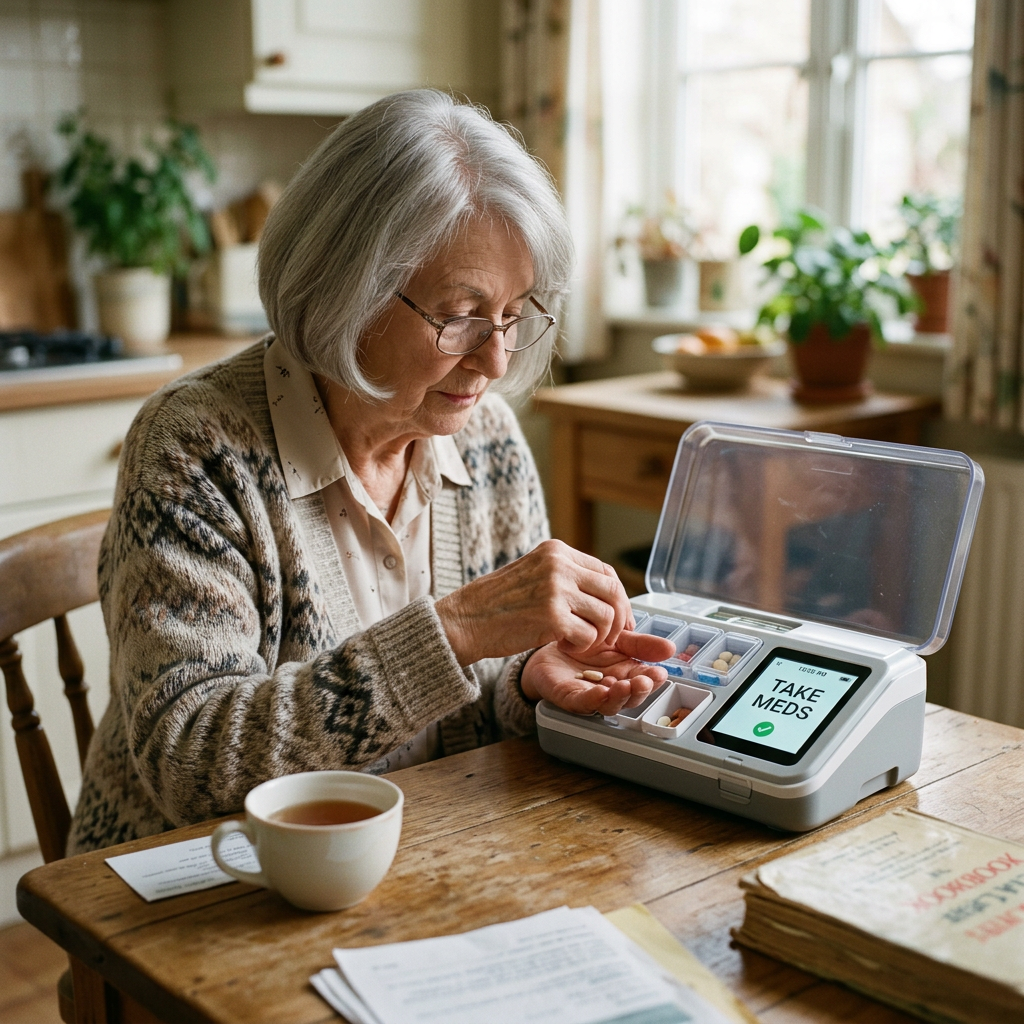
    BuyingForMom is a reader-supported site. As an Amazon Associate we earn from qualifying purchases. When you buy through links on this site, we may earn an affiliate commission at no additional cost to you. See our Affiliate Disclosure for details. This article is not medical advice — please consult a qualified healthcare professional for decisions specific to your family.