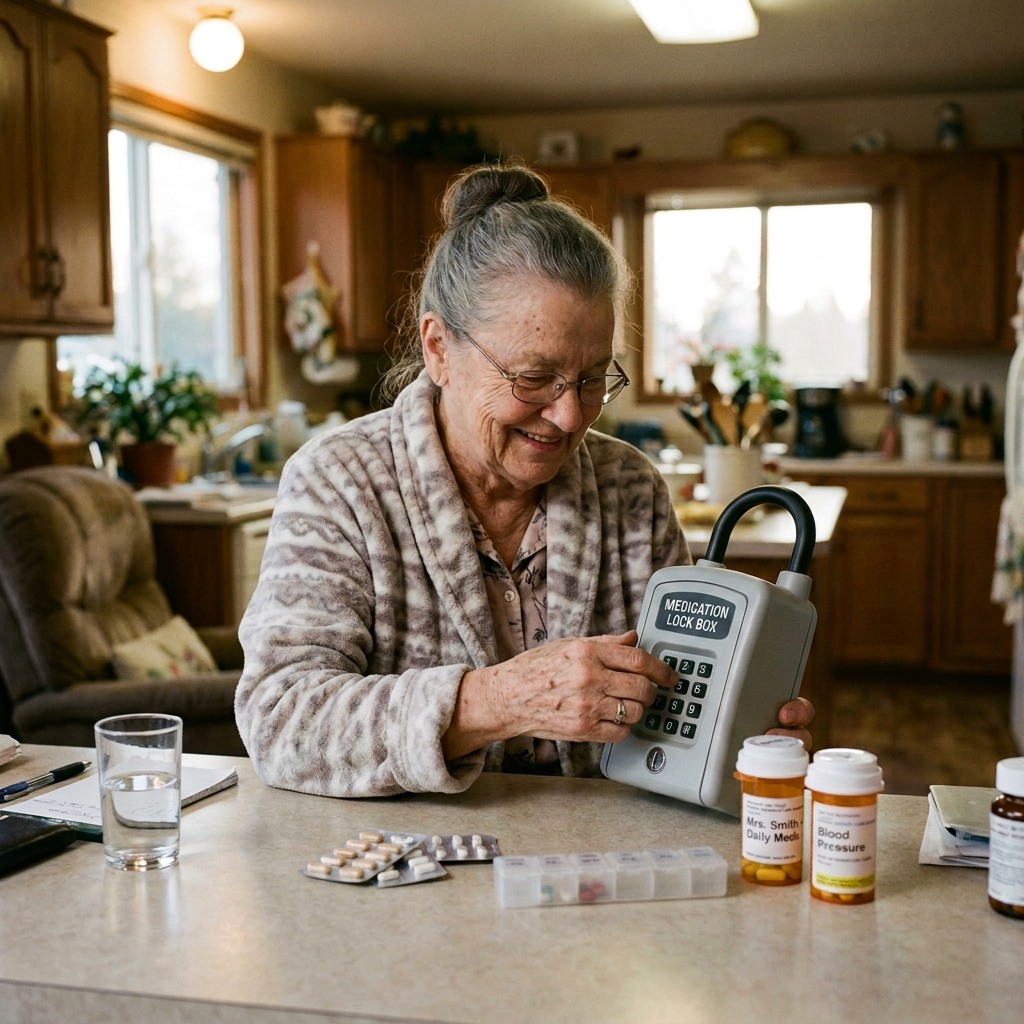
5 Best Medication Lock Boxes for Seniors
By Sarah Mitchell · Editor, BuyingForMom · Updated September 2026
9-minute read · Pill Dispensers & Medication Safety · 5 picks compared

How we sorted through 30-plus medication lock boxes in three weeks
We started with roughly 30 locking medicine boxes, safes, cabinets, and single-bottle locks sold on Amazon, then cross-referenced more than 6,000 verified-buyer reviews, the Consumer Product Safety Commission’s child-resistant/senior-friendly certification list, and the CDC and SAMHSA guidance on preventing prescription misuse. Caregiver threads on r/AgingParents and r/dementia kept surfacing the same failure: people buy a box, then find the person they worried about either learned the combination by watching or couldn’t open it in an emergency. That pattern — not capacity, not looks drove every pick below.
Who this guide is for
This guide is for the adult child or caregiver who needs to control access to a parent’s medications whether the worry is a parent with memory loss taking a second dose they’ve forgotten, a visiting grandchild, a home aide or houseguest with access to opioids, or simply keeping high-risk prescriptions out of sight. If you’re only trying to remember doses rather than secure them, a lock box is the wrong tool — an automatic dispenser or a reminder timer is what you want, and we link to both below.
The one question that picks the box: who must not get in?
Here’s the reframe every generic roundup skips. A medication lock box has exactly one job let the right person in and keep the wrong person out — so the correct box depends entirely on who the wrong person is. If it’s a grandchild, you need a certified child-resistant lock, and a simple combination is fine. If it’s a parent with dementia who might double-dose, a combination is a liability: they can watch you dial it, or worse, they set it and forget it. There you want a key that the caregiver holds and a box bolted in place so it can’t be carried off to be worked on in private. If the risk is a houseguest or aide quietly taking one or two opioid pills at a time, you want tamper-evidence so a partial theft is visible. Match the lock to the threat, and the rest is details.
At a glance
Best Overall Vaultz Locking Medicine Box — ~$25 — roomy keyless combo box for the everyday home.
Best Child-Resistant Safer Lock Box — ~$30 — CPSC-certified child-resistant and senior-friendly.
Best for Dementia Metateel Wall-Mount Steel Cabinet — ~$35 — caregiver-held key, bolts to the wall.
Best Single-Bottle Safe Rx Locking Pill Bottle — ~$13 — tamper-evident lock for one high-risk prescription.
Best Heavy-Duty Vaultz Steel Security Box — ~$38 — reinforced steel for theft-resistant storage.
Best Overall Vaultz Locking Medicine Box
~$25 · Check price on Amazon →

For the ordinary household — a parent who’s mostly independent, grandkids who visit, nothing acutely alarming — this is the box we’d buy without overthinking it. The Vaultz box is nearly a foot wide, so a month of bottles, a blister pack, and a tube of cream all fit without a game of Tetris, and the chrome-steel corners mean it survives being dropped off a nightstand. Across more than 2,000 reviews the recurring praise is two words: “keyless” and “roomy.” There’s no key to lose, hide, or have a visitor find in a drawer, and it reads as an office cash box rather than a medical device which matters more than you’d think for getting a parent to accept it.
The good
- Genuinely roomy holds a full month of bottles plus supplies, not just a pill organizer.
- Keyless 3-digit combo means nothing to lose or leave lying around.
- Steel corners and metal trim shrug off drops and daily handling.
The catch
- A determined adult can watch you dial the 3 digits — not the pick for a parent you’re locking out of their own meds.
- Not bolted down, so it can be carried off; it deters, it doesn’t defeat a determined thief.
This is right if… you want one reliable, no-fuss box for a home where the main worry is visiting kids or general tidiness.
Look elsewhere if… the person you’re securing meds from is the parent themselves — go to the keyed Metateel below.
Best Child-Resistant Safer Lock Box
~$30 · Check price on Amazon →
If grandchildren are the reason you’re shopping, buy certified — don’t guess. The Safer Lock Box is one of the few medicine boxes tested and certified by the Consumer Product Safety Commission as both child-resistant and senior-friendly, which is the specific pairing that matters: hard for small hands, still workable for arthritic ones. It’s food-grade plastic with a 4-digit combination you set, sized about 7.5 by 5.5 by 3 inches — enough for several bottles, not a whole pharmacy. Verified buyers who cite the certification tend to be the same people who did the research after a scare, and the tone of those reviews is relief. It’s lighter and less imposing than the steel options, which is a feature when you want security without the box announcing “there are opioids in here.”
The good
- CPSC-certified child-resistant and senior-friendly — a genuine, tested credential, not a marketing line.
- Set-your-own 4-digit combo; resettable if you think it’s been seen.
- Light and discr reads as a lunchbox, not a safe.
The catch
- Plastic construction won’t stop a determined adult with time and a screwdriver.
- Smaller than the Vaultz — a heavy-regimen household may need two.
This is right if… the honest risk is a child or teen getting into pills, and you want a certified answer.
Look elsewhere if… you need theft resistance against an adult — step up to steel.
Best for Dementia Metateel Wall-Mount Locking Medicine Cabinet
~$35 · Check price on Amazon →

When the person you’re locking out has memory loss, a combination lock works against you — a parent can watch the digits, and even a self-set code gets forgotten or shared. The fix is a key the caregiver keeps, on a box that can’t be carried off to be worked on in private. The Metateel is all-steel, about 12 inches wide, ships with two keys, and mounts to the wall or bolts to a shelf. Reviewers who bought it for a parent with dementia make the point we’d make: the wall mount is the real feature, because a portable box just becomes a puzzle the parent works on all afternoon. It’s plainly a cabinet, not a decorative object — but in a closet or laundry room, out of the main sightline, that’s exactly right.
The good
- Caregiver-held key — nothing for a confused parent to watch, learn, or reset.
- Bolts to the wall, so it can’t be relocated and pried at in private.
- All-steel body and roomy shelf; holds a real household’s worth of medication.
The catch
- Requires basic installation — you’ll need a drill and two anchors.
- Keys can be lost; keep a labeled spare somewhere the parent won’t find it.
This is right if… you’re securing meds from a parent with dementia, or you want a fixed, theft-resistant location.
Look elsewhere if… you rent and can’t drill, or you need something portable for travel.
Best Single-Bottle Safe Rx Locking Pill Bottle
~$13 · Check price on Amazon →

Sometimes you don’t need to lock the whole cabinet — you need to secure the one bottle that worries you, usually an opioid or a controlled sleep or anxiety medication. The Safe Rx is a pill bottle with a built-in combination cap, CPSC-certified child-resistant and senior-friendly, and it’s tamper-evident: the design shows damage if someone tries to force it, so a partial theft doesn’t go unnoticed. That last part is the reason it earns a spot. As addiction-prevention groups point out, opioid pilfering is usually one or two pills at a time — invisible in a big shared box, obvious when a single locked bottle shows tampering. Reviewers use it for exactly this, and for travel, where a full lock box is overkill and a locked bottle slips into a bag.
The good
- Secures one high-risk prescription cheaply, without locking down everything else.
- Tamper-evident — makes a partial-count opioid theft visible.
- Pocket-sized and CPSC-certified; ideal for travel or a purse.
The catch
- One bottle’s worth of pills only — not a storage solution for a full regimen.
- You transfer pills into it, so keep the original labeled bottle for dosing reference.
This is right if… the real concern is a single controlled substance and who might take a few.
Look elsewhere if… you need to secure a whole shelf of medications at once.
Best Heavy-Duty Vaultz Locking Security Box (Steel)
~$38 · Check price on Amazon →

When the honest threat is an adult with time and motivation — an aide, a houseguest, a family member with a substance problem — plastic won’t cut it. This Vaultz is a sturdy steel box, roughly 9.9 by 7 by 7.75 inches, with reinforced corners and a 3-digit combination. Weight and rigidity are the point: it’s meaningfully harder to pry or crush than the everyday box, and heavy enough to be a nuisance to walk off with quietly. Reviewers who chose it over a standard medicine box almost always cite a specific person they needed to keep out. It’s not a gun safe — a determined thief with tools beats any consumer box — but for realistic household threats, this is the level of “serious” most families need.
The good
- Rigid steel with reinforced corners — real resistance to prying and crushing.
- Heavy enough to deter a grab-and-go; keyless 3-digit combo.
- Deep interior swallows a large regimen plus valuables.
The catch
- Heavier and bulkier than the everyday box — not for travel or a small counter.
- Not bolted from the factory; anchor it or secure it inside a cabinet for real theft resistance.
This is right if… you’re guarding against an adult with access, not just curious kids.
Look elsewhere if… you want something light, discreet, and easy to move.
How the five compare
| Box | Lock type | Best for | Price |
|---|---|---|---|
| Vaultz Medicine Box | 3-digit combo | Everyday home, roomy | ~$25 |
| Safer Lock Box | 4-digit combo | Child-resistant (certified) | ~$30 |
| Metateel Cabinet | Caregiver key + wall mount | Dementia / fixed location | ~$35 |
| Safe Rx Bottle | Combo cap, tamper-evident | One high-risk Rx / travel | ~$13 |
| Vaultz Steel Box | 3-digit combo, steel | Theft-resistant / adults | ~$38 |
The conversation you’ll have
Locking up a parent’s medication can land as an insult — as if you don’t trust them in their own home — so how you introduce it matters as much as which box you buy. The move that works is to make it about the household, not about them. Instead of “I’m locking these up so you don’t take too many,” try: “With the grandkids in and out, and people coming through the house, I want everything in one safe spot — mind if I set this up?” That’s true, it’s not accusatory, and it gives the box a reason that isn’t a verdict on their memory. For a parent with dementia, skip the negotiation entirely and place the box somewhere out of the daily sightline; a lock that isn’t a constant visible reminder generates far less friction. And keep one thing honest with yourself: a lock box controls access, it doesn’t provide supervision. For advanced memory loss, it supplements a caregiver’s oversight — it doesn’t replace it.
Insurance and savings
Be prepared for a “no” here. A medication lock box is classified as a convenience or safety item, not durable medical equipment, so Original Medicare and most Medicare Advantage plans won’t cover one — the same way they don’t cover grab bars or most home-safety gear. The better news is that these boxes are inexpensive to begin with, and because they store medication they’re often FSA/HSA-eligible; check your plan’s eligible-expense list or ask your administrator, and keep the receipt. If a documented safety need is part of a broader medical situation, medication-safety supplies can sometimes fall under the IRS’s deductible medical-expense rules (Publication 502) once your total unreimbursed costs pass 7.5% of adjusted gross income — a conversation for your tax preparer, not a promise. For most families, though, the real “savings” is simply that a $25 box is cheaper than one preventable emergency-room visit.
What to actually look for
Match the lock to who you’re locking out
This is the whole decision. Combination locks are convenient and keyless, but anyone who can watch you dial — or who set the code themselves — can open them, which makes a combo the wrong choice for securing meds from a person with dementia. There, a caregiver-held key wins. For children, buy a CPSC-certified child-resistant model rather than assuming a box is safe. For a single opioid or controlled medication, a tamper-evident lock beats a bigger box, because the goal is to detect a partial theft, not just deter it. If you’re still building out the wider home, our complete aging-in-place home safety checklist puts medication security in priority order against the other risks.
Fixed vs. portable — and can it be carried off?
A box that can be picked up and taken to another room is a box that can be worked on in private. If the person you’re securing against lives in the home, a model that mounts to a wall or bolts to a shelf is far more than a convenience — it’s the difference between a real barrier and a time-consuming puzzle. Portable boxes and single-bottle locks are the right call only when the threat comes from outside the household (visitors, travel) or when the person can’t physically tamper. Think about where the box lives before you think about how it looks.
Remember: a lock secures, it doesn’t dose
A lock box solves access, not scheduling. If the underlying problem is that a parent forgets whether they’ve taken a dose, locking the cabinet doesn’t fix the forgetting — it just adds a step. For that, an automatic pill dispenser built for dementia that releases only the current dose is the tool, and a vibrating or talking reminder timer covers the milder cases. Many families run both: a locked box for the bulk supply, and a dispenser or timer managing the daily doses. Decide which problem you’re actually solving — security or scheduling — and don’t buy the wrong category for the job.
Frequently asked questions
What is a medication lock box?
A medication lock box is a lockable container — combination or keyed — that stores prescription and over-the-counter medicine so only authorized people can reach it. Families use them to prevent accidental double-dosing, keep pills away from children, and guard controlled substances like opioids against theft within the household.
How do you secure medication from an elderly parent with dementia?
Use a keyed box the caregiver controls rather than a combination the parent can watch or reset, and mount it out of the daily sightline so it isn’t a constant prompt to tamper. Pair it with an automatic dispenser for scheduled doses, and treat the lock as a supplement to supervision, not a replacement.
Are medication lock boxes child-resistant?
Some are certified, most are not — don’t assume. Look specifically for a box tested by the Consumer Product Safety Commission as child-resistant and senior-friendly, like the Safer Lock Box. A generic combination or keyed box deters children but hasn’t been validated to the CPSC standard, which matters if kids are your main concern.
Where should you keep a medicine lock box?
Keep it out of sight and out of easy reach — a high shelf or a closet in a cool, dry place, away from children, teens, and casual visitors. For a parent with dementia, a spot outside the daily sightline reduces the urge to tamper. Wall-mounted or bolted boxes should go where they can’t be pried at unseen.
Does Medicare cover a medication lock box?
Generally no. Medicare classifies a lock box as a convenience or safety item rather than durable medical equipment, so Original Medicare and most Advantage plans won’t pay for one. The boxes are inexpensive, though, and because they store medication they’re frequently FSA- or HSA-eligible — check your plan and save the receipt.
What’s the difference between a locking pill dispenser and a medication lock box?
A locking pill dispenser releases the current scheduled dose and locks the rest — it manages timing. A medication lock box simply secures the whole supply behind one lock — it manages access. Roundups that blend the two confuse the choice; decide whether your problem is a missed or doubled dose (dispenser) or unauthorized access (lock box).
The shortlist


What we’d do tomorrow
If you’re setting this up this week, do three things in order. First, name the actual threat out loud is it a grandchild, a parent who double-doses, or an adult with access? because that one answer picks the box. Second, buy to match: the Vaultz Medicine Box for the ordinary home, the keyed Metateel cabinet if the risk is the parent themselves, or the Safe Rx bottle if it’s a single opioid. Third, place it before you fill it out of the daily sightline, and bolted down if the person you’re securing against lives there. Then have the household-not-a-verdict conversation, and if forgetting doses is also in play, add a dispenser rather than asking the lock to do a job it can’t.
— Sarah
Leave a Reply