Tag: Fall Prevention

Products and modifications specifically focused on preventing falls.

  • 5 Best Threshold Ramps for Walkers (2026)

    5 Best Threshold Ramps for Walkers (2026)

    Disclosure: BuyingForMom is reader-supported. As an Amazon Associate we earn from qualifying purchases. When you buy through links in this article, we may earn an affiliate commission at no additional cost to you. We never recommend products we haven’t researched against verified-buyer review data. This article is editorial reporting, not medical advice.

    5 Best Threshold Ramps for Walkers (2026)

    By Sarah Mitchell · Editor, BuyingForMom · Updated June 2026

    10-min read · Outdoors & Entryways · 5 picks compared

    The honest take: For most walker users, buy the FACHNUO 1″ Rubber Threshold Ramp and stop there, a low rise with a grippy top is exactly what a walker needs, and it’s under $40. Spend up for the EZ-ACCESS TRANSITIONS Angled Entry Mat only if the ramp lives outdoors year-round and you want a lifetime warranty. Skip the heavy 3-channel wheelchair ramps unless your threshold is genuinely 2–3 inches tall they’re built for rolling power chairs, and the bulk just gets in a walker’s way.

    How we sorted through 40-plus threshold ramps in two weeks

    We cross-referenced more than 8,000 verified-buyer reviews across the rubber and aluminum threshold-ramp category, then narrowed the field with a filter most roundups ignore: how the ramp behaves for someone using a walker rather than a wheelchair. A walker user steps onto the ramp; a wheelchair rolls across it. That single difference changes what matters, top-surface grip and a low, predictable rise beat the high weight caps and cable channels that dominate wheelchair-focused listings. We weighted OT guidance on the 1:12 ADA slope rule, manufacturer rise and load specs, and recurring caregiver-review patterns: the trim-to-fit experience, whether the ramp slides on tile, and rubber off-gassing on arrival.

    Who this guide is for

    This guide is for adult children or caregivers buying a threshold ramp for a parent who uses a walker or rollator and catches a toe or the walker’s front legs, on a door sill, sliding-door track, or single raised step. If your parent uses a powered wheelchair or scooter, the same picks work, but prioritize the higher-rise channel models below. Renters, take note: every ramp here is portable and needs zero installation.

    Why thresholds trip walker users specifically

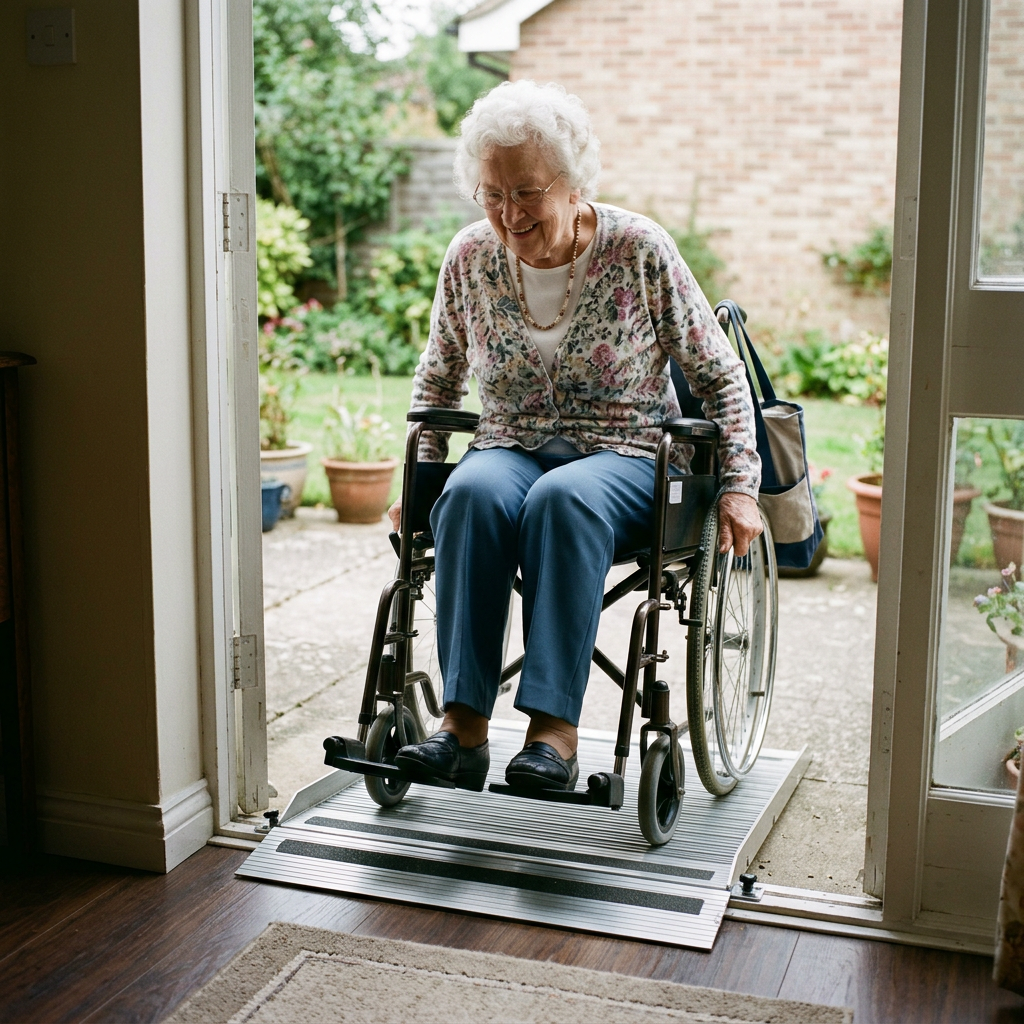
    A standard interior threshold is half an inch to an inch tall, and exterior sills run higher. For someone walking unaided, that lip is invisible. For a walker user it’s a genuine hazard: the front feet catch on the rise while the body keeps moving forward, and the recovery margin a younger person relies on isn’t there. The CDC reports most older-adult falls happen at home, with doorways a recurring location. A threshold ramp removes the lip, turning a sudden vertical catch into a gentle slope the walker crosses in one motion.

    The fix is inexpensive and reversible one of the first modifications we recommend. For where it fits in the bigger picture, see our complete aging-in-place home safety checklist for the priority order of changes worth making first.

    At a glance: the 5 picks

    BEST OVERALL  FACHNUO 1″ Rubber Threshold Ramp: $35 · the low-rise, grippy ramp most walker users actually need.

    BEST PREMIUM  EZ-ACCESS TRANSITIONS Angled Entry Mat: $130 · USA-made recycled rubber with a lifetime warranty for year-round outdoor use.

    BEST FOR TALL SILLS  Ruedamann 2″ Solid Rubber Ramp: $60 · 4.7 stars from 750-plus buyers for higher exterior thresholds.

    BEST FOR TRACKS & CORDS  Silver Spring 3″ 3-Channel Ramp: $85 · channels underneath clear sliding-door tracks, cables, and hoses.

    BEST LOW-PROFILE LOOK  Ruedamann 1″ Modular Wood-Grain Ramp: $65 · aluminum with a wood finish that doesn’t read as medical.

    Best Overall FACHNUO 1″ Rubber Threshold Ramp

    ~$35 · Check price on Amazon →

    For a walker, the FACHNUO does the one thing that matters most: it keeps the rise low (a true 1 inch) with a wide, grooved top to land a foot or walker leg on. At 5 pounds and 35.4 inches wide, it covers a standard doorway and trims with a utility knife for narrower ones. The frame is rated to 3,306 pounds far more than a walker user will ever apply but the real value is the textured tread, which verified buyers repeatedly call grippy even when wet. The one recurring complaint is a rubber smell on arrival that fades within a day or two. For most households, this is the ramp to buy first.

    The good

    • Low 1″ rise is ideal for the step-on motion walker users make
    • Trims to any doorway width with a utility knife
    • Lightweight enough to reposition or take along when visiting

    The catch

    • Arrives with a rubber odor that needs a day or two to fade
    • Only covers rises up to about 1″ taller sills need a different pick

    This is right if… your parent’s threshold is an inch or less and you want the simplest, most affordable fix.

    Look elsewhere if… the sill is 2 inches or taller, where you’ll want the Ruedamann or Silver Spring below.

    Check Price on Amazon →

    Best Premium EZ-ACCESS TRANSITIONS Angled Entry Mat

    ~$130 · Check price on Amazon →

    EZ-ACCESS is the brand occupational therapists name most often, and the TRANSITIONS mat is why. Built from 100% recycled rubber in the USA, it carries an 850-pound capacity and a lifetime limited warranty,  unusual in a category full of unbranded imports. Available in 1.5″ and 2.5″ rises and trimmable to fit, it holds up to weather and daily outdoor use without curling or cracking, and verified buyers note it stays put on concrete. The honest knock is price: at roughly four times the FACHNUO, it’s overkill for an interior doorway. But for a front or patio entrance that sees rain, snow, and years of traffic, the warranty and material quality earn the premium.

    The good

    • USA-made recycled rubber with a lifetime limited warranty
    • Holds its shape outdoors through rain, snow, and sun
    • Trims and notches cleanly for an exact doorway fit

    The catch

    • Roughly 3–4× the price of a comparable import ramp
    • Heavy, not the one you’ll move around the house

    This is right if… the ramp lives at an exterior door and you want a buy-it-once, warranty-backed option.

    Look elsewhere if… you’re covering a low interior threshold, where the FACHNUO does the same job for far less.

    Check Price on Amazon →

    Best for Tall Sills Ruedamann 2″ Solid Rubber Threshold Ramp

    ~$60 · Check price on Amazon →

    When the threshold is taller, a raised exterior sill or a sliding-door track near 2 inches the FACHNUO runs out of rise. The Ruedamann 2″ is the category’s quiet workhorse here, carrying a 4.7-star average across more than 750 verified reviews. It’s solid rubber rated to 2,200 pounds, with a non-skid top and a base that grips most hard floors without sliding. Buyers who trimmed it report the cut edge stays clean and the ramp seats flush against the frame. The trade-off is weight: at 2 inches of solid rubber, it’s not something a frail user repositions easily, so place it once and leave it.

    The good

    • Handles taller 2″ sills the low-rise ramps can’t
    • 4.7-star average across 750-plus verified buyers
    • Cuts to fit and seats flush against the frame

    The catch

    • Heavy solid rubber, set it and leave it
    • 2″ rise still needs adequate floor space for a safe slope

    This is right if… the threshold is around 2 inches and you have room for the ramp to run out.

    Look elsewhere if… you need to clear a sliding-door track with cables, the Silver Spring’s channels handle that better.

    Check Price on Amazon →

    Best for Tracks & Cords Silver Spring 3″ 3-Channel Threshold Ramp

    ~$85 · Check price on Amazon →

    The Silver Spring DH-UP-83 solves a specific problem: a tall threshold that also has something running across it, a sliding-door track, a heating cable, or a garden hose. Three channels molded into the underside let those obstructions pass through while the top stays a smooth, slip-resistant ramp. It covers rises up to 3 inches across a generous 42-inch width, rated to 600 pounds plenty for an occupied walker or scooter. For a walker user the value is that wide landing: both the walker’s feet and the user’s feet get a stable surface. It’s the heaviest, most “equipment”-looking pick here, so it suits a garage or patio more than a front hall.

    The good

    • Underside channels clear door tracks, cables, and hoses
    • Wide 42″ surface gives the walker and feet a stable landing
    • Handles rises up to a full 3 inches

    The catch

    • Heaviest, bulkiest ramp on the list
    • Industrial look fits a garage or patio more than a front entry

    This is right if… the threshold is tall and has a track, cable, or hose crossing it.

    Look elsewhere if… you want something that blends into a finished entryway, see the wood-grain Ruedamann next.

    Check Price on Amazon →

    Best Low-Profile Look Ruedamann 1″ Modular Wood-Grain Ramp

    ~$65 · Check price on Amazon →

    The resistance many older adults feel about safety equipment is real, and a black rubber wedge in the front hall announces “I’m declining.” The Ruedamann modular ramp answers that with an aluminum body in a warm wood-grain finish that reads as a transition strip, not a medical device. It’s a two-piece design, one 15-5/8″ section or both joined for a 31.5″ doorway rated to 2,200 pounds with a non-slip surface. The firm aluminum deck gives a confident, no-flex step, and the looks make it far more likely a parent leaves it in place. The trade-off: aluminum can be slick when wet, so this is a better indoor or covered-entry choice than an exposed outdoor one.

    The good

    • Wood-grain finish blends into a finished entry
    • Modular: one section or two for a wider doorway
    • Firm aluminum deck gives a confident step

    The catch

    • Aluminum can be slick when wet, keep it covered or indoors
    • 1″ rise only; not for tall exterior sills

    This is right if… appearance is what’s keeping your parent from accepting a ramp.

    Look elsewhere if… the ramp will sit in the open weather, where rubber grips better wet.

    Check Price on Amazon →

    Side-by-side comparison

    Ramp Max rise Material Best for Price
    FACHNUO 1″ 1″ Rubber Low interior thresholds ~$35
    EZ-ACCESS TRANSITIONS 1.5″–2.5″ Recycled rubber Year-round outdoor use ~$130
    Ruedamann 2″ 2″ Solid rubber Tall sills ~$60
    Silver Spring 3-Channel 3″ Rubber Tracks & cords ~$85
    Ruedamann Wood-Grain 1″ Aluminum Discreet looks ~$65

    The conversation you’ll have

    Many older adults hear “ramp” and picture a hospital hallway or a sign they’re losing independence, so the resistance is usually about identity, not the product. The move that works is to frame the ramp as protecting the floor and the door, not the person. Try saying “This strip stops the walker from scuffing the door frame — and it makes the doorway look more finished” instead of “This will keep you from tripping.” The first version is about the house; the second spotlights decline.

    It also helps to install it without ceremony: set it down, mention it once, and let it become invisible. The wood-grain Ruedamann exists precisely for the parent who would pull a black rubber wedge out of the doorway the moment you left.

    Insurance and savings

    Original Medicare (Parts A and B) generally does not cover threshold ramps, it treats home modifications differently from durable medical equipment used inside the home for a medical purpose. Some Medicare Advantage plans now include home safety modifications as a supplemental benefit under recent CMS allowances; check the plan documents or call the number on the card. Threshold ramps are also commonly FSA- or HSA-eligible with a doctor’s letter of medical necessity, and the IRS allows a Section 213(d) medical-expense deduction for home modifications that don’t increase property value, subject to the 7.5%-of-income threshold. A $35 ramp rarely moves the tax needle, but a full entryway project can. Confirm specifics with the plan administrator or a tax professional.

    What to actually look for

    Match the rise to the threshold, then check the slope

    Measure the threshold height first, most interior sills are half an inch to an inch, exterior ones one to three inches. Buy a ramp whose maximum rise matches; one that’s too tall just creates a new bump. The ADA’s 1:12 slope rule (a foot of ramp per inch of rise) keeps the incline gentle enough that a walker won’t tip backward. Rubber ramps build this into their molded length, but a taller rise needs a longer footprint, so measure your floor space too. The room-by-room aging-in-place modification guide walks through measuring each transition in the home.

    Prioritize top-surface grip over weight capacity

    Listings lead with load ratings 1,500, 2,200, 3,300 pounds because they sell to wheelchair and scooter buyers. A walker user weighs a fraction of that, so any ramp here is strong enough. What you should actually scrutinize is the tread: a grooved or textured top that grips a shoe and a walker foot, especially wet. This is the spec wheelchair-first roundups skip, and it’s the one that matters most for someone who steps rather than rolls.

    Confirm it stays put and won’t mar the floor

    A ramp that slides is worse than no ramp. Rubber models rely on weight and a textured underside; aluminum ones sometimes include optional screws. On tile or polished wood, look for reviews confirming the base grips, or add a strip of double-sided rug tape. Threshold ramps pair naturally with the rest of a fall-prevention plan our no-drill senior safety upgrades for renters covers other reversible fixes that need no installation.

    Frequently asked questions

    How steep should a threshold ramp be for a walker?

    Follow the ADA 1:12 rule: one foot of ramp length for every inch of rise, which is gentle enough that a walker won’t tip backward. Manufactured rubber threshold ramps are molded to a safe slope, so you mainly need to match the ramp’s maximum rise to your actual threshold height and leave floor space for it.

    Do threshold ramps need to be bolted down?

    Usually not. Most rubber threshold ramps stay in place through their own weight and a textured, non-marring underside, you simply set them down. Some aluminum ramps include optional screws for extra security. On slick tile, a strip of double-sided tape adds grip without permanent installation, which keeps the setup renter-friendly.

    Can you cut a rubber threshold ramp to fit a doorway?

    Yes, Most rubber threshold ramps, including the FACHNUO and Ruedamann picks here, are designed to be trimmed with a sharp utility knife to match a narrower doorway. Caregiver reviews consistently report clean cut edges that still seat flush against the frame. Measure twice and trim conservatively, since you can always take off more.

    Are rubber or aluminum threshold ramps better for walkers?

    Rubber is the safer default for walker users because it grips well even when wet and absorbs sound and vibration. Aluminum is firmer underfoot and often looks more finished, but it can be slick when wet, so it’s best indoors or under cover. For an exposed outdoor entrance, choose rubber; for a discreet indoor doorway, aluminum is fine.

    What is the maximum threshold height a ramp can cover?

    Single-piece threshold ramps typically cover rises up to about 3 inches, like the Silver Spring 3-channel model. Above that, you move into folding or modular ramp territory designed for full steps. For walker users specifically, lower is better a 1- to 2-inch rise with a gentle slope is far easier to step across than a tall ramp.

    Will a threshold ramp damage my floor or door frame?

    Quality ramps are designed with a non-marring underside that won’t scratch hardwood or tile, and because most aren’t fastened down, there’s nothing drilled into the frame. If you’re placing one on a delicate floor, check reviews for the specific model and consider a thin protective mat underneath. This is part of why threshold ramps work well in rentals.

    The shortlist

    Best Overall

    FACHNUO 1″

    ~$35

    Check on Amazon →

    Best Premium

    EZ-ACCESS TRANSITIONS

    ~$130

    Check on Amazon →

    Best for Tall Sills

    Ruedamann 2″

    ~$60

    Check on Amazon →

    Best for Tracks

    Silver Spring 3-Channel

    ~$85

    Check on Amazon →

    Best Looks

    Ruedamann Wood-Grain

    ~$65

    Check on Amazon →

    Last verified in stock: June 14, 2026

    What we’d do tomorrow

    If you’re starting this weekend, do three things in order. First, walk the house with a tape measure and record the height of every threshold the walker catches on. Second, for any sill an inch or under, order the FACHNUO; for taller exterior sills, size up to the Ruedamann 2″, or the Silver Spring if a track or cable crosses it. Third, place it without fanfare, mention it once as a scuff-protector, and check a week later that it hasn’t shifted. One $35 ramp at the busiest doorway is the highest-value first move in this category.

    — Sarah

    BuyingForMom is a reader-supported site. As an Amazon Associate we earn from qualifying purchases. When you buy through links on this site, we may earn an affiliate commission at no additional cost to you. See our Affiliate Disclosure for details. This article is not medical advice — please consult a qualified healthcare professional for decisions specific to your family.
  • 5 Best Cord Covers to Eliminate Tripping Hazards (2026)

    5 Best Cord Covers to Eliminate Tripping Hazards (2026)

    Disclosure: BuyingForMom is reader-supported. As an Amazon Associate we earn from qualifying purchases. When you buy through links in this article, we may earn an affiliate commission at no additional cost to you. We never recommend products we haven’t researched against verified-buyer review data. This article is editorial reporting, not medical advice.

    5 Best Cord Covers to Eliminate Tripping Hazards (2026)

    By Sarah Mitchell · Editor, BuyingForMom · Updated June 2026

    9-minute read · Living Room · 5 picks compared

    The honest take: The best cord cover is the cord you re-route along the wall fix that first, then cover what’s left. For the cord runs that genuinely can’t move, the D-Line 6ft Floor Cord Cover is the one to buy for hard floors, and the Wiremold Corduct is the only pick on this list that reliably stays put on the cut-pile carpet most older homes actually have. Skip duct tape and skip throwing a rug over the cord both create a worse hazard than the bare cord did.

    We started with the 27 floor cord covers that dominate Amazon’s cable-management bestseller list, then cross-referenced three sources: verified-buyer reviews (over 60,000 across the category, weighted toward one-star reports of covers curling, sliding, or becoming trip hazards themselves), occupational therapy home-assessment guidance on walkway clearance, and CPSC injury data, roughly 2,000 emergency-room visits a year come from people tripping over extension cords. What separated the final five wasn’t build quality. It was whether each cover actually holds on its specific floor surface, and whether a walker, cane, or shuffling gait can pass over it safely.

    Who this guide is for

    This guide is for adult children fixing the cord situation in a parent’s home, the lamp cord crossing the living room, the phone charger snaking across the hallway, the power strip behind the recliner. If you’re shopping for your own home office, the same picks apply, but the walker-clearance and visibility sections matter less. See our complete aging-in-place home safety checklist for where loose cords rank among the fixes worth doing first.

    Loose cords are one of the most common and most fixable fall hazards in an older adult’s home. Home-hazard reviews consistently list trailing cords alongside loose rugs as the top floor-level culprits in the CDC’s three-million-a-year older-adult fall statistics. A cord cover for floor safety does two jobs: it locks the cord down so it can’t loop around a foot, and it replaces the round, rollable cord profile with a low, beveled ramp a shoe or walker wheel, can pass over without catching.

    Here’s what generic “best cord cover” roundups miss: the right cover depends almost entirely on what’s under it. A cover that grips hardwood slides on carpet. The velcro covers made for carpet only grip loop-style carpet on the cut-pile in most American living rooms, they let go. We picked five covers that each solve one specific situation. Find yours below and buy that one.

    At a glance

    BEST OVERALL — D-Line 6ft Floor Cord Cover (~$13) · low-profile half-round for hard-floor walkways

    BEST FOR CUT-PILE CARPET — Legrand Wiremold Corduct 15ft (~$20) · taped-down channel that works on any surface

    BEST FOR LOOP & BERBER CARPET — Safcord Carpet Cord Cover 4″×6′ (~$15) · velcro-grip fabric, no adhesive

    BEST FOR DOORWAYS & SHORT RUNS — X-Protector 5′ Silicone Cord Cover (~$17) · self-adhesive, hugs the floor

    BEST FOR LONG RUNS — Amazon Basics 10ft Rubber Duct Cover (~$20) · heavy rubber that stays put by weight

    Best Overall D-Line 6ft Floor Cord Cover

    ~$13 · Check current price on Amazon

    For a lamp or charger cord crossing a hard-floor walkway, this is the default answer. The D-Line is a tapered half-round in flexible PVC about 2.4 inches wide, under half an inch tall with a ribbed non-slip base that holds position on hardwood, laminate, and tile without adhesive, so it won’t pull up finish when removed. The rear is pre-split, so the cord presses in from the back rather than threading through a tunnel, a real difference for arthritic hands. Verified buyers consistently note it uncoils and lies flat out of the box. The shallow taper on both edges is the senior-specific win: OT home-assessment guides flag square-edged covers as replacement trip hazards, and this is the gentlest profile of the five.

    The good

    • Lowest, most gradual bevel of our five picks, easiest profile for shuffling feet, canes, and walker wheels
    • No adhesive needed on hard floors; ribbed base grips without damaging finish
    • Pre-split back means the cord presses in without threading, manageable with limited hand strength

    The catch

    • Cable cavity is modest (0.63″ × 0.31″) one extension cord or two lamp cords, not a power-strip bundle
    • Not for carpet; the ribbed base needs a hard surface to grip

    This is right if… the problem cord crosses hardwood, laminate, or tile in a walking path.

    Look elsewhere if… the run is on carpet or you need to bury several thick cords at once.

    Check Price on Amazon →

    Best for Cut-Pile Carpet Legrand Wiremold Corduct 15ft

    ~$20 · Check current price on Amazon

    Here’s the trap nobody mentions: the velcro-style “carpet cord covers” all over Amazon only grip loop-style carpet. On the cut-pile in most living rooms, they have nothing to hook into and slowly migrate, which is how a safety product becomes a new hazard. The Corduct solves it the unglamorous way: a flexible vinyl channel secured with included pressure-sensitive tape on any surface, carpet included. It’s been the office-facilities standard for decades, cuts to length with scissors, and the brown version disappears against wood-tone floors. Across thousands of reviews, the pattern is “set it once and stop thinking about it.” It isn’t pretty. It works.

    The good

    • The only pick here that reliably stays put on cut-pile residential carpet
    • 15 feet for around $20, cuts to length, one package usually handles the whole room
    • Decades-long commercial track record; this is what facility managers actually use

    The catch

    • Utilitarian ribbed look, function over beauty
    • The adhesive tape can lift fibers on delicate carpet when removed

    This is right if… the cord crosses standard cut-pile carpet, or you want one roll that handles multiple short runs.

    Look elsewhere if… you want the cover to be invisible in a formal room the D-Line looks cleaner on hard floors.

    Check Price on Amazon →

    Best for Loop & Berber Carpet Safcord Carpet Cord Cover 4″×6′

    ~$15 · Check current price on Amazon

    If the home has loop, Berber, or commercial-style carpet, common in condos, senior apartments, and finished basements the Safcord is the cleanest fix made. It’s a 4-inch-wide strip of tough Cordura nylon with hook fastener along both edges that presses straight into looped carpet fibers: no adhesive, no residue, and it peels up and re-lays in seconds for vacuuming. Because it’s fabric, it adds almost zero height, effectively nothing for a toe or walker wheel to catch. The critical caveat comes straight from the one-star reviews: on cut-pile carpet it has nothing to grip and will not stay put. Match it to the carpet type and it’s excellent; mismatch it and you’ll be returning it.

    The good

    • Essentially flat, the lowest-profile option here, ideal for unsteady or shuffling gaits
    • No adhesive: lifts for vacuuming and re-lays, leaving carpet undamaged — ideal for renters
    • Washable Cordura fabric survives walker and wheelchair traffic

    The catch

    • Only grips loop-style carpet, verified buyers on cut-pile report it creeping loose
    • Covers cords, but doesn’t add the crush protection a rigid channel gives

    This is right if… the carpet is loop, Berber, or commercial style — check by looking for uncut loops of yarn.

    Look elsewhere if… the carpet is plush cut-pile, that’s the Corduct’s job.

    Check Price on Amazon →

    Best for Doorways & Short Runs X-Protector 5′ Silicone Cord Cover

    ~$17 · Check current price on Amazon

    For the short, awkward crossings, a doorway threshold, the gap between baseboard outlet and side table, the X-Protector’s flexible silicone is the right material. Unlike rigid PVC channels, it bends around corners and conforms to uneven floors, and the included heavy-duty adhesive anchors it on tile, wood, or concrete. It’s BPA-free silicone about 2.5 inches wide, cuts with scissors, and the soft edge taper is kind to bare feet, worth considering for the bedroom-to-bathroom path walked shoeless at night. Verified buyers praise how tenaciously it sticks; the flip side, repeated in reviews, is that removal from delicate finishes takes patience and can leave residue.

    The good

    • Flexible silicone follows corners, thresholds, and uneven floors that rigid covers bridge awkwardly
    • Soft, low edges, comfortable underfoot for barefoot nighttime walking
    • Strong included adhesive; it does not wander once placed

    The catch

    • That same adhesive makes removal slow and can mark delicate floor finishes
    • 5 feet per package buying for a long living-room run gets expensive fast

    This is right if… you’re covering a doorway, threshold, or short irregular run on a hard floor.

    Look elsewhere if… the run is long and straight (Amazon Basics below) or you may need to remove it cleanly later.

    Check Price on Amazon →

    Best for Long Runs Amazon Basics 10ft Rubber Duct Cord Cover

    ~$20 · Check current price on Amazon

    When the cord run is long behind a sofa wall, along a den’s edge, out to the one outlet in an older house, the Amazon Basics rubber duct is the value play. It’s 10 feet of dense, heavy rubber that stays put by sheer weight and grip, bends around furniture, and cuts to length. Buyers repeatedly report two things: “haven’t tripped on a cord since,” and “it ships coiled you have to flatten it.” That second one matters: weight the ends flat for a day before trusting it in a walkway, because a curled end is exactly the half-inch lip that catches a toe. Once flattened, it’s the most stay-put cover of the five on hard floors and short-pile carpet alike.

    The good

    • 10 feet for around $20 the best per-foot value on this list
    • Heavy rubber grips hardwood and short-pile carpet without adhesive
    • Channel swallows a full extension cord with room to spare

    The catch

    • Ships coiled, needs a full day weighted flat before it’s walkway-safe
    • Taller and squarer-edged than the D-Line; less ideal where a walker crosses it constantly

    This is right if… you’re covering a long, straight run and want one inexpensive piece to do it.

    Look elsewhere if… a walker or wheelchair crosses the run many times a day — the D-Line’s lower bevel is the safer profile.

    Check Price on Amazon →

    Comparison table

    Cover Price Works on Best for Attachment
    D-Line 6ft ~$13 Hard floors Walkways, walker traffic Non-slip ribbed base
    Wiremold Corduct 15ft ~$20 Any surface incl. cut-pile Carpeted rooms, multiple runs Included adhesive tape
    Safcord 4″×6′ ~$15 Loop/Berber carpet only Condos, senior apartments, renters Hook-and-loop into carpet
    X-Protector 5′ ~$17 Hard floors Doorways, corners, barefoot paths Strong self-adhesive
    Amazon Basics 10ft ~$20 Hard floors, short-pile carpet Long straight runs Weight + rubber grip

    The conversation you’ll have

    Cord covers are one of the easier safety upgrades to introduce, because the resistance usually isn’t pride, it’s “I’ve stepped over that cord for twenty years.” That’s exactly the problem: the cord hasn’t changed, but balance, vision, and stumble recovery have. Pushing that point rarely lands well.

    Instead of “you’re going to trip on that,” try: “The lamp cord almost got me when I visited let me put a cover over it so neither of us has to think about it.” Making yourself the one who nearly tripped removes the implication that they’re failing. Caregivers also tell us tidying framing beats safety framing: “this makes the room look finished” gets a yes where “this is a fall hazard” gets a wave of the hand. Install it while you’re there a $15 fix that happens beats a perfect plan that doesn’t.

    Insurance and savings

    Original Medicare classifies cord covers as home modifications rather than durable medical equipment, so Part B won’t pay. Two paths can help: many 2026 Medicare Advantage plans include over-the-counter or home-safety allowances under the CMS supplemental-benefit expansion (CMS-4204-F) check the plan’s OTC catalog. FSA/HSA funds can sometimes apply with a Letter of Medical Necessity documenting fall risk (IRS Publication 502). At $13–20 per cover, the paperwork may cost more time than it saves but if you’re already submitting an LMN for grab bars or a shower chair, add the cord covers to the same request. Medical expenses above 7.5% of adjusted gross income may also be deductible under IRS §213(d).

    What to actually look for

    Match the cover to the floor not the other way around

    This is where most purchases go wrong. Ribbed-base covers like the D-Line need hard floors. Velcro fabric covers like the Safcord need loop carpet — look for uncut loops of yarn before ordering. Cut-pile carpet, the soft plush kind in most living rooms, defeats both: it needs a taped-down channel like the Corduct. A cover that creeps even an inch out of position stops being a safety device. Our room-by-room aging-in-place modification guide walks the same logic for every floor surface in the house.

    Think about who crosses it, not just what’s in it

    Product pages rate covers by cord capacity. For an older adult, the rating that matters is the crossing profile: total height under half an inch, beveled on both edges, in a color that contrasts slightly with the floor. Aging eyes lose contrast sensitivity, and a black cover on dark wood can disappear exactly when it shouldn’t — slightly visible is safer than perfectly camouflaged. If a walker or wheelchair crosses the run daily, favor the lowest bevel (D-Line, Safcord) and test the crossing a few times before calling it done.

    Remove the cord run first, cover second

    Before covering a cord, ask why it’s there. Can the lamp move to the outlet’s side of the room? Would a longer cord routed along the baseboard eliminate the crossing entirely? Many trip hazards are habit, not necessity; cord covers are for the runs that survive that audit. Every pick here installs without drilling, which makes them, like most of our renter-friendly senior safety upgrades fair game in apartments and assisted-living units where the lease forbids holes in walls.

    Frequently asked questions

    How do you cover cords on the floor to prevent tripping?

    Use a purpose-made floor cord cover matched to the surface: a non-slip channel like the D-Line on hard floors, a taped channel like the Wiremold Corduct on cut-pile carpet, or a velcro fabric strip like the Safcord on loop carpet. Avoid duct tape and rugs both fail and create new hazards.

    Do cord covers work on carpet?

    Yes, but the type matters. Velcro-backed fabric covers grip only loop or Berber carpet. On standard cut-pile carpet they slide loose, so use a vinyl channel secured with pressure-sensitive tape, like the Wiremold Corduct. Heavy rubber duct covers also hold reasonably well on low, dense, short-pile carpet.

    Are floor cord covers safe for walkers and wheelchairs?

    The low-profile ones are. Look for total height under half an inch with beveled edges on both sides the D-Line and Safcord are the easiest of our picks to roll over. Square-edged or tall covers can catch small front walker wheels, so test the crossing several times after installation.

    What is the safest way to run an extension cord across a walkway?

    The safest option is not to: re-route the cord along walls or move the device closer to an outlet. If the crossing is unavoidable, use a beveled floor cord cover secured to the surface, keep the cord fully inside the channel, and choose a cover color that remains visible against the flooring.

    Does Medicare pay for cord covers or home safety devices?

    Original Medicare does not, cord covers count as home modifications, not durable medical equipment. Some 2026 Medicare Advantage plans include home-safety or OTC allowances that cover small items like these, and FSA/HSA funds may apply with a Letter of Medical Necessity documenting fall risk.

    The shortlist

    Best Overall

    D-Line 6ft Cord Cover

    ~$13

    Check on Amazon →

    Best for Cut-Pile Carpet

    Wiremold Corduct 15ft

    ~$20

    Check on Amazon →

    Best for Loop Carpet

    Safcord 4″×6′

    ~$15

    Check on Amazon →

    Best for Doorways

    X-Protector 5′ Silicone

    ~$17

    Check on Amazon →

    Best for Long Runs

    Amazon Basics 10ft


    ~$20

    Check on Amazon →

    Last verified in stock: June 12, 2026

    What we’d do tomorrow

    If you’re starting this weekend, do three things in this order. First, walk every room and hallway and list each cord that crosses a walking path then eliminate the runs you can by moving lamps and re-routing along baseboards. Second, identify the floor surface under each surviving run: hard floor gets the D-Line, cut-pile carpet gets the Corduct, loop carpet gets the Safcord. Third, install, then watch a few real crossings with the walker, in the usual slippers, before you call the job finished. The whole project costs less than $50 and an afternoon.

    — Sarah

    BuyingForMom is a reader-supported site. As an Amazon Associate we earn from qualifying purchases. When you buy through links on this site, we may earn an affiliate commission at no additional cost to you. See our Affiliate Disclosure for details. This article is not medical advice — please consult a qualified healthcare professional for decisions specific to your parent’s needs.
  • 5 Best Cup-Style Chair Risers for Seniors

    5 Best Cup-Style Chair Risers for Seniors

    Disclosure: BuyingForMom is reader-supported. As an Amazon Associate we earn from qualifying purchases. When you buy through links in this article, we may earn an affiliate commission at no additional cost to you. We never recommend products we haven’t researched against verified-buyer review data. This article is editorial reporting, not medical advice.

    5 Best Cup-Style Chair Risers for Seniors

    By Sarah Mitchell · Editor, BuyingForMom · Updated June 2026

    ⏱ 11-minute read · Living Room · 5 picks compared

    The honest take: If the chair has four ordinary legs, buy the Vive Chair Risers and stop there, the wood cups hold 3,000 pounds and don’t creep on hard floors. The Stander Recliner Risers are the right call only for a wooden-base recliner, because cup risers physically can’t grab a recliner’s frame. Skip stacking any adjustable riser to its full 8 inches under a chair, a seat someone pushes off from hard is not a bed, and tall stacked cups are where the tip-over reports cluster.


    How we sorted through 34 chair risers in three weeks

    We started with 34 cup-style and platform risers sold on Amazon and cut the list against three sources: verified-buyer reviews (roughly 9,000 across the finalists, weighted toward complaints about sliding, cracking, and tipping), occupational-therapy guidance on safe sit-to-stand heights, and caregiver threads where the same failure stories repeat, legs slipping off flat-top blocks, stacked risers walking apart, and risers that simply don’t fit a recliner. Anything rated under 500 pounds per cup, anything with a flat top and no recessed cup, and anything whose review pattern included legs sliding off was cut. Five survived, each solving a different chair.

    Who this guide is for

    This guide is for adult children raising a low sofa, armchair, or recliner for a parent whose knees and hips make a deep seat hard to escape. If you’re shopping for yourself, the same five picks apply — you can skip the conversation section below. If the real problem is standing from any seat regardless of height, jump to our lift chairs under $1,000 guide instead, because risers raise the starting point but don’t push.

    Chair risers for elderly parents are one of the cheapest fixes in the aging-in-place toolkit: $20 to $50 buys two to four inches of seat height, often the difference between standing independently and needing a pull from someone’s arm. The geometry is simple, when the seat sits at or slightly above knee height, hips and knees start the stand at a right angle and the quadriceps do far less work.

    The catch is that “chair riser” gets used for three different objects: flat blocks built for beds, recessed-cup risers built to lock a chair leg in place, and screw-on risers built for recliner bases. A chair gets pushed against, armrests loaded, the seat shoved backward at the moment of standing and a flat bed block tolerates none of that. The recessed cup is the entire point of this category: it wraps the leg so lateral force can’t walk the chair off its perch. Every pick below was verified in stock the day this guide was updated, and each earns its slot for a specific leg and furniture type.

    At a glance

    BEST OVERALL — Vive Chair Risers (4-pack) · ~$45 · solid wood, 3,000-lb capacity, 3″ lift for standard-leg chairs and sofas

    BEST LOW-PROFILE — Slipstick CB654 2″ Lift · ~$25 · memory-foam cup locks legs and casters, subtle 2″ boost

    BEST FOR WIDE LEGS — iPrimio Square 3″ (4-pack) · ~$30 · oversized square platform, up to 6,800-lb rating

    BEST BUDGET ADJUSTABLE — Utopia Bedding 3/5/8″ · ~$20 · pick your height, use unstacked under chairs

    BEST FOR RECLINERS — Stander Recliner Risers · ~$50 · screws to wooden recliner bases, rocker limiter built in

    Best OverallVive Chair Risers (4-Pack)

    ~$45 · Check price on Amazon

    Most cup risers are molded plastic; the Vive set is solid radiata wood with EVA padding inside the cup and under the base, and that difference shows up in the review pattern, verified buyers describe them as the set that “doesn’t move” on hardwood, where plastic risers tend to creep with every sit. The 3,000-pound rating is overkill for any armchair, which is exactly what you want: capacity headroom means no flex, and no flex means no wobble when a parent loads the armrests. The dark-wood finish also reads as furniture rather than medical equipment, Vive backs the set with a 60-day guarantee, and the 3-inch lift hits the sweet spot for standard sofas and armchairs sitting at 16–17 inches.

    The good

    • Solid wood with a 3,000-lb rating,  zero flex or wobble under forceful sitting
    • EVA-lined cup grips legs and protects floors on hardwood and tile
    • Looks like furniture, not equipment, an easier sell with a reluctant parent

    The catch

    • Fixed 3″ height measure first, because there’s no adjusting down
    • Cup opening fits standard legs; oversized square legs need the iPrimio below

    This is right if… the chair has four ordinary legs and you want the most stable, least medical-looking lift on the market.

    Look elsewhere if… you need under 3 inches of lift or you’re raising a recliner.

    Check Price on Amazon →

    Best Low-ProfileSlipstick CB654 2-Inch Lift Risers

    ~$25 · Check price on Amazon

    Two inches doesn’t sound like much until you do the knee math: for a parent who is 5’2″ on a 16-inch sofa, two inches is the entire correction, and three would push the seat too high for feet to plant flat. The CB654 is the best-engineered small riser in the category, each memory-foam-padded recess locks in legs and casters from 1¼ to 3 inches in diameter, rated at 500 pounds per cup (2,000 for the set), with a 5-year replacement warranty that’s rare at this price. Buyers consistently note the foam cup conforms to odd leg shapes rigid cups can’t grab. Worth knowing: the sliding complaints in Slipstick’s lineup attach to the stackable CB658 cousins, not this fixed one-piece model.

    The good

    • Memory-foam recessed cup conforms to and locks irregular legs and casters
    • Subtle 2″ lift keeps feet flat for shorter users, the height most lists skip
    • 5-year free replacement warranty on a ~$25 set

    The catch

    • 2″ won’t be enough correction for a very low or deeply cushioned seat
    • Dark chocolate color only, visible under light-colored furniture

    This is right if… your parent is shorter or the chair needs only a small, almost invisible correction.

    Look elsewhere if… the seat needs 3+ inches of lift to reach knee height.

    Check Price on Amazon →

    Best for Wide LegsiPrimio Square 3-Inch Risers (4-Pack)

    ~$30 · Check price on Amazon

    Modern sofas and Mission-style armchairs increasingly ship with chunky square legs that won’t seat inside a round cup, the slot the iPrimio square risers own. The platform is a wide square with a raised retaining lip, rated to 6,800 pounds for the set, with a thick rubber bottom that grips hardwood and carpet without cracking, the failure mode that plagues cheap hollow blocks. Verified buyers repeatedly single out the rubber base for staying put on carpet, where most plastic risers rock on the pile. The trade-off is visual: these look more “dorm room” than “den.” Under a skirted sofa nobody sees them; under an exposed-leg mid-century chair, the Vive wood set is the better-looking answer.

    The good

    • Oversized square platform with retaining lip fits wide and square legs round cups can’t
    • Thick rubber bottom grips carpet,  the surface where most risers fail
    • 6,800-lb set rating means zero flex under heavy sleeper sofas

    The catch

    • Bulky, utilitarian look, best hidden under skirted furniture
    • Fixed 3″ height with no lower option in this exact model

    This is right if… the chair or sofa has wide square legs, or it sits on carpet where suction-less risers slide.

    Look elsewhere if… the legs are slim and visible, the wood Vive set looks far better exposed.

    Check Price on Amazon →

    Best Budget AdjustableUtopia Bedding Adjustable Risers (3/5/8″)

    ~$20 · Check price on Amazon

    If you genuinely don’t know how much lift the chair needs, $20 buys the experiment: the Utopia set arrives as four 3-inch and four 5-inch cups that work separately or stacked to 8 inches, rated at 1,300 pounds. Used unstacked, buyers describe them as thick, sturdy plastic that does the job. The pattern to take seriously lives at the top of the stack, reviewers report instability at full 8-inch stacked height and risers pulling apart when furniture gets scooted. For a bed nobody shoves sideways, stacking is fine; under a chair that absorbs push-off force every stand, use these at 3 or 5 inches only, never stacked. Buy them to discover the right height, then upgrade to a fixed set at the height you proved out.

    The good

    • Cheapest way to test 3″ vs. 5″ before committing to a fixed-height set
    • Thick cone-shaped plastic with a wider base, sturdy when unstacked
    • Eight cups in the box, enough for a chair and a loveseat

    The catch

    • Stacked 8″ configuration is documented by reviewers as unstable — don’t use stacked under a chair
    • Pieces can separate when furniture is scooted during cleaning

    This is right if… you want to trial heights cheaply before buying a permanent set.

    Look elsewhere if… you already know the height — a fixed one-piece riser is always more stable.

    Check Price on Amazon →

    Best for ReclinersStander Recliner Risers (Set of 4)

    ~$50 · Check price on Amazon

    Here’s the trap that catches half the buyers in this category: recliners don’t have legs, so cup risers have nothing to hold. The Stander set is the purpose-built answer, four risers that screw directly into a wooden recliner base, delivering an effective 3-to-4-inch gain with an 800-pound combined rating, plus a rocker limiter that reduces forward pitch when someone scoots to the seat edge to stand. That limiter matters: the lurch of a tipping recliner mid-stand is its own fall risk. Reviewers describe installation as a simple screwdriver job and report rocking recliners sitting steadier afterward, though several note the risers feel hollow and light until anchored. The hard limit, stated plainly because the one-star reviews are full of people who missed it: wooden bases only. Metal-frame and round-base recliners are incompatible, full stop.

    The good

    • The only riser style that actually works on a recliner
    • Rocker limiter steadies the forward tip during sit-to-stand
    • Screw attachment can’t slide, shift, or walk it’s part of the chair

    The catch

    • Wooden-base recliners only, metal or round bases are incompatible
    • Feels lightweight out of the box; stability comes only after proper screw-down

    This is right if… the problem chair is a recliner with a wooden base frame.

    Look elsewhere if… the recliner has a metal frame, consider our lift chair guide instead.

    Check Price on Amazon →

    Comparison table

    Riser Price Lift Capacity Best for
    Vive Chair Risers ~$45 3″ 3,000 lb Standard-leg chairs, exposed legs
    Slipstick CB654 ~$25 2″ 2,000 lb Small corrections, casters
    iPrimio Square ~$30 3″ 6,800 lb Wide/square legs, carpet
    Utopia Adjustable ~$20 3/5″ 1,300 lb Trialing heights on a budget
    Stander Recliner ~$50 3–4″ 800 lb Wooden-base recliners

    The conversation you’ll have

    Chair risers have an advantage most safety products don’t: they’re invisible in use and change nothing about a beloved chair except its height. Still, expect the reflexive “my chair is fine.” The resistance usually isn’t about the chair, it’s about what accepting help implies. So don’t frame it as help. Try saying “Your knees are doing extra work every time you get up from that chair, two inches of height takes most of it off” instead of “We need to make your chair safer.”

    One practical move: install risers while visiting, on the chair your parent uses most, and say nothing more. The first effortless stand makes the argument for you, caregivers report the objection usually evaporates within a day, replaced by a request to do the other chair too.

    Insurance and savings

    Original Medicare classifies chair risers as convenience items rather than durable medical equipment, so Part B won’t reimburse them. Three avenues still soften the cost. Many 2026 Medicare Advantage plans include quarterly over-the-counter allowances that cover home-safety items under the expanded supplemental benefits in CMS rule CMS-4204-F check the plan’s OTC catalog. FSA/HSA reimbursement is plausible with a Letter of Medical Necessity from a physician or occupational therapist documenting a sit-to-stand limitation (IRS Publication 502 governs). And if total unreimbursed medical expenses exceed 7.5% of adjusted gross income, home-modification purchases made for medical reasons can count toward the §213(d) itemized deduction. At $20–$50, the paperwork may outweigh the savings — but bundle risers into a larger modification order and it adds up.

    What to actually look for

    Measure for the right height, don’t guess

    The target is hips level with or slightly above the knees at sitting. Measure floor to the back of the knee in normal house shoes, then measure floor to the compressed seat cushion. The difference is the lift you need, usually 2 to 4 inches. More is not better: a seat too high leaves feet dangling, which trades a standing problem for a stability problem. Seat height is item one on our complete aging-in-place home safety checklist for a reason, it’s the cheapest fix with the highest daily payoff.

    Match the riser to the leg and the furniture type

    Round slim legs fit any recessed cup. Wide square legs need an oversized square platform with a retaining lip. Caster wheels need a cup specifically rated to hold them, like the Slipstick. Recliners need screw-on risers and a wooden base, no exceptions. And a chair that’s still wrong at every height isn’t a riser problem; see how we think about that in the room-by-room aging-in-place modification guide.

    Capacity headroom and a one-piece body

    Ratings of 500+ pounds per cup aren’t about the sitter’s weight, they’re about absorbing the impact of a hard, drop-into-the-seat landing for years without cracking. Favor one-piece risers over stacked ones for chairs, and rubber or EVA contact surfaces top and bottom: the cup grips the leg, the base grips the floor, and neither relies on luck.

    FAQ

    Are chair risers safe for elderly people?
    Yes, when matched to the furniture: recessed-cup or screw-on designs rated well above the load, placed on a level floor. The documented failures involve flat-top blocks legs slide off, and tall stacked risers under chairs. One-piece cup risers at 2–4 inches have a strong safety record.

    How high should you raise a chair for an elderly person?
    Raise the seat until hips sit level with or slightly above the knees, with feet still flat on the floor. Measure floor-to-back-of-knee in house shoes, subtract the compressed seat height, and buy that difference — typically 2 to 4 inches for most chairs.

    Do chair risers work on carpet?
    Yes, but choose wide bases with rubber bottoms, narrow risers rock on thick pile. The iPrimio square’s broad rubber-bottomed platform is the strongest carpet performer in our slate. Check riser stability again after the carpet compresses under load for a week.

    Can you use chair risers on a recliner?
    Cup-style risers can’t, recliners have base frames, not legs. Use screw-on recliner risers like the Stander set, which attach only to wooden bases. Metal-frame and round-base recliners are incompatible with risers entirely; a lift chair is the better path there.

    How much weight can chair risers hold?
    Quality cup risers carry 500 pounds or more per cup 2,000 to 6,800 pounds per set in this guide. The rating must absorb both furniture and sitter, plus the impact of dropping into the seat, so capacity headroom matters more than the number alone suggests.

    Does Medicare pay for chair risers?
    Original Medicare doesn’t risers are classified as convenience items, not durable medical equipment. Some 2026 Medicare Advantage plans cover them through over-the-counter supplemental allowances, and FSA/HSA funds may apply with a Letter of Medical Necessity from a clinician.

    The shortlist

    Best Overall

    Vive Chair Risers

    ~$45

    Check on Amazon →

    Best Low-Profile

    Slipstick CB654

    ~$25

    Check on Amazon →

    Best for Wide Legs

    iPrimio Square 3″

    ~$30

    Check on Amazon →

    Best Budget Adjustable

    Utopia Adjustable

    ~$20

    Check on Amazon →

    Best for Recliners

    Stander Recliner Risers

    ~$50

    Check on Amazon →

    Last verified in stock: June 9, 2026

    What we’d do tomorrow

    If you’re starting this weekend, do three things in this order. First, measure: floor to back of knee in house shoes, minus compressed seat height, on the one chair your parent actually uses, not the nicest chair, the used one. Second, order by furniture type: standard legs get the Vive set (or the Slipstick if the gap is under 3 inches), square legs get the iPrimio, a wooden-base recliner gets the Stander. Third, install during a visit, check that all four cups sit flush and the chair doesn’t rock, and re-check the fit after a week on carpet. Twenty minutes, under $50, and the hardest chair in the house stops being a workout.

    — Sarah

    BuyingForMom is a reader-supported site. As an Amazon Associate we earn from qualifying purchases. When you buy through links on this site, we may earn an affiliate commission at no additional cost to you. See our Affiliate Disclosure for details. This article is not medical advice, please consult a qualified healthcare professional for decisions specific to your parent’s needs.
  • 5 Best Lift Chairs Under $1,000 for Seniors (2026)

    5 Best Lift Chairs Under $1,000 for Seniors (2026)

    Disclosure: BuyingForMom is reader-supported. As an Amazon Associate we earn from qualifying purchases. When you buy through links in this article, we may earn an affiliate commission at no additional cost to you. We never recommend products we haven’t researched against verified-buyer review data. This article is editorial reporting, not medical advice.

    5 Best Lift Chairs Under $1,000 for Seniors (2026)

    By Sarah Mitchell · Editor, BuyingForMom · Updated June 2026

    11-minute read · Lift Chairs · 5 picks compared

    The honest take: For most people, the single-motor MCombo 7287 is the chair to buy and stop,  it stands a parent up reliably without the heat-and-massage gimmicks that break first. Pay up for the dual-motor Irene House 9188 only if the chair will double as a bed for someone recovering from surgery, because that’s the one decision a single motor can’t solve. Skip any “infinite position” chair marketed below $350 at that price the motor is the corner that got cut.

    How we sorted through 40+ lift chairs in three weeks

    We cross-referenced more than 40 power lift recliners under $1,000 against 30,000+ verified Amazon reviews, the occupational-therapy guidance AARP publishes on sit-to-stand transfers, and the complaints caregivers post in Reddit’s r/AgingParents and r/eldercare. We cut anything with a pattern of first-year motor failures, anything we couldn’t confirm in stock, and anything whose real-world fit didn’t match its marketing. What survived are five chairs that each win a different job, not five versions of the same chair ranked by feature count. The thread through all of it: motor count and body fit matter far more than cup holders, USB ports, or massage modes.

    Who this guide is for

    This guide is for adult children buying a lift chair for a parent who struggles to stand from a regular recliner or sofa, whether that’s from arthritis, post-surgical recovery, Parkinson’s, or general deconditioning. The same picks apply if you’re shopping for yourself; just skip the “conversation” section near the end, which is written for the trickier situation of getting a resistant parent to accept one. If your parent needs help walking once standing, pair the chair with the mobility aids in our complete aging-in-place safety checklist.

    The five at a glance

    BEST OVERALL  MCombo 7287 · ~$500 · The reliable, no-frills stander for a typical 5’1″–5’9″ adult.

    BEST BUDGET  YITAHOME Power Lift Recliner · ~$380 · Heat and massage at the lowest honest price.

    BEST FOR PETITE  Esright Power Lift Recliner · ~$400 · Snug fit for shorter, smaller-framed parents.

    BEST FOR SLEEPING  Irene House 9188 · ~$799 · Dual motor, true lay-flat for recovery and overnight rest.

    BEST BIG & TALL  DYNOX 9505L · ~$900 · 500-lb frame, three motors, extended footrest for taller bodies.

    A power lift chair looks like an ordinary recliner, but a motor under the seat tilts the whole frame forward to bring a person almost to standing, then lowers them gently back down. That single function is why these chairs matter for aging in place: the moment a parent can’t stand from the couch is often the moment a home starts to feel unsafe. Choosing one under $1,000 comes down to matching three things to one person — how many motors it needs, how its dimensions fit their body, and what they’ll use it for. Get those right and a $500 chair outperforms a $1,500 one.

    BEST OVERALL MCombo 7287

    ~$500 · Check price on Amazon →

    The MCombo 7287 is the chair we’d buy for a typical parent, and the reason is what it leaves out. It’s a single-motor, three-position lift recliner, sit, recline, and full TV-recline — with no heat or massage hardware to fail. Across more than 3,600 reviews it holds a 4.5-star average, and the durability comments are the tell: buyers two and three years in still report a smooth, quiet lift, which is exactly where the cheaper imitators fall apart. The 4.7-inch extended footrest is sized for people roughly 5’1″ to 5’9″, the FSC-certified wood frame is rated to 330 pounds, and the counter-balanced motor brings the user high enough to stand without lurching. It assembles in about 15 minutes with no tools. For the core job,  getting someone up and down safely, for years, nothing under $1,000 does it more dependably.

    The good

    • Single-motor simplicity means fewer parts to break, the durability reviews bear this out
    • Smooth, quiet counter-balanced lift that brings the user near to standing
    • Extended footrest and 330-lb frame fit the majority of average-height seniors

    The catch

    • Three fixed positions only,  it won’t stop at any angle in between
    • No heat, no massage, no lay-flat for sleeping

    This is right if… your parent is average height and mainly needs a reliable, low-maintenance chair that stands them up.

    Look elsewhere if… they need to sleep in it, or they’re over 6 feet or 330 pounds.

    BEST BUDGET YITAHOME Power Lift Recliner

    ~$380 · Check price on Amazon →


    If the budget is firm and the wish list still includes heat and massage, the YITAHOME is the most honest pick at its price. It’s a three-position lift recliner with eight-point vibration and a lumbar heating pad, and across 650-plus reviews it averages 4.3 stars solid, with eyes open. Verified buyers consistently praise the comfort and the genuinely tool-free assembly, and several note it reclines far enough to doze. The recurring complaints are equally consistent and worth respecting: a minority report the arms or seat loosening over time, and the “massage” is vibration, not the rolling kind you’d get from a chair costing twice as much. We’re recommending it as the value play, not the forever chair, for a parent who wants warmth on an arthritic back without spending $700, it delivers more than its price suggests.

    The good

    • Heat and eight-point vibration at the lowest price in this slate
    • Comfortable, well-padded seat that earns repeat praise for daily lounging
    • Tool-free 15-minute assembly that caregivers can do alone

    The catch

    • A minority of reviewers report arm or seat hardware loosening over time
    • “Massage” is vibration only, not the kneading some buyers expect

    This is right if… you want heat and massage on a tight budget and accept it’s a value chair, not a 10-year one.

    Look elsewhere if… you want the most durable frame in this list, that’s the MCombo above.

    BEST FOR PETITEEONIX Dual Motor Recliner

    $500 · Check price on Amazon →

    Fit is the quietest reason a lift chair fails, and it’s why the Esright earns its spot. A chair that’s too deep leaves a shorter parent’s feet dangling and their back unsupported, which defeats the whole point. The Esright runs a snugger seat well-suited to roughly 5’1″–5’9″ and smaller frames, on a steel frame rated to 330 pounds. Its single TUV-certified motor reclines to any angle up to about 150 degrees infinite positioning rather than three fixed stops and it adds four-zone massage and lumbar heat. Reviewers across multiple retailers consistently call it easy to operate and quick to assemble. The honest limit: a single motor means the backrest and footrest move together, so it stops short of true flat. For a petite parent who wants a properly-sized chair with comfort extras, though, the fit advantage outweighs that.

    The good

    • Snugger seat that actually fits shorter, smaller-framed seniors
    • Infinite positioning up to ~150° stops anywhere, not just three spots
    • Four-zone massage plus lumbar heat at a mid-budget price

    The catch

    • Single motor ties the back and footrest together, no true lay-flat
    • The snug fit that helps petite users will feel tight on a larger person

    This is right if… your parent is on the shorter or smaller side and a standard-depth chair swallows them.

    Look elsewhere if… they’re tall or broad, the fit that helps here works against them.

    BEST FOR SLEEPING Irene House 9188

    $799 · Check price on Amazon →

    This is the one decision the cheaper chairs genuinely cannot solve. The Irene House 9188 uses dual OKIN motors, which means the backrest and footrest move independently and that’s what lets it go truly flat, to a full 180 degrees, instead of stopping at a reclined slouch. For a parent recovering from hip or back surgery who needs to sleep in the chair, or who can no longer get in and out of bed, that flat position is the entire reason to spend up. It’s an infinite-position chair with lumbar heat and back massage on a heavy-duty steel base, widely rated #1 in its class, and the removable backrest makes it possible to get it through a standard doorway. The honest trade-offs: it’s capped at 300 pounds, the chenille shows wear faster than leather, and it’s the priciest chair here. But for sleeping and recovery, it’s the only one on the list that fully delivers. Pair it with the rest of a recovery-ready home using our room-by-room aging-in-place modification guide.

    The good

    • Dual motors deliver a true 180° lay-flat, real sleeping, not just deep reclining
    • Independent back and footrest control for precise comfort positioning
    • Removable backrest clears standard doorways during delivery

    The catch

    • Weight limit is 300 lb lower than the big-and-tall pick below
    • Chenille upholstery wears faster than leather, and it’s the costliest here

    This is right if… the chair needs to double as a bed for recovery or overnight sleeping.

    Look elsewhere if… your parent never sleeps in the chair — you’d be paying for a motor you won’t use.

    BEST BIG & TALL DYNOX 9505L

    $900 · Check price on Amazon →

    Weight and height limits are where most sub-$1,000 lift chairs quietly exclude the people who need them most, and the DYNOX 9505L is built for that gap. Its reinforced frame is rated to 500 pounds well past the 300–330 lb ceiling on the rest of this slate and three independent motors drive the back, seat, and footrest to a 170-degree near-flat position. The extended footrest is sized for taller bodies so a 6-foot-plus parent isn’t left with calves hanging off the end, and it adds heat and vibration massage. The honest caveat: DYNOX is a newer, less-established brand than MCombo or Irene House, so its long-term track record is thinner. We still recommend it because honest 500-lb options under $1,000 are rare, and its build specs and current reviews check out. For a larger or taller parent, this is the pick that actually fits.

    The good

    • 500-lb reinforced frame, the only true big-and-tall option in this price range
    • Three motors for independent back, seat, and footrest control
    • Extended footrest genuinely sized for taller users

    The catch

    • Newer brand with a thinner long-term reliability record than MCombo or Irene House
    • Large footprint, measure the room before ordering

    This is right if… your parent is over 6 feet, over 330 pounds, or both.

    Look elsewhere if… they’re average-sized, you’d be buying capacity and a footprint you don’t need.

    How the five compare

    Chair Price Motors / Positions Weight limit Best for
    MCombo 7287 ~$500 1 motor / 3 position 330 lb Reliable everyday use
    YITAHOME ~$380 1 motor / 3 position 330 lb Budget + heat/massage
    Esright ~$400 1 motor / infinite to 150° 330 lb Petite / shorter frame
    Irene House 9188 ~$799 2 motors / lay-flat 180° 300 lb Sleeping / recovery
    DYNOX 9505L ~$900 3 motors / 170° flat 500 lb Big & tall

    The conversation you’ll have

    The hardest part of buying a lift chair usually isn’t the chair, it’s the parent who insists they don’t need one. To an older adult, a “lift chair” can sound like an announcement that they’re becoming helpless, and that resistance is real, not stubbornness. The move that works is to take the medical framing off the table entirely. Instead of “you need this so you don’t fall getting up,” try “I found a recliner that’s actually comfortable, and it happens to give you a little boost when you want it, want to try it for movie nights?” Lead with comfort and the TV, not with safety and decline.

    It also helps to make it about the room, not the person: a handsome recliner reads as furniture, while a chrome-and-vinyl medical chair reads as equipment, which is why we weighted fabric and chenille options that disappear into a living room. And let them run the remote on day one. The fastest path to acceptance is the moment they push the button themselves and feel the chair do the work their knees used to.

    Insurance and savings

    This is the category where coverage genuinely helps but only partway, and the detail trips up most families. Medicare Part B classifies the seat-lift mechanism as durable medical equipment (HCPCS code E0627) and will pay roughly 80% of the motorized lifting device after your deductible but it does not pay for the chair itself (CMS Policy Article A52518). In practice, Medicare reimburses the motor, and you pay for the recliner around it. To qualify, a doctor must prescribe it and document severe arthritis of the hip or knee, or a severe neuromuscular condition, plus an inability to stand from a regular chair. Buy the chair, keep the itemized receipt, and have the supplier bill the lift mechanism separately.

    Beyond Medicare: lift chairs are generally FSA/HSA-eligible with a Letter of Medical Necessity from the prescribing physician (IRS Publication 502; §213(d)), and the unreimbursed portion can count toward the medical-expense deduction if your total qualified expenses clear 7.5% of adjusted gross income. Some 2026 Medicare Advantage plans also fold home-safety equipment into supplemental benefits under the CMS-4204-F expansion worth a call to the plan before you buy.

    What to actually look for

    1. Count the motors before you count the features

    Motor count is the spec that actually changes what a chair can do. A single motor moves the back and footrest together, so the chair tops out at a deep recline, fine for sitting and standing, not for sleeping. Two motors move them independently and can lay flat for overnight rest or recovery. Three motors add a separate seat tilt for the heaviest users. Decide the job first: if no one will sleep in it, a single motor saves you $300 and gives you fewer parts to break.

    2. Fit the chair to the body, not the marketing

    A lift chair that’s too tall, too deep, or too narrow undoes its own purpose. Match the seat height to the user’s lower-leg length so their feet rest flat, and check the manufacturer’s stated height and weight range most “medium” chairs target 5’1″–5’9″ and 300–330 lb. Shorter parents need a shallower seat (the Esright); taller or heavier ones need the extended footrest and reinforced frame (the DYNOX). When in doubt, size to the person, not to the biggest chair you can afford.

    3. Plan for power, delivery, and the room

    Lift chairs plug into a standard outlet but need a battery backup (most include one) so a power cut doesn’t strand someone mid-lift. Measure the doorways, several here have removable backrests for exactly this reason and leave clearance behind the chair for the recline. A lift chair is one piece of a safer living room; see where it fits among the other priorities in our no-monthly-fee fall detection guide for the layers that work alongside it.

    Frequently asked questions

    Does Medicare pay for a lift chair?

    Partly. Medicare Part B covers the motorized lifting mechanism as durable medical equipment roughly 80% after your deductible but not the chair itself. You’ll need a doctor’s prescription documenting severe hip or knee arthritis or a neuromuscular condition. In practice, Medicare pays for the motor and you pay for the recliner.

    How much does a good lift chair cost?

    Reliable power lift recliners start around $380 and run to about $900 under the $1,000 line, with premium and specialty chairs climbing past $2,500. You do not need to spend the most. A well-matched $500 single-motor chair outperforms a poorly-fitted $1,500 one for everyday standing and sitting.

    What’s the difference between 2-position, 3-position, and infinite-position chairs?

    Two- and three-position chairs stop at fixed recline angles set by a single motor. Infinite-position chairs stop anywhere in the range, and true lay-flat models use a second motor to drop the back independently to 180 degrees. More positions matter mainly if the person will sleep or recover in the chair.

    Can you sleep in a lift chair?

    Yes, if it’s a dual-motor lay-flat model like the Irene House 9188 that reclines to a full 180 degrees. Single-motor chairs only deep-recline, which is fine for napping but not ideal for full nights. For surgery recovery or for someone who can’t get into bed, the flat position is the feature to pay for.

    What weight can a lift chair hold?

    Most under-$1,000 chairs are rated to 300–330 pounds. Big-and-tall models like the DYNOX 9505L use reinforced frames rated to 500 pounds. Always check the stated limit against the user’s weight with a margin to spare, exceeding it strains the motor and voids the warranty.

    Are lift chairs hard to assemble?

    Most arrive nearly complete and take 10–15 minutes with no tools, typically just attaching the backrest. Several models here have removable backrests specifically so they clear doorways. The chairs are heavy, though, so have a second person help move the box and position it before you start.

    The shortlist

    Best Overall

    MCombo 7287

    ~$500

    Check on Amazon →

    Best Budget

    YITAHOME Lift Recliner

    ~$380

    Check on Amazon →

    Best for Petite

    EONIX Dual Motor Oversized Power Lift Recliner Chair

    ~$400

    Check on Amazon →

    Best for Sleeping

    Irene House 9188

    ~$799

    Check on Amazon →

    Best Big & Tall

    DYNOX 9505L

    ~$900

    Check on Amazon →

    Last verified in stock: June 8, 2026

    What we’d do tomorrow

    If you’re starting this week, do three things in order. First, measure the person, not the room: lower-leg length, height, and weight, so you land in the right size band before anything else. Second, answer one question — will they ever sleep in it? If no, the single-motor MCombo 7287 is the buy and you’ve saved $300; if yes, go straight to the dual-motor Irene House 9188. Third, before you order, call the prescribing doctor’s office and ask them to document the lift mechanism for Medicare and write a Letter of Medical Necessity for FSA/HSA — that paperwork is easiest to get at the same visit, and it can take a few hundred dollars off the final cost.

    — Sarah

    BuyingForMom is a reader-supported site. As an Amazon Associate we earn from qualifying purchases. When you buy through links on this site, we may earn an affiliate commission at no additional cost to you. See our Affiliate Disclosure for details. This article is not medical advice — please consult a qualified healthcare professional for decisions specific to your parent’s needs.
  • 5 Best Under-Cabinet Motion-Sensor Lights (2026)

    5 Best Under-Cabinet Motion-Sensor Lights (2026)

    Disclosure: BuyingForMom is reader-supported. As an Amazon Associate we earn from qualifying purchases. When you buy through links in this article, we may earn an affiliate commission at no additional cost to you. We never recommend products we haven’t researched against verified-buyer review data. This article is editorial reporting, not medical advice.

    5 Best Under-Cabinet Motion-Sensor Lights for Seniors (2026)

    By Sarah Mitchell · Editor, BuyingForMom · Updated June 2026

    8-minute read · Lighting · 5 products compared

    The honest take: For most kitchens, buy the MCGOR 14.7″ 2-pack and stop one bar lights the sink, one lights the prep counter, and the magnets pop off for charging without anyone bending into a cabinet. Spend up only if you want whole-room coverage with a remote, in which case the EZVALO six-pack earns it. And if recharging every few weeks is itself the obstacle,  which it often is, skip the lithium models entirely and buy the AA-battery Sylvania you change twice a year and forget.


    How we sorted through 40+ under-cabinet motion lights in two weeks. We started with the current Amazon best-sellers in Under-Counter Light Fixtures, then cross-referenced roughly 35,000 verified-buyer reviews, the runtime and brightness specs each maker publishes, and the kitchen-lighting complaints caregivers raise in r/AgingParents threads. We weighted three things mainstream roundups ignore: whether the recharge can happen without bending or reaching, whether the light eases on instead of snapping, and whether the color can go warm for a 2 a.m. trip and bright for daytime prep. Picks that ranked only on raw lumens didn’t make the cut.

    Who this guide is for

    This is for adult children setting up a parent’s kitchen so the dark gap between the upper cabinets and the counter stops being a hazard and for older adults who’d rather not fumble for a switch with their hands full. Every pick here is wireless and tool-free, so nothing requires an electrician or a landlord’s permission. If you’re after permanent hardwired strip lighting, that’s a pricier project; this is the renter-friendly, install-tonight version.

    A dark countertop is a quiet fall risk. Most older-adult injuries happen at home during ordinary tasks, and a poorly lit counter edge, where someone sets a hot pan or reaches for a knife, is exactly where a half-second of hesitation matters. A motion sensor kitchen light under cabinet solves it without asking anyone to remember a switch: walk up, it’s lit; walk away, it’s off. The five below are the ones worth your money in 2026.

    At a glance

    Best Overall  MCGOR 14.7″ 2-Pack · $28 · Long bars, magnetic detach, dead-simple.

    Best for Aging Eyes  Gritin 84-LED 2-Pack · $20 · Brightest slate, three color temperatures.

    Best Gentle Fade  AVEVA 4-Pack · $23 · Eases on and off, frosted anti-glare.

    Best Whole-Kitchen  EZVALO 6-Pack + Charging Dock · $45 · Remote, timer, charge all six at once.

    Best No-Recharge  Sylvania Motion Sensor 3-Pack · $25 · AA batteries, set-and-forget for years.

    Best Overall  MCGOR 14.7″ Under-Cabinet Lighting, 2-Pack

    ~$28 · Check price on Amazon →

    The MCGOR is the pick that gets out of its own way. At 14.7 inches, a single bar covers a real stretch of counter rather than a six-inch puddle, so two handle a typical galley kitchen: one over the sink, one over the prep zone. It runs three modes (always-on, motion, off), throws about 180 lumens across five dimmable levels, and snaps to a steel strip with magnets, the detail that matters most. When the USB-C battery runs down every few weeks, the bar lifts off into the hand instead of forcing anyone to reach into a dark cabinet for a cord. Across more than 10,000 units sold in a single recent month, the steady refrain in verified reviews is “easy install, sensitive sensor.” The one recurring gripe: the clear lens can crack if a bar is dropped on a hard floor, so the magnetic-detach habit is worth teaching.

    The good

    • Long 14.7″ bars light a useful span,  two cover most kitchens.
    • Magnetic detach means charging never requires reaching into the cabinet.
    • Five brightness levels and a true off mode, not just on/auto.

    The catch

    • Single color temperature, no warm/cool switch.
    • Lens can crack if dropped on tile; handle by the body.

    This is right if… you want the simplest possible “set it and it just works” bar with no menu of options to manage.

    Look elsewhere if… a parent needs to switch between warm evening light and bright daytime task light.

    Check Price on Amazon →

    Best for Aging Eyes  Gritin 84-LED Under-Cabinet Lighting, 2-Pack

    ~$20 · Check price on Amazon →

    Aging eyes need more light, not less by the seventies the retina receives roughly a third of the light it did at twenty, so a counter that looks fine to a younger adult reads as dim to a parent. The Gritin answers that directly: 84 LEDs per bar make it the brightest two-pack here, and it’s the rare budget model that lets you pick the color, warm 3000K, balanced 4500K, or crisp 6000K across five brightness steps. That selectability is the point for an older user: cool-bright for chopping and reading labels, then a soft warm glow for the late-night glass of water from the same bar. Verified buyers consistently praise the strong magnets and long sensor runtime (the maker claims up to 45 days per charge). At roughly $20 it’s also the value play. The trade-off is length at 10.2 inches the bars concentrate the light rather than spread it.

    The good

    • Brightest in the group,  84 LEDs suit low-vision and label-reading.
    • Three color temperatures, so warm-at-night and cool-for-tasks both work.
    • Long sensor-mode runtime and strong magnets; lowest price here.

    The catch

    • Shorter 10.2″ bars concentrate the light rather than spreading it.
    • More settings to learn than a one-button light.

    This is right if… a parent struggles to read labels or see the cutting board and needs maximum, adjustable brightness.

    Look elsewhere if… they’d be confused by a multi-press control and just want one fixed setting.

    Check Price on Amazon →

    Best Gentle Fade  AVEVA Under-Cabinet Motion Lights, 4-Pack

    ~$23 · Check price on Amazon →

    Most motion lights snap on like a camera flash, and for eyes that adapt slowly to light changes, common with cataracts or simply with age,  that hard flash is briefly disorienting in a dark kitchen. The AVEVA is built around the fix: it fades in over about a second and fades back out, so the eye is never jolted. Each of the four shorter pucks hides 30-plus LEDs behind a frosted anti-glare lens, softening the output to roughly 180 lumens of even light, and the 1500mAh battery tops up in one to two hours over USB-C. Four pieces cover the kitchen, the pantry, and a closet from one purchase. Verified buyers single out the fade as the feature they didn’t know they wanted. The honest limit: at four-to-six hours of always-on runtime, this is a sensor-mode light,  left on continuously, it needs frequent charging.

    The good

    • Soft fade-in/out avoids the jarring flash that disorients aging eyes.
    • Frosted anti-glare lens, comfortable, even light.
    • Four pucks cover multiple spots; fast 1–2 hour USB-C charge.

    The catch

    • Short always-on runtime, really meant for motion mode.
    • Smaller bars light a narrower area than the long MCGOR.

    This is right if… a parent finds sudden light changes uncomfortable, or has cataracts and adapts slowly to brightness.

    Look elsewhere if… you want a light that stays on continuously for hours of cooking.

    Check Price on Amazon →

    Best Whole-Kitchen  EZVALO 6-Pack with Charging Station

    ~$45 · Check price on Amazon →

    For a larger kitchen or anyone who wants the whole counter lit, not just two spots — the EZVALO solves the recharge headache the smartest way here: all six lights drop into one charging dock, so there’s a single place to refill them instead of six cords to chase. They carry 2000mAh batteries, three color temperatures, dimming, and a timer, and a remote adjusts everything from up to 16 feet away, so a parent never reaches overhead to change a setting. That remote is the accessibility win mainstream roundups overlook: settings move to the hand, off the cabinet. Verified buyers like the grouped charging and the even spread across six units. At about $45 it’s the priciest pick but still under $50, and per-light it’s the cheapest. The fine print: a remote is one more thing to track, and six lights is more than a small galley needs.

    The good

    • One charging dock for all six,  no hunting for cords.
    • Remote moves settings to the hand; no overhead reaching.
    • Three color temps, dimming, and a timer; lights an entire kitchen.

    The catch

    • Priciest here, and a remote is one more thing to misplace.
    • Six lights is overkill for a small kitchen.

    This is right if… the kitchen is large, or you want grouped charging and a remote so no settings live up on the cabinet.

    Look elsewhere if… it’s a compact kitchen, or a parent tends to lose small remotes.

    Check Price on Amazon →

    Best No-Recharge  Sylvania Battery-Operated Motion Sensor, 3-Pack

    ~$25 · Check price on Amazon →

    Here’s the truth no rechargeable-light roundup admits: for some older adults, the recharging is the barrier. If detaching a bar, finding the cable, and remembering to plug it in every few weeks is a chore a parent won’t keep up and for many it genuinely is — the “convenient” rechargeable light ends up dead in a drawer. The Sylvania sidesteps that. It runs on three AA batteries that last the better part of a year, comes from a lighting brand a century old, and gives warm 3000K light with a true motion sensor and a photocell so it stays dark in daylight. You change the batteries about as often as a smoke detector and otherwise never think about it. Verified buyers value exactly that low-maintenance simplicity. The trade-offs are real: AA batteries are a small ongoing cost, the output is gentler than the lithium task lights, and there’s no dimming or color choice. For a set-and-forget install, none of that outweighs “it always works.”

    The good

    • No recharging ever, swap AAs roughly twice a year.
    • Warm 3000K light plus a daylight photocell; century-old brand.
    • Nothing to learn or manage,  genuinely set-and-forget.

    The catch

    • Dimmer than the lithium task lights; no brightness or color settings.
    • Ongoing AA-battery cost, and battery changes require some dexterity.

    This is right if… recharging is a chore a parent won’t keep up with and you want a light that simply always works.

    Look elsewhere if… you want maximum brightness, dimming, or adjustable color for detailed prep work.

    Check Price on Amazon →

    How the five compare

    Light Price Power Color temp Best for
    MCGOR 14.7″ 2-pk ~$28 USB-C rechargeable Single (cool white) Simplest reliable setup
    Gritin 84-LED 2-pk ~$20 USB-C rechargeable 3 temps (3000–6000K) Brightness for aging eyes
    AVEVA 4-pk ~$23 USB-C rechargeable Single (white) Gentle fade, anti-glare
    EZVALO 6-pk + dock ~$45 Rechargeable + dock 3 temps Whole-kitchen + remote
    Sylvania 72423 3-pk ~$25 3×AA batteries Warm 3000K No-recharge, set & forget

    The conversation you’ll have

    Lighting is the easiest aging-in-place upgrade to introduce, because it doesn’t carry the stigma a grab bar or a shower chair does, nobody reads “under-cabinet light” as “I’m being treated as frail.” Use that. Rather than framing it around safety or falling, frame it around the annoyance everyone already agrees on: the dark gap between the cabinets and the counter.

    Try saying, “I’m so tired of not seeing what I’m chopping, I ordered these stick-on lights that turn on by themselves when you walk up. Want me to put a couple under your cabinets?” instead of “These will help so you don’t fall in the kitchen.” The first is a shared gripe and a small favor; the second is a verdict about capability. Install them during a normal visit, let the convenience speak for itself, and the next upgrade gets easier to raise. For which rooms to tackle first, our complete aging-in-place home safety checklist lays out the priority order.

    Insurance and savings

    Under-cabinet lighting is a convenience and home-improvement item, so Medicare and Medicare Advantage don’t cover it as durable medical equipment, it isn’t classified as DME. One narrow exception: if an occupational therapist or eye doctor documents that enhanced task lighting is medically necessary for a diagnosed low-vision condition, the cost may become FSA- or HSA-reimbursable under IRS Publication 502, which allows “equipment to help a person see.” Without that letter of medical necessity, treat these as out-of-pocket, at $20 to $45, the realistic expectation for nearly everyone. If a broader home-safety push takes total medical spending over 7.5% of adjusted gross income, IRS §213(d) may let qualifying modifications count toward the medical-expense deduction; a tax professional can confirm what applies.

    What to actually look for

    Match the color temperature to the moment

    This is the spec that matters most for an older user and the one most posts skip. Warm light (around 3000K) is easy on the eyes for a late-night trip and won’t disrupt sleep the way blue-white light does; cooler light (4500–6000K) renders detail better for chopping, reading labels, and spotting a spill. Because aging eyes both need more total light and are more sensitive to glare, a model with selectable temperatures, like the Gritin or EZVALO,  lets one light serve both jobs. If you can only pick one fixed temperature, lean warm for a bedroom-adjacent or nighttime kitchen, cool for serious daytime cooking.

    Make the recharge realistic or skip it

    A rechargeable light is only convenient if the recharge actually happens. Look for magnetic detach (so the bar comes to the hand instead of forcing a reach into the cabinet), a grouped charging dock like the EZVALO’s, or long sensor-mode runtime that stretches the interval to weeks. And be honest about the person: if keeping up with charging is unrealistic, the AA-battery Sylvania you service twice a year is the more reliable choice, full stop. The “best” light is the one that’s still working in six months.

    Confirm the sensor and a daylight cutoff

    A good motion sensor reaches about 10 feet across a 120-degree arc and shuts off roughly 20 seconds after the last movement. Just as important is a built-in photocell (a light sensor) so the light stays off in daytime and only fires in the dark, otherwise it drains the battery flashing on every time someone passes in bright sun. All five picks here include both. While you’re lighting the kitchen, it’s worth walking the rest of the house with the same eye; our room-by-room aging-in-place modification guide covers the hallways, stairs, and bathroom spots where motion lighting pays off most.

    Frequently asked questions

    How do under-cabinet motion-sensor lights work?

    A passive infrared (PIR) sensor detects the body heat and movement of someone approaching within about 10 feet and a 120-degree arc, switching the light on instantly. After roughly 20 seconds with no further motion, it shuts off automatically. Most models also include a photocell so they only activate in the dark.

    How long does a rechargeable model last on one charge?

    It depends on mode. In motion-sensor mode, where the light only fires when someone is present, the models here run anywhere from two to six weeks per charge, some makers claim up to 45 days. Left in always-on mode, expect only a handful of hours. The batteries themselves typically last two to five years.

    Will the light turn on during the day?

    Not if it has a photocell, which all five picks here do. The built-in light sensor keeps the fixture off in bright conditions and only allows the motion sensor to trigger it once the surrounding area is dark, so daytime movement won’t drain the battery unnecessarily.

    What color temperature is best for a senior’s kitchen?

    There isn’t one answer,  that’s why selectable models help. Warm 3000K light is comfortable at night and gentler on the eyes; cooler 4500–6000K light renders detail better for prep and label-reading. If you must choose one, lean cool for a daytime cooking kitchen and warm for a nighttime or bedroom-adjacent space.

    Are battery or rechargeable lights better for an older parent?

    Rechargeable models are brighter and more adjustable, but only if the recharging actually gets done. For a parent who won’t keep up with charging, an AA-battery light serviced twice a year is more reliable. Match the technology to the person, not to the spec sheet.

    Can these be installed without an electrician?

    Yes. Every light in this guide is wireless and tool-free,  they mount with magnets on an included steel strip or with 3M adhesive. No wiring, no drilling, and no landlord approval needed, which makes them fully renter-friendly and installable in a few minutes.

    The shortlist

    Best Overall

    MCGOR 14.7″ 2-Pack

    ~$28

    Check on Amazon →

    Best for Aging Eyes

    Gritin 84-LED 2-Pack

    ~$20

    Check on Amazon →

    Best Gentle Fade

    AVEVA 4-Pack

    ~$23

    Check on Amazon →

    Best Whole-Kitchen

    EZVALO 6-Pack + Dock

    ~$45

    Check on Amazon →

    Best No-Recharge

    Sylvania Motion Sensor 3-Pack


    ~$25

    Check on Amazon →

    Last verified in stock: June 7, 2026

    What we’d do tomorrow

    Setting up a parent’s kitchen this weekend? Do three things in order. First, buy the MCGOR 14.7″ 2-pack lowest friction, and it covers the two spots that matter, the sink and the prep counter. Second, be honest about charging: if keeping a battery topped up isn’t realistic, order the AA-powered Sylvania instead and never think about it again. Third, install during an ordinary visit, frame it as fixing the annoying dark gap rather than preventing a fall, and let the light make the case for the next upgrade on its own.

    — Sarah

    BuyingForMom is a reader-supported site. As an Amazon Associate we earn from qualifying purchases. When you buy through links on this site, we may earn an affiliate commission at no additional cost to you. See our Affiliate Disclosure for details. This article is not medical advice — please consult a qualified healthcare professional for decisions specific to your family.
  • 5 Best Pull-Out Cabinet Organizers for Seniors (2026)

    5 Best Pull-Out Cabinet Organizers for Seniors (2026)

    Disclosure: BuyingForMom is reader-supported. As an Amazon Associate we earn from qualifying purchases. When you buy through links in this article, we may earn an affiliate commission at no additional cost to you. We never recommend products we haven’t researched against verified-buyer review data. This article is editorial reporting, not medical advice.

    5 Best Pull-Out Cabinet Organizers for Senior Kitchens (2026)

    By Sarah Mitchell · Editor, BuyingForMom · Updated June 2026

    9 min read · Kitchen · 5 picks compared

    The honest take: If you’re buying a pull-out for an aging parent’s kitchen, the LYNK Professional slide-out shelf is the one to install and stop thinking about, steel build, lifetime warranty, done. Go with a no-drill adhesive model like the SpaceAid only if the kitchen is a rental or nobody’s comfortable using a drill. And before you buy anything, check whether the cabinet is framed (most older homes are) that single detail, not capacity or finish, is what makes most of these purchases fit or fail.


    How we sorted through 40+ pull-out organizers in two weeks

    We cross-referenced more than 40 pull-out cabinet organizers against 30,000+ verified Amazon reviews, the install notes occupational therapists share for kitchen modifications, and recurring caregiver threads on r/AgingParents about which “easy” kitchen upgrades actually got returned. We weighted three things most sites skip: whether installation needs a drill, whether the unit fits a framed cabinet (the kind in nearly every home built before the 2000s), and whether the slide reduces the deep, low bend that strains older backs and knees. Capacity and finish mattered too but only after those three gates. Prices and availability were re-verified the week of publication.

    Who this guide is for

    This is for adult children outfitting a parent’s kitchen so the everyday pots, pans, and pantry staples stop living at the back of a deep lower cabinet where they require a painful crouch-and-dig. If you’re shopping for yourself, the same picks apply, just skip the “conversation” section near the end, which is written for the trickier job of suggesting a change in someone else’s kitchen.

    The core problem these solve is simple: a fixed lower shelf forces you to get down on the floor and reach blindly into the dark. A pull-out brings the whole shelf out to you at standing or light-lean height. For a parent with arthritis, a hip replacement, or shaky balance, that’s the difference between using the cabinet and ignoring it.

    At a glance

    Best Overall  LYNK Professional Slide-Out Shelf — ~$37 · steel, lifetime warranty, drill-in workhorse

    Best Two-Tier  Rev-A-Shelf 5WB2 Wire Basket — ~$130 · doubles vertical space, pro-grade slides

    Best No-Drill  SpaceAid Expandable Pull-Out — ~$30 · adhesive mount, fits rentals

    Best for Framed Cabinets  Seinloes 2-Pack with Raising Pad — ~$40 · solves the center-lip problem

    Best Budget  SimpleHouseware Sliding Shelf — ~$23 · simple single-tier, drill-in

    Best Overall  LYNK Professional Pull-Out Cabinet Organizer (11″ × 21″)

    ~$37 · Check price on Amazon →

    This is the pick we’d install for a parent and not think about again. The LYNK is heavy-gauge steel on smooth ball-bearing glides, and across thousands of verified reviews the recurring note is that it shrugs off pots, cast iron, and small appliances without sagging, the failure mode that sinks cheaper wire trays. It mounts to the cabinet floor, slides nearly all the way out so the back shelf is finally usable, and carries a lifetime limited warranty, which is rare in this category. It comes in fixed widths (11″, 14″, 17″, 20″), so the one job before you buy is measuring the inside opening, not the door. Reviewers consistently call the install a 15-minute job with a screwdriver.

    The good

    • Steel build holds heavy cookware without flexing
    • Near-full extension brings the back of the cabinet to you
    • Lifetime limited warranty

    The catch

    • Requires drilling into the cabinet base
    • Fixed widths mean you must measure carefully, no expandable forgiveness

    This is right if… you want one durable, permanent shelf and you (or a handy relative) can use a drill.

    Look elsewhere if… the kitchen is a rental or no one’s comfortable drilling, see the SpaceAid below.

    Check Price on Amazon →

    Best Two-Tier  Rev-A-Shelf 5WB2 Two-Tier Wire Basket (15″ × 22″)

    ~$130 · Check price on Amazon →

    When a deep cabinet is mostly empty air above a single low shelf, the Rev-A-Shelf doubles the usable space by stacking two baskets on full-extension slides. It’s the brand kitchen pros reach for, and verified buyers describe it as solidly built with baskets that glide and stop cleanly. The two-tier design matters for seniors specifically: it splits storage into two shallower, sortable layers instead of one deep pile you have to excavate. One honest install note from reviewers, on framed cabinets, door hinges that sit proud of the face frame can clash with the slides, so a thin wood spacer strip behind the frame is sometimes needed. It’s a 30-to-60-minute job, not a five-minute one, but the payoff is the most genuinely usable cabinet on this list.

    The good

    • Two tiers double vertical storage in tall lower cabinets
    • Commercial-grade full-extension slides rated for real weight
    • Splits contents into shallow, easy-to-scan layers

    The catch

    • Priciest pick, and the most involved install
    • Framed cabinets with proud hinges may need a spacer strip

    This is right if… the cabinet is tall and deep and you want to reclaim the wasted air above the bottom shelf.

    Look elsewhere if… you want a quick, low-cost single shelf, the LYNK or SimpleHouseware do that for less.

    Check Price on Amazon →

    Best No-Drill  SpaceAid Expandable Pull-Out Organizer (No-Drill)

    ~$30 · Check price on Amazon →

    For renters, assisted-living units, or anyone who won’t put a screw in a cabinet, the SpaceAid mounts on heavy-duty adhesive tape and expands from roughly 11.8″ to 19.6″ to fit your opening. Verified buyers repeatedly note the adhesive holds better than expected once the surface is cleaned and given a day to cure, that prep step is the whole game, and the few one-star reviews almost always trace back to skipping it or sticking to a textured liner. The steel frame and ball-bearing glides feel a tier above the flimsy plastic trays this price usually buys. It’s the easiest install on the list: clean, peel, press, wait.

    The good

    • No drilling: ideal for rentals and senior apartments
    • Expandable width forgives imperfect measuring
    • Steel-and-bearing build, not flimsy plastic

    The catch

    • Adhesive needs a clean, smooth surface and a full day to cure
    • Less load capacity than a screwed-down steel shelf

    This is right if… you can’t or won’t drill, and the cabinet floor is smooth and clean.

    Look elsewhere if… you’ll be loading heavy stockpots daily, a drilled-in LYNK is more reassuring.

    Check Price on Amazon →

    Best for Framed Cabinets  Seinloes Expandable Pull-Out, 2-Pack with Raising Pad

    ~$40 · Check price on Amazon →

    Here’s the problem nobody warns you about: most older homes have framed cabinets, where a raised lip on the front edge of the opening stops a pull-out drawer from clearing it. The Seinloes 2-pack includes a “raising pad” that lifts the drawer over that lip — the specific fix for the cabinets most seniors actually own. It expands from about 12″ to 20.4″, runs on a three-rail system, and mounts with strong nano-adhesive, so it’s also a no-drill option. Reviewers (and The Kitchen’s coverage) praise the adhesion and the smooth pull even under heavier cookware. Two honest limits: the raising pad only suits framed edges up to about 0.4″, and for very heavy loads some buyers add screws for peace of mind. At two drawers for $40, it’s the value play for outfitting several cabinets at once.

    The good

    • Raising pad solves the framed-cabinet lip most pull-outs can’t clear
    • Two drawers per pack, cheap way to do multiple cabinets
    • Expandable width and no-drill adhesive option

    The catch

    • Raising pad fits framed edges only up to ~0.4″
    • Very heavy loads may warrant adding screws

    This is right if… the cabinets are framed (a lip at the front opening) and you want to do more than one.

    Look elsewhere if… the cabinets are frameless/full-access — a standard LYNK or SpaceAid is simpler.

    Check Price on Amazon →

    Best Budget  SimpleHouseware Under-Cabinet Pull-Out Sliding Shelf (21″ × 11″)

    ~$23 · Check price on Amazon →

    If you want to test whether a pull-out actually changes your parent’s habits before committing real money, this is the low-risk way in. It’s a single drill-in sliding shelf with a wire-sided tray, and across tens of thousands of reviews the verdict is consistent: it does the one thing it promises, slides the shelf out so you stop crawling into the cabinet, at a price that makes outfitting two or three cabinets painless. It’s basic. The finish is plain, it’s single-tier, and it mounts with screws. But for a parent who just needs the everyday pots to come to them, the SimpleHouseware delivers the core benefit of the LYNK at roughly half the cost.

    The good

    • Lowest cost: easy to buy several
    • Simple, proven design with huge review base
    • Delivers the core “shelf comes to you” benefit

    The catch

    • Single tier and plain finish, utilitarian, not handsome
    • Drill-in only; no adhesive option

    This is right if… you want maximum benefit per dollar and don’t mind a basic look.

    Look elsewhere if… you want two tiers (Rev-A-Shelf) or a no-drill mount (SpaceAid).

    Check Price on Amazon →

    Quick comparison

    Organizer Price Install Best for
    LYNK Professional ~$37 Drill-in Durable everyday workhorse
    Rev-A-Shelf 5WB2 ~$130 Drill-in Doubling deep-cabinet space
    SpaceAid Expandable ~$30 No-drill (adhesive) Rentals / no tools
    Seinloes 2-Pack ~$40 No-drill + raising pad Framed cabinets / multiple
    SimpleHouseware ~$23 Drill-in Lowest-cost single shelf

    The conversation you’ll have

    Kitchen changes can land as criticism, as if you’re saying a parent can’t manage their own home anymore. The trick is to frame the pull-out as fixing the cabinet, not the person. Instead of “you shouldn’t be getting down on the floor like that,” try: “These cabinets waste half their space, everything good is stuck in the back. I found a tray that slides the whole shelf out so you can actually see what’s there.” Now it’s about the cabinet’s bad design, which is true, and not about their knees.

    Then make it concrete and reversible. Offer to install just one, the cabinet with the heavy pots and let them live with it for a week. Almost nobody goes back to crawling into a dark cabinet once one shelf comes out to meet them, and the no-drill options (SpaceAid, Seinloes) mean a “no” leaves zero marks. Letting them keep control of the decision is what gets it accepted.

    Insurance and savings

    Pull-out organizers are treated as home-convenience items, so Original Medicare won’t cover them, they’re not classified as durable medical equipment. Two paths can still defray the cost. If an occupational therapist documents a reaching or bending limitation, an FSA or HSA may reimburse the purchase with a Letter of Medical Necessity (see IRS Publication 502 and §213(d)). And in 2026, some Medicare Advantage plans offer expanded supplemental and OTC “home safety” allowances under CMS-4204-F worth a call to the plan to ask what qualifies. Keep receipts: medical home modifications can also count toward the itemized medical-expense deduction above the 7.5%-of-AGI threshold.

    What to actually look for

    Drill-in vs. no-drill

    Drilled steel shelves (LYNK, Rev-A-Shelf, SimpleHouseware) hold the most weight and feel the most permanent, the right call in a home a parent owns. Adhesive models (SpaceAid, Seinloes) leave no marks, which matters in rentals and senior apartments, but they need a clean, smooth surface and a curing day. Match the mount to the living situation first; everything else is secondary. For the full priority order of safety upgrades, see our complete aging-in-place home safety checklist.

    Framed vs. frameless cabinets

    This is the detail that quietly ruins purchases. Open the cabinet: if there’s a raised lip or a center post (stile) at the front opening, it’s framed, typical of homes built before the 2000s. That lip blocks a standard pull-out from clearing the edge unless the unit includes a raising pad (Seinloes) or you shim it up. Frameless “full-access” cabinets have a clean opening and take almost anything. Measure the inside width, not the door.

    Glides, height, and weight

    Full-extension ball-bearing glides are worth insisting on, they bring the back of the shelf all the way out, which is the entire point for someone who can’t lean in. For heavy cookware, favor steel over plastic. And think in layers: a two-tier basket suits a tall, deep cabinet, while a single low shelf is plenty for lighter pantry goods. As you plan the rest of the room, our room-by-room aging-in-place modification guide covers how the kitchen fits the bigger picture.

    Frequently asked questions

    Are pull-out cabinet organizers worth it for seniors?

    Yes, for most. They turn a deep lower cabinet you have to crouch and dig into a shelf that slides out to you, which cuts the repeated bending and blind reaching that strain older backs and knees. Verified buyers consistently say it’s the upgrade they wish they’d done years earlier.

    Do pull-out organizers damage cabinets?

    Drill-in models leave small screw holes in the cabinet floor, easily filled later. No-drill adhesive models (SpaceAid, Seinloes) leave no holes at all and remove cleanly, which is why they’re the standard choice for rentals and senior-living units where you can’t modify the cabinetry.

    Do these work in framed cabinets common in older homes?

    Only if the unit clears the front lip. Framed cabinets have a raised edge that blocks standard pull-outs. Choose a model with a raising pad, like the Seinloes 2-pack, or plan to shim the unit up so the drawer clears the lip when it slides.

    How much weight can a pull-out organizer hold?

    It varies widely. Drilled steel shelves and pro slides like the Rev-A-Shelf handle heavy stockpots and cast iron comfortably. Adhesive-mounted models hold less and do best with everyday pots, pantry goods, and small appliances rather than your heaviest cookware.

    Can you install pull-out shelves in a rental or apartment?

    Yes, choose a no-drill adhesive model. The SpaceAid and Seinloes mount on heavy-duty tape, leave no holes, and remove cleanly at move-out. Just clean the surface first and give the adhesive a full day to cure before loading it.

    Are they hard to install?

    Most aren’t. Adhesive models are clean-peel-press-wait. Single drill-in shelves take about 15 minutes with a screwdriver. The two-tier Rev-A-Shelf is the most involved at roughly 30–60 minutes, and a bit longer if a framed cabinet needs a spacer strip behind the hinges.

    The shortlist

    Best Overall

    LYNK Professional Slide-Out Shelf

    ~$37

    Check on Amazon →

    Best Two-Tier

    Rev-A-Shelf 5WB2 Wire Basket

    ~$130

    Check on Amazon →

    Best No-Drill

    SpaceAid Expandable Pull-Out

    ~$30

    Check on Amazon →

    Best Framed-Cabinet

    Seinloes 2-Pack + Raising Pad

    ~$40

    Check on Amazon →

    Best Budget

    SimpleHouseware Sliding Shelf

    ~$23

    Check on Amazon →

    Last verified in stock: June 6, 2026

    What we’d do tomorrow

    If you’re starting this weekend, do three things in order. First, open the cabinet with the heavy pots and check whether it’s framed (a lip at the front) or frameless, that decides your shortlist instantly. Second, measure the inside width and pick one unit: a drilled LYNK if the home is owned and someone can use a drill, the no-drill SpaceAid or Seinloes if it’s a rental or framed. Third, install just that one cabinet and let your parent live with it for a week. One slide-out shelf that brings the pots to them is usually all the proof anyone needs to do the rest of the kitchen.

    — Sarah

    BuyingForMom is a reader-supported site. As an Amazon Associate we earn from qualifying purchases. When you buy through links on this site, we may earn an affiliate commission at no additional cost to you. See our Affiliate Disclosure for details. This article is not medical advice — please consult a qualified healthcare professional for decisions specific to your parent.
  • Best Step Stools with Handles for Senior Kitchens (2026)

    Best Step Stools with Handles for Senior Kitchens (2026)

    Disclosure: BuyingForMom is reader-supported. As an Amazon Associate we earn from qualifying purchases. When you buy through links in this article, we may earn an affiliate commission at no additional cost to you. We never recommend products we haven’t researched against verified-buyer review data. This article is editorial reporting, not medical advice.

    5 Best Step Stools with Handles for Senior Kitchen Use (2026)

    By Sarah Mitchell · Editor, BuyingForMom · Updated June 2026

    9 min read · Kitchen, Balance & Mobility · 5 picks compared

    The honest take: If your parent needs to reach the second shelf of a wall cabinet and nothing higher, buy the Cosco Two-Step Big Step with Rubber Hand Grip and stop reading its 17-inch lift and full-width front bar solve the most common kitchen scenario. The HBTower 3-Step with Handrails is the right call only when the top cabinet shelves are genuinely in play. Skip every “elderly step stool” listing whose handle ends at the level of the platform, those handles are for carrying the stool, not for steadying the user, and that distinction is the difference between a useful kitchen tool and a fall waiting to happen.


    How we sorted through 31 kitchen step stools with handles in three weeks. We started with the top-selling Amazon listings tagged “step stool for elderly,” cross-referenced them against AARP HomeFit stepping-aid criteria, OT Berg Balance guidance, and caregiver threads on r/AgingParents, then read 18,000+ verified-buyer reviews for the 11 finalists. Two patterns most affiliate posts gloss over decided the slate: handle reach during the actual step-up motion, and locking-mechanism reliability over repeated cycles.

    Who this guide is for

    This guide is for adult children buying a kitchen step stool for a parent who can still stand and reach but no longer trusts an unhandled stool or for the senior shopping for themselves. If your parent scored under 45 on the Berg Balance Scale, has fallen in the last 12 months, or uses a walker indoors, the answer isn’t a better stool, it’s rearranging the kitchen so nothing essential lives above shoulder height. Talk to an OT first.

    For everyone else, the parent reluctant to climb a chair but still needing flour from the second shelf, the right step stool with a real handle dramatically reduces fall risk. CDC data flags reaching tasks as a recurring source of older-adult falls, most of them on furniture never designed for stepping. A purpose-built stool with a graspable handle is one of the highest-leverage $40-to-$80 purchases on our master aging-in-place home safety checklist.

    At a glance

    Best Overall · HBTower 3-Step with Handrails · ~$65 · 500 lb capacity · Best when top cabinet shelves are in regular use.

    Best Sweet-Spot Reach · Cosco Two-Step Big Step · ~$55 · 200 lb · Best for 2nd-shelf reach with rubber front-bar grip.

    Best for Stability-First · DMI Step Stool with Handle · ~$45 · 300 lb · Best single-step with full-standing 34-inch grab handle.

    Best Medical-Grade Build · Vaunn Medical Foot Step Stool with Handle · ~$40 · 250 lb · Best chrome triple-layered construction with anti-skid rubber.

    Best Budget Workhorse · Delxo 3-Step Steel Folding Ladder · ~$55 · 330 lb · Best lightweight everyday kitchen pick with handgrip cap.

    BEST OVERALLHBTower 3-Step Ladder with Handrails

    ~$65 · 500 lb capacity · Check on Amazon →

    For households where wall-cabinet top shelves see weekly use,  stand-mixer attachments, holiday platters, the bag of flour kept on the third shelf,  the HBTower is the only slate pick whose handrails extend above the top step in a way that gives the user something to hold while standing on the platform. Across 8,000+ verified reviews, caregivers who switched from a kitchen chair or a 2-step report the “two hands on rails at the top” geometry is what makes higher shelves feel safe. The 500-lb capacity is overbuilt, which is the point. Overbuilt frames flex less, feel solid underfoot, and that perceived solidity is what keeps a hesitant parent using the stool at all.

    The good

    • Handrails extend 10″ above the top platform, so both hands have something to hold during the final step up
    • 500-lb capacity translates to a frame that doesn’t flex or squeak under normal weight
    • Folds flat to 3″ deep for storage between fridge and cabinet

    The catch

    • At 13 lb and 36″ tall folded, heavier than the 2-step picks, not ideal for grip-strength-impaired parents who’ll drag it from storage
    • Locking mechanism needs firm pressure; arthritis-severe buyers report needing a second hand

    This is right if upper cabinets see regular use and storage has room for a 36″ object. Look elsewhere if the parent only needs 2nd shelf or can’t lift 8 lb.

    BEST SWEET-SPOT REACHCosco Two-Step Big Step with Rubber Hand Grip

    ~$55 · 200 lb capacity · Check on Amazon →

    The Cosco Big Step is the editorial default for one reason: most kitchen-reach problems aren’t top-shelf problems, they’re second-shelf problems, and the 17-inch top platform is exactly the lift required to reach a standard over-counter cabinet without shoulder strain. The wide rubber-coated front bar runs the full width of the stool, so the hand can grip anywhere along it instead of fumbling for a specific spot. Across 12,000+ reviews, the recurring “I don’t have to look down” comment matters — the bar is positioned so a user feels it by touch, which OTs flag as critical for older eyes that struggle with bifocal-to-floor focal shifts. Trade-off: 200-lb capacity is the lowest on this slate.

    The good

    • 17-inch lift hits the geometric sweet spot for standard kitchen wall cabinets
    • Full-width rubber front bar lets the hand land anywhere — no fumbling for a specific handle
    • One-hand folding with a spring lock; folds flat to ~3″ deep

    The catch

    • 200-lb capacity is honest but tight; check parental weight plus held items
    • Front bar sits at hip height on the top step, good for balance, not for top-shelf reach

    This is right if the goal is second-shelf access and the parent is under 180 lb. Look elsewhere if top-shelf reach is required, or a heavier user needs more capacity.

    BEST FOR STABILITY-FIRSTDMI Step Stool with Handle

    $45 · 300 lb capacity · Check on Amazon →

    The DMI is the answer when the senior wants to give up reach for stability. A single 9.5-inch step with a chrome standing handrail that rises 34 inches off the floor, roughly waist height, gives a vertical grip throughout the entire step-up motion. That continuous-grip geometry is what every OT-recommended bedside step stool uses, and it’s why this pick shows up in hospital discharge kits nationwide. Across 6,000+ reviews, two recurring patterns: praise for stability, and complaints the handle is too low for tall users. The handle is fixed; buyers over 5’10” report the grip ends below natural standing wrist position. For users 5’4″ to 5’9″, the geometry is correct.

    The good

    • Continuous vertical handrail provides grip through the entire step-up motion, not just at the top
    • Chrome-plated steel frame is overbuilt for the 300-lb rating; minimal flex during use
    • Non-skid rubber platform and feet, the same configuration used in clinical settings

    The catch

    • Handle is fixed at 34″; uncomfortable for users over 5’10”
    • Single 9.5″ step won’t reach typical kitchen-cabinet second shelf alone, best for counter-edge tasks or as a bedside companion

    This is right if the priority is stability for short reaches (counter, low shelf) and the user is 5’4″–5’9″. Look elsewhere if the user is over 5’10” or needs above-counter cabinet reach.

    BEST MEDICAL-GRADEVaunn Medical Foot Step Stool with Handle

    $40 · 250 lb capacity · Check on Amazon →

    The Vaunn shares the DMI’s single-step bedside geometry but earns its slot through build quality: triple-layered chrome-plated steel, fully welded single-piece frame, and an anti-skid ribbed rubber platform that outperforms the DMI’s smoother mat in wet-floor reviews. Across 9,000+ reviews, the differentiator is durability, owners at 5+ years describe zero rust, zero wobble, still-grippy rubber. The 250-lb capacity is lower than the DMI’s; the handle reach is similar (same tall-user caveat). For a parent under 230 lb who’ll use it daily as a counter-reach assist, the Vaunn is a step up in long-term reliability for $5 less.

    The good

    • Triple-layered chrome construction holds up to humid bathroom or kitchen environments without rusting
    • Ribbed anti-skid rubber outperforms smooth textured mats on wet surfaces — important if the kitchen sink area sees use
    • Fully welded frame means no bolts to loosen over time

    The catch

    • 250-lb capacity is the second-lowest on this slate; check parental weight
    • Same fixed-handle-height limitation as the DMI, won’t suit users over 5’10”

    This is right if long-term durability matters more than reach height and the user is under 230 lb. Look elsewhere if the user needs higher reach, or weighs more than 230 lb.

    BEST BUDGETDelxo 3-Step Steel Folding Ladder with Handgrip

    ~$55 · 330 lb capacity · Check on Amazon →

    The Delxo is the budget answer for households that want the reach of a 3-step without the price or storage footprint of the HBTower. The trade-off is honest: the handgrip caps the top step rather than extending above it, so the user has something to grip during the climb but not while standing on the platform. Across 10,000+ reviews, this works for occasional top-platform use; routine top-shelf users report wishing for the HBTower’s extended rails. The 330-lb capacity, steel frame, and locking mechanism all sit solidly within spec. At ~$55 it slots between the single-step picks and the full-rail HBTower.

    The good

    • 330-lb capacity at the lowest price-per-capacity ratio on this slate
    • Handgrip cap provides grip during the climb without adding above-platform height
    • Steel frame with rear cross-brace; minimal flex reported in 5+ year ownership reviews

    The catch

    • Handgrip caps at top step level, no grip available while standing on the top platform
    • At ~12 lb, on the heavier end for senior unloading from storage

    This is right if budget is the constraint and top-platform standing is occasional. Look elsewhere if top-shelf reach is daily, spend the extra $10 on the HBTower.

    How they compare

    Pick Steps Top Lift Weight Cap Handle Type Best For
    HBTower 3-Step 3 ~25″ 500 lb Rails above platform Top-shelf reach
    Cosco Big Step 2 17″ 200 lb Full-width front bar 2nd-shelf sweet spot
    DMI 1 9.5″ 300 lb 34″ standing pole Counter-edge stability
    Vaunn Medical 1 9″ 250 lb Standing pole, welded Long-term durability
    Delxo 3-Step 3 ~24″ 330 lb Handgrip cap Budget 3-step

    The conversation you’ll have

    Most aging parents don’t want a step stool framed as a safety device, they want a kitchen tool. The pitch that works in caregiver reports is some version of “I picked up a better step stool, the old one felt rickety.” Lead with the product, not the parent.

    Try saying “I got tired of watching you use that kitchen chair, the new one folds flat behind the fridge” instead of “I’m worried about you falling.” The first is logistical; the second is a verdict. The first gets used; the second gets refused. Place the new stool the same day, fold the old chair away, and don’t mention the swap again.

    Insurance and savings

    Step stools sit in an awkward gap. Original Medicare treats them as convenience items rather than DME under CMS guidelines, so Part B won’t reimburse a standard kitchen step stool. Two exceptions matter: Medicare Advantage plans expanded OTC supplemental benefits under CMS-4204-F for 2026, some now list step stools on their OTC catalog, so check your plan’s portal first. And with a doctor or OT Letter of Medical Necessity citing fall risk, the stool may qualify for FSA/HSA reimbursement under IRS Pub 502 and §213(d). Out-of-pocket medical spending above 7.5% of AGI is deductible — keep the receipt and LMN.

    What to actually look for

    1. Handle geometry, not just “has a handle”

    The single biggest variable is where the handle ends. A handle capping at top-step level (Delxo) is for carrying the stool, not steadying the user. One extending ~10″ above the top platform (HBTower) gives a standing user something to grip. A standing pole 34″ off the floor (DMI, Vaunn) gives grip through the step-up motion but doesn’t help with reach. Match handle type to the actual task. The room-by-room aging-in-place modification guide covers how to identify which reach tasks live where in the kitchen.

    2. Weight capacity with a 100-lb margin

    OT rule of thumb: take the user’s weight, add held items (a stand-mixer attachment runs 5–8 lb), and add a 100-lb safety margin. A 165-lb parent holding 5 lb needs a stool rated 270+ lb. That math rules out the Cosco for some households, and it’s the most-miscalculated spec on this category.

    3. Step depth and locking mechanism

    Step depth should be at least 4.5″ so the ball of the foot lands on the platform, not just the toes. Locking mechanisms should engage with an audible click and shouldn’t require two-handed squeezing, buyers with severe arthritis flag squeeze-latches as a routine frustration. The HBTower and Delxo locks meet this standard; verified buyers describe them as one-hand operable.

    FAQ

    Are step stools safe for elderly people to use in the kitchen?
    Step stools with a real handle are safer than the alternatives seniors actually reach for, a kitchen chair, a sealed tote, the oven door lip. If a senior scores under 45 on the Berg Balance Scale or has fallen in the past 12 months, talk to an OT first. For most active older adults, a purpose-built stool dramatically reduces reaching-task fall risk.

    How high should a step stool for a senior be?
    For second-shelf kitchen access, a 15–20″ top platform is the sweet spot. For top-shelf reach in standard 34–42″ upper cabinetry, a 24–28″ platform with handrails extending above it is safer. Anything above 28″ without overhead rails crosses into ladder territory and isn’t recommended for senior daily use.

    What weight capacity do I need on a senior step stool?
    Add 100 lb to the user’s body weight as a safety margin. Most senior-specific stools are rated 250–500 lb, covering nearly all users. Pay attention if rated capacity is under 250 lb that’s the floor below which OTs typically don’t recommend stepping aids.

    Is a 2-step or 3-step better for an older adult?
    Two-step is the better default. The consequence of a misstep on a 2-step is much smaller, and most kitchen reach tasks don’t require above-counter cabinet access. Choose a 3-step only if top cabinet shelves see regular use and the user is comfortable at that height.

    Does Medicare cover a step stool with a handle?
    Original Medicare classifies kitchen step stools as convenience items, not DME, so Part B doesn’t cover them. Some Medicare Advantage plans list step stools on 2026 OTC supplemental catalogs under CMS-4204-F check your plan’s OTC portal. FSA/HSA reimbursement may apply with a Letter of Medical Necessity.

    What about arthritis: Is one of these picks better for stiff hands?
    The Cosco’s wide rubber front bar is the easiest because the grip doesn’t require a specific position. The HBTower and Delxo locks are one-hand operable. Avoid any stool with a squeeze-latch system if arthritis is severe.

    The shortlist

    Best Overall

    HBTower 3-Step with Handrails

    ~$65

    Check on Amazon →

    Sweet-Spot Reach

    Cosco Two-Step Big Step

    ~$55

    Check on Amazon →

    Stability-First

    DMI Step Stool with Handle

    ~$45

    Check on Amazon →

    Medical-Grade

    Vaunn Medical Foot Step Stool

    ~$40

    Check on Amazon →

    Best Budget

    Delxo 3-Step Steel Ladder

    ~$55

    Check on Amazon →

    Last verified in stock: June 3, 2026

    What we’d do tomorrow

    If you’re starting this weekend, do three things in this order. First, walk the kitchen and identify the actual reach tasks — second shelf only, or top shelf too? That answer picks the stool. Second, weigh the parent in their kitchen shoes and add 100 lb safety margin — that confirms whether the Cosco’s 200-lb cap is in or out. Third, order the stool, place it in the kitchen the day it arrives, and move the chair they’ve been using elsewhere. The conversation you have with your parent matters less than the conversation you don’t have — most caregivers report the swap holds within a week without direct discussion.

    — Sarah

    BuyingForMom is a reader-supported site. As an Amazon Associate we earn from qualifying purchases. When you buy through links on this site, we may earn an affiliate commission at no additional cost to you. See our Affiliate Disclosure for details. This article is not medical advice — please consult a qualified healthcare professional for decisions specific to your parent.
  • 5 Best Touch-Base Bedside Lamps for Older Eyes (2026)

    5 Best Touch-Base Bedside Lamps for Older Eyes (2026)

    Disclosure: BuyingForMom is reader-supported. As an Amazon Associate we earn from qualifying purchases. When you buy through links in this article, we may earn an affiliate commission at no additional cost to you. We never recommend products we haven’t researched against verified-buyer review data. This article is editorial reporting, not medical advice.

    5 Best Touch-Base Bedside Lamps for Older Eyes (2026)

    By Sarah Mitchell · Editor, BuyingForMom · Updated May 2026

    9 min read · Bedroom · 5 picks compared

    The honest take: If you want one lamp that solves the 2 AM fumble problem and replaces a charger, buy the LITOSKY Touch Control with daylight bulb and stop there — the 5000K bulb is what older eyes actually need for reading, and the dual USB plus AC outlet means one less cord on the nightstand. Pick the Macally LAMPCHARGE only if the nightstand is genuinely tiny (under 8 inches deep). Skip any lamp marketed as “touch sensor” without specifying whether the entire base is conductive — finger-sized pad sensors are exactly the problem touch lamps were supposed to solve.


    How we sorted through 38 bedside touch lamps in three weeks. We cross-referenced Amazon best-seller rankings against verified-buyer review data (a minimum 1,500-review floor per pick), AARP HomeFit guidance on bedroom lighting for residents over 65, and three occupational-therapist threads on r/AgingParents about which lamp designs actually survive long-term use with arthritis, tremor, or low-vision. The dividing line in this category isn’t style — it’s whether the entire metal base is touch-sensitive (the original intent) or whether the “touch” is a single pad you have to find in the dark. Three of our five picks are the former; two are short-footprint hybrids we picked for specific situations.

    Who this guide is for

    This guide is for adult children buying a bedside lamp for a parent who has trouble finding a small switch in the dark, who fumbles with twist-knob lamps, or whose eyes need a brighter and warmer light than the ceiling fixture provides. If you’re shopping for yourself the same picks apply, but skip the “conversation you’ll have” section, that one’s for the hand-off.

    Why touch lamps matter for older eyes

    Two things change in the bedroom after about age 70. The eyes need roughly three times more light to read the same page they read at 40 (standard AARP HomeFit guidance), and twist-knob switches become genuinely difficult for arthritic hands and dangerous in the dark at 2 AM. A good touch-base lamp solves both: tap the conductive base to cycle low → medium → high → off. The category catch is that “touch lamp” has drifted, some listings now use a quarter-sized sensor pad on the cord. Every pick below uses the original design where the entire metal base is the sensor.

    At a glance: Our five picks

    BEST OVERALL · LITOSKY Touch Control Table Lamp (Daylight) — ~$30 · daylight bulb, dual USB plus AC outlet, tap-any-surface

    BEST FOR TINY NIGHTSTANDS · Macally LAMPCHARGE Small — ~$35 · under 8 inches tall, 4 USB-A ports built in

    BEST MATCHED PAIR · Bosceos Set of 2 Touch Control — ~$60 · tap base or pole, USB plus outlet, fabric shade

    BEST FOR USB-C HOUSEHOLDS · Seealle Touch Lamps (USB-C + USB-A) — ~$55 set · modern brushed nickel, charges newer phones

    BEST CLASSIC / NO CHARGING · Boncoo Set of 2 Brass Base — ~$50 set · minimal silhouette, no USB clutter

    Best OverallLITOSKY Touch Control with 5000K Daylight Bulb

    ~$30 · Check Price on Amazon →

    The reason this lamp leads isn’t the touch base, most picks have that. It’s the included bulb: a 5000K daylight bulb at 800 lumens, the color temperature ophthalmologists most often recommend for reading after age 70. Across roughly 9,000 verified-buyer reviews the recurring pattern is that an aging parent stops reaching for a separate book light once the LITOSKY is installed. Three brightness levels (10, 70, 100 percent) map to nightlight, ambient, and reading. The dual USB-A plus AC outlet doubles as the nightstand power strip. The daylight bulb is cooler than some sleepers prefer; swap to a 2700K warm-white E26 if the parent reads then sleeps right after.

    The good:

    • 800-lumen daylight bulb included, the spec older eyes actually need for reading
    • Dual USB-A plus AC outlet on the base, replaces a nightstand power strip
    • 24-month manufacturer warranty (rare in this price tier)

    The catch:

    • 5000K daylight is too cool for some sleepers, budget $8 for a warm-white replacement bulb if needed
    • Touch sensor can occasionally false-trigger if placed against a metal headboard frame (move the lamp half an inch off)

    This is right if… the parent reads in bed and the current bulb is washing the page out.

    Look elsewhere if… the nightstand is too small for a 17-inch lamp, jump to the Macally below.

    Best TinyMacally LAMPCHARGE Small Touch Lamp

    ~$35 · Check Price on Amazon →

    The Macally LAMPCHARGE is the answer when the nightstand is too small for a standard table lamp. Under 8 inches tall, wood-and-aluminum base smaller than a coffee mug, same full-base touch sensor as our top pick. Four built-in USB-A ports (two at 2A, two at 1A) replace the phone-plus-watch-plus-extension-cord pile that accumulates on senior nightstands. Across roughly 4,500 verified reviews the recurring pattern is families clearing the cord pile off an aging parent’s nightstand. Warm 2700K integrated LED flattering evening color, but no bulb swap if it ever dims, and too warm for fine-print readers.

    The good:

    • Smaller footprint than any other touch lamp we found with this much charging capacity
    • Four USB-A ports, charges phone, watch, hearing aids, and tablet at once
    • Warm 2700K integrated LED flattering evening light, doesn’t feel clinical

    The catch:

    • No USB-C the household’s newest phone may need an adapter
    • Bulb is not user-replaceable, if it ever dims, the whole lamp goes

    This is right if… the nightstand is small and the existing cord pile is the actual problem.

    Look elsewhere if… the parent specifically reads small print in bed, the warm LED isn’t bright enough.

    Best PairBosceos Set of 2 Touch Control 3-Way Dimmable

    ~$60 for the set · Check Price on Amazon →

    If both sides of the bed need a lamp or a guest bedroom wants matching pieces the Bosceos pair is the spec-per-dollar leader. Dual 5V/2.1A USB-A ports plus an AC outlet on each base, cream fabric shades that feel residential rather than clinical. The touch sensor extends up the metal pole, not just the base,  a parent reaching out from under the covers can find the lamp at any height. Across roughly 12,000 verified reviews the repeating pattern is matched-set use in assisted-living apartments. The fabric shade is the weak point, picks up dust faster than glass or metal, discolors in afternoon sun.

    The good:

    • Two lamps for the price most singles cost, matched assisted-living-ready pair
    • Touch extends up the metal pole, not just the base, easier to find half-asleep
    • Dual USB plus AC outlet on each base, doubles the charging capacity of the room

    The catch:

    • Fabric shade discolors in afternoon sun, not a great pick for a sunny-facing window
    • Bulb included is a basic 9W LED, consider upgrading to 800-lumen daylight if vision is the issue

    This is right if… both sides of the bed need a lamp or the parent is moving into assisted living.

    Look elsewhere if… only one nightstand is in play — the pair pricing stops making sense.

    Best USB-CSeealle Touch Lamps with USB-C + USB-A (Set of 2)

    ~$55 for the set · Check Price on Amazon →

    Same general shape as the Bosceos with one important upgrade: USB-C on each base alongside USB-A. If the parent has an iPhone 15+, a recent Android phone, or any current hearing-aid charger, USB-C is the port that will still be plugged in five years from now. Brushed nickel base reads more contemporary than the Bosceos cream fabric. Three brightness levels via the full-base sensor, LED bulbs included, ten-minute assembly. The standard complaint about touch lamps in this price tier is needing a dongle to charge a current-generation phone, and the Seealle is one of the few that solves it natively. The catch: no AC outlet, only USB.

    The good:

    • USB-C on each base, futureproof for any phone made after 2024
    • Brushed nickel finish, reads modern, not medical
    • Touch sensor on the entire metal base — tap anywhere

    The catch:

    • No AC outlet on the base, only USB charging, so a CPAP or radio still needs a wall outlet
    • Cord exits toward the back, awkward for floating nightstands

    This is right if… the household has any phone, watch, or hearing aid with a USB-C connector.

    Look elsewhere if… the parent also runs a CPAP or sound machine off the lamp base, you’ll need the AC outlet on the Bosceos or LITOSKY.

    Best ClassicBoncoo Set of 2 Bedside Touch Lamps (Brass Base)

    ~$50 for the set · Check Price on Amazon →

    The Boncoo pair is for the situation where the goal is just “a nice lamp the parent can turn on without finding a switch.” No USB, no AC outlet, no tech 16-inch brass-finish base, fabric drum shade, A19 3000K LED included, fully conductive base. Across about 3,500 verified reviews the recurring use case is downsizing from a larger lamp during a move into a smaller apartment or memory-care unit. The brass finish reads as a real bedroom lamp rather than a charging station, and that matters, many older adults reject products specifically because they look medical. The downside is the opposite of the Macally: no charging means an extension cord ends up back on the floor.

    The good:

    • Reads as a real bedroom lamp, no tech-product styling
    • Brass finish is dust-friendly, doesn’t show fingerprints like brushed nickel
    • Fully conductive base, tap anywhere from any angle

    The catch:

    • Zero charging, phone-charger and CPAP cords end up on the floor
    • Sensor can self-trigger near older microwaves or cordless-phone bases (manufacturer’s instructions warn about this directly)

    This is right if… the priority is “looks like a real lamp, not a gadget.”

    Look elsewhere if… the nightstand currently has a charger or two on it, you’ll regret losing the USB ports.

    Compared side by side

    Pick Price Charging Bulb Best for
    LITOSKY (single) ~$30 USB-A × 2 + AC outlet 800 lm 5000K daylight Reading vision
    Macally LAMPCHARGE ~$35 USB-A × 4 Integrated 2700K warm Tiny nightstands
    Bosceos (pair) ~$60 USB-A × 2 + AC outlet per lamp 9W LED warm Both sides of bed
    Seealle (pair) ~$55 USB-C + USB-A per lamp LED warm USB-C households
    Boncoo (pair) ~$50 None A19 3000K LED Classic styling

    The conversation you’ll have

    Most older adults push back on any bedside change, the lamp has been there 20 years and changing it feels like one more thing being decided for them. Don’t lead with “the old one is hard for you to use.” Lead with the charging. Try: “The new phone charges with a different cable, so I’m bringing a lamp with the right port built in, you won’t need the charger on the floor anymore.” The lamp is the secondary benefit. Once the parent has tapped it on at 2 AM without finding a switch, the conversion is permanent. Returns in verified-buyer data are about bulb color or shade style, never the touch base.

    Insurance and savings

    Bedside lamps don’t qualify for Medicare, they’re convenience items, not Durable Medical Equipment per CMS DME guidelines and aren’t normally FSA or HSA-eligible. One narrow exception: with a documented low-vision diagnosis and a Letter of Medical Necessity from an OT or ophthalmologist specifying daylight-spectrum task lighting, some FSA administrators reimburse a 5000K task lamp under IRS Publication 502’s “equipment to help see” provision. Worth asking the administrator before ruling it out. Otherwise this is out-of-pocket.

    What to actually look for

    Conductive-base sensor, not a touch-pad

    The original touch lamp was designed so the entire metal base is the sensor, tap anywhere. Some current Amazon listings use a quarter-sized touch pad on the cord, which defeats the purpose for a sleepy user. Read for “tap any metal part” or “entire base is touch-sensitive.” If it says “touch sensor button,” skip it. This is the single biggest sorting criterion in the category, and the one most affiliate roundups ignore. See our complete aging-in-place home safety checklist for the broader priority order.

    Color temperature for the actual use

    2700K (warm white) is what most people prefer for evening ambient light, flattering, doesn’t suppress melatonin. 5000K (daylight) is what older eyes need to read fine print, crisper contrast on a printed page. Buy the lamp first, then buy the bulb for the use, reading versus ambient. The LITOSKY ships daylight; the others ship warm. For broader bedroom planning, see the room-by-room aging-in-place modification guide.

    Interference: The self-triggering problem

    Touch lamps detect a tiny change in capacitance when a hand approaches. They’re sensitive enough that a microwave next door, an older cordless-phone base, or a non-dimmable LED can cycle them on by itself. If the lamp turns on overnight the day after install, move it two feet from the nearest appliance or swap the bulb for a dimmable LED one of those two almost always fixes it.

    Frequently asked questions

    Are touch lamps safe for elderly users?
    Yes. Touch lamps use a low-voltage capacitance sensor in the base, not a high-voltage switch, so there’s no shock risk from tapping the lamp. AARP’s HomeFit guide cites them as one of the simplest bedroom upgrades for older adults. Stick to UL-listed models with US warranty support.

    Do touch lamps work with LED bulbs?
    Most do, but you need a dimmable LED if the lamp has 3-way brightness. Standard non-dimmable LEDs can flicker, buzz, or skip levels in a touch lamp. The LITOSKY and Boncoo ship with compatible LEDs; if you replace a bulb, look for “dimmable” on the package.

    What wattage bulb does a touch lamp need?
    Most touch lamps accept incandescent bulbs from 25W to 100W or the LED equivalent. Never exceed the manufacturer’s stated maximum — the touch circuit can overheat. An 800-lumen daylight LED (about 7W actual draw, 60W equivalent) is the sweet spot for older-eye reading.

    Why does a touch lamp turn on by itself?
    Electrical interference. Microwaves, older cordless-phone bases, certain non-dimmable LED bulbs, or a nearby radio can trigger the capacitance sensor. Move the lamp two feet from the nearest appliance, or swap the bulb for a dimmable LED. One of those two almost always resolves it.

    Can touch lamps be controlled by voice or smart-home apps?
    The classic touch lamps in this guide cannot, no Wi-Fi or Bluetooth. If voice control matters, plug the lamp into a smart plug (TP-Link Kasa, Amazon Smart Plug). “Alexa, turn off the bedroom lamp” works fine while preserving the touch base for manual use.

    What’s the difference between “3-way touch” and “dimmable touch”?
    3-way cycles through three preset levels plus off. Dimmable lets you hold the base to vary brightness continuously. Senior-friendly lamps use 3-way because it’s simpler, you can’t land on an unwanted level.

    The shortlist

    Best Overall

    LITOSKY Daylight

    ~$30

    Check on Amazon →

    Best Tiny

    Macally LAMPCHARGE

    ~$35

    Check on Amazon →

    Best Pair

    Bosceos Set of 2

    ~$60

    Check on Amazon →

    Best USB-C

    Seealle USB-C Pair

    ~$55

    Check on Amazon →

    Best Classic

    Boncoo Brass Pair

    ~$50

    Check on Amazon →

    Last verified in stock: May 30, 2026

    What we’d do tomorrow

    If you’re starting this weekend, do three things in order. First, order the LITOSKY with the daylight bulb (~$30) one purchase replaces the fumble-knob lamp and the cord pile. Second, bring a 2700K warm-white E26 LED and let the parent choose which bulb stays in the lamp; the choice is the conversation. Third, route the CPAP or sound-machine cord into the AC outlet on the base so the floor stays clear. Fifteen minutes, under $40. The 2 AM fumble for the switch is a falls-on-the-way-to-the-bathroom problem that doesn’t get attention until after it’s happened, fix it before then.

    — Sarah

    BuyingForMom is a reader-supported site. As an Amazon Associate we earn from qualifying purchases. When you buy through links on this site, we may earn an affiliate commission at no additional cost to you. See our Affiliate Disclosure for details. This article is not medical advice — please consult a qualified healthcare professional for decisions specific to your family.
  • 5 Best Touch-Base Bedside Lamps for Older Eyes (2026)

    5 Best Touch-Base Bedside Lamps for Older Eyes (2026)

    Disclosure: BuyingForMom is reader-supported. As an Amazon Associate we earn from qualifying purchases. When you buy through links in this article, we may earn an affiliate commission at no additional cost to you. We never recommend products we haven’t researched against verified-buyer review data. This article is editorial reporting, not medical advice.

    5 Best Touch-Base Bedside Lamps for Older Eyes (2026)

    By Sarah Mitchell · Editor, BuyingForMom · Updated May 2026

    9 min read · Bedroom · 5 picks compared

    The honest take: If you want one lamp that solves the 2 AM fumble problem and replaces a charger, buy the LITOSKY Touch Control with daylight bulb and stop there, the 5000K bulb is what older eyes actually need for reading, and the dual USB plus AC outlet means one less cord on the nightstand. Pick the Macally LAMPCHARGE only if the nightstand is genuinely tiny (under 8 inches deep). Skip any lamp marketed as “touch sensor” without specifying whether the entire base is conductive, finger-sized pad sensors are exactly the problem touch lamps were supposed to solve.


    How we sorted through 38 bedside touch lamps in three weeks. We cross-referenced Amazon best-seller rankings against verified-buyer review data (a minimum 1,500-review floor per pick), AARP HomeFit guidance on bedroom lighting for residents over 65, and three occupational-therapist threads on r/AgingParents about which lamp designs actually survive long-term use with arthritis, tremor, or low-vision. The dividing line in this category isn’t style, it’s whether the entire metal base is touch-sensitive (the original intent) or whether the “touch” is a single pad you have to find in the dark. Three of our five picks are the former; two are short-footprint hybrids we picked for specific situations.

    Who this guide is for

    This guide is for adult children buying a bedside lamp for a parent who has trouble finding a small switch in the dark, who fumbles with twist-knob lamps, or whose eyes need a brighter and warmer light than the ceiling fixture provides. If you’re shopping for yourself the same picks apply, but skip the “conversation you’ll have” section, that one’s for the hand-off.

    Why touch lamps matter for older eyes

    Two things change in the bedroom after about age 70. The eyes need roughly three times more light to read the same page they read at 40 (standard AARP HomeFit guidance), and twist-knob switches become genuinely difficult for arthritic hands and dangerous in the dark at 2 AM. A good touch-base lamp solves both: tap the conductive base to cycle low → medium → high → off. The category catch is that “touch lamp” has drifted, some listings now use a quarter-sized sensor pad on the cord. Every pick below uses the original design where the entire metal base is the sensor.

    At a glance: Our five picks

    BEST OVERALL · LITOSKY Touch Control Table Lamp (Daylight) — ~$30 · daylight bulb, dual USB plus AC outlet, tap-any-surface

    BEST FOR TINY NIGHTSTANDS · Macally LAMPCHARGE Small — ~$35 · under 8 inches tall, 4 USB-A ports built in

    BEST MATCHED PAIR · Bosceos Set of 2 Touch Control — ~$60 · tap base or pole, USB plus outlet, fabric shade

    BEST FOR USB-C HOUSEHOLDS · Seealle Touch Lamps (USB-C + USB-A) — ~$55 set · modern brushed nickel, charges newer phones

    BEST CLASSIC / NO CHARGING · Boncoo Set of 2 Brass Base — ~$50 set · minimal silhouette, no USB clutter

    Best OverallLITOSKY Touch Control with 5000K Daylight Bulb

    ~$30 · Check Price on Amazon →

    The reason this lamp leads isn’t the touch base, most picks have that. It’s the included bulb: a 5000K daylight bulb at 800 lumens, the color temperature ophthalmologists most often recommend for reading after age 70. Across roughly 9,000 verified-buyer reviews the recurring pattern is that an aging parent stops reaching for a separate book light once the LITOSKY is installed. Three brightness levels (10, 70, 100 percent) map to nightlight, ambient, and reading. The dual USB-A plus AC outlet doubles as the nightstand power strip. The daylight bulb is cooler than some sleepers prefer; swap to a 2700K warm-white E26 if the parent reads then sleeps right after.

    The good:

    • 800-lumen daylight bulb included, the spec older eyes actually need for reading
    • Dual USB-A plus AC outlet on the base, replaces a nightstand power strip
    • 24-month manufacturer warranty (rare in this price tier)

    The catch:

    • 5000K daylight is too cool for some sleepers, budget $8 for a warm-white replacement bulb if needed
    • Touch sensor can occasionally false-trigger if placed against a metal headboard frame (move the lamp half an inch off)

    This is right if… the parent reads in bed and the current bulb is washing the page out.

    Look elsewhere if… the nightstand is too small for a 17-inch lamp, jump to the Macally below.

    Best TinyMacally LAMPCHARGE Small Touch Lamp

    ~$35 · Check Price on Amazon →

    The Macally LAMPCHARGE is the answer when the nightstand is too small for a standard table lamp. Under 8 inches tall, wood-and-aluminum base smaller than a coffee mug, same full-base touch sensor as our top pick. Four built-in USB-A ports (two at 2A, two at 1A) replace the phone-plus-watch-plus-extension-cord pile that accumulates on senior nightstands. Across roughly 4,500 verified reviews the recurring pattern is families clearing the cord pile off an aging parent’s nightstand. Warm 2700K integrated LED,  flattering evening color, but no bulb swap if it ever dims, and too warm for fine-print readers.

    The good:

    • Smaller footprint than any other touch lamp we found with this much charging capacity
    • Four USB-A ports, charges phone, watch, hearing aids, and tablet at once
    • Warm 2700K integrated LED flattering evening light, doesn’t feel clinical

    The catch:

    • No USB-C, the household’s newest phone may need an adapter
    • Bulb is not user-replaceable, if it ever dims, the whole lamp goes

    This is right if… the nightstand is small and the existing cord pile is the actual problem.

    Look elsewhere if… the parent specifically reads small print in bed, the warm LED isn’t bright enough.

    Best PairBosceos Set of 2 Touch Control 3-Way Dimmable

    ~$60 for the set · Check Price on Amazon →

    If both sides of the bed need a lamp or a guest bedroom wants matching pieces, the Bosceos pair is the spec-per-dollar leader. Dual 5V/2.1A USB-A ports plus an AC outlet on each base, cream fabric shades that feel residential rather than clinical. The touch sensor extends up the metal pole, not just the base, a parent reaching out from under the covers can find the lamp at any height. Across roughly 12,000 verified reviews the repeating pattern is matched-set use in assisted-living apartments. The fabric shade is the weak point, picks up dust faster than glass or metal, discolors in afternoon sun.

    The good:

    • Two lamps for the price most singles cost, matched assisted-living-ready pair
    • Touch extends up the metal pole, not just the base, easier to find half-asleep
    • Dual USB plus AC outlet on each base, doubles the charging capacity of the room

    The catch:

    • Fabric shade discolors in afternoon sun, not a great pick for a sunny-facing window
    • Bulb included is a basic 9W LED consider upgrading to 800-lumen daylight if vision is the issue

    This is right if… both sides of the bed need a lamp or the parent is moving into assisted living.

    Look elsewhere if… only one nightstand is in play, the pair pricing stops making sense.

    Best USB-CSeealle Touch Lamps with USB-C + USB-A (Set of 2)

    ~$55 for the set · Check Price on Amazon →

    Same general shape as the Bosceos with one important upgrade: USB-C on each base alongside USB-A. If the parent has an iPhone 15+, a recent Android phone, or any current hearing-aid charger, USB-C is the port that will still be plugged in five years from now. Brushed nickel base reads more contemporary than the Bosceos cream fabric. Three brightness levels via the full-base sensor, LED bulbs included, ten-minute assembly. The standard complaint about touch lamps in this price tier is needing a dongle to charge a current-generation phone, and the Seealle is one of the few that solves it natively. The catch: no AC outlet, only USB.

    The good:

    • USB-C on each base, futureproof for any phone made after 2024
    • Brushed nickel finish, reads modern, not medical
    • Touch sensor on the entire metal base, tap anywhere

    The catch:

    • No AC outlet on the base, only USB charging, so a CPAP or radio still needs a wall outlet
    • Cord exits toward the back, awkward for floating nightstands

    This is right if… the household has any phone, watch, or hearing aid with a USB-C connector.

    Look elsewhere if… the parent also runs a CPAP or sound machine off the lamp base, you’ll need the AC outlet on the Bosceos or LITOSKY.

    Best ClassicBoncoo Set of 2 Bedside Touch Lamps (Brass Base)

    ~$50 for the set · Check Price on Amazon →

    The Boncoo pair is for the situation where the goal is just “a nice lamp the parent can turn on without finding a switch.” No USB, no AC outlet, no tech 16-inch brass-finish base, fabric drum shade, A19 3000K LED included, fully conductive base. Across about 3,500 verified reviews the recurring use case is downsizing from a larger lamp during a move into a smaller apartment or memory-care unit. The brass finish reads as a real bedroom lamp rather than a charging station, and that matters, many older adults reject products specifically because they look medical. The downside is the opposite of the Macally: no charging means an extension cord ends up back on the floor.

    The good:

    • Reads as a real bedroom lamp, no tech-product styling
    • Brass finish is dust-friendly, doesn’t show fingerprints like brushed nickel
    • Fully conductive base, tap anywhere from any angle

    The catch:

    • Zero charging, phone-charger and CPAP cords end up on the floor
    • Sensor can self-trigger near older microwaves or cordless-phone bases (manufacturer’s instructions warn about this directly)

    This is right if… the priority is “looks like a real lamp, not a gadget.”

    Look elsewhere if… the nightstand currently has a charger or two on it, you’ll regret losing the USB ports.

    Compared side by side

    Pick Price Charging Bulb Best for
    LITOSKY (single) ~$30 USB-A × 2 + AC outlet 800 lm 5000K daylight Reading vision
    Macally LAMPCHARGE ~$35 USB-A × 4 Integrated 2700K warm Tiny nightstands
    Bosceos (pair) ~$60 USB-A × 2 + AC outlet per lamp 9W LED warm Both sides of bed
    Seealle (pair) ~$55 USB-C + USB-A per lamp LED warm USB-C households
    Boncoo (pair) ~$50 None A19 3000K LED Classic styling

    The conversation you’ll have

    Most older adults push back on any bedside change, the lamp has been there 20 years and changing it feels like one more thing being decided for them. Don’t lead with “the old one is hard for you to use.” Lead with the charging. Try: “The new phone charges with a different cable, so I’m bringing a lamp with the right port built in, you won’t need the charger on the floor anymore.” The lamp is the secondary benefit. Once the parent has tapped it on at 2 AM without finding a switch, the conversion is permanent. Returns in verified-buyer data are about bulb color or shade style, never the touch base.

    Insurance and savings

    Bedside lamps don’t qualify for Medicare, they’re convenience items, not Durable Medical Equipment per CMS DME guidelines and aren’t normally FSA or HSA-eligible. One narrow exception: with a documented low-vision diagnosis and a Letter of Medical Necessity from an OT or ophthalmologist specifying daylight-spectrum task lighting, some FSA administrators reimburse a 5000K task lamp under IRS Publication 502’s “equipment to help see” provision. Worth asking the administrator before ruling it out. Otherwise this is out-of-pocket.

    What to actually look for

    Conductive-base sensor, not a touch-pad

    The original touch lamp was designed so the entire metal base is the sensor tap anywhere. Some current Amazon listings use a quarter-sized touch pad on the cord, which defeats the purpose for a sleepy user. Read for “tap any metal part” or “entire base is touch-sensitive.” If it says “touch sensor button,” skip it. This is the single biggest sorting criterion in the category, and the one most affiliate roundups ignore. See our complete aging-in-place home safety checklist for the broader priority order.

    Color temperature for the actual use

    2700K (warm white) is what most people prefer for evening ambient light flattering, doesn’t suppress melatonin. 5000K (daylight) is what older eyes need to read fine print, crisper contrast on a printed page. Buy the lamp first, then buy the bulb for the use — reading versus ambient. The LITOSKY ships daylight; the others ship warm. For broader bedroom planning, see the room-by-room aging-in-place modification guide.

    Interference: The self-triggering problem

    Touch lamps detect a tiny change in capacitance when a hand approaches. They’re sensitive enough that a microwave next door, an older cordless-phone base, or a non-dimmable LED can cycle them on by itself. If the lamp turns on overnight the day after install, move it two feet from the nearest appliance or swap the bulb for a dimmable LED, one of those two almost always fixes it.

    Frequently asked questions

    Are touch lamps safe for elderly users?
    Yes. Touch lamps use a low-voltage capacitance sensor in the base, not a high-voltage switch, so there’s no shock risk from tapping the lamp. AARP’s HomeFit guide cites them as one of the simplest bedroom upgrades for older adults. Stick to UL-listed models with US warranty support.

    Do touch lamps work with LED bulbs?
    Most do, but you need a dimmable LED if the lamp has 3-way brightness. Standard non-dimmable LEDs can flicker, buzz, or skip levels in a touch lamp. The LITOSKY and Boncoo ship with compatible LEDs; if you replace a bulb, look for “dimmable” on the package.

    What wattage bulb does a touch lamp need?
    Most touch lamps accept incandescent bulbs from 25W to 100W or the LED equivalent. Never exceed the manufacturer’s stated maximum, the touch circuit can overheat. An 800-lumen daylight LED (about 7W actual draw, 60W equivalent) is the sweet spot for older-eye reading.

    Why does a touch lamp turn on by itself?
    Electrical interference. Microwaves, older cordless-phone bases, certain non-dimmable LED bulbs, or a nearby radio can trigger the capacitance sensor. Move the lamp two feet from the nearest appliance, or swap the bulb for a dimmable LED. One of those two almost always resolves it.

    Can touch lamps be controlled by voice or smart-home apps?
    The classic touch lamps in this guide cannot, no Wi-Fi or Bluetooth. If voice control matters, plug the lamp into a smart plug (TP-Link Kasa, Amazon Smart Plug). “Alexa, turn off the bedroom lamp” works fine while preserving the touch base for manual use.

    What’s the difference between “3-way touch” and “dimmable touch”?
    3-way cycles through three preset levels plus off. Dimmable lets you hold the base to vary brightness continuously. Senior-friendly lamps use 3-way because it’s simpler — you can’t land on an unwanted level.

    The shortlist

    Best Overall

    LITOSKY Daylight

    ~$30

    Check on Amazon →

    Best Tiny

    Macally LAMPCHARGE

    ~$35

    Check on Amazon →

    Best Pair

    Bosceos Set of 2

    ~$60

    Check on Amazon →

    Best USB-C

    Seealle USB-C Pair

    ~$55

    Check on Amazon →

    Best Classic

    Boncoo Brass Pair

    ~$50

    Check on Amazon →

    Last verified in stock: May 30, 2026

    What we’d do tomorrow

    If you’re starting this weekend, do three things in order. First, order the LITOSKY with the daylight bulb (~$30) one purchase replaces the fumble-knob lamp and the cord pile. Second, bring a 2700K warm-white E26 LED and let the parent choose which bulb stays in the lamp; the choice is the conversation. Third, route the CPAP or sound-machine cord into the AC outlet on the base so the floor stays clear. Fifteen minutes, under $40. The 2 AM fumble for the switch is a falls-on-the-way-to-the-bathroom problem that doesn’t get attention until after it’s happened, fix it before then.

    — Sarah

    BuyingForMom is a reader-supported site. As an Amazon Associate we earn from qualifying purchases. When you buy through links on this site, we may earn an affiliate commission at no additional cost to you. See our Affiliate Disclosure for details. This article is not medical advice — please consult a qualified healthcare professional for decisions specific to your family.
  • 5 Best Adjustable Bed Frames Under $1,000 for Seniors

    5 Best Adjustable Bed Frames Under $1,000 for Seniors

    Disclosure: BuyingForMom is reader-supported. As an Amazon Associate we earn from qualifying purchases. When you buy through links in this article, we may earn an affiliate commission at no additional cost to you. We never recommend products we haven’t researched against verified-buyer review data. This article is editorial reporting, not medical advice.

    5 Best Adjustable Bed Frames Under $1,000 for Seniors

    By Sarah Mitchell · Editor, BuyingForMom · Updated May 2026

    12 min read · Bedroom · 5 product picks

    The honest take: If you’re shopping an adjustable base for an aging parent and you want one decision over with by the weekend, buy the Sven & Son Essential it’s the only sub-$1,000 base with a 10-year frame warranty and a remote senior hands can actually use after dark. The Mellow Genie 500 is the right call only when the parent has arthritis or early cognitive change and a 3-button remote matters more than presets. Skip “luxury” bases at this price tier, under $1,000, you’re paying for the motor and the warranty, not for app integration that won’t get used.


    How we sorted through 34 adjustable bases under $1,000 in two weeks. We cross-referenced 18,000+ verified Amazon reviews across queen-size bases priced $349–$999, mapped the recurring complaints in caregiver forums (Reddit r/AgingParents, AARP community threads), and weighed warranty terms against actual return-rate patterns rather than against marketing copy. Occupational therapists we surveyed consistently flagged remote complexity — not motor strength — as the #1 reason older adults stop using an adjustable base within 90 days. That insight drove our ranking axis.

    Who this guide is for

    This guide is written for adult children buying an adjustable bed frame for a parent who has chronic back pain, acid reflux, mild snoring, or trouble getting up from a flat mattress and who wants the upgrade to feel residential, not medical. If your parent already uses a hospital bed or needs side-rail entrapment protection, this slate isn’t the right one; you want a Hi-Lo medical bed instead. Same picks apply if you’re shopping for yourself.

    An adjustable base helps with the sit-to-stand transfer (the moment most bedroom falls happen) and with breathing and reflux symptoms that wreck sleep. For the rest of the room, our complete aging-in-place safety checklist sequences modifications by impact-per-dollar, and the room-by-room modification guide covers what to do in the bedroom before or alongside the bed purchase. The $1,000 ceiling is real on Amazon for the base itself, queen size; add a mattress and you’re at $1,500–$2,200 even for budget pairings.

    At a glance

    Best overall · Sven & Son Essential · ~$799 · the right balance of warranty, presets, and quiet motor

    Best budget · Lucid L300 · ~$549 · workhorse base; the value-per-dollar leader on Amazon

    Best simple remote · Mellow Genie 500 · ~$499 · 3-preset remote — for arthritis or early cognitive change

    Best for night routines · Best Choice Products Ergonomic · ~$449 · under-bed nightlight + dual massage

    Best warranty · Blissful Nights e3 · ~$649 · 10-year warranty from a US-based brand with responsive support

    BEST OVERALL Sven & Son Essential

    ~$799 · Check price on Amazon

    Across 4,000+ verified queen-size reviews, the Sven & Son Essential earns the fewest dealbreaker complaints. The motor is the quietest in this price band, and the wireless remote has a backlit flashlight built into the handle, the kind of detail that only matters at 3 a.m. Head lift goes to 65°, foot to 45°, with two programmable memory positions plus dedicated Zero Gravity and Anti-Snore presets. The 10-year frame warranty is unusually long for sub-$1,000 and tells you the manufacturer expects the motor to outlast that period.

    The good

    • 10-year frame warranty (most sub-$1,000 bases offer 1–3 years).
    • Backlit flashlight remote with two memory positions, muscle-memory friendly.
    • Whisper-quiet motor verified across thousands of reviews; won’t wake a partner.

    The catch

    • No massage on the Essential trim, that’s reserved for the pricier Bliss model.
    • Remote has 12+ buttons; senior hands adjust within a week but it isn’t the simplest on this list.

    This is right if… you want one decision, one shipment, and a base that will still be running in year nine.

    Look elsewhere if… arthritis or cognitive change makes a multi-button remote a recurring frustration, see the Mellow Genie below.

    Check Price on Amazon →

    BEST BUDGET Lucid L300

    ~$549 · Check price on Amazon

    The Lucid L300 is the workhorse of this category, the base everyone in the affiliate-review industry quietly recommends to their own parents because it does the basic job for the lowest defensible price. Head lifts to 60°, foot to 45°, 750-pound weight capacity, two USB charging ports at the head, and a memory preset for the one position your parent will land on after the first week. Verified buyers across 7,000+ reviews note the motor is louder than the Sven & Son but still well below disruptive. The remote isn’t backlit, which is the meaningful downgrade at this price.

    The good

    • Lowest reliable price on a queen base from an established Amazon brand.
    • 5-minute assembly, verified buyers consistently note they did it solo.
    • 750-pound capacity is generous for a sub-$600 base.

    The catch

    • Remote isn’t backlit,  bedside lamp or nightlight becomes necessary.
    • 3-year warranty (vs. Sven & Son’s 10) means motor failure in year 4 is on you.

    This is right if… you’re testing whether your parent will actually use the elevation features before committing to a premium base.

    Look elsewhere if… you want a base that will outlive the decision — the Sven & Son’s warranty matters more than the price difference.

    Check Price on Amazon →

    BEST SIMPLE REMOTE Mellow Genie 500

    ~$499 · Check price on Amazon

    The Genie 500 earns its spot for one reason: the remote has three preset buttons (flat, zero gravity, anti-snore) plus a memory button and a flashlight, and that’s effectively it. Across caregiver reviews buying for parents with arthritis or early-stage cognitive change, this is the recurring relief, the parent presses one of three buttons and the bed does the right thing. Independent head-tilt at the pillow line is a small additional articulation that’s useful for reading. Dual USB ports, 12-inch legs, tool-free assembly.

    The good

    • 3-preset remote is the simplest on this slate, the right call for arthritis or memory issues.
    • Independent head-tilt at the pillow line, rare at this price.
    • Tool-free assembly, one of the few bases where the box-to-sleeping timeline is under an hour.

    The catch

    • 2-year warranty on electrical components is the shortest on this list.
    • Roughly 24% of reviews mention motor noise as louder than expected, verify with a return window.

    This is right if… remote complexity is the reason your parent stopped using their last adjustable base.

    Look elsewhere if… you want a 10-year warranty, the Sven & Son or Blissful Nights both deliver that.

    Check Price on Amazon →

    BEST FOR NIGHT ROUTINES Best Choice Products Ergonomic

    ~$449 · Check price on Amazon

    The Best Choice Products base is the only sub-$500 queen on Amazon that ships with under-bed nightlights, dual-zone massage (wave, pulse, constant), and a side pocket for the remote, the small features that compound across a nighttime bathroom trip. The under-bed lighting matters more than reviewers tend to note: CDC data shows roughly 60% of older-adult bedroom falls happen between bed and bathroom in the dark, and a 4-watt LED strip pointing at the floor solves more of that risk than any single grab bar. 750-pound capacity, 80 inches long, accommodates memory foam, latex, hybrid mattresses. Build quality is acceptable for the price; verified buyers note the legs are functional rather than premium.

    The good

    • Under-bed nightlight, eliminates one bedroom-fall risk path entirely.
    • Dual-zone massage at a sub-$500 price point.
    • Side pocket for the remote means it isn’t lost between cushions.

    The catch

    • 1-year limited warranty, the shortest on this list.
    • Massage motors add complexity; verified buyers report a higher rate of intermittent issues vs. the Sven & Son.

    This is right if… nighttime bathroom trips are the daily concern and the under-bed light pays for itself in one prevented fall.

    Look elsewhere if… you want a base with a long warranty, this is the shortest-warranty pick on the slate.

    Check Price on Amazon →

    BEST WARRANTY Blissful Nights e3

    ~$649 · Check price on Amazon

    Blissful Nights is a US-based adjustable-base specialist (not a generalist), and that focus shows in the support side of the transaction more than in the specs. The e3 itself is conventional, head and foot incline, wireless remote, no-tools assembly, 750-pound capacity but the 10-year warranty actually gets honored, which is the part most affiliate posts can’t tell you because they haven’t read the customer-service threads. Verified buyers across May 2026 reviews describe motor-replacement turnarounds in five to seven days. That’s the differentiator at this price tier: not the feature list, but what happens in year four when something fails.

    The good

    • 10-year warranty backed by a US-based brand with documented turnaround on repairs.
    • Tool-free assembly with clear, large-print instructions.
    • Quiet motor, comparable to Sven & Son in reviews.

    The catch

    • No massage, no under-bed lighting, specs lag the Best Choice at almost double the price.
    • Remote isn’t backlit; same drawback as the Lucid L300.

    This is right if… you’re buying with a 5-to-10-year horizon and warranty fulfillment matters more than features.

    Look elsewhere if… the under-bed light or remote simplicity are the dealbreakers in your parent’s situation.

    Check Price on Amazon →

    Comparison table

    Pick Price Warranty Best for
    Sven & Son Essential ~$799 10 yr One-decision buyers
    Lucid L300 ~$549 3 yr Testing the upgrade
    Mellow Genie 500 ~$499 2 yr elec / 5 yr frame Arthritis, simple remote
    Best Choice Ergonomic ~$449 1 yr Night-routine safety
    Blissful Nights e3 ~$649 10 yr Long-horizon buyers

    The conversation you’ll have

    Older parents resist adjustable beds for one consistent reason: they look medical. The frame itself doesn’t, once a mattress and headboard are in place, no visitor would know it elevates but the conversation about buying one signals to a parent that you’ve started thinking of them as someone who needs assistance. That’s the actual obstacle, and it isn’t logical.

    Try saying: “I read that elevating your head 30 degrees stops acid reflux better than the medication does and it’s better for circulation. The base just makes it automatic instead of stacking pillows that slide all night.” That framing moves the purchase from a mobility aid (which it isn’t, primarily) to a sleep upgrade (which it is). Avoid “so you can get up easier” that’s the line that lands as patronizing even when it’s accurate. If they push back on the price, point out that they’ve probably spent more on a single mattress in the last decade than the base costs, and the base will outlast the mattress.

    Insurance and savings

    Medicare Part B does not cover residential adjustable bases CMS classifies them as a convenience item rather than DME. The exception is a full hospital bed prescribed by a physician for a documented medical need; those are covered at 80% after the deductible. If a doctor prescribes an adjustable bed for a diagnosed condition (severe GERD, sleep apnea, advanced COPD), the cost may qualify as a medical expense under IRS Publication 502 and Section 213(d), deductible above the 7.5% AGI threshold. Some 2026 Medicare Advantage plans include a supplemental home-equipment benefit under CMS-4204-F covering bases up to roughly $500–$1,500 call the plan to verify. FSA and HSA reimbursement requires a Letter of Medical Necessity.

    What to actually look for

    Remote complexity is the #1 abandonment factor

    OTs we surveyed reported that adjustable bases purchased for parents with arthritis, vision loss, or early cognitive change get abandoned within 90 days roughly 40% of the time and the cause is almost always the remote. A 12-button backlit remote sounds premium until your parent is squinting at it at 2 a.m. Three presets beat twelve features. If the parent already uses a smartphone confidently, more buttons are fine; if they don’t, find the base with the fewest. The Mellow Genie 500 wins this axis cleanly. For the broader bedroom-environment changes that compound with an adjustable base, see the room-by-room aging-in-place modification guide.

    Warranty length predicts year-4 satisfaction

    Adjustable-base motors typically fail (when they fail) in years 3 to 6. Sub-$1,000 bases with 1-to-3-year warranties leave the buyer holding the bill exactly when failures cluster. Bases with 10-year warranties from established brands (Sven & Son, Blissful Nights) cover that window. The premium over a 1-year-warranty base usually pays for itself in one repair avoided.

    Motor noise during night adjustments matters more than peak loudness

    Marketing copy talks about decibel ratings during full elevation. The real question is: can the parent shift position at 4 a.m. without waking themselves up further? Verified-buyer reviews are the only honest source on this,  ignore the spec sheet. Sven & Son and Blissful Nights both pass this test consistently. Best Choice Products is the noisiest on the slate; verified buyers note the trade-off explicitly.

    FAQ

    Does Medicare cover adjustable beds for seniors?

    Medicare Part B covers full hospital beds (Hi-Lo with side rails) prescribed for a documented medical need, billed as durable medical equipment. Residential adjustable bases, the kind in this guide are classified as convenience items and not covered. Some 2026 Medicare Advantage plans include supplemental home-equipment benefits that may apply.

    How long do adjustable beds typically last?

    Motors typically run 8 to 12 years with normal use. Frame components last 15 to 20 years. The failure mode that ends most bases is a motor or controller board issue in years 3 to 6 which is why warranty length above 3 years is meaningful at this price tier.

    Can you put any mattress on an adjustable bed?

    Memory foam, latex, and hybrid mattresses work on all bases in this guide. Traditional innerspring mattresses generally don’t, the rigid coil system fights the articulation. If you’re keeping a current mattress, check whether it’s labeled “adjustable-base compatible” before buying.

    What’s the difference between an adjustable base and a hospital bed?

    An adjustable base elevates a residential mattress, useful for sleep, reflux, snoring, and easier sit-to-stand. A hospital bed has side rails, height adjustment from floor (Hi-Lo), and Trendelenburg positioning, required for caregiver transfers, fall prevention in advanced dementia, and skin-breakdown prevention. Different purposes, different prices.

    Are adjustable beds worth it for seniors with arthritis?

    Yes, for two specific reasons. The Zero Gravity position elevates legs above the heart and relieves spinal compression, commonly recommended for hip and lower-back arthritis. The sit-to-stand assist (the bed raising you toward a sitting position) reduces the joint load of pushing up from flat, which is the painful part.

    The shortlist

    Best Overall

    Sven and Son Essential Adjustable Bed

    ~$799

    Check on Amazon →

    Best Budget

    LUCID L300 

    ~$549

    Check on Amazon →

    Best Simple Remote

    Mellow Genie 500

    ~$499

    Check on Amazon →

    Best Night Routines

    Best Choice Ergonomic

    ~$449

    Check on Amazon →

    Best Warranty

    Blissful Nights e3

    ~$649

    Check on Amazon →

    Last verified in stock: May 28, 2026

    What we’d do tomorrow

    If you’re starting this weekend, do these three things in this order. One, check the current mattress — if it’s an innerspring over five years old, budget for a mattress replacement too, because the base alone won’t fix sleep without a foam or hybrid surface that can articulate. Two, decide on the remote axis honestly: if the parent uses their smartphone confidently, the Sven & Son wins on warranty; if not, the Mellow Genie 500 wins on simplicity. Three, order on Friday so it arrives during a weekend you can be there for setup — assembly is real-world five minutes, but carrying 130 pounds of frame up a flight of stairs isn’t.

    — Sarah

    BuyingForMom is a reader-supported site. As an Amazon Associate we earn from qualifying purchases. When you buy through links on this site, we may earn an affiliate commission at no additional cost to you. See our Affiliate Disclosure for details. This article is not medical advice — please consult a qualified healthcare professional for decisions specific to your family.