Disclosure: BuyingForMom is reader-supported. As an Amazon Associate we earn from qualifying purchases. When you buy through links in this article, we may earn an affiliate commission at no additional cost to you. We never recommend products we haven’t researched against verified-buyer review data. This article is editorial reporting, not medical advice.
5 Best Outdoor Motion-Sensor Lights for Senior Safety (2026)
By Sarah Mitchell · Editor, BuyingForMom · Updated June 2026
≈ 12 min read · Lighting · 5 picks compared
The honest take: If you’re lighting a parent’s path from car to front door, buy the Mr Beams MB360XT two-pack, one over the walkway, one at the door and you’re done for most homes: no electrician, one battery change a year. The hardwired LEPOWER is the right call only if someone is comfortable with a wire nut or an electrician is already coming. Skip the no-name solar floods entirely, the battery fades by midwinter and the light quietly dies exactly when the ice shows up.

How we sorted through 40+ outdoor motion-sensor lights in two weeks
We started with more than 40 outdoor motion-activated lights from Amazon’s best-seller lists and senior-safety guides, then spent two weeks cross-referencing verified-buyer review patterns (weighting one-star reviews mentioning winter failures and sensor drift), CDC and NIA fall-prevention guidance, and caregiver threads on Reddit’s r/AgingParents. We cut anything needing a smartphone app or subscription, and any brand whose review history fades after a season. The five that remain cover every realistic install and maintenance situation.
Who this guide is for
This guide is for adult children lighting the outside of a parent’s home driveway, walkway, porch steps, the trash-can route, so a 7 PM winter arrival doesn’t happen in the dark. The same picks apply to your own home, but the “who climbs the ladder” framing assumes the maintainer isn’t the person using the light. If a fall has already happened, our no-monthly-fee fall detection guide is the companion read.
Why outdoor motion lighting is a fall-prevention tool, not a security gadget
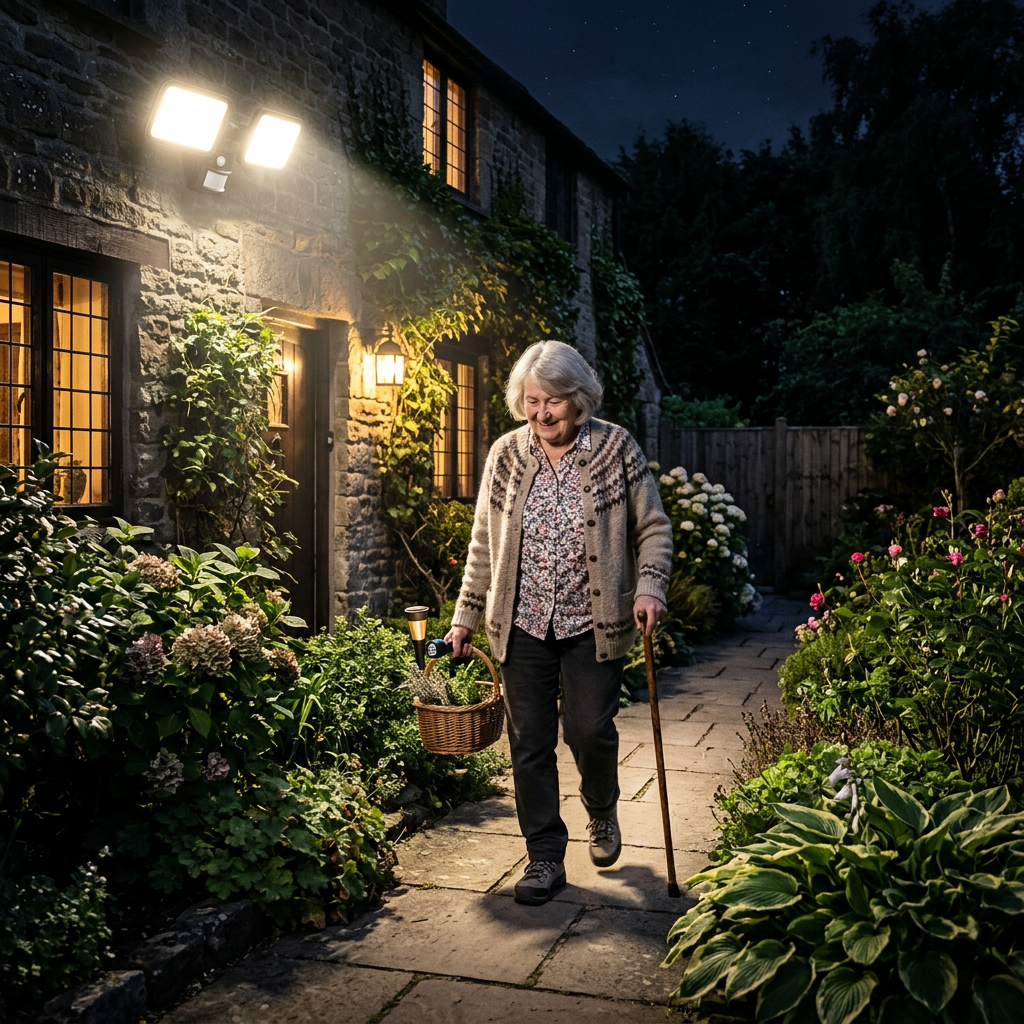
Search for an outdoor motion light for elderly parents and nearly every result ranks security floodlights by lumens, as if the goal were startling burglars. For aging-in-place the goal is different: light the path of travel, driveway to walkway to steps to door before a foot lands on it. The National Institute on Aging lists poor outdoor lighting alongside loose steps and missing railings as a core exterior fall hazard, and falls on concrete are the unforgiving kind.
Motion activation matters because nobody has to remember a switch, a parent carrying groceries at dusk gets light automatically. And because aging eyes adapt slowly, the right light is warm, aimed down, and never pointed at the eyes. The five picks below are organized by the question that actually decides this purchase: what power source can this household realistically install and maintain?
At a glance
Best Overall: Mr Beams MB360XT 2-Pack ($40) · battery-powered, 5-minute install, ~1 year per battery set
Best Zero-Install: Sengled Motion-Sensor PAR38 Bulb 2-Pack ($25) · screws into the existing porch fixture
Best for Driveways: LEPOWER 30W Hardwired Security Light ($40) · 3,200 lumens, set-and-forget
Best Solar: URPOWER 40-LED Solar Lights 4-Pack ($36) · no wiring, no battery swaps, needs sun
Best for Steps: Home Zone Security Solar Step Lights 2-Pack ($20) · marks the step edge itself
Best OverallMr Beams MB360XT Wireless Spotlight, 2-Pack
~$40 · View on Amazon

The MB360XT solves the problem that kills most outdoor lighting projects before they start: there’s no outlet where the light needs to go. Each spotlight runs on three D-cells, screws to any surface — siding, fence post, shed, tree — in about five minutes, and throws 200 lumens across roughly 600 square feet when the sensor trips. Across thousands of verified reviews the consistent pattern is a year or more per battery set at typical use, and the IPX6 weather rating holds up in rain and snow belts. Caregivers describe the same install again and again: one unit over the walkway, one at the door, done in one visit. The honest limitation is equally consistent: 200 lumens is path lighting for walking, not flood lighting for a 40-foot driveway.
The good
- Installs anywhere in minutes with two screws — no electrician, no outlet, no sun requirement
- ~1 year per set of D-cells at average use, so maintenance is one battery swap per annual visit
- Photocell keeps it off in daylight; auto shut-off after 30 seconds protects battery life
The catch
- 200 lumens per head won’t light a long driveway — it’s walkway-scale light
- D-cell batteries still need someone to change them — put it on the calendar, not on memory
This is right if… you want the path from car to door lit this weekend with no wiring and a once-a-year maintenance burden.
Look elsewhere if… you need to flood a wide driveway or you never want to think about batteries again.
Best Zero-InstallSengled Motion-Sensor PAR38 Bulbs, 2-Pack
~$25 · View on Amazon

If the porch or garage already has a working fixture, this is the cheapest, fastest upgrade in this guide: a PAR38 flood bulb with the motion sensor and dusk-to-dawn photocell built into the bulb itself. Screw it in and the existing fixture becomes a 1,500-lumen motion light at 3000K warm white — gentler on dark-adapted older eyes than blue-white security floods. Verified buyers praise exactly this use case: converting a porch light a parent always forgot to switch on. The recurring complaints are worth knowing — the sensor needs line-of-sight, so enclosed frosted-glass fixtures block detection, and the roughly 90-second on-time isn’t adjustable.
The good
- True zero-install — uses the fixture and wiring that’s already there
- 1,500 lumens at 3000K warm white: bright enough for entries without the glare blast
- Dusk-to-dawn photocell means it never triggers in daylight and never needs a switch
The catch
- Doesn’t work behind enclosed or frosted fixtures — the sensor in the bulb face must see the approach
- Fixed ~90-second on-time, no sensitivity adjustment
This is right if… there’s already a fixture at the door or garage and you want motion lighting for the price of a light bulb.
Look elsewhere if… the fixture is enclosed, or there’s no fixture where the light is actually needed.
Best for DrivewaysLEPOWER 30W LED Security Light, Hardwired
~$40 · View on Amazon

When the job is a real driveway, a parent stepping out of the car 30 feet from the door battery and solar lights run out of muscle, and the hardwired LEPOWER earns its place. Two adjustable heads put out 3,200 lumens with a sensor rated to about 72 feet across 180 degrees, and the on-time adjusts between one, five, and ten minutes long enough to unload groceries without the light cutting out mid-trip, the complaint that fills reviews of fixed-timer floods. Wired to house power, it’s the only pick with genuinely zero recurring maintenance. The trade-off is the install: it needs a junction box and someone comfortable with basic wiring, and reviewers note the instructions are thin. If an electrician is already coming for anything else, this is a 20-minute line item.
The good
- 3,200 lumens covers a full driveway and garage apron, real arrival lighting
- Adjustable 1/5/10-minute on-time, so the light lasts through the grocery trips
- Wired power means no batteries, no sun, no winter fade ever
The catch
- Requires hardwiring at a junction box, budget an electrician if nobody in the family does this
- 5500K output is cool white; aim the heads down at the surface, not at eye level
This is right if… the dark zone is the driveway and you want a permanent fixture that nobody ever has to maintain.
Look elsewhere if… there’s no existing wiring and hiring an electrician kills the budget — the Mr Beams pair covers the walkway portion for the same price.
Best SolarURPOWER 40-LED Solar Motion Lights, 4-Pack
~$36 · View on Amazon

Solar is the right answer when there’s no wiring, nobody wants to change batteries, and the mounting spots get real sun fence lines, south-facing walls, the path to the trash cans. URPOWER’s 40-LED panel is the long-standing category staple: each unit mounts with two screws, charges its 2200mAh battery by day, and trips on motion at roughly 16 to 26 feet at night. Verified buyers consistently report it surviving rainy stretches and lighting for hundreds of activations per charge. The honest limits show up in the same reviews: the 30-second on-time is fixed, and winter performance drops with short days and shade exactly why we’d never make solar the only light at the critical front-door approach. Four units for the price of one wired fixture makes it the best way to cover the secondary routes.
The good
- Four lights for ~$36 cover the side path, trash route, and fence line in one order
- No wiring and no battery swaps, ever the panel is the maintenance plan
- Two-screw install at exactly the height each spot needs
The catch
- Fixed ~30-second on-time, fine for walking past, short for tasks
- Output drops in deep winter and shade; don’t make it the only front-door light
This is right if… you’re lighting sunny secondary paths and want the no-maintenance option everywhere at once.
Look elsewhere if… the key approach is north-facing or tree-shaded — go battery or wired there.
Best for StepsHome Zone Security Solar Step Lights, 2-Pack
~$20 · View on Amazon

Overhead floods light the area; they don’t always light the one thing that causes exterior falls, the step edge itself, which can sit in the shadow of the person walking toward it. These low-profile solar units mount at the steps or deck edge, hold a dim glow all night, and jump to full brightness when motion trips. That dim-then-bright behavior is the senior-relevant detail: the step is always faintly marked, never a black hole, and the approach triggers task-level light at foot level. Buyers consistently note the simple no-wire install; the equally consistent caveat is that these are markers, not floodlights, they complement the overhead picks rather than replace them.
The good
- Lights the actual fall point, the step edge, at foot level where shadows hide it
- Dim always-on glow plus motion-triggered full brightness, all solar, no wiring
- Around $20 for the pair, the cheapest meaningful fall-prevention buy in this guide
The catch
- Modest output, these mark edges, they don’t light yards
- Solar dependence means shaded stoops will shorten the nightly runtime
This is right if… the home has exterior steps, a stoop, or a deck edge that disappears after dark.
Look elsewhere if… the steps are deeply shaded all day — a hardwired or battery option aimed at the steps beats starving solar cells.
Comparison table
| Pick | Power | Brightness | Install | Best for | ~Price |
|---|---|---|---|---|---|
| Mr Beams MB360XT (2) | 3× D-cell each | 200 lm/head | 2 screws, 5 min | Walkway + door | $40 |
| Sengled PAR38 (2) | Existing fixture | 1,500 lm | Screw in bulb | Porch / garage | $25 |
| LEPOWER 30W | Hardwired | 3,200 lm | Junction box | Driveway | $40 |
| URPOWER Solar (4) | Solar | 40 LED/unit | 2 screws each | Side paths, fence | $36 |
| Home Zone Step (2) | Solar | Dim + boost | Surface mount | Step edges | $20 |
The conversation you’ll have
Outdoor lighting is one of the easier aging-in-place conversations, it doesn’t carry the “you think I’m frail” sting of a grab bar, but you can still trip the resistance wire by making it about them. Frame it as the house’s problem: “The walkway out front is really dark — I nearly missed the step myself last week. I’m putting a light up Saturday.” Most older adults object to being monitored; very few object to being able to see.
Try saying “this place is too dark at night, and it bugs me” instead of “I’m worried about you falling out there.” The first is a homeowner observation; the second makes the light a verdict on their steadiness. Do the install during a normal visit a light that just appears and works becomes part of the house within a week.
Insurance and savings
Original Medicare classifies outdoor lighting as a home modification rather than durable medical equipment, so Part B won’t cover it. Two narrower paths exist: many 2026 Medicare Advantage plans include supplemental home-safety or OTC allowances under the CMS-4204-F benefit expansion, worth a call before buying and FSA/HSA reimbursement is sometimes possible with a Letter of Medical Necessity from a doctor or OT documenting fall risk, under IRS Publication 502. Larger safety projects can also count toward the medical-expense deduction once unreimbursed costs clear 7.5% of AGI under IRS §213(d). At $20–$40 per pick, the honest note is that the paperwork may cost more time than the light costs money.
What to actually look for
Match the power source to the maintainer, not the spec sheet
The most common outdoor-lighting failure isn’t the light, it’s the maintenance plan. Hardwired never needs attention but needs an installer once. Battery installs anywhere but needs a designated battery-changer (your calendar, not a parent’s memory). Solar needs neither, but only earns its keep in real sun — a north-facing stoop starves the panel in December. Decide who does the upkeep first, then pick the light. Our complete aging-in-place home safety checklist uses the same who-maintains-it logic for every system in the house.
Light the path of travel, then the step edges
Walk the route a parent actually takes after dark — car door to front door, kitchen door to trash cans — and put light where feet land, mounted roughly 6 to 10 feet up and angled down. Then treat step edges as their own job: an overhead flood can leave the stair nose in the walker’s own shadow, which is where the foot-level step lights earn their $20. Coverage of the route beats raw lumens at the door every time.
Warm light, aimed down — older eyes hate glare more than darkness
Aging eyes adapt slowly between dark and bright, so a 5500K flood firing at face height can leave a person briefly blinded mid-step — the opposite of the goal. Prefer 3000K warm white at eye-traffic areas, save cool bright floods for the driveway, and tilt heads toward the ground. If a light makes you squint on the walk up, it’s aimed wrong for a 78-year-old. Pair the outdoor work with a plan for if a fall still happens — our fall detection devices with no monthly fee roundup covers that layer.
FAQ
How high should an outdoor motion sensor light be mounted?
Six to ten feet above the ground is the sweet spot. That height lets the sensor sweep the approach reliably while spreading light across the walking surface. Higher and ground-level sensitivity drops; lower and coverage shrinks. Tilt the head slightly downward toward the path.
Do motion sensor lights actually help prevent falls?
Yes, lighting is one of the most consistently cited modifiable fall-risk factors. Motion lights illuminate steps, uneven pavement, and walkway edges automatically, which matters because most exterior falls happen on familiar routes walked in the dark. The automatic part is the point: no switch to remember.
Are solar motion lights reliable in winter?
Partially. Short days, low sun angles, and snow on panels all cut charge, so expect reduced brightness and runtime in deep winter. Solar works well on sunny secondary paths year-round in most climates, but the critical front-door approach deserves battery or wired light that doesn’t depend on yesterday’s weather.
How many lumens should an outdoor motion light have?
Match output to the job: around 200 lumens lights a walkway or entry comfortably, while a driveway or garage apron wants 1,500 to 3,000-plus. More isn’t automatically better for older eyes — past the needed brightness you’re buying glare, not safety. Warm color temperature matters as much as the number.
Can I put a motion sensor bulb in an existing porch fixture?
Yes, if the fixture is open enough for the bulb’s face to see the approach. Sensor bulbs like the Sengled PAR38 build the motion and dusk-to-dawn sensors into the bulb, so an open or downward-facing fixture converts in seconds. Enclosed or frosted-glass fixtures block the sensor and won’t work.
Should outdoor lights be warm or cool white for seniors?
Warm white (around 3000K) at entries and walkways, where eyes meet the light up close, it causes less glare and less momentary blinding for slowly adapting older eyes. Cool white (5000K+) is fine for driveway floods aimed down and away from the line of sight.
The shortlist
Best Overall
Mr Beams MB360XT 2-Pack
Best Zero-Install
Sengled PAR38 Bulbs 2-Pack
Best for Driveways
LEPOWER 30W Security Light
Best Solar
URPOWER Solar 4-Pack
Best for Steps
Home Zone Step Lights 2-Pack
Last verified in stock: June 11, 2026
What we’d do tomorrow
If you’re starting this weekend, do three things in order. First, walk the after-dark route yourself, car to door, door to trash cans and note every dark stretch and step edge. Second, order the Mr Beams two-pack for the walkway and door, plus the Home Zone step lights if there are exterior stairs; both install in one visit with a screwdriver. Third, if the driveway is the real dark zone, get the LEPOWER on an electrician’s list and until it’s wired, screw a Sengled sensor bulb into whatever fixture exists. The whole project lands under $100 and removes the most fixable exterior fall risk a house has.
— Sarah
BuyingForMom is a reader-supported site. As an Amazon Associate we earn from qualifying purchases. When you buy through links on this site, we may earn an affiliate commission at no additional cost to you. See our Affiliate Disclosure for details. This article is not medical advice, please consult a qualified healthcare professional for decisions specific to your parent’s needs.
Leave a Reply