
5 Best Ice Cleats for Seniors in 2026: Walking Traction That Works
By Sarah Mitchell · Editor, BuyingForMom · Updated October 2026
6 min read · Outdoors & Entryways · 5 picks

How we sorted through 11 traction devices this October
We compared 11 traction devices that Outdoor Gear Lab and Outdoor Life have tested side by side, then cross-referenced each against Amazon buyer ratings. The five picks below carry more than 35,000 combined ratings. We weighted comfort on bare pavement, ease of putting them on, and low profile above raw hiking grip, because that is what an older walker actually needs. Every product was confirmed in stock on Amazon on October 26, 2026.
Who this guide is for
This guide is for adult children buying winter traction for a parent who still walks outside but dreads the first icy morning. If you’re shopping for yourself, the same picks apply; just skip the conversation section below.
Winter is when a small slip becomes a big problem. The CDC reports that about one in four adults 65 and older falls each year, and ice multiplies the odds on routes that are safe the rest of the year. The best ice cleats for seniors are not the most aggressive ones. They are the ones your parent will actually wear: quick to put on, stable on a shuffling or uneven gait, and comfortable on the dry stretches between patches of ice.
Cleats do not replace other safety layers. Salt, a handrail, and a clear path still matter, and cleats pair well with a cane that has an ice tip or a walker used on cleared routes. Think of them as one layer in a larger winter plan, not a license to walk anywhere.
At a glance
Yaktrax Walk · ~$21
Yaktrax Pro · ~$35
Due North Everyday G3 · ~$21
Kahtoola NANOspikes · ~$70
Kahtoola MICROspikes · ~$90
Best Overall1. Yaktrax Walk

~$21 · See current price on Amazon
The Yaktrax Walk is a rubber harness with steel coils that stretches over a shoe in about ten seconds, which is the whole reason it wins. Across more than 27,000 Amazon ratings it averages 4.4 stars, and Outdoor Gear Lab named it the top pick for everyday urban winter walking, praising its low profile and secure fit on all footwear. The coils bite into packed snow and thin ice without turning the shoe into a lump. Reviewers who dislike it mostly wanted deep-snow performance it was never built for.
The good
- Stretches on fast, even with stiff or arthritic fingers
- Low profile, so it feels like walking in a normal shoe
- Rated 4.4/5 across 27,000+ buyers at about $21
The catch
- Weak grip in deep or soft snow and on steep slopes
- Coils wear down faster if worn on bare pavement all day
This is right if… your parent mostly walks to the mailbox, car, and corner on shoveled or lightly icy surfaces.
Look elsewhere if… the route includes unplowed paths, hills, or thick ice.
Best With a Top Strap2. Yaktrax Pro
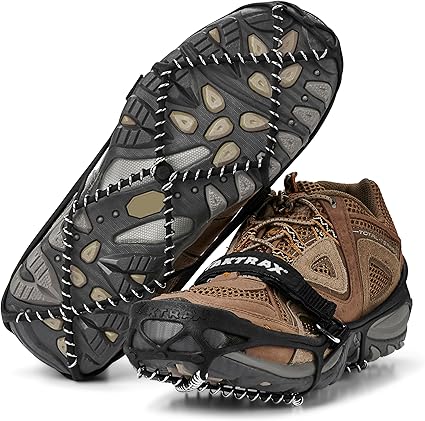
~$35 · See current price on Amazon
The Pro is the Walk’s sturdier sibling: same coil idea, plus a hook-and-loop strap that cinches across the top of the foot so the cleat stays put. That strap matters for older walkers whose gait includes a shuffle or a dragged toe, because a cleat that rotates mid-stride is its own trip hazard. Outdoor Gear Lab called it a low-profile option for icy city streets. Buyer ratings run 4.3 stars, though with far fewer reviews (about 500) than the Walk.
The good
- Top strap keeps the cleat from sliding or rotating
- Low profile suited to icy city sidewalks
- Easy to pull on and off without tools
The catch
- Costs roughly $14 more than the Walk
- Described as uncomfortable for running and poor in soft snow
This is right if… your parent has a shuffling gait or has had a cleat slip sideways before.
Look elsewhere if… you want the cheapest option, since the plain Walk covers most sidewalk use.
Best Budget Spikes3. Due North Everyday G3

~$21 · See current price on Amazon
Instead of coils, the G3 uses short tungsten carbide studs set in a rubber sole plate, which grip glare ice more aggressively than a coil. Outdoor Life named it its budget pick for occasional icy conditions and called it a good choice for an ice storm. It averages 4.3 stars across more than 4,300 Amazon ratings. The common complaint, echoed by that same review, is that it is harder to stretch on than the Yaktrax, so have a younger family member fit it the first time.
The good
- Carbide studs bite hard into glazed ice
- Reasonably comfortable on bare ground
- 4.3/5 from 4,300+ buyers at about $21
The catch
- Stiff rubber makes it hard to put on
- Studs can feel slippery on tile, so take it off indoors
This is right if… ice storms and freezing rain are the main worry and someone can help fit them.
Look elsewhere if… your parent has weak hands and will be putting them on alone.
Best for Thin Ice4. Kahtoola NANOspikes

~$70 · See current price on Amazon
The NANOspikes pair a flexible elastomer frame with small tungsten carbide spikes, and the design goal is grip on ice you can barely see without feeling clunky on dry pavement. Outdoor Life called it the most comfortable option it tested on firm ground, and Outdoor Gear Lab rated it best for winter running, with grip on packed snow and thin ice. It carries a 4.7 average on Amazon, though from a smaller pool of about 200 ratings. Price is the obvious barrier.
The good
- Most comfortable on mixed ice and bare pavement in expert testing
- Small spikes are less likely to catch on a rug or doorway
- 4.7/5 average on Amazon
The catch
- Roughly $70, more than three times the Walk
- Weak in deep snow
This is right if… your parent walks daily, hits patches of ice and bare road in the same trip, and you want comfort over cost.
Look elsewhere if… budget matters or the walk is a short trip to the car.
Best for Deep Snow & Hills5. Kahtoola MICROspikes

~$90 · See current price on Amazon
MICROspikes are the benchmark traction device: a stretch harness with a chain of stainless spikes under the whole foot. Outdoor Gear Lab gave it Editors’ Choice for strong spike layout and durability, and it holds a 4.7 average across more than 3,500 Amazon ratings. It is overkill for a flat sidewalk, and that review flagged it as heavy and annoying on dry surfaces. But for a long driveway with a slope, packed snow, or rural walks, nothing here grips better.
The good
- Excellent grip on hills, packed snow, and thick ice
- Durable construction that lasts multiple winters
- 4.7/5 from 3,500+ buyers
The catch
- Heavy and high-profile, which can feel awkward for a shuffling gait
- Most expensive pick, at about $90
This is right if… your parent lives somewhere with sloped driveways, deep snow, or rural paths.
Look elsewhere if… the only goal is crossing a salted city sidewalk.
Side-by-side comparison
| Pick | Price | Traction type | Best for |
|---|---|---|---|
| Yaktrax Walk | ~$21 | Rubber harness, steel coils | Everyday sidewalks |
| Yaktrax Pro | ~$35 | Coils + top strap | Shuffling gait |
| Due North Everyday G3 | ~$21 | Tungsten carbide studs | Ice storms, budget |
| Kahtoola NANOspikes | ~$70 | Carbide spikes, elastomer frame | Mixed ice and pavement |
| Kahtoola MICROspikes | ~$90 | Stainless steel spike chain | Hills and deep snow |
The conversation you’ll have
Many older adults hear “ice cleats” as “you’re not steady anymore.” The resistance is usually about independence, not the product. Try framing it around the route, not the person: “The sidewalk by the mailbox gets glazed every January, and I’d feel better if you had something for that stretch.” Avoid “so you don’t fall,” which turns a gadget into a verdict.
Then make it easy. Buy the pair together, try them on at the front door, and put a small bench and basket by the entry so the routine feels like a habit, not a medical device. Offer to take them back if they don’t like them; people keep what they chose.
Insurance and savings
Original Medicare covers durable medical equipment such as walkers and canes, but it does not cover consumer traction cleats, which are treated as footwear accessories. FSA and HSA funds generally exclude them too, since they are not medical care by themselves; confirm with your plan administrator. At $20 to $90, they are one of the cheapest fall-prevention upgrades around. Compare that to the cost of a fall, and the math is easy.
What to actually look for
Match the traction to the route
Coil cleats such as the Yaktrax Walk suit shoveled sidewalks and thin ice. Carbide studs handle glazed ice better. Full spike chains are for slopes and deep snow. Buying more aggressive than the route requires is the most common mistake, because heavy spikes are tiring and awkward on bare pavement. Our aging-in-place home safety checklist lists the other outdoor risks worth fixing at the same time.
Make sure they go on fast
If your parent has arthritis or weak grip, a stiff rubber harness will end up in a closet. Choose a stretchy harness, practice at the door, and consider a boot jack or a seated entry bench. Reviewers repeatedly flag hard-to-fit models as a drawback, and that matters even more for seniors.
Plan for the cane, the walker, and the stairs
If your parent uses a cane, pair cleats with ice grip tips for a cane. If they use a walker, check that the cleat is flat enough not to snag the walker’s legs or tennis-ball glides. And remember the rule for entries: cleats off before stepping inside, and never on indoor stairs. For a wider safety net, see our guide to fall detection devices with no monthly fee.
Frequently asked questions
Do ice cleats work for seniors who shuffle their feet?
They can, but pick carefully. Low-profile coil styles like the Yaktrax Walk and Pro sit close to the sole and are less likely to catch than tall spikes. Choose a model with a top strap, and test it on a rug-free, dry floor with someone beside your parent first.
Can older adults wear ice cleats inside the house?
No. Metal coils and carbide studs are slippery on tile, hardwood, and polished stone, and they can scratch floors. Teach a simple habit: cleats go on at the door seat and come off before stepping inside. A bench and a boot tray by the entry make that routine realistic.
What size ice cleats should I buy for a senior?
Match the cleat to the shoe, not just the shoe size. Most brands sell small, medium, and large by shoe size range, and fit snugly over the sole. If your parent wears orthopedic or extra-wide shoes, check the listing’s size chart and return policy before ordering.
Are ice cleats better than a cane tip for winter?
They solve different problems. An ice-grip cane tip steadies the cane, while cleats grip under the feet, where most slips begin. If your parent uses a cane, the strongest setup is both. Cleats alone are not a substitute for a walker when one is recommended.
Does Medicare cover ice cleats?
Generally no. Original Medicare covers durable medical equipment such as walkers and canes, but traction cleats are treated as ordinary footwear accessories. FSA and HSA plans usually exclude them as well. Ask your plan administrator, and consider a physical therapist’s letter only if your plan allows case-by-case review.
How do you walk safely on ice with cleats?
Take short, flat-footed steps, keep your feet slightly apart, and point your toes a little outward. Keep your hands free rather than in pockets, and slow down on transitions between ice and bare pavement, where grip changes suddenly. Walk the route in daylight at least once first.
The shortlist
Last verified in stock: October 26, 2026
What we’d do tomorrow
If you’re starting this weekend, do these three things in this order. First, walk your parent’s actual route and note where ice collects. Second, order the Yaktrax Walk in the right size and try it on at the door before the first freeze. Third, set up a bench and basket by the entry so cleats go on and off in the same spot every time. Upgrade to the NANOspikes or MICROspikes only if the route proves you need them.
— Sarah
Leave a Reply