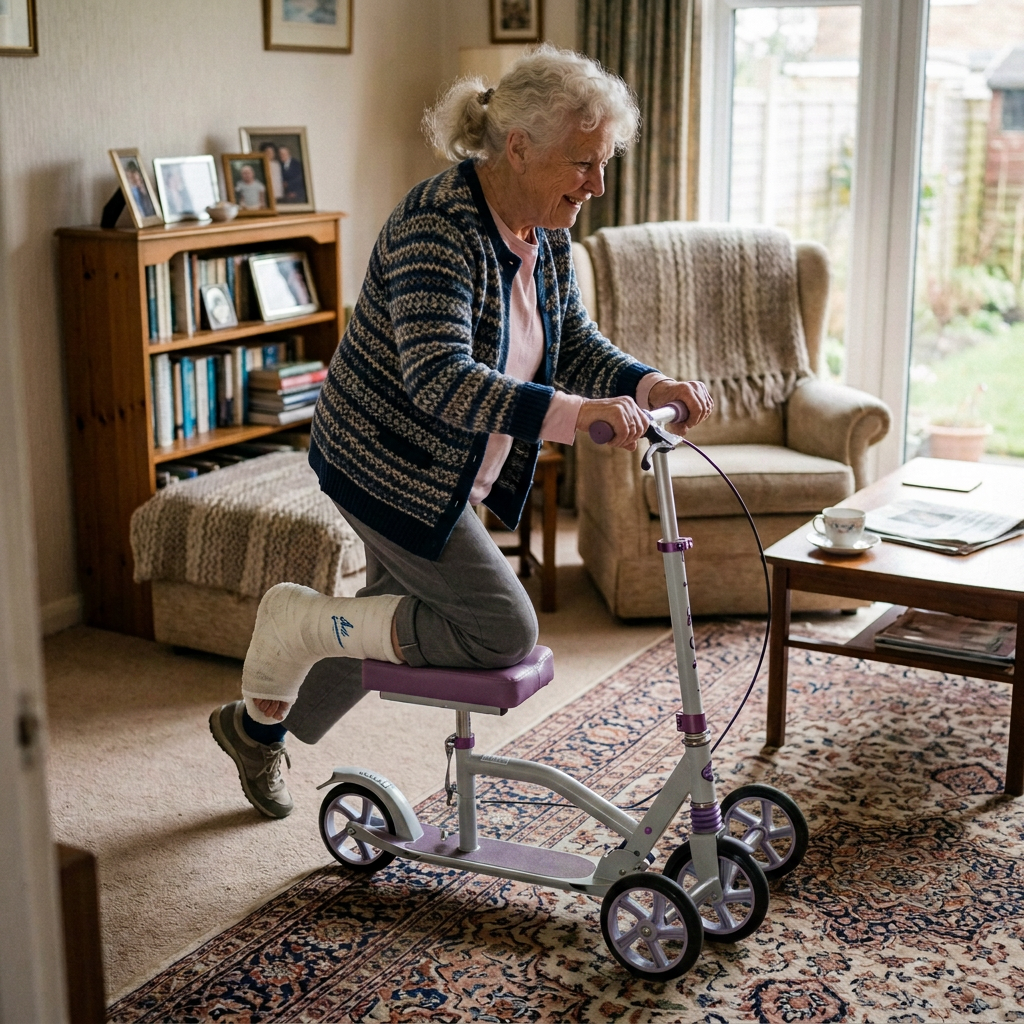
5 Best Knee Scooters for Foot Recovery
By Sarah Mitchell · Editor, BuyingForMom · Updated July 2026
9-minute read · Walkers & Canes · 5 picks compared

How we sorted through 30 knee scooters in two weeks
We started with roughly 30 knee scooters on Amazon and cross-referenced them three ways: against more than 15,000 verified-buyer reviews, against the setup instructions occupational therapists hand out after foot and ankle surgery, and against the complaints caregivers post in recovery forums. We weighted three things heavily, steering play (the wobble that scares people off), the force needed to squeeze the brake (a barrier for arthritic hands), and whether the frame fits a shorter or taller senior. Anything with a pattern of collapsing brakes, seized steering, or “too tall for a petite parent” reviews was cut.
Who this guide is for
This guide is for adult children helping a parent stay mobile after foot surgery, a broken ankle, or a diabetic foot wound that requires weeks off one leg. The picks apply equally if you’re shopping for yourself — just skip the “conversation” section below, written for families navigating a parent’s resistance to “looking disabled.”
A knee scooter (also called a knee walker) lets someone rest an injured lower leg on a padded platform and roll along using the good leg, hands on the handlebars for balance. For a senior, that’s often far safer than crutches, which demand upper-body strength and steady balance many older adults no longer have. The right knee scooter for foot recovery keeps a parent independent through the kitchen, bathroom, and front door. The wrong one gets parked and never used.
The most useful way to choose is to decide where it will mostly be used. Indoor-dominant recovery favors a compact, tight-turning scooter with smaller wheels; a parent crossing a driveway, lawn, or gravel path needs larger tires and a heavier frame. Each pick below is slotted to a real situation rather than ranked as if the five were interchangeable.
At a glance
BEST OVERALL Vive Mobility Knee Scooter — ~$140 · tight indoor turns, steady outdoors, easy locking brakes.
BEST BUDGET KneeRover Economy Steerable — ~$125 · 4.5★ from 4,000+ buyers, the proven starter pick.
BEST OUTDOORS KneeRover Original All Terrain — ~$180 · 12″ pneumatic tires, 350 lb capacity for grass and gravel.
LIGHTEST Drive Medical DV8 Steerable — ~$150 · aluminum frame, easiest to lift into a car trunk.
CAN’T KNEEL KneeRover Seated Scooter — ~$260 · sit-and-roll design for a bad opposite knee.
Best Overall Vive Mobility Knee Scooter
~$140 · 300 lb capacity · 8″ wheels · Check price on Amazon →

Vive has quietly become the default recommendation among the review sites we cross-referenced, and the reason is boring in the best way: it does everything competently and nothing badly. The 8-inch wheels are the sweet spot. Small enough to pivot through a doorway and around a kitchen island, big enough to roll over thresholds and driveway cracks without stalling. Verified buyers single out the dual locking brakes, which set with a light squeeze rather than the death-grip some budget models demand, and the knee pad drops low enough that the “too tall” complaint largely disappears. The recurring gripe is sparse assembly instructions, so budget ten minutes and a wrench.
The good
- Tight indoor turning without sacrificing outdoor stability
- Locking brakes engage with minimal hand force, friendly to arthritic grips
- Knee pad drops low enough for shorter seniors
The catch
- Assembly instructions are thin, expect to eyeball a step or two
- Solid wheels transmit more bump on rough pavement than pneumatic tires
This is right if… your parent’s recovery is mostly indoors with the occasional trip to the car or mailbox.
Look elsewhere if… the daily route crosses grass, gravel, or a steep driveway, size up to the All Terrain below.
Best Budget KneeRover Economy Steerable
~$125 · 300 lb capacity · fits 4’9″–6’4″ · Check price on Amazon →

If a scooter is only needed for six or eight weeks, premium money can feel wrong and the KneeRover Economy makes spending less defensible. It carries a 4.5-star average across roughly 4,000 verified reviews, a deep enough pool to trust the pattern: excellent value, genuinely steerable, folds for the car, and holds a 185-pound adult plus groceries without complaint. The honest downside shows up in those same reviews — the steering head can develop a small wobble on fast turns until you tighten the bolt under the column, a five-second fix buyers repeatedly flag and then forgive. For a budget indoor-and-sidewalk recovery, it’s the safe starter.
The good
- 4.5★ from 4,000+ buyers the most-proven pick here
- Wide height range fits most seniors out of the box
- Folds flat for a trunk or a closet
The catch
- Steering can wobble at speed until the column bolt is tightened
- Solid wheels catch in sidewalk cracks and loose gravel
This is right if… you want the lowest-risk, best-reviewed scooter and the terrain is floors and sidewalks.
Look elsewhere if… nobody in the house owns a wrench or the recovery route is rough outdoor ground.
Best Outdoors KneeRover Original All Terrain
~$180 · 350 lb capacity · 12″ pneumatic tires · Check price on Amazon →

Most indoor scooters fail outdoors because of wheel size: a small solid caster drops into every sidewalk seam and stops the rider cold. The KneeRover All Terrain solves that with four 12-inch air-filled tires that roll over grass, gravel, and cracked pavement the way a wheelbarrow does. It also carries the highest capacity here at 350 pounds and fits taller seniors up to about 6’5″. The trade-offs are real: it’s heavier to lift, turns wider indoors, and as reviewers note. The pneumatic tires slowly lose air and need topping off with a bike pump. For a suburban or rural parent on real ground, that’s a fair price for not getting stuck.
The good
- 12″ pneumatic tires clear grass, gravel, and driveway cracks
- 350 lb capacity and a taller fit than most rivals
- Air tires absorb bumps that jar solid-wheel models
The catch
- Heavier to lift and wider to turn in tight indoor spaces
- Tires need periodic re-inflation with a pump
This is right if… the daily route includes lawn, gravel, or a sloped driveway.
Look elsewhere if… recovery is apartment-bound and lifting a heavier frame is a problem.
Lightest Drive Medical DV8 Steerable
~$150 · 300 lb capacity · aluminum, ~13 lb frame · Check price on Amazon →
Drive Medical is a name occupational therapists recognize, and the DV8 is the pick for the household where someone else lifts the scooter constantly — into a trunk, up a porch step, out of the way in a narrow hall. Its aluminum frame is among the lightest here at roughly 13 pounds, the steering column folds for storage, and the handle adjusts from 33 to 37.5 inches for shorter seniors. Verified buyers reach for phrases like “sturdy for how light it is” and praise the deluxe lever brakes. The compromise: a lighter frame feels slightly less planted at speed, so it rewards a cautious roller — which, for most recovering seniors, is the right temperament anyway.
The good
- ~13 lb aluminum frame — the easiest to lift and load
- Folding steering column stores in a closet or trunk
- Trusted clinical brand with responsive lever brakes
The catch
- Lighter frame feels less planted at higher speed
- 8″ wheels handle sidewalks well but not rough terrain
This is right if… a caregiver lifts the scooter often, or space is tight.
Look elsewhere if… your parent rolls fast and wants the reassurance of a heavier steel frame.
If You Can’t Kneel KneeRover Seated Scooter
~$260 · 300 lb capacity · gel seat + leg rest · Check price on Amazon →

Here is the case almost every knee-scooter roundup ignores: kneeling on a bent knee only works if the other knee is healthy. A parent with arthritis in the good knee, a recent knee replacement, or hip trouble often can’t tolerate the kneeling posture at all and forcing it is why so many scooters get abandoned. The KneeRover Seated Scooter answers that by letting the rider sit on a gel seat and extend the injured leg forward on a padded rest, propelling with the good foot. It’s heavier, wider, and pricier, and needs more room to turn. But for the senior who physically cannot kneel, it’s not a luxury upgrade — it’s the difference between mobile and stranded, and verified buyers call it a “game-changer” for exactly that group.
The good
- Sit-and-roll design works when kneeling is impossible
- Padded leg rest keeps the injured foot elevated
- Locking handbrake plus rear drum brake for control
The catch
- Bulkier and needs more room to maneuver indoors
- Costs more than a standard kneeling scooter
This is right if… the good knee, hip, or back can’t handle kneeling for weeks.
Look elsewhere if… your parent can kneel comfortably — a standard scooter is lighter and cheaper.
Quick comparison
| Scooter | Price | Capacity | Best for |
|---|---|---|---|
| Vive Mobility | ~$140 | 300 lb | Indoor + light outdoor (overall) |
| KneeRover Economy | ~$125 | 300 lb | Budget, most-reviewed |
| KneeRover All Terrain | ~$180 | 350 lb | Grass, gravel, driveways |
| Drive Medical DV8 | ~$150 | 300 lb | Lifting, tight spaces |
| KneeRover Seated | ~$260 | 300 lb | Can’t kneel |
The conversation you’ll have
A knee scooter is easier to introduce than a walker or cane, because most parents read it as temporary — a recovery tool, not an admission of decline. Use that. The resistance you’re likelier to hit is a parent insisting they’ll “just use the crutches the hospital gave me,” which for an older adult is often the genuinely dangerous choice. Rather than arguing about capability, frame it around fatigue and hands: “Crutches will wear out your arms by day two, and you won’t have a free hand to carry your coffee. The scooter lets you roll to the kitchen and bring the coffee with you.” Independence and coffee win more of these conversations than safety lectures do — and remind them it goes back in the closet the week the boot comes off.
Insurance and savings
Original Medicare (Part B) generally does not cover knee scooters. It treats them as convenience items rather than durable medical equipment, so an out-of-pocket purchase is the norm. Two things soften the cost. Knee scooters are eligible expenses under most FSA and HSA plans as a mobility aid, effectively discounting the purchase by your marginal tax rate, so keep the receipt. And if a household’s unreimbursed medical expenses exceed 7.5% of adjusted gross income, the scooter can count toward the itemized medical-expense deduction under IRS Publication 502. Some 2026 Medicare Advantage plans have added supplemental home-safety allowances, so a five-minute call to the plan before paying full price is worth it.
What to actually look for
Wheel size matched to terrain
This is the decision that matters most. Wheels around 7.5–8 inches turn tightly and suit indoor floors and smooth sidewalks; 12-inch pneumatic tires roll over grass and gravel but turn wider and weigh more. Pick for the surface your parent crosses every day, not the one they might cross once. For the prep that makes any scooter safer, see our complete aging-in-place home safety checklist.
Brake force and steering feel
Squeeze the brake before you trust it. Older hands with arthritis or reduced grip need a lever that locks with light pressure, and a dual braking system that holds the scooter still on a slight incline. Steering should feel firm, not sloppy; a little play is normal on budget models and usually tightens with one bolt. When recovery ends and a parent needs longer-term support, a rollator often follows our guide to walkers for tall seniors over six feet covers that handoff.
Fit: height range and weight capacity
A scooter that doesn’t fit gets abandoned. Check the stated height range, many models bottom out around 4’9″ and top out near 6’4″, with the All Terrain reaching taller. Confirm weight capacity with a real margin, and remember that being unsteady during non-weight-bearing recovery raises fall risk, so pairing the scooter with a no-monthly-fee alert can help; see our fall detection devices with no monthly fee guide.
Frequently asked questions
Are knee scooters safer than crutches for seniors?
For most seniors, yes. Crutches demand upper-body strength, grip, and steady balance many older adults have lost, which raises fall risk. A knee scooter rests the injured leg on a platform and rolls on wheels, so it takes far less arm effort and offers a more stable, less tiring way to stay mobile.
Can seniors use a knee scooter indoors?
Yes. Standard scooters with 7.5–8 inch wheels are designed for smooth, level indoor floors and maneuver well in tight spaces like kitchens and bathrooms. They also roll on low carpet, though crossing between surfaces calls for extra caution. Three-wheel and smaller-wheel models turn most tightly for confined rooms.
What weight can a knee scooter hold?
Most standard knee scooters support 300 pounds, while heavy-duty and all-terrain models handle 350 or more. Always choose one rated comfortably above the user’s weight, and account for anything they’ll carry. The picks here range from 300 to 350 pounds of capacity.
How do you steer a knee scooter?
You steer with the handlebars, much like a bicycle. Rest the injured leg on the padded platform at a comfortable 90-degree bend, hold the handlebars firmly, and push off with the good foot. Practice wide turns first, tightening the radius as confidence grows, and use the hand brakes to control speed.
Does Medicare cover a knee scooter?
Original Medicare generally does not, classifying knee scooters as convenience items rather than durable medical equipment. However, they are usually FSA- and HSA-eligible, may count toward the itemized medical-expense deduction, and some 2026 Medicare Advantage plans include supplemental allowances. Call your plan to confirm before purchasing.
Should you rent or buy a knee scooter?
Buying usually wins for recoveries of six weeks or more, since rental fees add up and a purchased scooter can be resold or kept for later. Renting can make sense for very short recoveries or one-time travel. At typical purchase prices near $125–$180, most families find buying the better value.
What’s the difference between a kneeling and a seated knee scooter?
A kneeling scooter rests the injured leg on a bent-knee platform, which requires a healthy opposite knee. A seated scooter lets you sit and extend the injured leg forward on a rest, propelling with the good foot. Choose seated if arthritis, a hip issue, or a recent knee replacement makes kneeling painful.
The shortlist

Last verified in stock: July 17, 2026
What we’d do tomorrow
If you’re setting this up this week, do three things in order. First, decide where the scooter will mostly roll — indoors and sidewalks points to the Vive Mobility or budget KneeRover Economy; real outdoor ground points to the All Terrain. Second, honestly assess the good knee: if kneeling for weeks would hurt it, order the Seated Scooter and don’t second-guess it. Third, when it arrives, spend ten minutes tightening every bolt and practicing wide turns in a clear hallway before the first trip to the kitchen. That ten minutes is what turns a scooter from a hallway ornament into the thing that keeps a parent independent through recovery.
— Sarah
Leave a Reply