5 Best Hip Protectors for Seniors
By Sarah Mitchell · Editor, BuyingForMom · Updated November 2026
11 min read · Balance & Mobility · 5 picks

How we sorted through 16 hip protectors in two weeks
We started with 16 hip protectors sold to U.S. families, from Medline, Safehip (Tytex), Posey Hipsters, HipSaver, Secure, Delloch and a handful of newer Amazon-only brands. We cross-referenced manufacturer specs (shield design, wash rating, sizing range) against the 2014 Cochrane review of hip protectors, a 2019 independent impact test of 18 models published in Osteoporosis International, and falls-prevention guidance from Canadian health authorities that issue these garments to patients, then read verified-buyer reviews for the recurring complaints: sizing, heat and pads that drift off the hip bone.
Who this guide is for
This guide is for adult children buying hip protectors for a parent who has fallen before, has osteoporosis, or is unsteady enough that a sideways fall feels like a matter of when, not if. If you’re shopping for yourself, the same picks apply, but you can skim past “The conversation you’ll have” below.
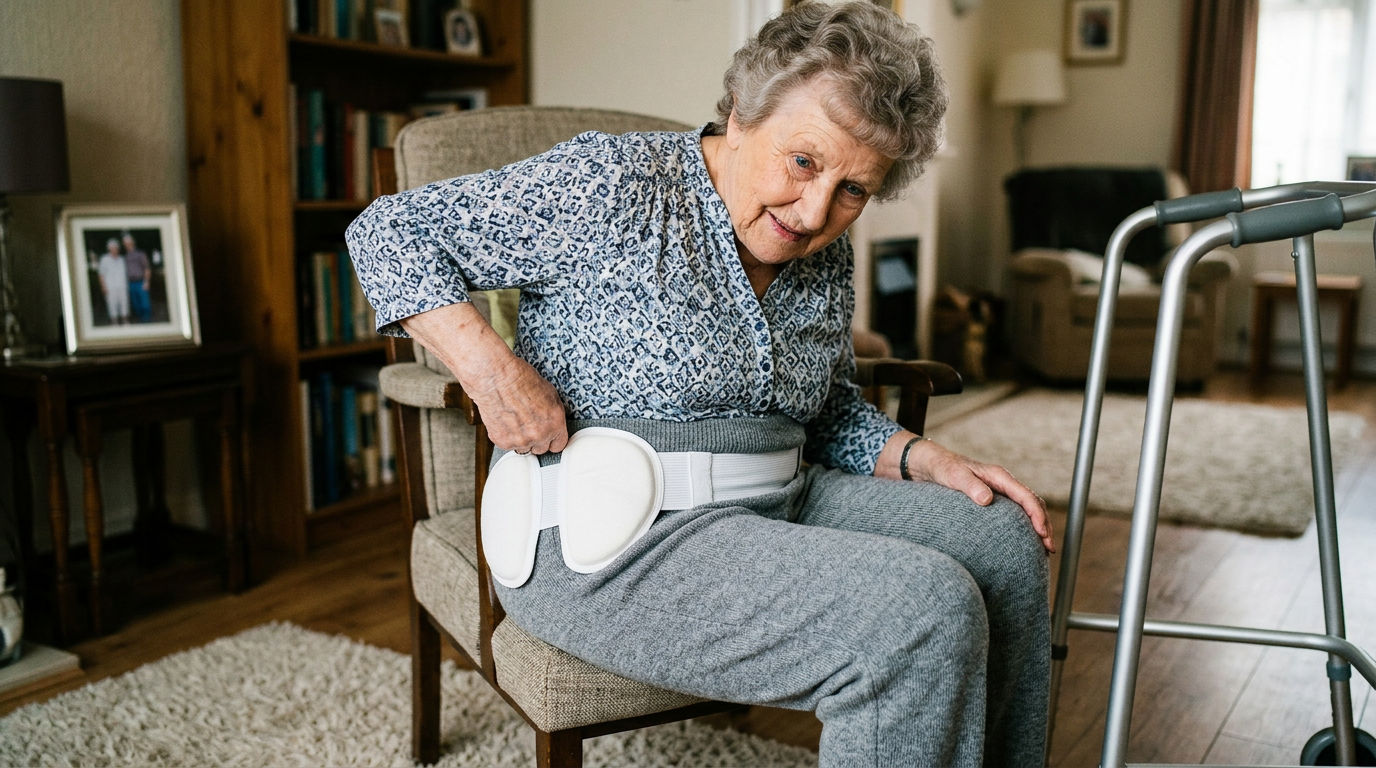
Hip protectors for seniors are padded underwear or belts with a shield over each hip bone. They don’t prevent falls. They’re meant to change what happens when a fall lands on the side of the hip, which is how most hip fractures happen. According to the CDC, more than 300,000 older adults are hospitalized for hip fractures each year, and more than 95% of those fractures are caused by falling, usually sideways.
The evidence is honest, not magical. The 2014 Cochrane review found that in nursing homes and residential care, hip protectors probably reduce the risk of a hip fracture slightly. For older adults living at home, the effect was small to none, mostly because people stop wearing them. The best hip protector is the one your parent will put on every morning.
At a glance
Best Overall Medline Premium Hip Protector · ~$45–$65 · Unisex daily-wear brief with four 3D shields
Best for Women Safehip AirX Women’s · ~$50–$75 · Breathable, cut for a woman’s hips
Best for Dad Safehip AirX Unisex · ~$50–$75 · Worn over his own underwear
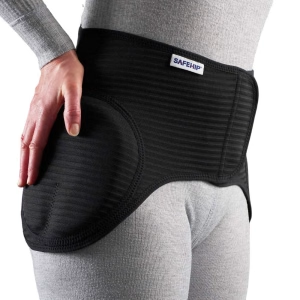
Easiest On Safehip Active Belt · ~$60–$90 · Hook-and-loop belt, over or under clothes
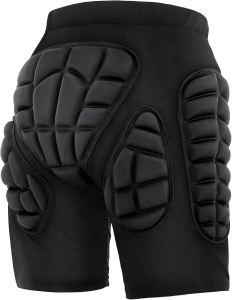
Best Budget WILLQ Hip Pads · ~$25–$35 · Hip plus tailbone padding
Best OverallMedline Premium Hip Protector
~$45–$65 · See it on Amazon

Medline is one of the largest suppliers to U.S. nursing homes, and this brief is sold to facilities in cases of ten, which tells you it’s built for daily laundering. It’s a unisex, form-fitting microfiber brief with four contoured 3D spacer-fabric shields that spread impact energy across the hip instead of letting it land on one point. Medline rates the pads for up to 200 washes without warping, and the garment is latex-free and machine washable and dryable. The spacer pads are thin enough to sit under ordinary slacks, and across hip protector reviews, low bulk is the single biggest predictor of whether one gets worn.
The good
- Four 3D shields cover the hip bone with room for the pad to stay put as the wearer moves.
- Rated for about 200 washes, so two or three pairs last a long time.
- Wide size range up to 60″ waist, and it can be worn over or instead of regular underwear.
The catch
- Size selection matters a lot; too loose and the shields slide forward off the hip bone.
- The standard brief has no opening for incontinence products; Medline sells a separate “Open” version for that.
This is right if… your parent needs an everyday garment that’s discreet, durable and easy to keep in rotation.
Look elsewhere if… your parent wants something they can strap on over pants without undressing.
Best for WomenSafehip AirX Women’s Hip Protector
~$50–$75 · See it on Amazon
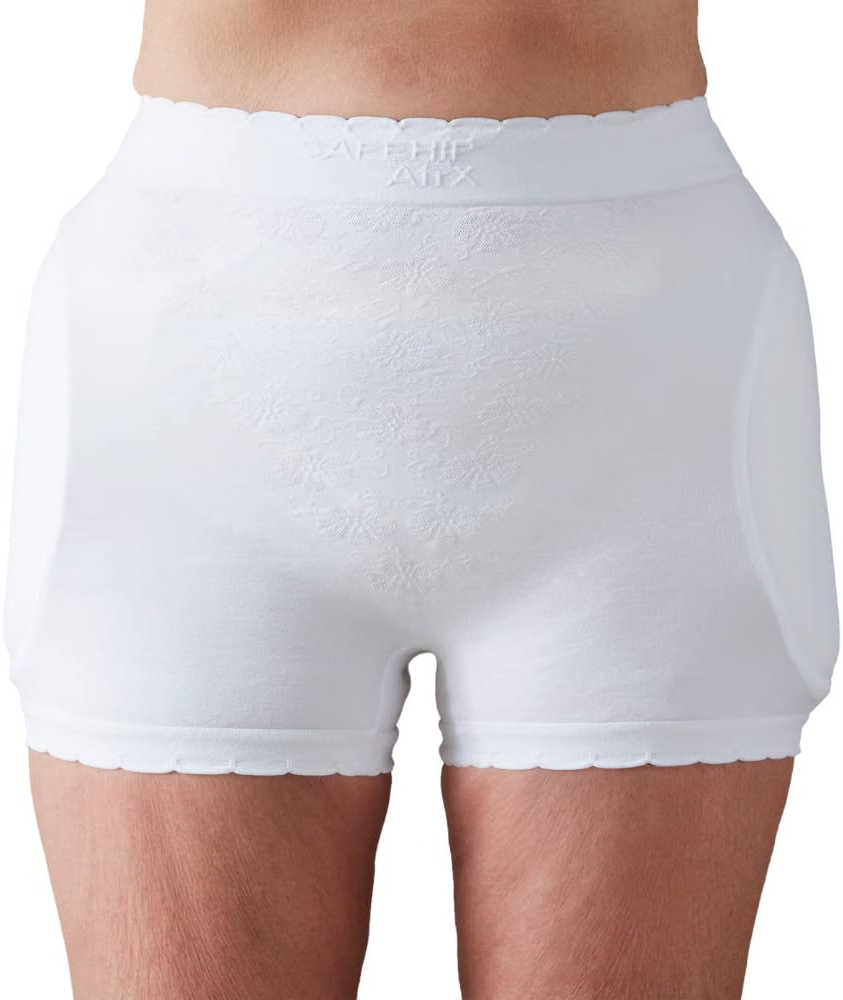
Safehip is made by Tytex, a Danish company that has built hip protectors for care systems in Europe, Canada and Australia for decades, and it’s one of the brands Canadian health authorities name in their patient fitting guides. The AirX Women’s version uses a horseshoe-shaped shield designed to steer fall energy around the hip joint rather than straight into it, set in a soft, high-elastane brief cut for a woman’s hips. The AirX shield fabric is breathable, which addresses the most common reason women give for abandoning hip protectors: they run hot. Since women account for roughly three-quarters of hip fractures, this is the pick we’d start with for most moms.
The good
- Horseshoe shield is designed to route impact away from the bony point of the hip.
- Breathable AirX fabric runs cooler than closed-cell foam pads.
- Survives hot-water washing and high-heat drying.
The catch
- Pricier per pair than Medline once you buy two or three for rotation.
- Sizing is by hip measurement, not dress size, so measure before you order.
This is right if… your mom has osteoporosis, gets warm easily, and needs something comfortable enough to wear all day.
Look elsewhere if… she uses incontinence briefs and needs an open-style garment.
Best for DadSafehip AirX Unisex Hip Protector
~$50–$75 · See it on Amazon

Men are less likely to fracture a hip, but when they do, outcomes tend to be worse, and they are notably harder to convince to wear anything that looks like special underwear. The AirX Unisex solves part of that: it’s a seamless knit garment, roughly 58% cotton, designed to be worn over his own boxers or briefs, so he doesn’t give up anything familiar. It uses the same horseshoe AirX shield as the women’s model and is rated for washes up to about 200°F. Tytex says the shields were biomechanically tested to withstand multiple falls, so one fall doesn’t mean an immediate replacement. Tytex notes it also works with a light incontinence pad.
The good
- Worn over existing underwear, which lowers the resistance most men have.
- Same horseshoe shield design as the women’s model, rated for repeated falls.
- Seamless knit avoids pressure lines for men who sit most of the day.
The catch
- Wearing it over boxers adds a layer, which some men find warm in summer.
- The older Amazon listing can show limited sizes at times; check his size is available before you commit.
This is right if… you’re shopping for your dad and need something he’ll accept without a fight.
Look elsewhere if… he won’t wear an extra garment at all; the belt below is the fallback.
Easiest OnSafehip Active Hip Protector Belt
~$60–$90 · See it on Amazon

The Safehip Active is a belt, not a brief: it wraps around the hips and closes with hook-and-loop, with a horseshoe shield over each side. That means no stepping into anything, which is a big deal for a parent with stiff knees, a new hip on the other side, or arthritis in the hands. Verified buyers consistently praise how quickly it goes on and the peace of mind it gives during walks, gardening or exercise class. The recurring complaint is sizing: several buyers report the small and medium run tight, so order up if your parent is between sizes.
The good
- Goes on in seconds, standing or seated, with no stepping in.
- Can be worn over clothes, which makes it easy to use only for higher-risk activities.
- Breathable, latex-free and available in five sizes.
The catch
- Buyers repeatedly say it runs small; measure the widest part of the hips and size up if between sizes.
- Belts can shift more than a fitted brief, so check the shields sit over the hip bones.
This is right if… your parent is active, has trouble with dressing, or will only wear protection for outings.
Look elsewhere if… you need all-day, all-night protection; a fitted brief stays in place better.
Best BudgetWILLQ Hip Pads for Seniors
~$25–$35 · See it on Amazon

WILLQ is an Amazon-native brand, and its padded shorts cover both hips and the tailbone, which matters for parents who tend to fall backward into a seat or onto their bottom. At roughly half the price of the medical brands, it’s a reasonable way to find out whether your parent will tolerate wearing protection at all before you invest in a rotation of Medline or Safehip briefs. Be clear-eyed about what you’re getting, though: we found no independent impact testing for WILLQ, and its foam is thicker and bulkier than the medical-grade spacer shields.
The good
- Hip and tailbone coverage in one garment.
- Low price makes it a low-risk trial, or a spare pair.
- Stretch fabric is easy to pull on.
The catch
- No published impact testing, unlike Safehip and Medline.
- Bulkier foam shows more under fitted pants and runs warmer.
This is right if… you want to test whether your parent will wear hip protection before spending more.
Look elsewhere if… your parent has severe osteoporosis or a prior hip fracture; buy a tested medical brand.
Comparison table
| Product | Approx. price | Style | Shield | Best for |
|---|---|---|---|---|
| Medline Premium | ~$45–$65 | Unisex brief | 4 × 3D spacer | Everyday wear |
| Safehip AirX Women’s | ~$50–$75 | Women’s brief | Horseshoe AirX | Most moms |
| Safehip AirX Unisex | ~$50–$75 | Over-underwear | Horseshoe AirX | Reluctant dads |
| Safehip Active Belt | ~$60–$90 | Wrap belt | Horseshoe | Active seniors |
| WILLQ Hip Pads | ~$25–$35 | Padded shorts | Foam + tailbone | Trial / spare pair |
The conversation you’ll have
Hip protectors are a hard sell because they feel like a verdict. Padded underwear says “you’re fragile” louder than a grab bar ever does, and many older adults will quietly leave them in the drawer even after agreeing to try them. That’s exactly why the at-home evidence is weaker: the garment only works on the days it’s worn. Lead with what your parent wants to keep doing, not with what you’re afraid of.
Try saying “These are what people wear so a slip on the patio is a bruise instead of a surgery, and you can keep doing your walks” instead of “You need these because you’re going to fall.” Then offer a trial with a clear end date: two weeks, and if they hate them, you’ll try a different style. Buying a belt and a brief, so they can choose, gives them control over the decision, which is often the real issue.
Insurance and savings
Original Medicare (Part B) generally doesn’t cover hip protectors, because they aren’t classified as durable medical equipment. Some Medicare Advantage plans do include hip protectors in their over-the-counter benefit catalogs, so check your parent’s OTC allowance before paying out of pocket. Hip protectors are a medical-purpose item, so they may be FSA- or HSA-eligible; some administrators ask for a letter of medical necessity from a doctor. Under IRS Publication 502, they can also count toward medical expenses you itemize above 7.5% of adjusted gross income. As always, we’re not tax advisors, so confirm with your plan or a tax professional.
What to actually look for
A shield that stays on the hip bone
The pad only helps if it’s over the greater trochanter, the bony knob on the outside of the hip, at the moment of impact. Fitted briefs hold position better than belts, and correct sizing matters more than brand. Measure the widest part of the hips and follow that manufacturer’s chart. Soft spacer or energy-shunting shields, like Medline’s and Safehip’s, are far more comfortable than old hard-shell designs and are what most care programs now use.
Comfort and washing, because that’s what drives wear
Buy at least two, ideally three, so one is always clean. Look for breathable fabric, flat seams and a high wash rating. If your parent uses incontinence products, buy an “open” style designed around them, because a garment that complicates the bathroom gets abandoned fast. Hip protection works best alongside the other basics in our complete aging-in-place home safety checklist, especially lighting and footwear like our picks for non-slip grip socks for seniors.
Night protection is a separate decision
Many falls happen on the way to the bathroom at night, when nobody is wearing daytime hip protection. Some soft briefs are comfortable enough to sleep in; if not, add a bedside fall mat to cushion a fall out of bed, and consider one of the devices in our no-monthly-fee fall detection guide so help comes quickly if a fall does happen.
FAQ
Do hip protectors really work?
They can, if worn. The 2014 Cochrane review found hip protectors probably reduce hip fracture risk slightly for older adults in nursing homes and residential care. For people living at home, the benefit was small to none, largely because many stopped wearing them. Consistent daily use is what makes the difference.
Who should wear hip protectors?
Older adults at high risk of falling and breaking a hip benefit most: people with osteoporosis, a previous fall or fracture, balance problems, or conditions like Parkinson’s or dementia. Ask your parent’s doctor, nurse, or a physical or occupational therapist which style suits their mobility, continence needs and daily routine.
Does Medicare pay for hip protectors?
Original Medicare generally does not cover hip protectors, since they aren’t considered durable medical equipment. Some Medicare Advantage plans list them in their over-the-counter benefit catalogs, which can cover the cost. Check your parent’s plan documents or call the plan before buying so you don’t pay twice.
Can you wear hip protectors to bed?
Yes, many soft brief-style hip protectors are designed to be worn day and night, and nighttime protection matters because many falls happen on the way to the bathroom. If your parent finds them uncomfortable for sleep, a bedside fall mat and good night lighting are practical backups.
How do you wash hip protectors?
Most modern hip protectors are machine washable with the pads left in. Medline rates its premium brief for about 200 washes, and Safehip garments tolerate very hot washes and high-heat drying. Always follow the label, skip bleach and fabric softener, and keep at least two pairs in rotation.
Are hard-shell or soft hip protectors better?
Soft protectors are now preferred for most people because they’re more comfortable, which means they get worn. Hard shells spread impact well but are bulky and uncomfortable when sitting. Modern soft spacer-fabric and energy-shunting shields, like Safehip’s horseshoe design, aim to balance protection with all-day comfort.
The shortlist

Listings last checked: November 10, 2026. Prices change often; confirm price and size availability on Amazon.
What we’d do tomorrow
If you’re starting this weekend, do these three things in this order. First, measure the widest part of your parent’s hips and write it down, because sizing is where most hip protector purchases fail. Second, order two Medline Premium briefs (or Safehip AirX if it’s for your mom and she runs warm), plus one Safehip Active belt as a no-undressing backup for outings. Third, set a two-week trial with your parent, check in at the end, and keep whichever style they actually wore.
— Sarah
Leave a Reply