5 Best Step Stools with Handles for Senior Kitchen Use (2026)
By Sarah Mitchell · Editor, BuyingForMom · Updated June 2026
9 min read · Kitchen, Balance & Mobility · 5 picks compared
Who this guide is for
This guide is for adult children buying a kitchen step stool for a parent who can still stand and reach but no longer trusts an unhandled stool or for the senior shopping for themselves. If your parent scored under 45 on the Berg Balance Scale, has fallen in the last 12 months, or uses a walker indoors, the answer isn’t a better stool, it’s rearranging the kitchen so nothing essential lives above shoulder height. Talk to an OT first.
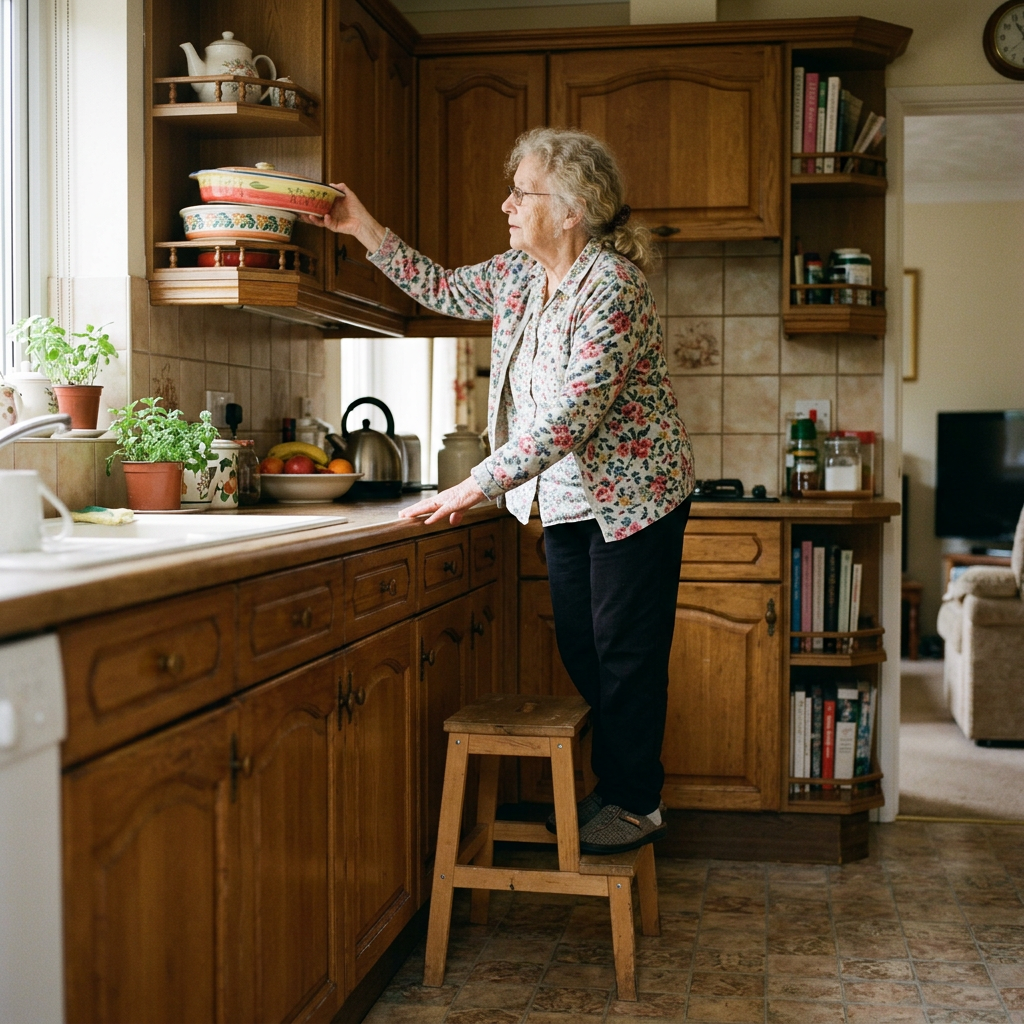
For everyone else, the parent reluctant to climb a chair but still needing flour from the second shelf, the right step stool with a real handle dramatically reduces fall risk. CDC data flags reaching tasks as a recurring source of older-adult falls, most of them on furniture never designed for stepping. A purpose-built stool with a graspable handle is one of the highest-leverage $40-to-$80 purchases on our master aging-in-place home safety checklist.
At a glance
Best Overall · HBTower 3-Step with Handrails · ~$65 · 500 lb capacity · Best when top cabinet shelves are in regular use.
Best Sweet-Spot Reach · Cosco Two-Step Big Step · ~$55 · 200 lb · Best for 2nd-shelf reach with rubber front-bar grip.
Best for Stability-First · DMI Step Stool with Handle · ~$45 · 300 lb · Best single-step with full-standing 34-inch grab handle.
Best Medical-Grade Build · Vaunn Medical Foot Step Stool with Handle · ~$40 · 250 lb · Best chrome triple-layered construction with anti-skid rubber.
Best Budget Workhorse · Delxo 3-Step Steel Folding Ladder · ~$55 · 330 lb · Best lightweight everyday kitchen pick with handgrip cap.
BEST OVERALLHBTower 3-Step Ladder with Handrails
~$65 · 500 lb capacity · Check on Amazon →

For households where wall-cabinet top shelves see weekly use, stand-mixer attachments, holiday platters, the bag of flour kept on the third shelf, the HBTower is the only slate pick whose handrails extend above the top step in a way that gives the user something to hold while standing on the platform. Across 8,000+ verified reviews, caregivers who switched from a kitchen chair or a 2-step report the “two hands on rails at the top” geometry is what makes higher shelves feel safe. The 500-lb capacity is overbuilt, which is the point. Overbuilt frames flex less, feel solid underfoot, and that perceived solidity is what keeps a hesitant parent using the stool at all.
The good
- Handrails extend 10″ above the top platform, so both hands have something to hold during the final step up
- 500-lb capacity translates to a frame that doesn’t flex or squeak under normal weight
- Folds flat to 3″ deep for storage between fridge and cabinet
The catch
- At 13 lb and 36″ tall folded, heavier than the 2-step picks, not ideal for grip-strength-impaired parents who’ll drag it from storage
- Locking mechanism needs firm pressure; arthritis-severe buyers report needing a second hand
This is right if upper cabinets see regular use and storage has room for a 36″ object. Look elsewhere if the parent only needs 2nd shelf or can’t lift 8 lb.
BEST SWEET-SPOT REACHCosco Two-Step Big Step with Rubber Hand Grip
~$55 · 200 lb capacity · Check on Amazon →

The Cosco Big Step is the editorial default for one reason: most kitchen-reach problems aren’t top-shelf problems, they’re second-shelf problems, and the 17-inch top platform is exactly the lift required to reach a standard over-counter cabinet without shoulder strain. The wide rubber-coated front bar runs the full width of the stool, so the hand can grip anywhere along it instead of fumbling for a specific spot. Across 12,000+ reviews, the recurring “I don’t have to look down” comment matters — the bar is positioned so a user feels it by touch, which OTs flag as critical for older eyes that struggle with bifocal-to-floor focal shifts. Trade-off: 200-lb capacity is the lowest on this slate.
The good
- 17-inch lift hits the geometric sweet spot for standard kitchen wall cabinets
- Full-width rubber front bar lets the hand land anywhere — no fumbling for a specific handle
- One-hand folding with a spring lock; folds flat to ~3″ deep
The catch
- 200-lb capacity is honest but tight; check parental weight plus held items
- Front bar sits at hip height on the top step, good for balance, not for top-shelf reach
This is right if the goal is second-shelf access and the parent is under 180 lb. Look elsewhere if top-shelf reach is required, or a heavier user needs more capacity.
BEST FOR STABILITY-FIRSTDMI Step Stool with Handle
$45 · 300 lb capacity · Check on Amazon →

The DMI is the answer when the senior wants to give up reach for stability. A single 9.5-inch step with a chrome standing handrail that rises 34 inches off the floor, roughly waist height, gives a vertical grip throughout the entire step-up motion. That continuous-grip geometry is what every OT-recommended bedside step stool uses, and it’s why this pick shows up in hospital discharge kits nationwide. Across 6,000+ reviews, two recurring patterns: praise for stability, and complaints the handle is too low for tall users. The handle is fixed; buyers over 5’10” report the grip ends below natural standing wrist position. For users 5’4″ to 5’9″, the geometry is correct.
The good
- Continuous vertical handrail provides grip through the entire step-up motion, not just at the top
- Chrome-plated steel frame is overbuilt for the 300-lb rating; minimal flex during use
- Non-skid rubber platform and feet, the same configuration used in clinical settings
The catch
- Handle is fixed at 34″; uncomfortable for users over 5’10”
- Single 9.5″ step won’t reach typical kitchen-cabinet second shelf alone, best for counter-edge tasks or as a bedside companion
This is right if the priority is stability for short reaches (counter, low shelf) and the user is 5’4″–5’9″. Look elsewhere if the user is over 5’10” or needs above-counter cabinet reach.
BEST MEDICAL-GRADEVaunn Medical Foot Step Stool with Handle
$40 · 250 lb capacity · Check on Amazon →

The Vaunn shares the DMI’s single-step bedside geometry but earns its slot through build quality: triple-layered chrome-plated steel, fully welded single-piece frame, and an anti-skid ribbed rubber platform that outperforms the DMI’s smoother mat in wet-floor reviews. Across 9,000+ reviews, the differentiator is durability, owners at 5+ years describe zero rust, zero wobble, still-grippy rubber. The 250-lb capacity is lower than the DMI’s; the handle reach is similar (same tall-user caveat). For a parent under 230 lb who’ll use it daily as a counter-reach assist, the Vaunn is a step up in long-term reliability for $5 less.
The good
- Triple-layered chrome construction holds up to humid bathroom or kitchen environments without rusting
- Ribbed anti-skid rubber outperforms smooth textured mats on wet surfaces — important if the kitchen sink area sees use
- Fully welded frame means no bolts to loosen over time
The catch
- 250-lb capacity is the second-lowest on this slate; check parental weight
- Same fixed-handle-height limitation as the DMI, won’t suit users over 5’10”
This is right if long-term durability matters more than reach height and the user is under 230 lb. Look elsewhere if the user needs higher reach, or weighs more than 230 lb.
BEST BUDGETDelxo 3-Step Steel Folding Ladder with Handgrip
~$55 · 330 lb capacity · Check on Amazon →

The Delxo is the budget answer for households that want the reach of a 3-step without the price or storage footprint of the HBTower. The trade-off is honest: the handgrip caps the top step rather than extending above it, so the user has something to grip during the climb but not while standing on the platform. Across 10,000+ reviews, this works for occasional top-platform use; routine top-shelf users report wishing for the HBTower’s extended rails. The 330-lb capacity, steel frame, and locking mechanism all sit solidly within spec. At ~$55 it slots between the single-step picks and the full-rail HBTower.
The good
- 330-lb capacity at the lowest price-per-capacity ratio on this slate
- Handgrip cap provides grip during the climb without adding above-platform height
- Steel frame with rear cross-brace; minimal flex reported in 5+ year ownership reviews
The catch
- Handgrip caps at top step level, no grip available while standing on the top platform
- At ~12 lb, on the heavier end for senior unloading from storage
This is right if budget is the constraint and top-platform standing is occasional. Look elsewhere if top-shelf reach is daily, spend the extra $10 on the HBTower.
How they compare
| Pick | Steps | Top Lift | Weight Cap | Handle Type | Best For |
|---|---|---|---|---|---|
| HBTower 3-Step | 3 | ~25″ | 500 lb | Rails above platform | Top-shelf reach |
| Cosco Big Step | 2 | 17″ | 200 lb | Full-width front bar | 2nd-shelf sweet spot |
| DMI | 1 | 9.5″ | 300 lb | 34″ standing pole | Counter-edge stability |
| Vaunn Medical | 1 | 9″ | 250 lb | Standing pole, welded | Long-term durability |
| Delxo 3-Step | 3 | ~24″ | 330 lb | Handgrip cap | Budget 3-step |
The conversation you’ll have
Most aging parents don’t want a step stool framed as a safety device, they want a kitchen tool. The pitch that works in caregiver reports is some version of “I picked up a better step stool, the old one felt rickety.” Lead with the product, not the parent.
Try saying “I got tired of watching you use that kitchen chair, the new one folds flat behind the fridge” instead of “I’m worried about you falling.” The first is logistical; the second is a verdict. The first gets used; the second gets refused. Place the new stool the same day, fold the old chair away, and don’t mention the swap again.
Insurance and savings
Step stools sit in an awkward gap. Original Medicare treats them as convenience items rather than DME under CMS guidelines, so Part B won’t reimburse a standard kitchen step stool. Two exceptions matter: Medicare Advantage plans expanded OTC supplemental benefits under CMS-4204-F for 2026, some now list step stools on their OTC catalog, so check your plan’s portal first. And with a doctor or OT Letter of Medical Necessity citing fall risk, the stool may qualify for FSA/HSA reimbursement under IRS Pub 502 and §213(d). Out-of-pocket medical spending above 7.5% of AGI is deductible — keep the receipt and LMN.
What to actually look for
1. Handle geometry, not just “has a handle”
The single biggest variable is where the handle ends. A handle capping at top-step level (Delxo) is for carrying the stool, not steadying the user. One extending ~10″ above the top platform (HBTower) gives a standing user something to grip. A standing pole 34″ off the floor (DMI, Vaunn) gives grip through the step-up motion but doesn’t help with reach. Match handle type to the actual task. The room-by-room aging-in-place modification guide covers how to identify which reach tasks live where in the kitchen.
2. Weight capacity with a 100-lb margin
OT rule of thumb: take the user’s weight, add held items (a stand-mixer attachment runs 5–8 lb), and add a 100-lb safety margin. A 165-lb parent holding 5 lb needs a stool rated 270+ lb. That math rules out the Cosco for some households, and it’s the most-miscalculated spec on this category.
3. Step depth and locking mechanism
Step depth should be at least 4.5″ so the ball of the foot lands on the platform, not just the toes. Locking mechanisms should engage with an audible click and shouldn’t require two-handed squeezing, buyers with severe arthritis flag squeeze-latches as a routine frustration. The HBTower and Delxo locks meet this standard; verified buyers describe them as one-hand operable.
FAQ
Are step stools safe for elderly people to use in the kitchen?
Step stools with a real handle are safer than the alternatives seniors actually reach for, a kitchen chair, a sealed tote, the oven door lip. If a senior scores under 45 on the Berg Balance Scale or has fallen in the past 12 months, talk to an OT first. For most active older adults, a purpose-built stool dramatically reduces reaching-task fall risk.
How high should a step stool for a senior be?
For second-shelf kitchen access, a 15–20″ top platform is the sweet spot. For top-shelf reach in standard 34–42″ upper cabinetry, a 24–28″ platform with handrails extending above it is safer. Anything above 28″ without overhead rails crosses into ladder territory and isn’t recommended for senior daily use.
What weight capacity do I need on a senior step stool?
Add 100 lb to the user’s body weight as a safety margin. Most senior-specific stools are rated 250–500 lb, covering nearly all users. Pay attention if rated capacity is under 250 lb that’s the floor below which OTs typically don’t recommend stepping aids.
Is a 2-step or 3-step better for an older adult?
Two-step is the better default. The consequence of a misstep on a 2-step is much smaller, and most kitchen reach tasks don’t require above-counter cabinet access. Choose a 3-step only if top cabinet shelves see regular use and the user is comfortable at that height.
Does Medicare cover a step stool with a handle?
Original Medicare classifies kitchen step stools as convenience items, not DME, so Part B doesn’t cover them. Some Medicare Advantage plans list step stools on 2026 OTC supplemental catalogs under CMS-4204-F check your plan’s OTC portal. FSA/HSA reimbursement may apply with a Letter of Medical Necessity.
What about arthritis: Is one of these picks better for stiff hands?
The Cosco’s wide rubber front bar is the easiest because the grip doesn’t require a specific position. The HBTower and Delxo locks are one-hand operable. Avoid any stool with a squeeze-latch system if arthritis is severe.
The shortlist


Last verified in stock: June 3, 2026
What we’d do tomorrow
If you’re starting this weekend, do three things in this order. First, walk the kitchen and identify the actual reach tasks — second shelf only, or top shelf too? That answer picks the stool. Second, weigh the parent in their kitchen shoes and add 100 lb safety margin — that confirms whether the Cosco’s 200-lb cap is in or out. Third, order the stool, place it in the kitchen the day it arrives, and move the chair they’ve been using elsewhere. The conversation you have with your parent matters less than the conversation you don’t have — most caregivers report the swap holds within a week without direct discussion.
— Sarah