5 Best Non-Slip Bathroom Flooring for Seniors (2026)
By Sarah Mitchell · Editor, BuyingForMom · Updated May 2026
10-min read · Bathroom Safety · 5 picks compared

Who this guide is for
This guide is for adult children buying non-slip flooring for a parent who still lives independently and wants the bathroom safer without a full remodel. CDC data shows roughly 80% of bathroom falls involve the floor (wet surfaces, transitioning out of the tub, standing up from the toilet) rather than the tub itself, yet most fall-prevention checklists jump straight to grab bars and skip the surface underfoot. The grab bar only helps if the foot doesn’t slide out first. Every pick below is verified in stock on Amazon as of this writing.
At a glance
BEST OVERALL · SlipDoctors Stone Grip · ~$32 · For homeowners with existing porcelain or ceramic tile who want an invisible fix.
BEST WET-ZONE COVERAGE · Foghorn Interlocking Rubber Tiles (9-pack) · ~$75 · For the area in front of the shower or tub where standing water collects.
BEST BUDGET OVERLAY · Achim Nexus Bianco Marble Vinyl Tile · ~$30 · For replacing a dated or damaged floor surface without demolition.
BEST FOR RENTERS · VinTile Modular Interlocking Tiles (6-pack) · ~$50 · For apartments where adhesive products aren’t allowed.
BEST LOW-PROFILE MAT · Drymate Low-Profile Bath Mat · ~$25 · For households with a walker or rollator that needs to roll over a thin, secure surface.
Best OverallSlipDoctors Stone Grip Anti-Slip Treatment

~$32 on Amazon · View on Amazon →
Stone Grip is the product most occupational therapists quietly recommend before suggesting any kind of demolition. It’s a clear chemical etch that opens microscopic channels in glazed porcelain, ceramic, and natural stone invisible to the eye but dramatically increases traction when the floor is wet. Across 3,000+ verified reviews, the recurring pattern is the same: applied in 15 to 20 minutes, dry to walk on within an hour, results last “more than two years.” One quart treats about 100 square feet, more than enough for a standard bathroom with leftover for the shower pan. Buyers consistently note the floor “looks identical but feels different,” which is precisely what you want when the goal is safety without a visible remodel.
The good
- Invisible: doesn’t change the look of the tile, only the grip
- Exceeds the ADA recommendation for 0.60 DCOF traction on wet surfaces
- One application lasts 2+ years; reapplication is a 20-minute job
The catch
- Only works on glazed porcelain, ceramic, and natural stone, not vinyl, laminate, or epoxy
- Requires a thorough cleaning before application; skipping that step is the #1 cause of bad reviews
This is right if… the existing bathroom floor is sound tile but too slippery when wet.
Look elsewhere if… the floor is vinyl, laminate, or visibly damaged, Stone Grip won’t bond.
Best Wet-Zone CoverageFoghorn Construction Interlocking Rubber Tiles

~$75 on Amazon · View on Amazon →
When the area in front of a walk-in shower stays wet for hours after every use, a chemical treatment isn’t enough — you want a floor that drains. The Foghorn 9-tile set covers roughly 12 square feet with 11.5-inch interlocking rubber squares that snap together without glue. The tread grips wet bare feet aggressively, and the open underside lets water flow through to evaporate. Buyers in senior-care and rehab settings consistently flag the tiles as “softer than expected” underfoot, the same cushioning that reduces foot fatigue is what reduces fracture severity in a fall. Tiles cut with a utility knife to fit around the toilet flange, and the whole installation lifts for deep cleaning.
The good
- Drainable construction prevents the trapped-water-and-mildew problem that ruins foam tiles
- Cushioned rubber softens impact if a fall does occur
- No adhesive, rents and removes cleanly
The catch
- Visual is utilitarian (gray rubber, gym-floor aesthetic); not the right call for a guest bath
- 9 tiles covers about 12 sq. ft. larger bathrooms need two sets
This is right if… the floor in front of a walk-in shower or tub stays wet long after bathing.
Look elsewhere if… the bathroom is mostly dry and you care strongly about how the floor looks.
Best Budget OverlayAchim Nexus Bianco Marble Peel-and-Stick Vinyl Tile

~$30 on Amazon · View on Amazon →
When the existing tile is cracked, the grout is stained beyond rescue, or the visual is so dated that a chemical treatment feels like polishing a dent, Achim’s Nexus line is the cheapest legitimate fix. The Bianco Marble pattern reads as bright white-and-gray veining, honest enough up close that no one will be embarrassed and ships 20 tiles per box at 12 inches square, covering 20 square feet for around $30. Across 8,000+ verified Nexus reviews, the recurring praise is “looked better than I expected” and the recurring complaint is “subfloor prep matters.” Clean and level the floor first. The low-sheen vinyl grips bare feet better than glossy ceramic and is fully waterproof; most installers finish a small bathroom in under three hours.
The good
- Cheapest legitimate way to replace a damaged floor, about $1.50 per square foot
- Low-sheen vinyl naturally grips wet feet better than glossy tile
- No demolition, no contractor; one afternoon with a utility knife
The catch
- Subfloor must be clean, dry, and level, bad prep is the #1 cause of edge lifting
- Lifetime is shorter than ceramic (5–10 years in a bathroom vs. 25+ for tile)
This is right if… the existing floor needs a cosmetic upgrade and a chemical treatment alone won’t help.
Look elsewhere if… the floor is already sound tile, treat it with Stone Grip instead of layering vinyl over it.
Best for RentersVinTile Modular Interlocking Cushion Floor Tiles (6-pack)

~$50 on Amazon · View on Amazon →
For renters and assisted-living residents who can’t commit to a permanent change, VinTile’s 6-tile pack is the cleanest option on Amazon. Each tile is 11-3/4 inches square in flexible recycled vinyl with an open mesh underside that drains through to the floor below; six tiles cover about 6 square feet — perfect for the strip in front of the vanity or beside the toilet. Tiles snap together in seconds, lift in seconds, and leave zero residue. Across 4,000+ verified reviews, the most-cited use cases are rentals, RVs, and assisted-living rooms where management won’t approve adhesives. The waffle surface grips wet feet, and the 5/8″ thickness creates a comfortable barrier from cold tile. A landlord walkthrough sees “a mat” rather than “an installation,” which is the entire point.
The good
- No glue, no adhesive, no damage, safe for any rental
- Drains through to the underlying floor; doesn’t trap moisture against the tile
- Tiles can be added or removed individually to fit awkward bathroom layouts
The catch
- 6 tiles covers only 6 sq. ft.; whole-bathroom coverage needs multiple packs
- The underlying floor still gets wet underneath, needs a periodic lift-and-dry
This is right if… the bathroom is in a rental, an apartment, or an assisted-living unit.
Look elsewhere if… you own the home and want a permanent solution, Stone Grip or Foghorn cost less per square foot.
Best Low-ProfileDrymate Low-Profile Bath & Shower Mat

~$25 on Amazon · View on Amazon →
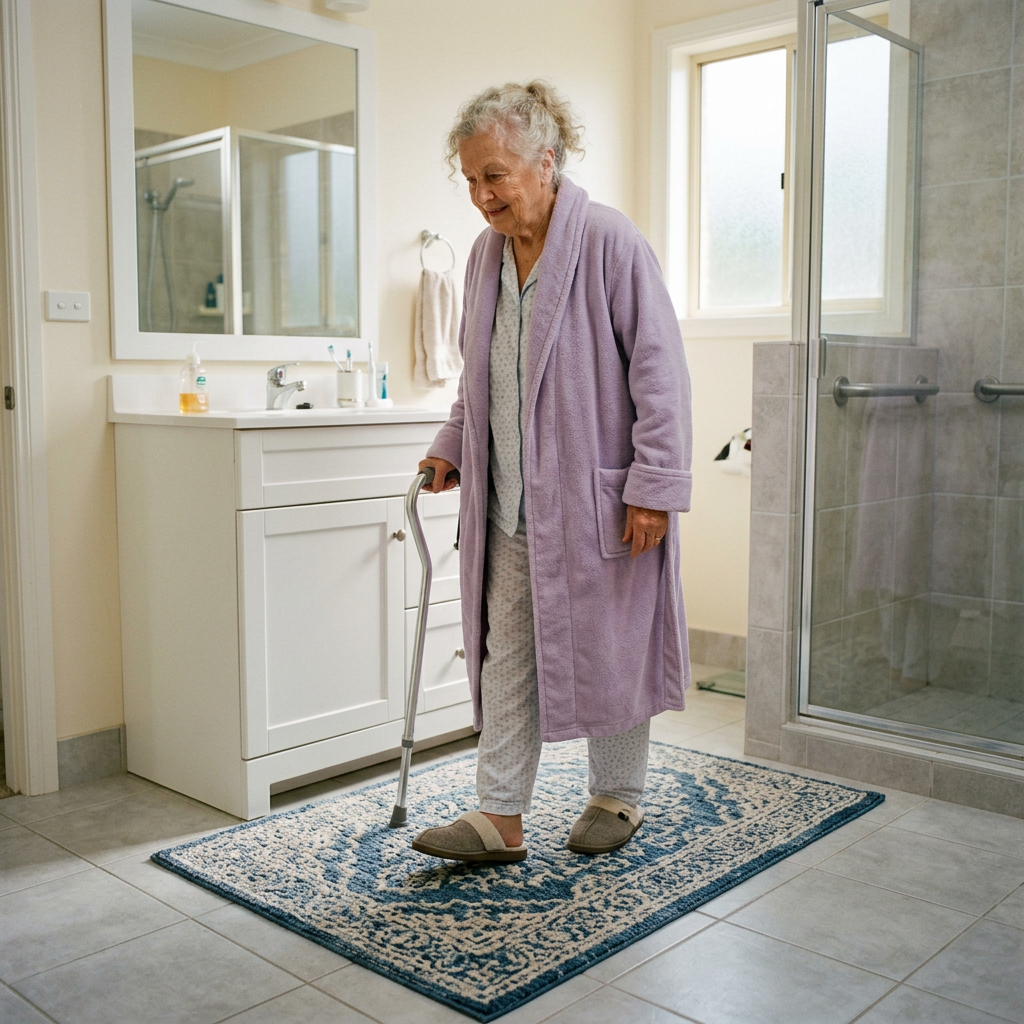
Households using a walker or rollator have a problem most product roundups ignore: traditional bath mats are tall enough that wheels catch on the edge. The Drymate Low-Profile mat is engineered specifically to solve that, ultra-thin (fits under most bathroom doors without bunching), absorbs four times its weight in water, and has a non-slip rubberized backing that holds firm on tile or vinyl. Buyers in the senior-mobility category consistently flag it as “works with my walker” and “doesn’t move when I’m using a cane.” Made in the USA from recycled material, phthalate- and BPA-free, machine-washable on delicate. The 16×28-inch size fits the standard zone in front of a vanity or shower; larger versions are available.
The good
- Low profile means wheels (walker, rollator, wheelchair) don’t snag
- Absorbs water on contact, the floor underneath stays dry
- Machine-washable; no mildew if washed every two weeks
The catch
- Smaller footprint than full-floor solutions, one mat doesn’t cover an entire bathroom
- Backing grip is excellent but not permanent; expect to reposition every few months
This is right if… the household uses a walker, rollator, or wheelchair in the bathroom.
Look elsewhere if… you want full-floor coverage rather than a targeted absorbent zone.
Side-by-side comparison
| Product | Approx. price | Coverage | Best use |
|---|---|---|---|
| SlipDoctors Stone Grip (qt) | ~$32 | ~100 sq. ft. | Existing tile, invisible fix |
| Foghorn Rubber Tiles (9) | ~$75 | ~12 sq. ft. | Wet zone, cushioned |
| Achim Nexus Vinyl Tile (20) | ~$30 | 20 sq. ft. | Cosmetic floor refresh |
| VinTile Modular (6) | ~$50 | ~6 sq. ft. | Renter, no adhesive |
| Drymate Low-Profile Mat | ~$25 | 16×28 in. | Walker/rollator households |
The conversation you’ll have
Most aging parents resist this purchase before they even hear it “I’ve lived here 40 years and I haven’t fallen yet” is the script you’ll hear in the first 30 seconds. Avoid framing the conversation around them. Try “I read about someone slipping in the bathroom and breaking her hip last winter, I want to do this one thing so I stop worrying,” instead of “I’m worried you’ll fall.” Lead with your anxiety, not their fragility. If resistance continues, offer the Drymate mat first, it looks like a regular bath mat and crosses no psychological threshold. Two weeks in, the larger conversation about treating the floor itself gets dramatically easier.
Insurance and savings
Anti-slip flooring sits in a gray zone for Medicare. Traditional Medicare Parts A and B classify it as a “home modification” rather than durable medical equipment, so it is not covered, the same rule that excludes grab bars. However, many 2026 Medicare Advantage plans offer up to $500 in supplemental fall-prevention benefits under the expanded CMS rule (CMS-4204-F), and bathroom flooring upgrades are explicitly eligible under several of them. Worth a 10-minute call to your parent’s plan administrator. Separately, FSA and HSA accounts will reimburse the purchase with a physician’s Letter of Medical Necessity citing fall risk, IRS Publication 502 lists home modifications for medical reasons as deductible, and the §213(d) deduction applies if total medical costs exceed 7.5% of AGI.
What to actually look for
Dynamic Coefficient of Friction (DCOF)
The single number that matters most. ANSI A326.3 sets 0.42 DCOF as the minimum for level interior wet surfaces; the ADA recommends 0.60 for bathrooms used by anyone with mobility limitations. Stone Grip publishes 0.65+ after treatment; Foghorn rubber tile measures around 0.80. If a product page doesn’t list a DCOF or COF rating, assume it’s below 0.42 and look elsewhere.
Drainage and mildew resistance
Any product that traps water against the floor grows mildew within a season. Foam puzzle tiles are the classic offender, attractive in the photo, a mold problem by month three. Rubber drainable tiles (Foghorn, VinTile) and chemical treatments (SlipDoctors) avoid the problem; peel-and-stick vinyl (Achim) avoids it only when the subfloor is fully dry at install. Skip anything described as “closed-cell foam” for bathroom use. See our complete aging-in-place home safety checklist for the full priority order.
Compatibility with other safety modifications
Non-slip flooring works best as part of a layered system. A treated floor plus a properly anchored grab bar plus a shower chair drops fall-injury risk by an estimated 70% per AARP research, far more than any single product. Pair this guide with our decorative grab bars roundup and the shower chairs that don’t tip guide. The flooring is the foundation; the bars and seating catch the slip when it happens.
Frequently asked questions
What is the best non-slip flooring for elderly bathrooms?
For most homes, an anti-slip chemical treatment like SlipDoctors Stone Grip applied to existing porcelain or ceramic tile is the most effective and least disruptive option. For households with standing water, cushioned interlocking rubber tiles offer better drainage and impact absorption.
Can you put non-slip coating on existing tile?
Yes, SlipDoctors Stone Grip and similar etching treatments bond directly to glazed porcelain, ceramic, and natural stone. They work by opening microscopic channels in the glaze that increase traction without changing the appearance. They do not bond to vinyl, laminate, or epoxy floors.
How much does it cost to make a bathroom floor non-slip?
DIY options range from $25 (low-profile bath mat) to $75 (interlocking rubber tile coverage for the wet zone). Chemical treatments cost about $0.30 per square foot of coverage. Professional installation of a full anti-slip floor replacement typically runs $1,200 to $3,500 depending on bathroom size and material.
Does non-slip flooring actually prevent falls?
Research from the CDC and AARP shows that bathroom-specific slip-resistant surfaces reduce fall risk by 40 to 60% in seniors with mobility limitations. The effect is largest when non-slip flooring is paired with grab bars and a shower seat, the three-modification combination drops injury risk by an estimated 70%.
Is rubber flooring really safe for a bathroom?
Yes, when the tiles include drainage holes or an open mesh underside (like the Foghorn and VinTile picks above). Solid rubber mats without drainage trap moisture and grow mildew. Look explicitly for “drainable” or “perforated” rubber tile, not flat rubber matting designed for gyms.
Will Medicare pay for non-slip bathroom flooring?
Traditional Medicare does not. However, many 2026 Medicare Advantage plans include up to $500 in supplemental fall-prevention benefits that cover anti-slip flooring, check with the plan administrator. FSA and HSA accounts will reimburse the purchase with a physician’s Letter of Medical Necessity citing fall risk.
How long does anti-slip floor treatment last?
SlipDoctors Stone Grip and comparable etching treatments last more than two years on a properly cleaned floor before reapplication is needed. Interlocking rubber and vinyl tile solutions last 5 to 10 years with normal bathroom use. Bath mats need washing every two weeks and replacement annually.
The shortlist


Last verified in stock: May 25, 2026
What we’d do tomorrow
If you’re starting this weekend, do three things in order. First, put the Drymate mat in the bathroom, no conversation needed, $25, protecting the highest-risk zone the day it arrives. Second, on the following Saturday morning, apply SlipDoctors Stone Grip to the rest of the tile (one quart, 20 minutes, done before noon). Third, when the Foghorn rubber tiles arrive, lay them in the wettest section as cushioned backup. Three weekends, under $135 total, materially safer bathroom, no contractor required.
— Sarah
Leave a Reply