Tag: Post-Hospital Discharge

Equipment and modifications most useful when a senior is coming home from a hospital stay.

  • 5 Best Dressing Aids for Seniors

    5 Best Dressing Aids for Seniors

    Disclosure: BuyingForMom is reader-supported. As an Amazon Associate we earn from qualifying purchases. When you buy through links in this article, we may earn an affiliate commission at no additional cost to you. We never recommend products we haven’t researched against verified-buyer review data. This article is editorial reporting, not medical advice.

    5 Best Dressing Aids for Seniors: Sock Aids, Shoe Horns & Button Hooks

    By Sarah Mitchell · Editor, BuyingForMom · Updated July 2026

    9 min read · Arthritis & Daily Living · 5 products compared

    The honest take: If you’re buying one thing, buy the Vive Sock Aid & Shoe Horn Kit  it solves the two hardest movements (reaching the foot to put on a sock, and reaching the heel to put on a shoe) in one purchase. Buy the individual pieces only if the limitation is grip rather than reach, in which case the button hook matters more than the sock aid. Skip the fabric “sock slider” style aids for anyone with real arthritis. The rigid molded shell is far easier to load one-handed.


    How we sorted through 40+ dressing aids in two weeks. We cross-referenced more than 9,000 verified Amazon reviews across the sock-aid, shoe-horn, button-hook and dressing-stick categories, then filtered against the way occupational therapists actually prescribe these tools by the specific limitation they fix, not by product type. We weighted three signals: whether the aid can be loaded and operated with one hand (critical after a stroke), handle length relative to a seated reach, and recurring complaints in caregiver threads on Reddit’s r/AgingParents and arthritis forums.

    Who this guide is for. This guide is for an adult child or caregiver buying dressing aids for a parent who struggles to bend to their feet, grip small buttons, or dress after hip, knee, or shoulder surgery. If you’re shopping for yourself post-surgery, the same picks apply,  start with the hip kit.

    The best dressing aids for elderly parents aren’t the ones with the most features. They’re the ones matched to the exact movement that’s become hard. Someone with arthritis in their hands has a completely different problem than someone recovering from a hip replacement who can’t bend forward. A sock aid solves the second problem beautifully and does nothing for the first. Which is why so many of these tools end up in a drawer. Below, each pick is labeled by the limitation it solves; read the “This is right if…” line before you buy.

    At a glance

    Best Overall  Vive Sock Aid & Shoe Horn Kit — ~$20 · solves reach for both socks and shoes in one buy

    Gentlest  RMS Deluxe Sock Aid — ~$13 · molded shell, long foam handles, easiest to load

    Best for Reach  Vive Dressing Stick — ~$15 · pulls up pants, zippers, and blankets without bending

    Best for Grip  Vive Button Hook & Zipper Pull — ~$11 · fastens buttons one-handed with a wide grip

    Best All-in-One  RMS 5-Piece Hip Kit — ~$28 · reacher, sock aid, stick, sponge & shoe horn for surgery recovery

    Best Overall Vive Sock Aid & Shoe Horn Kit

    ~$20 · Check price on Amazon →

    This is the pick that solves the most for the least money. The sock aid uses a firm-but-flexible molded shell that holds the sock open so a foot slides straight in, and the detachable 23-inch shoe horn handles the second half of the routine most guides ignore — getting into a shoe without crushing the heel or bending to the floor. Across roughly 4,000 verified reviews, the recurring praise is that the handle length adjusts with button sliders to fit both a tall senior and a shorter one; the recurring complaint is that very thick socks can be a tight load on the shell. For everyday socks and light compression up to about 15–20 mmHg, buyers consistently report it works after a short learning curve.

    The good

    • Two tools in one, covers both socks and shoes, the two hardest reaches
    • Adjustable handle length fits different heights and reach ranges
    • Nonslip lining keeps the sock from sliding off the shell mid-pull

    The catch

    • Very thick or fuzzy socks are a tight stretch over the shell
    • The cords take a few sessions to master for hands with low grip strength

    This is right if… the main problem is bending or reaching the feet, and you want one purchase that covers socks and shoes.

    Look elsewhere if… the real issue is hand grip rather than reach a button hook will matter more than this kit.

    Gentlest RMS Deluxe Sock Aid

    ~$13 · Check price on Amazon →

    If the hands doing the pulling are arthritic, the detail that matters is the handle and RMS gets it right with 38-inch foam-padded cords that are soft to grip and long enough that almost no forward lean is required. OTs frequently point families toward the molded (not fabric) style for exactly this reason: a rigid gutter holds its shape, so you’re not fighting the aid while also fighting the sock. Across more than 5,000 verified reviews, buyers with limited hand strength single out the cushioned handles as the difference between doing it themselves and giving up. The trade-off is that it’s a sock aid only — no shoe horn — so it’s the right buy when socks are the specific daily battle.

    The good

    • Long 38-inch foam handles need almost no bending and are gentle on sore hands
    • Rigid molded shell holds its shape, so it’s easy to load one-handed
    • Among the lowest-priced quality options in the category

    The catch

    • Sock aid only,  no shoe horn or other tools included
    • Sized for regular socks; the tightest medical compression stockings can be a struggle

    This is right if… arthritis is the limiter and you want the softest, longest handles for the least money.

    Look elsewhere if… you also need help with shoes — the Vive kit above bundles the shoe horn.

    Best for Reach Vive Dressing Stick

    ~$15 · Check price on Amazon →

    The dressing stick is the most underrated tool here it gets pants, underwear, and jackets up and over without a forward bend that’s off-limits after hip or back surgery. This 27-inch birch version has a coated hook on one end for pulling clothing and a push hook plus zipper pull on the other, so it also reaches zippers and nudges socks off at day’s end. Verified buyers recovering from hip replacements consistently describe it as the tool their occupational therapist actually handed them, and the wood shaft draws fewer “it flexed and gave out” complaints than cheap plastic sticks. The learning curve is real for a week, but it protects a surgical hip precaution better than anything else on this list.

    The good

    • Pulls up pants and jackets with zero forward bend — protects hip precautions
    • Rigid birch shaft doesn’t flex or fold like cheap plastic sticks
    • Zipper pull and sock-remover hook built into the second end

    The catch

    • Takes about a week of practice to hook fabric confidently
    • Doesn’t help with socks going on — pair it with a sock aid

    This is right if… bending forward is restricted after hip, knee, or back surgery and pants are the daily hurdle.

    Look elsewhere if… the problem is buttons and grip, not reach — the button hook below is the tool.

    Best for Grip Vive Button Hook & Zipper Pull

    ~$11 · Check price on Amazon →

    Buttons are the wall that arthritis and post-stroke recovery hit hardest, and a button hook is a quietly transformative $11 fix. You push the wire loop through the buttonhole, catch the button, and pull it back through  a motion that needs one working hand and almost no pinch strength. This Vive version pairs the hook with a zipper pull and wraps both around a wide, textured grip that’s far easier to hold than the pencil-thin handles on bargain multipacks. Across thousands of reviews, people with rheumatoid arthritis and one-handed dressers after a stroke report the same arc: a short frustrating session, then genuine independence. The honest downside is that tiny shirt-cuff buttons stay fiddly for anyone, aided or not.

    The good

    • Wide textured handle is easy to hold with weak or painful grip
    • Works one-handed a genuine stroke-recovery aid
    • Zipper pull built in, so it earns its keep beyond buttons

    The catch

    • Very small cuff and collar buttons stay fiddly even with the hook
    • The thin wire loop can bend if forced through a too-tight hole

    This is right if… the limitation is hand grip or dexterity arthritis, tremor, or one working hand.

    Look elsewhere if… the person can button fine but can’t reach their feet that’s a sock-aid problem.

    Best All-in-One RMS 5-Piece Hip Kit

    ~$28 · Check price on Amazon →

    When the trigger is a scheduled hip or knee replacement, don’t buy piecemeal buy the kit the discharge planner would hand you. This RMS set bundles a 26-inch reacher, a molded sock aid, a 28-inch dressing stick, a long-handled bath sponge, and a shoe horn, which together cover the seated dressing-and-bathing routine surgeons require during hip precautions. Across more than 8,000 verified reviews it’s a repeat recommendation from physical and occupational therapists, and the standout in caregiver feedback is value: five coordinated tools for roughly the price of two bought separately. The reacher is light-duty. For clothing and light objects, not a full laundry basket but that’s exactly its job here.

    The good

    • Covers the full seated routine surgeons require after hip or knee surgery
    • Five coordinated tools for about the price of two bought alone
    • The exact kit PTs and discharge planners recommend pre-surgery

    The catch

    • The reacher is light-duty — for clothing and light items, not heavy lifting
    • Individual pieces are good, not best-in-class; you’re buying the bundle

    This is right if… there’s a hip or knee replacement coming and you want everything in one order.

    Look elsewhere if… you only need one tool — buying the single best sock aid or stick is cheaper.

    Quick comparison

    Product Solves Price Best for
    Vive Sock Aid & Shoe Horn Kit Reach (socks + shoes) ~$20 One-purchase starter
    RMS Deluxe Sock Aid Reach (socks) ~$13 Arthritic hands
    Vive Dressing Stick Reach (pants, zippers) ~$15 Hip/back precautions
    Vive Button Hook & Zipper Pull Grip (buttons) ~$11 Arthritis, one hand
    RMS 5-Piece Hip Kit Everything, seated ~$28 Surgery recovery

    The conversation you’ll have

    Dressing is intimate, and an aging parent often reads a dressing aid as a verdict on their independence rather than a tool that protects it. The resistance is real, and pushing “you need this” usually backfires. Framing the aid around effort and dignity, not decline, tends to land better.

    Try saying, “This just means you don’t have to wait for me to help with socks” instead of “This will keep you from falling.” The first hands back control; the second takes it away. It also helps to leave the tool out casually rather than presenting it with a speech. A sock aid that simply appears by the chair invites a private, no-audience trial. And if surgery is the reason, let the occupational therapist introduce it: parents accept from a clinician what they resist from a child. Your job is often just to have the right tool already there when the OT says the word.

    Insurance and savings

    Original Medicare generally does not cover dressing aids CMS classifies sock aids, dressing sticks, and button hooks as convenience items rather than durable medical equipment, so they’re paid out of pocket. The better news: because they treat a medical condition, they’re typically FSA/HSA-eligible, which effectively discounts them by your tax rate. Some 2026 Medicare Advantage plans also fold daily-living aids into their supplemental over-the-counter (OTC) benefit — worth a two-minute check of your parent’s OTC catalog before paying retail. And if unreimbursed medical expenses clear the IRS threshold of 7.5% of adjusted gross income, these tools count toward the medical-expense deduction under IRS Publication 502. None of this is tax advice, confirm specifics with the plan or a tax professional.

    What to actually look for

    Match the tool to the limitation, not the wish list

    The most common buying mistake is choosing by product popularity instead of by the movement that’s become hard. Reach problems (can’t bend to the feet, can’t lean for pants) call for a sock aid, shoe horn, and dressing stick. Grip problems (can’t pinch a button, can’t hold a zipper) call for a button hook. One working hand after a stroke calls for tools that load and operate one-handed. Buy for the limitation in front of you, and cross-reference the priority order in our complete aging-in-place home safety checklist.

    Handle length and grip width

    For sock aids and dressing sticks, longer handles mean less forward lean, the whole point. Look for cords or shafts around 27 inches or more, and for arthritic hands, padded or wide grips over thin plastic. A wider handle is easier to control with reduced pinch strength, which is why the bargain multipacks with pencil-thin handles so often disappoint. This is the same principle behind choosing lever handles and wide grips throughout the home, covered in our room-by-room aging-in-place modification guide.

    Rigid molded vs. flexible fabric sock aids

    Rigid molded sock aids hold their shape, so loading the sock is a one-handed task and the aid doesn’t collapse mid-pull. Flexible fabric “sliders” are gentler on sensitive skin and pack flatter for travel, but they’re harder to load with weak hands. For most seniors with arthritis, the molded style wins on ease; reserve the fabric style for delicate skin or trips.

    Frequently asked questions

    What devices help seniors get dressed?
    The core set is a sock aid, a long-handled shoe horn, a dressing stick for pants and jackets, and a button hook for fasteners. No-tie elastic laces and a reacher round it out. Match each to the specific movement that’s hard reach, grip, or one-handed use, rather than buying all of them at once.

    How do you put socks on someone who can’t bend?
    Use a sock aid. Slide the sock over the molded shell, set the aid on the floor, guide the foot into the opening while seated, then pull the cord handles up. The sock rolls onto the foot with no forward bending. Always do this seated in a sturdy chair, never standing.

    What is a dressing stick used for?
    A dressing stick pulls pants, underwear, and jackets up and over the body without bending forward, hooks a zipper pull, and pushes clothing off at day’s end. It’s the key tool for protecting hip precautions after a replacement, when leaning down to the feet is medically restricted for several weeks.

    How does a button hook work?
    You push the wire loop through the buttonhole from the far side, catch the button in the loop, and pull it back through the hole. It needs one working hand and almost no pinch strength, which makes it a genuine aid for arthritis, tremor, and post-stroke dressing with a single hand.

    Can you use a sock aid with compression socks?
    Yes, up to a point. Light-to-moderate compression (roughly 15–20 mmHg) usually loads onto a molded sock aid fine. The tightest medical-grade stockings (20–30 mmHg and up) are a struggle on standard aids — for those, choose a sock aid specifically labeled for compression, with a wider, more open gutter.

    Are dressing aids covered by Medicare?
    Generally no. Original Medicare treats them as convenience items, not durable medical equipment, so they’re out of pocket. They are usually FSA/HSA-eligible, some Medicare Advantage OTC benefits include them, and they can count toward the medical-expense tax deduction if you clear the 7.5%-of-AGI threshold.

    The shortlist

    Best Overall

    Vive Sock Aid & Shoe Horn Kit

    ~$20

    Check on Amazon →

    Gentlest

    RMS Deluxe Sock Aid

    ~$13

    Check on Amazon →

    Best for Reach

    Vive Dressing Stick

    ~$15

    Check on Amazon →

    Best for Grip

    Vive Button Hook & Zipper Pull

    ~$11

    Check on Amazon →

    Best All-in-One

    RMS 5-Piece Hip Kit

    ~$28

    Check on Amazon →

    Last verified in stock: July 19, 2026

    What we’d do tomorrow

    If you’re starting this weekend, do three things in order. First, name the limitation out loud — reach, grip, or one working hand? That answer picks the tool. Second, if surgery is on the calendar, buy the RMS Hip Kit now so it’s in the house before the OT asks for it; if it’s everyday arthritis, start with the Vive sock aid and shoe horn plus the button hook. Third, leave the tool by the chair without a speech and let a private first try do the convincing. Our aging-in-place safety checklist lays out what to tackle next around the home.

    — Sarah
    BuyingForMom is a reader-supported site. As an Amazon Associate we earn from qualifying purchases. When you buy through links on this site, we may earn an affiliate commission at no additional cost to you. See our Affiliate Disclosure for details. This article is not medical advice — please consult a qualified healthcare professional for decisions specific to your situation.
  • 5 Best Knee Scooters for Foot Recovery (2026)

    5 Best Knee Scooters for Foot Recovery (2026)

    Disclosure: BuyingForMom is reader-supported. As an Amazon Associate we earn from qualifying purchases. When you buy through links in this article, we may earn an affiliate commission at no additional cost to you. We never recommend products we haven’t researched against verified-buyer review data. This article is editorial reporting, not medical advice.

    5 Best Knee Scooters for Foot Recovery

    By Sarah Mitchell · Editor, BuyingForMom · Updated July 2026

    9-minute read · Walkers & Canes · 5 picks compared

    The honest take: For most seniors recovering from foot or ankle surgery, the Vive Mobility Knee Scooter is the one to buy it steers tightly enough for a real kitchen and holds up outdoors, which is all most people need. Reach for the KneeRover All Terrain only if the daily route involves gravel, grass, or a sloped driveway. And if kneeling on a bent knee is impossible. A bad opposite knee, arthritis, a recent replacement, skip every kneeling model here and go straight to the KneeRover Seated Scooter; forcing a painful kneel is the single most common reason a scooter ends up abandoned in a hallway.

    How we sorted through 30 knee scooters in two weeks

    We started with roughly 30 knee scooters on Amazon and cross-referenced them three ways: against more than 15,000 verified-buyer reviews, against the setup instructions occupational therapists hand out after foot and ankle surgery, and against the complaints caregivers post in recovery forums. We weighted three things heavily, steering play (the wobble that scares people off), the force needed to squeeze the brake (a barrier for arthritic hands), and whether the frame fits a shorter or taller senior. Anything with a pattern of collapsing brakes, seized steering, or “too tall for a petite parent” reviews was cut.

    Who this guide is for

    This guide is for adult children helping a parent stay mobile after foot surgery, a broken ankle, or a diabetic foot wound that requires weeks off one leg. The picks apply equally if you’re shopping for yourself — just skip the “conversation” section below, written for families navigating a parent’s resistance to “looking disabled.”

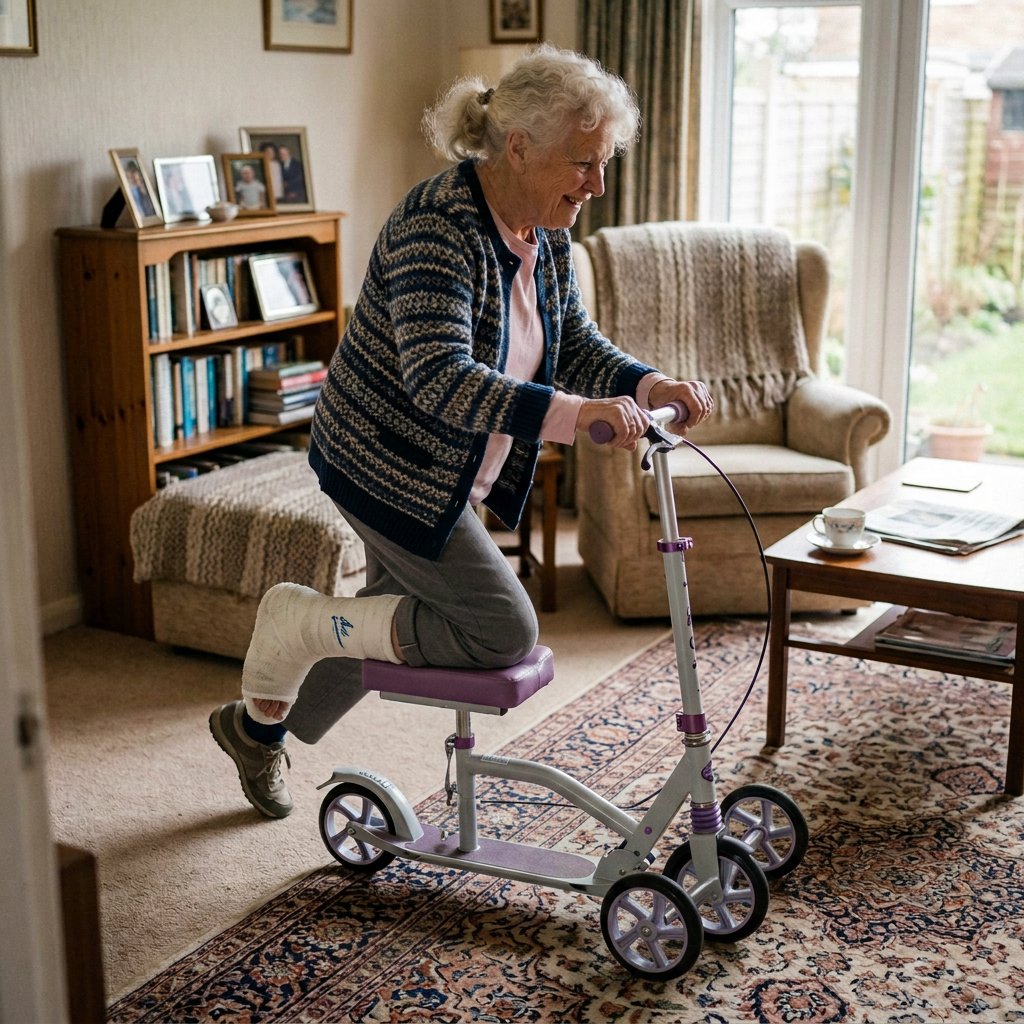
    A knee scooter (also called a knee walker) lets someone rest an injured lower leg on a padded platform and roll along using the good leg, hands on the handlebars for balance. For a senior, that’s often far safer than crutches, which demand upper-body strength and steady balance many older adults no longer have. The right knee scooter for foot recovery keeps a parent independent through the kitchen, bathroom, and front door. The wrong one gets parked and never used.

    The most useful way to choose is to decide where it will mostly be used. Indoor-dominant recovery favors a compact, tight-turning scooter with smaller wheels; a parent crossing a driveway, lawn, or gravel path needs larger tires and a heavier frame. Each pick below is slotted to a real situation rather than ranked as if the five were interchangeable.

    At a glance

    BEST OVERALL  Vive Mobility Knee Scooter — ~$140 · tight indoor turns, steady outdoors, easy locking brakes.

    BEST BUDGET  KneeRover Economy Steerable — ~$125 · 4.5★ from 4,000+ buyers, the proven starter pick.

    BEST OUTDOORS  KneeRover Original All Terrain — ~$180 · 12″ pneumatic tires, 350 lb capacity for grass and gravel.

    LIGHTEST  Drive Medical DV8 Steerable — ~$150 · aluminum frame, easiest to lift into a car trunk.

    CAN’T KNEEL  KneeRover Seated Scooter — ~$260 · sit-and-roll design for a bad opposite knee.

    Best Overall  Vive Mobility Knee Scooter

    ~$140 · 300 lb capacity · 8″ wheels · Check price on Amazon →

    Vive has quietly become the default recommendation among the review sites we cross-referenced, and the reason is boring in the best way: it does everything competently and nothing badly. The 8-inch wheels are the sweet spot. Small enough to pivot through a doorway and around a kitchen island, big enough to roll over thresholds and driveway cracks without stalling. Verified buyers single out the dual locking brakes, which set with a light squeeze rather than the death-grip some budget models demand, and the knee pad drops low enough that the “too tall” complaint largely disappears. The recurring gripe is sparse assembly instructions, so budget ten minutes and a wrench.

    The good

    • Tight indoor turning without sacrificing outdoor stability
    • Locking brakes engage with minimal hand force, friendly to arthritic grips
    • Knee pad drops low enough for shorter seniors

    The catch

    • Assembly instructions are thin, expect to eyeball a step or two
    • Solid wheels transmit more bump on rough pavement than pneumatic tires

    This is right if… your parent’s recovery is mostly indoors with the occasional trip to the car or mailbox.

    Look elsewhere if… the daily route crosses grass, gravel, or a steep driveway, size up to the All Terrain below.

    Check Price on Amazon →

    Best Budget  KneeRover Economy Steerable

    ~$125 · 300 lb capacity · fits 4’9″–6’4″ · Check price on Amazon →

    If a scooter is only needed for six or eight weeks, premium money can feel wrong and the KneeRover Economy makes spending less defensible. It carries a 4.5-star average across roughly 4,000 verified reviews, a deep enough pool to trust the pattern: excellent value, genuinely steerable, folds for the car, and holds a 185-pound adult plus groceries without complaint. The honest downside shows up in those same reviews — the steering head can develop a small wobble on fast turns until you tighten the bolt under the column, a five-second fix buyers repeatedly flag and then forgive. For a budget indoor-and-sidewalk recovery, it’s the safe starter.

    The good

    • 4.5★ from 4,000+ buyers the most-proven pick here
    • Wide height range fits most seniors out of the box
    • Folds flat for a trunk or a closet

    The catch

    • Steering can wobble at speed until the column bolt is tightened
    • Solid wheels catch in sidewalk cracks and loose gravel

    This is right if… you want the lowest-risk, best-reviewed scooter and the terrain is floors and sidewalks.

    Look elsewhere if… nobody in the house owns a wrench or the recovery route is rough outdoor ground.

    Check Price on Amazon →

    Best Outdoors  KneeRover Original All Terrain

    ~$180 · 350 lb capacity · 12″ pneumatic tires · Check price on Amazon →

    Most indoor scooters fail outdoors because of wheel size: a small solid caster drops into every sidewalk seam and stops the rider cold. The KneeRover All Terrain solves that with four 12-inch air-filled tires that roll over grass, gravel, and cracked pavement the way a wheelbarrow does. It also carries the highest capacity here at 350 pounds and fits taller seniors up to about 6’5″. The trade-offs are real: it’s heavier to lift, turns wider indoors, and as reviewers note. The pneumatic tires slowly lose air and need topping off with a bike pump. For a suburban or rural parent on real ground, that’s a fair price for not getting stuck.

    The good

    • 12″ pneumatic tires clear grass, gravel, and driveway cracks
    • 350 lb capacity and a taller fit than most rivals
    • Air tires absorb bumps that jar solid-wheel models

    The catch

    • Heavier to lift and wider to turn in tight indoor spaces
    • Tires need periodic re-inflation with a pump

    This is right if… the daily route includes lawn, gravel, or a sloped driveway.

    Look elsewhere if… recovery is apartment-bound and lifting a heavier frame is a problem.

    Check Price on Amazon →

    Lightest  Drive Medical DV8 Steerable

    ~$150 · 300 lb capacity · aluminum, ~13 lb frame · Check price on Amazon →

    Drive Medical is a name occupational therapists recognize, and the DV8 is the pick for the household where someone else lifts the scooter constantly — into a trunk, up a porch step, out of the way in a narrow hall. Its aluminum frame is among the lightest here at roughly 13 pounds, the steering column folds for storage, and the handle adjusts from 33 to 37.5 inches for shorter seniors. Verified buyers reach for phrases like “sturdy for how light it is” and praise the deluxe lever brakes. The compromise: a lighter frame feels slightly less planted at speed, so it rewards a cautious roller — which, for most recovering seniors, is the right temperament anyway.

    The good

    • ~13 lb aluminum frame — the easiest to lift and load
    • Folding steering column stores in a closet or trunk
    • Trusted clinical brand with responsive lever brakes

    The catch

    • Lighter frame feels less planted at higher speed
    • 8″ wheels handle sidewalks well but not rough terrain

    This is right if… a caregiver lifts the scooter often, or space is tight.

    Look elsewhere if… your parent rolls fast and wants the reassurance of a heavier steel frame.

    Check Price on Amazon →

    If You Can’t Kneel  KneeRover Seated Scooter

    ~$260 · 300 lb capacity · gel seat + leg rest · Check price on Amazon →

    Here is the case almost every knee-scooter roundup ignores: kneeling on a bent knee only works if the other knee is healthy. A parent with arthritis in the good knee, a recent knee replacement, or hip trouble often can’t tolerate the kneeling posture at all and forcing it is why so many scooters get abandoned. The KneeRover Seated Scooter answers that by letting the rider sit on a gel seat and extend the injured leg forward on a padded rest, propelling with the good foot. It’s heavier, wider, and pricier, and needs more room to turn. But for the senior who physically cannot kneel, it’s not a luxury upgrade — it’s the difference between mobile and stranded, and verified buyers call it a “game-changer” for exactly that group.

    The good

    • Sit-and-roll design works when kneeling is impossible
    • Padded leg rest keeps the injured foot elevated
    • Locking handbrake plus rear drum brake for control

    The catch

    • Bulkier and needs more room to maneuver indoors
    • Costs more than a standard kneeling scooter

    This is right if… the good knee, hip, or back can’t handle kneeling for weeks.

    Look elsewhere if… your parent can kneel comfortably — a standard scooter is lighter and cheaper.

    Check Price on Amazon →

    Quick comparison

    Scooter Price Capacity Best for
    Vive Mobility ~$140 300 lb Indoor + light outdoor (overall)
    KneeRover Economy ~$125 300 lb Budget, most-reviewed
    KneeRover All Terrain ~$180 350 lb Grass, gravel, driveways
    Drive Medical DV8 ~$150 300 lb Lifting, tight spaces
    KneeRover Seated ~$260 300 lb Can’t kneel

    The conversation you’ll have

    A knee scooter is easier to introduce than a walker or cane, because most parents read it as temporary — a recovery tool, not an admission of decline. Use that. The resistance you’re likelier to hit is a parent insisting they’ll “just use the crutches the hospital gave me,” which for an older adult is often the genuinely dangerous choice. Rather than arguing about capability, frame it around fatigue and hands: “Crutches will wear out your arms by day two, and you won’t have a free hand to carry your coffee. The scooter lets you roll to the kitchen and bring the coffee with you.” Independence and coffee win more of these conversations than safety lectures do — and remind them it goes back in the closet the week the boot comes off.

    Insurance and savings

    Original Medicare (Part B) generally does not cover knee scooters. It treats them as convenience items rather than durable medical equipment, so an out-of-pocket purchase is the norm. Two things soften the cost. Knee scooters are eligible expenses under most FSA and HSA plans as a mobility aid, effectively discounting the purchase by your marginal tax rate, so keep the receipt. And if a household’s unreimbursed medical expenses exceed 7.5% of adjusted gross income, the scooter can count toward the itemized medical-expense deduction under IRS Publication 502. Some 2026 Medicare Advantage plans have added supplemental home-safety allowances, so a five-minute call to the plan before paying full price is worth it.

    What to actually look for

    Wheel size matched to terrain

    This is the decision that matters most. Wheels around 7.5–8 inches turn tightly and suit indoor floors and smooth sidewalks; 12-inch pneumatic tires roll over grass and gravel but turn wider and weigh more. Pick for the surface your parent crosses every day, not the one they might cross once. For the prep that makes any scooter safer, see our complete aging-in-place home safety checklist.

    Brake force and steering feel

    Squeeze the brake before you trust it. Older hands with arthritis or reduced grip need a lever that locks with light pressure, and a dual braking system that holds the scooter still on a slight incline. Steering should feel firm, not sloppy; a little play is normal on budget models and usually tightens with one bolt. When recovery ends and a parent needs longer-term support, a rollator often follows our guide to walkers for tall seniors over six feet covers that handoff.

    Fit: height range and weight capacity

    A scooter that doesn’t fit gets abandoned. Check the stated height range, many models bottom out around 4’9″ and top out near 6’4″, with the All Terrain reaching taller. Confirm weight capacity with a real margin, and remember that being unsteady during non-weight-bearing recovery raises fall risk, so pairing the scooter with a no-monthly-fee alert can help; see our fall detection devices with no monthly fee guide.

    Frequently asked questions

    Are knee scooters safer than crutches for seniors?

    For most seniors, yes. Crutches demand upper-body strength, grip, and steady balance many older adults have lost, which raises fall risk. A knee scooter rests the injured leg on a platform and rolls on wheels, so it takes far less arm effort and offers a more stable, less tiring way to stay mobile.

    Can seniors use a knee scooter indoors?

    Yes. Standard scooters with 7.5–8 inch wheels are designed for smooth, level indoor floors and maneuver well in tight spaces like kitchens and bathrooms. They also roll on low carpet, though crossing between surfaces calls for extra caution. Three-wheel and smaller-wheel models turn most tightly for confined rooms.

    What weight can a knee scooter hold?

    Most standard knee scooters support 300 pounds, while heavy-duty and all-terrain models handle 350 or more. Always choose one rated comfortably above the user’s weight, and account for anything they’ll carry. The picks here range from 300 to 350 pounds of capacity.

    How do you steer a knee scooter?

    You steer with the handlebars, much like a bicycle. Rest the injured leg on the padded platform at a comfortable 90-degree bend, hold the handlebars firmly, and push off with the good foot. Practice wide turns first, tightening the radius as confidence grows, and use the hand brakes to control speed.

    Does Medicare cover a knee scooter?

    Original Medicare generally does not, classifying knee scooters as convenience items rather than durable medical equipment. However, they are usually FSA- and HSA-eligible, may count toward the itemized medical-expense deduction, and some 2026 Medicare Advantage plans include supplemental allowances. Call your plan to confirm before purchasing.

    Should you rent or buy a knee scooter?

    Buying usually wins for recoveries of six weeks or more, since rental fees add up and a purchased scooter can be resold or kept for later. Renting can make sense for very short recoveries or one-time travel. At typical purchase prices near $125–$180, most families find buying the better value.

    What’s the difference between a kneeling and a seated knee scooter?

    A kneeling scooter rests the injured leg on a bent-knee platform, which requires a healthy opposite knee. A seated scooter lets you sit and extend the injured leg forward on a rest, propelling with the good foot. Choose seated if arthritis, a hip issue, or a recent knee replacement makes kneeling painful.

    The shortlist

    Best Overall

    Vive Mobility Knee Scooter

    ~$140

    Check on Amazon →

    Best Budget

    KneeRover Economy

    ~$125

    Check on Amazon →

    Best Outdoors

    KneeRover All Terrain

    ~$180

    Check on Amazon →

    Lightest

    Drive Medical DV8

    ~$150

    Check on Amazon →

    Can’t Kneel

    KneeRover Seated

    ~$260

    Check on Amazon →

    Last verified in stock: July 17, 2026

    What we’d do tomorrow

    If you’re setting this up this week, do three things in order. First, decide where the scooter will mostly roll — indoors and sidewalks points to the Vive Mobility or budget KneeRover Economy; real outdoor ground points to the All Terrain. Second, honestly assess the good knee: if kneeling for weeks would hurt it, order the Seated Scooter and don’t second-guess it. Third, when it arrives, spend ten minutes tightening every bolt and practicing wide turns in a clear hallway before the first trip to the kitchen. That ten minutes is what turns a scooter from a hallway ornament into the thing that keeps a parent independent through recovery.

    — Sarah

    BuyingForMom is a reader-supported site. As an Amazon Associate we earn from qualifying purchases. When you buy through links on this site, we may earn an affiliate commission at no additional cost to you. See our Affiliate Disclosure for details. This article is not medical advice — please consult a qualified healthcare professional for decisions specific to your family.
  • 5 Best Lightweight Transport Wheelchairs Under $250

    5 Best Lightweight Transport Wheelchairs Under $250

    Disclosure: BuyingForMom is reader-supported. As an Amazon Associate we earn from qualifying purchases. When you buy through links in this article, we may earn an affiliate commission at no additional cost to you. We never recommend products we haven’t researched against verified-buyer review data. This article is editorial reporting, not medical advice.

    5 Best Lightweight Transport Wheelchairs Under $250

    By Sarah Mitchell · Editor, BuyingForMom · Updated July 2026

    9-minute read · Walkers & Mobility · 5 picks compared

    The honest take: If you want one chair that lifts into a trunk without a second person and still fits through a bathroom door, buy the Medline Ultralight and stop reading. Spend the extra only on the Drive Fly-Lite if the trip that matters is an airport, where every pound and every folded inch counts. Skip any “transport” chair with large rear push-rim wheels. That’s a standard wheelchair in disguise, and it will fight you every time you load the car.

    How we sorted through 40+ transport wheelchairs in three weeks

    We started with more than forty transport chairs listed under $250 on Amazon, then cross-referenced roughly 9,000 verified-buyer reviews, manufacturer weight-and-dimension specs, and the recurring complaints caregivers post in Reddit’s r/AgingParents and r/CaregiverSupport. Two patterns did most of the sorting. First, the number that predicts whether a chair gets used isn’t seat comfort it’s how many pounds a caregiver has to hoist into a trunk, because a chair that stays in the garage helps no one. Second, “lightweight” is used loosely: several chairs marketed that way are 28-pound steel frames. We weighted our picks toward aluminum in the 16–23 pound range, a fold that clears a standard 32-inch doorway, and caregiver brakes for anyone pushing on a slope.

    Who this guide is for

    This guide is for adult children buying a chair to get a parent to medical appointments, family gatherings, airports, and the occasional long museum or store where walking the whole distance isn’t realistic. A transport wheelchair is caregiver-pushed.  The person seated cannot self-propel, because there are no large rear wheels to grip. If your parent needs to move independently around the house, you want a standard or lightweight self-propel wheelchair instead, and these picks aren’t it.

    At a glance

    Best Overall  Medline Ultralight Transport Wheelchair — $220 · 19 lb, fits standard doorways, easiest all-around lift.

    Best for Travel  Drive Medical Fly-Lite — ~$180 · 16 lb without footrests, folds smallest for airports.

    Best Budget  ProBasics Aluminum Transport Chair — $160 · 20 lb, 12″ rear wheels for a smoother ride.

    Best Brakes  Vive Mobility Folding Transport Wheelchair — $160 · caregiver loop brakes, 4.5★ from 460+ buyers.

    Best for Petite Users  Vive Ultra-Lightweight Narrow Transport — $190 · narrow seat for smaller adults, 23 lb.

    A lightweight transport wheelchair solves one specific problem: getting an aging parent from the car to the appointment without either of you dreading the trip. Below are five chairs that clear our bar on lift weight, folded size, and braking each matched to the situation it wins in. All hold under $250 as of this update.

    Best Overall Medline Ultralight Transport Wheelchair

    ~$220 · 19 lb · 300 lb capacity · Check price on Amazon →

    This is the chair most families should buy first. At 19 pounds with a frame about 23 inches wide, it threads through standard interior and bathroom doorways that trip up wider chairs, and one caregiver can fold and lift it into a trunk without help. Across several thousand verified reviews, the phrase that repeats is “lighter than I expected” buyers consistently mention loading it one-handed while holding a parent’s arm with the other. The desk-length arms slide under most tables, which matters more than it sounds at a restaurant. It’s the pick that does the most ordinary jobs without complaint.

    The good

    • 19-lb aluminum frame lifts into a trunk one-handed
    • ~23″ width clears standard and most bathroom doorways
    • Desk-length arms tuck under tables and counters

    The catch

    • Small 8″ wheels transmit a firmer ride over broken pavement
    • Footrests are functional but basic, no calf padding

    This is right if… you want one dependable chair for appointments, outings, and doorways at home.

    Look elsewhere if… the primary use is air travel and folded size is your top priority.

    Check Price on Amazon →

    Best for Travel Drive Medical Fly-Lite

    ~$180 · ~16 lb (without footrests) · 300 lb capacity · Check price on Amazon →

    When the trip that matters is an airport, the Fly-Lite is the one to beat. Remove the swing-away footrests and the aircraft-grade aluminum frame drops to around 16 pounds the lightest genuinely stable chair in this roundup and it collapses to a slim profile that slides into a car trunk or gate-check with room to spare. Reviewers who fly regularly single out the fold-and-carry speed and the included storage pouch. It is not the plushest seat here; buyers who sit for hours tend to add a gel cushion. But for the “parking lot to the gate” job, nothing under $200 folds smaller.

    The good

    • ~16 lb without footrests, the lightest here
    • Folds slim for trunks, overhead-adjacent storage, and gate-check
    • Swing-away, removable footrests speed transfers

    The catch

    • Firm seat, long sittings benefit from an added cushion
    • Some buyers report an occasional frame squeak that oiling fixes

    This is right if… you fly or travel often and want the smallest, lightest fold.

    Look elsewhere if… your parent sits for long stretches and comfort outranks pack size.

    Check Price on Amazon →

    Best Budget ProBasics Aluminum Transport Chair

    ~$160 · 20 lb · 300 lb capacity · Check price on Amazon →

    If you want a competent aluminum transport chair for the least money, this is the honest value pick. The differentiator is the 12-inch rear wheels, larger than the 8-inch casters on most budget chairs which verified buyers repeatedly credit for a smoother roll over thresholds, gravel driveways, and the seams in a parking lot. At 20 pounds with a 19-inch seat and a 300-pound capacity, it covers the same core jobs as chairs costing more. You give up refinements: the upholstery is plain, and the brakes are simple wheel locks rather than caregiver squeeze-brakes, so it’s best on flat ground. For occasional use or a spare kept in a second car, it’s hard to argue with.

    The good

    • 12″ rear wheels smooth out thresholds and rough pavement
    • 20-lb aluminum frame, 300-lb capacity real specs, low price
    • Swing-away footrests and a flat-folding back

    The catch

    • Wheel-lock brakes only, no caregiver squeeze brakes for hills
    • Basic padding; a cushion helps for longer sits

    This is right if… you want a capable chair at the lowest price, mostly on flat ground.

    Look elsewhere if… you’ll routinely push down slopes and need hand brakes.

    Check Price on Amazon →

    Best Brakes Vive Mobility Folding Transport Wheelchair

    ~$160 · ~28 lb · 300 lb capacity · Check price on Amazon →

    The reason this chair earns a spot despite being the heaviest here is the caregiver braking. Bicycle-style loop brakes on the push handles let you slow and hold the chair with your hands. The single feature that changes how safe a chair feels on a ramp, a sloped parking lot, or a driveway. It’s the most-reviewed pick in this group, holding a 4.5-star average across 460-plus buyers, who highlight the sturdy steel frame, padded armrests, and a quick-release seat belt. Be clear-eyed about the trade: at roughly 28 pounds it’s real weight to lift, and one honest reviewer noted they “wouldn’t call it lightweight.” If the pushing route involves any incline, that weight buys you control.

    The good

    • Caregiver loop hand brakes for slopes and ramps
    • Highest review volume here 4.5★ from 460+ buyers
    • Padded arms and quick-release seat belt included

    The catch

    • ~28 lb steel frame, the heaviest lift in this roundup
    • Bulkier folded than the aluminum picks

    This is right if… your route has hills or ramps and hand braking matters most.

    Look elsewhere if… lifting weight is your constraint, go aluminum instead.

    Check Price on Amazon →

    Best for Petite Users Vive Ultra-Lightweight Narrow Transport Wheelchair

    ~$190 · 23 lb · narrow seat · Check price on Amazon →

    A 19-inch seat swallows a small-framed parent, leaving them sliding and unsupported on turns — a complaint that shows up constantly under standard-width chairs. This Vive is built narrow specifically for petite and slighter seniors, and that closer fit is the whole point: better posture, less sideways drift, and a chair that still folds flat and clears tight doorways. At 23 pounds it isn’t the lightest, but the tighter seat and foldability make it the right call for a smaller rider. Because it’s a newer listing, the review count is thinner than the others here; buyers so far single out the snug, secure fit as exactly what wider chairs got wrong.

    The good

    • Narrow seat sized for petite and smaller-framed seniors
    • Folds flat and clears tight doorways
    • Better posture and less sideways drift than a 19″ seat

    The catch

    • Too narrow for average or larger adults, measure first
    • Newer listing, so fewer reviews to lean on

    This is right if… your parent is small-framed and swims in a standard chair.

    Look elsewhere if… the rider is average build or larger, size up to a 19″ seat.

    Check Price on Amazon →

    How the five compare

    Chair Price Weight Best for Reviews
    Medline Ultralight ~$220 19 lb All-around, doorways 4.5★ · thousands
    Drive Fly-Lite ~$180 ~16 lb Air travel, smallest fold 4.4★ · thousands
    ProBasics Aluminum ~$160 20 lb Budget, smoother ride 4.4★ · hundreds
    Vive Mobility Folding ~$160 ~28 lb Hand brakes for hills 4.5★ · 460+
    Vive Narrow Transport ~$190 23 lb Petite / small-framed users New listing

    The conversation you’ll have

    Almost no one wants their first wheelchair, and a transport chair can feel like a verdict on independence. The resistance is rarely about the chair and it’s about what the chair seems to say. The move that works is framing it as your tool, not their limitation. Instead of “you need a wheelchair now,” try: “The parking at Dr. Levine’s is a nightmare and I hate rushing you across that lot can we keep a chair in the trunk just for the long walks?” That makes it a convenience for the outing, used sometimes, and a way to keep them out doing things they’d otherwise skip. Many families find a parent who refused “a wheelchair” accepts “a chair for the airport” without a second thought. Start with the trips where walking the full distance isn’t fun for anyone, and let the chair prove its own case.

    Insurance and savings

    Set expectations before you file anything: Medicare Part B classifies transport wheelchairs as durable medical equipment, but coverage hinges on medical necessity inside the home, and a doctor must document that a standard wheelchair is needed for daily in-home mobility. Because transport chairs are typically used to get out of the house, Medicare frequently denies them as convenience items rather than in-home DME so don’t count on reimbursement for one of these under $200 chairs. The better lever is pre-tax dollars: transport wheelchairs are generally FSA- and HSA-eligible, letting you buy with untaxed money. If out-of-pocket medical costs are high, the IRS allows medical-equipment deductions under Section 213(d) once expenses clear 7.5% of adjusted gross income (see IRS Publication 502). A physician’s letter of medical necessity strengthens both the FSA/HSA claim and any deduction.

    What to actually look for

    Lift weight, not just “lightweight”

    The only weight number that matters is what one person hoists into a trunk. Aluminum frames in the 16–23 pound range are liftable one-handed while you steady a parent; steel chairs near 28 pounds are safe and sturdy but a genuine two-hand job. Match the frame to whoever will do the loading, and factor mobility aids into your broader plan our complete aging-in-place home safety checklist lays out the priority order for combining a chair with grab bars and other fall-prevention basics.

    Seat width and doorway clearance

    A standard transport seat is 17–19 inches; the overall frame runs a few inches wider. Measure your narrowest interior doorway and the seat itself against your parent’s hips, too wide and they slide on turns, too narrow and it’s a squeeze. Petite riders often do far better in a narrow chair than a standard 19-inch seat. If your parent also uses a walker for tall or larger frames, our guide to walkers for tall seniors over 6 feet covers the same fit logic for standing mobility.

    Brakes and wheel size for your route

    Wheel-lock brakes only park the chair when it’s stopped; caregiver loop brakes let you slow it while moving, essential on any slope, ramp, or sloped parking lot. Bigger 12-inch rear wheels roll more smoothly over thresholds and rough ground, while 8-inch casters keep the chair lighter and more compact. Walk your actual route in your head, driveway, curb cuts, the path from car to door and choose accordingly.

    Frequently asked questions

    What is a transport wheelchair?

    A transport wheelchair is a lightweight chair with four small wheels, built to be pushed by a caregiver rather than self-propelled. It lacks the large rear push-rim wheels of a standard wheelchair, which is what makes it lighter, more compact, and easier to lift into a car for short trips and appointments.

    Can the person in the chair move themselves?

    No. Because a transport chair has small rear wheels with no hand rims to grip, the seated person cannot self-propel and always relies on a caregiver to push. If your parent needs to move around independently, you want a standard or lightweight self-propel wheelchair with large rear wheels instead.

    How much does a lightweight transport wheelchair weigh?

    Most lightweight transport chairs weigh between 15 and 25 pounds. Aluminum models like the Drive Fly-Lite drop to about 16 pounds without footrests, while sturdier steel chairs can reach 28 pounds. The lightest transport chairs on the market bottom out around 13 pounds, though those often cost well over $250.

    What’s the difference between a transport chair and a standard wheelchair?

    A standard wheelchair has large rear wheels the rider can push to self-propel; a transport chair has four small wheels and must be pushed by someone else. Transport chairs trade independence for portability this is far easier to fold and load, but unsuitable for anyone who needs to move on their own.

    Does Medicare cover transport wheelchairs?

    Sometimes, but often not. Medicare Part B may cover a transport chair as durable medical equipment only when a doctor documents it’s medically necessary for mobility inside the home. Since these chairs are usually used to leave the house, Medicare frequently denies them as convenience items. FSA and HSA funds are a more reliable way to pay.

    Are transport wheelchairs allowed on airplanes?

    Yes. Transport wheelchairs are permitted at airports and can be gate-checked, which is a major reason folding aluminum models are popular with travelers. Airlines stow the folded chair and return it at the gate on arrival. The Drive Fly-Lite’s slim fold and light frame make it the easiest of these picks to travel with.

    The shortlist

    Best Overall

    Medline Ultralight

    ~$177

    Check on Amazon →

    Best for Travel

    Drive Fly-Lite

    ~$180

    Check on Amazon →

    Best Budget

    ProBasics Aluminum

    ~$160

    Check on Amazon →

    Best Brakes

    Vive Mobility Folding

    ~$160

    Check on Amazon →

    Best for Petite

    Vive Narrow Transport

    ~$190

    Check on Amazon →

    Last verified in stock: July 15, 2026

    What we’d do tomorrow

    If you’re sorting this out this weekend, do three things in order. First, measure the narrowest doorway the chair has to clear and your parent’s hip width. That alone tells you whether you need a standard 19-inch seat or the narrow Vive. Second, decide who lifts it: if that’s one person doing it solo, buy the 19-pound Medline Ultralight and don’t overthink it. Third, only if your route has real slopes, step up to the Vive Mobility with hand brakes and accept the extra weight for the control. Order today, keep the box until you’ve rolled it around the block, and start with the outing where walking the whole way was already the hard part.

    — Sarah
    BuyingForMom is a reader-supported site. As an Amazon Associate we earn from qualifying purchases. When you buy through links on this site, we may earn an affiliate commission at no additional cost to you. See our Affiliate Disclosure for details. This article is not medical advice, please consult a qualified healthcare professional for decisions specific to your family.
  • 5 Best Rollators With Seats Under $150

    5 Best Rollators With Seats Under $150

    Disclosure: BuyingForMom is reader-supported. As an Amazon Associate we earn from qualifying purchases. When you buy through links in this article, we may earn an affiliate commission at no additional cost to you. We never recommend products we haven’t researched against verified-buyer review data. This article is editorial reporting, not medical advice.

    5 Best Rollators With Seats Under $150

    By Sarah Mitchell · Editor, BuyingForMom · Updated July 2026

    10-min read · Walkers & Canes · 5 picks compared

    The honest take: For most parents, the Drive Medical 10257BL-1 is the one to buy and stop a steel workhorse that at around $85 does 90% of what a $300 Nitro does. Pay up for the Vive Ultra Lightweight only if lifting it into a car trunk every day is the real problem. Skip the cheapest 6-inch-wheel rollator if your parent walks outside at all small wheels catch on sidewalk cracks, and that’s where falls happen.

    How we sorted through 40+ rollators in two weeks

    We cross-referenced more than 8,000 verified Amazon reviews across 40-plus four-wheel rollators, then narrowed to models that stay reliably under $150 while still passing the tests that matter: a seat wide enough to rest on, brakes that lock without a hand-crush of force, and a frame that folds narrow enough for a sedan trunk. We weighted Consumer Reports’ rollator testing, occupational-therapist guidance on seat height and wheel size, and the complaints caregivers leave in Reddit’s r/AgingParents threads about tippy seats and brakes that drift. Every pick was confirmed in stock at the time of writing.

    Who this guide is for

    This guide is for adult children buying a first rollator for a parent who’s steady enough to walk but tires quickly, feels unsure on longer distances, or has started reaching for furniture between rooms. If your parent still balances well and only needs occasional support, a cane or standard walker may be enough but if the built-in seat is what brought you here, a rollator is the right category, and you don’t need to spend $300 to get a good one.

    The picks

    A rollator with a seat is one of the highest-impact aging-in-place purchases you can make. it extends how far a parent will confidently walk, which protects independence more than almost any single home modification, and it earns a spot in our complete aging-in-place home safety checklist. Below are the five sub-$150 rollators we’d actually put in a parent’s hands, each chosen for a specific real-world situation rather than a spec sheet.

    At a glance

    Best Overall  Drive Medical 10257BL-1 — ~$85 · the reliable steel standard most families start with

    Best Budget  Medline Steel Rollator (8″ wheels) — ~$75 · the most rollator for the least money

    Best Lightweight  Vive Ultra Lightweight — ~$140 · 14 lbs, folds narrow for daily car trips

    Best Outdoors  ELENKER All-Terrain (10″ wheels) — ~$110 · big wheels for grass, gravel, and cracked sidewalks

    Best Seat  OasisSpace With Cup Holder — ~$120 · thick cushioned seat for taller parents who rest often

    Best Overall Drive Medical 10257BL-1

    ~$85 · Check price on Amazon →

    This is the rollator you’ve seen in a hundred living rooms, and there’s a reason it keeps selling. Across more than 5,000 verified reviews it earns a steady 4.6-star average, and the pattern owners repeat is dependability: the powder-coated steel frame doesn’t flex, the 7.5-inch casters handle indoor thresholds and smooth pavement without drama, and the loop-lock brakes are firm enough to trust when a parent lowers onto the padded 12-inch seat. It supports up to 350 pounds and folds flat with the backrest tucked down. It isn’t the lightest at roughly 18 pounds but for a first rollator a parent will actually keep using, it’s the safest bet on this list.

    The good

    • 350-lb capacity and rigid steel frame inspire real confidence when sitting
    • Loop-lock brakes that reviewers consistently describe as easy to squeeze and hold
    • Sold everywhere, so replacement parts and pouches are trivial to find

    The catch

    • At ~18 lbs it’s heavier to lift into a trunk than the aluminum picks
    • 7.5-inch wheels are fine on pavement but struggle on grass and gravel

    This is right if… you want one dependable rollator that works indoors and on sidewalks without overthinking it.

    Look elsewhere if… your parent lifts it in and out of a car several times a day, the weight adds up.

    Check Price on Amazon →

    Best Budget Medline Steel Rollator (8″ Wheels)

    ~$75 · Check price on Amazon →

    When budget is the deciding factor, this is the most rollator you can buy for the money and the 8-inch wheels are the reason it outperforms its price. Verified buyers repeatedly note how much smoother the larger wheels roll over thresholds and rough pavement than the 6-inch wheels on cheaper models, a distinction most sub-$80 listings gloss over. The padded seat and backrest support up to 300 pounds, and the whole thing folds compactly with locking brakes. Reviewers flag thin assembly instructions and a heavier steel frame, but for a parent who mostly moves around the house and yard, it’s hard to argue with the value.

    The good

    • 8-inch wheels roll noticeably better over thresholds than budget 6-inch models
    • Padded seat and backrest at a genuinely low price point
    • Multiple color options make it feel less like medical equipment

    The catch

    • Sparse assembly instructions budget 20 minutes and a video
    • Steel build is sturdy but heavier than aluminum alternatives

    This is right if… you want a capable, comfortable rollator and price is the top constraint.

    Look elsewhere if… daily lifting or all-terrain use is a priority, spend a little more below.

    Check Price on Amazon →

    Best Lightweight Vive Ultra Lightweight Rollator

    ~$140 · Check price on Amazon →

    If the real obstacle is a parent who won’t use a rollator because it’s too heavy to lift into the car, this aluminum model solves the problem at 14 pounds. Vive has built a reliable following, and verified buyers single out two things: how narrow it folds for tight hallways and small trunks, and how genuinely usable the seat is despite the featherweight frame. It still supports up to 300 pounds, and setup is tool-free. The trade-off is honest, a lighter frame telegraphs a bit more road texture than the steel picks but for the parent who’ll only accept a rollator they can manage independently, this is the one that actually gets used.

    The good

    • 14 lbs the easiest pick here to lift into a car trunk
    • Folds narrow for tight hallways, small trunks, and travel
    • Tool-free assembly and a seat reviewers find surprisingly comfortable

    The catch

    • Lighter frame transmits more sidewalk vibration than steel
    • Underseat storage bag is on the small side

    This is right if… lifting and transporting the rollator every day is the main friction point.

    Look elsewhere if… your parent needs maximum stability over light weight, the steel picks feel more planted.

    Check Price on Amazon →

    Best Outdoors ELENKER All-Terrain (10″ Wheels)

    ~$110 · Check price on Amazon →

    For a parent who walks outdoors, around the block, through a park, across a gravel driveway — wheel size is the spec that changes everything, and this ELENKER’s 10-inch PU tires are twice the diameter of a standard rollator’s. Consumer Reports included it in its rollator testing program, and verified buyers echo the same theme: it glides over grass, gravel, and cracked sidewalks where small-wheeled rollators stall and jolt. The frame adjusts to fit users from 4’8″ to 6’4″, and it includes a roomy under-seat basket plus a cane holder. It’s bulkier and heavier to fold than the indoor picks — the price you pay for tackling terrain that would stop the others cold.

    The good

    • 10-inch PU wheels roll over grass, gravel, and sidewalk cracks with ease
    • Wide height range fits both short and tall parents
    • Large under-seat basket and cane holder for real outdoor errands

    The catch

    • Bulkier and heavier to fold and lift than the indoor picks
    • Wide footprint takes up more trunk and hallway space

    This is right if… your parent spends real time walking outdoors on uneven surfaces.

    Look elsewhere if… use is mostly indoors and closet or trunk space is tight.

    Check Price on Amazon →

    Best Seat Stander Wonder Rollator Plus

    ~$120 · Check price on Amazon →

    When a parent rests often or is tall enough that most rollator seats sit too low. The seat itself becomes the deciding feature, and OasisSpace built this one around comfort. The 2.5-inch-thick cushioned seat draws the most consistent praise in verified reviews, with owners calling it noticeably more supportive than the thin vinyl seats on cheaper rollators for longer sit-downs. The 8-inch wheels handle mixed terrain, the frame suits users roughly 5’3″ to 6’2″, and it ships with a cup holder and storage bag. It’s not the lightest option, but for the parent who treats the seat as a genuine rest stop rather than an emergency perch, it’s the most comfortable pick under $150.

    The good

    • 2.5-inch cushioned seat is the most comfortable on this list for frequent rests
    • Height range suits taller parents who find standard seats too low
    • Cup holder and storage bag included for everyday errands

    The catch

    • Heavier than the aluminum lightweight pick
    • Extra seat padding makes the folded profile a bit bulkier

    This is right if… your parent sits often or is tall enough that most rollator seats feel low.

    Look elsewhere if… minimum weight and the most compact fold matter more than seat comfort.

    Check Price on Amazon →

    Quick comparison

    Rollator Price Wheels / Capacity Best for
    Drive Medical 10257BL-1 ~$85 7.5″ · 350 lb Reliable all-around first rollator
    Medline Steel (8″) ~$75 8″ · 300 lb Tightest budget
    Vive Ultra Lightweight ~$140 6″ · 300 lb · 14 lbs Daily lifting into a car
    ELENKER All-Terrain ~$110 10″ · 300 lb Outdoor / uneven ground
    Stander Wonder Rollator Plus
    ~$120 8″ · 300 lb Comfort seat / taller parents

    The conversation you’ll have

    A rollator can be a harder sell than grab bars, because it’s visible it says “I need help” in a way a bathroom rail never does, and plenty of parents resist for exactly that reason. The move that tends to work is reframing the rollator as freedom rather than decline. Instead of “You keep losing your balance, so you need this,” try “This means you don’t have to cut the walk short or skip the farmers market, you’ve got a seat with you whenever you want one.” Lead with what it lets them keep doing, not what it protects against. And let them choose the color if the model offers options, a small say in the decision softens the resistance.

    Insurance and savings

    Rollators are one of the aging-in-place products insurance may actually help with. Medicare classifies a rollator as durable medical equipment (DME), and under Part B it can be covered at roughly 80% after your deductible when a doctor documents medical necessity and you buy through a Medicare-enrolled supplier. Amazon purchases are typically out of pocket, so ask the prescribing physician about a covered supplier if cost is a barrier. Rollators are also generally FSA- and HSA-eligible, letting you buy with pre-tax dollars, and if annual out-of-pocket medical expenses exceed 7.5% of adjusted gross income, mobility equipment may count toward the IRS medical-expense deduction (see IRS Publication 502). Check current CMS and IRS guidance, since coverage rules change year to year.

    What to actually look for

    Wheel size for where they’ll walk

    Wheel diameter is the single most important spec, and it maps directly to terrain. Six-inch wheels are fine for smooth indoor floors; 7.5- to 8-inch wheels are the sweet spot for mixed indoor-and-sidewalk use; 10-inch wheels are for parents who spend real time on grass, gravel, or broken pavement. Buying too-small wheels for an outdoor walker is the most common regret in the reviews we read, small wheels catch on cracks, and that catch is exactly where a stumble starts. If your parent is unusually tall, cross-check our guide to walkers built for taller seniors before buying.

    Seat height, brakes, and weight capacity

    Have your parent sit before you commit: their feet should rest flat with knees at roughly 90 degrees, which for most people means a seat height around 21 inches. Test the brakes too — loop-style hand brakes should lock and release without a hard crush of force, since arthritic hands are a common reason a rollator gets abandoned. Confirm the weight capacity comfortably exceeds your parent’s weight; a 300-pound rating is standard, and if you need more, look to bariatric models. A rollator that supports a confident sit is a genuine fall-prevention tool, which is why it belongs alongside the other layers in a home-safety plan.

    Weight and fold for real life

    The best rollator is the one that gets used, and daily logistics decide that more than any feature. If it goes in and out of a car often, aluminum in the 14–17-pound range is worth the premium over heavier steel, and a narrow fold matters if hallways or closets are tight. Pair the rollator with a fall-safety layer for the moments it isn’t in reach our no-monthly-fee fall detection guide covers the devices that make the most sense.

    Frequently asked questions

    What is the weight limit of a rollator?

    Standard rollators support 250 to 300 pounds, which covers most users. Heavy-duty models handle 350 to 400 pounds, and bariatric rollators support up to 500 or 600 pounds. Always choose a capacity that comfortably exceeds the user’s weight, since the seat and frame are only rated safe within that limit.

    What is the difference between a walker and a rollator?

    A standard walker has no wheels (or two front wheels) and must be lifted or pushed with each step, offering maximum stability. A rollator has four wheels, hand brakes, and a built-in seat, so it rolls continuously and lets the user rest. Rollators suit people who tire easily; walkers suit those needing firmer support at each step.

    Are rollators covered by Medicare?

    Yes, Medicare Part B classifies rollators as durable medical equipment and may cover about 80% after your deductible when a physician documents medical necessity and you purchase through a Medicare-enrolled supplier. Retail purchases like Amazon are typically out of pocket, so ask your doctor about a covered supplier if you want to use benefits.

    What size wheels are best for a rollator?

    It depends on terrain. Six-inch wheels work for smooth indoor floors, 7.5- to 8-inch wheels handle mixed indoor and sidewalk use, and 10-inch wheels are best for grass, gravel, and cracked pavement. Larger wheels roll over obstacles more smoothly but add bulk.

    How much should a good rollator cost?

    A reliable rollator with a seat costs $75 to $150, and that range covers the vast majority of needs. Premium carbon-fiber models run $200 to $400, but the extra cost mostly buys lighter weight, not better safety. For most families, a well-reviewed sub-$150 model is the sensible choice.

    Can you sit on a rollator to be pushed by someone else?

    Most standard rollators are designed for the user to sit and rest while stationary, not to be pushed like a transport chair, and pushing someone seated on one can be unstable. If you need both walking support and the ability to be pushed, look for a dedicated rollator-transport chair combo instead.

    The shortlist

    Best Overall

    Drive Medical 10257BL-1

    ~$85

    Check on Amazon →

    Best Budget

    Medline Steel (8″)

    ~$75

    Check on Amazon →

    Best Lightweight

    Vive Ultra Lightweight

    ~$140

    Check on Amazon →

    Best Outdoors

    ELENKER All-Terrain

    ~$110

    Check on Amazon →

    Best Seat

    Stander Wonder Rollator Plus

    ~$120

    Check on Amazon →

    Last verified in stock: July 12, 2026

    What we’d do tomorrow

    If you’re starting this weekend, do three things in order. First, have your parent sit and check that their feet rest flat with knees near 90 degrees — that’s the seat height to match. Second, decide the single biggest constraint: budget (Medline), daily lifting (Vive), outdoor terrain (ELENKER), or seat comfort (OasisSpace) — and if none dominates, buy the Drive Medical 10257BL-1 and move on. Third, before it ships, ask your parent’s doctor whether a prescription and Medicare-enrolled supplier make sense for coverage. Then set it up together and take the first walk with them.

    — Sarah

    BuyingForMom is a reader-supported site. As an Amazon Associate we earn from qualifying purchases. When you buy through links on this site, we may earn an affiliate commission at no additional cost to you. See our Affiliate Disclosure for details. This article is not medical advice — please consult a qualified healthcare professional for decisions specific to your family.

  • 5 Best Long-Handled Bath Sponges for Limited Reach

    5 Best Long-Handled Bath Sponges for Limited Reach

    Disclosure: BuyingForMom is reader-supported. As an Amazon Associate we earn from qualifying purchases. When you buy through links in this article, we may earn an affiliate commission at no additional cost to you. We never recommend products we haven’t researched against verified-buyer review data. This article is editorial reporting, not medical advice.

    5 Best Long-Handled Bath Sponges & Brushes for Limited Reach

    By Sarah Mitchell · Editor, BuyingForMom · Updated July 2026

    8-minute read · Shower & Bath · 5 picks compared

    The honest take: For most older adults who just can’t reach their back and feet anymore, buy the Vive 17″ loofah on a stick and stop there. The non-slip grip and wrist cord matter more than any fancy feature. Choose the bendable Helping Hand sponge only if a fixed curve won’t reach the exact spot, and the silicone Fanwer scrubber if mildew in the bathroom is a real concern. Skip anything sold as a rigid straight-handle brush, if the handle doesn’t curve or bend, it won’t actually reach the middle of the back, which is the whole point.

    How we sorted through 40+ long-handled bathing aids in two weeks. We started with every long-handled sponge, loofah, and brush on Amazon carrying at least 500 verified reviews, then cross-referenced them against occupational-therapist bathing guides, caregiver threads on r/AgingParents, and manufacturer-stated handle lengths. The pattern that mattered most wasn’t material — it was reach geometry: whether the handle curves, bends, or stays straight, because a straight handle simply cannot reach the center of an older adult’s back. We also flagged the one thing most roundups ignore — that natural loofahs trap moisture and grow mildew, which matters more for immune-compromised seniors than for anyone else.

    Who this guide is for

    This guide is for adult children and caregivers buying a bathing aid for a parent who can no longer reach their own back, feet, or lower legs usually from arthritis, a shoulder injury, a recent hip or knee surgery, or general loss of range of motion. If you’re shopping for yourself after surgery, the same five picks apply; just skip the “conversation” section below.

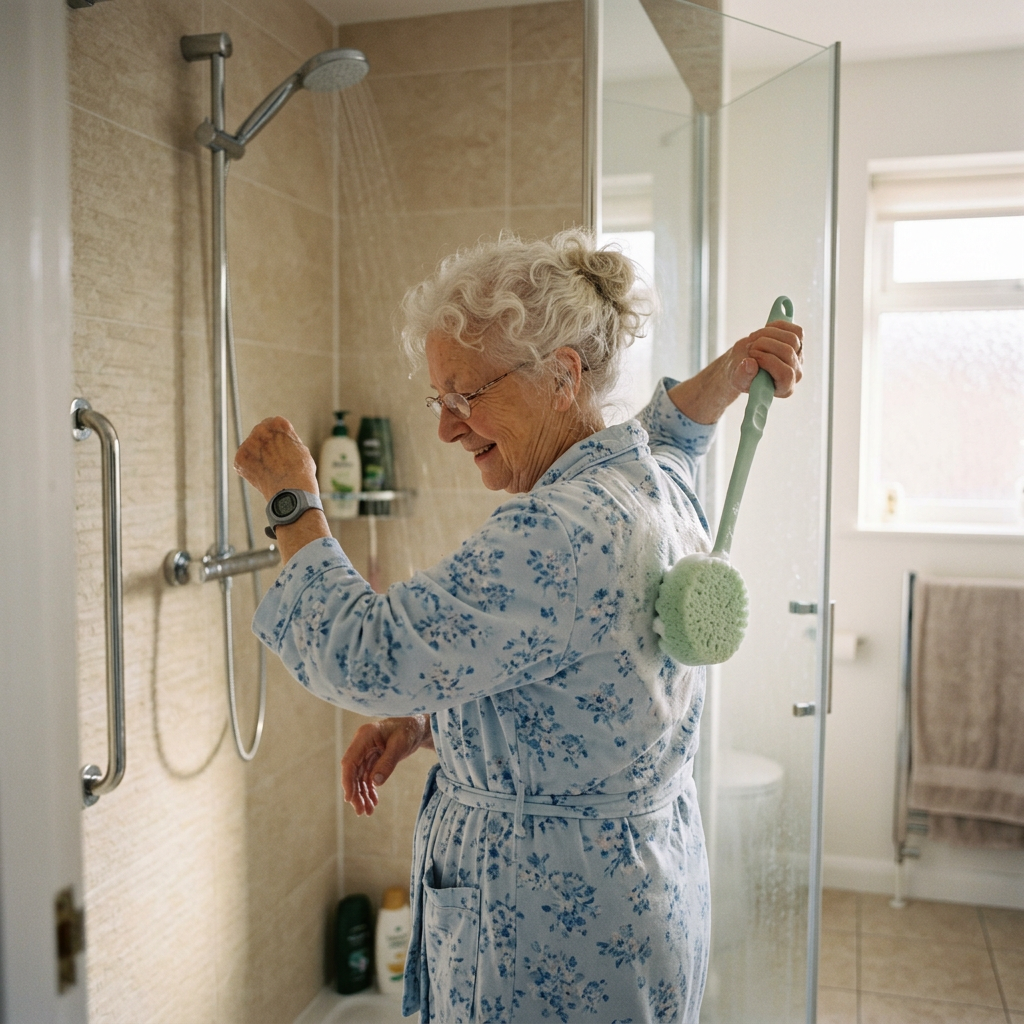
    Losing the ability to wash your own feet is a quiet milestone that rarely gets discussed, but it’s a common reason older adults start skipping full washes and skipped washing leads to skin breakdown and fungal infections between the toes. A long-handled bath sponge for elderly use is one of the cheapest, highest-impact aging-in-place buys there is: usually under $15, no installation, and it restores independent bathing for years. The trick is matching the type of sponge to the actual reason your parent can’t reach.

    At a glance

    Best Overall  Vive 17″ Shower Loofah — ~$14 · non-slip grip, wrist cord, spare loofah included

    Best for Fragile Skin  MaxiAids 22″ Contoured Sponge — ~$12 · soft foam, gentle on thin skin

    Most Adjustable  Helping Hand 26″ Bendable Sponge — ~$15 · handle bends to any angle

    Best for Hygiene  Fanwer 27.5″ Silicone Scrubber — ~$13 · mildew-resistant, longest reach

    Best for Lotion  MainBasics Back Lotion Applicator — ~$11 · self-applies cream & medicine

    Best Overall Vive 17″ Shower Loofah with Long Handle

    ~$14 · Check price on Amazon →

    Vive is the brand occupational therapists cite most often when a family needs an adaptive bathing aid that doesn’t feel medical, and this loofah-on-a-stick is why. The lotus-wood handle runs 17 inches long enough to reach the mid-back and feet without bending and it’s wrapped in a textured rubber sleeve that stays grippable when soapy, the single detail that separates a usable aid from one that gets dropped. Across more than 1,200 verified reviews, the recurring praise is the wrist cord: buyers with weak grip say it’s the reason the sponge doesn’t hit the tub floor mid-wash. The set includes a spare handheld loofah and a wall hook so it dries between uses.

    The good

    • Non-slip rubber sleeve grips reliably even with soap and weak hands
    • Wrist cord prevents the drops that frustrate low-grip users
    • Comes with a spare loofah and hook so it dries properly between washes

    The catch

    • The handle is a fixed curve, it won’t re-angle for an unusual reach
    • Loofah material needs replacing every few months to stay hygienic

    This is right if… your parent has generally lost reach and just needs a dependable, grippable everyday sponge.

    Look elsewhere if… they need to bend the handle to a specific angle, or have very fragile skin that a loofah texture would irritate.

    Check Price on Amazon →

    Best for Fragile Skin MaxiAids 22″ Contoured Bath Sponge

    ~$12 · Check price on Amazon →

    Older skin thins with age, and a coarse loofah or stiff bristle brush can leave bruise-like marks or tears on someone on blood thinners. That’s where this MaxiAids pick earns its place, a soft, contoured foam sponge on a 22-inch handle, designed to clean without abrading. MaxiAids has sold adaptive daily-living aids for decades, and reviewers who bought it for a parent with paper-thin skin or after chemotherapy note it’s gentle enough for daily use where an exfoliating loofah was not. The contour holds body wash well, so a caregiver doesn’t re-soap constantly. For the fragile-skin population it’s the safest sponge on this list.

    The good

    • Soft foam is gentle on thin, bruise-prone, or post-treatment skin
    • Contoured shape holds lather so you re-soap less often
    • Established adaptive-aids brand with reliable construction

    The catch

    • No exfoliation, not for anyone who wants a scrubbing texture
    • Foam sponges wear out and should be replaced on a schedule

    This is right if… your parent has thin, fragile, or easily bruised skin, or is on blood thinners.

    Look elsewhere if… they want a firmer exfoliating scrub or a longer reach than 22 inches.

    Check Price on Amazon →

    Most Adjustable Helping Hand 26″ Bendable Exfoliating Sponge

    ~$15 · Check price on Amazon →

    Helping Hand is a British occupational-therapy brand, and this 26-inch bendable sponge solves the problem a fixed-curve handle can’t: a reach that has to be personalized. The internal wire lets you shape the handle to whatever angle a specific shoulder or spine limitation demands, and you re-set it by warming the handle under hot water, bending, then cooling it. At 26 inches it’s the longest sponge here, which matters for taller users or anyone who can’t rotate the shoulder at all. Verified buyers with frozen shoulder and post-stroke limitations single out the adjustability as the feature that finally let them wash their own back. The exfoliating texture is firmer than the MaxiAids a scrub, not a gentle wipe.

    The good

    • Handle bends and re-sets to any angle a specific limitation needs
    • 26″ reach, the longest on this list, good for taller seniors
    • Occupational-therapy brand pedigree, praised in frozen-shoulder reviews

    The catch

    • Exfoliating texture is too firm for very fragile skin
    • Bendable handles can loosen over time and need re-setting

    This is right if… a standard fixed curve won’t reach the spot, or your parent is tall or has a fixed-shoulder limitation.

    Look elsewhere if… they have delicate skin or want the simplest possible grab-and-go sponge.

    Check Price on Amazon →

    Best for Hygiene Fanwer 27.5″ Silicone Body Scrubber

    ~$13 · Check price on Amazon →

    Here’s the detail almost every long-handled-sponge roundup skips: natural loofahs and foam trap water and grow mildew and bacteria, a genuine concern for immune-compromised or diabetic seniors. This Fanwer scrubber answers that with a food-grade silicone head on a rigid U-shaped 27.5-inch handle — silicone dries fast, resists mildew, and rinses clean, so it doesn’t harbor the film a loofah does. The stiff curved handle also gives the most controlled, leverage-friendly reach on the list for someone with real strength loss. Reviewers buying for post-surgery and limited-mobility use praise how easy it is to sanitize, and the texture sits between the soft MaxiAids and the firm Helping Hand.

    The good

    • Silicone resists mildew and rinses clean, most hygienic material here
    • Rigid U-curve gives strong, controlled leverage for weak arms
    • Longest fixed-handle reach at 27.5 inches

    The catch

    • Silicone doesn’t lather as richly as a loofah or foam sponge
    • The rigid handle can’t be re-angled like a bendable one

    This is right if… hygiene is a priority (diabetes, compromised immunity) or you want the sturdiest long reach.

    Look elsewhere if… your parent prefers a soft, sudsy sponge feel over a firm silicone scrub.

    Check Price on Amazon →

    Best for Lotion MainBasics Back Lotion Applicator

    ~$11 · Check price on Amazon →

    This one isn’t a sponge, it’s the tool families forget they also need. Once your parent can’t reach their back to wash it, they also can’t reach it to apply moisturizer or a prescribed topical, and dry, cracked senior skin left untreated leads to itching and breakdown. The MainBasics applicator puts a washable pad on a 16-inch handle so lotion, medicated cream, or sunscreen goes exactly where hands can’t reach. It’s an Amazon best-seller in daily-living lotion aids, and reviewers caring for a parent with a back eczema prescription call it the difference between the medicine getting used and getting skipped. Buy it alongside whichever sponge you choose.

    The good

    • Applies lotion, medicated cream, or sunscreen to the unreachable back
    • Washable pad; best-seller in the lotion-aid category
    • Cheapest pick here and pairs with any sponge above

    The catch

    • 16″ handle is shorter reach is adequate, not the longest
    • It’s a lotion tool, not a washing sponge, you need both

    This is right if… your parent has dry skin or a prescribed back/leg cream they can’t apply themselves.

    Look elsewhere if… you only need a washing sponge and skin care isn’t a factor.

    Check Price on Amazon →

    Quick comparison

    Product Reach Material Best for Price
    Vive Loofah 17″ fixed curve Loofah Everyday reliability ~$14
    MaxiAids Contoured 22″ straight Soft foam Fragile skin ~$12
    Helping Hand Bendable 26″ bendable Exfoliating Custom angle ~$15
    Fanwer Silicone 27.5″ rigid curve Silicone Hygiene ~$13
    MainBasics Applicator 16″ curved Washable pad Lotion & cream ~$11

    The conversation you’ll have

    Here’s the part that trips families up: a long-handled sponge is a visible admission that a parent can’t do something they’ve done unaided for eighty years, and plenty of older adults will wave it off rather than accept it. The resistance usually isn’t about the sponge, it’s about what the sponge represents.

    Don’t frame it as a mobility aid. Try saying “I found this thing that saves your shoulder you don’t have to twist to get your back anymore,” rather than “this will help you since you can’t reach.” The first is about protecting a sore joint; the second is about decline. Leave it hanging in the shower without ceremony, mention that lots of people use them, and let your parent try it privately. Most people who resist the idea quietly keep using it once no one’s watching because reaching your own feet again feels like getting a piece of yourself back.

    Insurance and savings

    Set expectations low here: Medicare generally does not cover long-handled bath sponges. They’re classified as personal-care convenience items rather than durable medical equipment, so Part B won’t reimburse them. The realistic savings path is a tax-advantaged health account many FSA and HSA administrators treat adaptive bathing aids as eligible when bought for a specific medical need like post-surgical limited reach or arthritis, sometimes with a Letter of Medical Necessity from a doctor or occupational therapist. Under IRS Publication 502, adaptive equipment required because of a medical condition can also count toward the medical-expense deduction, though only the portion of medical costs above 7.5% of adjusted gross income is deductible. At $11–$15 most families simply buy them outright, but if your parent has an FSA or HSA, submit the receipt.

    What to actually look for

    Handle shape beats handle length

    A 24-inch straight handle sounds long, but a straight handle can’t wrap to the center of the back — the geometry doesn’t work. A curved or bendable handle at even 17 inches reaches more usable area. Prioritize curve first, length second. If your parent has a fixed-shoulder limitation, a bendable handle you can set to their exact angle is worth the extra couple of dollars. For a broader plan on making the whole bathroom work, our complete aging-in-place home safety checklist lays out the priority order.

    Grip and drop protection

    The most common reason these sponges fail in real bathrooms is a slippery handle that gets dropped by weak, soapy hands and bending to retrieve a dropped sponge in a wet tub is exactly the fall risk you’re trying to avoid. Look for a textured rubber sleeve and, ideally, a wrist loop. If reaching down is already unsafe, pair the sponge with seated bathing; our guide to shower chairs for the elderly that don’t tip covers picks that make washing seated feasible.

    Material vs. skin and hygiene

    Match the head to the skin. Thin, bruise-prone skin needs soft foam; anyone who wants exfoliation can handle a loofah or firm sponge; and if mildew is a concern, silicone is the most sanitary because it dries fast and doesn’t hold moisture. Whatever the material, replace loofahs and foam every few months they harbor bacteria over time. Because reaching is only half the safety picture, it’s worth pairing bathing aids with grab bars that don’t look like a hospital so standing transfers stay stable too.

    Frequently asked questions

    How do elderly people wash hard-to-reach areas like their back and feet?

    A long-handled bath sponge, loofah, or brush lets an older adult wash their back, lower legs, and feet without bending or twisting. The handle extends reach 16 to 27 inches, and curved or bendable versions wrap to the middle of the back where a straight handle can’t reach.

    How do you use a long-handled bath sponge?

    Wet the sponge fully, add body wash, then use slow circular strokes to reach the back, legs, and feet while seated or standing. Rinse the sponge afterward and hang it to dry. For bendable handles, warm under hot water, bend to your angle, then set it under cold water.

    How often should you replace a bath sponge or loofah?

    Replace natural loofahs and foam sponges every three to four weeks if used daily, since they trap moisture and grow bacteria and mildew. Silicone heads last far longer and can simply be rinsed and sanitized, making them the lower-maintenance choice for seniors with hygiene or infection concerns.

    Are loofahs or sponges more hygienic for seniors?

    Silicone scrubbers are the most hygienic because they dry quickly and don’t harbor bacteria. Natural loofahs are the least hygienic if not dried and replaced regularly. Foam sponges fall in between. For diabetic or immune-compromised seniors, a fast-drying silicone head is the safer default.

    Can a long-handled sponge help caregivers with bathing?

    Yes. A caregiver bathing someone else can use the long handle to reach without leaning far over a tub, which reduces their own back strain and the risk of losing balance. It also lets the care recipient keep doing part of the wash themselves, preserving dignity and independence.

    What handle length is best for reaching your feet and back?

    For most adults, a curved or bendable handle of 17 to 22 inches reaches both feet and back comfortably. Taller users or those who cannot rotate the shoulder at all benefit from a 26- to 27-inch handle. Handle curve matters more than raw length for reaching the mid-back.

    The shortlist

    Best Overall

    Vive 17″ Shower Loofah

    ~$14

    Check on Amazon →

    Fragile Skin

    MaxiAids 22″ Contoured

    ~$12

    Check on Amazon →

    Most Adjustable

    Helping Hand 26″ Bendable

    ~$15

    Check on Amazon →

    Best Hygiene

    Fanwer 27.5″ Silicone

    ~$13

    Check on Amazon →

    Best for Lotion

    MainBasics Applicator

    ~$11

    Check on Amazon →

    Last verified in stock: July 11, 2026

    What we’d do tomorrow

    If you’re sorting this out this weekend, do three things in order. First, buy the Vive loofah — it’s the safe default for the widest range of situations and it’ll ship before the weekend’s out. Second, if your parent has thin or fragile skin, swap in the MaxiAids soft foam sponge instead. Third, add the MainBasics lotion applicator for about $11 — the same reach limit that stops the wash also stops the moisturizing. Total spend is under $30, and it quietly hands your parent back one of the small daily independences that matter most.

    — Sarah

    BuyingForMom is a reader-supported site. As an Amazon Associate we earn from qualifying purchases. When you buy through links on this site, we may earn an affiliate commission at no additional cost to you. See our Affiliate Disclosure for details. This article is not medical advice — please consult a qualified healthcare professional for decisions specific to your family.
  • 5 Best Tub Transfer Benches for Seniors

    5 Best Tub Transfer Benches for Seniors

    Disclosure: BuyingForMom is reader-supported. As an Amazon Associate we earn from qualifying purchases. When you buy through links in this article, we may earn an affiliate commission at no additional cost to you. We never recommend products we haven’t researched against verified-buyer review data. This article is editorial reporting, not medical advice.

    5 Best Tub Transfer Benches for Seniors (2026)

    By Sarah Mitchell · Editor, BuyingForMom · Updated July 2026

    10-min read · Shower & Bath · 5 picks compared

    The honest take: For most bathtub situations, buy the Drive Medical Classic Tub Transfer Bench and stop there it is stable, height-adjustable, and cheap enough that hesitation makes no sense. Step up to the Drive Medical Sliding Transfer Bench only if the person genuinely cannot bear weight on one leg (post-hip-fracture, dense stroke), because the sliding seat removes the scoot that static benches still demand. Skip any bench without adjustable legs and a reversible backrest, the wrong seat height or a backrest on the wrong side turns a safety device into a new fall risk.

    How we sorted through 40+ transfer benches in two weeks. We cross-referenced more than 12,000 verified Amazon reviews, the current Amazon Best Sellers list for bath transfer seating, and occupational-therapist guidance from rehab-supply publishers, then narrowed 40-plus listings to the five below. We weighted three things heavily: real adjustable seat height (not just “adjustable” on the box), weight capacity a caregiver can trust, and how each bench behaves with a shower curtain and a wet floor the failure point verified buyers complain about most.

    Who this guide is for

    This guide is for adult children (and spouses) buying a tub transfer bench for someone who can no longer step safely over a bathtub wall. This is typically after a hip fracture, a stroke, a knee or foot surgery, or a slow decline in balance. If the person can already get in and out of the tub but just needs to sit while washing, a shower chair is the cheaper, smaller answer, and our guide to shower chairs that don’t tip is the better place to start.

    A tub transfer bench solves one dangerous moment: the swing of the legs over the tub edge. Standard tub walls are 14 to 16 inches high, and stepping over one on a wet floor is the single most cited cause of bathroom falls among older adults. Instead of stepping over, the bather sits on the outer half of the bench, two legs outside the tub, two inside, then slides across and lifts the legs over in one supported motion.

    The category looks interchangeable: five white plastic benches that seem identical. They aren’t. The differences that matter are the ones photos hide whether the seat height reaches the person’s knees, whether the backrest moves to the correct side for their bathroom, and whether the design keeps water in the tub instead of on the floor you’re trying to keep dry.

    At a glance

    Best Overall  Drive Medical Classic Tub Transfer Bench — ~$45 · adjustable, reversible backrest, 350 lb

    Best Budget  Carex Universal Tub Transfer Bench — ~$45 · 400 lb, built-in backrest handles

    Best Padded  Medline Padded Transfer Bench — ~$75 · cushioned seat, side arm, 400 lb

    Best Wet-Floor Seal  Drive Medical Splash Defense — ~$70 · U-shaped curtain guard, 400 lb

    Best Non-Weight-Bearing  Drive Medical Sliding Transfer Bench — ~$130 · sliding seat + seatbelt

    Best Overall Drive Medical Classic Tub Transfer Bench

    ~$45 · Check price on Amazon →

    This is the bench most occupational therapists reach for first, and across roughly 8,000 verified reviews it earns its 4.7-star average on three unglamorous strengths: the aluminum frame doesn’t flex, the legs adjust in half-inch increments from 17.5 to 22.5 inches, and the backrest reverses for left- or right-hand tub entry. The seat has a U-shaped drainage cutout that keeps a shower liner inside the tub, and the whole thing assembles without tools in about ten minutes. Verified buyers who mention hip and knee surgery consistently note it felt “solid, not wobbly” from the first use, the phrase that shows up over and over. Rated to 350 pounds.

    The good

    • Rock-solid aluminum frame that reviewers repeatedly describe as wobble-free
    • Half-inch height adjustment actually reaches short and tall users alike
    • Reversible backrest works in either tub orientation

    The catch

    • No side arm, so someone needing a push-off handle should look at the padded Medline instead
    • Firm plastic seat is fine for short showers, less so for long soaks

    This is right if… you want the safe, boring default that fits almost any standard tub.

    Look elsewhere if… the bather can’t push up to their feet without an armrest to grip.

    Best Budget Carex Universal Tub Transfer Bench

    ~$45 · Check price on Amazon →

    Carex has made bath-safety equipment for decades, and this universal bench is the value pick that doesn’t cut the wrong corners. It carries a higher 400-pound capacity than the Drive classic, the backrest reverses for either entry side, and the detail that sets it apart — the backrest has two built-in hand grips molded into it, giving the bather something to hold during the slide across. Reviewers repeatedly call it “lightweight but sturdy,” which is the balance that matters when a caregiver has to move it to clean. The trade-off shows up in assembly: a minority of verified buyers report the leg-height pins take a firm push to seat fully, so it’s worth checking each pin clicks before first use.

    The good

    • 400 lb capacity at a budget price
    • Built-in backrest handles give a grip point mid-transfer
    • Light enough for a caregiver to reposition one-handed

    The catch

    • Leg pins can require a firm push to lock, verify before use
    • Narrower seat than the padded or splash-guard models

    This is right if… you want maximum weight rating for the lowest reliable price.

    Look elsewhere if… you want a cushioned seat or a curtain guard for a splash-prone bathroom.

    Best Padded Medline Padded Transfer Bench

    ~$75 · Check price on Amazon →

    Bony hips and fragile skin change the math on a bare plastic seat, and this Medline is the answer when comfort isn’t optional. It pairs a cushioned, water-resistant padded seat with a side arm and backrest, holds 400 pounds, and adjusts for height with slip-resistant legs. Verified buyers caring for very thin or post-surgical parents call the padding “the difference between five minutes and twenty” in the shower — skin tolerance, not preference. The side arm doubles as a push-off point, which the Drive classic lacks. The honest downside: the cushion needs drying between uses or it can hold moisture.

    The good

    • Genuine cushioned seat for fragile or bony skin
    • Side arm doubles as a push-off handle
    • 400 lb capacity with slip-resistant legs

    The catch

    • Padding must be dried between uses or it can trap moisture
    • Costs more than the two bare-seat picks

    This is right if… the bather is thin, post-surgical, or spends real time seated in the shower.

    Look elsewhere if… you want the lowest-maintenance seat you can hose off and forget.

    Best Wet-Floor Seal Drive Medical Splash Defense Tub Transfer Bench

    ~$70 · Check price on Amazon →

    Every transfer bench creates the same problem: the seat spans the tub wall, so the shower curtain can’t fully close, and water finds the gap. The Splash Defense is Drive Medical’s fix a U-shaped curtain guard built into the outer seat lets the curtain tuck inside the guard instead of draping over the bench, so far less water reaches the floor. It keeps the 400-pound capacity, reversible design, and adjustable legs of a full-featured bench. Verified buyers in older homes with no walk-in shower repeatedly cite the dry-floor difference as the reason they kept it over a cheaper bench they returned. If your bathroom floods a little every bath, this is the one that earns its premium.

    The good

    • Built-in curtain guard genuinely reduces water on the floor
    • 400 lb capacity, reversible for either entry side
    • Solves the single biggest complaint about transfer benches

    The catch

    • Bulkier footprint than a plain bench
    • Costs more than the standard Drive classic

    This is right if… your tub-shower floods the floor and you’re tired of towels.

    Look elsewhere if… you have a roomy tub-shower where curtain gap isn’t an issue.

    Best Non-Weight-Bearing Drive Medical Sliding Transfer Bench

    ~$130 · Check price on Amazon →

    Static benches still ask the bather to scoot across a dry plastic seat, friction that’s fine for most people and impossible for someone who can’t bear weight on a leg. This Drive Medical model solves it with a seat that physically slides on the frame’s rails and locks in place, plus armrests and a seatbelt. The user (or caregiver) slides the whole seat across the tub wall instead of dragging the body over it. Rehab clinicians frequently recommend a sliding bench for post-hip-fracture and dense-stroke situations for this reason. It’s the priciest and heaviest pick, rated to 300 pounds but for a non-weight-bearing transfer, nothing else here is safe by comparison.

    The good

    • Sliding locking seat removes the scoot entirely
    • Seatbelt and armrests add control for weak or one-sided users
    • The clinician default for non-weight-bearing transfers

    The catch

    • Heaviest and most expensive pick here
    • Lower 300 lb capacity than the mid-priced benches

    This is right if… the person truly cannot bear weight on one leg during the transfer.

    Look elsewhere if… they can safely scoot across a static seat — you’ll save money and space.

    How the five compare

    Bench Price Capacity Best for
    Drive Medical Classic ~$45 350 lb The safe default
    Carex Universal ~$45 400 lb Budget + high capacity
    Medline Padded ~$75 400 lb Fragile skin, comfort
    Drive Splash Defense ~$70 400 lb Wet-floor bathrooms
    Drive Sliding Bench ~$130 300 lb Non-weight-bearing

    The conversation you’ll have

    Most older adults don’t refuse a transfer bench because they doubt it works — they refuse because it announces something. A medical-looking bench in the bathroom says “I’m declining,” and that’s the resistance you’re actually negotiating. The move that works is to frame it as protecting independence, not conceding it. Try saying “This is what keeps you bathing on your own instead of needing someone in the room” rather than “This is so you don’t fall.” The first sentence offers control; the second takes it away.

    It also helps to make it reversible in the telling, especially after surgery: “Let’s use it while the hip heals — if you don’t need it later, it goes in the closet.” Framed that way, a bench is a tool, not a verdict. And let them choose the model if you can — handing someone the decision between the padded seat and the plain one restores the exact agency the conversation is about.

    Insurance and savings

    Original Medicare (Part B) generally does not cover tub transfer benches. Medicare classifies durable medical equipment as items needed for use in the home broadly, but bath-safety seating is treated as a personal-convenience or comfort item, so it falls outside standard DME coverage — the same reasoning that excludes grab bars and raised toilet seats. Some Medicare Advantage (Part C) plans now include an over-the-counter or home-safety supplemental allowance that can reimburse one, so it’s worth a call to the plan’s member line before you assume no.

    The reliable savings path is a pre-tax account. Tub transfer benches are generally FSA- and HSA-eligible with a Letter of Medical Necessity from a physician, under the medical-expense rules in IRS Publication 502 and Publication 969. If total unreimbursed medical expenses exceed 7.5% of adjusted gross income, the cost may also count toward the itemized medical deduction under IRC §213(d). Ask the prescribing doctor or discharge planner for the letter while you still have them on the phone — it’s a two-minute request that unlocks both benefits.

    What to actually look for

    Real, tool-free height adjustment

    The seat has to reach roughly knee height so the bather sits down rather than drops down. Look for legs that adjust independently — bathtubs sit lower than the bathroom floor, so the inside legs almost always need to run longer than the outside pair to keep the seat level. A bench that only adjusts as a set can’t level itself over a tub wall. All five picks here adjust each leg separately. For the full priority order of bathroom changes, see our complete aging-in-place home safety checklist.

    Weight capacity and a stable frame

    Buy well above the bather’s actual weight — ratings assume a still, centered load, and a real transfer is neither. Aluminum frames resist rust better than steel in a wet room, and slip-resistant feet matter more than the spec sheet suggests. If balance is the deeper issue, our shower chairs that don’t tip guide covers what sits alongside a bench inside the tub.

    A reversible backrest and a water plan

    The backrest must sit on the tub side so the bather leans away from the edge, which means it has to reverse for your specific bathroom — a fixed backrest on the wrong side is useless. And every transfer bench breaks the shower-curtain seal, so decide up front whether you’ll manage that with a curtain-guard model like the Splash Defense, a second inside-the-tub curtain, or a towel line on the floor. Planning for the water beats mopping it nightly.

    Frequently asked questions

    What’s the difference between a tub transfer bench and a shower chair?

    A transfer bench straddles the tub wall — two legs outside, two inside — so the bather sits and slides across instead of stepping over. A shower chair sits entirely inside the tub or shower and is for someone who can already get in but needs to sit while washing.

    How do you use a tub transfer bench safely?

    Sit on the outer half of the bench with both feet flat on the bathroom floor, slide across the seat toward the tub, then lift one leg at a time over the wall using your hands or a caregiver’s support. Never step over the wall while standing — that defeats the purpose.

    Does Medicare cover a tub transfer bench?

    Original Medicare generally does not, treating it as a comfort item rather than durable medical equipment. Some Medicare Advantage plans reimburse one through a home-safety or OTC benefit, and FSA/HSA funds usually cover it with a doctor’s Letter of Medical Necessity.

    How do you keep water off the floor with a transfer bench?

    Because the seat spans the tub wall, the curtain can’t fully close. Use a bench with a built-in curtain guard like the Splash Defense, add a second curtain that tucks inside the tub, or run a rolled towel along the seam. A U-shaped seat cutout also drains water back into the tub.

    What weight capacity do I need?

    Choose a bench rated comfortably above the bather’s weight — most seniors are well served by a 300 lb model, but 400 lb picks like the Carex and Medline add margin for heavier users and for the shifting load of a real transfer. Confirm the number on the current listing before buying.

    Will a transfer bench fit my bathtub?

    Most standard benches fit standard tubs, but measure your tub’s inside width and the floor space outside it before ordering. The bench needs two legs planted firmly on the bathroom floor with room for the bather to sit before sliding, so a very narrow bathroom may need a compact model.

    The shortlist

    Best Overall

    Drive Medical Classic

    ~$45

    Check on Amazon →

    Best Budget

    Carex Universal

    ~$45

    Check on Amazon →

    Best Padded

    Medline Padded

    ~$75

    Check on Amazon →

    Best Wet-Floor

    Drive Splash Defense

    ~$70

    Check on Amazon →

    Non-Weight-Bearing

    Drive Sliding Bench

    ~$130

    Check on Amazon →

    Last verified in stock: July 8, 2026

    What we’d do tomorrow

    If you’re setting this up this weekend, do three things in order. First, measure the tub’s inside width and the floor space just outside it — that one measurement decides whether any bench fits before you spend a dollar. Second, unless the bather truly can’t bear weight on a leg, buy the Drive Medical Classic; it’s the safe default and it’s cheap enough that waiting makes no sense. Third, while you have the doctor or discharge planner on the phone, ask for a Letter of Medical Necessity so an FSA or HSA can cover it. Then adjust the inside legs longer than the outside pair, confirm the seat sits level and doesn’t rock, and put the backrest on the tub side. That’s a safe bath by tonight.

    — Sarah

    BuyingForMom is a reader-supported site. As an Amazon Associate we earn from qualifying purchases. When you buy through links on this site, we may earn an affiliate commission at no additional cost to you. See our Affiliate Disclosure for details. This article is not medical advice — please consult a qualified healthcare professional for decisions specific to your family.
  • 5 Best One-Handed Tools for Post-Stroke Recovery

    5 Best One-Handed Tools for Post-Stroke Recovery

    Affiliate disclosure: As an Amazon Associate we earn from qualifying purchases. Links below go to Amazon at no extra cost to you. Products were selected based on OT-aligned criteria, not commission rate.

    5 Best One-Handed Tools for Post-Stroke Recovery

    By Sarah Mitchell · Updated June 21, 2026 · 5 products reviewed

    After a stroke, one of the most disorienting realizations is how many ordinary tasks assume two functioning hands. Opening a jar, buttoning a shirt, lifting a plate, none of these feel difficult until hemiplegia or significant arm weakness makes each one a negotiation. Occupational therapists spend much of early stroke rehabilitation addressing exactly this: not just exercises to restore function, but adaptive tools that restore independence while that function is still returning.

    The adaptive equipment market is enormous, which makes it genuinely hard to navigate. Most roundup lists online contain twenty or more items with no clear rationale for which to buy first or why. This guide takes a different approach: five tools, each mapped to a specific daily task post-stroke survivors commonly struggle with, each verified in stock on Amazon as of June 2026.

    At a glance

    • Best kitchen prep: Fanwer Adaptive One-Handed Cutting Board (~$32, B0D7L792P4)
    • Best reaching aid: DMI 32″ Reacher Grabber Tool (~$18, B0009STNME)
    • Best dressing aid: Sock Aid + Button Hook + Dressing Stick Kit (~$22, B0FFZYLP75)
    • Best grip stabilizer: Dycem Non-Slip Round Mat 7.5″ (~$12, B00BRCG5K4)
    • Best mealtime aid: Modaliv Scooper Bowl with Suction Base (~$22, B06XJXG3DJ)

    The honest take

    The most important thing to understand about one-handed adaptive tools is that they fall into two philosophies and mixing them up is the most common buying mistake families make.

    Compensatory tools let the person do the task right now, without waiting for recovery. A one-handed cutting board, a sock aid, a reacher: these do not require practice. They restore independence on day one home from the hospital.

    Remedial tools grip strengtheners, therapy putty, hand exercise devices, are designed to rebuild the affected hand. These are also valuable, but they serve a different purpose and are typically prescribed by an occupational therapist based on where someone is in their recovery arc.

    This guide covers compensatory tools only. If the person you are buying for has just returned home from a hospital or inpatient rehab stay, these are the tools that will make the most immediate difference. An OT evaluation will guide the remedial plan in parallel.

    How we sorted through the options

    We organized the search around the five daily tasks that stroke survivors most commonly report as immediately disruptive: kitchen meal prep, reaching for dropped or distant objects, dressing the lower body, stabilizing items during one-handed use, and eating independently. For each task, we screened Amazon’s catalog for products genuinely designed for one-handed operation — not “senior-friendly” tools that still require two hands for the critical step. We also excluded products with unavailable or discontinued flags, and focused on items with meaningful review counts confirming real-world usability over time.

    Pick 1: Best Kitchen Prep: Fanwer Adaptive One-Handed Cutting Board

    ~$32 · ASIN: B0D7L792P4

    Cutting food is one of the first kitchen tasks that stops working after a stroke, it is the exact action that requires the non-dominant hand to hold, stabilize, and brace while the dominant hand cuts. The Fanwer board replaces that second hand with engineering: stainless steel spikes impale food to hold it stationary, adjustable bread and food stops on two sides block rolling or sliding, and suction cups on the underside lock the board to the counter surface.

    The board is large enough for most slicing tasks, vegetables, fruit, bread and without needing to reposition mid-cut. The spikes fold flat for washing, and the board is dishwasher safe. At approximately $32, it is one of the more affordable pieces of post-stroke kitchen adaptive equipment, and it requires no instruction or practice to start: food goes on, the spike holds it, and you cut with one hand.

    One honest caveat: the spikes are designed for soft-to-medium density foods. Very hard root vegetables, raw sweet potato, dense beets, winter squash and may resist the spike enough that the board lifts rather than holding. For most everyday meal prep, this is not a limiting factor in practice.

    Check on Amazon →

    Pick 2: Best Reaching Aid: DMI 32″ Reacher Grabber Tool

    ~$18 · ASIN: B0009STNME

    The reacher and grabber is the Swiss Army knife of post-stroke adaptive tools. It extends reach by 32 inches enough to recover something dropped on the floor without bending or losing balance, pull a shirt off a hook, nudge a light switch, and assist with pulling on loose-fitting clothing. For someone with balance concerns, which commonly co-occur with stroke, avoiding bending and extended reaching is a genuine fall-prevention strategy, not just a convenience.

    The DMI model has been on the market long enough to accumulate thousands of verified reviews, which is meaningful in a category where newer entrants often sacrifice jaw durability. The magnetic tip picks up metal objects, medication lids, dropped pens, coins and the jaw has a full 180-degree range. The trigger handle is designed for single-handed operation without requiring a strong grip, which is relevant for someone whose unaffected hand is doing all the work while the affected side is still recovering.

    Worth knowing: this is a non-folding model, which makes it slightly less portable than collapsible versions but significantly more durable at the jaw-hinge joint. For home use, which is what early post-stroke recovery mostly involves and the non-folding design is the correct trade-off.

    Check on Amazon →

    Pick 3: Best Dressing Aid: Sock Aid + Button Hook + Dressing Stick Kit

    ~$22 · ASIN: B0FFZYLP75

    Getting dressed is one of the tasks that most affects stroke survivors’ sense of dignity and independence early in recovery. Lower-body dressing, pulling on socks, shoes, and pants, requires either deep bending or two-handed coordination, both of which may be unavailable immediately after a stroke. Upper-body dressing involves buttons, zippers, and fasteners designed with two hands in mind.

    This kit addresses both categories in one package. A rigid sock aid with foam handles eliminates the need to bend or reach the foot, the sock loads onto the cradle, the cradle is lowered by the handles, and the foot slides in. A dressing stick assists with pulling clothing over the affected shoulder and pushing it over the hips without reaching across the body. A combined button hook and zipper pull handles standard-size shirt buttons with a single pull-through motion rather than requiring fine pinch grip.

    Of all five tools in this guide, the dressing kit has the steepest learning curve. There is a small technique component, especially with the sock aid and in getting the approach right initially. Most occupational therapists will teach the correct method during inpatient or outpatient rehab. If a home health OT visit is available post-discharge, asking them to demonstrate the dressing stick and sock aid technique makes a significant difference in early success.

    Check on Amazon →

    Pick 4: Best Grip Stabilizer: Dycem Non-Slip Round Mat 7.5″

    ~$12 · ASIN: B00BRCG5K4

    Dycem is not a gadget, it is a material. The circular mat is made from a proprietary polymer that creates extremely high friction with smooth surfaces without being sticky in the conventional sense. Place it under a bowl, plate, cutting board, phone, water bottle, or medication bottle, and the object stays precisely where you set it when you apply one-handed lateral force. Remove the mat and nothing leaves a residue on the surface below or the object above.

    Occupational therapists have recommended Dycem for one-handed use. For decades,  it is one of those products where the catalog is essentially unchanged because the underlying function is genuinely excellent. The 7.5″ round size handles most bowls and plates. The material is machine washable, regains its grip after washing, and does not deteriorate quickly with normal daily use.

    At twelve dollars, the Dycem mat delivers the highest independence-per-dollar of anything in this guide. Many families order a second one to keep in another room. The use case extends well beyond mealtimes: under a book that slides, under a laptop that shifts, under a water glass on a nightstand one-handed life reveals how many objects we normally stabilize passively with the other hand without registering the effort. The Dycem mat quietly handles all of those situations.

    Check on Amazon →

    Pick 5 : Best Mealtime Aid: Modaliv Scooper Bowl with Suction Base

    ~$22 · ASIN: B06XJXG3DJ

    Eating independently after a stroke involves two distinct challenges: keeping the bowl or plate from sliding while the person applies one-handed pressure, and being able to scoop food onto a utensil using one hand against the bowl’s interior edge without pushing food over the rim. Standard bowls are not designed for the second task, the curved wall works against a lateral scooping motion. The Modaliv scooper bowl addresses it with a straight interior wall section that gives the utensil a surface to scoop against effectively with one hand.

    The bowl includes an integrated silicone suction base that forms a vacuum seal on smooth, flat surfaces — so the Dycem mat may not even be necessary at mealtimes if the table or placemat surface is smooth. The bowl is 34 ounces, microwave safe, and dishwasher safe. The design is clean enough that it does not look clinical at the dinner table, which matters for the person’s comfort in social eating situations.

    Honest note on surface compatibility: the suction base requires a smooth, non-porous surface, glass, lacquered wood and solid stone countertops all work well. Textured placemats, rough wooden tables, or porous surfaces will break the seal. If the dining surface is textured, place a Dycem mat under the bowl rather than relying on the suction base alone; the two work well in combination.

    Check on Amazon →

    Quick comparison

    Tool Task it addresses Price ASIN
    Fanwer Cutting Board Kitchen prep / cutting food ~$32 B0D7L792P4
    DMI Reacher 32″ Reaching, dressing assist, drops ~$18 B0009STNME
    Dressing Aid Kit Socks, buttons, zippers ~$22 B0FFZYLP75
    Dycem Mat 7.5″ Stabilizing everything, everywhere ~$12 B00BRCG5K4
    Modaliv Scooper Bowl Independent eating / mealtime ~$22 B06XJXG3DJ

    Who this guide is for

    This guide is written for stroke survivors in the early-to-mid recovery phase — typically the first three to twelve months after a stroke, where one-sided weakness, hemiplegia, or significant reduction in fine motor control is still affecting daily life. It is also useful for the family members and caregivers who are setting up the home environment before or shortly after hospital discharge.

    If you are also setting up the broader home safety environment, the Master Home Safety Checklist covers fall prevention and room-by-room modifications that support post-stroke independence beyond the adaptive tools covered here. Because falls are a leading risk in early stroke recovery, you may also want to review the fall detection device guide many families put a fall alert system in place during the period when the stroke survivor is first moving around the home independently.

    The conversation you will have

    Introducing adaptive equipment to a stroke survivor requires some care. Many people experience their stroke as a sudden loss of identity — someone who managed their own home and routine now being offered tools designed for “disabled” use. The framing matters considerably.

    The most effective approach is to lead with the task, not the diagnosis. “The cutting board makes it easier to prep food with one hand” lands very differently than “this is for people who can not use both hands.” The goal is to reconnect the person with the activity they want to do and not to highlight the limitation preventing it.

    If there is resistance to trying adaptive tools, occupational therapists are often more persuasive than family members — they present these tools as standard components of the recovery process, which they are. Framing the Dycem mat or dressing stick as “what the OT recommended” rather than “what we thought you needed” often makes them significantly easier to accept. If formal OT has not begun yet, requesting an evaluation is one of the highest-leverage asks at the first follow-up appointment.

    What to look for in one-handed adaptive tools

    Single-handed operation at every step. The most common failure mode in adaptive products is that they require two hands for one step in the process — usually setup or cleanup. Before purchasing, trace through each step of using the tool and confirm the affected hand is genuinely not needed at any point.

    A stable base. Anything that tips, slides, or requires stabilization with the second hand undermines the entire purpose. Suction cups, Dycem, and weighted bases are the three reliable stabilization mechanisms. Friction feet alone are typically not sufficient for someone applying one-handed lateral force during actual use.

    Easy cleaning. A tool that requires two hands to disassemble or wash will not be used consistently. Dishwasher-safe products with smooth surfaces and minimal crevices are significantly more realistic for ongoing daily use than hand-wash-only designs with small interlocking parts.

    Recognition from OT practice. Products that occupational therapists commonly recommend carry a meaningful advantage: the technique has already been validated and the therapist can teach proper use. Dycem, dressing aids, reachers, and suction-base bowls appear in OT practice guidelines because they work reliably — not because they are new or technically impressive.

    Insurance and savings

    Medicare Parts A and B cover occupational therapy services — including the OT evaluation and treatment that guides adaptive equipment selection — but generally exclude the adaptive tools themselves. Reachers, dressing aids, non-slip mats, and adaptive bowls are classified as convenience items or daily living aids rather than durable medical equipment, and fall outside standard Medicare coverage. However, if durable adaptive equipment is specifically prescribed by a physician or OT as medically necessary, an FSA or HSA can typically be used to purchase it.

    FSA and HSA coverage for adaptive daily living aids generally requires a Letter of Medical Necessity from the treating physician or OT, documenting the stroke diagnosis and the functional limitation the equipment addresses. With an LMN, items like adaptive cutting boards and dressing aids fall under IRS Publication 502’s “equipment to help a person with a disability” category, which qualifies as a medical expense under Section 213(d).

    Medicare Advantage plans under the 2024 and 2025 supplemental benefits expansions may include home-safety or assistive-device allowances, depending on the specific plan. Many 2026 MA plans include an OTC or home-safety benefit that can cover adaptive equipment explicitly. Check the plan’s Summary of Benefits or call member services with the specific product name before purchasing.

    The total cost of all five tools in this guide is approximately $106 — under the annual OTC allowance of many Medicare Advantage plans, and clearly within the range where FSA or HSA reimbursement is worth documenting.

    The shortlist

    Best Kitchen Prep

    Fanwer One-Handed Cutting Board

    ~$32

    Check on Amazon →

    Best Reaching Aid

    DMI 32″ Reacher Grabber

    ~$18

    Check on Amazon →

    Best Dressing Aid

    Sock Aid + Button Hook Kit

    ~$22

    Check on Amazon →

    Best Grip Stabilizer

    Dycem Non-Slip Round Mat

    ~$12

    Check on Amazon →

    Best Mealtime Aid

    Modaliv Scooper Bowl

    ~$22

    Check on Amazon →

    Frequently asked questions

    What tools help stroke survivors with one-sided weakness?

    The most immediately useful tools for hemiplegia or one-sided weakness are: a reacher and grabber for extending reach without balance compromise, a one-handed cutting board for kitchen prep, a dressing aid kit for independent dressing, and a non-slip surface like Dycem for stabilizing objects during one-handed use. These compensatory tools restore independence for specific daily tasks while recovery continues in parallel with OT-guided rehab.

    Can someone recover hand function after a stroke?

    Many stroke survivors do regain significant hand and arm function, particularly with consistent occupational and physical therapy started early. Neuroplasticity — the brain’s ability to form new neural pathways around damaged tissue — underpins recovery, and the research on intensive early rehabilitation is encouraging. The adaptive compensatory tools in this guide are designed to support independence during recovery, not instead of it. An OT evaluation is the most important first step in building both the adaptive equipment plan and the recovery exercise program.

    When can stroke survivors start using adaptive tools at home?

    Adaptive equipment can typically be introduced as soon as the person arrives home from the hospital or rehabilitation facility. In many cases, the inpatient OT team will have already begun teaching the use of reachers, dressing aids, and similar tools during the hospital stay. Having them available at home — on the nightstand, in the kitchen, at the dining table — removes one barrier to independent activity on the first day back.

    Does Medicare cover adaptive equipment for stroke recovery?

    Standard Medicare Parts A and B cover occupational therapy services but generally exclude most daily living adaptive tools, which are classified as convenience items rather than durable medical equipment. FSA and HSA funds can typically cover these items with a Letter of Medical Necessity from the treating physician or OT. Medicare Advantage plans may include a home-safety or OTC supplement benefit that explicitly covers adaptive equipment — check the plan’s 2026 Summary of Benefits or call member services directly.

    Are the tools in this guide the same ones OTs recommend?

    The product categories covered here — reachers, dressing aids, Dycem mats, suction-base bowls, and one-handed cutting boards — are all standard OT-recommended tools for hemiplegia and post-stroke ADL support. The specific brands chosen represent currently available, in-stock Amazon options within each category as of June 2026. An OT may recommend a specific variant based on the individual’s hand function, grip strength, or cognitive status — this guide is a starting point and reference for families, not a substitute for a professional OT evaluation.

    What we’d do tomorrow

    If you are setting up for someone coming home from stroke rehabilitation, start with two purchases: the DMI reacher and the Dycem non-slip mat. Together they cost about $30, ship quickly, and address the two most immediately disruptive problems of one-handed life at home: things that are out of reach and things that will not stay still. Add the dressing kit before the first morning back.

    Once the person is settled and you have observed which specific tasks are the most frustrating, the cutting board and scooper bowl can follow based on priority. If tremor is also part of the picture — which sometimes co-occurs with stroke-related fine motor changes — the tools covered in the Parkinson’s tremor management guide overlap meaningfully with post-stroke fine motor challenges and are worth reviewing.


    As an Amazon Associate we earn from qualifying purchases. Prices and availability are accurate as of June 21, 2026 and subject to change. Recommendations reflect independent editorial judgment — not commission rate. Always consult a licensed occupational therapist for adaptive equipment guidance specific to the individual’s medical situation and functional status.

  • 5 Best Lift Chairs Under $1,000 for Seniors (2026)

    5 Best Lift Chairs Under $1,000 for Seniors (2026)

    Disclosure: BuyingForMom is reader-supported. As an Amazon Associate we earn from qualifying purchases. When you buy through links in this article, we may earn an affiliate commission at no additional cost to you. We never recommend products we haven’t researched against verified-buyer review data. This article is editorial reporting, not medical advice.

    5 Best Lift Chairs Under $1,000 for Seniors (2026)

    By Sarah Mitchell · Editor, BuyingForMom · Updated June 2026

    11-minute read · Lift Chairs · 5 picks compared

    The honest take: For most people, the single-motor MCombo 7287 is the chair to buy and stop,  it stands a parent up reliably without the heat-and-massage gimmicks that break first. Pay up for the dual-motor Irene House 9188 only if the chair will double as a bed for someone recovering from surgery, because that’s the one decision a single motor can’t solve. Skip any “infinite position” chair marketed below $350 at that price the motor is the corner that got cut.

    How we sorted through 40+ lift chairs in three weeks

    We cross-referenced more than 40 power lift recliners under $1,000 against 30,000+ verified Amazon reviews, the occupational-therapy guidance AARP publishes on sit-to-stand transfers, and the complaints caregivers post in Reddit’s r/AgingParents and r/eldercare. We cut anything with a pattern of first-year motor failures, anything we couldn’t confirm in stock, and anything whose real-world fit didn’t match its marketing. What survived are five chairs that each win a different job, not five versions of the same chair ranked by feature count. The thread through all of it: motor count and body fit matter far more than cup holders, USB ports, or massage modes.

    Who this guide is for

    This guide is for adult children buying a lift chair for a parent who struggles to stand from a regular recliner or sofa, whether that’s from arthritis, post-surgical recovery, Parkinson’s, or general deconditioning. The same picks apply if you’re shopping for yourself; just skip the “conversation” section near the end, which is written for the trickier situation of getting a resistant parent to accept one. If your parent needs help walking once standing, pair the chair with the mobility aids in our complete aging-in-place safety checklist.

    The five at a glance

    BEST OVERALL  MCombo 7287 · ~$500 · The reliable, no-frills stander for a typical 5’1″–5’9″ adult.

    BEST BUDGET  YITAHOME Power Lift Recliner · ~$380 · Heat and massage at the lowest honest price.

    BEST FOR PETITE  Esright Power Lift Recliner · ~$400 · Snug fit for shorter, smaller-framed parents.

    BEST FOR SLEEPING  Irene House 9188 · ~$799 · Dual motor, true lay-flat for recovery and overnight rest.

    BEST BIG & TALL  DYNOX 9505L · ~$900 · 500-lb frame, three motors, extended footrest for taller bodies.

    A power lift chair looks like an ordinary recliner, but a motor under the seat tilts the whole frame forward to bring a person almost to standing, then lowers them gently back down. That single function is why these chairs matter for aging in place: the moment a parent can’t stand from the couch is often the moment a home starts to feel unsafe. Choosing one under $1,000 comes down to matching three things to one person — how many motors it needs, how its dimensions fit their body, and what they’ll use it for. Get those right and a $500 chair outperforms a $1,500 one.

    BEST OVERALL MCombo 7287

    ~$500 · Check price on Amazon →

    The MCombo 7287 is the chair we’d buy for a typical parent, and the reason is what it leaves out. It’s a single-motor, three-position lift recliner, sit, recline, and full TV-recline — with no heat or massage hardware to fail. Across more than 3,600 reviews it holds a 4.5-star average, and the durability comments are the tell: buyers two and three years in still report a smooth, quiet lift, which is exactly where the cheaper imitators fall apart. The 4.7-inch extended footrest is sized for people roughly 5’1″ to 5’9″, the FSC-certified wood frame is rated to 330 pounds, and the counter-balanced motor brings the user high enough to stand without lurching. It assembles in about 15 minutes with no tools. For the core job,  getting someone up and down safely, for years, nothing under $1,000 does it more dependably.

    The good

    • Single-motor simplicity means fewer parts to break, the durability reviews bear this out
    • Smooth, quiet counter-balanced lift that brings the user near to standing
    • Extended footrest and 330-lb frame fit the majority of average-height seniors

    The catch

    • Three fixed positions only,  it won’t stop at any angle in between
    • No heat, no massage, no lay-flat for sleeping

    This is right if… your parent is average height and mainly needs a reliable, low-maintenance chair that stands them up.

    Look elsewhere if… they need to sleep in it, or they’re over 6 feet or 330 pounds.

    BEST BUDGET YITAHOME Power Lift Recliner

    ~$380 · Check price on Amazon →


    If the budget is firm and the wish list still includes heat and massage, the YITAHOME is the most honest pick at its price. It’s a three-position lift recliner with eight-point vibration and a lumbar heating pad, and across 650-plus reviews it averages 4.3 stars solid, with eyes open. Verified buyers consistently praise the comfort and the genuinely tool-free assembly, and several note it reclines far enough to doze. The recurring complaints are equally consistent and worth respecting: a minority report the arms or seat loosening over time, and the “massage” is vibration, not the rolling kind you’d get from a chair costing twice as much. We’re recommending it as the value play, not the forever chair, for a parent who wants warmth on an arthritic back without spending $700, it delivers more than its price suggests.

    The good

    • Heat and eight-point vibration at the lowest price in this slate
    • Comfortable, well-padded seat that earns repeat praise for daily lounging
    • Tool-free 15-minute assembly that caregivers can do alone

    The catch

    • A minority of reviewers report arm or seat hardware loosening over time
    • “Massage” is vibration only, not the kneading some buyers expect

    This is right if… you want heat and massage on a tight budget and accept it’s a value chair, not a 10-year one.

    Look elsewhere if… you want the most durable frame in this list, that’s the MCombo above.

    BEST FOR PETITEEONIX Dual Motor Recliner

    $500 · Check price on Amazon →

    Fit is the quietest reason a lift chair fails, and it’s why the Esright earns its spot. A chair that’s too deep leaves a shorter parent’s feet dangling and their back unsupported, which defeats the whole point. The Esright runs a snugger seat well-suited to roughly 5’1″–5’9″ and smaller frames, on a steel frame rated to 330 pounds. Its single TUV-certified motor reclines to any angle up to about 150 degrees infinite positioning rather than three fixed stops and it adds four-zone massage and lumbar heat. Reviewers across multiple retailers consistently call it easy to operate and quick to assemble. The honest limit: a single motor means the backrest and footrest move together, so it stops short of true flat. For a petite parent who wants a properly-sized chair with comfort extras, though, the fit advantage outweighs that.

    The good

    • Snugger seat that actually fits shorter, smaller-framed seniors
    • Infinite positioning up to ~150° stops anywhere, not just three spots
    • Four-zone massage plus lumbar heat at a mid-budget price

    The catch

    • Single motor ties the back and footrest together, no true lay-flat
    • The snug fit that helps petite users will feel tight on a larger person

    This is right if… your parent is on the shorter or smaller side and a standard-depth chair swallows them.

    Look elsewhere if… they’re tall or broad, the fit that helps here works against them.

    BEST FOR SLEEPING Irene House 9188

    $799 · Check price on Amazon →

    This is the one decision the cheaper chairs genuinely cannot solve. The Irene House 9188 uses dual OKIN motors, which means the backrest and footrest move independently and that’s what lets it go truly flat, to a full 180 degrees, instead of stopping at a reclined slouch. For a parent recovering from hip or back surgery who needs to sleep in the chair, or who can no longer get in and out of bed, that flat position is the entire reason to spend up. It’s an infinite-position chair with lumbar heat and back massage on a heavy-duty steel base, widely rated #1 in its class, and the removable backrest makes it possible to get it through a standard doorway. The honest trade-offs: it’s capped at 300 pounds, the chenille shows wear faster than leather, and it’s the priciest chair here. But for sleeping and recovery, it’s the only one on the list that fully delivers. Pair it with the rest of a recovery-ready home using our room-by-room aging-in-place modification guide.

    The good

    • Dual motors deliver a true 180° lay-flat, real sleeping, not just deep reclining
    • Independent back and footrest control for precise comfort positioning
    • Removable backrest clears standard doorways during delivery

    The catch

    • Weight limit is 300 lb lower than the big-and-tall pick below
    • Chenille upholstery wears faster than leather, and it’s the costliest here

    This is right if… the chair needs to double as a bed for recovery or overnight sleeping.

    Look elsewhere if… your parent never sleeps in the chair — you’d be paying for a motor you won’t use.

    BEST BIG & TALL DYNOX 9505L

    $900 · Check price on Amazon →

    Weight and height limits are where most sub-$1,000 lift chairs quietly exclude the people who need them most, and the DYNOX 9505L is built for that gap. Its reinforced frame is rated to 500 pounds well past the 300–330 lb ceiling on the rest of this slate and three independent motors drive the back, seat, and footrest to a 170-degree near-flat position. The extended footrest is sized for taller bodies so a 6-foot-plus parent isn’t left with calves hanging off the end, and it adds heat and vibration massage. The honest caveat: DYNOX is a newer, less-established brand than MCombo or Irene House, so its long-term track record is thinner. We still recommend it because honest 500-lb options under $1,000 are rare, and its build specs and current reviews check out. For a larger or taller parent, this is the pick that actually fits.

    The good

    • 500-lb reinforced frame, the only true big-and-tall option in this price range
    • Three motors for independent back, seat, and footrest control
    • Extended footrest genuinely sized for taller users

    The catch

    • Newer brand with a thinner long-term reliability record than MCombo or Irene House
    • Large footprint, measure the room before ordering

    This is right if… your parent is over 6 feet, over 330 pounds, or both.

    Look elsewhere if… they’re average-sized, you’d be buying capacity and a footprint you don’t need.

    How the five compare

    Chair Price Motors / Positions Weight limit Best for
    MCombo 7287 ~$500 1 motor / 3 position 330 lb Reliable everyday use
    YITAHOME ~$380 1 motor / 3 position 330 lb Budget + heat/massage
    Esright ~$400 1 motor / infinite to 150° 330 lb Petite / shorter frame
    Irene House 9188 ~$799 2 motors / lay-flat 180° 300 lb Sleeping / recovery
    DYNOX 9505L ~$900 3 motors / 170° flat 500 lb Big & tall

    The conversation you’ll have

    The hardest part of buying a lift chair usually isn’t the chair, it’s the parent who insists they don’t need one. To an older adult, a “lift chair” can sound like an announcement that they’re becoming helpless, and that resistance is real, not stubbornness. The move that works is to take the medical framing off the table entirely. Instead of “you need this so you don’t fall getting up,” try “I found a recliner that’s actually comfortable, and it happens to give you a little boost when you want it, want to try it for movie nights?” Lead with comfort and the TV, not with safety and decline.

    It also helps to make it about the room, not the person: a handsome recliner reads as furniture, while a chrome-and-vinyl medical chair reads as equipment, which is why we weighted fabric and chenille options that disappear into a living room. And let them run the remote on day one. The fastest path to acceptance is the moment they push the button themselves and feel the chair do the work their knees used to.

    Insurance and savings

    This is the category where coverage genuinely helps but only partway, and the detail trips up most families. Medicare Part B classifies the seat-lift mechanism as durable medical equipment (HCPCS code E0627) and will pay roughly 80% of the motorized lifting device after your deductible but it does not pay for the chair itself (CMS Policy Article A52518). In practice, Medicare reimburses the motor, and you pay for the recliner around it. To qualify, a doctor must prescribe it and document severe arthritis of the hip or knee, or a severe neuromuscular condition, plus an inability to stand from a regular chair. Buy the chair, keep the itemized receipt, and have the supplier bill the lift mechanism separately.

    Beyond Medicare: lift chairs are generally FSA/HSA-eligible with a Letter of Medical Necessity from the prescribing physician (IRS Publication 502; §213(d)), and the unreimbursed portion can count toward the medical-expense deduction if your total qualified expenses clear 7.5% of adjusted gross income. Some 2026 Medicare Advantage plans also fold home-safety equipment into supplemental benefits under the CMS-4204-F expansion worth a call to the plan before you buy.

    What to actually look for

    1. Count the motors before you count the features

    Motor count is the spec that actually changes what a chair can do. A single motor moves the back and footrest together, so the chair tops out at a deep recline, fine for sitting and standing, not for sleeping. Two motors move them independently and can lay flat for overnight rest or recovery. Three motors add a separate seat tilt for the heaviest users. Decide the job first: if no one will sleep in it, a single motor saves you $300 and gives you fewer parts to break.

    2. Fit the chair to the body, not the marketing

    A lift chair that’s too tall, too deep, or too narrow undoes its own purpose. Match the seat height to the user’s lower-leg length so their feet rest flat, and check the manufacturer’s stated height and weight range most “medium” chairs target 5’1″–5’9″ and 300–330 lb. Shorter parents need a shallower seat (the Esright); taller or heavier ones need the extended footrest and reinforced frame (the DYNOX). When in doubt, size to the person, not to the biggest chair you can afford.

    3. Plan for power, delivery, and the room

    Lift chairs plug into a standard outlet but need a battery backup (most include one) so a power cut doesn’t strand someone mid-lift. Measure the doorways, several here have removable backrests for exactly this reason and leave clearance behind the chair for the recline. A lift chair is one piece of a safer living room; see where it fits among the other priorities in our no-monthly-fee fall detection guide for the layers that work alongside it.

    Frequently asked questions

    Does Medicare pay for a lift chair?

    Partly. Medicare Part B covers the motorized lifting mechanism as durable medical equipment roughly 80% after your deductible but not the chair itself. You’ll need a doctor’s prescription documenting severe hip or knee arthritis or a neuromuscular condition. In practice, Medicare pays for the motor and you pay for the recliner.

    How much does a good lift chair cost?

    Reliable power lift recliners start around $380 and run to about $900 under the $1,000 line, with premium and specialty chairs climbing past $2,500. You do not need to spend the most. A well-matched $500 single-motor chair outperforms a poorly-fitted $1,500 one for everyday standing and sitting.

    What’s the difference between 2-position, 3-position, and infinite-position chairs?

    Two- and three-position chairs stop at fixed recline angles set by a single motor. Infinite-position chairs stop anywhere in the range, and true lay-flat models use a second motor to drop the back independently to 180 degrees. More positions matter mainly if the person will sleep or recover in the chair.

    Can you sleep in a lift chair?

    Yes, if it’s a dual-motor lay-flat model like the Irene House 9188 that reclines to a full 180 degrees. Single-motor chairs only deep-recline, which is fine for napping but not ideal for full nights. For surgery recovery or for someone who can’t get into bed, the flat position is the feature to pay for.

    What weight can a lift chair hold?

    Most under-$1,000 chairs are rated to 300–330 pounds. Big-and-tall models like the DYNOX 9505L use reinforced frames rated to 500 pounds. Always check the stated limit against the user’s weight with a margin to spare, exceeding it strains the motor and voids the warranty.

    Are lift chairs hard to assemble?

    Most arrive nearly complete and take 10–15 minutes with no tools, typically just attaching the backrest. Several models here have removable backrests specifically so they clear doorways. The chairs are heavy, though, so have a second person help move the box and position it before you start.

    The shortlist

    Best Overall

    MCombo 7287

    ~$500

    Check on Amazon →

    Best Budget

    YITAHOME Lift Recliner

    ~$380

    Check on Amazon →

    Best for Petite

    EONIX Dual Motor Oversized Power Lift Recliner Chair

    ~$400

    Check on Amazon →

    Best for Sleeping

    Irene House 9188

    ~$799

    Check on Amazon →

    Best Big & Tall

    DYNOX 9505L

    ~$900

    Check on Amazon →

    Last verified in stock: June 8, 2026

    What we’d do tomorrow

    If you’re starting this week, do three things in order. First, measure the person, not the room: lower-leg length, height, and weight, so you land in the right size band before anything else. Second, answer one question — will they ever sleep in it? If no, the single-motor MCombo 7287 is the buy and you’ve saved $300; if yes, go straight to the dual-motor Irene House 9188. Third, before you order, call the prescribing doctor’s office and ask them to document the lift mechanism for Medicare and write a Letter of Medical Necessity for FSA/HSA — that paperwork is easiest to get at the same visit, and it can take a few hundred dollars off the final cost.

    — Sarah

    BuyingForMom is a reader-supported site. As an Amazon Associate we earn from qualifying purchases. When you buy through links on this site, we may earn an affiliate commission at no additional cost to you. See our Affiliate Disclosure for details. This article is not medical advice — please consult a qualified healthcare professional for decisions specific to your parent’s needs.
  • 5 Best Bed Wedge Pillows for Acid Reflux & Sleep (2026)

    5 Best Bed Wedge Pillows for Acid Reflux & Sleep (2026)

    Disclosure: BuyingForMom is reader-supported. As an Amazon Associate we earn from qualifying purchases. When you buy through links in this article, we may earn an affiliate commission at no additional cost to you. We never recommend products we haven’t researched against verified-buyer review data. This article is editorial reporting, not medical advice.

    5 Best Bed Wedge Pillows for Acid Reflux & Sleep (2026)

    By Sarah Mitchell · Editor, BuyingForMom · Updated June 2026

    10-min read · Bedroom · 5 picks reviewed

    The honest take: If you’re shopping for an aging parent with nighttime reflux, buy the Sleepnitez 8″ and stop there for most situations, it hits the clinically studied 30–45° elevation range without the medical look. The MedCline Advanced Positioning Wedge is the right call only if your parent sleeps on their side and slides off conventional wedges. Skip any pillow under 6″ of elevation entirely, it won’t keep stomach acid down, and you’ll just be paying for an expensive head-prop.


    How we sorted through 31 bed wedge pillows in six weeks. We cross-referenced 41,000+ verified Amazon reviews against clinical elevation guidance from the Cleveland Clinic and the American College of Gastroenterology, then weighed every candidate against three failure modes seniors actually report: sliding down at night, neck strain from too-steep an angle, and overheating. The five picks below cleared all three filters at an in-stock price a family member can buy today.

    Who this guide is for

    This guide is for adult children buying a wedge pillow for a parent who wakes up coughing, has been diagnosed with GERD or hiatal hernia, recently had abdominal or cardiac surgery, or sleeps better propped up. If your parent already uses a CPAP, talk to their sleep specialist first; wedge angle can interact with mask fit.

    Nighttime reflux is one of the most underdiagnosed sleep disrupters in aging adults, the American College of Gastroenterology estimates 20% of U.S. adults have GERD symptoms weekly, with prevalence rising sharply after age 60. A complete aging-in-place safety checklist usually focuses on falls and grab bars first, but a wedge pillow is the cheapest, lowest-friction sleep intervention with real clinical backing. The trick is buying the right one, most are too short, a few are overbuilt, and the better question isn’t “which wedge is best” but “which wedge solves my parent’s specific sleep problem.” That’s how we organized the picks below.

    At a glance

    BEST OVERALL Sleepnitez 8″ Bed Wedge Pillow — ~$75 · Hits the 30–45° clinical elevation target with a 3.25″ memory foam top.

    BEST BUDGET Kolbs 7.5″ Jacquard Wedge Pillow — ~$50 · FSA-eligible with a jacquard cover that doesn’t look medical.

    BEST FOR SIDE SLEEPERS MedCline Advanced Positioning Wedge — ~$200 · Clinically validated; patented arm pocket eliminates the slide-down problem.

    BEST ADJUSTABLEBedluxe Wedge Pillow— ~$60 · Two-piece set lets you fine-tune the angle.

    BEST COOLING4PCS Orthopedic Bed Wedge Pillow Set— ~$109 · Activated charcoal memory foam runs cooler than dense single-density wedges.

    BEST OVERALL Sleepnitez 8″ Bed Wedge Pillow

    ~$75 · Check price on Amazon

    The Sleepnitez is the wedge most caregivers should default to. Across 3,184+ verified reviews averaging 4.3 stars, the praise is consistent: 8″ elevation is steep enough to stop nighttime reflux without triggering neck strain. Most cheap wedges sit at 6″ or shorter, what gastroenterologists call “comfortable but not therapeutic.” The 3.25″ memory foam top is the most generous in the category, and the Tencel bamboo cover survives repeated washing without the seam-splitting that plagues budget wedges.

    FSA/HSA eligible · 30–45° elevation · ~7 lb · 27″ L × 25″ W × 8″ H

    The good

    • 8″ height hits the clinically studied elevation range for GERD
    • 3.25″ memory foam top is unusually generous at this price
    • FSA/HSA eligible, receipt qualifies automatically

    The catch

    • Foam has the typical “new memory foam” smell for the first 48–72 hours
    • Verified buyers note the cover seam can loosen if washed in hot water (use cold)

    This is right if your parent has been told by a doctor to elevate the head of the bed for reflux or has been waking up coughing at night.

    Look elsewhere if they’re a strict side sleeper, the flat-top design lets side sleepers roll off the apex during the night.

    Check Price on Amazon →

    BEST BUDGET Kolbs 7.5″ Jacquard Wedge Pillow

    ~$50 · Check price on Amazon

    The Kolbs is the one to buy when your parent isn’t sure they’ll keep using a wedge, or when they explicitly don’t want anything that looks like a hospital aid. Across 17,000+ verified reviews, the most-cited reason for purchase is the cover, a jacquard pattern that reads bedroom-decor, not durable-medical-equipment. That sounds superficial until you’re the one convincing a parent who’s resisted every other aging-in-place purchase. The 7.5″ height is just under the therapeutic threshold but meaningfully better than two stacked pillows, and the 1.5″ memory foam top prevents the rigid-board feel of low-density wedges. FSA-eligible. A 12″ Kolbs variant exists as a separate ASIN, skip it; that angle is too aggressive for most older spines.

    FSA/HSA eligible · 7.5″ height · 24″ × 24″ · Jacquard washable cover

    The good

    • Cover looks like decor, not a medical device
    • Best per-dollar density of foam in the under-$60 tier
    • FSA/HSA eligible and one of the most-purchased wedges on Amazon

    The catch

    • At 7.5″ the elevation is on the lower edge of the therapeutic range
    • Single-layer foam is firmer than the Sleepnitez and takes a week to break in

    This is right if your parent has mild reflux or you’re buying their first wedge and want it to look intentional.

    Look elsewhere if the gastroenterologist specifically asked for 30°+ elevation; you’ll want the 8″ Sleepnitez instead.

    Check Price on Amazon →

    BEST FOR SIDE SLEEPERS MedCline Advanced Positioning Wedge (Medium)

    ~$200 · Check price on Amazon

    The only wedge on the list with peer-reviewed clinical evidence, five independent trials documenting 87% less esophageal acid exposure than a standard bed wedge, plus a ~2× comfort rating. The mechanism is a patented left-side arm pocket that keeps a side sleeper on the wedge instead of rolling off after 20 minutes. The single most-repeated phrase from people switching from a flat wedge: “I stopped sliding.” Sized by height: Medium fits 5’5″–5’10”, with Small and Large variants. Trade-offs: 3× the Sleepnitez price and a body-pillow footprint that doesn’t suit smaller beds. If your parent is a side sleeper with diagnosed reflux, this is the one to buy.

    Clinically validated · ~10″ elevation · Left-side arm pocket · Sized by user height

    The good

    • Only wedge with published clinical trial data behind the marketing claim
    • Arm pocket actually solves the side-sleep-on-a-wedge problem no one else does
    • Four-density foam construction holds shape past the typical 18-month wedge life

    The catch

    • ~$200 is a real commitment; verify your parent is a side sleeper first
    • Body-pillow footprint doesn’t fit twin beds well

    This is right if your parent has been formally diagnosed with GERD and you’ve confirmed they sleep on their side.

    Look elsewhere if they sleep flat on their back, or if you’re trying a wedge for the first time and aren’t sure it’ll stick.

    Check Price on Amazon →

    BEST ADJUSTABLE Bedluxe Wedge Pillow

    ~$60 · Check price on Amazon

    The BedLuxe is the pick when your parent doesn’t know what angle they want yet,  more caregivers than you’d guess. The 12″ main wedge is steeper than most therapists recommend for the average senior; what makes the package useful is the separate 2.5″ headrest that adjusts cervical angle independently from torso angle. Use them together for post-surgical recovery or congestion. Use the wedge alone for everyday GERD. Across 32,000+ reviews the pattern is the same: buyers initially feel 12″ is too steep, then reconfigure by setting the headrest aside,  flexibility no fixed-height wedge offers. The Egyptian cotton cover is a nicer touch than the price suggests. Catch: denser foam runs hotter than the Sleepnitez.

    Two-piece set · 25″ × 24″ × 12″ main wedge · Egyptian cotton cover · 30-day trial via brand

    The good

    • Two pieces let you adjust torso angle and head angle independently
    • Works equally for sleep, post-surgical recovery, and bed-bound reading
    • Egyptian cotton case is a meaningful step up at this price tier

    The catch

    • 12″ is too steep for the average senior unless paired with the headrest
    • Denser foam retains heat; not the pick for hot sleepers

    This is right if your parent’s needs change week to week, post-surgery recovery, congestion, reflux all in the same year.

    Look elsewhere if they consistently sleep hot or want a single-purpose, set-it-and-forget-it pillow.

    Check Price on Amazon →

    BEST COOLING4PCS Orthopedic Bed Wedge Pillow Set

    ~$109 · Check price on Amazon

    If your parent runs hot and a large minority of older adults do, particularly post-menopause and on certain blood pressure or antidepressant medications, wedges become heat traps. Dense memory foam holds body warmth, and a wedge keeps it pressed against the back all night. The Brentwood Crystal Cove fixes this: a 1.5″ activated charcoal-infused memory foam top layer that genuinely sleeps cooler than the Sleepnitez or Kolbs. Made in California with CertiPUR-US foam, which matters for medical use (off-gassing on cheap import foam can persist for weeks). The 10″ height is closer to therapeutic GERD positioning than the 7.5″ Kolbs but less aggressive than the 12″ InteVision. The consistent review praise: “I actually stopped throwing it off in the middle of the night.”

    CertiPUR-US foam · Made in California · 24″ × 24″ × 10″ · Removable cover

    The good

    • Activated charcoal foam genuinely sleeps cooler,  not a marketing claim
    • CertiPUR-US certified, minimal off-gassing for sensitive parents
    • 10″ elevation sits in the upper therapeutic range

    The catch

    • Cover is removable but the foam itself isn’t washable
    • Slightly firmer than the Sleepnitez takes 5–7 nights to break in

    This is right if heat has been the dealbreaker with previous wedges, or your parent already runs warm at night.

    Look elsewhere if budget is the top constraint, the Kolbs is half the price.

    Check Price on Amazon →

    Side-by-side comparison

    Pick Price Height Best for FSA
    Sleepnitez 8″ ~$75 8″ Most caregivers, daily GERD ✓
    Kolbs 7.5″ ~$50 7.5″ First-time wedge, mild reflux ✓
    MedCline APW ~$200 ~10″ Diagnosed GERD + side sleepers ✓
    BedLuxe Wedge Pillow” ~$60 12″ (adjustable) Multi-purpose, post-surgery —
    4PCS Orthopedic Bed Wedge Pillow Set
    ~$109 10″ Hot sleepers —

    The conversation you’ll have

    This is the part most affiliate sites skip. Older adults often resist the wedge pillow conversation because, on a subconscious level, it feels like an admission that something has changed. Framing matters. Try “the gastroenterologist said elevation works better than pills for nighttime symptoms let’s try one for a few weeks” rather than “this will help with your acid reflux.” The first offloads the suggestion onto a medical authority and frames it as a trial; the second is heard, however unfairly, as a label.

    Two tactics that work: put the wedge on the bed before they see it, with the regular pillow already on top, so the visual surprise is minimized. And avoid the word “medical” the Kolbs jacquard cover exists exactly for this reason. Most resistance dissolves once the coughing stops at 3 a.m.

    Insurance and savings

    Bed wedge pillows are FSA- and HSA-eligible when used for a diagnosed condition, GERD, acid reflux, sleep apnea, hiatal hernia, post-surgical recovery. Sleepnitez, Kolbs, and MedCline list themselves as FSA-eligible at checkout. For Bedluxe and Brentwood Crystal Cove, a Letter of Medical Necessity from your parent’s doctor usually qualifies the purchase. Medicare Part B does not classify wedge pillows as DME they’re convenience items,  so straight-Medicare reimbursement is unlikely. Some Medicare Advantage plans now cover comfort-related sleep equipment as supplemental OTC benefits under CMS-4204-F; check the plan’s catalog. Out-of-pocket purchases above 7.5% of AGI qualify under IRS Publication 502.

    What to actually look for

    Elevation height (the only spec that matters)

    The clinically studied range for GERD relief is 30 to 45 degrees roughly 6 to 12 inches of vertical lift. Below 6″ the gravity effect is negligible; above 12″ the cervical angle causes neck stiffness in older adults. The 8 to 10″ band is the sweet spot. Anything advertised as a “wedge” at 4 to 5″ tall is a head pillow with marketing.

    Foam density and top layer

    A wedge is only as comfortable as its top layer. Dense single-density foam holds the angle well but feels like a board. Two-layer construction,  a firm core with 1.5 to 3 inches of softer memory foam on top,  is the difference between a wedge your parent uses and one that ends up in the closet. The Sleepnitez and Brentwood do this best in the slate.

    Cover material and washability

    Reflux often comes with overnight saliva pooling and small regurgitation events. A removable, machine-washable cover is non-optional. Bamboo and Tencel breathe and resist odor better than polyester. Pair the wedge with our room-by-room aging-in-place modification guide for the rest of the bedroom changes that move the needle on sleep quality.

    Frequently asked questions

    What angle should a wedge pillow be for acid reflux?
    The clinically studied effective range is 30 to 45 degrees,  roughly 6 to 12 inches of vertical elevation. Most gastroenterologists target the 30 to 40 degree band for nighttime GERD; below 30, gravity stops doing meaningful work against stomach acid.

    How high should a wedge pillow be for GERD?
    Eight to ten inches is the sweet spot for most adults. A 7.5″ wedge offers mild improvement; 8 to 10″ hits the clinical threshold; anything taller than 12″ tends to cause neck strain and lower-back fatigue without adding reflux benefit.

    Can a wedge pillow make acid reflux worse?
    Only if it’s too short. A 4 to 6 inch elevation can bend the torso just enough to compress the stomach without lifting the esophagus above the reflux line, which can worsen symptoms. Stay above 7 inches of true elevation or skip the wedge entirely.

    How do you sleep on a wedge pillow without sliding down?
    Three tricks: place a small wedge under the knees to anchor the lower body, tuck a fitted sheet over the wedge and mattress together, or buy a wedge designed for side sleeping with an arm pocket. The MedCline on this list is the only one engineered specifically to solve sliding.

    Are wedge pillows covered by FSA or HSA?
    Yes, when used for a diagnosed condition like GERD, sleep apnea, post-surgical recovery, or hiatal hernia. Sleepnitez, Kolbs, and MedCline self-list as FSA-eligible at checkout. For others, a Letter of Medical Necessity from your parent’s doctor qualifies the purchase.

    How do you stop neck pain from a wedge pillow?
    Don’t add a standard flat pillow on top of a steep wedge — that creates a sharp double-bend at the neck. Use a thinner contour pillow, or the integrated headrest from adjustable sets like the Bedluxe If neck pain persists past one week, the angle is likely too steep.

    How long does it take a wedge pillow to help acid reflux?
    Most users report symptom improvement within three to seven nights. Full adjustment to sleeping at an incline takes two to three weeks. If symptoms haven’t improved after a month at 8″ or higher, see a gastroenterologist.

    The shortlist

    Best Overall

    Sleepnitez 8″

    ~$75

    Check on Amazon →

    Best Budget

    Kolbs 7.5″ Jacquard

    ~$50

    Check on Amazon →

    Best for Side Sleepers

    MedCline APW

    ~$200

    Check on Amazon →

    Best Adjustable

    BedLuxe Wedge Pillow

    ~$60

    Check on Amazon →

    Best Cooling

    Brentwood Crystal Cove 10″

    ~$109

    Check on Amazon →

    Last verified in stock: June 1, 2026

    What we’d do tomorrow

    If you’re starting this weekend, three steps in order. First, ask one question: does your parent sleep on their back, side, or both. Back or both means Sleepnitez; side means MedCline. Second, buy the wedge before discussing it in detail; place it on the bed under the regular pillow so the visual surprise is gone before the conversation starts. Third, give it two weeks before judging — the night-three response (“this is uncomfortable”) almost always becomes the night-fourteen response (“I sleep better with it”). If symptoms haven’t budged after a month at 8″ of elevation, that’s the signal to book a gastroenterology consult.

    — Sarah

    BuyingForMom is a reader-supported site. As an Amazon Associate we earn from qualifying purchases. When you buy through links on this site, we may earn an affiliate commission at no additional cost to you. See our Affiliate Disclosure for details. This article is not medical advice — please consult a qualified healthcare professional for decisions specific to your parent.
  • 5 Best Raised Toilet Seats With Arms for Seniors

    5 Best Raised Toilet Seats With Arms for Seniors

    Disclosure: BuyingForMom is reader-supported. As an Amazon Associate we earn from qualifying purchases. When you buy through links in this article, we may earn an affiliate commission at no additional cost to you. We never recommend products we haven’t researched against verified-buyer review data. This article is editorial reporting, not medical advice.

    5 Best Raised Toilet Seats With Arms for Seniors

    By Sarah Mitchell · Editor, BuyingForMom · Updated May 2026

    9-minute read  ·  Category: Shower & Bath  ·  5 picks compared

    The honest take. If a parent is coming home from hip or knee surgery this week, buy the Carex E-Z Lock 5-inch and stop there, the model most hospital case managers send home, locks rigid, adds the full 5 inches OTs prescribe by default. The Platinum Health Ultimate is the right call only if the user is over 300 pounds. Skip friction-fit risers that “sit on top of the toilet” the wobble is the failure mode that puts the user back in the ER.
    How we sorted through 38 raised toilet seats in two weeks. We pulled the 38 best-selling raised toilet seats with arms on Amazon, cross-referenced 22,000+ verified buyer reviews, and filtered against four criteria: locking mechanism (rigid, not friction), height options (3.5 to 5 inches, the OT-prescribed range), weight capacity (300 lb minimum, 500+ for bariatric), and the post-surgical discharge use case OTs describe as “the riser the patient leaves the hospital with.” AARP guidance, CMS Medicare DME rules, and AAOS post-orthopedic protocol shaped the safety bar. Five survived.

    Who this guide is for

    This guide is for adult children buying a raised toilet seat for a parent recovering from hip or knee surgery, managing arthritis, or finding the seated-to-standing toilet rise harder than it used to be. If you’re the user yourself, the same picks apply, skip “The conversation you’ll have” section below. Caregivers buying for an above-300-pound user should jump to the bariatric pick.

    Standard residential toilets sit 14 to 15 inches off the floor. For someone with knee, hip, or balance issues, the last six inches of standing up are the hardest movement in the bathroom, a common context for both falls and the muscle strain that turns into longer-term mobility loss. A raised toilet seat with arms solves both at once: it adds 3.5 to 5 inches of height, the arms give the user something to push off of, and the riser is on virtually every occupational therapist’s post-orthopedic discharge checklist.

    At a glance

    Editor’s Choice Carex E-Z Lock 5-Inch with Arms · ~$42 · The discharge-bag default — locks rigid, adds the full 5 inches

    Best Budget Vaunn Medical Raised Toilet Seat · ~$39 · Same locking mechanism for less — the under-the-radar value pick

    Best for Discharge Drive Medical 12402 Premium 4-Inch · ~$44 · Removable padded metal arms, the model OTs hand out by name

    Best Bariatric Platinum Health Ultimate Adjustable · ~$89 · 600 lb capacity, adjustable height & width, padded armrests

    Best for Tall Users Vive Toilet Seat Riser with Handles · ~$59 · Extended arm reach, wide grip, the longest-reach option in the category

    Editor’s ChoiceCarex E-Z Lock Raised Toilet Seat with Arms, 5″

    Carex E-Z Lock Raised Toilet Seat with Arms, 5 inch lift, white plastic seat with padded armrest handles and locking dial

    ~$42 · Check on Amazon →

    Across 2,900+ verified Amazon reviews the Carex E-Z Lock averages 4.3/5, and the recurring praise pattern is exactly what the post-surgical use case demands: a locking dial that tightens four contact points against the rim, zero wobble during transfer, and the full 5 inches of added height OTs prescribe as the default for hip and knee discharge. Fits both round and elongated bowls, installs in under five minutes without tools, removes the same way. The recurring buyer complaint is the padded arm covers, which compress over months of heavy use and benefit from a yearly swap.

    The good

    • Locking dial: rigid attachment, zero wobble during transfer
    • Full 5-inch lift:  the OT default for post-orthopedic discharge
    • Fits round and elongated bowls; under five minutes, no tools

    The catch

    • Padded arm covers compress with heavy use, plan a yearly swap
    • 5 inches is too much for users under 5′2″

    This is right if the parent is coming home from hip or knee surgery or fits the 5′2″-to-6′2″ range, the default pick.

    Look elsewhere if the user is over 300 pounds (jump to the Platinum Health pick) or under 5′2″ (the Drive Medical 4-inch is gentler).

    Check Price on Amazon →

    Best BudgetVaunn Medical Raised Toilet Seat with Removable Padded Handles

    Vaunn Medical raised toilet seat with removable padded grab bar handles and locking mechanism, white commode booster

    ~$39 · Check on Amazon →

    Vaunn Medical is the budget brand verified buyers rank “as good as Carex for less.” Across 3,800+ reviews it averages 4.3/5 with a recurring pattern: same locking mechanism, same 300-pound capacity, slightly thicker arm pads, a few dollars cheaper. Arms detach with a single pin pull, clean when the riser is shared. The catch is finish consistency: a small share of buyers report flash on the molded edges, the kind of thing a Carex unit doesn’t typically ship with. Worth the tradeoff when unit cost matters.

    The good

    • Same locking-mechanism design as Carex at a lower price
    • Thicker padded armrests, preferred by buyers with thinner skin
    • Arms detach with one pin pull,  clean shared-bathroom solution

    The catch

    • Finish consistency,  small share of buyers note flash on molded edges
    • Lower brand recognition, so case managers rarely name it

    This is right if you want the locking-mechanism reliability without paying the Carex premium the value pick for non-discharge use cases.

    Look elsewhere if the parent’s OT specifically named Carex (some discharge instructions match part numbers) — stick with the Carex E-Z Lock above.

    Check Price on Amazon →

    Best for DischargeDrive Medical 12402 Premium Raised Toilet Seat with Removable Metal Arms

    Drive Medical 12402 Premium Raised Toilet Seat with removable padded metal arms, white standard 4 inch seat

    ~$44 · Check on Amazon →

    Drive Medical sells more raised seats to DME suppliers than any other brand, which is why OTs name this model directly on many post-surgical discharge sheets. Across 3,700+ verified reviews it averages 4.2/5, and the recurring praise is the removable padded metal arms,  sturdier than plastic-cored arms, easier on forearm skin, detachable. The 4-inch lift sits between the standard 3.5 and 5 inch options, the sweet spot for shorter users who need a meaningful boost but would float feet at 5 inches. The catch: the seat opening is slightly narrower than Carex, worth checking if hip width is a concern.

    The good

    • Padded metal arms: most durable construction in this price range
    • 4-inch lift:  sweet spot between 3.5″ and 5″
    • DME-supplier default brand:  replacement parts easy to find

    The catch

    • Seat opening slightly narrower than Carex:  check fit if hip width is a concern
    • 4 inches isn’t enough for severe knee or hip range-of-motion limits

    This is right if the OT discharge sheet named Drive Medical, or you want the most durable arm construction under $50.

    Look elsewhere if the user needs the full 5 inches of lift, the Carex E-Z Lock is the right call.

    Check Price on Amazon →

    Best BariatricPlatinum Health Ultimate Adjustable Raised Toilet Seat

    Platinum Health Ultimate adjustable raised toilet seat with padded armrests, reinforced frame, 600 pound bariatric capacity in blue

    ~$89 · Check on Amazon →

    Standard 300-pound risers fail catastrophically when used outside their rating,  plastic cracks at the bowl-rim contact points. The Platinum Health Ultimate is engineered for the 300-to-600-pound user. Across 3,500+ verified reviews it averages 4.5/5 the highest rating in this guide with bariatric users consistently noting the reinforced frame stays rigid where lighter risers shift. Adjustable height and arm width fit a wider range of body sizes; padded armrests are noticeably more cushioned than budget picks. Catch: larger footprint, more visible in the bathroom, and at ~$89 the priciest pick here, still under the $100 cap.

    The good

    • 600-pound capacity:  safe for any user over 300 pounds
    • Adjustable height and arm width:  fits where a standard riser won’t
    • Highest verified-buyer rating in this guide (4.5/5, 3,500+ reviews)

    The catch

    • Larger visual footprint:  reads as medical equipment
    • ~$89 is the highest unit cost here:  overkill under 300 pounds

    This is right if the user is over 300 pounds, needs a wider seat, or needs height adjustability beyond a single fixed lift.

    Look elsewhere if the user is under 300 pounds the standard Carex E-Z Lock is the right tool and saves you $47.

    Check Price on Amazon →

    Best for Tall UsersVive Toilet Seat Riser with Handles

    Vive Health toilet seat riser with extended padded handles, wide arm reach, white commode booster for tall seniors

    ~$59 · Check on Amazon →

    Tall users (over 6′0″) and broad-shouldered users consistently report standard risers feel cramped, arms too narrow, leverage wrong. The Vive is the riser the tall-user reviews keep recommending. Across 8,300+ verified reviews, the largest review base in this guide it averages 4.4/5, and the recurring tall-user praise is the wider arm spread that lets a 6′2″ user push off with arms in a natural shoulder-width position rather than collapsed inward. Adds 3.5 inches of height but with a markedly wider grip geometry. Catch: 3.5 inches isn’t enough for severe knee or hip limits.

    The good

    • Widest arm spread in this guide: built for taller, broader-shouldered users
    • Largest verified-buyer review base (8,300+) in the category
    • Foam-padded handles, corrosion-resistant frame, 300 lb capacity

    The catch

    • 3.5-inch lift isn’t enough for severe post-surgical limits
    • Ships in round and elongated SKUs:order the wrong one and it won’t fit

    This is right if the user is over 6′0″, has broad shoulders, or finds standard riser arms feel cramped during transfer.

    Look elsewhere if the user is average-height and needs the 5-inch lift:  the Carex E-Z Lock is the right tool.

    Check Price on Amazon →

    Side-by-side comparison

    Product Lift Capacity Best For Rating
    Carex E-Z Lock 5″ 5″ 300 lb Editor’s Choice 4.3/5 · 2,900+
    Vaunn Medical 3.5″ 300 lb Budget 4.3/5 · 3,800+
    Drive Medical 12402 4″ 300 lb Discharge 4.2/5 · 3,700+
    Platinum Health Ultimate Adjustable 600 lb Bariatric 4.5/5 · 3,500+
    Vive Toilet Seat Riser 3.5″ 300 lb Tall users 4.4/5 · 8,300+

    The conversation you’ll have

    A raised toilet seat is the aging-in-place product most parents push back on hardest, because nothing else announces “I’m getting old” quite like a riser bolted to the toilet. Avoid “the doctor said you need one” that turns the riser into a verdict. Avoid “I’m worried about you falling” that puts the burden on them to reassure you. Both will get the box stashed in a closet, unopened.

    Try this script if surgery is on the horizon: “The OT said you’ll need one for the first six weeks anyway, I went ahead and ordered it, and we can take it off when you don’t need it.” The riser becomes temporary, surgery-specific, removable. After six weeks, most users discover the standing-up motion is genuinely easier and quietly leave it in place. Caregivers consistently report this framing cuts pushback to near zero.

    Insurance and savings

    Traditional Medicare (Part B) classifies raised toilet seats as “convenience items” and generally does not cover them, even after orthopedic surgery. Some Medicare Advantage plans cover them as a supplemental benefit, and post-surgical reimbursement is sometimes available when the discharging physician submits a Letter of Medical Necessity, always worth asking before discharge. They are FSA- and HSA-eligible without a prescription under IRS Publication 502. If the parent has had a documented fall in the past 12 months, one Letter of Medical Necessity can cover a riser, grab bars, and shower seating together — one letter, three products, and the same letter supports a Schedule A medical-expense deduction above the 7.5% AGI threshold.

    What to actually look for

    1. Locking mechanism: rigid, not friction

    The single most important spec, and the one cheap risers fail at. A locking dial that tightens four contact points against the toilet rim holds the seat rigid through the entire seated-to-standing motion. Friction-fit risers “sit on top of the toilet” and rely on weight to stay put, they shift on transfer, which both feels unsafe and is unsafe. Every pick in this guide locks. Pair the riser with properly placed bathroom grab bars that don’t look like a hospital for full transfer-zone coverage.

    2. Height: match the user, not the surgery

    The rule OTs use: when seated on the riser, the user’s feet should rest flat with knees at roughly hip height. Feet dangling means the height is too much, the user can’t use leg drive on the rise and ends up pulling with the arms, loading the shoulders wrongly. Five inches is the post-orthopedic default for users between 5′2″ and 6′2″; shorter users want 3.5 to 4 inches. See our master aging-in-place checklist for full bathroom protocol.

    3. Bowl shape: round versus elongated

    Residential toilets come in two bowl shapes: round (about 16.5 inches front-to-back) and elongated (about 18.5 inches). Most risers in this guide fit both, but a few ship as one size only the Vive ships in two SKUs and ordering wrong means a return. Caregivers often default to elongated and are sometimes wrong. Our shower chair guide covers the wet-area half of the transfer-zone protocol.

    Frequently asked questions

    Does Medicare cover raised toilet seats?

    Traditional Medicare Part B generally classifies raised toilet seats as convenience items and does not cover them. Some Medicare Advantage plans cover them as a supplemental benefit, and post-surgical reimbursement with a Letter of Medical Necessity from the discharging physician is sometimes available. They are FSA- and HSA-eligible without a prescription.

    How tall should a raised toilet seat be?

    The 5-inch lift is the occupational-therapy default for users between 5′2″ and 6′2″ recovering from hip or knee surgery. Shorter users typically want 3.5 to 4 inches so their feet still rest flat on the floor. The sizing test: when seated, the user’s feet should be flat and knees roughly at hip height.

    What is the difference between a raised toilet seat and a toilet riser?

    The terms are used interchangeably. Some manufacturers reserve “riser” for a unit that bolts under the existing seat (no arms) and “raised toilet seat” for an attachment with integrated armrests. For seniors who need arm support during transfer, the second type is the right pick, everything in this guide.

    Can a raised toilet seat fit any toilet?

    Most attach to both round (about 16.5 inches front-to-back) and elongated (about 18.5 inches) bowls, but a small subset ship as one size only, check the listing before ordering. Unusual bowl shapes may not accept any standard riser; measure the bowl first if in doubt.

    Are raised toilet seats safe?

    Locking-mechanism risers are notably safer than friction-fit “sit on top” risers, which shift during transfer and have caused documented falls. Every pick in this guide uses rigid attachment. Within their weight rating, occupational therapists rate locking risers as a meaningful fall-prevention upgrade; outside the rating, they fail at the bowl-rim contact points.

    How much weight can a raised toilet seat hold?

    Standard risers are rated 300 pounds. Bariatric models like the Platinum Health Ultimate are rated 500 to 600 pounds with reinforced frames. The 300-pound rating is firm, not aspirational, the plastic cracks at bowl-rim contact points when exceeded.

    How do you clean a raised toilet seat with arms?

    Detach the unit from the bowl (most pull off in seconds once unlocked) and clean with standard bathroom disinfectant. Avoid bleach,  it degrades the molded plastic over time. Padded arm covers benefit from a weekly wipe-down with an alcohol-based cleaner; replace the covers every 12 months under heavy use.

    The shortlist

    Carex E-Z Lock Raised Toilet Seat with Arms 5 inch

    Editor’s Choice

    Carex E-Z Lock 5″

    ~$42

    Check on Amazon →

    Vaunn Medical Raised Toilet Seat with Padded Handles

    Best Budget

    Vaunn Medical

    ~$39

    Check on Amazon →

    Drive Medical 12402 Premium Raised Toilet Seat with Metal Arms

    Best for Discharge

    Drive Medical 12402

    ~$44

    Check on Amazon →

    Platinum Health Ultimate Bariatric Raised Toilet Seat

    Best Bariatric

    Platinum Health Ultimate

    ~$89

    Check on Amazon →

    Vive Toilet Seat Riser with Handles

    Best for Tall Users

    Vive Toilet Seat Riser

    ~$59

    Check on Amazon →

    Last verified in stock: May 18, 2026

    What we’d do tomorrow

    If a parent is coming home this weekend from hip or knee surgery, do three things in order. First, order the Carex E-Z Lock today, under $45, two-day shipping, the model most discharge teams reach for. Second, check the bowl shape (round vs. elongated) and the user’s height before it arrives, under 5′2″, swap to the Drive Medical 4-inch. Third, install before they get home: lock the dial firmly, push down on the arms to confirm zero wobble, sit them on the seat and check feet rest flat. Five minutes. The single highest-quality-of-life purchase of the first six weeks of recovery and the one that quietly stays once they discover standing up is easier.

    — Sarah

    BuyingForMom is a reader-supported site. As an Amazon Associate we earn from qualifying purchases. When you buy through links on this site, we may earn an affiliate commission at no additional cost to you. See our Affiliate Disclosure for details. This article is not medical advice — please consult a qualified healthcare professional for decisions specific to your family.