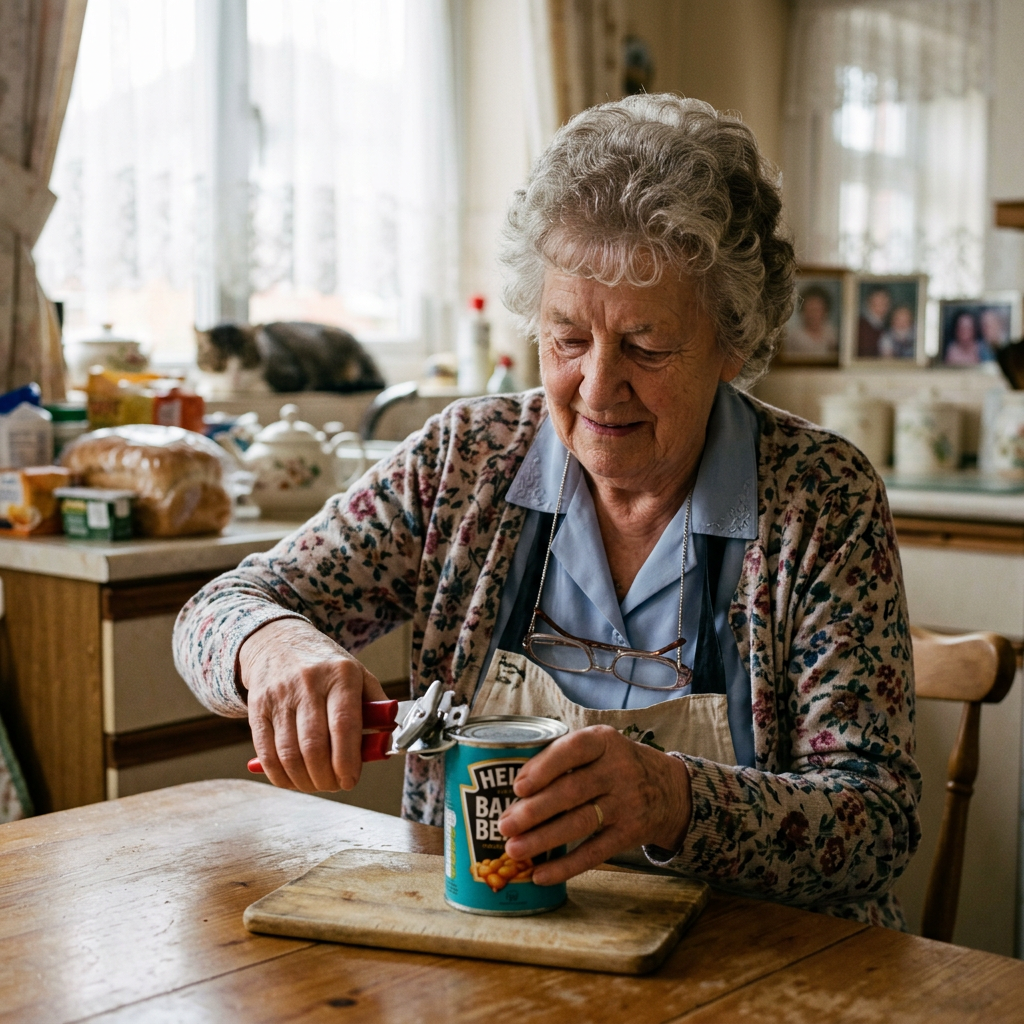
5 Best One-Touch Electric Can Openers for Seniors
By Sarah Mitchell · Editor, BuyingForMom · Updated July 2026
9 min read · Kitchen · 5 picks compared

Who this guide is for
This guide is for adult children buying a can opener for a parent whose hands no longer manage the squeeze-and-crank of a manual opener, usually arthritis, sometimes post-stroke weakness or a tremor. It’s equally for seniors shopping for themselves. If grip is the whole problem, a handheld one-touch model solves it; if lifting and steadying anything is the harder issue, you want a countertop unit. Both paths are below.
A one-touch electric opener removes grip and twisting from the equation entirely — you set it, press a button, and it does the work. That’s why occupational therapists so often put one near the top of the arthritis-kitchen list, and why the wrong one ends up abandoned in a drawer within a week.
At a glance
Best Overall Handheld
Kitchen Mama Auto
~$30 · One button, no grip, smooth edge
Best Countertop
Hamilton Beach Smooth Touch
~$25 · Push-down lever, nothing to hold
Best Premium
Cuisinart SCO-60 Deluxe
~$50 · Stainless, wide anti-tip base
Best Value Countertop
Hamilton Beach 76607 + Scissors
~$30 · Same lever, adds easy-grip scissors
Best Rechargeable
USB-C One-Touch Handheld
~$20 · No AA batteries to change
Best Overall HandheldKitchen Mama Auto Electric Can Opener

~$30 · Check price on Amazon →
This is the one most caregivers land on, and for good reason. Across more than 87,000 verified reviews at roughly 4.5 stars, the recurring line is identical: you clamp it on the rim, press once, and walk away while it circles the can and stops itself. No squeezing, no cranking, no wrist rotation — the exact motions arthritic and post-stroke hands can’t do. Its tilted blade cuts the side seam rather than the top, so the removed lid has no sharp edge and never touches the food. Reviewers who mention arthritis call it the first opener a parent could use without asking for help. The one honest caveat, echoed across reviews, is placement: it has to sit squarely on the rim or it won’t grab, which takes a can or two to learn.
The good
- True one-button, hands-free operation — no grip or twist required
- Side-cut leaves a smooth, safe edge and a lid you can lift with the built-in magnet
- Cordless and light enough to store in a drawer or take to a second home
The catch
- Runs on four AA batteries (not included) the battery door needs some dexterity
- Must be positioned precisely on the rim, which has a short learning curve
This is right if… grip and twisting are the whole problem and you want the simplest possible fix.
Look elsewhere if… holding a device steady on the can is hard — a countertop model asks less of the hands.
Best CountertopHamilton Beach Smooth Touch (76606)

~$25 · Check price on Amazon →
When the harder task is holding anything at all, a countertop opener is the answer, and this is the one testers and buyers reach for first. You slide the can under the head and press a wide lever straight down, no pinching, no fine motor control, and the machine holds the can for you. It cuts the side seam for a smooth edge and grips the lid with a magnet so nothing drops into the food. Independent kitchen testers rated it the best Amazon electric can opener largely because the push-down lever is so much friendlier to weak hands than the pull-up levers on older models. The extra-tall opening clears soup and coffee cans and handles pop-tops. It takes counter space and an outlet the trade for never lifting it.
The good
- Press-down lever needs almost no hand strength and nothing to hold
- Smooth side-cut edge plus a magnet that lifts the lid off for you
- Extra-tall throat opens standard, tall, and pop-top cans
The catch
- Takes up counter space and needs a nearby outlet
- The magnet occasionally needs a nudge on lightweight lids
This is right if… lifting and steadying a handheld device is the real limitation, not just grip.
Look elsewhere if… counter space is tight or the kitchen has no free outlet near the prep area.
Best PremiumCuisinart SCO-60 Deluxe

~$50 · Check price on Amazon →
If the opener will get daily use and needs to last, the Cuisinart earns its price. It’s a one-touch countertop unit with a stainless body, an extra-wide base that resists tipping when a heavier hand leans on it, and a magnetic lid holder that keeps the cut lid out of the food. Buyers who upgraded from a bargain plastic opener consistently note the stability — it stays planted while the motor works, which matters when balance or one-handed use is in play. The arm is removable for cleaning. It’s the heaviest and priciest pick here, so it’s overkill for someone who opens a can or two a week — but for a household that cooks from cans daily, the durability is worth it.
The good
- Wide anti-tip base stays planted for one-handed or unsteady use
- One-touch start with a strong motor that handles large cans without stalling
- Removable arm and stainless body make cleanup and longevity easy
The catch
- The most expensive pick on this list
- Larger footprint, it commits real counter space
This is right if… the opener sees daily use and stability and durability matter more than saving $25.
Look elsewhere if… cans come out once or twice a week, a cheaper model does the same job.
Best Value CountertopHamilton Beach 76607 with Scissors

~$30 · Check price on Amazon →
This is the same easy push-down lever as our top countertop pick, plus one addition that matters a lot for arthritic hands: stainless kitchen scissors that store in the back of the unit. Cans aren’t the only thing a weak grip can’t manage — bags of frozen vegetables, cracker sleeves, and vacuum-sealed pouches are just as hard, and reviewers repeatedly say the built-in scissors quietly became their most-used tool. The opener itself does everything the standard Smooth Touch does. Buyers call the pair a “lifesaver” that “works right every time.” For a few dollars more, you solve two grip problems instead of one.
The good
- Same low-effort push-down lever as the top countertop pick
- Bundled easy-grip scissors handle bags and pouches a weak hand can’t tear
- Scissors tuck into the back, so nothing extra clutters the drawer
The catch
- Same counter-space and outlet needs as any countertop unit
- Scissors are handy but not spring-loaded — very severe grip loss may still struggle with them
This is right if… opening bags and pouches is as much a problem as opening cans.
Look elsewhere if… you only ever open cans — the base Smooth Touch saves a few dollars.
Best RechargeableUSB-C Rechargeable One-Touch Handheld

~$20 · Check price on Amazon →
Here’s the failure mode nobody warns you about: a battery-powered handheld is perfect for arthritic hands right up until the four AA batteries die — and prying open a stiff battery door is exactly the motion those same hands can’t do. A USB-C rechargeable handheld sidesteps that entirely: it charges from any phone cable, holds 60-plus opens per charge, and has no door to fight. Operation matches the Kitchen Mama press once, it circles the can, auto-stops, and a magnetic lifter pulls the lid off hands-free. It’s the newest category here, so it lacks six-figure review counts, but for a senior who lives alone and can’t reliably swap batteries, removing that chore is worth more than review history.
The good
- No batteries to buy or swap charges from a standard USB-C cable
- Same one-touch, hands-free side-cut as the top handheld
- Magnetic lid lifter removes the lid without touching a sharp edge
The catch
- Newer product with a shorter review track record than the Kitchen Mama
- Someone has to remember to recharge it best paired with a weekly routine
This is right if… changing AA batteries is itself a barrier and a weekly charge is easy to keep up.
Look elsewhere if… you’d rather have the longest, deepest review history that’s the Kitchen Mama.
Side-by-side comparison
| Model | Type | Power | Best for | Price |
|---|---|---|---|---|
| Kitchen Mama Auto | Handheld | 4 AA | Grip loss, simplest fix | ~$30 |
| Hamilton Beach 76606 | Countertop | Corded | Nothing to hold | ~$25 |
| Cuisinart SCO-60 | Countertop | Corded | Daily use, durability | ~$50 |
| Hamilton Beach 76607 | Countertop | Corded | Cans + bags/pouches | ~$30 |
| USB-C Rechargeable | Handheld | USB-C | No battery swaps | ~$20 |
The conversation you’ll have
A can opener seems too small to cause friction, but it can. A parent who has opened cans by hand for sixty years may hear “I got you an electric one” as “I’ve decided you can’t manage anymore.” Frame it as a convenience, not a concession. Instead of “This is easier for your hands,” try “These leave a smooth edge so you can’t cut yourself on the lid — the old kind always left that jagged rim.” Everyone dislikes the jagged rim; nobody feels diminished agreeing about it.
It also helps to leave it out and let it get discovered rather than presenting it as a fix. Set it on the counter, open one can together, and let the “oh, that’s actually nice” happen on its own. A tool used willingly beats the perfect model left in the box.
Insurance and savings
Set expectations honestly: an electric can opener is almost never covered. Medicare classifies it as a convenience kitchen item, not durable medical equipment, so Part B won’t pay, and most FSA and HSA plans treat it the same way — everyday kitchen gadgets don’t qualify without a specific medical justification. The narrow exception is adaptive equipment recommended in writing by an occupational therapist as part of a documented care plan; some flexible-spending administrators will then reimburse it, and the cost may count toward the IRS medical-expense deduction (deductible only above 7.5% of adjusted gross income, per IRS Publication 502). For a $20–$50 device the paperwork rarely pays off but if a parent already has an OT involved, it’s worth asking the therapist to note it.
What to actually look for
1. Handheld or countertop decide the failure mode first
This is the choice that matters most, and the one competitor roundups skip. If the problem is grip and twisting but the hands can still steady a small device, a handheld one-touch is the lightest, cheapest fix. If holding anything steady is the harder task — tremor, severe weakness, or one-handed use after a stroke — a countertop unit that holds the can for you is the right answer. Buy for the actual limitation, not the star rating. Our room-by-room aging-in-place modification guide helps spot which kitchen tasks have quietly become two-hand jobs.
2. Smooth-edge (side-cut) blade, not top-cut
Older openers cut down through the top of the lid and leave a sharp, jagged rim — a real cut risk for thin senior skin. Every pick here uses a side-cut (also sold as “smooth edge” or “safety”) blade that slices the outer seam, so the lid lifts off cleanly with no sharp edge and never touches the food. It’s the single most important safety feature — confirm it in the product title before you buy. Grip-sparing tools like these sit alongside the priorities in our complete aging-in-place home safety checklist.
3. Power source — and who has to maintain it
Corded countertop units never need batteries but need an outlet and space. Battery handhelds are portable and cheap but rely on someone changing four AA cells — and a stiff battery door defeats the purpose for a weak hand. USB-C rechargeables split the difference: portable, no door to fight, just a weekly charge. Match the power source to whoever maintains the device day to day. If cans are a struggle, jars and bottles usually are too — pair this with our companion jar and bottle openers for arthritic hands guide.
Frequently asked questions
What is the easiest can opener to use with arthritis?
A one-touch electric opener is easiest, because it removes grip and twisting entirely. For most arthritic hands the handheld Kitchen Mama Auto is the simplest fix — clamp on, press once, done. If holding a device is also hard, a countertop model like the Hamilton Beach Smooth Touch holds the can for you.
Are electric can openers actually good for arthritis?
Yes. Occupational therapists frequently recommend them because they eliminate the squeezing and cranking manual openers require — the exact motions arthritic joints can’t tolerate. The smooth-edge side-cut also removes the sharp-rim cut risk, which matters for thinner, slower-healing senior skin.
What is a smooth-edge (safety) can opener?
It’s an opener that cuts the side seam rather than the top of the lid, so the lid lifts off with no jagged edge and never touches the food. Every pick here uses this side-cut design — it’s the key safety feature to confirm before buying.
Are handheld or countertop electric can openers better for seniors?
It depends on the limitation. Handhelds are cheaper, portable, and fix grip and twisting problems. Countertop units cost a little more and take space but hold the can for you — the better choice when steadying a device one-handed, with a tremor, or with severe weakness is the harder task.
Do electric can openers need batteries?
Some do. Handhelds usually run on four AA batteries, countertop models plug into an outlet, and newer handhelds recharge over USB-C. For a senior who can’t easily open a stiff battery door, a corded or USB-C model avoids that recurring chore.
Why won’t my electric can opener grip the can?
Handheld one-touch openers must sit squarely on the rim to engage — a slightly-off placement is the most common complaint. Line the cutting wheel up on the outer edge and press firmly until it bites. Fresh batteries matter too; weak cells stall the motor partway around.
The shortlist


Last verified in stock: July 24, 2026
What we’d do tomorrow
If you’re sorting this out this week, do three things in order. First, decide the failure mode: grip, or holding a device steady? Grip alone points to the handheld Kitchen Mama Auto; trouble steadying anything points to the countertop Hamilton Beach Smooth Touch. Second, ask whether they can change AA batteries if not, choose the USB-C rechargeable or a corded model. Third, when it arrives, open the first can together and leave it on the counter, not in a drawer. The right opener only helps if it’s the one that gets reached for.
— Sarah
Leave a Reply