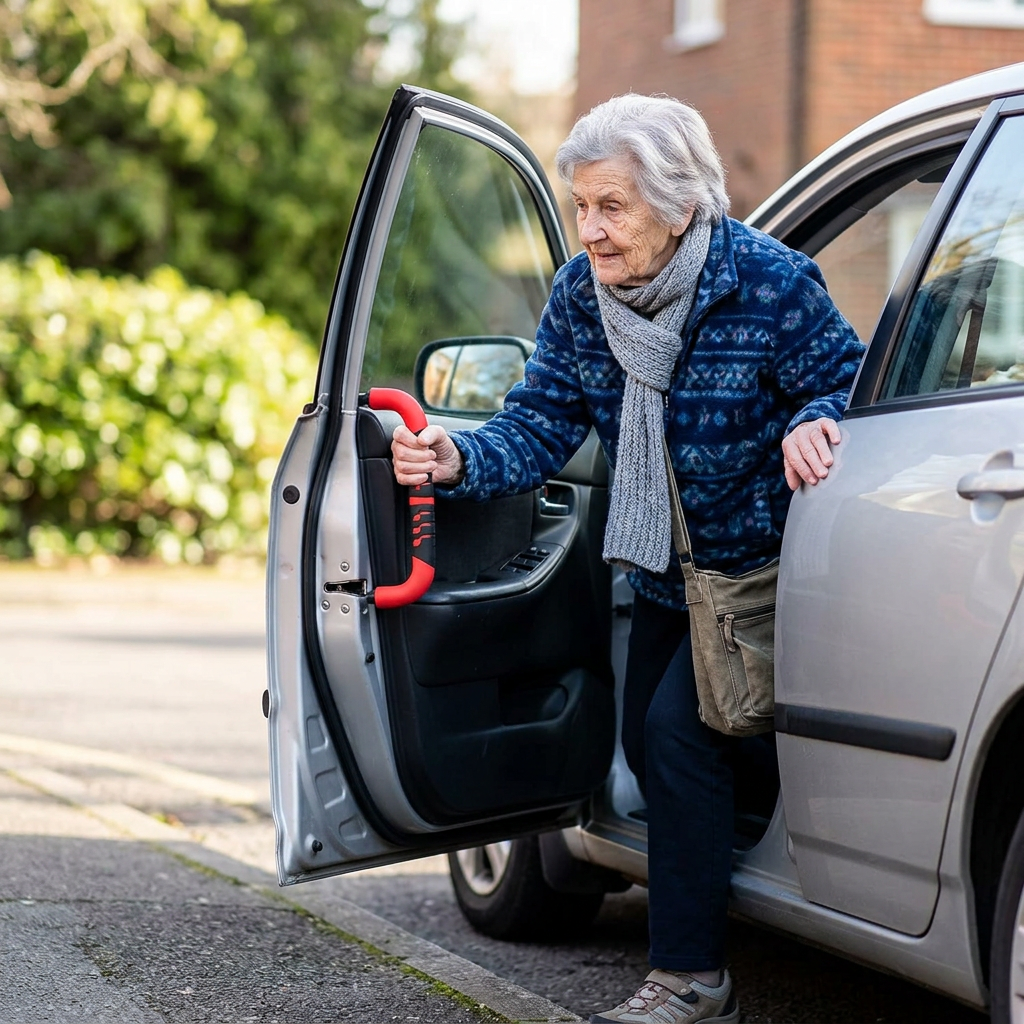
5 Best Car Assist Handles for Seniors Getting In and Out
By Sarah Mitchell · Editor, BuyingForMom · Updated August 2026
10-minute read · Balance & Mobility · 5 products compared

How we sorted through 40+ car assist handles in three weeks
We cross-referenced more than 8,000 verified-buyer reviews across the four dominant brands in this category (Stander, Able Life, Vive, and the flood of near-identical import handles), then filtered by the one thing most roundups ignore: which physical problem is the handle actually solving? A senior who can’t push down through weak wrists needs a different tool than one who can’t lift a stiff leg over the sill. We weighted occupational-therapist guidance from AARP and university aging programs, mined Reddit caregiver threads for the recurring complaints, and threw out anything with a pattern of “wouldn’t fit my car.” Everything below was confirmed as a live, in-stock Amazon listing the week this went up.
Who this guide is for
This is for adult children buying for a parent who has started grabbing the door frame, the seat, or your arm every time they get in or out of the car, the people for whom a $25 handle buys back a surprising amount of independence and dignity. If you’re shopping for yourself after a hip or knee surgery, the same picks apply; just pay extra attention to the “pull-up vs push-down” distinction, because it changes which one is right for you.
At a glance
Best Overall Stander HandyBar — ~$28 · push-down door-latch bar with emergency tools
Best Lightweight Able Life Auto Cane — ~$25 · fits a glovebox or purse, comes in colors
Best for Pulling Up Stander CarCaddie — ~$18 · strap over the window frame, no latch needed
Best for Stiff Hips Vive Swivel Car Seat Cushion — ~$35 · 360° rotation kills the twist
Best for Weak Grip Able Life Auto Assist Grab Bar — ~$30 · cushioned grip + key storage, FSA-eligible
Best Overall Stander HandyBar
~$28 · Check price on Amazon →

The HandyBar is the handle most occupational therapists point to first, and the reviews explain why: across thousands of verified buyers, the recurring word is “sturdy.” You slip its forked base into the U-shaped striker on the door frame, and a solid steel post gives your parent something to press straight down on while they pivot and stand the exact motion that fails when knees and quads are weak. It’s rated to about 350 pounds, and the bright non-slip grip is easy to spot for eyes that don’t see contrast well. As a bonus, the head hides a seatbelt cutter and a spring-loaded window breaker, so it earns its place in the door pocket even on the days no one needs a boost. The honest caveat, echoed by a minority of reviewers, is fit: on a few vehicles the base sits a touch loose in the striker.
The good
- Steel post feels genuinely solid, the most-praised trait in reviews
- Built-in window breaker and seatbelt cutter add real emergency value
- High-contrast grip is easy to locate for low-vision users
The catch
- Only works with a U-shaped door-latch striker (see the buying guide below)
- A handful of buyers report a slightly loose fit on certain models
This is right if… your parent needs firm push-down leverage and the car has a standard U-shaped latch.
Look elsewhere if… the car has a bolt-style striker, or your parent can’t press down and needs to pull up instead.
Best Lightweight Able Life Auto Cane
~$25 · Check price on Amazon →

If the HandyBar is the workhorse, the Auto Cane is the one your parent will actually keep in the car, because it weighs about a third of a pound and disappears into a glovebox or handbag. It works on the same principle drop it into the U-shaped striker and press down but the compact profile and the choice of colors (blue, lavender, red) make it feel less like a medical device, which matters more than caregivers expect. Verified buyers consistently note that it “travels well” and works across their own car, a spouse’s car, and the grandkids’ SUV. It’s rated to about 300 pounds. The trade-off for that featherweight design is a shorter, slimmer grip; a large hand or a very heavy user will prefer the beefier HandyBar or the cushioned Able Life grab bar further down this list.
The good
- Barely a third of a pound — genuinely purse- and glovebox-portable
- Color options make it feel less clinical than a bare steel bar
- Moves easily between multiple vehicles
The catch
- Same U-shaped-striker requirement as every latch handle
- Slimmer, shorter grip than the HandyBar — less ideal for large hands
This is right if… the handle needs to travel between cars or vanish into a bag when not in use.
Look elsewhere if… your parent has large hands or wants the most substantial grip they can get.
Best for Pulling Up Stander CarCaddie
~$18 · Check price on Amazon →

The CarCaddie solves the two problems every latch handle can’t. First, some cars simply don’t have a U-shaped striker and on those vehicles a latch bar is useless. Second, some seniors can’t press down at all (painful wrists, a recent shoulder repair) but can still pull themselves up against a strap. The CarCaddie loops a padded nylon strap over the top of the window frame; you roll the window up to pin it, adjust the length between roughly 7 and 16 inches, and your parent hauls up on the grip like a subway strap. Buyers who “couldn’t get the HandyBar to fit” repeatedly land here as the fix. The honest limits: it’s rated to a lower ~250 pounds, it needs a framed window (frameless coupe windows won’t hold it), and it flexes a bit it’s leverage, not a fixed steel post.
The good
- Works on cars with no U-shaped latch striker
- Pull-up motion suits weak wrists or a healing shoulder
- Cheapest pick here and folds flat into a door pocket
The catch
- Lower ~250 lb capacity than the steel latch bars
- Needs a framed window and has natural strap flex
This is right if… the car has no usable latch, or your parent needs to pull up rather than push down.
Look elsewhere if… you want a rigid, no-flex handle or the user is over ~250 pounds.
Best for Stiff Hips Vive Swivel Car Seat Cushion
~$35 · Check price on Amazon →

Sometimes the problem isn’t standing up it’s the twist. Getting out of a car means swiveling stiff hips 90 degrees to face the door before you can put a foot down, and for a parent with arthritis or a replaced hip, that rotation is the painful part a handle does nothing for. Vive’s swivel cushion sits on the seat and spins a full 360 degrees on a low-noise bearing, so your parent sits, then rotates to face out with almost no hip strain. The memory-foam top wins praise for long-drive comfort. Two honest cautions from reviewers: it raises seat height by a few inches (a problem in an already-tall SUV or for a short driver near the wheel), and it’s meant for a flat seat — deep bucket seats keep it from spinning freely. Use it as a passenger aid, not under a driver working the pedals.
The good
- Kills the hip-twisting motion no handle can help with
- Memory-foam top is comfortable for long rides
- Works in the car, then moves to a dining or office chair
The catch
- Raises seat height a few inches awkward in tall vehicles
- Needs a flat seat; won’t rotate freely on deep bucket seats
This is right if… the hard part is twisting stiff hips to face the door, not standing up.
Look elsewhere if… the car already sits high or the seats are deep buckets.
Best for Weak Grip Able Life Auto Assist Grab Bar
~$30 · Check price on Amazon →

This is the latch handle to choose when the hands themselves are the weak link. Where the HandyBar and Auto Cane give you a slim bar, Able Life’s Auto Assist Grab Bar wraps a wider, softer ergonomic grip that arthritic fingers can close around without the pressure points a thin post creates. It fits the same U-shaped striker, is rated to about 300 pounds, and tucks a small key compartment into the handle a genuinely thoughtful touch for a parent who’s forever hunting for keys mid-transfer. It’s also marketed as HSA/FSA-eligible, which the thin bars usually aren’t. Reviewers who bought it specifically for a spouse with rheumatoid arthritis call the cushioned grip the difference-maker. The trade-off is bulk: it’s chunkier in the door pocket than the featherweight Auto Cane.
The good
- Wide cushioned grip is far kinder to arthritic hands
- Built-in key compartment is a small but real convenience
- Marketed as HSA/FSA-eligible
The catch
- Same U-shaped-striker requirement as the other latch bars
- Bulkier to store than the ultralight Auto Cane
This is right if… arthritis or a weak grip makes a thin steel bar uncomfortable to hold.
Look elsewhere if… you want the smallest, lightest handle for a purse.
Quick comparison
| Handle | Type | Capacity | Best for | Price |
|---|---|---|---|---|
| Stander HandyBar | Push-down latch | ~350 lb | Most people; emergency tools | ~$28 |
| Able Life Auto Cane | Push-down latch | ~300 lb | Travel & portability | ~$25 |
| Stander CarCaddie | Pull-up strap | ~250 lb | No-latch cars; weak wrists | ~$18 |
| Vive Swivel Cushion | Rotating seat | ~300 lb | Stiff hips; twisting | ~$35 |
| Able Life Auto Assist Grab Bar | Push-down latch | ~300 lb | Arthritic / weak grip | ~$30 |
The conversation you’ll have
Here’s the part no product page warns you about: a lot of parents don’t want a “handicap handle” clipped to their car. It reads as a public admission that they’re getting old, and for a proud person that’s a bigger barrier than the stiff knee itself. Pushing the safety angle (“you’re going to fall”) usually backfires, it makes the object a symbol of decline.
Try leading with convenience instead of frailty. Rather than “I got you this so you don’t fall,” say “This clips into the door so you’ve got something solid to hold — I keep grabbing the door frame and it’s filthy, this is better.” Framing it as a shared annoyance, or as the smart thing everyone should have, lets your parent accept it without conceding anything. It also helps to leave it in the car and say nothing for a week; most people quietly start using a handle once it’s simply there, long before they’ll admit they need one. The colored Auto Cane and the strap-style CarCaddie both read less “medical” than a bare steel bar, which is worth the trade if resistance is the real obstacle.
Insurance and savings
Set expectations honestly: Original Medicare almost never pays for a car assist handle. Durable medical equipment has to be “primarily medical” and used in the home, and a $25 handle that helps you in and out of a car fails both tests, so Part B treats it as a convenience item. The realistic levers are elsewhere. Most of these handles the Able Life Auto Assist Grab Bar explicitly, and many others — are sold as HSA/FSA-eligible, so tax-advantaged dollars can cover them, sometimes with a simple letter of medical necessity from a doctor. If your parent itemizes, the IRS (Publication 502) allows medical-expense deductions above 7.5% of adjusted gross income, and mobility aids can count toward that total. And some Medicare Advantage plans now carry supplemental over-the-counter or home-safety allowances that a $20–$35 handle fits neatly inside — worth a five-minute call to the plan to check.
What to actually look for
1. Check the door latch before you buy anything
This is the return-rate killer. A latch-style handle only works if the car’s door frame has a U-shaped striker the metal loop the door clicks shut against with a visible gap you can slide the forked base into. Many newer cars use a covered or bolt-style striker with no gap, and on those, the HandyBar, Auto Cane, and Auto Assist Grab Bar simply won’t seat. Open the front passenger door and look at the frame before ordering. If there’s no U-loop, go straight to the strap-style CarCaddie or the swivel cushion. This one check saves the most grief and belongs at the top of any complete aging-in-place home safety checklist.
2. Match the motion to the weakness
Watch which part of the transfer actually fails. If it’s standing up, a push-down latch bar gives the leverage. If it’s wrists or shoulders that can’t press down, a pull-up strap works with their body instead of against it. If it’s twisting stiff hips to face the door, no handle helps, you want the swivel cushion. Buying the wrong category is the most common mistake, and it’s why generic “best handle” lists fail people. Getting in and out of the car is one line item in a bigger picture; our room-by-room aging-in-place modification guide walks through the rest.
3. Weight rating and grip size
Buy well above your parent’s body weight a transfer puts more than static weight through the handle when someone catches a stumble on it. The steel latch bars top out around 300–350 pounds; the strap sits lower at ~250. And don’t overlook grip diameter: arthritic hands do far better on a wide cushioned grip than a thin bar. Because a fall during a transfer is exactly the scenario families worry about, pairing a handle with a no-monthly-fee fall detection device gives peace of mind for the moments no one’s there to spot them.
Frequently asked questions
Do car assist handles work on all cars?
No. Latch-style handles need a U-shaped door-latch striker with an open gap, and some newer vehicles use a covered or bolt-style striker where they won’t fit. Check the door frame before buying. If there’s no U-loop, a strap-style handle that loops over the window frame works on virtually any car with a framed window.
What is the best car handle for an elderly person getting out of the car?
For most people it’s the Stander HandyBar a steel push-down bar that seats in the door latch and doubles as an emergency tool. But “best” depends on the weakness: choose a pull-up strap if wrists can’t press down, or a swivel cushion if the hard part is twisting stiff hips rather than standing.
Does Medicare cover a car assist handle?
Original Medicare generally does not. To qualify as durable medical equipment, an item must be primarily medical and used in the home, and a car handle meets neither test. However, most are HSA/FSA-eligible, may count toward itemized medical deductions, and can sometimes be bought through a Medicare Advantage OTC allowance.
How much weight do car assist handles hold?
Steel latch-style handles are typically rated to about 300–350 pounds, while strap-style handles hold roughly 250 pounds. Always choose a capacity comfortably above the user’s body weight, because catching a stumble briefly loads the handle with far more than a person’s standing weight.
Do swivel seat cushions really help getting out of the car?
Yes, for the right problem. A 360-degree swivel cushion removes the painful hip-twisting motion of turning to face the door, which a handle can’t address. The trade-offs are that it raises seat height a few inches and needs a flat seat deep bucket seats keep it from rotating freely.
How do you safely help an elderly person in and out of a car?
Park on flat ground, open the door fully, and have them scoot to the seat edge before standing. For exits, swing both legs out together to face the door first, then rise. Give a stable handle to hold rather than pulling on their arm, and never rush the movement.
The shortlist


Last verified in stock: August 4, 2026
What we’d do tomorrow
If you’re sorting this out this weekend, do three things in order. First, walk out to the car and look at the passenger door frame U-shaped latch or not. If yes, order the Stander HandyBar and you’re done for most situations. If there’s no U-loop, order the CarCaddie strap instead. Second, if the real fight is stiff hips twisting to face the door, add the swivel cushion it solves a different problem than any handle. Third, leave whatever you buy in the car without a lecture, and let your parent discover it on their own terms.
— Sarah
Leave a Reply