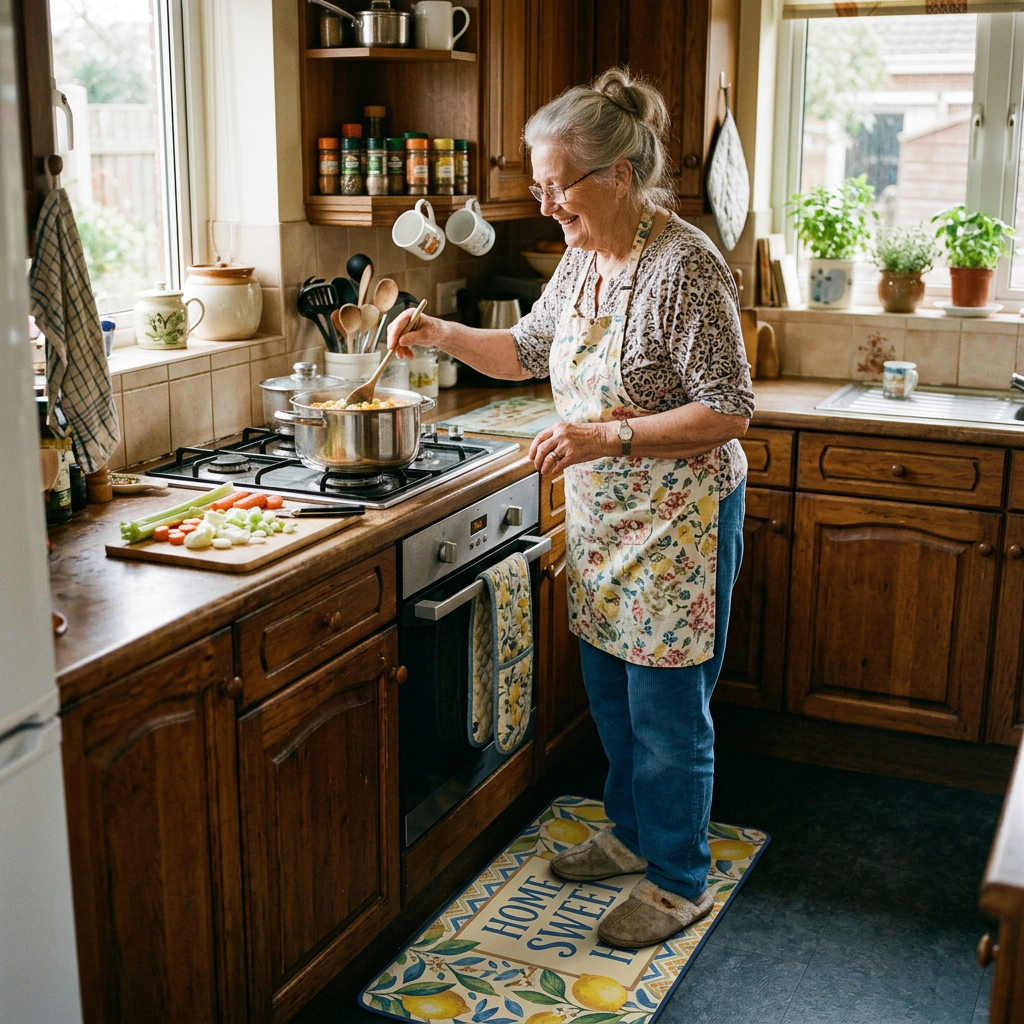
5 Best Anti-Fatigue Kitchen Mats for Seniors
By Sarah Mitchell · Editor, BuyingForMom · Updated August 2026
10-min read · Kitchen · 5 picks compared

How we sorted through 40+ anti-fatigue mats in three weeks
We cross-referenced more than 40 kitchen and standing mats against roughly 90,000 verified Amazon reviews, then filtered them through a lens most roundups skip: what helps an older adult standing at the sink, not a warehouse worker on concrete. We weighted three things — the firmness-versus-comfort balance flagged by occupational therapists and certified ergonomists, the height and taper of the mat’s edge (the part that becomes a trip lip), and the grip of the backing on tile and hardwood. Where reviewers reported a mat that curled, slid, or “felt like standing on a mattress,” we noted it, because for a senior those are safety issues, not annoyances.
Who this guide is for
This guide is for adult children buying a kitchen mat for a parent who stands to cook, wash dishes, or make coffee and comes away with aching feet, knees, or a sore lower back. It’s also for the parent shopping for themselves. If the person you’re shopping for has significant balance problems or has fallen before, read the balance section carefully the “best” mat for them is probably not the softest one on the page.
Standing on a hard kitchen floor is quietly punishing. The cushioning in a good anti-fatigue kitchen mat encourages tiny, constant shifts in the leg muscles that keep blood moving, reducing the foot, leg, and back fatigue that builds over a few minutes at the counter. For an older adult with arthritis or a stiff lower back, that relief is the whole point. But the same softness that relieves a healthy cook’s feet can work against an unsteady parent’s balance, so the right pick depends as much on the person as on the mat.
At a glance
Best Overall ComfiLife 3/4″ (~$32) — firm-but-cushioned, ideal thickness, beveled edge.
Best Budget KitchenClouds Cushioned Mat (~$15) — soft, low-profile, wipes clean, 21,000+ reviews.
Best for Balance Sky Solutions 3/4″ (~$25) — denser, firmer, less “sink” for unsteady standers.
Best Long Runner Sky Solutions 24″x70″ (~$50) — one piece from sink to stove, fewer edges.
Premium WellnessMats Trellis 2’x3′ (~$130) — seamless, won’t flatten, 20-year warranty.
Best Overall ComfiLife Anti-Fatigue Floor Mat, 3/4″
~$32 · Check price on Amazon →

The ComfiLife is the mat we’d hand almost anyone, because it lands on the 3/4-inch thickness reviewers and ergonomists agree is the practical sweet spot — enough give to unload the joints, not so much that standing feels like balancing on a cushion. Across more than 40,000 reviews, the recurring praise is “firm but forgiving,” and the high-density core doesn’t bottom out or develop a permanent foot-shaped dent the way cheaper foam does. The edges are beveled so a slipper or a walker foot rolls on rather than catching, and the textured non-slip backing holds on tile and sealed hardwood. It comes in muted colors that read as a kitchen rug, not a gym accessory — which matters when you’re trying to get a parent to actually keep it down.
The good
- 3/4″ thickness hits the comfort-versus-stability sweet spot
- Beveled edges reduce the trip lip; walker- and cart-friendly
- Dense core resists flattening; wipes clean, stain-resistant top
The catch
- Ships rolled and can take a day or two to lie fully flat
- One-mat size (20″x32″) only covers a single station, not a galley
This is right if… your parent wants real standing relief without the wobble a plush mat adds.
Look elsewhere if… you need to cover a long stretch of counter — size up to the runner below.
Best Budget KitchenClouds Cushioned Kitchen Mat
~$15 · Check price on Amazon →

If you’re not sure a mat will get used and don’t want to spend much to find out, the KitchenClouds is the low-risk try. It carries more than 21,000 reviews at a steady 4.4 stars, and buyers consistently describe the memory-foam top as pillow-soft the moment you step on. Its advantage for seniors is counterintuitive: at roughly half an inch it sits lower than the thicker picks, so the edge is a smaller lip to clear a genuine plus for anyone who shuffles or drags a foot. The waterproof surface wipes clean when something drips. The trade-off is durability: the soft foam compresses faster over a year of daily standing than the denser mats here, and a few reviewers note the edges can lift on textured tile until it settles.
The good
- Lowest price and lowest profile — smaller trip lip to clear
- Plush memory-foam feel that’s easy on tender feet and knees
- Waterproof, wipe-clean top; 21,000+ reviews at 4.4 stars
The catch
- Soft foam compresses faster than denser mats over a year
- Edges can lift on textured tile until it settles flat
This is right if… you want an inexpensive, low-profile mat to test whether one gets used at all.
Look elsewhere if… the mat will get hours of daily standing — spend up for a denser core.
Best for Balance Sky Solutions Anti-Fatigue Mat, 3/4″
~$25 · Check price on Amazon →

When the person standing on the mat has balance trouble, firmness beats plushness and the Sky Solutions is the firmer of our two 3/4-inch picks. Reviewers who compare it to memory-foam mats call it “supportive” rather than “sinky,” and that denser feel is what an ergonomist would steer an unsteady stander toward, because a foot that sinks less has less correcting to do. It’s a huge seller with hundreds of thousands of units behind it, a stain-resistant diamond-textured top, and a one-year guarantee that’s rare at this price. It won’t feel as cloud-like as the KitchenClouds, and that’s the point: for a parent who’s fallen before, you want a stable, slightly cushioned platform, not a soft one they have to fight.
The good
- Firmer, denser core more stable for unsteady standers
- Beveled diamond-textured top; grippy non-slip backing
- One-year guarantee; hundreds of thousands of units sold
The catch
- Less plush underfoot, comfort-seekers may want softer
- Standard 20″x32″ size covers one station only
This is right if… the person has balance issues or a fall history and needs stability first.
Look elsewhere if… the goal is pure plush comfort and balance isn’t a concern.
Best Long Runner Sky Solutions Runner, 24″x70″
~$50 · Check price on Amazon →

In a galley kitchen where the sink, stove, and counter all sit along one wall, two small mats create two edges to trip over and a cold gap between. The 24-by-70-inch Sky Solutions runner solves that with a single continuous piece across the whole working stretch — one taper to step onto and cushioning the whole way. It shares the firmer, stable feel of its smaller sibling, which suits a parent who moves back and forth along the counter rather than standing in one spot. The main caution is size — measure the run first, because 70 inches is real floor space, and you want the far edge to end at a natural stopping point, not mid-stride.
The good
- One continuous piece, fewer edges than two separate mats
- Covers the full sink-stove-counter run in a galley layout
- Same firm, stable 3/4″ core as the balance pick
The catch
- 70 inches is a big footprint — measure before buying
- Costs roughly double a single-station mat
This is right if… the kitchen is a galley and your parent works along the whole counter.
Look elsewhere if… they stand at one spot — a single mat is cheaper and easier to place.
Premium WellnessMats Trellis, 2’x3′
~$130 · Check price on Amazon →

The WellnessMats is the mat you buy when you don’t want to think about it again. Instead of foam that compresses, it’s a single molded piece of dense polyurethane, made in the USA and backed by a 20-year warranty, the reason occupational therapists and durability-focused reviewers keep naming it. It won’t flatten, curl, or tear at the seams, because there are no seams; the whole edge tapers to the floor in one continuous no-trip bevel. Verified buyers who’d replaced two or three cheap mats frame it as the one they should have bought first. The catch is price, roughly four times our overall pick — so it’s the right call when a parent stands in the kitchen daily and you’d rather spend once than replace foam annually.
The good
- Seamless polyurethane won’t flatten, curl, or tear
- Continuous tapered no-trip edge; grips without a separate backing
- Made in USA, 20-year warranty, a genuine buy-it-once
The catch
- Roughly 4x the price of our overall pick
- Firm, thin-feeling surface, less “plush” than foam mats
This is right if… your parent stands in the kitchen daily and you want to buy once, for good.
Look elsewhere if… the budget is tight or you’re not sure the mat will get regular use.
Compare the five at a glance
| Mat | Approx. price | Feel | Best for |
|---|---|---|---|
| ComfiLife 3/4″ | ~$32 | Firm-cushioned | Most kitchens (overall) |
| KitchenClouds | ~$15 | Soft, low profile | Budget / lowest trip lip |
| Sky Solutions 3/4″ | ~$25 | Firm, stable | Balance / fall history |
| Sky Solutions 24″x70″ | ~$50 | Firm, stable | Galley / long counter |
| WellnessMats Trellis | ~$130 | Firm, seamless | Buy-it-once durability |
The conversation you’ll have
A kitchen mat is one of the easiest aging-in-place upgrades to introduce, because it doesn’t announce itself as a “safety product.” Nobody feels older for owning a comfortable mat. The resistance you’re more likely to hit is the opposite worry — an unsteady parent who’s been told to clear the floors of rugs may see a mat as one more thing to trip on, and they’re not wrong to ask. Lead with comfort, not caution.
Try saying “I got you a cushioned mat so your feet and back don’t ache when you’re cooking” rather than “this will help you not fall.” The first frames it as a small kindness; the second turns a gift into a verdict about their independence. Then handle the trip worry out loud together: put the mat down, walk the edge onto it a few times, and point out that the beveled edge tapers to the floor instead of sitting up like a rug lip. If it doesn’t feel right within a day or two, it goes back — that reassurance is often what gets it kept.
Insurance and savings
Set expectations honestly: Original Medicare does not cover an anti-fatigue kitchen mat. Medicare’s durable medical equipment rules require an item to be “primarily medical” and prescribed for a diagnosis, and a comfort mat doesn’t qualify — the same reason grab bars and shower chairs are excluded. If your parent has a Medicare Advantage plan, check it: a number of MA plans now offer an over-the-counter or home-safety allowance that can stretch to fall-prevention items, and a mat may be eligible where the plan says so. An FSA or HSA generally won’t reimburse a kitchen mat without a documented medical need, but if a doctor or occupational therapist recommends one in writing for a specific condition, keep that note (see IRS Publication 502). At these prices the real savings play is simpler than paperwork buy the mat that lasts instead of replacing a cheap one every year.
What to actually look for
Thickness: for a senior, firmer usually wins
This is where senior shopping diverges from everyone else’s. The general sweet spot is 3/8 to 3/4 inch — enough to cushion without feeling unstable. But occupational therapists and certified ergonomists warn that a too-soft or too-thick mat forces the feet, ankles, and lower back into constant micro-corrections, “similar to standing on a mattress,” which raises balance and trip risk. For a steady cook, chase comfort. For an unsteady parent, choose the firmer mat and never stack two for extra plush. Our complete aging-in-place home safety checklist lays out where a kitchen mat fits in the wider priority order.
The edge is the part that trips people
The single most important safety feature is a beveled edge — one that tapers down to the floor rather than sitting up as a lip. A square-edged mat is a trip hazard; a well-beveled one lets a slipper, a walker foot, or a cart roll on without catching. Lower-profile mats have a smaller lip to begin with, which is why the thinner budget pick can be the safer choice for someone who shuffles. Whatever you choose, position the far edge to end at a wall or cabinet toe-kick, not in the middle of a walking path. For the room-by-room view of trip-hazard fixes, our room-by-room aging-in-place modification guide covers the whole house.
Grip, cleanability, and the floor underneath
A mat that slides is worse than no mat, so look for a textured or rubberized non-slip backing and test it on the actual floor — some backings grip tile beautifully and skate on waxed hardwood. A wipe-clean, waterproof top matters in a kitchen where spills happen, and it’s easier for arthritic hands than a mat that has to be hauled to the wash. And remember the mat isn’t the only thing on the floor: a curling throw rug near the sink undoes everything, so if there’s a loose rug in the kitchen, fix or remove it our guide to rug grippers that stop slipping and curling rugs covers that companion problem.
Frequently asked questions
Are anti-fatigue mats good for seniors?
Yes, for most older adults they reduce foot, leg, and back fatigue while standing at the counter, which encourages standing longer and more comfortably. The caveat is balance: for a parent who is unsteady or has fallen, choose a firmer, lower-profile mat with a beveled edge rather than a thick, plush one.
How thick should a kitchen anti-fatigue mat be?
Aim for 3/8 to 3/4 inch. That range cushions the joints without feeling unstable. Thinner than 3/8 inch won’t relieve much pressure, and mats near or above an inch can feel like standing on a mattress — comfortable for the steady, but a balance risk for an older adult.
Can an anti-fatigue mat be a trip hazard?
It can, if it has a square, raised edge or slides on the floor. Choose a mat with a beveled edge that tapers to the floor and a non-slip backing, position it so the far edge ends at a wall or cabinet, and never stack two mats. Done right, the trip risk is minimal.
Do anti-fatigue mats help with back pain?
They can. The cushioning prompts small, constant leg-muscle movements that improve circulation and reduce the strain hard floors put on the feet, legs, and lower back. They won’t cure a back condition, but many people with arthritis or general stiffness report noticeably less soreness after standing.
What’s the difference between an anti-fatigue mat and a fall mat?
They’re different products. An anti-fatigue mat is thin and firm, made for standing comfort. A fall mat is a thick, soft impact pad placed beside a bed to cushion a fall and because it’s soft and tall, it’s a poor standing surface. Don’t substitute one for the other.
How do you keep an anti-fatigue mat from sliding?
Start with a mat that has a textured or rubberized non-slip backing, then test it on your actual floor. On slick or waxed surfaces, a thin non-slip rug pad underneath adds grip. Keep the underside and floor clean, since dust and grease are what let a mat drift.
Are anti-fatigue mats safe with a walker or wheelchair?
With a beveled edge, yes — a walker or wheelchair rolls onto a low, tapered mat without catching. Favor a firmer 3/4-inch or thinner mat over a plush one, since soft foam is harder to roll across, and make sure the edge tapers fully to the floor on the approach side.
The shortlist


Last verified in stock: August 21, 2026
What we’d do tomorrow
If you’re setting this up this week, do three things in order. First, measure the spot where your parent actually stands. One station takes a single mat, a long counter takes the runner. Second, match the feel to the person: steady cook, get the ComfiLife 3/4-inch; unsteady or a fall history, get the firmer Sky Solutions; tight budget, start with the KitchenClouds. Third, when it arrives, put it down together, walk the beveled edge a few times, and make sure any loose kitchen rug is gripped down or gone. That’s the whole job, a more comfortable kitchen that’s also a little safer, without it ever feeling like a medical purchase.
— Sarah
BuyingForMom is a reader-supported site. As an Amazon Associate we earn from qualifying purchases. When you buy through links on this site, we may earn an affiliate commission at no additional cost to you. See our Affiliate Disclosure for details. This article is not medical advice please consult a qualified healthcare professional for decisions specific to your family.
Leave a Reply