Best Gifts for Seniors With Dementia: 5 Picks Routed by Stage
By Sarah Mitchell · Editor, BuyingForMom · Updated September 2026
9 min read · Dementia & Memory · Gift Guides

Who this guide is for
This is for the adult child or caregiver buying for a parent with Alzheimer’s or another dementia, who wants a gift that comforts rather than frustrates. The picks are organized by stage orientation and connection tools for early dementia, soothing and sensory items for the later stages. If you’re unsure of the stage, the companion pet and the fidget blanket work across almost all of them.
Why “meet them where they are” beats a long list
The best dementia gift, as one geriatric care expert put it, isn’t about the price tag — it’s about meeting the person where they are today. The kindest gifts feel familiar, ask very little, and never make the person feel tested. Most guides ignore that and hand you 30 or 40 items to sort yourself; we did the opposite — five picks, each tied to a specific need (orientation, connection, calm, music, busy hands) so you can shop by what your parent is struggling with this month.
At a glance
Best Overall Joy for All Companion Pet — ~$110 · lifelike robotic cat or pup that purrs and responds to touch; calms restlessness at any stage.
Best for Orientation American Lifetime Day Clock — ~$70 · spells out the full day, date and time of day; for early-stage “what day is it?”
Best for Connection Skylight Digital Picture Frame (10″) — ~$160 · family emails photos straight to the frame; sparks conversation and reassurance.
Best for Calm iGuerburn Simple Music Player — ~$45 · one giant button, no Wi-Fi or screen; taps preserved musical memory.
Best for Restless Hands Assistex Fidget Blanket — ~$30 · OT-designed sensory lap blanket for the middle and later stages.
Best Overall Joy for All Companion Pet
~$110 · Check price on Amazon →

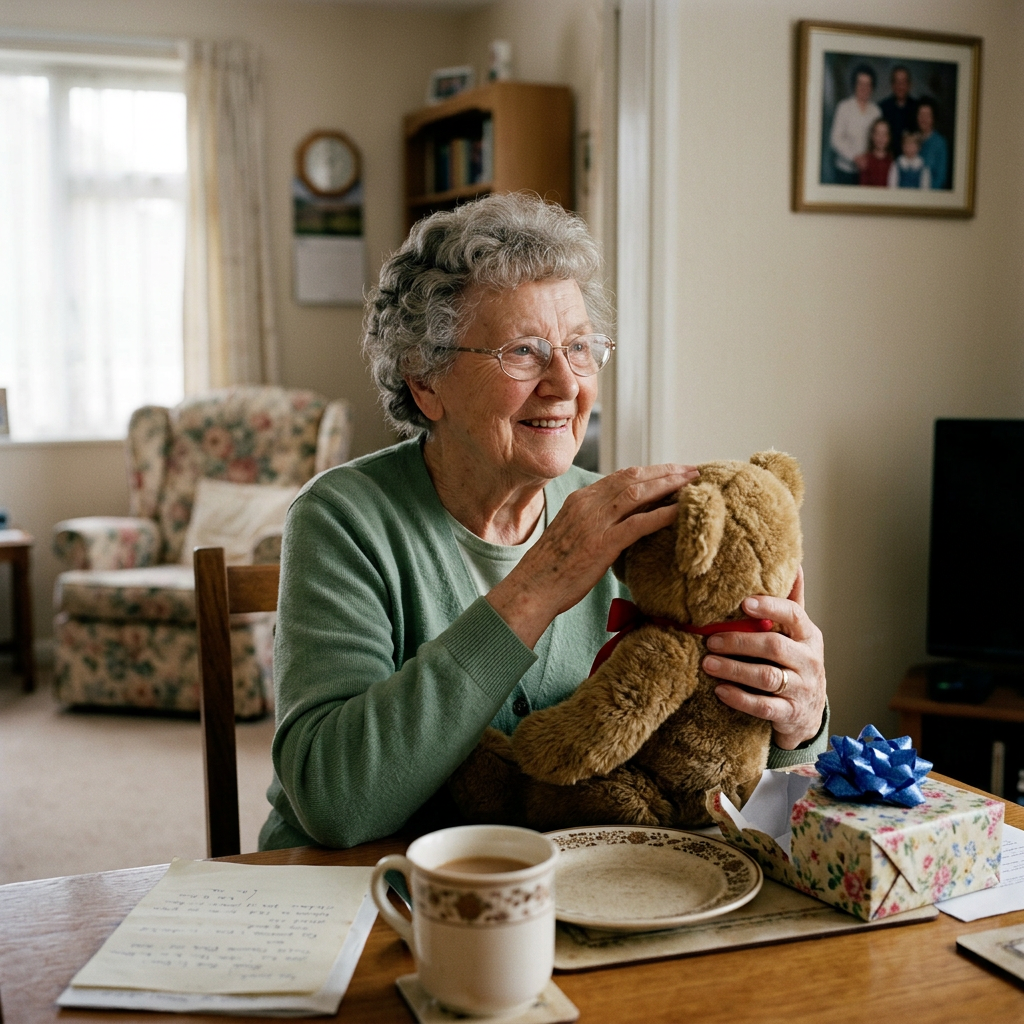
If you buy one thing on this page, buy this. The Joy for All robotic cat and companion pup look, sound and feel convincingly like the real thing soft fur, a purr or heartbeat you can feel, and sensors that trigger head turns, meows and paw movements at a touch. Across more than 20,000 verified reviews, the pattern is the same: a parent who paces or “sundowns” in the late afternoon settles when the pet is placed in their lap. It won the Dementia SMART Award from the Dementia Society of America, and it asks nothing of the person — no rules, no memory, just companionship. The cat is the most popular pick; the Freckled Pup (about $140) suits a dog person.
The good
- Calms agitation and sundowning without medication — the most-cited benefit in reviews.
- Zero learning curve; works for every stage, including late-stage when little else lands.
- Runs on batteries (4 C cells) — no charging, no Wi-Fi, no app.
The catch
- The meow or bark loop can feel repetitive, and up close it’s clearly a toy.
- The fur can mat over time and needs occasional gentle brushing.
This is right if… your parent shows restlessness, anxiety, or a history of loving pets.
Look elsewhere if… they’d read a stuffed animal as condescending an early-stage parent may prefer the clock or frame below.
Best for Orientation American Lifetime Day Clock
~$70 · Check price on Amazon →

For an early-to-middle-stage parent who keeps asking what day it is or who takes morning pills at nigh a day clock is one of the few “gifts” that genuinely reduces daily friction. This one spells everything out in plain, non-abbreviated text: “Tuesday, September 8, 2026 Afternoon,” in letters large enough to read across a room. It’s the category’s runaway best-seller, with a 4.6-star average across roughly 40,000 reviews, and caregivers consistently say it cuts down the repeated “is it morning or night?” questions that wear a family out. It auto-dims at night and holds up to five spoken-alarm reminders for medication or meals. If you want a second display, see our roundup of dementia-friendly wall clocks.
The good
- Full day/date/time-of-day in clear text no confusing abbreviations.
- Auto-dimming night mode so it doesn’t glare in a bedroom.
- Five customizable alarms double as medication and meal cues.
The catch
- Needs to stay plugged in; the backup battery only holds settings briefly through outages.
- In later stages, some people stop registering the clock entirely — it works best when introduced early.
This is right if… your parent is early-to-mid stage and losing track of day and time.
Look elsewhere if… they’re past the point of reading a display — go to comfort items instead.
Best for Connection Skylight Digital Picture Frame (10″)
~$160 · Check price on Amazon →

Emotional memory often outlasts short-term memory in dementia, which is why a stream of familiar faces can be so grounding. The Skylight is the frame families reach for when the recipient can’t manage an app: relatives email photos to the frame’s private address and they appear automatically, no setup on your parent’s end. It carries a 4.6-star average and near-universal praise for being genuinely tech-averse-friendly the person just looks at the pictures. Choose photos deliberately: reviewers and specialists both note that images from earlier decades spark more recognition than last week’s snapshots. For the full field, including no-fee alternatives, see our guide to the best digital photo frames for seniors.
The good
- Family emails photos in the recipient does nothing but watch.
- Bright touchscreen; the base experience needs no subscription.
- Old family photos become a low-pressure conversation starter on visits.
The catch
- Skylight nudges you toward its ~$39/year “Plus” plan the #1 complaint; the frame works fine without it.
- Initial Wi-Fi setup needs a family member; your parent can’t do it alone.
This is right if… family lives far away and you want daily, effortless connection.
Look elsewhere if… there’s no home Wi-Fi a printed photo album is the better gift.
Best for Calm iGuerburn Simple Music Player
~$45 · Check price on Amazon →

Musical memory is famously durable in dementia people who no longer recognize their own children will still sing along to the songs of their youth, and research links familiar music to real drops in agitation. The problem is that a smartphone or smart speaker is unusable at this stage. The iGuerburn solves it with brutal simplicity: one oversized button plays and pauses, a hidden side knob sets volume, and there’s no Wi-Fi, Bluetooth, screen or password anywhere. You load a 32GB card with their music once; from then on they press one button. Reviewers call it the rare device a person with dementia can actually operate independently.
The good
- One-touch play; nothing to learn, nothing to unlock.
- No Wi-Fi, app or account, it can’t get “stuck” on a login screen.
- Familiar music reliably soothes restlessness and lifts mood.
The catch
- You have to load the person’s own music onto the card first — a one-time bit of fiddling for the gift-giver.
- Sound quality is functional, not audiophile.
This is right if… your parent had a lifelong soundtrack and needs a device they can run alone.
Look elsewhere if… the household already has a caregiver happy to cue up a smart speaker.
Best for Restless Hands Assistex Fidget Blanket
~$30 · Check price on Amazon →

In the middle and later stages, hands often stay busy even when words are gone — fidgeting, pulling at clothing, wringing. A fidget (or “activity”) blanket gives that restlessness a soft, safe outlet: a lap-sized quilt covered in zippers, buttons, textures and pockets to explore. The Assistex version is designed with occupational-therapy input and reviews at 4.4 stars, with caregivers reporting it holds attention during the anxious late-afternoon hours and travels well to appointments. It asks for no memory and has no wrong way to use it — the point is comfort and occupied hands, and it machine-washes, which matters more than you’d think.
The good
- OT-designed textures and fasteners channel restless hands safely.
- Portable and machine-washable — realistic for daily use.
- No memory or skill required; there’s no way to “fail” at it.
The catch
- It’s lap-sized, not a bed blanket — some buyers expect it larger.
- A few attachments can loosen with heavy daily handling.
This is right if… your parent fidgets, paces, or picks at clothing and bedding.
Look elsewhere if… they’re early-stage and would find it patronizing — start with the clock or frame.
How the five compare
| Gift | Best stage | Approx. price | Rating |
|---|---|---|---|
| Joy for All Companion Pet | Any / mid–late | ~$110 | 4.4★ (20k+) |
| American Lifetime Day Clock | Early–mid | ~$70 | 4.6★ (40k+) |
| Skylight Picture Frame 10″ | Early–mid | ~$160 | 4.6★ |
| iGuerburn Music Player | Any / mid–late | ~$45 | 4.4★ |
| Assistex Fidget Blanket | Mid–late | ~$30 | 4.4★ |
The conversation you’ll have
The awkward part isn’t choosing the gift — it’s handing it over without your parent feeling handled. People with dementia are often acutely sensitive to being treated as diminished, and a gift that reads as “this is because you’re sick” can land badly. The fix is framing. Present the companion pet as a companion, not a therapy device: “I saw this and thought of you and Whiskers.” Give the music player already loaded and playing a favorite song, so the first experience is the music, not a gadget.
For the day clock, skip the word “dementia” entirely — set it up yourself and say, “I got you a big clock so you don’t have to squint.” And if a gift doesn’t land on day one, don’t push; recognition and comfort sometimes arrive a week later. For the broader instinct behind gifting a parent who insists they need nothing, see our guide to thoughtful gifts for aging parents.
Insurance and savings
Be realistic: most dementia gifts are comfort and consumer items, and Medicare does not reimburse for a companion pet, a photo frame, or a fidget blanket. There’s no tidy insurance angle. The one exception worth knowing is that some FSA or HSA plans will cover items with a documented medical purpose — a day clock or sensory aid — if your parent’s physician writes a Letter of Medical Necessity. It’s rarely worth the paperwork for a $30 blanket, but for higher-ticket items it can be. When in doubt, check with the plan administrator first and keep the receipt.
What to actually look for
Match the gift to the stage, not the wish list
Orientation and connection tools — the day clock, the photo frame — pay off most in early-to-middle dementia, while the person can still read a display and follow a photo. Comfort and sensory items — the pet, the music player, the fidget blanket — carry through the later stages, when almost everything else stops working. Buying a step ahead of where your parent is now usually beats buying for last year. If you’re mapping the whole home, our complete aging-in-place home safety checklist lays out the priority order.
Rule out anything that frustrates, overstimulates, or endangers
Caregivers and clinicians converge on the same “don’t” list: no gifts with many buttons or confusing instructions, no loud or busy-patterned items that overstimulate, no candles or bladed kitchen gadgets, and no small parts that pose a choking risk in later stages. Smart devices that need a password often cause anxiety rather than help. When unsure, ask the care team first — or skip that category.
Favor the familiar over the novel
A gift that connects to who the person has always been their music, their old photographs, the kind of pet they loved reaches past the disease in a way a clever new gadget can’t. Novelty asks the brain to learn; familiarity only asks it to recognize.
Frequently asked questions
What do you buy someone with dementia?
Buy for comfort and familiarity, not for the calendar. The reliable winners are a robotic companion pet, a simple preloaded music player, an easy-to-read day clock, a digital photo frame family can update remotely, and a sensory fidget blanket. Match the gift to the person’s current stage and avoid anything that asks them to remember or learn.
What gifts should you avoid for a dementia patient?
Avoid anything with many buttons, confusing instructions, or a password, plus loud or busy-patterned items that overstimulate. Skip candles, bladed kitchen tools, and gifts with small parts that pose a choking risk in later stages. When you’re unsure whether an item is safe, check with the care team before buying.
Do fidget blankets really help people with dementia?
For many people in the middle and later stages, yes. A fidget blanket gives restless hands a safe, soothing outlet — the zippers, buttons and textures occupy the person without demanding memory or skill. Caregivers frequently report it eases anxious pacing and picking, especially during the difficult late-afternoon “sundowning” hours.
Are robotic pets good for dementia patients?
They’re one of the most consistently effective gifts in this category. Robotic pets like the Joy for All cat and pup mimic real animal sounds and movement, and are used in pet therapy to ease loneliness and agitation. They’re especially comforting for former pet owners and require nothing of the person beyond holding them.
What is a good gift for late-stage dementia?
Late-stage gifts should be purely sensory and comforting: a soft companion pet, familiar music through a one-touch player, a fidget blanket, or a soft lap robe. The person may not respond in words, but touch, sound and warmth still register. Skip anything that requires reading, remembering, or operating a device.
What do you get someone with dementia who lives in a nursing home?
Choose small-footprint, easy-clean, clearly labeled items with no open flame: a companion pet, a fidget blanket, a preloaded music player, or a photo frame for the room. Label belongings with the person’s name, keep it simple, and check the facility’s rules on electronics and batteries before you send anything.
The shortlist


Last verified in stock: September 3, 2026
What we’d do tomorrow
If you’re shopping this week, start with the Joy for All Companion Pet — the safest bet for almost any stage and the gift most likely to produce a visible moment of calm. If your parent is still early and time-confused, add the American Lifetime day clock and set it up yourself before you leave. And for the gift that keeps giving on every visit, order the Skylight frame and quietly load it with old photos first. Buy for who your parent is today, frame it with warmth, and don’t worry if it takes a few days to land.
— Sarah
Leave a Reply