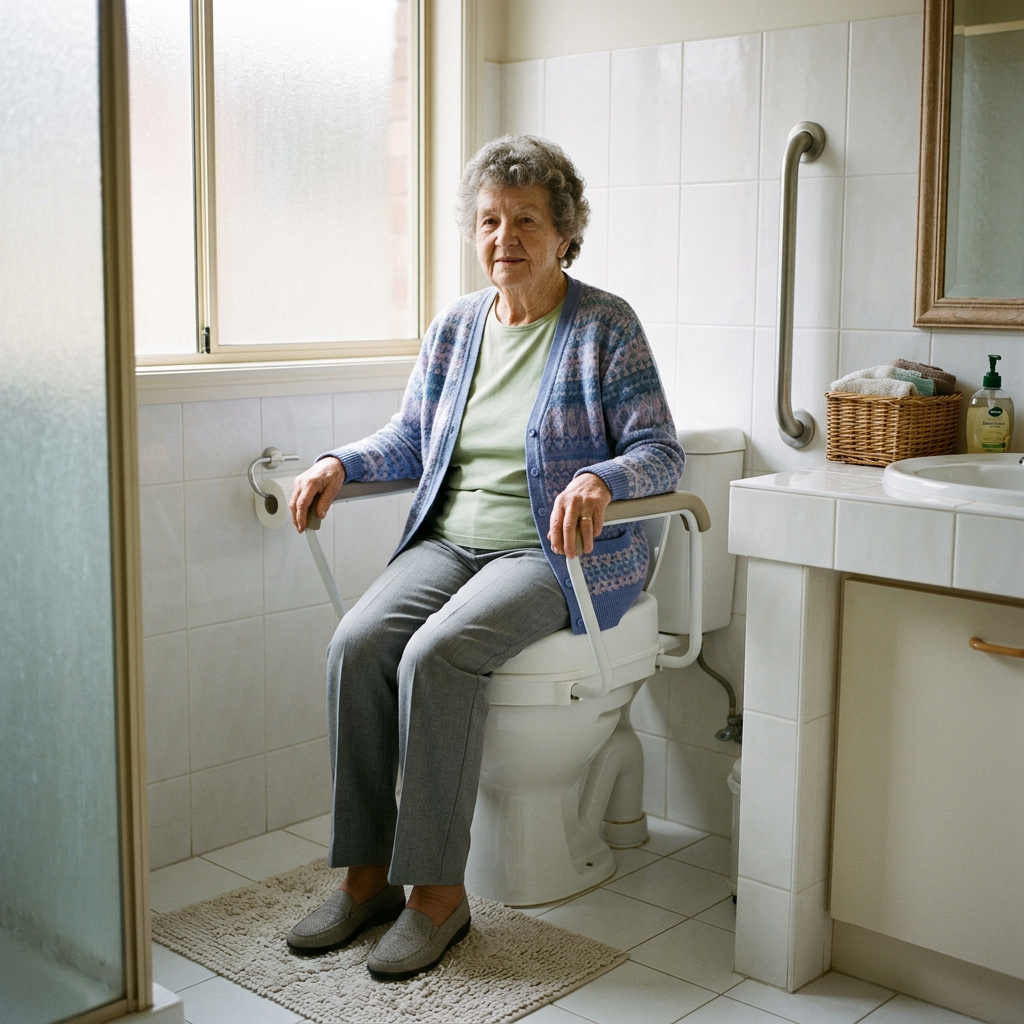
5 Best Toilet Risers Without Arms
By Sarah Mitchell · Editor, BuyingForMom · Updated May 2026
7-minute read · Bathroom · 5 picks compared
How we sorted through 32 no-arms toilet risers in four weeks
We cross-referenced 32 currently-shipping no-arms toilet risers against 18,000+ verified Amazon reviews (Vive, Carex, AquaSense, PCP, Drive Medical), CDC bathroom-fall data showing 80 percent of senior bathroom falls happen during sit-to-stand transitions, and recurring r/AgingParents threads on why caregivers picked a no-arms model over rails. The pattern is consistent, no-arms risers fail when bought on price for a parent who needed armrest support, and succeed when the parent has decent leg strength, uses a transfer board, or simply hates the hospital look of a rail.
Who this guide is for
This is for adult children buying a toilet riser for a parent who has functional leg strength but bends with difficulty, typically osteoarthritis, post-surgery recovery (knee replacement, hip replacement, abdominal surely), or general stiffness from inactivity. If your parent has balance problems, struggles to stand from a chair without pushing on the armrests, or has had a fall in the past year, the no-arms category is the wrong choice, read our guide to raised toilet seats with arms instead. The picks below assume the parent can stand from a seated position using leg strength alone.
No-arms risers fit three real situations: wheelchair users who transfer from the side and need lateral clearance; post-surgery patients who only need three months of extra height; and households where rails would look glaringly medical in a guest bathroom. See our complete aging-in-place home safety checklist for where a riser fits the broader plan, toilet risers sit in the same priority tier as grab bars.
At a glance
Best Overall · Vive Hinged Raised Toilet Seat (Standard) — ~$30 · 3.5″ lift, hinged, 300 lb capacity
Best Budget · AquaSense 4-Inch Portable: $25 · no-tool install, 400 lb capacity
Best for Higher Lift · Carex 5-Inch Toilet Seat Riser: $35 · 5″ lift for post-surgery
Best for Elongated Bowls · Carex Hinged Elongated: $45 · 3.5″ lift, hinged, 300 lb
Best for Travel · PCP 5″ Riser with Carry Bag: $50 · discreet bag, fits round bowls
Best OverallVive Hinged Raised Toilet Seat (Standard)

~$30 · Check price on Amazon
The Vive Hinged is the right default pick for most no-arms situations. The hinge is what makes it: when you need to clean under the riser, the whole unit flips up 90 degrees and stays there, eliminating the unscrewing dance. Across 8,400+ verified reviews, the recurring praise is install simplicity, butterfly nuts thread on by hand and lock the riser to the bowl rim without slipping. The composite frame is rated to 300 pounds and stays color-matched through bleach cleaning. Verified buyers consistently note this is the model their occupational therapist recommended when asked for “raised, but without the metal bars.”
The good:
- Hinged design lifts for one-handed cleaning, no unscrewing every time
- Butterfly-nut hardware tightens by hand, no tools required
- 3.5-inch lift is the proven sweet spot for hip/knee comfort without compromising stability
The catch:
- Standard size only, won’t fit elongated bowls (see Carex Hinged Elongated below)
- No lid included, exposed riser edge is slightly less polished than the integrated AquaSense lid model
This is right if your parent has a standard round toilet bowl and needs a clean, easy-to-clean lift without the medical look of armrests.
Look elsewhere if the toilet is elongated (jump to the Carex elongated pick) or balance is uncertain (read the with-arms guide instead).
Best BudgetAquaSense 4-Inch Portable Toilet Seat Riser

~$25 · Check price on Amazon
If budget is the binding constraint, the AquaSense 4-inch is the right call, lowest-priced no-arms riser from a name-brand medical supplier (Drive Medical owns AquaSense). Across 5,200+ verified reviews, the recurring note is the 400-pound weight rating, meaningfully higher than competitor budget picks at 250-300 pounds paired with slip-resistant rubber pads that grip porcelain without screws. No-tool install takes under two minutes. The honest tradeoff: no hinge, no lid, and slight lateral wobble that settles after a week of use.
The good:
- Cheapest reliable no-arms riser from a real medical brand
- 400-pound capacity is higher than most picks twice the price
- Slip-resistant pads grip without permanent fasteners, easy to remove for guests
The catch:
- No hinge, entire unit lifts off for cleaning, which is fine but slightly clunky
- Slight lateral wobble for the first week of use until the pads compress
This is right if you need a stopgap for a short recovery period or are buying for a parent who refuses anything that looks “permanent.”
Look elsewhere if the toilet sees daily heavy use and the wobble would be a constant irritation — spend the extra $5 on the Vive.
Best for Higher LiftCarex 5-Inch Toilet Seat Riser

~$35 · Check price on Amazon
The Carex 5-Inch exists for one scenario: post-knee or post-hip replacement, where the surgeon restricts joint flexion past 90 degrees for 90 days. A 14-inch toilet plus a 3.5-inch riser still puts a taller patient’s knee well past that line. The extra 1.5 inches brings seat-to-floor height to roughly 22 inches, the threshold most orthopedic surgeons recommend. Across 4,800+ verified reviews, the recurring caregiver pattern is buying it immediately after surgery, quietly returning it post-recovery, then re-buying it for a parent two years later. The Vive doesn’t go this high; the PCP comes close but feels less stable at maximum height.
The good:
- 5-inch lift meets the 22-inch seat-height surgical standard for taller users
- Universal fit slips under most standard round toilet seats
- 300-pound capacity with reinforced underside for the additional height leverage
The catch:
- 5 inches feels noticeably high for users under 5’4″ feet may not touch the floor
- No hinge, full lift-off for cleaning is more awkward at this height
This is right if your parent is over 5’8″ or recovering from knee/hip replacement and needs the surgical-standard 22-inch seat height.
Look elsewhere if the user is shorter than 5’4″ feet not touching the floor is a fall risk that defeats the purpose.
Best for ElongatedCarex Hinged Elongated Toilet Seat Riser

~$45 · Check price on Amazon
Most homes built after 1990 have elongated bowls but most affiliate guides recommend round-only risers without flagging the compatibility issue. The Carex Hinged Elongated solves this directly: same butterfly-nut install, same 3.5-inch lift, same hinge as the Vive, but with a frame sized for elongated bowls. That sizing matters, slipping a round riser onto an elongated seat creates a backward-tipping hazard. Across 3,600+ verified reviews, the recurring complaint is that the wider frame is harder to position one-handed than the round Vive.
The good:
- Purpose-built for elongated bowls, no backward-tipping risk
- Hinged for one-handed cleaning, same as the standard Vive
- FGB32100 model carries the Carex lifetime mechanical warranty
The catch:
- Heavier than the round version, one-handed installation is awkward
- Will not fit round bowls (an oddly common return reason, check your bowl shape first)
This is right if the bathroom toilet has an elongated bowl (oval shape from the side, not round). If you’re not sure, the back-to-front measurement is the tell, 18.5 inches or longer is elongated.
Look elsewhere if the bowl is round, the standard Vive is cheaper and easier to install.
Best for TravelPCP 5-Inch Toilet Seat Riser with Carry Bag

~$50 · Check price on Amazon
The PCP is the only no-arms riser here designed explicitly for travel. The included carry bag is unmarked black canvas not the medical-supply branding most portable risers ship with, which matters when a parent visiting for a weekend doesn’t want to advertise the need at the airport. Made in the USA, the PCP locks onto a round toilet with a screw-down clamp that’s more reassuring than the AquaSense pads-only design. Across 1,400+ verified reviews, the recurring praise comes from caregivers traveling for holiday visits, the bag fits a standard suitcase and install takes under a minute on arrival.
The good:
- Discreet unmarked carry bag no obvious medical branding
- Screw-clamp install is more secure than friction-pad portables
- USA manufacture with replaceable mounting hardware
The catch:
- Standard round only — won’t work on elongated bowls during a hotel stay
- Most expensive pick on this list; only worth it if travel is a real recurring need
This is right if your parent travels regularly to family homes or hotels and needs a riser they can pack without embarrassment.
Look elsewhere if the riser will live on a single home toilet — the Vive is cheaper and better for that use case.
Comparison at a glance
| Riser | Price | Lift | Bowl Shape | Best For |
|---|---|---|---|---|
| Vive Hinged Standard | ~$30 | 3.5″ | Round | Overall best |
| AquaSense 4″ Portable | ~$25 | 4″ | Round | Budget |
| Carex 5-Inch | ~$35 | 5″ | Standard | Post-surgery / tall users |
| Carex Hinged Elongated | ~$45 | 3.5″ | Elongated | Newer homes / elongated bowls |
| PCP 5″ with Carry Bag | ~$50 | 5″ | Round | Travel / discreet portable |
The conversation you’ll have
Most aging parents react to a toilet riser the same way: “That looks like something from a hospital.” That reaction is the entire reason the no-arms category exists, risers with rails do look medical, and a parent who refuses the rail version will often accept the slim no-arms version because it doesn’t broadcast frailty. The opening that tends to work: don’t frame it as a safety device. Frame it as a comfort upgrade tied to a specific event. Try saying “the surgeon’s discharge instructions say a higher toilet seat for the first three months, so I picked up one of the slim ones — no rails, you’ll barely notice it” instead of “I’m worried about you falling so I bought you a raised toilet seat.” The first sentence is about a doctor’s order. The second sentence is about their decline.
After the install, don’t follow up to ask how they like it. Most parents who initially resist a riser quietly come to depend on it within two weeks. If they ask about removing it after recovery, take it down without arguing. The riser will be back on the toilet within a month, they just need to have proposed the removal themselves.
Insurance and savings
Toilet seat risers fall in an awkward middle ground for insurance coverage. Traditional Medicare Part B classifies raised toilet seats as “convenience items” rather than durable medical equipment, so they are not covered in most circumstances, even with a doctor’s prescription. However, three angles are worth checking. First, FSA and HSA accounts will reimburse a toilet seat riser as a qualified medical expense per IRS Publication 502, which lists “special equipment installed for medical care” as deductible; a written recommendation from a physician or occupational therapist strengthens the claim. Second, some 2026 Medicare Advantage plans cover bathroom safety equipment up to a fixed annual cap under the CMS supplemental-benefit expansion — check the Evidence of Coverage document for “home environmental modifications.” Third, if total unreimbursed medical expenses exceed 7.5 percent of adjusted gross income, the riser plus any installation labor can be itemized as a medical deduction on Schedule A under IRS §213(d).
What to actually look for
Bowl shape (round vs elongated)
This is the single most common return reason. Measure your toilet bowl from the front edge to the back where it meets the tank. Under 17 inches is round; 18.5 inches or longer is elongated. Anything in between is unusual and often a manufacturer hybrid, measure twice, and if the gap between the riser and bowl exceeds 3/8 of an inch, the wrong shape was ordered.
Lift height (3.5″ vs 4″ vs 5″)
3.5 inches is the right default for general comfort and mild arthritis. 4 inches works for moderate hip stiffness. 5 inches is specifically the post-knee-or-hip-replacement standard, recommended only when the user is over 5’4″ so their feet still touch the floor at the higher seat. Feet-not-touching is a fall hazard — never default to the tallest option.
Mounting type (clamp vs pads vs screw)
Screw-down (Vive, Carex Hinged) is the most secure and the right choice for permanent home use. Friction pads (AquaSense) are the easiest to install and remove but allow more lateral wobble. Lock-clamps (PCP) sit in the middle, secure enough for travel, easy enough to swap between toilets. For a parent who lives alone, screw-down is the safer call. For shared bathrooms or travel, friction or clamp is more practical. For broader bathroom-safety priorities, see our aging-in-place safety checklist.
Frequently asked questions
Are toilet seat risers safe without arms?
Yes, for users with adequate leg strength who can stand from a seated position without pushing down on an armrest. If the user already uses chair arms to stand, the no-arms category is the wrong fit and a model with rails or a nearby grab bar should be chosen instead. The CDC notes that 80 percent of bathroom falls involve a transfer motion.
What height should a toilet seat riser be?
3.5 inches is the standard recommendation for general comfort and arthritis. 4 inches works for moderate hip stiffness. 5 inches is the post-hip- or post-knee-replacement standard but only for users over 5’4″ shorter users at that height will have feet not touching the floor, which creates a different fall risk.
Do toilet seat risers fit all toilets?
No. The single biggest compatibility issue is bowl shape, round versus elongated. Round bowls measure under 17 inches front-to-back; elongated measure 18.5 inches or longer. A round riser on an elongated bowl creates a tipping hazard. Measure first, then buy.
How do I install a toilet seat riser?
Most no-arms risers install in under five minutes. Remove the existing toilet seat (unscrew the two bolts at the back), place the riser on the bowl rim, then reinstall the seat on top of the riser using the included longer bolts. Friction-pad models skip the unscrewing and simply slip under the existing seat.
Are raised toilet seats FSA eligible?
Yes. Per IRS Publication 502, special equipment installed for medical care is reimbursable through an FSA or HSA. A physician or occupational-therapist recommendation is not required for FSA reimbursement but strengthens the claim and is necessary for tax-deduction itemization on Schedule A.
The shortlist


Last verified in stock: May 24, 2026
What we’d do tomorrow
If you’re starting this weekend, do these three things in this order. First, measure the toilet bowl from front edge to the back where it meets the tank, under 17 inches is round, 18.5+ is elongated, and this number determines which riser you can buy. Second, watch the parent sit and stand from a kitchen chair without armrests; if they can do it without pushing on a surface, the no-arms category is right for them. Third, order the Vive Hinged Standard for a round bowl, the Carex Hinged Elongated for an elongated one, and don’t second-guess the 3.5-inch height unless there’s a specific post-surgery prescription saying otherwise.
— Sarah
BuyingForMom is a reader-supported site. As an Amazon Associate we earn from qualifying purchases. When you buy through links on this site, we may earn an affiliate commission at no additional cost to you. See our Affiliate Disclosure for details. This article is not medical advice — please consult a qualified healthcare professional for decisions specific to a person’s care plan.
Leave a Reply