
5 Best Key Lock Boxes for Seniors
By Sarah Mitchell · Editor, BuyingForMom · Updated August 2026
10 min read · By Room → Outdoors & Entryways · 5 picks compared
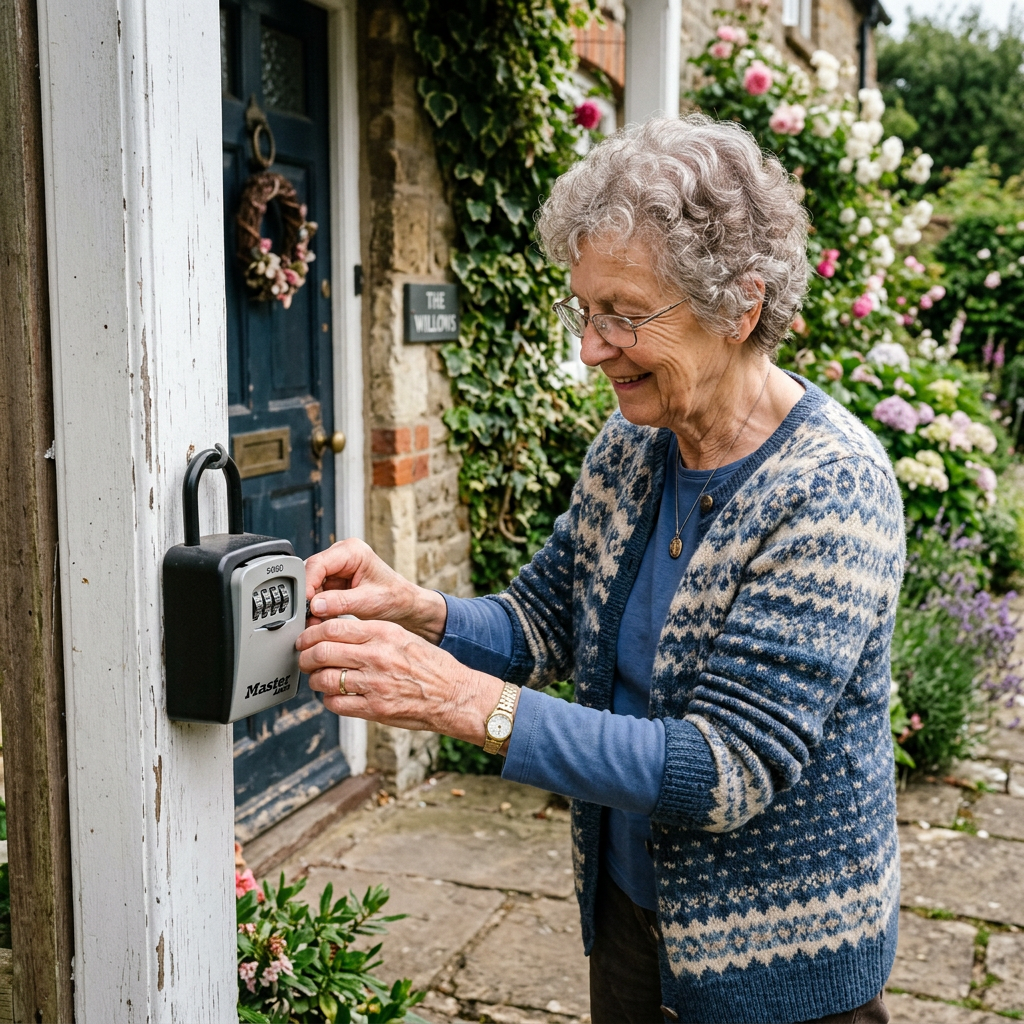
How we sorted through 40+ key lock boxes in two weeks
We cross-referenced more than 8,000 verified Amazon reviews across 40-plus combination key boxes, then filtered for what matters when the buyer is an older adult and the reader is often an EMT: a code that opens on the first try in January, buttons a hand with arthritis can work, and a mount that won’t shear off. We weighted the failure pattern caregivers report again and again. Dials that freeze or jam outdoors and checked each pick against the emergency-access guidance providers like Lifeline and Medical Care Alert publish. Every product below was verified as a live, purchasable Amazon listing in August 2026.
Who this guide is for
This guide is for adult children setting up a home so a caregiver, neighbor, or paramedic can get in fast when a parent can’t reach the door after a fall, a stroke, or a locked deadbolt on a hard day. If you’re buying for yourself, the same picks apply; just skip the “conversation” section near the end.
A key lock box is a small metal safe that holds a spare key behind a combination you choose. Mount it by the door, share the code with the people who need it, and an emergency responder can be inside in seconds instead of breaking a window. For a parent aging in place especially one who lives alone or uses a medical alert button — it’s one of the cheapest, highest-leverage safety upgrades on the checklist. The catch is that a box is only as good as its weakest moment: a dial seized shut by ice, or a code nobody wrote down. So the picks below are ranked by mount type, weatherproofing, and how easy the buttons are for older hands — not by which brand shouts loudest.
At a glance
Best overall — Master Lock 5401D (~$40): permanent wall mount, push-button, 5 keys.
Best no-drill / renter — Master Lock 5422D (~$25): over-the-knob, push-button, weather cover.
Best discreet — Kidde KeySafe Slimline (~$30): low-profile, the model alert companies ship.
Best budget — AMRIU Key Lock Box (~$16): solid wall-mount box for the price.
Best capacity — Vault Locks 3200 (~$18): roomy hanging box for several caregivers.
Best OverallMaster Lock 5401D Wall-Mount Key Box
~$40 · Check price on Amazon →

This is the box we’d mount by most front doors. The 5401D screws permanently to a wall or frame, holds up to five keys, and opens with a set-your-own four-digit push-button code rather than four spinning dials a meaningful difference for arthritic or cold hands. Across thousands of reviews the pattern owners praise most is weather reliability: Master Lock rates the body to sub-zero temperatures, and northern-state buyers note it still opens after ice storms that jammed their old dial boxes. Verified buyers do flag that the buttons take a firm push and that the four-digit code offers fewer combinations than pricier boxes fine for a home, less so for a busy rental. Where a handful of trusted people need in, it balances secure, weatherproof, and easy to operate.
The good
- Push-button code is far easier than a dial for stiff or shaky hands
- Permanent mount can’t be lifted and carried off like a hanging box
- Weather-rated body holds up to freezing, wet outdoor conditions
The catch
- Requires drilling, not an option for renters
- Buttons need a deliberate press; very weak hands may need a helper to set the code
This is right if… you own the home and want one durable, easy-press box mounted for good.
Look elsewhere if… you rent or can’t drill into the frame — get the over-the-knob 5422D below.
Best No-DrillMaster Lock 5422D Over-the-Knob Box
~$25 · Check price on Amazon →

If drilling is off the table, a rental, an apartment, or a parent who won’t hear of holes in the trim. The 5422D hangs its shackle over a door handle or railing. Like its wall-mount sibling it uses a four-digit push-button code, and it ships with a rubber weather cover that snaps over the buttons against rain, snow, and grit. That cover earns its keep: the most common one-star complaint across cheap hanging boxes is a mechanism that froze outdoors, and verified buyers credit this cover with keeping the box working through winter. The trade-off is inherent to any hanging box — it can be lifted and carried off, so keep it out of full street view.
The good
- No tools or drilling hangs over a knob or railing in seconds
- Push-button code plus a snap-on weather cover that prevents freeze-ups
- Fully portable, so it moves with a parent who relocates
The catch
- A hanging box is less secure than a bolted one — keep it out of street view
- Holds fewer keys than the larger boxes on this list
This is right if… you rent or want a box that installs with zero tools.
Look elsewhere if… the door is in plain view of the street and you want something bolted down.
Best DiscreetKidde AccessPoint KeySafe Original Slimline
~$30 · Check price on Amazon →

If you’ve ever seen a lock box installed by a medical-alert company, odds are it was a Kidde KeySafe the low-profile, permanently mounted model on countless senior front doors, sold directly on Amazon. The Slimline body sits close to the wall so it reads as unremarkable hardware rather than “there’s a key here,” and it opens with a push-button combination that’s forgiving for older fingers. Reviewers consistently describe it as sturdy and long-lived, many units still working years after install; aging-in-place resources name Kidde as a default because the brand has made these boxes for decades. The honest limits: it holds two keys rather than a fat keyring, and like any permanent box it needs a few screws. If you want the quietly professional look alert companies rely on without a monthly rental, this is it.
The good
- Slim, discreet profile that doesn’t advertise a hidden key
- Push-button combo that’s easy to teach and easy to press
- The proven model many medical-alert providers install
The catch
- Two-key capacity — tight for a big keyring or multiple keys
- Permanent mount; not for renters who can’t drill
This is right if… you want the discreet, alert-company-grade box without a monthly fee.
Look elsewhere if… a parent carries several keys that all need to live in the box.
Best BudgetAMRIU Combination Key Lock Box
~$16 · Check price on Amazon →
Not every household needs to spend $40 here, and the AMRIU is the box we’d hand to a family testing whether a lock box even fits their routine before a permanent install. It’s a wall-mounted, set-your-own four-digit box explicitly marketed for an elderly parent’s spare keys, and its reviews come back to straightforward value — it holds a key behind a resettable code for well under twenty dollars. Because it uses rotating dials rather than push-buttons, it asks a bit more of arthritic hands and a bit more weather caution, so pair it with a small overhang in wet climates. As a first box or a budget-first choice, it punches above its price.
The good
- Lowest price on this list — easy to try the concept risk-free
- Set-your-own four-digit code, wall-mountable
- Marketed and sized for a parent’s spare house keys
The catch
- Dials are harder on arthritic hands than push-buttons
- Best sheltered from direct weather — exposed dials can stiffen in cold
This is right if… you want to spend the least and the door has some overhead cover.
Look elsewhere if… hands are weak or the box will sit fully exposed to snow — go push-button.
Best CapacityVault Locks 3200 Hanging Key Safe
~$18 · Check price on Amazon →

When a parent’s care involves a rotating cast a home health aide, two adult children, a neighbor one small two-key box gets crowded. The Vault Locks 3200 answers with a roomy interior owners say swallows a dozen-plus keys, fobs, and cards, all behind a set-your-own four-digit code. It hangs by a coated shackle over a knob or railing — a no-drill option like the 5422D with far more room. Across its reviews the standout theme is capacity for the price, so everyone’s key lives in one place. As a hanging numeric box it carries the usual caveats: keep it out of direct street view, and give the dials a firm, weather-aware spin.
The good
- Large interior holds many keys, fobs, and cards for several caregivers
- No-drill hanging design; set-your-own four-digit code
- Inexpensive for the amount of storage
The catch
- Hanging box, less secure than bolted; keep it discreet
- Numeric dials, not push-buttons — a bit more effort for stiff hands
This is right if… several people share access and you need room for many keys.
Look elsewhere if… only one or two keys ever go inside — a slim box is tidier.
Quick comparison
| Box | Mount | Lock type | Best for | Price |
|---|---|---|---|---|
| Master Lock 5401D | Wall (permanent) | Push-button | Overall pick | ~$40 |
| Master Lock 5422D | Over-the-knob | Push-button | Renters / no-drill | ~$25 |
| Kidde KeySafe Slimline | Wall (permanent) | Push-button | Discreet / proven | ~$30 |
| AMRIU Key Lock Box | Wall | Dial | Budget | ~$16 |
| Vault Locks 3200 | Over-the-knob | Numeric dial | Many keys / caregivers | ~$18 |
The conversation you’ll have
Plenty of older adults hear “let’s put a lock box on your door” as “we don’t trust you on your own” and dig in. The trick is to frame it as protecting the house, not policing them. Instead of “This is so we can check on you,” try: “If you ever fall and can’t reach the door, this is how the paramedics get in without smashing your good door.” Most parents soften when the box is presented as their control: they pick the code, they decide who gets it, and they can change it any time.
One more move that lowers resistance: install it together and let them set the first code. Handing over that small decision turns the box into something they own. If a parent has a medical alert system, note that the alert company can hold the code and pass it to responders.
Cost, coverage, and the free option
Here’s the straight answer: Original Medicare does not pay for a key lock box — it isn’t durable medical equipment, so there’s no billing path, and a standalone box generally isn’t FSA/HSA-eligible on its own. The real savings are elsewhere. Many medical-alert providers (Lifeline, Medical Care Alert, and others) include a lock box free with a monitoring plan, or sell one for around $35 so if a parent already has or is weighing an alert button, ask before buying separately. And the free option most families miss: many local fire departments run a lock-box or key-registration program for residents with medical needs, sometimes at no cost — a quick call to the non-emergency line is worth it. For where a box fits among other upgrades, see our complete aging-in-place home safety checklist.
What to actually look for
Push-button vs. dial and why it matters for older hands
The lock mechanism is the biggest usability decision. Push-button boxes let you press a code, far kinder to arthritic or cold hands than pinching and rotating four tiny dials. Dials cost less and are fine for a capable user, but if the person opening the box has hand pain or low grip strength, spend the extra few dollars on push-buttons. Whichever you choose, one habit matters more than the brand: pick a code and write it down where trusted people and the medical-alert company can find it — a lock box nobody can open is just a rock.
Weatherproofing is the failure point
The most common reason a lock box fails in an emergency isn’t a thief — it’s ice. Exposed dials and buttons freeze, corrode, or clog with grit, and the box that opened fine in July won’t budge in January. Look for a sealed mechanism, a shutter, or a snap-on weather cover, and mount it with a little overhead shelter when you can — which is exactly why our top two picks are push-button Master Lock boxes with weather protection built in.
Mount type, placement, and security
A bolted wall-mount box can’t be carried away; a hanging over-the-knob box can, which is why renters trade a little security for no-drill convenience. If you go hanging, put it on a side or back door out of street view. Wherever it goes, make sure responders can be told where it is — a box paired with a medical alert system, so the monitoring center can relay the location and code, beats a secret box only the family knows about. For how a lock box works alongside an alert button, read our guide to the best no-monthly-fee fall detection devices.
Frequently asked questions
Are key lock boxes safe, or can they be broken into?
A quality metal lock box resists prying, sawing, and hammering, and a set-your-own code you keep private is secure for everyday use. No box is burglar-proof, so mount a bolted one where possible, keep a hanging box out of street view, and change the code if too many people learn it. For most homes the safety gained in an emergency far outweighs the small residual risk.
How do paramedics or EMS get the code?
If the home has a monitored medical alert system, you give the code to the provider, who relays it to responders when the alarm is triggered. Without a system, share it with trusted neighbors and family, and ask your local fire department whether it runs a key-registration or lock-box program for residents with medical needs.
Can renters use a key lock box without drilling?
Yes. Over-the-knob boxes like the Master Lock 5422D and Vault Locks 3200 hang from a handle or railing with no tools and no holes, so they’re ideal for apartments and rentals. The trade-off is that a hanging box is less secure than a bolted one, so place it discreetly and keep the code private.
Do medical alert companies provide a lock box?
Many do — providers such as Lifeline and Medical Care Alert either include a lock box with a monitoring plan or sell one for around $35. If a parent already uses or is considering an alert button, ask before buying separately, since the provider can hold the code for responders.
Will a key lock box freeze or jam in winter?
Cheaper boxes with exposed dials can freeze, corrode, or clog outdoors — the leading reason a box fails when it’s needed. Choose a model with a sealed mechanism or snap-on weather cover, such as the push-button Master Lock picks here, and mount it with some overhead shelter.
The shortlist


What we’d do tomorrow
If you’re setting this up this weekend, do three things in order. First, buy the box that matches the door: the Master Lock 5401D if you own and can drill, the Master Lock 5422D if you rent. Second, install it together, let your parent set the code, and write that code where trusted people can reach it. Third, the step most families skip make sure responders can learn the code: give it to the medical-alert provider if there is one, or call the fire department’s non-emergency line about their lock-box program. A box on the door is good; a box responders can actually open is what saves the door, the window, and the minutes.
— Sarah
Leave a Reply