Author: Sarah

  • 5 Best Pulse Oximeters for Seniors

    5 Best Pulse Oximeters for Seniors

    Disclosure: BuyingForMom is reader-supported. As an Amazon Associate we earn from qualifying purchases. When you buy through links in this article, we may earn an affiliate commission at no additional cost to you. We never recommend products we haven’t researched against verified-buyer review data. This article is editorial reporting, not medical advice.

    5 Best Pulse Oximeters for Seniors

    By Sarah Mitchell · Editor, BuyingForMom · Updated September 2026

    10-min read · Smart Home, Vision & Hearing, Caregiver Resources · 5 products compared

    The honest take: For most parents, buy the Innovo Deluxe iP900AP and stop there, its waveform and perfusion index tell you whether a reading is trustworthy, which matters more than a bigger screen or an app. The Wellue O2Ring is worth its much higher price only if a doctor is worried about oxygen drops during sleep, because a fingertip clip can’t record overnight. Skip the no-name $12 multipacks entirely, reviewers report numbers that jump several points between fingers, and a reading you can’t trust is worse than no reading at all.

    How we sorted through 35 pulse oximeters in three weeks

    We cross-referenced more than 10,000 verified-buyer reviews across 35 fingertip and wearable oximeters, then filtered them against sources most roundups skip: the FDA’s safety communication on oximeter limitations, NIH MedlinePlus guidance on getting an accurate reading, published research on skin pigmentation and cold fingers, and recurring caregiver threads on Reddit’s r/AgingParents and r/COPD. The pattern that decided every pick: the right oximeter is the one matched to the senior’s actual barrier — reading the screen, trusting the number, or having someone else see it — not the one with the longest feature list.

    Who this guide is for

    This guide is for adult children and caregivers buying an oximeter for a parent with COPD, heart failure, sleep apnea, a recent pneumonia or COVID illness, or a hospital discharge that came with “keep an eye on your oxygen.” If you’re buying for yourself, the same picks apply — skip the conversation section, which is written for the harder job of getting a parent to actually use it.

    What a home oximeter can and can’t do

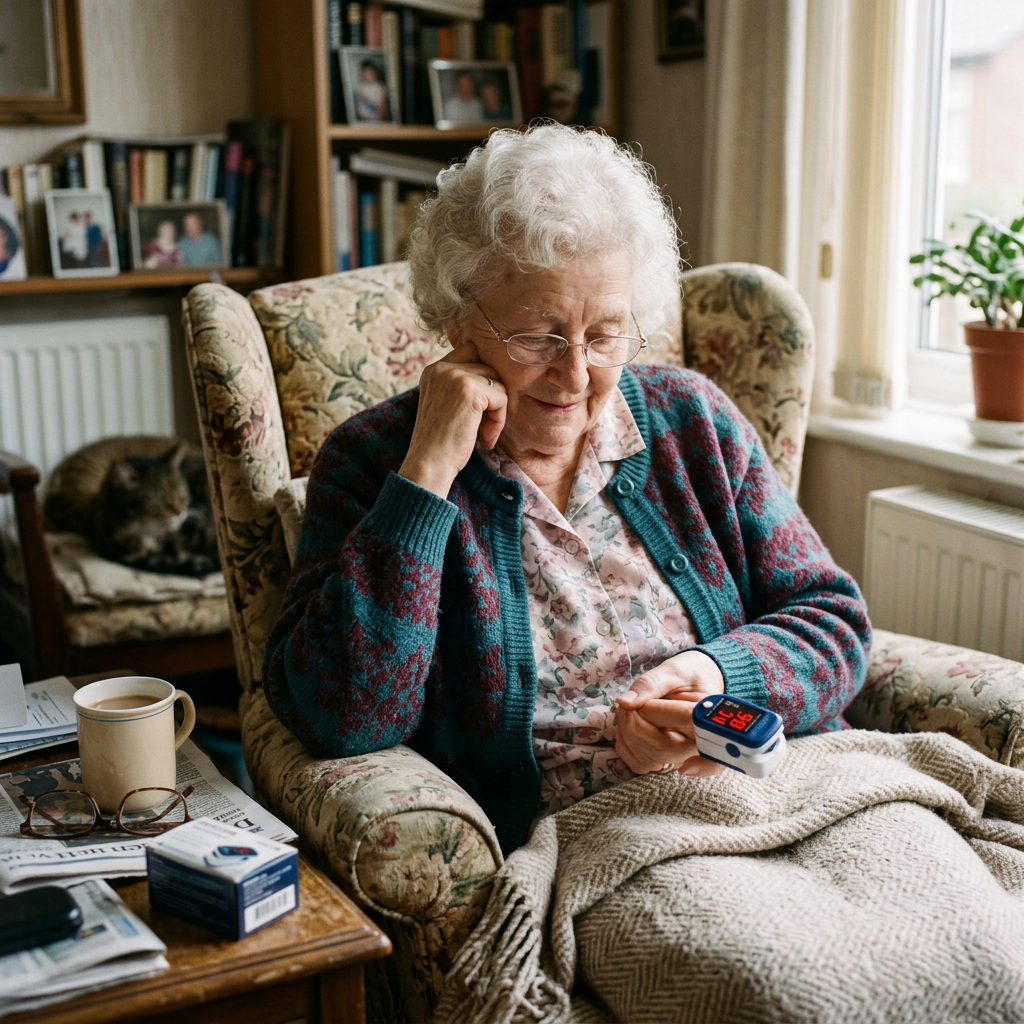
    A pulse oximeter for seniors clips onto a fingertip and shines light through the skin to estimate blood oxygen saturation (SpO2) and pulse rate in about ten seconds. For most healthy adults, a normal reading is 95% to 100%; many older adults and people with lung disease run a little lower, and their doctor may give them a personal target. That personal baseline is the number that matters.

    What the box won’t tell you: most sub-$50 fingertip units are sold as “sports and aviation” devices rather than FDA-cleared medical monitors, and even good ones can be off by 2–3 points. Cold hands, nail polish, a shaky finger, and darker skin tones can all skew the result — the FDA has warned that oximeters may overestimate oxygen in people with darker skin. So the smart way to use one is for trends — is today lower than her usual? and to call the doctor on a sustained drop rather than panic over a single number.

    At a glance

    Best Overall  Innovo Deluxe iP900AP — ~$35 · waveform + perfusion index, alarm

    Best Budget  Zacurate Pro Series 500DL — ~$20 · one button, bright LED digits

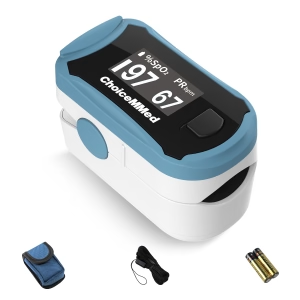
    Best Big Screen  ChoiceMMed C29 — ~$30 · large OLED, 10 brightness levels

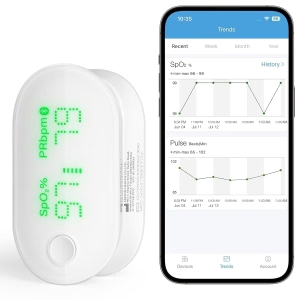
    Best for Remote Caregivers  iHealth Air — ~$30 · rechargeable, logs to an app

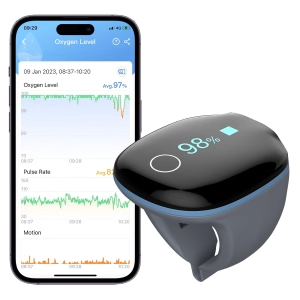
    Best Overnight  Wellue O2Ring — ~$180 · ring sensor, records all night, vibrates on drops

    Best Overall  Innovo Deluxe iP900AP

    ~$35 · Check price on Amazon →
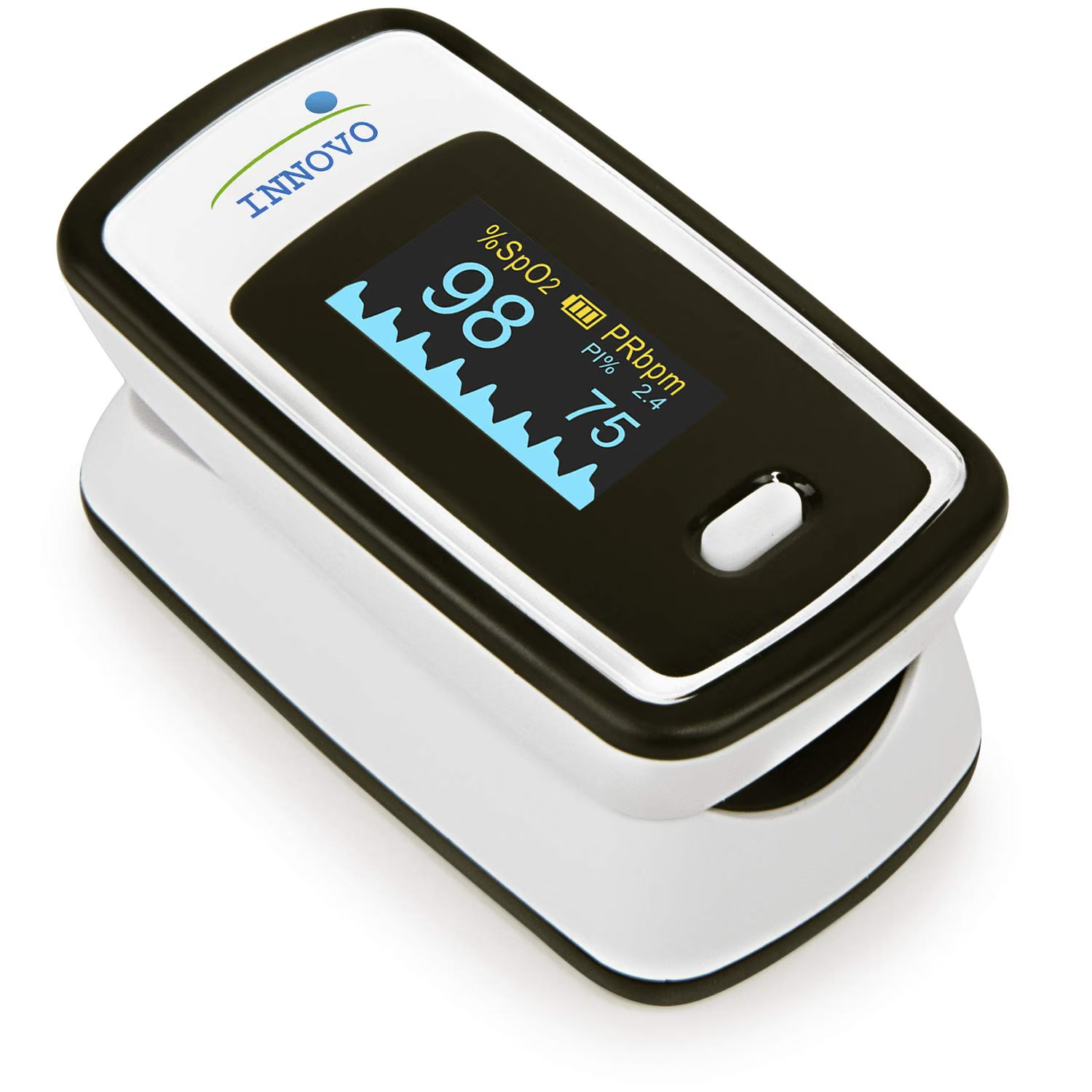
    The Innovo earns the top spot for one feature most cheap oximeters lack: a live pulse waveform (plethysmograph) plus a perfusion index that shows how strong the signal is. In plain terms, it tells you whether to believe the number, a smooth, even wave means a good read; a flat or jagged one means warm the hand and try again. Across thousands of reviews, caregivers of parents with COPD and heart failure single this out as the reason they stopped second-guessing readings. The latest version adds an adjustable alarm, pulse beeps, and a screen that rotates six ways so a caregiver can read it upside-down.

    The good

    • Waveform + perfusion index show whether a reading is trustworthy
    • Reads reliably even with weaker circulation, per verified buyers
    • Rotating OLED screen and optional alarm help a caregiver standing beside the bed

    The catch

    • OLED digits are crisp but smaller than the big-screen pick below
    • Menu for the alarm settings takes a few minutes to learn

    This is right if… your parent has a lung or heart condition and you want readings you can actually trust.

    Look elsewhere if… reading small screens is the main struggle — the ChoiceMMed C29 is easier on the eyes.

    Best Budget  Zacurate Pro Series 500DL

    ~$20 · Check price on Amazon →
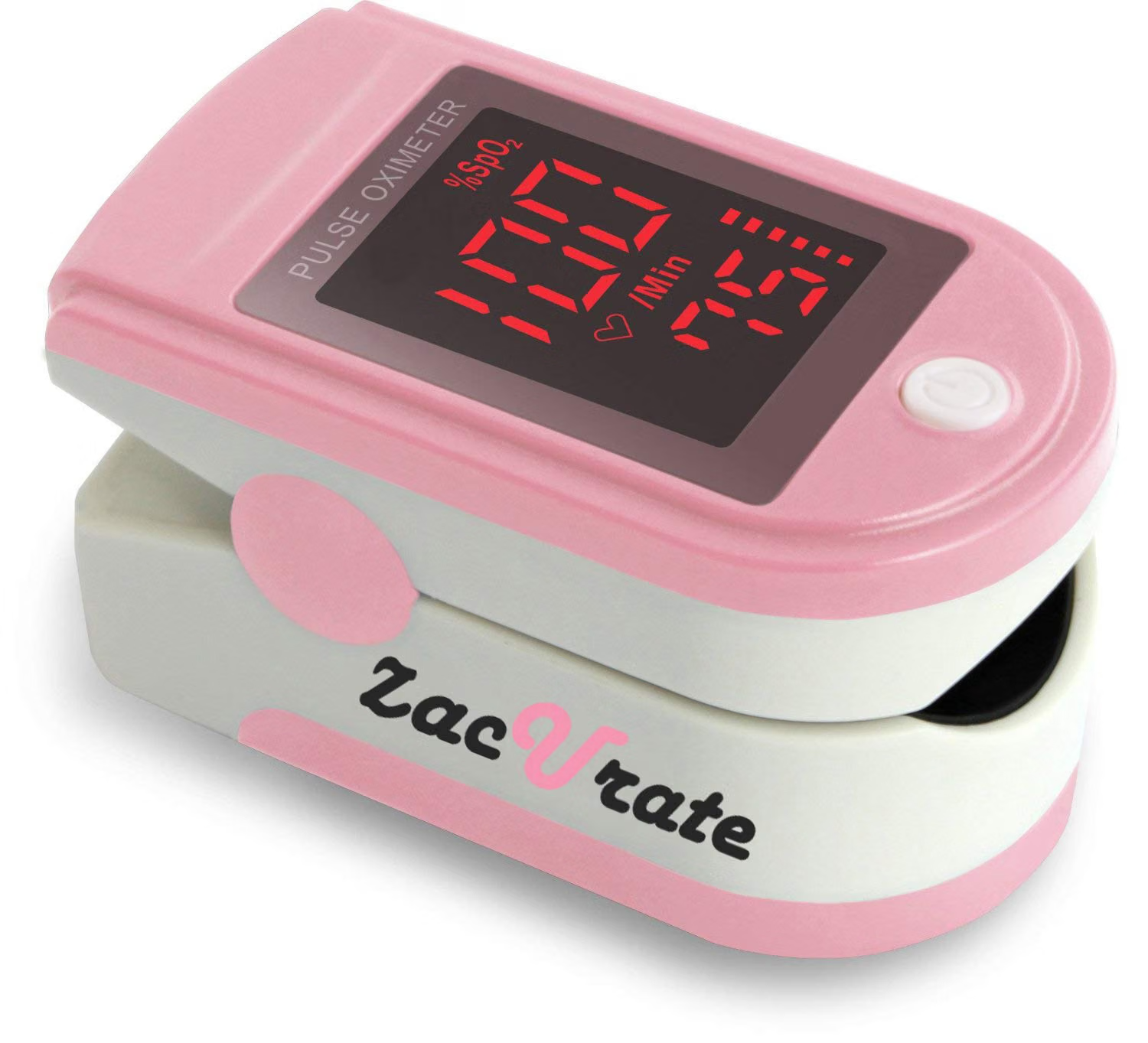
    The Zacurate is the oximeter we’d hand a parent who hates gadgets. There’s one button, the bright red LED digits are readable in a dim bedroom without glasses, and a spring-loaded chamber accommodates a wide range of finger sizes, including knobby, arthritic ones. It has been one of Amazon’s most-reviewed oximeters for years, and the recurring praise is that it simply works: clip on, press, read. It comes with batteries, a silicone cover, and a lanyard, plus a 12-month warranty with U.S.-based phone support — rare at this price.

    The good

    • One-button operation — nothing to set up or remember
    • High-contrast LED digits readable in low light
    • Roomy finger chamber suits arthritic or larger fingers

    The catch

    • No waveform, so it’s harder to tell when a reading is unreliable
    • No alarm and no memory — you have to write readings down

    This is right if… your parent needs occasional spot checks and the simplest possible device.

    Look elsewhere if… the doctor wants a daily log — the iHealth Air records it for you.

    Best Big Screen  ChoiceMMed C29

    ~$30 · Check price on Amazon →
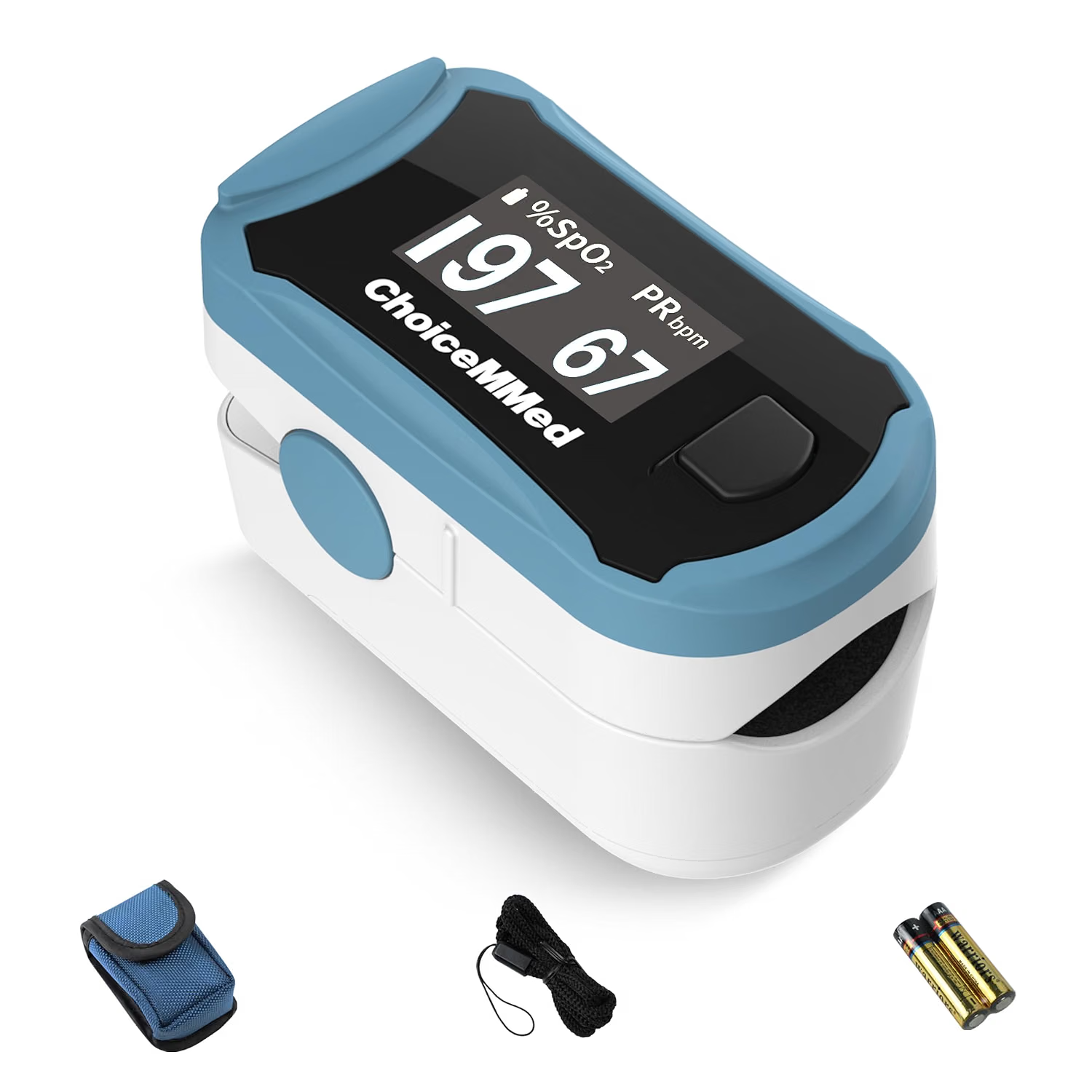
    ChoiceMMed is a long-established oximeter maker whose units are widely used by clinics and the UK’s NHS, and the C29 is its large-display model. The OLED screen is noticeably bigger than a standard fingertip unit, with two display modes and ten brightness levels — the details that matter for macular degeneration, cataracts, or simply tired eyes. Verified buyers describe it as solid and simple, and a pair of AAA batteries runs it for 30-plus hours. It shows the numbers plus a pulse-strength bar, a middle ground between the bare-bones Zacurate and the Innovo.

    The good

    • Larger OLED display with adjustable brightness for low vision
    • Reputable clinical brand; simple single-button use
    • Carrying pouch and lanyard included; long battery life

    The catch

    • Newer listing with a smaller review base than the Zacurate or Innovo
    • No app or reading history

    This is right if… your parent’s eyesight is the barrier and they’ll be checking on their own.

    Look elsewhere if… you need readings sent to you — go with the iHealth Air.

    Best for Remote Caregivers  iHealth Air

    ~$30 · Check price on Amazon →
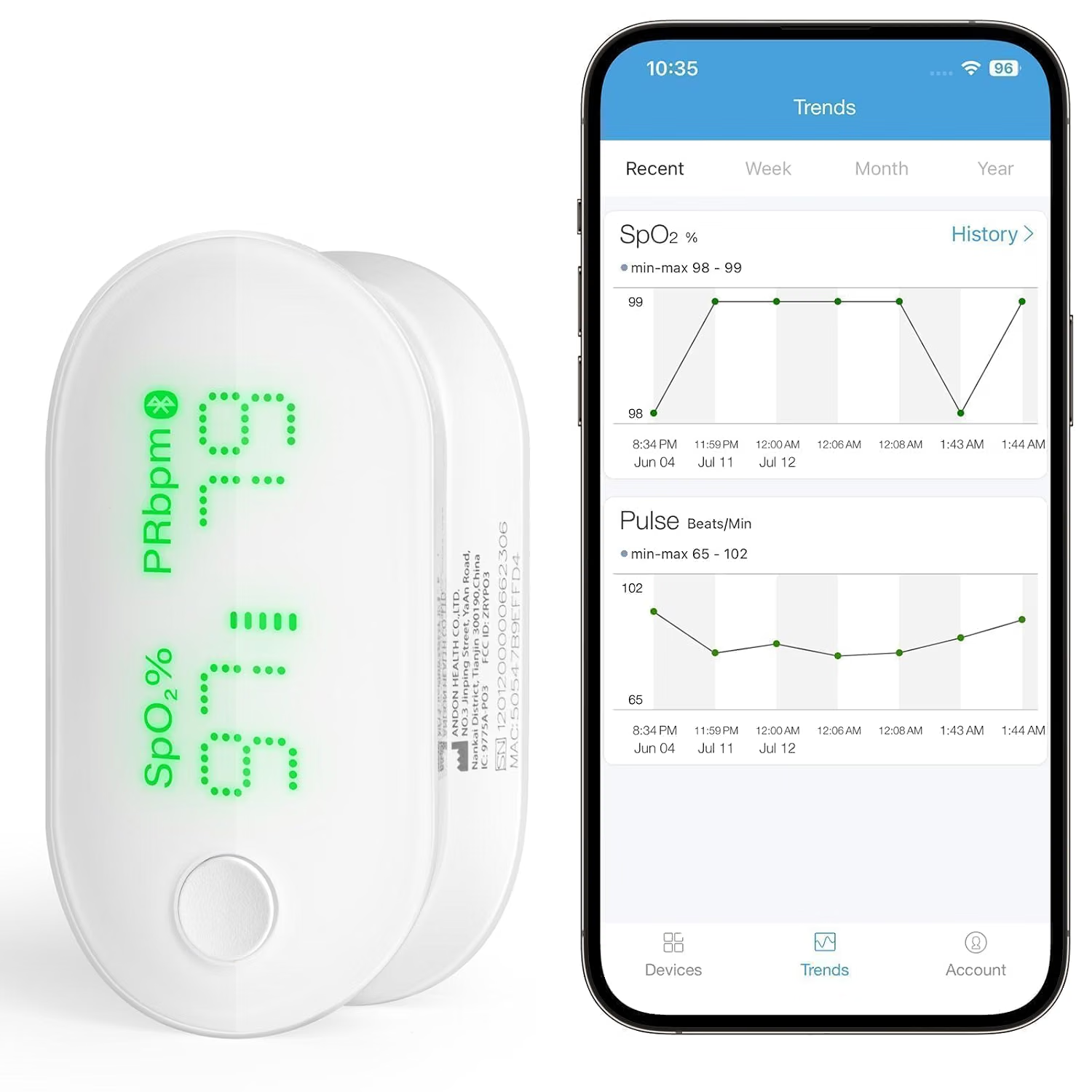
    If you live an hour or a time zone away, the iHealth Air solves the problem no screen can: remembering, and knowing. It syncs by Bluetooth to the free iHealth MyVitals app, which logs every reading with a timestamp, so a doctor can see a two-week trend instead of a scribbled note. It’s also rechargeable — up to about 300 checks per charge — which ends the “batteries died and nobody noticed” failure caregivers complain about most. iHealth devices are used by many U.S. telemedicine programs, and reviewers praise the bright LED display.

    The good

    • Automatic reading log in an app — easy to share with the doctor
    • Rechargeable; no battery swaps for arthritic hands
    • Also works as a plain spot-check oximeter without a phone

    The catch

    • Syncing requires a smartphone nearby — someone has to set it up
    • Some third-party retailers have shown backorders; buy from the main Amazon listing

    This is right if… the doctor wants a daily log or you want to see readings from afar.

    Look elsewhere if… your parent has no smartphone and no one nearby to sync it — the Zacurate is simpler.

    Best Overnight  Wellue O2Ring

    ~$180 · Check price on Amazon →

    This is a different tool, priced accordingly. The O2Ring is a soft ring sensor worn on the thumb or finger all night; it records oxygen and pulse continuously and vibrates gently if levels drop below a threshold you set. Verified buyers with sleep apnea, COPD, or unexplained morning headaches describe the app’s overnight graph as the thing that finally got their doctor’s attention. It’s rechargeable and far more comfortable to sleep in than a fingertip clip. But it’s overkill for daytime spot checks, buy it only when overnight drops are the question.

    The good

    • Continuous all-night recording with shareable reports
    • Vibration alert on drops — no loud alarm waking the house
    • Comfortable ring design stays on during sleep

    The catch

    • Several times the price of a fingertip unit
    • Needs an app to see the report; setup is a caregiver job

    This is right if… a doctor suspects oxygen drops at night and wants data before or between sleep studies.

    Look elsewhere if… you only need a daytime check — any fingertip pick above does it for a fraction of the price.

    How the five compare

    Product Type Price Best for
    Innovo iP900AP Fingertip, waveform + PI, alarm ~$35 Lung/heart conditions, trustworthy reads
    Zacurate 500DL Fingertip, LED, one button ~$20 Occasional spot checks
    ChoiceMMed C29 Fingertip, large OLED ~$30 Low vision
    iHealth Air Fingertip, Bluetooth, rechargeable ~$30 Logging and remote caregivers
    Wellue O2Ring Wearable ring, continuous ~$180 Overnight drops, sleep apnea

    The conversation you’ll have

    An oximeter looks harmless, but to a parent it can feel like being watched or like proof they’re sicker than they want to admit. The most common failure isn’t a bad device; it’s one that sits in a drawer because checking it feels like inviting bad news. Instead of “you need to check your oxygen every day,” try “the doctor said a few numbers would help her adjust things without another appointment — can we write down one in the morning and one at night?” That frames it as fewer office visits, not more worry.

    Then agree on what the numbers mean before a scary one shows up. Ask the doctor for your parent’s personal range and write it on a card next to the device: “Usual: 93–96. Call Dr. Lee if under 90 for more than a few minutes.” A plan turns a frightening number into a clear next step.

    Insurance and savings

    The honest picture: Original Medicare generally doesn’t pay for a standalone home fingertip oximeter for spot checks; oximetry is typically covered only as part of a prescribed home-oxygen setup or a doctor-ordered overnight test. The good news is that at $20–$35 these are inexpensive, and pulse oximeters are FSA- and HSA-eligible, so you can pay with pre-tax dollars. Many Medicare Advantage plans include an over-the-counter allowance that covers exactly this kind of item — worth a quick call to the plan before paying out of pocket.

    What to actually look for

    Match the device to the barrier

    Ask what would actually stop your parent from using it. Can’t read small digits? Prioritize screen size. Forgets or won’t write readings down? Choose one that logs to an app. Doctor worried about sleep? Only a wearable records overnight. That single question narrows the field faster than any spec sheet — and it’s the same logic we apply across the whole house in our complete aging-in-place home safety checklist.

    Look for signal-quality clues

    A waveform or perfusion index is the most underrated feature for older adults, whose circulation to the fingers is often weaker. It shows when a number is unreliable, so you don’t act on a false low. To get a good read: warm the hands, remove nail polish, sit still for five minutes, rest the hand at heart level, and use the middle or index finger. Wait for the number to hold steady for several seconds before writing it down.

    Know what an oximeter won’t catch

    An oximeter measures oxygen, not falls, blood pressure, or an emergency when no one’s watching. If your parent lives alone with a lung or heart condition, pair it with a way to call for help — see our no-monthly-fee fall detection guide — and consider tracking blood pressure too with one of our easy-to-use blood pressure monitors for seniors. And whatever the screen says, trouble breathing, chest pain, confusion, or bluish lips mean calling 911, not re-checking.

    Frequently asked questions

    What is a normal oxygen level for an 80-year-old?

    For most older adults, a resting reading of 95% to 100% is normal, though healthy seniors sometimes run slightly lower. People with COPD or other lung disease may have a doctor-set target closer to 88–92%. The most useful number is your parent’s personal baseline, so ask the doctor for their range.

    Are home pulse oximeters accurate?

    Good ones are reasonably close, typically within 2 to 3 points when oxygen is above 90% but accuracy drops at lower levels. Cold hands, movement, nail polish, and darker skin can skew results. Use a home oximeter to spot trends and changes, and confirm worrying readings with a doctor.

    Which finger is best for a pulse oximeter?

    The middle or index finger of the dominant hand usually gives the most reliable reading. Remove nail polish or artificial nails, warm the hand if it’s cold, and rest it at heart level. If a reading seems off, try a different finger and compare after the number holds steady for several seconds.

    Why is my parent’s oximeter reading low?

    Often it’s the reading, not the lungs. Cold fingers, poor circulation, shaky hands, nail polish, or bright light can all cause a false low. Warm the hands, sit still for five minutes, and recheck. If it stays below their usual range, or they’re short of breath, contact their doctor promptly.

    Does skin color affect pulse oximeter readings?

    Yes, The FDA and published research show oximeters can overestimate oxygen levels in people with darker skin, which means a genuinely low level could look normal. If your parent has darker skin, pay close attention to symptoms like breathlessness or confusion and don’t let a normal-looking number override them.

    Does Medicare cover a pulse oximeter?

    Original Medicare generally doesn’t cover a standalone fingertip oximeter for home spot checks; it’s usually covered only as part of prescribed home-oxygen equipment or a doctor-ordered test. Oximeters are FSA- and HSA-eligible, and many Medicare Advantage over-the-counter allowances include them — check the plan’s catalog.

    The shortlist

    Best Overall

    Innovo Deluxe iP900AP

    ~$35

    Check on Amazon →

    Best Budget

    Zacurate Pro Series 500DL

    ~$20

    Check on Amazon →

    Best Big Screen

    ChoiceMMed C29

    ~$30

    Check on Amazon →

    Best for Remote Caregivers

    iHealth Air

    ~$30

    Check on Amazon →

    Best Overnight

    Wellue O2Ring

    ~$180

    Check on Amazon →

    What we’d do tomorrow

    If you’re setting this up this week, do three things in order. First, call the doctor’s office and ask for your parent’s personal oxygen range and the number that should trigger a call. Second, buy the oximeter that matches the barrier the Innovo for most parents, the ChoiceMMed if eyesight is the problem, the iHealth Air if you need the log, the O2Ring only if nights are the question. Third, sit down together, take the first reading with warm hands, and tape the range card right next to it. The device is the easy part; knowing what to do with the number is the point.

    — Sarah

    BuyingForMom is a reader-supported site. As an Amazon Associate we earn from qualifying purchases. When you buy through links on this site, we may earn an affiliate commission at no additional cost to you. See our Affiliate Disclosure for details. This article is not medical advice, please consult a qualified healthcare professional for decisions specific to your own situation.
  • 5 Best Non-Slip Slippers for Swollen Feet

    5 Best Non-Slip Slippers for Swollen Feet

    Disclosure: BuyingForMom is reader-supported. As an Amazon Associate we earn from qualifying purchases. When you buy through links in this article, we may earn an affiliate commission at no additional cost to you. We never recommend products we haven’t researched against verified-buyer review data. This article is editorial reporting, not medical advice.

    5 Best Non-Slip Slippers for Seniors With Swollen Feet

    By Sarah Mitchell · Editor, BuyingForMom · Updated September 2026

    10-minute read · Balance & Mobility · 5 verified-in-stock picks

    The honest take: For most parents with feet that swell through the day, buy the RockDove Adjustable Wrap the wrap closure re-tightens as swelling changes and the sole actually grips. If your parent’s balance is shaky and they need real arch support, the Orthofeet Charlotte is worth the higher price. Skip anything backless, floppy, or “memory-foam soft with no strap” entirely a slipper that slides half-off or wobbles is a fall waiting to happen, and that is the opposite of why you’re buying one.

    How we sorted through 40+ senior slippers in two weeks

    We started with more than forty slippers marketed to older adults with swollen feet, then narrowed by the two things that actually matter: does the closure adjust to a foot that changes size through the day, and does the sole grip a hardwood or tile floor rather than skate across it. We cross-referenced several thousand verified-buyer reviews, leaned on the recurring guidance from occupational therapists and fall-prevention groups that backless and floppy slippers are a leading in-home hazard, and read the caregiver complaints (the number-one gripe: the strap wears out or the “non-slip” sole isn’t). Five made the cut because they stay on the foot, adjust for edema, and have a sole you can trust.

    Who this guide is for

    This is for adult children buying slippers for a parent whose feet swell, from edema, diabetes, arthritis, circulation issues, or long days on their feet and who needs something safe from the bedroom to the bathroom and kitchen. If you’re shopping for yourself, the same picks apply. If your parent’s swelling is severe, painful, or new, talk to their doctor before buying anything.

    Why the wrong slipper is more dangerous than no slipper

    Falls are the leading cause of injury for adults over 65, and a surprising share of home falls trace back to footwear that doesn’t stay on the foot. A backless mule slides at the heel, so the foot shuffles; a plush foam slipper skates on tile; a slipper gone tight because the foot swelled gets half-worn. The fix isn’t “softer” it’s a slipper that fastens to the foot, opens wide enough for a swollen foot without squeezing, and has a firm treaded sole. Comfort comes second to staying put. Every pick below clears that bar, and where one has a real weakness, we say so.

    At a glance

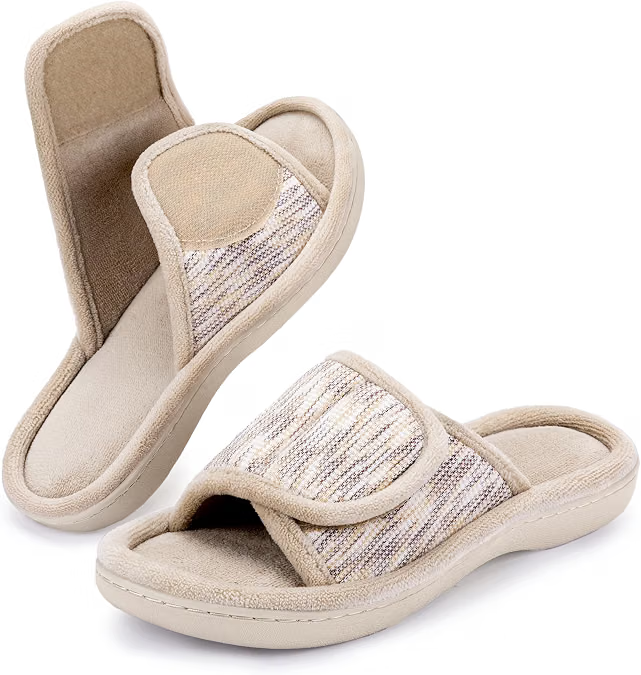
    Best Overall  RockDove Adjustable Wrap Memory Foam Slide — ~$28 · re-tightens as swelling changes, non-slip TPR sole, machine-washable.

    Best for Support  Orthofeet Charlotte Orthopedic — ~$85 · arch support + firm footbed + closed heel for shaky balance.

    Best for Big Swelling (Women)  MEJORMEN Women’s Diabetic Edema — ~$30 · dual straps, extra-wide, open toe.

    Best for Men  MEJORMEN Men’s Diabetic Edema — ~$32 · extra-wide, easy on/off, 11 sizes.

    Best for Severe Edema  Extra-Wide Fully-Opening Adjustable Slipper — ~$26 · opens flat, double-depth, thick grippy sole.

    Best Overall RockDove Women’s Adjustable Wrap Memory Foam Slide

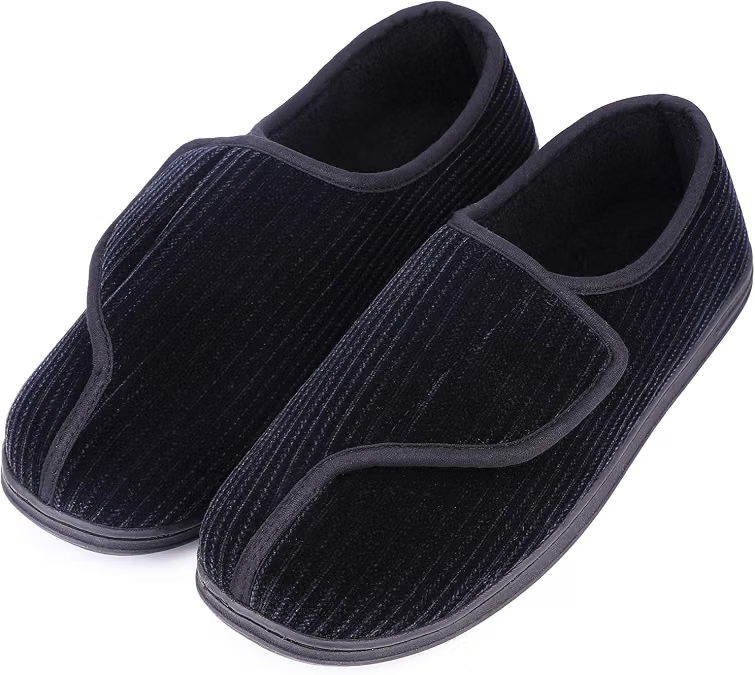
    The RockDove Adjustable Wrap is the pick we’d hand most families first, because it solves the real problem: a foot that isn’t the same size at 8 a.m. and 8 p.m. The wide wrap strap re-fastens across the top of the foot, so a parent or caregiver can loosen it as the day’s swelling builds without hunting for a bigger slipper. Across several thousand verified reviews the pattern is consistent — buyers with swollen or sensitive feet like that it adjusts, and the TPR outsole has a real anti-slip tread rather than the slick foam bottom that makes so many “cozy” slippers a hazard. It’s machine-washable and looks like a normal slipper, which matters for buy-in. The honest caveat: reviewers note the footbed is thin and the foam softens after repeated washing, so it’s an everyday-comfort slipper, not an all-day walking shoe.

    ~$28 · Check price on Amazon →

    The good

    • Wide wrap strap re-adjusts as swelling changes through the day
    • Genuinely grippy TPR outsole (not slick foam), indoor/outdoor rated
    • Machine-washable and looks like an ordinary slipper — easy sell to a resistant parent

    The catch

    • Thin footbed, not enough cushion for standing/cooking for long stretches
    • Open-heel slide design; the strap holds it, but a very unsteady walker may want a closed heel

    This is right if… your parent’s swelling comes and goes and you want one reliable, washable everyday slipper.

    Look elsewhere if… they’re on their feet for hours and need serious cushioning and arch support.

    Best for Support Orthofeet Charlotte Orthopedic Slippers

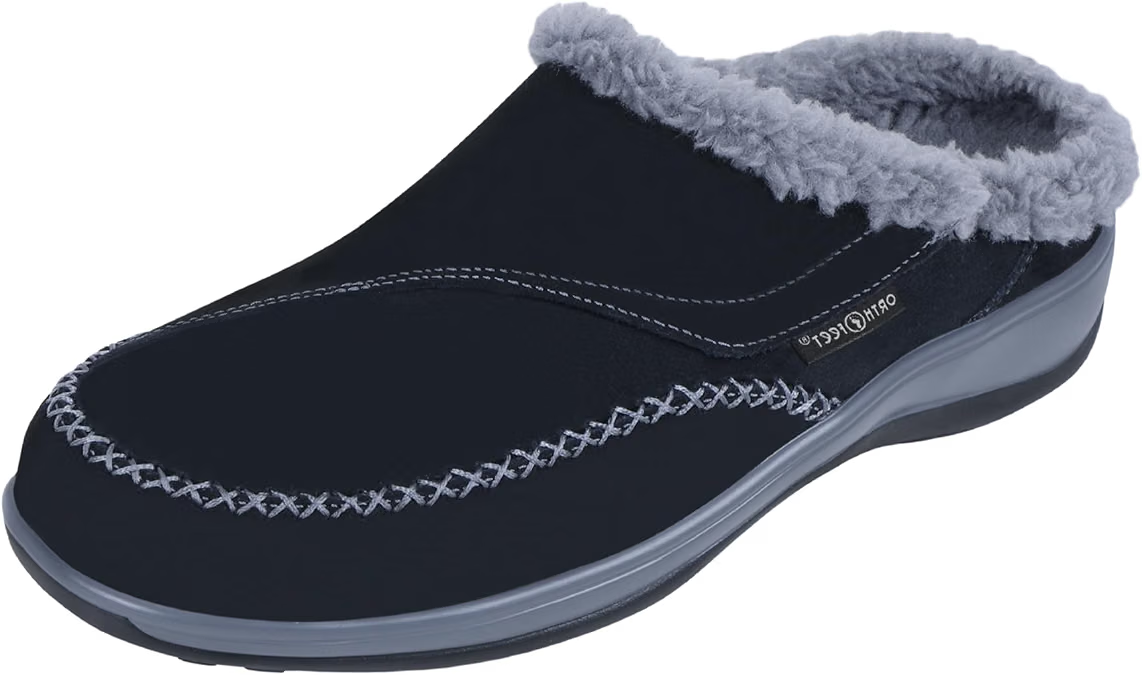
    When the bigger worry is balance rather than just swelling, the Orthofeet Charlotte is the upgrade. Orthofeet is the brand occupational therapists cite most for at-home orthopedic footwear, and the Charlotte carries a supportive footbed and arch support into a faux-fur house slipper with an enclosed heel — the feature an unsteady walker actually needs. The adjustable strap and wide toe box give swollen feet somewhere to go, and verified buyers with plantar fasciitis, diabetes, and arthritis repeatedly say it’s the first slipper that didn’t leave their feet aching. It’s the most expensive pick here by a wide margin — the honest trade is you’re paying for structure, not fluff. If your parent already wears Orthofeet shoes, it’s a no-brainer.

    ~$85 · Check price on Amazon →

    The good

    • Real arch support and a firm, supportive footbed — best of the five for shaky balance
    • Closed, enclosed heel stays on the foot far better than a slide or mule
    • Adjustable strap plus a wide toe box accommodates moderate swelling

    The catch

    • Roughly three times the price of the other picks
    • Faux-fur lining runs warm — less ideal for a parent whose feet already run hot

    This is right if… balance and foot pain are the real issues and you’ll pay for proper support.

    Look elsewhere if… swelling is severe and fluctuating — a dedicated dual-strap edema slipper opens wider.

    Best for Big Swelling — Women MEJORMEN Women’s Diabetic Edema Slippers

    When swelling is significant ankles that balloon by evening, or edema that varies day to day, a single strap isn’t enough, and this is where MEJORMEN’s dedicated edema slipper earns its place. Dual hook-and-loop straps open almost the full width of the slipper, so a very swollen foot goes in without bending, and each strap tightens independently for uneven swelling (one foot bigger than the other is common). It’s extra-wide with an open toe to relieve pressure, and the sole has a non-slip tread for indoor and light outdoor use. Verified buyers caring for diabetic and post-surgical parents consistently call it the rare slipper roomy enough for a genuinely swollen foot. The trade-off: it’s a utilitarian medical slipper, and the open toe means it’s not for cold rooms.

    ~$30 · Check price on Amazon →

    The good

    • Dual straps open nearly flat and tighten independently for uneven swelling
    • Extra-wide, open toe relieves pressure on a genuinely edematous foot
    • Non-slip tread rated for indoor and light outdoor use

    The catch

    • Function-first looks — reads more “medical” than “cozy slipper”
    • Open toe offers no warmth for a cold house

    This is right if… your mom’s feet swell a lot or unevenly and need to open wide to get in.

    Look elsewhere if… swelling is mild and she’d rather have something that looks like a normal slipper.

    Best for Men MEJORMEN Men’s Diabetic Edema Slippers

    The men’s version solves the same problem for a dad with swollen feet. It’s built extra-wide with a fully adjustable strap that opens the slipper up for easy on-and-off — important when bending to a foot is hard or a caregiver is helping. It comes in eleven sizes from 7 to 13 with slim-to-extra-wide fit, so you can match a real foot instead of guessing, and verified buyers describe it as the first house shoe that fit a swollen, hard-to-fit foot. The sole is treaded for grip on hard floors. Same honest caveat as its sibling: it’s a practical medical-style slipper, and a few reviewers report the hook-and-loop weakening after heavy daily use, so check it periodically.

    ~$32 · Check price on Amazon →

    The good

    • Extra-wide with a strap that opens wide for easy, low-bending on/off
    • Eleven sizes and multiple widths — you can match an actual swollen foot
    • Treaded sole grips hardwood and tile

    The catch

    • Utilitarian look; not a “gift-y” cozy slipper
    • A few buyers report the strap’s grip weakening with heavy daily wear

    This is right if… you’re buying for a dad with wide, swollen, hard-to-fit feet.

    Look elsewhere if… his feet don’t really swell and a standard supportive slipper would do.

    Best for Severe Edema Extra-Wide Fully-Opening Adjustable Slipper

    For the hardest cases, severe edema, a bandaged foot, or a parent who can’t bend or help — this fully-opening extra-wide slipper goes on when nothing else will. The whole top opens flat on wide hook-and-loop straps, so a caregiver can set the foot down and close the slipper around it rather than working the foot in. It’s double-depth to swallow a very swollen or dressed foot, and the sole is a thick rubber grip built for stability. Verified buyers dealing with post-surgical swelling and limited mobility repeatedly call it the only thing that fit. It’s the plainest-looking pick and the least “slipper-like” — think adaptive footwear more than loungewear, which is exactly why it works for the toughest fits.

    ~$26 · Check price on Amazon →

    The good

    • Opens completely flat, the foot is placed in, not forced in
    • Double-depth fit accommodates a bandaged or severely swollen foot
    • Thick rubber grip sole built for stability on hard floors

    The catch

    • Most utilitarian look of the five reads as adaptive footwear
    • Check the size chart carefully; the roomy fit can run large on a normal foot

    This is right if… swelling is severe, the foot is bandaged, or a caregiver does the dressing.

    Look elsewhere if… swelling is mild, this is more slipper than that situation needs.

    How the five compare

    Slipper ~Price Closure Best for
    RockDove Adjustable Wrap $28 Single wrap strap Everyday, fluctuating swelling
    Orthofeet Charlotte $85 Strap + closed heel Support & shaky balance
    MEJORMEN Women’s Edema $30 Dual straps, open toe Big/uneven swelling (women)
    MEJORMEN Men’s Edema $32 Wide adjustable strap Swollen feet (men)
    Extra-Wide Fully-Opening $26 Opens flat Severe edema / caregiver-assisted

    The conversation you’ll have

    Footwear is touchy, because handing someone “special slippers” can feel like telling them they’ve gotten old. Make it about comfort, not decline. Try “These adjust when your feet swell up at the end of the day, so they’re not squeezing” instead of “You need non-slip ones so you don’t fall.” If they’re attached to a beloved old pair gone flat and slick, don’t confiscate it — replace it with something that solves a real annoyance (a strap that finally fits the swollen foot) and let the old pair quietly retire. If the resistance is about looking frail, the RockDove and Orthofeet both pass for ordinary slippers.

    Insurance and savings

    Regular slippers aren’t covered by Medicare, and most edema slippers won’t be either. The exception worth knowing: under Medicare Part B’s therapeutic-shoe benefit, people with diabetes who meet specific criteria can get coverage for one pair of qualifying therapeutic shoes and inserts per calendar year — but that requires a prescription and a supplier enrolled in Medicare, and off-the-shelf house slippers generally don’t qualify. Where you’re more likely to save is an FSA or HSA: diabetic and therapeutic footwear is frequently an eligible expense, so keep the receipt and check your plan. If swelling is new, sudden, one-sided, or painful, treat that as a medical question first — a slipper manages the symptom, it doesn’t diagnose the cause.

    What to actually look for

    A closure that adjusts to the day, not a fixed size

    Swollen feet aren’t the same size at breakfast and dinner, so a slip-on that fits in the morning gets tight and gets kicked off by evening. A hook-and-loop strap or wrap that re-tightens is the single most important feature — it’s what lets one slipper work all day. For heavy or uneven swelling, look for two independent straps or a design that opens flat. Fit is the foundation of everything else; our complete aging-in-place home safety checklist walks through where footwear sits in the bigger fall-prevention picture.

    A sole that grips — and a slipper that stays on

    “Non-slip” has to mean a firm rubber or TPR outsole with a real tread, not a slightly-textured foam bottom that still skates on tile. Just as important, the slipper must stay on the foot: closed or secured heels beat backless mules, which slide at the heel and cause shuffling. If your parent moves between rooms and floor types, see how footwear fits into the whole home in our room-by-room aging-in-place modification guide.

    Slipper vs. grip sock — pick the right tool

    A non-slip grip sock and a non-slip slipper solve different problems. A grip sock is great for bed-to-bathroom trips and for a foot too swollen or sensitive for any structure — but it has no support and no real sole. A slipper adds a firm outsole, structure, and a closure that holds the foot. Many families use both: socks overnight, slippers for the day. If you want the sock side of that pairing, see our guide to non-slip grip socks for seniors.

    Frequently asked questions

    Are slippers safe for elderly people, or do they cause falls?

    Both, depending on the slipper. Backless, floppy, or smooth-soled slippers are a documented fall hazard — they slide off and cause shuffling. A slipper that fastens to the foot with an adjustable strap and has a firm treaded sole does the opposite: it improves footing and confidence indoors.

    What kind of slipper is best for swollen feet?

    Look for an adjustable hook-and-loop strap or wrap that re-tightens as swelling changes, a wide or extra-wide opening, and a roomy toe box. For significant or uneven edema, choose a dual-strap or fully-opening design so the foot goes in without being squeezed or bent.

    Should seniors wear open-back or closed-back slippers?

    Closed-back or securely strapped slippers are safer. Backless mules slide at the heel, which causes shuffling and heightens fall risk. If your parent has swelling, an adjustable closed or wrapped design gives both security and room to expand.

    Are non-slip socks or slippers better for seniors?

    They serve different needs. Grip socks suit bed-to-bathroom trips and feet too swollen for structure, but offer no support or sole. Slippers add a firm outsole and a closure that holds the foot. Many families use socks at night and slippers during the day.

    Can you wear edema slippers outside?

    Several here have indoor/outdoor-rated treaded soles fine for short trips to the mailbox or car. They aren’t a substitute for a properly fitted outdoor shoe for real walking, and open-toe styles offer no protection — keep those indoors.

    What makes diabetic slippers different from regular slippers?

    Diabetic and edema slippers are built extra-wide with seam-free or low-pressure interiors, adjustable closures for swelling, and non-binding openings to protect sensitive feet from pressure points. Regular slippers prioritize looks and warmth over fit and pressure relief.

    The shortlist

    Best Overall

    RockDove Adjustable Wrap

    ~$28

    Check on Amazon →

    Best for Support

    Orthofeet Charlotte

    ~$85

    Check on Amazon →

    Big Swelling — Women

    MEJORMEN Women’s Edema

    ~$30

    Check on Amazon →

    Best for Men

    MEJORMEN Men’s Edema

    ~$32

    Check on Amazon →

    Severe Edema

    Extra-Wide Fully-Opening

    ~$26

    Check on Amazon →

    Last verified in stock: September 16, 2026

    What we’d do tomorrow

    If you’re sorting this out this weekend, do three things in order. First, look at your parent’s feet at the end of a normal day — that’s the size the slipper has to fit, not the morning size. Second, match the pick to what you saw: fluctuating swelling, get the RockDove; shaky balance and foot pain, spend up for the Orthofeet Charlotte; big, uneven, or bandaged swelling, go straight to a dual-strap or fully-opening edema slipper. Third, when the new pair arrives, quietly retire the old flat, slick ones — a good slipper only helps if the dangerous pair isn’t still by the bed.

    — Sarah

    BuyingForMom is a reader-supported site. As an Amazon Associate we earn from qualifying purchases. When you buy through links on this site, we may earn an affiliate commission at no additional cost to you. See our Affiliate Disclosure for details. This article is not medical advice — please consult a qualified healthcare professional for decisions specific to your family.
  • Best Adult Diapers for Seniors: Briefs & Pull-Ups

    Best Adult Diapers for Seniors: Briefs & Pull-Ups

    Disclosure: BuyingForMom is reader-supported. As an Amazon Associate we earn from qualifying purchases. When you buy through links in this article, we may earn an affiliate commission at no additional cost to you. We never recommend products we haven’t researched against verified-buyer review data. This article is editorial reporting, not medical advice.

    Best Adult Diapers for Seniors: Briefs & Pull-Ups

    By Sarah Mitchell · Editor, BuyingForMom · Updated September 2026

    10-minute read · Bedroom & Caregiver Resources · 5 picks compared

    The honest take: If your parent still walks to the bathroom on their own, buy a pull-up like the Depend FIT-FLEX and stop overthinking it the form matters far more than the absorbency number. Reach for a tab-style brief like the NorthShore MegaMax only when a caregiver does the changing or your parent is spending most of the day in bed. Skip the instinct to buy the highest-capacity product you can find: an oversized, over-thick diaper is the single most common cause of the leaks, bunching, and skin breakdown it’s supposed to prevent.

    How we sorted through 40+ incontinence products in three weeks

    We cross-referenced more than 8,000 verified-buyer reviews across Amazon, ConsumerReports’ incontinence testing, and the National Association For Continence’s guidance, then filtered against the pattern that shows up again and again in Reddit’s r/AgingParents and r/CaregiverSupport threads: families buy the wrong form, then blame the brand. We weighted overnight leak protection, fit range, tab-vs-pull-on usability, skin-friendly materials, and cost-per-change because a $2 overnight brief and a 60-cent daytime pull-up aren’t competing for the same job. Every product below is verified in stock on Amazon as of September 2026, and every pick names a real downside.

    Who this guide is for

    This guide is for adult children and caregivers buying disposable incontinence products for a parent — someone managing light daytime leaks, heavy overnight flooding, or full-time care. If you’re shopping for yourself, the same picks apply; skip the “conversation” section below. If your parent is mobile and changes themselves, you want a pull-up; if a caregiver does the changing or your parent is largely bedbound, you want a tab brief. That single fork decides most of this purchase.

    Disposable products are only half of a real setup. Most families pair them with a washable layer under the sheets — see our guides to washable incontinence bed and chair pads and waterproof mattress protectors — so a single overnight leak doesn’t mean a 3 a.m. mattress change.

    Adult diapers vs. pull-ups: the choice that comes first

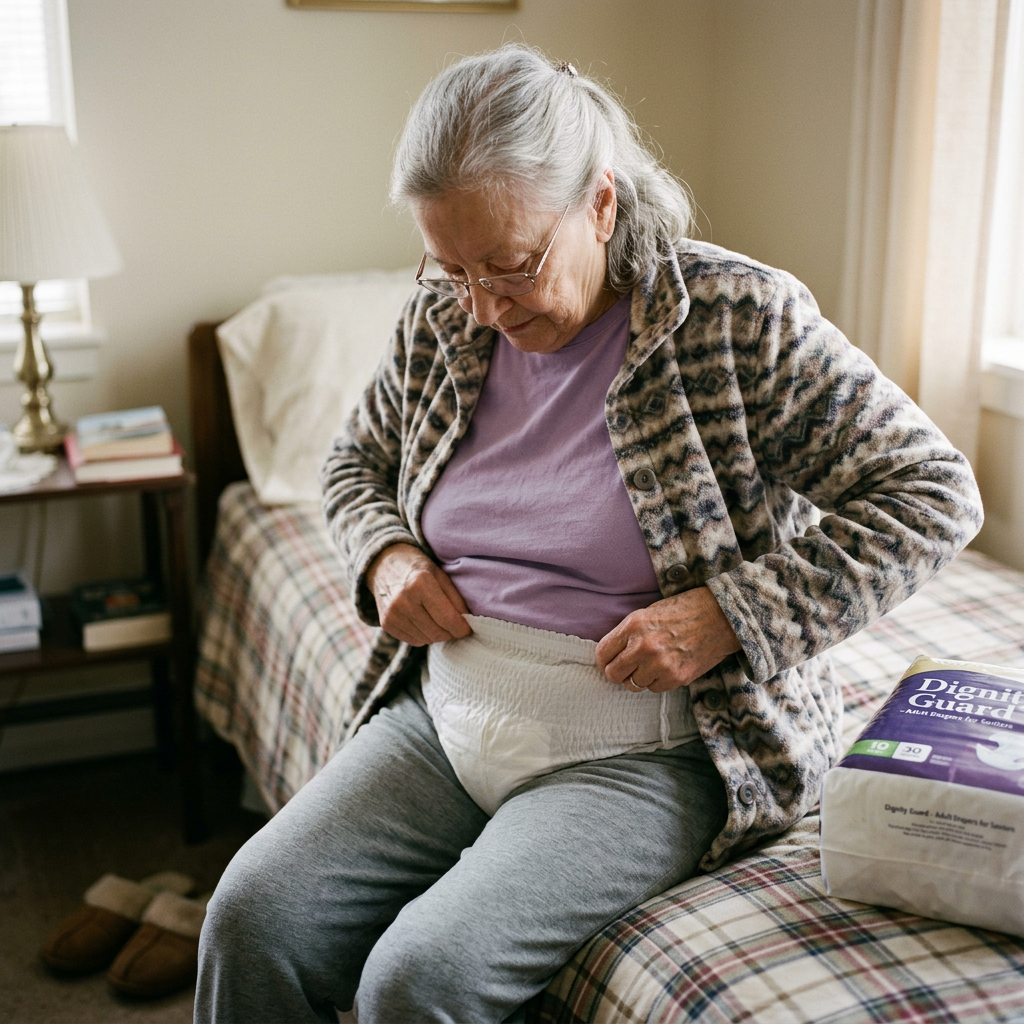
    “Adult diapers” is really two products. Pull-on protective underwear goes on like regular underwear and suits a parent who can walk to the toilet and pull them up and down independently — the discreet, everyday option. Tab-style briefs refasten at the hips and are designed to be changed while a person is lying down, making them the right tool when a caregiver does the changing, when your parent is bedbound, or when overnight volume is genuinely heavy. Buying a tab brief for an active parent feels infantilizing and gets refused; buying a pull-up for a bedbound parent means wrestling it up two legs at every change. Get the form right and the brand almost sorts itself out.

    At a glance

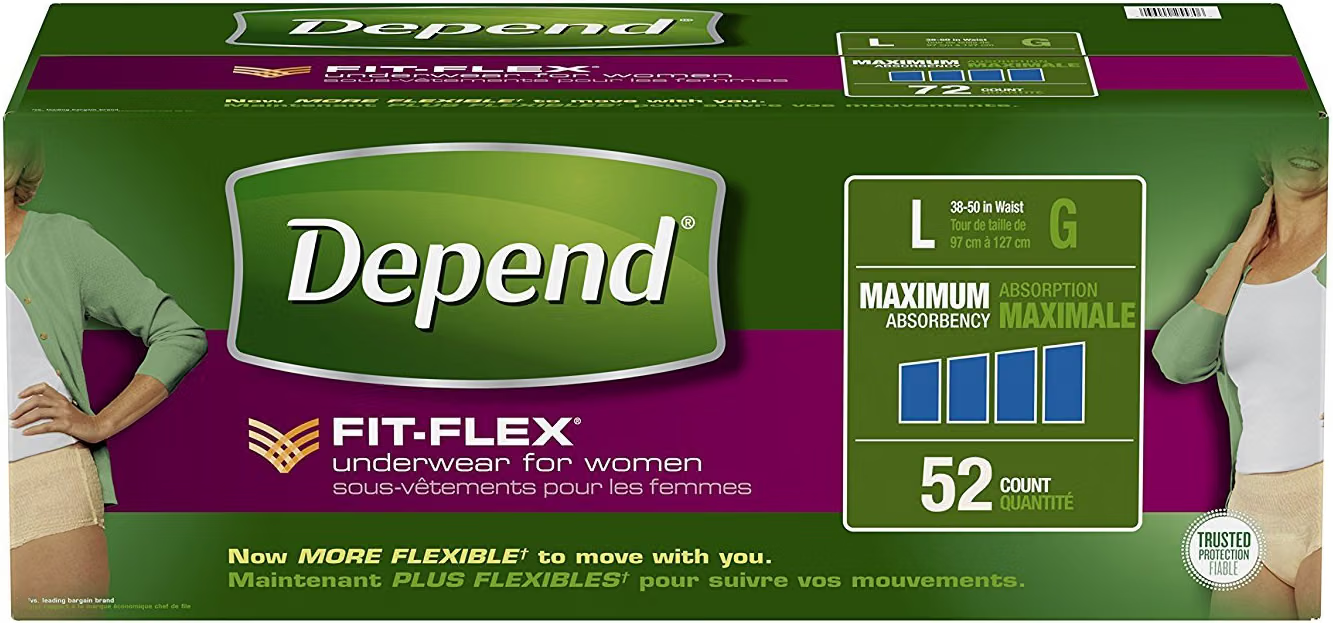
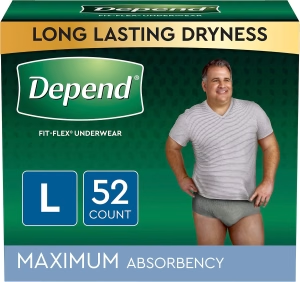
    Best overall pull-up  Depend FIT-FLEX for Women — ~$40/52ct · discreet daytime protection.

    Best for men  Depend FIT-FLEX for Men — ~$40/52ct · anatomically zoned, boxer-brief cut.

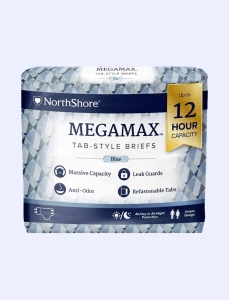
    Best overnight / heavy  NorthShore MegaMax Tab Briefs — ~$25/10ct · highest capacity, for caregiver changes.

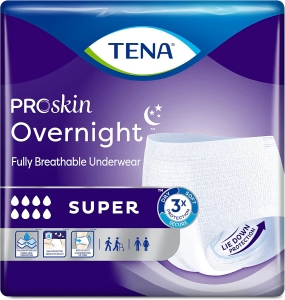
    Best for sensitive skin  TENA ProSkin Overnight Super — ~$55/56ct · breathable overnight pull-on.

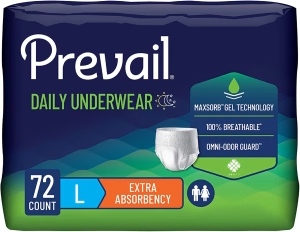
    Best budget  Prevail Per-Fit Daily Underwear — ~$45/72ct · about 60¢ a change.

    Best Overall Pull-Up  Depend FIT-FLEX for Women

    ~$40 for 52 (Maximum Absorbency) · Check price on Amazon →

    For the most common situation — a parent who still gets to the bathroom on her own but needs reliable insurance against leaks — this is the pick that draws the least resistance. Across more than 20,000 verified reviews, the FIT-FLEX earns its 4.5-star average on one recurring note: the elastic strands hug the body closely enough to disappear under slacks, which is what an independent parent cares about. Verified buyers consistently describe it as the product a reluctant parent will actually keep wearing, and those with light-to-moderate leakage rate the maximum-absorbency version as more than enough for daytime. The honest trade-off: this is a daytime and light-overnight product, not a flood-management brief, and a few reviewers note the newer packaging fits slightly trimmer.

    The good

    • Underwear-like cut that stays hidden under regular clothing.
    • Form-fitting elastic reduces the gapping that causes side leaks.
    • Widely stocked and easy to reorder in every size.

    The catch

    • Not built for heavy overnight volume pair with a bed pad or size up to an overnight product.
    • Runs slightly trim; check the waist chart rather than assuming a clothing size.

    This is right if… your mother is mobile, toilets independently, and wants protection nobody can see.

    Look elsewhere if… she floods overnight or a caregiver does the changing.

    Check Price on Amazon →

    Best for Men  Depend FIT-FLEX for Men

    ~$40 for 52 (Maximum Absorbency) · Check price on Amazon →

    Men’s incontinence products aren’t just women’s products in gray the absorbent core sits toward the front where it’s needed, and the cut mimics a boxer brief. That anatomical zoning is why male reviewers say this version outperforms unisex pull-ups, and why occupational therapists frequently steer men toward a gender-specific product. Across thousands of reviews the pattern is steady: dads who refused “diapers” will wear something that looks and feels like underwear. Like the women’s version, this is a daytime and moderate-overnight product; heavy nighttime volume calls for a tab brief. Some reviewers with larger builds find the waistband snug at the top of a size range, so measure before buying a case.

    The good

    • Front-weighted core matched to male anatomy.
    • Boxer-brief look lowers the “I’m not wearing a diaper” resistance.
    • Same trusted FIT-FLEX elastic as the women’s line.

    The catch

    • Moderate overnight capacity only; not for heavy flooding.
    • Runs snug at the top of each size band.

    This is right if… your father is active, toilets on his own, and balks at anything that reads as medical.

    Look elsewhere if… he needs all-night heavy protection or caregiver-assisted changes.

    Check Price on Amazon →

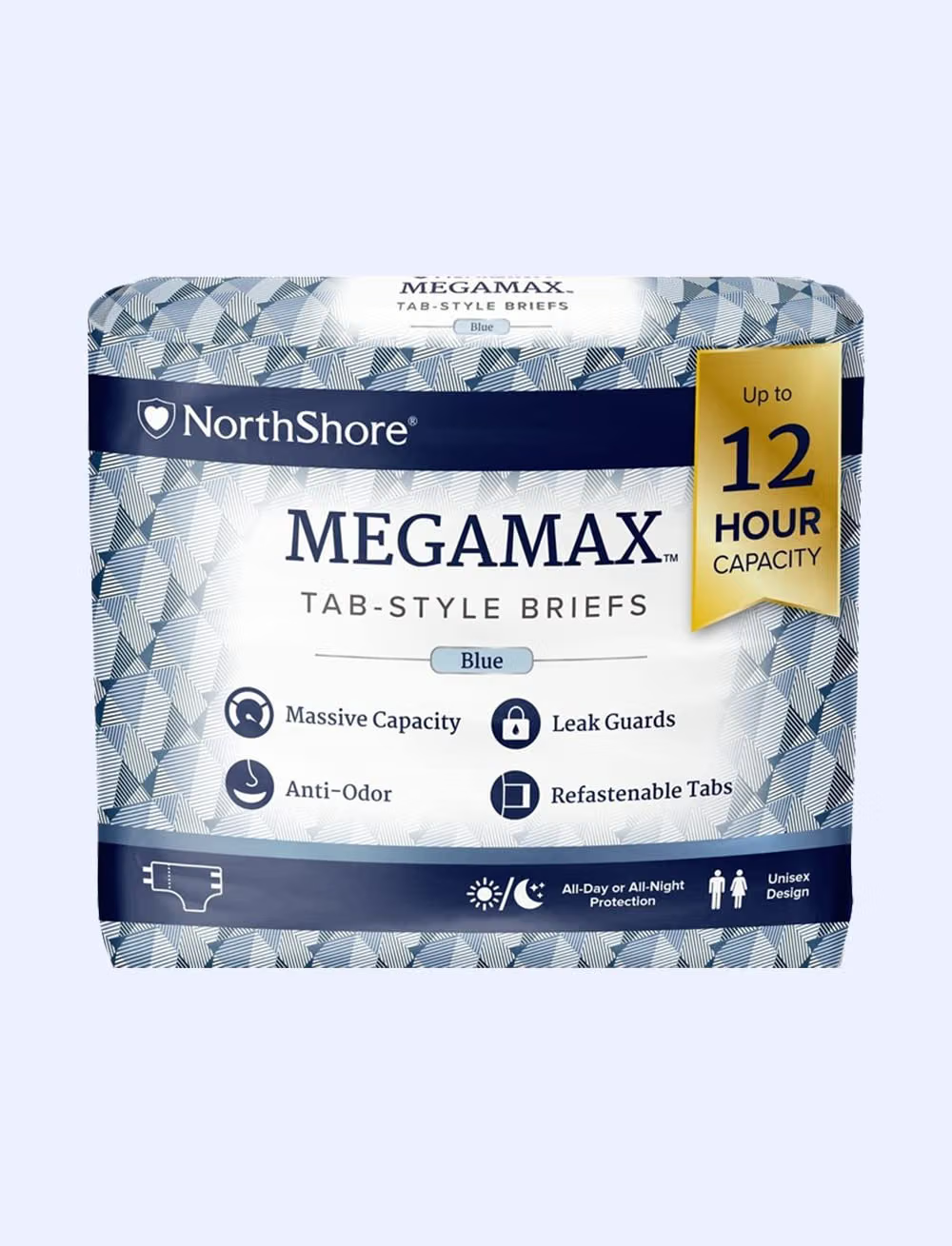
    Best Overnight / Heavy  NorthShore MegaMax Tab-Style Briefs

    ~$25 for 10 (12-hour capacity) · Check price on Amazon →

    When the real problem is overnight flooding or full-time care, this is the brief caregivers reach for. The MegaMax is a cult favorite in caregiver forums for one measurable reason: reviewers consistently report it holds a full night — often 10 to 12 hours — where drugstore briefs quit at four, meaning fewer 3 a.m. changes and stripped beds. Refastenable tabs let you change a parent while they’re lying down, and the tall back panel is the detail bedbound-care reviewers cite most for stopping up-the-back leaks. It’s a premium product at roughly $2.30 a change and genuinely bulky — not for a parent who’s out at lunch. Buy it for the situation it’s built for and it earns the price.

    The good

    • Among the highest real-world overnight capacity you can buy.
    • Refastenable tabs make lying-down changes manageable.
    • Tall back panel stops the classic overnight up-the-back leak.

    The catch

    • Premium price per change — the most expensive pick here.
    • Bulky under clothing; overkill for a mobile daytime parent.

    This is right if… your parent floods overnight, is largely bedbound, or a caregiver does the changing.

    Look elsewhere if… they’re active and independent — a pull-up will serve better and cost far less.

    Check Price on Amazon →

    Best for Sensitive Skin  TENA ProSkin Overnight Super

    ~$55 for 56 (unisex, heavy) · Check price on Amazon →

    If skin breakdown is the worry — and for anyone in a product 24 hours a day, it should be — TENA’s ProSkin line is the one dermatology-minded caregivers name most. The pitch isn’t just absorbency; it’s a breathable, wetness-wicking layer designed to keep skin drier between changes, preventing the redness and rashes that sideline other products. Verified buyers managing a parent’s fragile skin repeatedly say this is the pull-on that let them stop fighting irritation. It’s a unisex pull-up with genuine overnight capacity, bridging daytime pull-ups and full tab briefs. The honest catch: it costs more per change, and a few reviewers wish the overnight version came in more sizes.

    The good

    • Breathable, skin-drying materials that reduce rash and redness.
    • Overnight capacity in an easy pull-on form.
    • Dermatologist-tested; a caregiver favorite for fragile skin.

    The catch

    • Pricier per change than a basic pull-up.
    • Fewer size options in the overnight version.

    This is right if… your parent has fragile or easily irritated skin and wears a product most of the day.

    Look elsewhere if… cost per change is your top priority and skin isn’t a concern.

    Check Price on Amazon →

    Best Budget  Prevail Per-Fit Daily Underwear

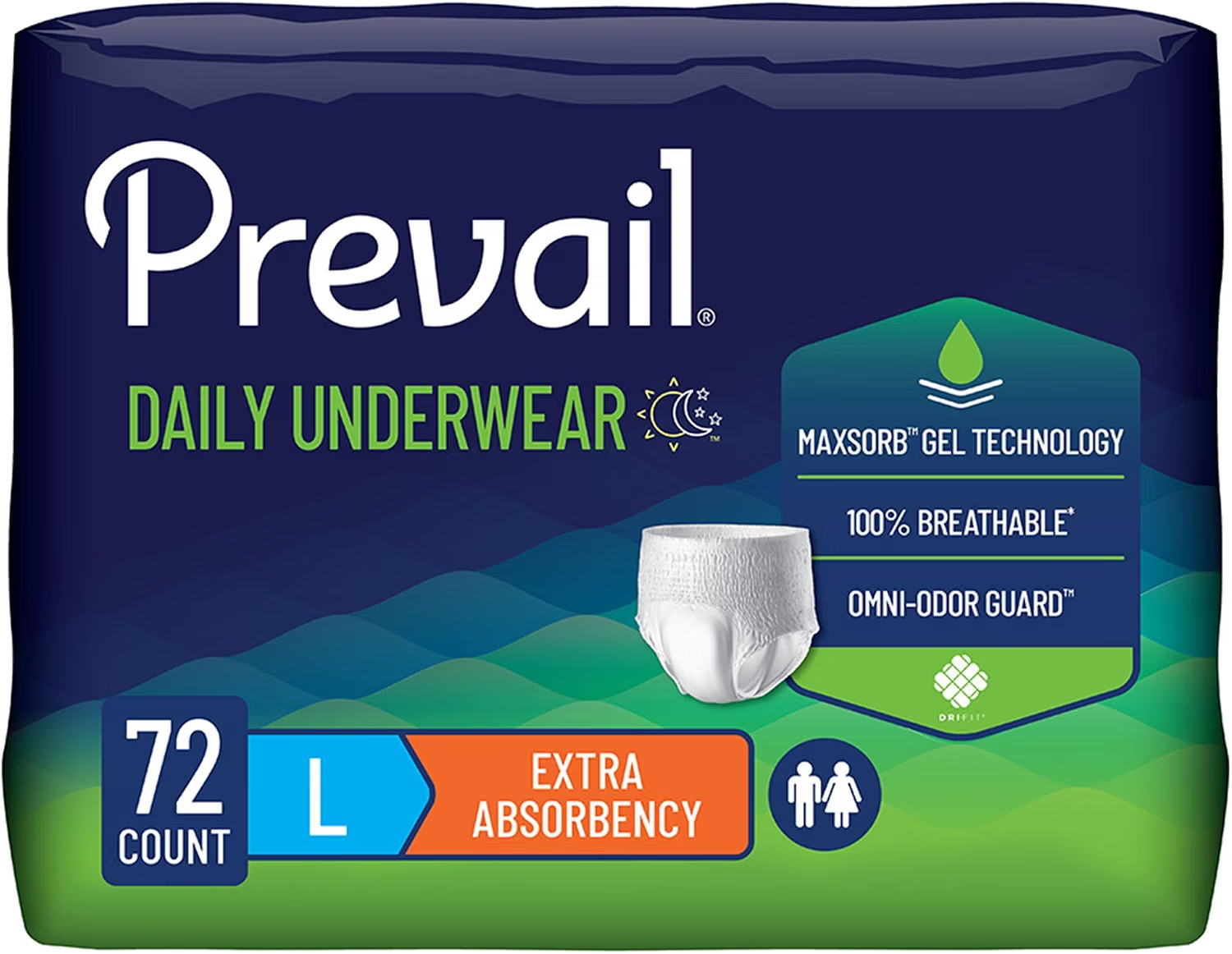
    0~$45 for 72 (~60¢ each) · Check price on Amazon →

    Incontinence is a repeat purchase, and at three to five changes a day the price per unit decides your yearly cost. Prevail keeps that number honest without dropping to bargain-bin quality. Verified buyers, many caregivers buying by the case consistently note it delivers name-brand daytime absorbency at roughly 60 cents a change, well under the premium pull-ups. It’s a professional-grade line used in care facilities, a quiet vote of confidence. The trade-offs are what you’d expect: the fit is a touch less contoured than Depend’s FIT-FLEX, and it’s a daytime and moderate-overnight product. For a parent who goes through a lot of them, the savings compound fast.

    The good

    • About 60¢ per change the lowest running cost here.
    • Facility-grade absorbency at a consumer price.
    • Sold in bulk cases that cut cost further.

    The catch

    • Fit is a little less trim than premium pull-ups.
    • Daytime/moderate use — not a heavy overnight product.

    This is right if… your parent uses several a day and yearly cost is the deciding factor.

    Look elsewhere if… you want the most invisible fit or the heaviest overnight capacity.

    Check Price on Amazon →

    Side-by-side comparison

    Product Form Best for ~Cost/change
    Depend FIT-FLEX (Women) Pull-up Daytime, discreet ~77¢
    Depend FIT-FLEX (Men) Pull-up Active men ~77¢
    NorthShore MegaMax Tab brief Overnight / bedbound ~$2.30
    TENA ProSkin Overnight Pull-up Sensitive skin ~98¢
    Prevail Per-Fit Daily Pull-up Budget / high volume ~60¢

    The conversation you’ll have

    This is the hardest aging-in-place purchase to talk about, and rushing it backfires. Incontinence carries real shame for the generation that raised us, and a parent who feels handled will refuse outright — often insisting the leaks aren’t happening at all. The two moves that consistently work in caregiver accounts are language and control. On language: the word “diaper” is the tripwire. Say “protective underwear” or just “these,” and hand over the pull-up form, which looks and feels like the underwear they already wear.

    On control, frame it as their decision rather than your intervention. Instead of “Mom, you need to wear these now,” try “I picked up a couple of kinds so you can tell me which one’s more comfortable I’ll return whatever you don’t like.” That single reframe turns a loss of dignity into a choice they’re making, and it’s why the pull-up almost always has to be the first product you introduce, even when the clinical need points to a brief. Moving to an overnight product later is then a much smaller conversation.

    Insurance and savings

    Here’s the reality most families learn the expensive way: Original Medicare (Parts A and B) does not cover disposable incontinence supplies it treats adult diapers and pull-ups as personal-care items, not durable medical equipment. There are three real paths to defraying the cost. Many Medicare Advantage plans include an over-the-counter benefit that can be spent on incontinence products — check your parent’s OTC catalog. Medicaid covers incontinence supplies in most states when a doctor documents medical necessity, often through a supply provider rather than a store. And disposable products are FSA- and HSA-eligible, so if you or your parent have either account, you can buy them with pre-tax dollars — the easiest saving for most families. Verify current coverage directly with the plan, since benefits change yearly.

    What to actually look for

    Form before absorbency

    Decide pull-up versus tab brief first, because it dictates everything else. A parent who toilets independently needs a pull-up; one who is changed by someone else needs tabs. Getting this backward is the most consequential mistake — it’s how families end up with a closet of refused product. Our aging-in-place safety checklist covers how these products fit the wider bedroom and bathroom setup.

    Match absorbency to the moment, don’t overbuy

    Counterintuitively, the highest-capacity product is often the wrong choice. Oversized, over-thick diapers gap at the legs (causing the side leaks they were meant to stop), bunch, and trap moisture against the skin. Buy moderate protection for the day and a genuine overnight product only for the night — many families run two products rather than one heavy one around the clock. Our room-by-room modification guide rounds out an overnight setup.

    Size by measurement, and protect the skin

    Sizing varies by brand, so measure the waist and hips and read the manufacturer’s chart rather than assuming a clothing size carries over — a size that didn’t match expectations is the number-one review complaint on every brand. And because moisture against skin causes breakdown, change promptly, choose a breathable product for full-time wear, and keep a barrier cream on hand. If skin is already fragile, weight that above every other spec.

    Frequently asked questions

    What’s the difference between adult diapers and pull-ups?

    Pull-ups (protective underwear) go on and off like regular underwear and suit a parent who toilets independently. Tab-style briefs — what most people mean by “adult diapers” refasten at the hips so they can be changed while lying down, making them right for bedbound care or heavy overnight volume. Choose the form before the brand.

    What’s the best adult diaper for overnight?

    For genuine overnight flooding, a high-capacity tab brief like the NorthShore MegaMax holds 10 to 12 hours and prevents the up-the-back leaks that ruin sheets. If your parent is mobile and needs an overnight pull-on instead, the TENA ProSkin Overnight Super offers real overnight capacity in an easier-to-manage form.

    Does Medicare pay for adult diapers?

    Original Medicare does not cover disposable incontinence supplies. However, many Medicare Advantage plans include an OTC allowance that can be spent on them, Medicaid covers them in most states with documented medical necessity, and they’re FSA- and HSA-eligible. Check your parent’s specific plan, as benefits change yearly.

    How often should an adult diaper be changed?

    Change promptly when wet or soiled roughly every three to four hours by day and once overnight with a high-capacity product. Leaving a wet product on to save money is a false economy; prolonged moisture against skin is the main cause of rashes and pressure-related breakdown.

    How do you prevent skin rash from incontinence products?

    Change promptly, choose a breathable product for all-day wear, clean gently and let skin dry fully before the next product, and apply a zinc-oxide or dimethicone barrier cream. If your parent’s skin is fragile, prioritize a skin-friendly line like TENA ProSkin over raw absorbency numbers, and check the skin at every change.

    The shortlist

    Best Overall

    Depend FIT-FLEX (Women)

    ~$40 / 52ct

    Check on Amazon →

    Best for Men

    Depend FIT-FLEX (Men)

    ~$40 / 52ct

    Check on Amazon →

    Best Overnight

    NorthShore MegaMax

    ~$25 / 10ct

    Check on Amazon →

    Best for Skin

    TENA ProSkin Overnight

    ~$55 / 56ct

    Check on Amazon →

    Best Budget

    Prevail Per-Fit Daily

    ~$45 / 72ct

    Check on Amazon →

    What we’d do tomorrow

    If you’re starting this weekend, do three things in order. First, figure out the form if your parent still walks to the bathroom, buy one pack of the Depend FIT-FLEX pull-up (men’s version for dad) and nothing heavier yet. Second, if nights are the real problem, add a small pack of NorthShore MegaMax for overnight only, plus a washable pad under the sheets. Third, don’t buy a case until you’ve confirmed size and comfort with a single pack these are cheap to test and expensive to stockpile wrong. Lead with the pull-up, protect the skin, and let your parent keep the choice.

    — Sarah

    BuyingForMom is a reader-supported site. As an Amazon Associate we earn from qualifying purchases. When you buy through links on this site, we may earn an affiliate commission at no additional cost to you. See our Affiliate Disclosure for details. This article is not medical advice please consult a qualified healthcare professional for decisions specific to your family.
  • Best Shoes for Elderly Swollen Feet: Velcro Picks

    Best Shoes for Elderly Swollen Feet: Velcro Picks

    Disclosure: BuyingForMom is reader-supported. As an Amazon Associate we earn from qualifying purchases. When you buy through links in this article, we may earn an affiliate commission at no additional cost to you. We never recommend products we haven’t researched against verified-buyer review data. This article is editorial reporting, not medical advice.

    Best Shoes for Elderly Swollen Feet: Velcro & Wide Picks

    By Sarah Mitchell · Editor, BuyingForMom · Updated September 2026

    10-minute read · Balance & Mobility · 5 picks compared

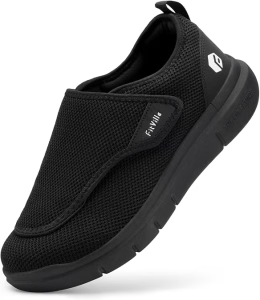
    The honest take: If your parent’s feet swell through the day and they can still work a strap, buy the FitVille EasyTop Wings and loosen the second strap as the afternoon goes on two straps beat one for edema that moves. The Skechers hands-free Slip-ins are the right call only if bending down is the real problem and the swelling is mild. Skip anything sold as “extra stretchy” with no adjustable closure at all — a sock-like shoe that fits at 9 a.m. is a tourniquet by 4 p.m.

    How we sorted through 40+ swollen-feet shoes in three weeks. We cross-referenced more than 9,000 verified Amazon reviews across the diabetic, orthopedic, and “extra-wide senior” footwear categories, then filtered against what podiatrists and occupational therapists consistently say about edema footwear: a wide, deep toe box, a genuinely adjustable closure, and a firm-but-cushioned sole. We weighted toward closures a person with arthritic hands can actually manage, flagged the recurring complaints (sizing that runs narrow, straps that peel), and confirmed every pick was in stock at publish time.

    Who this guide is for

    This guide is for adult children buying everyday outdoor shoes for a parent whose feet swell — from edema, diabetes, arthritis, or long days on their feet — and who struggles with regular laces. If you’re shopping for yourself, the same picks apply; skip the “conversation” section near the end.

    Swollen feet change the whole footwear math. The wrong pair genuinely raises fall risk, because a parent fighting a tight, hard-to-fasten shoe often gives up and shuffles around in socks or backless slippers instead. The best shoes for elderly swollen feet do three things at once: open wide enough to get a puffy foot in, adjust as the swelling rises and falls, and stay secure enough to walk safely — a narrower target than the “just buy wide” advice most roundups give.

    Two details matter more than brand. First, the closure has to match the hands using it — a single big strap is far easier for arthritic fingers than two small ones or a lace. Second, swelling fluctuates, so a shoe that only fits at one size is the wrong shoe; you want room to loosen it by afternoon. The five picks below are built around those two ideas, not a features spreadsheet.

    At a glance

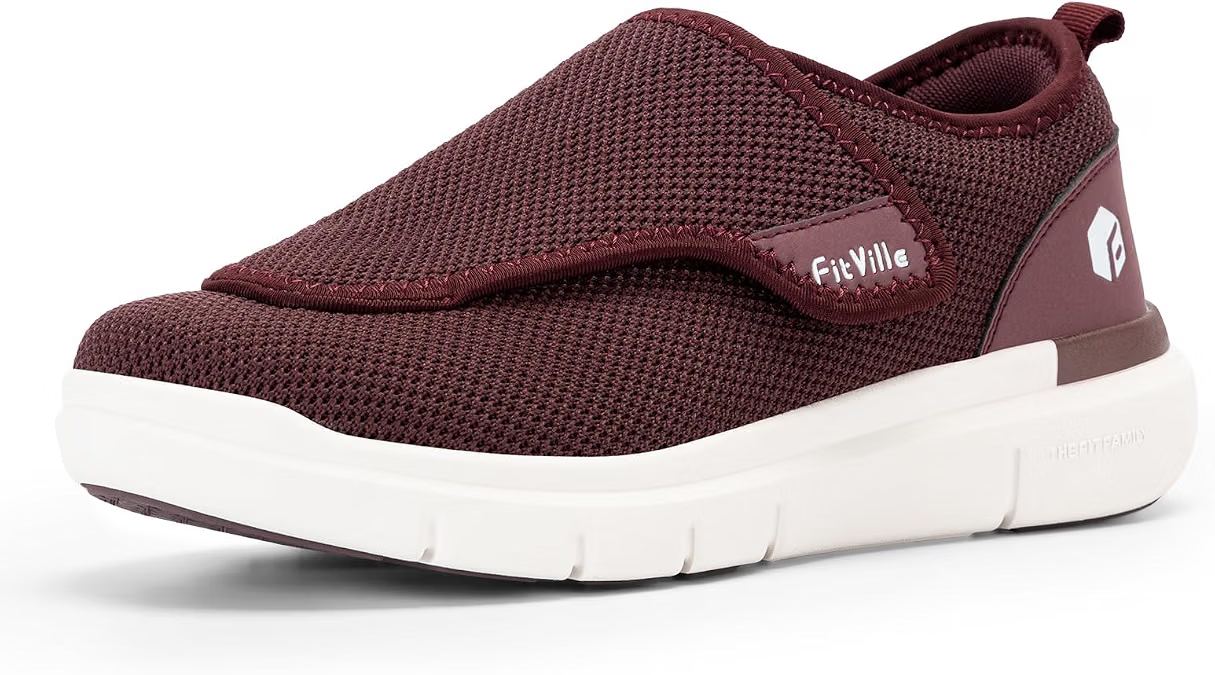
    Best Overall  FitVille EasyTop Wings (Men) — ~$79 · dual velcro straps that loosen as swelling rises.

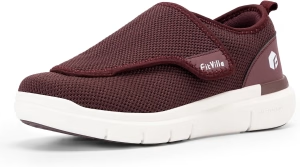
    Best for Women  FitVille EasyTop Wings V2 (Women) — ~$79 · same wide-and-adjustable build, women’s last.

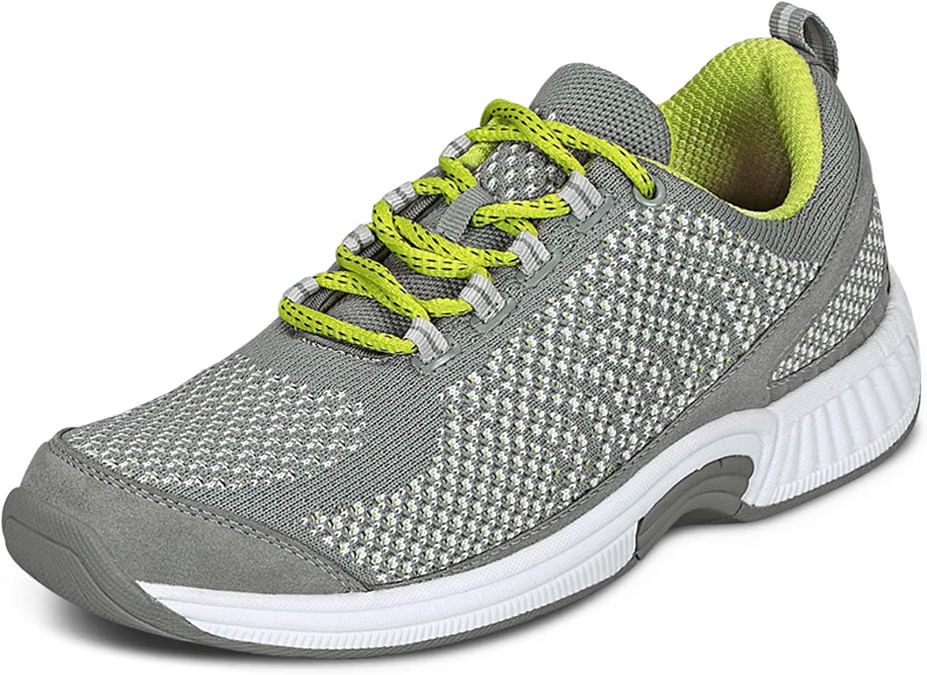
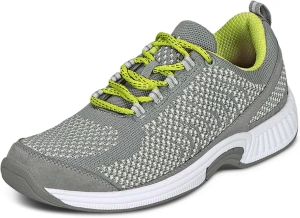
    Best for Orthotics  Orthofeet Coral Stretch Knit — ~$135 · removable insole, seam-free stretch upper.

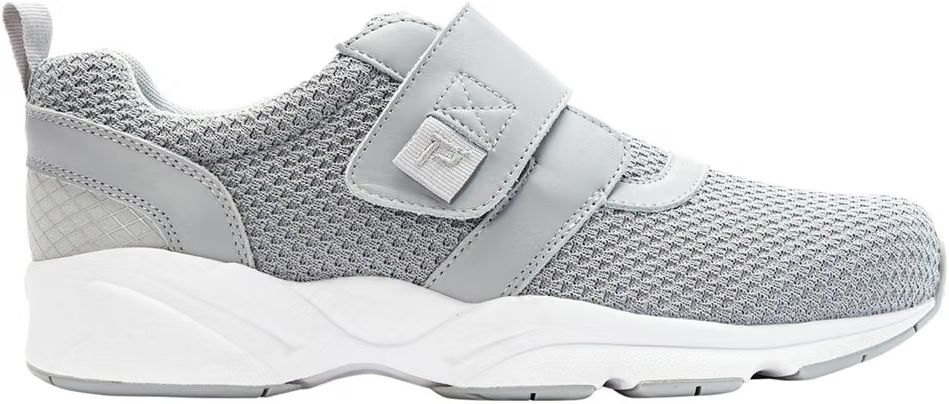
    Best for Balance  Propét Stability X Strap — ~$85 · one big strap, wide stable base.

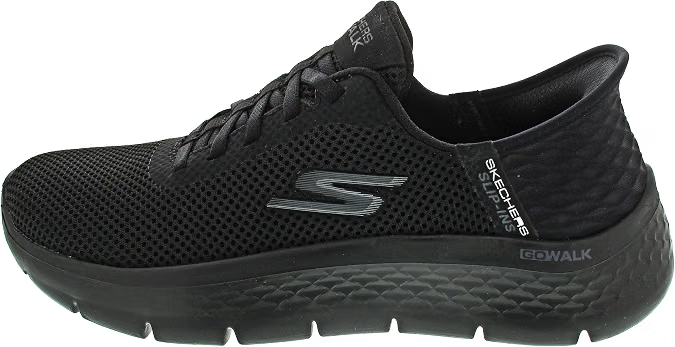
    Best Hands-Free  Skechers Slip-ins Go Walk — ~$75 · step in, no bending, no strap.

    Best Overall FitVille EasyTop Wings (Men)

    ~$79 · Check price on Amazon →

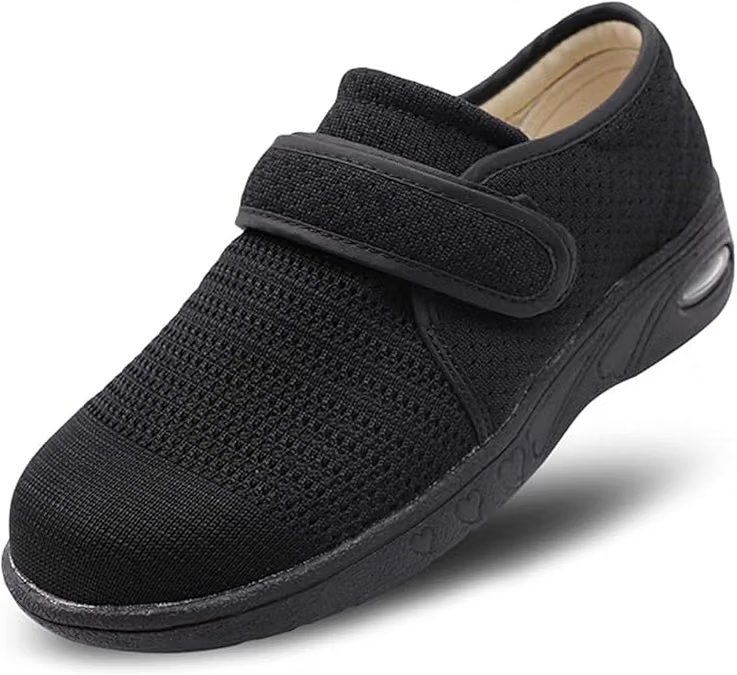
    This is the pick that best fits how swelling actually behaves. The EasyTop Wings opens with two independent hook-and-loop straps and a wing upper that folds all the way back, so a puffy foot goes in without a fight and you can crack the straps looser by afternoon when the ankle has ballooned. It comes in extra-wide up to 6E, genuinely rare, and the removable insole leaves room for a prescribed orthotic. Across 4,000-plus reviews the recurring caregiver note is “the only shoe that fit after the water pills stopped working,” with a rocker sole buyers with neuropathy say they can feel their footing in. The common complaint: order true to size, not up — sizing up left the heel sloppy for several reviewers.

    The good

    • Two straps adjust independently as swelling rises and falls through the day.
    • Extra-wide up to 6E — accommodates serious edema and bunions.
    • Removable insole makes room for custom orthotics.

    The catch

    • Sporty look won’t suit a parent who wants a dressier shoe.
    • Order true-to-size; sizing up loosens the heel.

    This is right if… your parent’s swelling changes hour to hour and they can still manage a strap.

    Look elsewhere if… they can’t bend to reach two straps — see the hands-free pick below.

    Check Price on Amazon →

    Best for Women FitVille EasyTop Wings V2 (Women)

    ~$79 · Check price on Amazon →

    The women’s V2 is the same open-wide, adjust-as-you-go design on a women’s last — which matters, because most “wide women’s” shoes are just a men’s shoe in a lighter color that sits wrong through the heel. Verified buyers with lymphedema and diabetic swelling praise how far the upper folds back for dressing, and the lighter cushioning gets called out as easier on knees than heavier orthopedic shoes. Reviewers flag that the brightest colorways run out fast, and a few wanted a stiffer heel counter. For a woman who wants swollen-feet room in something that reads like a normal walking shoe, this is the value pick.

    The good

    • Built on a women’s last — proper heel fit, not a shrunken men’s shoe.
    • Wing upper folds far back for easy dressing over a swollen foot.
    • Lighter cushioning is gentler on knees and hips.

    The catch

    • Popular colors sell out; you may be choosing from what’s left.
    • Heel counter is softer than a true stability shoe.

    This is right if… you want the EasyTop’s adjustability in a women’s fit and everyday look.

    Look elsewhere if… she needs maximum lateral stability — the Propét below is firmer underfoot.

    Check Price on Amazon →

    Best for Orthotics Orthofeet Coral Stretch Knit

    ~$135 · Check price on Amazon →

    If a podiatrist has prescribed custom orthotics, Orthofeet is the name that comes up most in caregiver forums and the Coral is its most-reviewed swollen-feet model. The seam-free stretch-knit upper conforms around bunions and hammertoes without pressure points, and it ships with a removable multi-layer insole you pull out to drop your own orthotic in. Across thousands of reviews the pattern is “expensive but the only pair that stopped the rubbing,” often from people with diabetes or neuropathy who can’t risk a blister. It’s the priciest pick here, and the stretch upper alone doesn’t cinch down — choose a strap model if the foot needs holding. A 60-day wear-and-return policy takes the sting out of the price.

    The good

    • Seam-free stretch interior — no pressure points on bunions or hammertoes.
    • Removable multi-layer insole makes real room for custom orthotics.
    • Extended widths through extra-extra-wide.

    The catch

    • Most expensive pick by a wide margin (~$135).
    • Slip-on stretch versions don’t cinch — choose a strap model for a foot that needs holding.

    This is right if… your parent wears prescribed orthotics or has fragile diabetic skin.

    Look elsewhere if… you’re on a budget — the FitVille pair covers most needs for half the price.

    Check Price on Amazon →

    Best for Balance Propét Stability X Strap

    ~$85 · Check price on Amazon →

    When the bigger worry is steadiness, not just fit, this is the shoe. The Stability X Strap uses one extra-large hook-and-loop strap — the single easiest closure here for arthritic hands or one working side after a stroke — over a wide forefoot and heel base with a firm shank underfoot. Physical therapists recommend Propét because it’s one of the few brands with a genuine XX-wide and 3E–5E range plus a stable platform. Reviewers with balance issues describe it as “planted,” and the breathable knit keeps a warm swollen foot cooler. The trade-off: one strap gives less fine control than the FitVille’s two, so for swelling that swings dramatically it’s less adaptable. Order the width up if between sizes.

    The good

    • One big strap the easiest closure here for weak or one-handed use.
    • Wide, firm base built for stability, not just cushioning.
    • True XX-wide and 3E–5E options.

    The catch

    • One strap adjusts less finely than two for big daily swings.
    • Runs slightly snug — size the width up if between.

    This is right if… balance is the priority and one simple strap is all their hands can manage.

    Look elsewhere if… the swelling swings widely each day — two straps give more control.

    Check Price on Amazon →

    Best Hands-Free Skechers Slip-ins Go Walk

    ~$75 · Check price on Amazon →

    Sometimes the barrier isn’t the foot at all — it’s the bending. Skechers’ Slip-ins use a firm heel piece that folds flat as the foot steps in and springs back to hold the heel, so a parent who can’t reach their feet gets a shoe on with no hands and no strap. They come in wide widths with the memory-foam cushioning Skechers is known for, and they’re the most “normal-looking” pair here. Be honest about the limit: the collar is fixed, so Slip-ins suit mild-to-moderate swelling — a severely edematous foot may not clear the opening, and there’s no strap to loosen later. For a parent whose main problem is reaching down, though, nothing here is this effortless; verified buyers overwhelmingly cite “I can finally put my own shoes on.”

    The good

    • Truly hands-free — no bending, no strap, no laces.
    • Available in wide widths with soft memory-foam cushioning.
    • Looks like an ordinary sneaker.

    The catch

    • Fixed collar — best for mild-to-moderate swelling, not severe edema.
    • No adjustable closure to loosen as the foot swells.

    This is right if… bending down is the real obstacle and swelling is mild-to-moderate.

    Look elsewhere if… the foot swells severely — a wing-and-strap shoe opens wider.

    Check Price on Amazon →

    Quick comparison

    Shoe Closure Widths Best for ~Price
    FitVille EasyTop Wings (Men) 2 velcro straps to 6E Fluctuating swelling ~$79
    FitVille EasyTop V2 (Women) 2 velcro straps to 4E Women’s everyday fit ~$79
    Orthofeet Coral Stretch / strap to XX-wide Orthotics, fragile skin ~$135
    Propét Stability X Strap 1 large velcro strap to 5E Balance + easy closure ~$85
    Skechers Slip-ins Go Walk Hands-free step-in Wide Can’t bend down ~$75

    The conversation you’ll have

    Footwear is quietly loaded for older adults. A parent who’s worn the same size since 1975 can hear “you need special shoes now” as “you’re falling apart,” and dig in. The resistance usually isn’t about the shoe — it’s about what the shoe admits. Lead with the problem they already feel, not the label on the box.

    Try “Your feet look like they hurt by dinnertime — want to try a pair you can loosen when they swell?” instead of “These are diabetic shoes for your edema.” The first is about comfort tonight; the second is a diagnosis. If they balk at Velcro as “old-people shoes,” the hands-free Skechers read as ordinary sneakers. And frame it as a trial: order one pair, keep the box, send it back if it’s wrong. Low stakes lowers the wall.

    Insurance and savings

    Here’s the part most shoppers get wrong: ordinary comfort shoes aren’t covered, but therapeutic shoes can be. Under Medicare Part B’s Therapeutic Shoe benefit, a person with diabetes plus a qualifying foot condition (neuropathy, a past ulcer, poor circulation, deformity) may get one pair of prescribed therapeutic shoes and inserts per year, with Medicare covering 80% after the deductible — but only when a Medicare-enrolled podiatrist certifies the need and a qualified supplier furnishes them. An off-the-shelf Amazon pair bought on your own won’t qualify. Separately, most shoes here are FSA/HSA eligible for a documented medical need — keep the receipt. If your parent has diabetes, ask their podiatrist about the program before paying out of pocket.

    What to actually look for

    Match the closure to the hands, not the shoe

    This is the decision that matters most and the one every generic roundup skips. A lace is out for most swollen feet. Between the alternatives: two straps give the finest control as swelling changes but need more dexterity; one large strap is the easiest single motion for arthritic or one-handed use; hands-free step-ins ask for nothing but can’t be loosened later. Pick for the person putting the shoe on. Our guide to no-tie laces and easy-on shoes goes deeper if regular laces are the sticking point.

    Width and depth beat “stretchy”

    A stretch upper alone is a trap for edema — it fits in the morning and squeezes by afternoon with no way to relieve it. What you want is genuine extra width (4E, 6E, XX-wide) and extra depth, so the foot has room top-to-bottom, paired with an adjustable closure you can open as the day goes on. Measure your parent’s foot at the end of the day, when it’s largest, and buy to that. Getting the fit right is also a core piece of fall prevention — our room-by-room aging-in-place safety checklist puts footwear alongside the other changes that keep an unsteady parent upright.

    Firm sole, real tread, and a neuropathy check

    Softer is not safer. A too-soft, too-thick sole makes an unsteady parent wobble; you want cushioning over a firm, stable platform with a real rubber tread — not a slick foam bottom. And a genuine caution: if your parent has diabetic neuropathy and can’t feel their feet, inspect their skin for the first two weeks — a seam they can’t feel can cause a blister that turns serious. For indoor wear, our non-slip slippers for swollen feet apply the same width-and-tread logic around the house.

    Frequently asked questions

    What kind of shoes should the elderly wear for swollen feet?

    Look for genuine extra width and depth, an adjustable closure (Velcro straps or hands-free) rather than laces, a firm cushioned sole with real tread, and a stretchable or seam-free upper. The closure should match the person’s hand ability, and the shoe should open wide enough to get a swollen foot in easily.

    Are Velcro or slip-on shoes better for seniors?

    It depends on the barrier. Velcro is better when swelling fluctuates, because you can loosen it as the foot expands through the day. Hands-free slip-ins are better when the real problem is bending down to reach the feet. If swelling is severe, choose Velcro — a fixed slip-on collar can’t open far enough.

    What is the best width for swollen feet?

    Most people with edema need at least a wide (2E), and many need extra-wide (4E) or extra-extra-wide (6E/XX). Rather than guess, measure the foot at the end of the day when it’s most swollen and match that width. Extra depth matters as much as width for a foot that swells upward, not just outward.

    Can the wrong shoes make swelling worse?

    Yes. A too-tight shoe restricts circulation, worsens swelling, and can cause skin breakdown — especially in a foot with diabetic neuropathy that can’t feel the pressure. A non-adjustable “stretch” shoe that fits in the morning can act like a tourniquet by afternoon. Always leave room to loosen the fit as the day goes on.

    When should you buy or try on shoes if your feet swell?

    Buy and fit shoes at the end of the day, when feet are at their largest. A pair sized to a morning foot will feel tight by afternoon. When ordering online, measure late in the day and choose the width and adjustable closure that leave room to expand into.

    Does Medicare cover shoes for swollen feet?

    Only in specific cases. Medicare Part B’s Therapeutic Shoe benefit covers one pair per year for people with diabetes plus a qualifying foot condition, at 80% after the deductible, when prescribed by a podiatrist and supplied by an enrolled provider. Ordinary comfort shoes bought on your own aren’t covered, though many are FSA/HSA eligible with documentation.

    The shortlist

    Best Overall

    FitVille EasyTop Wings (Men)

    ~$79

    Check on Amazon →

    Best for Women

    FitVille EasyTop V2 (Women)

    ~$79

    Check on Amazon →

    Best for Orthotics

    Orthofeet Coral Stretch Knit

    ~$135

    Check on Amazon →

    Best for Balance

    Propét Stability X Strap

    ~$85

    Check on Amazon →

    Best Hands-Free

    Skechers Slip-ins Go Walk

    ~$75

    Check on Amazon →

    What we’d do tomorrow

    If you’re starting this weekend, do three things in order. First, measure your parent’s foot in the evening width included because that number, not their old shoe size, is what you’re buying. Second, set the closure by how their hands work: if two straps are manageable, order the FitVille EasyTop Wings; if bending is the wall, order the Skechers Slip-ins. Third, try them on that same evening when the feet are swollen — if they don’t open wide enough, send them back and size the width up. One good pair, fitted to the worst part of the day, changes whether your parent walks or shuffles.

    — Sarah

    BuyingForMom is a reader-supported site. As an Amazon Associate we earn from qualifying purchases. When you buy through links on this site, we may earn an affiliate commission at no additional cost to you. See our Affiliate Disclosure for details. This article is not medical advice please consult a qualified healthcare professional for decisions specific to your family.
  • Best Adaptive Clothing for Seniors

    Best Adaptive Clothing for Seniors

    Disclosure: BuyingForMom is reader-supported. As an Amazon Associate we earn from qualifying purchases. When you buy through links in this article, we may earn an affiliate commission at no additional cost to you. We never recommend products we haven’t researched against verified-buyer review data. This article is editorial reporting, not medical advice.

    Best Adaptive Clothing for Seniors (2026): Magnetic, Open-Back & Anti-Strip Picks

    By Sarah Mitchell · Editor, BuyingForMom · Updated September 2026

    10-minute read · Adaptive Clothing · 5 picks compared

    The honest take: If your parent still dresses themselves but fights buttons, buy the magnetic-closure shirt or top and stop there — it solves the single most common problem. The only reason to reach for an anti-strip jumpsuit is active undressing or incontinence-related pulling in dementia; it’s a caregiving tool, not an everyday upgrade. Skip the pricey “adaptive” fashion lines that sell regular clothes with one hidden zipper — you’re paying for a label, not a real dressing solution.

    How we sorted through 40+ adaptive garments in three weeks

    We started with the four brands that actually stock verifiable, in-stock listings on Amazon Silverts, Ovidis, and a handful of magnetic-closure specialists and worked down from roughly forty garments to the five below. We cross-referenced verified-buyer reviews, occupational-therapist dressing guidance, and the recurring patterns caregivers describe on Reddit’s r/AgingParents and r/dementia, then matched each pick to a specific dressing barrier rather than a vague “senior-friendly” label. A garment earned a spot only if it removes a real obstacle — a button too small for arthritic fingers, a pullover a stroke survivor can’t manage — not because a brand slapped “adaptive” on a standard shirt.

    Who this guide is for

    This guide is for adult children and caregivers buying clothing for a parent whose dressing has gotten harder after a stroke, with arthritis or tremor, or as dementia progresses. If you’re shopping for yourself and can still dress independently, the magnetic-closure picks apply to you too; you can skip the caregiver-assisted sections (open-back and anti-strip) below.

    The phrase “adaptive clothing for seniors” covers a lot of ground, and buying the wrong category is the most common — and most expensive — mistake. A parent who can’t manage buttons needs a completely different garment than one who is bedbound, and neither needs the anti-strip jumpsuit dementia-care marketing pushes hardest. Below, we route each pick to the actual problem.

    At a glance

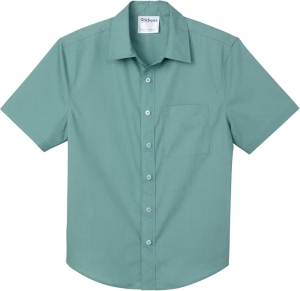
    BEST OVERALL Silverts Men’s Magnetic Button Shirt (~$45) — hidden magnets look like buttons, fasten one-handed.

    ARTHRITIC HANDS Silverts Women’s Magnetic Closure Top (~$40) — same magnet system in a women’s blouse cut.

    FOR DEMENTIA Ovidis “Bella” Anti-Strip Jumpsuit (~$70) — back-zip onesie that discourages undressing.

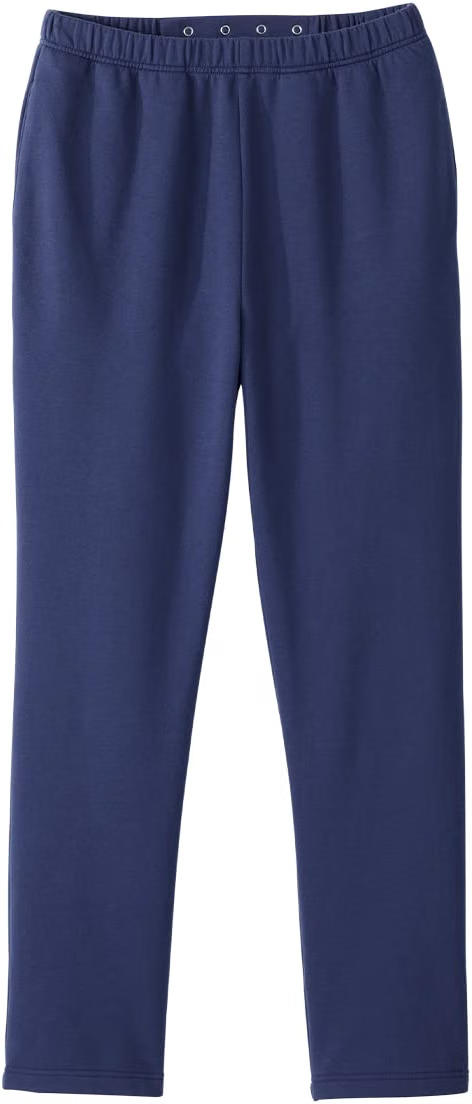
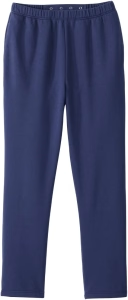
    WHEELCHAIR / BEDBOUND Silverts Men’s Open-Back Fleece Pants (~$50) — dress fully seated or lying down.

    EASY ACCESS Silverts Women’s Side-Closure Pants (~$50) — full side-zips for incontinence and catheter care.

    BEST OVERALL Silverts Men’s Magnetic Button Shirt

    ~$45 · Check price on Amazon →

    For most seniors, the dressing problem isn’t the whole shirt — it’s the buttons. This Silverts top replaces every button with a hidden magnet that snaps shut with a light one-handed press and looks, from across the room, exactly like a normal button-down. Across verified buyer reviews the same note recurs: a parent who had quietly stopped wearing collared shirts started wearing them again because they could finally fasten one alone. It’s the pick occupational therapists reach for first with post-stroke and arthritis clients, because it restores independence without announcing itself as a medical garment.

    The good

    • Fastens fully with one hand — ideal for a working-arm stroke survivor
    • Reads as an ordinary button-down; no clinical look
    • Machine-washable; magnets survive normal laundry cycles

    The catch

    • Magnetic closures should be kept clear of pacemakers and ICDs — check with the cardiologist first
    • Runs closer to fitted than boxy; size up for a fuller build

    This is right if… your parent can still dress standing but can’t work small buttons or has only one reliable hand.

    Look elsewhere if… they wear a pacemaker or defibrillator, or they can no longer stand to dress.

    Check Price on Amazon →

    ARTHRITIC HANDS Silverts Women’s Magnetic Closure Top

    ~$40 · Check price on Amazon →

    This is the women’s answer to the same problem, and it’s the pick we’d put in most mothers’ closets first. The magnetic placket takes the fine-motor demand out of buttoning entirely, which is exactly where arthritis and post-stroke weakness bite hardest. Verified buyers consistently praise the soft, drapey fabric and a cut that reads as a real blouse rather than a hospital gown — the dignity point matters, because a garment that looks “adaptive” is a garment a parent quietly refuses to wear. Reviewers with rheumatoid arthritis specifically call out being able to dress without the morning wrestling match that used to require a spouse’s help.

    The good

    • No buttons, snaps, or hooks — pure magnet closure for weak or painful hands
    • Blouse-style cut and soft fabric preserve dignity
    • Available across a wide size range

    The catch

    • Same pacemaker/ICD caution as any magnetic garment
    • A few reviewers wanted the magnets slightly stronger for very active wearers

    This is right if… arthritis, tremor, or one-sided weakness makes buttons the daily obstacle.

    Look elsewhere if… she has an implanted cardiac device, or she needs full caregiver-assisted dressing.

    Check Price on Amazon →

    FOR DEMENTIA Ovidis “Bella” Anti-Strip Jumpsuit

    ~$70 · Check price on Amazon →

    Ovidis was founded by a family caring for a relative with Alzheimer’s, and the “Bella” reflects that — it’s a one-piece onesie that closes with a long back zipper the wearer can’t reach, which is what “anti-strip” means. The garment is meant for a specific, difficult situation: a person in mid-to-late dementia who repeatedly undresses or reaches into an incontinence brief. The back zip and the fabric between the legs let a caregiver change and re-dress quickly while gently removing the constant access the behavior depends on. Caregivers describe it as the thing that finally let a parent stay dressed through the afternoon and sleep through the night. It is not an everyday upgrade for a parent who simply dresses slowly — reach for it only when active undressing or pulling is the real problem.

    The good

    • Back zipper removes the reach that undressing depends on
    • Leg-zip access makes incontinence changes fast for caregivers
    • Soft, breathable fabric designed for all-day wear on fragile skin

    The catch

    • It restricts a person’s own access to their clothing — an ethical call best made with the care team, not lightly
    • Priced above single garments; size carefully, as returns on worn items are limited

    This is right if… a parent with dementia actively undresses or pulls at an incontinence brief.

    Look elsewhere if… they still dress with cues and prompting — a magnetic top preserves far more independence.

    Check Price on Amazon →

    WHEELCHAIR / BEDBOUND Silverts Men’s Open-Back Fleece Pants

    ~$50 · Check price on Amazon →

    When a parent can’t stand to pull pants up, the fight isn’t dexterity it’s the whole maneuver. These open-back fleece pants are built for a seated or lying body: the back panel opens with snaps so a caregiver can position them without lifting the person’s full weight or wrestling a waistband over hips. Verified buyers who dress a spouse in a wheelchair repeatedly call this the difference between a two-person transfer and a one-person change. The fabric front looks like ordinary fleece pants from the front — which is what the wearer sees and what visitors see — so dignity stays intact even though the construction is entirely functional.

    The good

    • Dresses fully from a seated or lying position — no standing required
    • Snap-open back turns a two-person change into one
    • Looks like normal fleece pants from the front

    The catch

    • Designed for caregiver-assisted dressing, not independent use
    • Open-back construction isn’t meant for walking around unassisted for long stretches

    This is right if… your parent is in a wheelchair, bedbound, or can’t stand safely to dress.

    Look elsewhere if… they still walk and dress themselves — side-closure or pull-on pants keep more independence.

    Check Price on Amazon →

    EASY ACCESS Silverts Women’s Side-Closure Pants

    ~$50 · Check price on Amazon →

    Side-closure pants sit between fully independent and fully assisted, and for a lot of families that’s exactly the right middle. Full-length zippers run down both sides so the pants open flat a caregiver can lay them under a seated parent and close them up, and someone managing a catheter or frequent bathroom trips gets access without a full undress. Reviewers point to this pair as the practical choice for a parent who can still do some of the work but needs the process to be faster and less painful, particularly with incontinence in the picture. The waistband is elastic and forgiving, which matters for legs that swell through the day.

    The good

    • Full side-zips open the pants flat for fast, low-strain dressing
    • Discreet access for catheter care and incontinence changes
    • Forgiving elastic waist for fluctuating swelling

    The catch

    • Zipper pulls are small; a parent with severe hand weakness may still need help closing them
    • Sizing runs true but check the length — inseams can be long

    This is right if… your parent needs quick side access for incontinence or catheter care but still participates in dressing.

    Look elsewhere if… they’re fully bedbound — open-back pants are easier for a caregiver.

    Check Price on Amazon →

    How the five compare

    Product Closure Best for Price
    Silverts Men’s Magnetic Shirt Hidden magnets Stroke / arthritis, dresses self ~$45
    Silverts Women’s Magnetic Top Hidden magnets Arthritic hands, dresses self ~$40
    Ovidis “Bella” Jumpsuit Back + leg zip Dementia, active undressing ~$70
    Silverts Open-Back Pants Snap-open back Wheelchair / bedbound ~$50
    Silverts Side-Closure Pants Full side zips Incontinence / catheter access ~$50

    The conversation you’ll have

    Adaptive clothing carries a sting that grab bars and pill organizers don’t: it can feel like a label. A parent may hear “adaptive” as “I’ve given up,” and refuse the whole idea. The move is to never sell the category. Don’t say, “I bought you adaptive clothing.” Say, “I found a shirt that fastens itself — no more fighting those little buttons,” and hand them something that looks like a normal shirt. Let the garment make the case. For a parent with dementia and an anti-strip jumpsuit, skip the explanation entirely and fold it into the routine the way you would any other outfit. The goal is a calmer morning, not a conversation about decline — and the best adaptive clothing earns its place precisely because nobody has to think of it as adaptive at all.

    Insurance and savings

    Here’s the reality most brand sites bury: Medicare does not cover clothing, adaptive or otherwise it’s treated as a personal item, not durable medical equipment, so there’s no benefit to claim. The savings angle that does exist is the FSA/HSA one. Adaptive garments bought for a specific medical condition can sometimes qualify as an eligible expense with a doctor’s letter of medical necessity, particularly items tied to incontinence care or post-surgical recovery — but rules vary by plan administrator, so confirm first. If your parent is a veteran, the VA sometimes provides a clothing allowance for garments damaged by a prosthetic — worth a call to their benefits office. None of it is automatic, but don’t leave those angles unexplored.

    What to actually look for

    Match the closure to the hands and to who’s doing the dressing

    This is the whole game. If your parent dresses themselves and the problem is fine-motor — buttons, hooks, small zippers — magnetic closures solve it and nothing else is needed. If a caregiver does the dressing, you want the construction that opens the garment to a seated or lying body: open-back for bedbound, side-zip for partial help. Buying an anti-strip jumpsuit for a parent who just dresses slowly is the classic over-correction. Think through the same room-by-room, ability-first lens we use in our complete aging-in-place home safety checklist before you buy the most restrictive option.

    Don’t skip the tools — clothing is only half the fix

    Adaptive clothing removes the closures; dressing aids handle the reach and the pulling-on. A sock aid, a long-handled shoe horn, or a dressing stick often does more for a parent’s independence than a new wardrobe and the two work together. If the goal is keeping your parent dressing themselves as long as possible, pair the right garments here with the right tools from our guide to the best dressing aids for seniors. Clothing and tools solve different halves of the same problem.

    Fabric, skin, and the dignity test

    Fragile aging skin punishes bad fabric. Look for flat or covered seams, tagless designs, and soft breathable material — hard seams cause pressure points fast in someone who sits most of the day. And apply the dignity test to everything: if the garment reads as “medical” from across the room, a proud parent will refuse it and you’ll have wasted the money. The best picks look ordinary and work hard underneath. For where clothing fits into the larger picture of aging safely at home, our room-by-room aging-in-place modification guide maps the whole routine.

    Frequently asked questions

    What is adaptive clothing for seniors?

    Adaptive clothing is designed around the abilities of people who find ordinary dressing difficult. It swaps hard-to-manage features — small buttons, back zippers, narrow openings for magnetic closures, side or back zips, open backs, and elastic waists, so a senior can dress independently or a caregiver can dress them with far less strain.

    Does Medicare pay for adaptive clothing?

    No. Medicare treats clothing as a personal item rather than durable medical equipment, so adaptive garments aren’t covered. Some FSA or HSA plans reimburse condition-specific items with a doctor’s letter of medical necessity, and veterans may qualify for a VA clothing allowance. Confirm the specifics with your plan administrator before assuming coverage.

    What clothing is best for someone with dementia?

    It depends on the stage. Early on, simple pull-on pieces and magnetic closures preserve independence. If a parent actively undresses or reaches into an incontinence brief, an anti-strip jumpsuit with a back zipper the wearer can’t reach is the targeted tool — but it should be a considered decision made with the care team, not a first resort.

    How do you dress a stroke survivor with one working arm?

    The general rule is to dress the weaker side first and undress it last. Magnetic-closure shirts remove the two-handed buttoning step entirely, and front-opening garments beat pullovers. Occupational therapists can teach the specific sequence; the clothing simply removes the fine-motor obstacles that make one-handed dressing frustrating.

    Is adaptive clothing worth the money?

    For the right problem, yes — a $45 magnetic shirt that gives a parent back independent dressing is worth far more than its price in dignity and caregiver time. What’s not worth it is “adaptive” fashion that’s really a standard garment with one hidden feature at a premium. Buy for the specific barrier, not the label.

    What is anti-strip clothing?

    Anti-strip clothing is designed so the wearer can’t easily remove it — typically a one-piece jumpsuit that closes with a long back zipper out of reach. It’s used in dementia care when a person repeatedly undresses or disrupts incontinence care, giving caregivers a way to keep them safely and comfortably dressed.

    The shortlist

    Best Overall

    Silverts Men’s Magnetic Shirt

    ~$45

    Check on Amazon →

    Arthritic Hands

    Silverts Women’s Magnetic Top

    ~$40

    Check on Amazon →

    For Dementia

    Ovidis “Bella” Anti-Strip Jumpsuit


    ~$70

    Check on Amazon →

    Wheelchair / Bedbound

    Silverts Open-Back Pants

    ~$50

    Check on Amazon →

    Easy Access

    Silverts Women’s Side-Closure Pants

    ~$50

    Check on Amazon →

    Last verified in stock: September 19, 2026

    What we’d do tomorrow

    If you’re starting this weekend, do three things in order. First, name the actual barrier out loud — is it the buttons, the standing, or the undressing? That single answer picks the category. Second, if your parent still dresses themselves, buy one magnetic-closure top and nothing else yet; watch whether it gives the morning back before you invest in a wardrobe. Third, only if a caregiver is doing the dressing or dementia undressing is the real issue, step up to open-back, side-zip, or the anti-strip jumpsuit — and loop in the care team on that last one. Match the garment to the problem, and let the clothing do its work without ever calling itself adaptive.

    — Sarah

    BuyingForMom is a reader-supported site. As an Amazon Associate we earn from qualifying purchases. When you buy through links on this site, we may earn an affiliate commission at no additional cost to you. See our Affiliate Disclosure for details. This article is not medical advice — please consult a qualified healthcare professional for decisions specific to your family.
  • 5 Best Canes for Elderly Parents (Quad & Folding)

    5 Best Canes for Elderly Parents (Quad & Folding)

    Disclosure: BuyingForMom is reader-supported. As an Amazon Associate we earn from qualifying purchases. When you buy through links in this article, we may earn an affiliate commission at no additional cost to you. We never recommend products we haven’t researched against verified-buyer review data. This article is editorial reporting, not medical advice.

    5 Best Canes for Elderly Parents: Quad & Folding

    By Sarah Mitchell · Editor, BuyingForMom · Updated September 2026

    9-minute read · Walkers & Canes · 5 picks compared

    The honest take: For most parents who just need a little steadiness, buy the HurryCane Freedom Edition and stop there its three-point base gives real stability without the awkward gait of a full quad. Step up to the Drive Medical Small-Base Quad Cane only if balance loss is genuine and they need something that stands on its own and bears weight. Skip the heavy decorative “fashion” canes with a single narrow tip and they do little for someone who’s actually unsteady.

    How we sorted through 30-plus canes in two weeks. We cross-referenced more than 12,000 verified Amazon reviews, the 2026 cane roundups from physical therapists and nurses, and caregiver threads on Reddit’s r/AgingParents, then checked each pick against manufacturer-stated capacity and height range. The throughline OTs repeat: the right cane isn’t the fanciest — it’s the one matched to how much balance a person has lost, held at the correct height, on the correct side. Every product below was confirmed in stock at the time of writing.

    Who this guide is for. This is for adult children choosing a first (or better) cane for a parent who’s started feeling unsteady, is recovering from a fall or surgery, or leans on furniture to get around. Shopping for yourself? The same picks apply skip the “conversation” section below.

    A cane is the most underrated fall-prevention tool in the house and the most commonly bought wrong. Get the best cane for an elderly parent right and it quietly adds a third point of contact that turns a wobble into a non-event; get it wrong (too tall, too heavy, wrong base for their balance) and it becomes the thing they leave by the door. The decision comes down to three questions, none about color: how much balance have they lost, do they need it to stand on its own, and will they realistically carry it? The five canes below cover every honest answer — from a discreet single-point cane to a 500-pound-rated quad — each with its tradeoffs spelled out.

    At a glance

    Best Overall  HurryCane Freedom Edition — ~$45 · folding pivot base, steadies without a quad gait

    Best Budget Fold  Vive Folding Cane — ~$20 · folds in four, drops in a purse or glovebox

    Best for Balance  Drive Medical Small-Base Quad Cane — ~$25 · four feet, stands alone, real weight-bearing support

    Best Everyday  HealthSmart Comfort-Grip Offset Cane — ~$18 · light gel offset handle, discreet

    Best Heavy-Duty  Drive Medical Heavy-Duty Quad Cane — ~$35 · 500 lb capacity, quad base for larger users

    Best Overall  HurryCane Freedom Edition

    ~$45 · Check price on Amazon →

    The HurryCane solves the biggest reason canes fail: it steadies a person without forcing the slow, deliberate gait a rigid quad demands. Its three-point SteadiGrip base flexes to stay flat as the foot rolls through a step and lets the cane stand on its own instead of clattering to the floor. Across 4,000-plus reviews the pattern is telling — caregivers describe a parent who refused a cane finally accepting this one because it doesn’t read as “medical.” It folds to about 14 inches, adjusts from 30.5 to 37.5 inches, and is rated to 350 pounds. The honest caveat: a few long-term reviewers report the joints loosening with heavy use, so check the pivot periodically.

    The good

    • Pivoting three-point base steadies without the awkward stop-start gait of a quad
    • Folds small and stands on its own — the two features that keep it actually being used
    • 350 lb capacity and quiet “WhisperFlex” flex that doesn’t clack on hard floors

    The catch

    • A few long-term reviewers report joints loosening or wobbling with heavy use
    • Heavier and pricier than a plain single-point cane

    This is right if… your parent needs meaningful steadiness but still walks at a normal pace and will only use a cane that doesn’t look clinical.

    Look elsewhere if… they need to lean their full weight on the cane and let go with the other hand — that calls for a true quad.

    Check Price on Amazon →

    Best Budget Fold  Vive Folding Cane

    ~$20 · Check price on Amazon →

    If portability matters more than heavy support, the Vive Folding Cane is the value pick and one of the most reviewed folding canes on Amazon. This single-point cane breaks at four points and collapses small enough for a purse, tote, or glovebox — ideal for a parent who walks fine at home but wants something for the store or an uneven parking lot. The anodized aluminum weighs almost nothing, adjusts from 33 to 37 inches, and supports 250 pounds, with a lifetime guarantee reviewers repeatedly cite as the reason to trust it at the price. The honest trade-off: it’s a single narrow tip, for light steadying, not for someone who lists to one side. A few reviewers note the folding joints can rattle — snugging the internal cord tension fixes most of it.

    The good

    • Folds into four sections — genuinely bag-sized for travel and errands
    • Very light aluminum with a comfortable adjustable height range
    • Lifetime guarantee at a sub-$25 price

    The catch

    • Single narrow tip — light support only, not for real balance loss
    • Folding joints can rattle a little until the cord tension is snugged

    This is right if… your parent is mostly steady and wants a grab-when-needed cane that disappears into a bag.

    Look elsewhere if… they need support every step — a folding single-point cane isn’t stable enough for that.

    Check Price on Amazon →

    Best for Balance  Drive Medical Small-Base Quad Cane

    ~$25 · Check price on Amazon →

    When balance loss is real — after a stroke, during recovery, or for a parent who can’t trust a single tip — a quad cane is the right tool, and Drive Medical’s small-base model is the sensible default. Four feet on a compact base give a wide, stable footprint, and the offset handle puts the user’s weight directly over it. It adjusts from 30 to 39 inches and holds up to 300 pounds. The “small” base is deliberate: it clears doorways and stair edges more easily than a wide quad while still standing alone. The recurring complaint is worth knowing — a few units arrive with feet that don’t sit level, which defeats the whole point, so set it on a flat floor on day one and return it if it rocks.

    The good

    • Four-foot base stands on its own and bears real weight
    • Offset handle centers weight over the base for better stability
    • Small base clears doorways and stairs better than a wide quad

    The catch

    • Some units arrive with feet that don’t sit level — test on day one
    • Vinyl grip can get slick with perspiration (foam-grip version available)

    This is right if… your parent has meaningful balance loss and needs a cane that stands alone and takes real weight.

    Look elsewhere if… they walk quickly and steadily — a quad’s four feet slow the gait and can feel clunky for the mildly unsteady.

    Check Price on Amazon →

    Best Everyday  HealthSmart Comfort-Grip Offset Cane

    ~$18 · Check price on Amazon →

    For the parent who needs a touch of steadiness and nothing more  the most common situation of all — a simple offset single-point cane is often the honest right answer, and the HealthSmart Comfort-Grip is a well-made, inexpensive version. The offset handle, which occupational therapists tend to prefer over a straight shaft, places body weight directly over the tip, and the gel grip reduces the hand fatigue that makes people abandon canes. It’s lightweight aluminum, adjusts from 31 to 40 inches — enough range for a tall parent, which many budget canes lack — and supports 250 pounds. Verified buyers consistently praise the grip comfort and how discreet it looks. It’s the least supportive of the five, but for mild unsteadiness that’s the point: the best cane is the lightest one that does the job, because a heavy cane is a cane left at home.

    The good

    • OT-preferred offset handle centers weight over the tip
    • Gel-cushioned grip cuts hand and wrist fatigue on longer walks
    • Adjusts up to 40 inches genuinely usable for taller parents

    The catch

    • Single tip — least stable of the five, for mild support only
    • Doesn’t stand on its own; will slide down if hooked over a chair

    This is right if… your parent just needs light, everyday steadiness and will use the cane most if it’s light and unobtrusive.

    Look elsewhere if… they’ve had a fall or lean noticeably to one side — move up to a three-point or quad base.

    Check Price on Amazon →

    Best Heavy-Duty  Drive Medical Heavy-Duty Quad Cane

    ~$35 · Check price on Amazon →

    Most canes top out around 250 to 300 pounds, which rules out larger users — and a cane rated below the person leaning on it is a real safety problem. Drive Medical’s heavy-duty small-base quad is built for that gap, rated to 500 pounds on a reinforced four-foot base while keeping the same compact footprint and offset handle as the standard model. It stands on its own and gives a heavier or less steady parent a weight-bearing base they can genuinely trust; reviewers who bought it for the capacity report it feels reassuringly solid. The tradeoffs are any quad’s — heavier to lift each step, a slower walk — plus a bit more than a basic quad, the price of the higher rating.

    The good

    • 500 lb capacity — one of the few canes safe for larger users
    • Stands on its own with a wide, weight-bearing four-foot base
    • Compact small base still clears doorways despite the higher rating

    The catch

    • Heavier to lift each step, like every quad
    • Costs more than a basic quad cane

    This is right if… the person using it is heavier than a standard cane’s rating or needs the most weight-bearing base you can get.

    Look elsewhere if… they’re under 250 pounds and steady — the extra weight and slower gait aren’t worth it for them.

    Check Price on Amazon →

    How the five compare

    Cane Base type Capacity Best for ~Price
    HurryCane Freedom Edition Folding, pivoting 3-point 350 lb Steadiness without a quad gait ~$45
    Vive Folding Cane Folding single point 250 lb Travel & errands, bag-sized ~$20
    Drive Small-Base Quad Quad, small base 300 lb Real balance loss, stands alone ~$25
    HealthSmart Offset Cane Single point, offset 250 lb Light everyday steadiness ~$18
    Drive Heavy-Duty Quad Quad, small base 500 lb Larger users, max support ~$35

    The conversation you’ll have

    A cane is loaded with meaning in a way a grab bar isn’t for many older adults it’s the first visible admission that something has changed, which is exactly why so many refuse one until after a fall. The instinct is to frame it as safety (“I worry about you falling”), but that lands as a verdict on their independence. It goes better framed around what the cane protects — energy and freedom. Try “This means you don’t have to hold the walls, so you can walk the whole garden with me” instead of “You need this so you don’t fall.” One offers something back; the other takes something away.

    It also helps to let them choose: order two options and let a parent pick which handle feels right a cane someone chose is a cane someone uses. And if they’ll only accept the single-point cane when they arguably need a quad, take the win — a cane used imperfectly beats the perfect cane by the door.

    Insurance and savings

    Here’s the part most roundups skip: a cane is durable medical equipment, so Medicare Part B can cover roughly 80% after your deductible — but only with a doctor’s prescription for medical necessity and a Medicare-enrolled supplier. In practice, the sub-$50 canes here often cost less out of pocket than the paperwork and copay are worth, so most families just buy one outright. The better angle at this price is an FSA or HSA: canes are eligible, so you can buy any of these with pre-tax dollars. (General information, not tax or medical advice; confirm with the plan and a clinician.)

    What to actually look for

    Match the base to their real balance level

    This is the decision that matters most, and the one every “15 best canes” list glosses over. A single-point cane is for mild steadiness; a three-point pivoting base like the HurryCane’s bridges the middle; a quad is for genuine balance loss, when the person needs the cane to stand on its own and bear weight. The honest tradeoff runs one way: the wider the base, the slower the gait, so “more support to be safe” backfires if it saddles a mobile parent with a clunky quad they’ll resent. Our complete aging-in-place home safety checklist shows where a cane fits in the fall-prevention priority order.

    Get the height right — this decides whether it helps or hurts

    A cane at the wrong height is worse than none, and it’s astonishingly common. Have your parent stand in normal shoes with arms relaxed; the top of the cane should line up with the crease of the wrist, putting a comfortable 15-to-20-degree bend in the elbow. Too tall and they hunch; too short and they lean forward into a fall. Every cane here adjusts, so set it on the person, not the box. If they’re already leaning on furniture across whole rooms, it may be time for more support — our guide to walkers for tall seniors covers the step up when a cane isn’t enough.

    Handle, tip, and weight the details that get it used

    An offset or ergonomic handle distributes weight and eases arthritic hands far more than a straight handle, and a gel or foam grip prevents the fatigue that makes people quit a cane. Check the rubber tip on arrival and replace it the moment the tread wears smooth. And weigh the cane in your hand: the lightest cane that gives enough support is almost always the right one, because the heavy cane is the one that stays home. If falls are the worry driving this purchase, pair the cane with a backup — our roundup of fall-detection devices with no monthly fee covers the safety net for when a cane isn’t in hand.

    Frequently asked questions

    What is the best type of cane for balance?

    For genuine balance loss, a quad cane is safest because its four-foot base stands on its own and bears weight without tipping. For milder unsteadiness, a pivoting three-point base like the HurryCane’s gives strong stability while still allowing a natural walking stride, which a rigid quad does not.

    Are quad canes better than regular canes for seniors?

    Not universally. Quad canes provide far more stability and stand on their own, but the four feet slow the gait and can feel clunky for someone who’s only mildly unsteady. A quad is better for real balance loss or post-stroke recovery; a single-point cane is better for light, everyday support and faster walking.

    How tall should a cane be for an elderly person?

    Have them stand in normal shoes with arms relaxed at their sides. The top of the cane should reach the crease of the wrist, creating a comfortable 15-to-20-degree bend in the elbow. Too tall causes hunching; too short pushes them forward. Every cane here adjusts, so fit it to the person.

    Which side should a cane be held on?

    Hold the cane on the stronger side — opposite the weak or injured leg. It moves forward together with the weak leg, sharing the load. Holding it on the weak side is a common mistake that reduces its benefit and can throw off balance.

    Do canes actually prevent falls?

    A correctly fitted cane, used on the right side, meaningfully reduces fall risk by adding a stable third point of contact. The key words are fitted and used — a cane at the wrong height, on the wrong side, or left by the door protects no one.

    The shortlist

    Best Overall

    HurryCane Freedom Edition

    ~$45

    Check on Amazon →

    Best Budget Fold

    Vive Folding Cane

    ~$20

    Check on Amazon →

    Best for Balance

    Drive Small-Base Quad Cane

    ~$25

    Check on Amazon →

    Best Everyday

    HealthSmart Offset Cane

    ~$18

    Check on Amazon →

    Best Heavy-Duty

    Drive Heavy-Duty Quad Cane

    ~$35

    Check on Amazon →

    Last verified in stock: September 15, 2026

    What we’d do tomorrow

    If you’re sorting this out this week, do three things. First, watch how your parent moves for a day — walking fine but tiring, or grabbing furniture and listing to one side? That picks the base: single- or three-point for the former, a quad for the latter. Second, order the match — the HurryCane Freedom Edition for most, the Drive small-base quad if balance loss is real. Third, the day it arrives, fit it to the wrist crease and confirm they hold it on the strong side. That’s the whole job — an afternoon, not a project.

    — Sarah

    BuyingForMom is a reader-supported site. As an Amazon Associate we earn from qualifying purchases. When you buy through links on this site, we may earn an affiliate commission at no additional cost to you. See our Affiliate Disclosure for details. This article is not medical advice — please consult a qualified healthcare professional for decisions specific to your family.
  • 5 Best Bed Trapeze Bars for Seniors

    5 Best Bed Trapeze Bars for Seniors

    Disclosure: BuyingForMom is reader-supported. As an Amazon Associate we earn from qualifying purchases. When you buy through links in this article, we may earn an affiliate commission at no additional cost to you. We never recommend products we haven’t researched against verified-buyer review data. This article is editorial reporting, not medical advice.

    5 Best Bed Trapeze Bars & Overhead Assist Poles for Seniors

    By Sarah Mitchell · Editor, BuyingForMom · Updated September 2026

    10-min read · Bedroom & Mobility · 5 picks compared

    The honest take: If your parent has usable arm strength and you want one device that works with any bed, buy the DorBuphan Free-Standing Trapeze Bar and stop there. Step up to the Drive Medical Bariatric only if they’re over ~250 lb or the standard bars feel flimsy under real weight. And skip a trapeze entirely if your parent can’t pull their own body up with their arms no bar fixes that, and a caregiver lift or a side rail is the safer answer.

    How we sorted through 30-plus bed trapeze bars over two weeks: We cross-referenced verified-buyer reviews across the major Amazon listings, occupational-therapist guidance on bed mobility, and caregiver threads where the same two complaints recur — frames that rock and pull-triangles hung too high to reach. We weighted weight-capacity honesty, mount type, and how much upper-body strength each design really demands. Only bars we could confirm in stock made the list.

    Who this guide is for

    This guide is for adult children setting up a safer bedroom for a parent who struggles to sit up, roll over, or scoot to the edge of the bed — often after surgery, a stroke, or as strength fades. A trapeze bar is a self-help tool: it only works if your parent has enough arm and grip strength to pull. If they can’t, this isn’t your product — skip to the caregiver-transfer section below. If you’re shopping for yourself, the same picks apply.

    A bed trapeze bar is an overhead handle — usually a triangular pull-grip on a chain — that hangs above the chest so a person can grab it and lift or reposition their own upper body. For a parent with working arms it can restore real independence: sitting up to eat, shifting off a sore hip, or getting to the edge of the bed to stand. The trick is matching the mount type to the bed they already sleep in — exactly what the ranked lists online skip over.

    At a glance

    BEST OVERALL  DorBuphan Free-Standing Trapeze Bar (~$90) — works with any bed, no hospital frame needed.

    BEST VALUE  POPMOON Free-Standing Trapeze Bar (~$100) — higher 330 lb capacity, adjustable height.

    BEST HEAVY-DUTY  Drive Medical Bariatric Trapeze Bar (~$150) — built for larger users, trusted brand.

    BEST FOR HOSPITAL BEDS  Drive Medical Competitor Trapeze Bar (~$100) — 450 lb, frame-mounted.

    BEST SPACE-SAVING  KAAMOS Mounted Trapeze Bar (~$70) — multi-angle, no floor footprint.

    BEST OVERALL  DorBuphan Free-Standing Trapeze Bar

    ~$90 · Check price on Amazon →

    For most families, the free-standing design is the right starting point because it doesn’t care what bed your parent owns the frame carries its own weight on the floor and the boom arm reaches over the mattress. The DorBuphan adjusts from about 5 ft to 6.7 ft, so you can drop the pull-triangle to a height your parent can actually reach without shrugging their shoulders up (the single most common setup mistake). It’s rated to 250 lb and assembles without tools. Reviewers praise its stability once it’s positioned against the bed; the recurring gripe is that the base can slide on hard floors if it isn’t tucked snug under the frame, so seat it firmly.

    The good

    • Works with any bed, no hospital frame or headboard required
    • Height adjusts low enough for reachable pulls, a frequent fit problem on fixed bars
    • Tool-free assembly; light enough to reposition between rooms

    The catch

    • 250 lb capacity rules it out for heavier users
    • Base needs to be tucked tight to the bed or it can shift on hardwood

    This is right if… your parent has usable arm strength and you want one bar that works with the bed they already sleep in.

    Look elsewhere if… they weigh more than 250 lb or you have a compatible hospital bed frame to mount to.

    Check Price on Amazon →

    BEST VALUE  POPMOON Free-Standing Trapeze Bar

    ~$100 · Check price on Amazon →

    The POPMOON is the free-standing bar to reach for when you want a little more headroom on weight without jumping to bariatric pricing. It’s listed at 330 lb capacity with adjustable height and heavy-gauge steel tubing, and reviewers describe the assembled frame as reassuringly solid rather than wobbly — the quality that separates a trapeze someone will trust from one they won’t touch. Like every free-standing model, its stability depends on the base staying planted: tight against the bed it’s rock-steady; leave a gap and it can rock. A good pick when the standard 250 lb bars feel too close to your parent’s weight.

    The good

    • Higher 330 lb capacity than most standard free-standing bars
    • Adjustable height to dial in a reachable pull position
    • Buyers rate the assembled frame as genuinely sturdy

    The catch

    • Heavier frame is less convenient to move room to room
    • Same floor-contact caveat — must sit flush to the bed

    This is right if… your parent is near the 250 lb line and you want capacity headroom without paying bariatric prices.

    Look elsewhere if… you need to move the bar frequently between rooms.

    Check Price on Amazon →

    BEST HEAVY-DUTY  Drive Medical Bariatric Trapeze Bar

    ~$150 · Check price on Amazon →

    When weight is the deciding factor, Drive Medical is the name occupational therapists and DME suppliers cite most, and the bariatric version is built for it — reinforced steel tubing and a wider stance designed to help larger individuals change positions in bed or transfer to a chair. It assembles without tools and pairs with a free-standing base, so it doesn’t depend on a special bed frame. Buyers of Drive’s trapeze line reliably praise durability over years of daily use — the whole point at this price. It costs more and it’s heavier to move, but for a heavier parent it’s the confident choice.

    The good

    • Engineered for larger users where standard bars top out
    • Trusted clinical brand with a long durability track record
    • Tool-free assembly; works with a free-standing base

    The catch

    • Highest price of our picks
    • Heavy and bulky, not something you’ll move casually

    This is right if… your parent is a heavier or bariatric user and capacity is non-negotiable.

    Look elsewhere if… a standard 250–330 lb bar covers your parent’s weight and you’d rather save the money.

    Check Price on Amazon →

    BEST FOR HOSPITAL BEDS  Drive Medical Competitor Trapeze Bar

    ~$100 · Check price on Amazon →

    If a hospital bed has already come into the house — through a home-health order or a rental — a frame-mounted trapeze is the cleanest setup because it stays with the bed, takes zero floor space, and keeps the handle consistently positioned over the torso. Drive’s Competitor bar is heavy-gauge steel with a 450 lb capacity, the highest here, and drops into the bed’s built-in rail receptacle in seconds. The honest caveat, and the reason it’s not our overall pick: it’s designed for Drive’s Competitor bed and beds with a compatible frame receptacle — it will not clamp onto an ordinary home bed. Confirm your bed accepts it before you buy; if you’re unsure, choose a free-standing bar above.

    The good

    • Highest weight capacity here at 450 lb
    • Takes no floor space and stays perfectly positioned over the bed
    • Installs into a compatible frame in seconds, no tools

    The catch

    • Requires a compatible hospital-bed frame receptacle — not for standard home beds
    • No value if you don’t already have the right bed

    This is right if… your parent already has a hospital bed with a compatible rail receptacle.

    Look elsewhere if… they sleep in an ordinary home bed — a free-standing bar is what you want.

    Check Price on Amazon →

    BEST SPACE-SAVING  KAAMOS Mounted Trapeze Bar

    ~$40 · Check price on Amazon →

    In a tight bedroom where a floor frame simply won’t fit or where the bed is pushed into a corner — a mounted bar is the answer, and the KAAMOS is the one families reach for. Its arm latches into several fixed positions (roughly 0° through 180°) so you can swing the pull-handle out of the way, and the arm and pull-ring height adjust to the user. Because it anchors to a wall or sturdy structure instead of the floor, it reclaims the footprint a free-standing frame eats up. The trade-off is real: a mounted bar is only as safe as what it’s fastened to, so it needs solid anchoring into studs — not drywall alone — making it the most install-dependent pick here.

    The good

    • Zero floor footprint ideal for small or crowded bedrooms
    • Arm swings and latches out of the way when not in use
    • Adjustable arm and pull-ring height

    The catch

    • Only as strong as its anchor must fasten into studs or solid structure
    • Most install-dependent option; not a drop-in setup

    This is right if… floor space is tight and you can anchor securely into a wall or structure.

    Look elsewhere if… you rent, can’t drill into studs, or want a no-install setup — go free-standing.

    Check Price on Amazon →

    How the five compare

    Trapeze bar Mount type Capacity ~Price Best for
    DorBuphan Free-standing 250 lb $90 Any bed, most families
    POPMOON Free-standing 330 lb $100 Capacity headroom on a budget
    Drive Bariatric Free-standing base Bariatric $150 Larger / heavier users
    Drive Competitor Frame-mount 450 lb $100 Existing hospital beds
    KAAMOS Wall/structure-mount Varies $70 Tight rooms, no floor space

    The conversation you’ll have

    Overhead bars read as “hospital” to a lot of older adults, and a proud parent may wave one off before it’s out of the box. The reframe that lands is independence, not decline. Instead of “you need this so you don’t get stuck,” try “this means you can sit yourself up whenever you want, without waiting for anyone.” One is about losing ground; the other is about getting a little freedom back.

    It also helps to let them test the pull first. Set the handle where they can reach it with a relaxed arm, have them try a sit-up while you steady the frame, and adjust the height to them rather than making them stretch. A parent who feels the bar working for them in the first minute is far more likely to keep using it.

    Insurance and savings

    A trapeze bar can be covered by Medicare Part B as durable medical equipment, but only under real conditions: your parent generally has to be bed-confined or need the trapeze to reposition for a documented respiratory or orthopedic reason, a Medicare-enrolled physician has to prescribe it as medically necessary, and it has to be supplied by a Medicare-approved DME provider. A trapeze bought off the shelf for convenience typically won’t be reimbursed — the paperwork and the medical-necessity documentation are what unlock coverage.

    If Medicare isn’t in play, a trapeze bar is generally an eligible expense under an FSA or HSA when it’s used for a medical need, and out-of-pocket medical equipment may count toward a medical tax deduction if your total qualifying costs clear the IRS threshold. Keep the receipt and, ideally, a note from the doctor. When in doubt, confirm specifics with your plan administrator or a tax professional.

    What to actually look for

    Start with upper-body strength — not the bar

    A trapeze only helps a person who can pull their own weight with their arms. If your parent can grip and haul themselves up even a little, a trapeze can extend that independence for years. If they can’t — if the arms simply aren’t there anymore — no bar substitutes for that, and pushing one on them just adds a fall risk. In that case the safer tools are a side rail to brace against or caregiver-assisted transfer equipment. Our guide to bed-assist rails that don’t look medical covers the push-to-brace alternative for parents who do better bracing than pulling.

    Match the mount to the bed you already own

    This is the decision the ranked lists skip. If your parent sleeps in an ordinary home bed, you want a free-standing bar — it needs no special frame. If a hospital bed is already in the house, a frame-mounted bar is cleaner and stays put. And if the room is too small for a floor frame, a securely anchored mounted bar reclaims the space. Buy the mount type that fits the bed and room in front of you, not the one with the highest star rating in the abstract. Our room-by-room aging-in-place modification guide shows how the bedroom fits the rest of the home-safety plan.

    Capacity, height, and a stable base

    Pick a capacity with margin over your parent’s actual weight — don’t buy a 250 lb bar for a 240 lb user. Set the pull-triangle low enough to reach with a relaxed arm; a handle hung too high is the top reason a trapeze goes unused. And on any free-standing model, the base has to sit flush against the bed on a firm surface — the most common complaint in reviews is a frame that rocks when it’s left with a gap. For where a trapeze bar fits among the bigger fall-prevention priorities, see our complete aging-in-place home safety checklist.

    Frequently asked questions

    Does Medicare cover a trapeze bar for a bed?

    Sometimes. Medicare Part B may cover a trapeze bar as durable medical equipment if your parent is bed-confined or needs it to reposition for a documented respiratory or orthopedic reason. It requires a prescription from a Medicare-enrolled physician stating medical necessity and purchase through a Medicare-approved DME supplier.

    Do you need a hospital bed to use a trapeze bar?

    No. Free-standing trapeze bars carry their own floor frame and work with any ordinary bed, which is why they suit most homes. Frame-mounted bars do require a compatible hospital-bed receptacle. Choose the mount type based on the bed your parent already sleeps in.

    How much weight can a bed trapeze hold?

    Common capacities run from about 250 lb on standard free-standing bars up to 450 lb on heavy-duty frame-mounted models, with bariatric versions built for larger users. Choose a capacity with a comfortable margin above your parent’s actual weight rather than one that just barely covers it.

    Are bed trapeze bars safe for elderly users?

    They’re safe for a person with enough arm and grip strength to pull themselves up. For someone without that strength, a trapeze isn’t the right tool and can add a fall risk. An occupational therapist can confirm whether a trapeze fits your parent’s ability and help set the handle height.

    How do you set up a trapeze bar at home?

    Position the bar so the pull-triangle hangs over your parent’s chest, level and low enough to reach with a relaxed arm. Free-standing frames must sit flush against the bed on a firm floor; mounted bars must anchor into studs or solid structure. An OT or clinician can confirm the ideal placement.

    What’s the difference between a free-standing and a frame-mounted trapeze?

    A free-standing trapeze carries its own frame on the floor and works with any bed, giving you flexibility. A frame-mounted trapeze attaches to a compatible hospital-bed frame, takes no floor space, and stays consistently positioned over the user — but only fits beds built to accept it.

    The shortlist

    Best Overall

    DorBuphan Free-Standing

    ~$90

    Check on Amazon →

    Best Value

    POPMOON Free-Standing

    ~$100

    Check on Amazon →

    Best Heavy-Duty

    Drive Medical Bariatric

    ~$150

    Check on Amazon →

    Best for Hospital Beds

    Drive Medical Competitor

    ~$100

    Check on Amazon →

    Best Space-Saving

    KAAMOS Mounted

    ~40

    Check on Amazon →

    Last verified in stock: September 13, 2026

    What we’d do tomorrow

    If you’re setting this up this week, do three things in order. First, watch your parent try to sit up on their own and be honest about whether their arms can do the pulling that answer decides whether a trapeze is even the right tool. Second, look at the bed: ordinary home bed means a free-standing bar like the DorBuphan; an existing hospital bed means the frame-mounted Drive Competitor; a tight room means the mounted KAAMOS. Third, set the handle to them, low enough to reach relaxed and have them test a pull before you call it done. Get those three right and the bar earns its place the first night.

    — Sarah
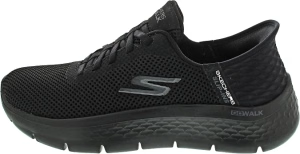
    BuyingForMom is a reader-supported site. As an Amazon Associate we earn from qualifying purchases. When you buy through links on this site, we may earn an affiliate commission at no additional cost to you. See our Affiliate Disclosure for details. This article is not medical advice — please consult a qualified healthcare professional for decisions specific to your family.
  • 5 Best Wheelchair Cushions for Pressure Sores

    5 Best Wheelchair Cushions for Pressure Sores

    Disclosure: BuyingForMom is reader-supported. As an Amazon Associate we earn from qualifying purchases. When you buy through links in this article, we may earn an affiliate commission at no additional cost to you. We never recommend products we haven’t researched against verified-buyer review data. This article is editorial reporting, not medical advice.

    5 Best Wheelchair Cushions for Pressure Sores

    By Sarah Mitchell · Editor, BuyingForMom · Updated September 2026

    11-minute read · Balance & Mobility · 5 picks compared

    The honest take: If a parent sits for long stretches and you’re trying to prevent a pressure sore, buy the ProHeal Inflatable Air Cushion and set a repositioning reminder the two together do more than any cushion alone. If there’s already a wound or absent sensation, step up to the powered Vive Alternating Pressure Pad and loop in a wound nurse. Skip the plush “memory foam comfort” cushions marketed to seniors — soft is not the same as pressure-redistributing, and for a genuine ulcer risk they’re the wrong tool.

    How we sorted through 40+ pressure-relief cushions in three weeks

    We cross-referenced more than 8,000 verified Amazon reviews across gel, air, foam, and powered-alternating cushions, then filtered against the criteria occupational therapists and wound-care nurses use: pressure redistribution, immersion depth, weight capacity, and cover hygiene. We leaned on the National Pressure Injury Advisory Panel’s guidance that no single surface prevents injury alone, a randomized trial (National Library of Medicine) showing skin-protection cushions lower ulcer incidence in at-risk seniors, and caregiver patterns from Reddit’s r/AgingParents and r/caregivers. Every product below was confirmed in stock as of September 2026.

    Who this guide is for

    This guide is for adult children and caregivers choosing a cushion for a parent who sits in a wheelchair, recliner, or transport chair for hours a day and is at risk of or already developing a pressure sore, often after a stroke, a hospital stay, or a stretch of limited mobility. If you’re buying for yourself and simply want comfort, the same picks apply, but pay closest attention to the risk-level routing below rather than the softest option.

    Pressure sores (bedsores, pressure ulcers) form where body weight presses skin against a hard surface long enough to cut off blood flow — most often the tailbone and the two “sit bones.” A good wheelchair cushion for pressure sores spreads that load and lets tissue breathe, but the cushion is only half the job. The other half is moving.

    At a glance

    Best Overall  ProHeal Inflatable Air Cushion — ~$45 · deep-immersion air for prevention and early sores

    Best No-Fuss Gel  Drive Medical Skin Protection Gel-E — ~$55 · zero inflation, wipe-clean

    Best for Accidents  Vive Waterproof Gel-Foam Cushion — ~$45 · washable waterproof cover, incontinence-friendly

    Best for Existing Wounds  Vive Alternating Pressure Pad — ~$80 · powered, cells inflate and deflate on a cycle

    Gold-Standard Air Cell  ROHO Mosaic Cushion — ~$100 · dry-flotation air cells that shape to the body

    Best Overall ProHeal Inflatable Wheelchair Air Cushion

    Check price on Amazon →  ·  around $45 (16″ × 16″)

    For most families shopping before a sore appears, this is the sweet spot: genuine air-immersion pressure redistribution at a gel-cushion price. The ProHeal uses inflatable cells that let the sit bones sink in rather than bear down, and it’s rated for pressure-sore treatment and prevention, not just comfort. Across 3,000-plus reviews the recurring praise is the dual-valve setup — soften one side independently if a wound or a bonier hip needs extra offloading — and a 500-pound capacity that outclasses most gel pads. Buyers caring for post-stroke parents repeatedly say it “actually held up” where cheaper foam flattened in weeks. It ships with a pump, nylon cover, and repair kit.

    The good

    • True air immersion at roughly the price of a basic gel cushion
    • Dual valves let you offload one side for an existing sore or uneven hips
    • 500 lb capacity and a 5-year warranty rare at this price

    The catch

    • Air cushions need an inflation check every week or two a con for a forgetful user living alone
    • The nylon cover is functional, not plush

    This is right if… you want the most protective mechanism you can get under $50 and don’t mind a periodic air check.

    Look elsewhere if… the user can’t manage inflation and no caregiver will check it — go with a maintenance-free gel below.

    Best No-Fuss Gel Drive Medical Skin Protection Gel-E

    Check price on Amazon →  ·  around $55 (16″ × 16″ × 3″)

    When no one will reliably check air pressure, a quality gel cushion is the honest recommendation — and the Drive Gel-E is the one OTs and medical-supply catalogs cite most. A viscous gel bladder sits over a firm polyurethane-foam base, so it redistributes weight without going flat or needing any upkeep beyond wiping the cover. Across roughly 4,000 reviews, the consistent theme is set-and-forget reliability for parents in assisted living where staff can’t fuss with valves. The gel also stays cooler than solid foam, which matters for skin that’s already fragile. It’s heavier than an air cushion and won’t immerse the sit bones as deeply, so we position it as prevention-and-comfort for low-to-moderate risk rather than a fix for an open wound.

    The good

    • Zero maintenance no inflating, no adjusting
    • Gel base runs cooler than plain foam for sensitive skin
    • Removable, water-resistant cover with a non-slip vinyl bottom

    The catch

    • Heavier than air or foam harder to move between chairs
    • Less deep immersion than air, so not ideal for high-risk or existing sores

    This is right if… the user or facility won’t maintain an air cushion and you want reliable, hands-off protection.

    Look elsewhere if… there’s already a wound — step up to an air or alternating-pressure option.

    Best for Accidents Vive Waterproof Wheelchair Cushion

    Check price on Amazon →  ·  around $45 (16″ × 16″ × 3″)

    Incontinence and pressure risk almost always travel together, and moisture is what turns a red spot into a broken one. This is the cushion for that reality. Vive layers a dynamic gel center between dense foam and wraps the whole thing in a genuinely waterproof, machine-washable cover — so a nighttime accident wipes off the seat instead of soaking into it. Across 5,000-plus reviews, caregivers of bedbound-to-chair parents call the washable cover the deciding feature, and note the gel-foam blend gives more stability than a pure-air cushion for someone who lists to one side. It’s not the deepest offloader here, but paired with clean, dry skin it’s a smart everyday pick, and it drops onto a recliner or car seat just as easily as a wheelchair.

    The good

    • Truly waterproof, machine-washable cover for incontinence
    • Gel-plus-foam gives steadier support for a parent who leans
    • Works on wheelchairs, recliners, and car seats

    The catch

    • Foam layer can compress over a year of heavy daily use
    • Less immersion than dedicated air cushions for the highest risk

    This is right if… incontinence is part of the picture and a wipe-clean, washable surface is non-negotiable.

    Look elsewhere if… the sole goal is maximum offloading for an established ulcer.

    Best for Existing Wounds Vive Alternating Pressure Pad

    Check price on Amazon →  ·  around $80 (fits seats 18″ and wider)

    When there’s already a sore, or sensation is absent, a static cushion can’t do enough  the contact site needs the load to physically move. This powered pad does that: five air cells inflate and deflate on a cycle so no single patch of skin bears weight continuously, the principle of a hospital alternating-pressure mattress shrunk to seat size. A rechargeable, quiet pump runs about eight hours per charge, and a static mode lets it double as a plain air cushion when unplugged. Skeptical reviewers repeatedly report it “made a real difference” for a parent recovering a Stage 1 or 2 sore. Capacity tops out near 220 pounds, so confirm the user’s weight, and use it alongside a wound-care plan, not instead of one.

    The good

    • Actively moves pressure, the strongest mechanism here for existing sores
    • Rechargeable, quiet pump with ~8 hours per charge
    • Static mode works as a backup air cushion

    The catch

    • 220 lb capacity — too low for heavier users
    • A pump is one more thing to charge and maintain

    This is right if… there’s a current or healing sore, or the user has no protective sensation.

    Look elsewhere if… the user is over ~220 lb or you want a purely passive cushion.

    Gold-Standard Air Cell ROHO Mosaic Cushion

    Check price on Amazon →  ·  around $100 (16″ × 16″)

    Ask a seating therapist which brand they trust for skin protection and the answer is almost always ROHO. Its interconnected air cells use “dry-flotation” the sit bones settle down into the cells rather than perch on top, and air shifts to match the body’s exact shape. The Mosaic is ROHO’s most affordable air-cell model and the one that fits an everyday budget, which is why it’s here. Be honest with yourself about the tier, though: the Mosaic is ROHO’s everyday line, rated for low-risk skin protection. If a parent has an established Stage 2-or-deeper wound, a therapist will likely spec the pricier High Profile or Quadtro Select — those are prescription-grade and run several hundred dollars. For prevention and light protection, the Mosaic delivers the genuine ROHO feel at a fraction of the cost.

    The good

    • Real ROHO air-cell dry-flotation, the therapist-trusted design
    • Cells conform closely to the body for even load-spreading
    • Heavy-duty, non-slip cover

    The catch

    • It’s the everyday line not the prescription High Profile for serious wounds
    • 250 lb capacity and, like all air cushions, needs periodic inflation checks

    This is right if… you want authentic ROHO protection for prevention without the prescription-model price.

    Look elsewhere if… there’s a deep or non-healing wound — get an OT to spec the medical ROHO.

    How the five compare

    Cushion Mechanism Best for Capacity ~Price
    ProHeal Inflatable Air Air immersion Prevention + early sores 500 lb $45
    Drive Medical Gel-E Gel over foam No-maintenance protection ~275 lb $55
    Vive Waterproof Gel-Foam Gel + foam, waterproof Incontinence + comfort ~265 lb $45
    Vive Alternating Pressure Powered alternating air Existing wounds / no sensation 220 lb $80
    ROHO Mosaic Air-cell dry-flotation Therapist-grade prevention 250 lb $100

    The conversation you’ll have

    Cushions like these can land as an insult — proof, in a parent’s mind, that they’re “falling apart.” That resistance is normal, and pushing the safety angle usually backfires. What works better is framing the cushion as comfort, not correction. Instead of “You need this so you don’t get a bedsore,” try “This one’s supposed to make sitting through the whole afternoon a lot easier on you — want to try it in your chair?” Let the cushion prove itself; most people notice within a day that a long sit hurts less.

    If a parent has a diagnosed risk or an actual sore, bring in the doctor or wound nurse as the messenger “Dr. Patel wants you on this cushion for a few weeks” carries more weight than a nudge from an adult child. And keep the skin conversation matter-of-fact: a quick daily look at the tailbone and hips, not a lecture. Our complete aging-in-place home safety checklist covers how to fold that kind of routine into a week without it feeling like surveillance.

    Insurance and savings

    Medicare can cover a wheelchair seat cushion, but the rules are specific. A general-use cushion (HCPCS code E2601/E2602) is covered only when the person has a Medicare-qualifying manual or power wheelchair and a face-to-face evaluation documents medical need. A skin-protection cushion (E2607/E2608) is covered when there’s a current pressure ulcer, a history of one at the contact site, or absent/impaired sensation — with a supplier-added KX modifier on the claim. The practical catch: Amazon isn’t an enrolled Medicare supplier, so buying here is out of pocket, but the same purchase is almost always FSA- and HSA-eligible as a qualified medical expense. If a sore already exists, ask the prescribing clinician to route a covered cushion through an enrolled durable-medical-equipment supplier and save your FSA dollars for the everyday backup.

    What to actually look for

    Match the mechanism to the risk, not the price

    This is the choice that matters most. Low-to-moderate risk and prevention: a quality gel or air cushion. Moderate-to-high risk or a bony, low-weight parent: air immersion (ProHeal or ROHO). An established or healing sore, or no protective sensation: powered alternating pressure. A soft “comfort” foam cushion feels nice but redistributes little — for genuine ulcer risk it’s the wrong category entirely.

    Get the size and weight capacity right

    Measure the seat width and depth, then match the cushion — one that overhangs the frame or perches too small undoes the pressure math. Check the weight rating too: several excellent cushions cap at 220–275 pounds, which rules them out for heavier users. Our guide to lightweight transport wheelchairs explains how to measure a chair correctly before you buy anything that sits in it.

    Plan for hygiene and upkeep

    A cushion is only protective if it stays clean and correctly inflated. If incontinence is a factor, insist on a waterproof, washable cover. If no one will check air pressure weekly, choose gel over air. And build the cushion into a room-by-room safety plan rather than treating it as a standalone fix — our room-by-room aging-in-place modification guide shows where seating fits alongside beds, bathrooms, and transfers.

    Frequently asked questions

    Do wheelchair cushions actually prevent pressure sores?

    Yes, but only as part of a routine. A randomized trial found skin-protection cushions lowered pressure-ulcer incidence in at-risk seniors versus generic foam. The cushion redistributes load; it can’t replace shifting position every one to two hours and checking skin daily. Cushion plus repositioning is what actually works.

    Gel, air, or foam — which is best for pressure sores?

    Air immersion (like ROHO or ProHeal) generally offers the most pressure relief and suits higher risk. Gel is a close, maintenance-free second for low-to-moderate risk. Plain foam offers the least redistribution and is best reserved for comfort, not sore prevention. Match the mechanism to the risk level.

    How often should a parent reposition even with a good cushion?

    Most wound-care guidance recommends shifting weight every one to two hours while seated — leaning side to side, doing seated push-ups, or being helped to stand briefly. A cushion buys time between shifts; it doesn’t eliminate the need. Set a phone or watch reminder to make it automatic.

    Does Medicare cover a wheelchair cushion for pressure sores?

    It can. A skin-protection cushion is covered when there’s a current or prior pressure ulcer at the contact site, or impaired sensation, ordered through an enrolled supplier with proper documentation. Amazon purchases are out of pocket but typically FSA- and HSA-eligible. Ask the prescriber to route a covered cushion through a medical-equipment supplier.

    How long do these cushions last before replacing?

    Foam and gel-foam cushions generally hold their shape one to two years of daily use before compressing; replace once the base bottoms out under the sit bones. Air cushions last longer if maintained but should be checked for leaks and correct inflation every week or two. Replace any cushion showing permanent flattening.

    Can these be used on a recliner or regular chair, not just a wheelchair?

    Most can. The gel and waterproof gel-foam picks work on recliners, dining chairs, and car seats. The alternating-pressure pad works anywhere it can reach an outlet or run on its charge. Just confirm the cushion sits flat and doesn’t overhang the seat, which reduces its effectiveness.

    The shortlist

    Best Overall

    ProHeal Inflatable Air

    ~$45

    Check on Amazon →

    Best No-Fuss Gel

    Drive Medical Gel-E

    ~$55

    Check on Amazon →

    Best for Accidents

    Vive Waterproof Gel-Foam

    ~$45

    Check on Amazon →

    Best for Wounds

    Vive Alternating Pressure

    ~$80

    Check on Amazon →

    Gold-Standard Air

    ROHO Mosaic

    ~$100

    Check on Amazon →

    What we’d do tomorrow

    If you’re starting this weekend, do these three things in order. First, be honest about risk: no wound and just long sitting means the ProHeal air cushion (or the maintenance-free Drive gel if no one will check inflation); a current or healing sore means the Vive alternating-pressure pad plus a call to the doctor. Second, measure the seat before ordering so the cushion fits. Third and this is the one that actually prevents sores set a repeating reminder to shift weight every one to two hours and glance at the skin once a day. The cushion buys time; the routine is what keeps skin intact.

    — Sarah

    BuyingForMom is a reader-supported site. As an Amazon Associate we earn from qualifying purchases. When you buy through links on this site, we may earn an affiliate commission at no additional cost to you. See our Affiliate Disclosure for details. This article is not medical advice please consult a qualified healthcare professional for decisions specific to your situation.
  • Best Recliner for Elderly Getting Up: 5 Picks

    Best Recliner for Elderly Getting Up: 5 Picks

    Disclosure: BuyingForMom is reader-supported. As an Amazon Associate we earn from qualifying purchases. When you buy through links in this article, we may earn an affiliate commission at no additional cost to you. We never recommend products we haven’t researched against verified-buyer review data. This article is editorial reporting, not medical advice.

    Best Recliner for Elderly Getting Up: 5 Non-Powered Picks

    By Sarah Mitchell · Editor, BuyingForMom · Updated September 2026

    10-min read · Living Room · 5 recliners compared

    The honest take: If a parent can still stand on their own but the recliner fights them, buy the CANMOV Classic Manual Recliner a firmer, higher seat with flat push-up arms does 90% of the work a motor does, for a third of the price. Choose a rocker recliner only if your parent is genuinely steady on their feet, because a rocking base is the single hardest thing to push up from. And if standing is already a real struggle, stop shopping manual recliners entirely that’s a job for a power lift chair, not a $300 recliner and wishful thinking.

    How we sorted through 40+ recliners in three weeks

    We started with more than 40 manual and pushback recliners, then cross-referenced roughly 30,000 verified-buyer reviews, the seat-height and egress guidance occupational therapists publish for chair selection, and recurring caregiver complaints on Reddit’s r/AgingParents. We deliberately set the power lift recliners aside — those are a different product we cover separately, and most families shopping “recliners for seniors” don’t actually need a motor. What we screened for: an 18–21″ seat height, a firm-not-mushy cushion, a stable base, and arms a person can push down on to stand. Beautiful chairs that sat low and soft got cut.

    Who this guide is for

    This is for the adult child buying a recliner for a parent who can still get up on their own but grunts, rocks, or needs two tries to do it and who either doesn’t want a motorized chair or doesn’t need one yet. If your parent already can’t rise from a standard chair without a hand, skip to the power-lift conversation near the end; a manual recliner will only frustrate them. Shopping for yourself with a stiff back or a new knee? The same five picks apply — just ignore the “conversation” section.

    Why “easy to get up from” is mostly about the seat, not the recline

    Almost every recliner roundup gets this wrong: it obsesses over the reclining action and ignores the one moment that matters for an aging body — standing back up. Getting out of a chair is the hardest movement of most seniors’ day, and it fails for three predictable reasons: the seat is too low (knees above hips, nothing to push against), too soft (the person sinks and has to climb out of a hole), or the base rocks (nothing solid to launch from). A firmer, taller seat with flat, sturdy arms turns standing into a controlled push. That’s the lens we used for every pick below — and why our top choice is a plain manual recliner, not the flashiest chair on the page.

    At a glance

    Best Overall  CANMOV Classic Manual Recliner — ~$270 · firm higher seat, flat push-up arms, non-rocking

    Best Budget  Homall Pushback Recliner — ~$160 · stable base, small footprint, best for shorter parents

    Most Popular  Ashley Bladen Rocker Recliner — ~$430 · best-reviewed, for a parent still steady on their feet

    Best for Tall Parents  Ashley RiverCam Recliner — ~$400 · 41″ back, needs only 13″ of wall clearance

    Best Easy-Clean  CANMOV Genuine Leather Recliner — ~$380 · wipeable leather, non-rocking, overstuffed

    Best Overall CANMOV Classic Manual Recliner

    ~$270 · Check price on Amazon →

    This is the chair we’d send most families to, precisely because it’s unremarkable. It’s a traditional single-lever recliner on a stable, non-rocking base, with a firm overstuffed seat that sits higher than the theater-style recliners it competes with — and that height is the whole game for standing up. The arms are wide, padded, and flat enough on top to plant a palm and push. Across CANMOV’s thousands of reviews the recurring note is “sturdier and firmer than expected” faint praise for a couch, high praise for a chair a parent launches out of a dozen times a day.

    The good

    • Firmer, higher seat than most manual recliners — the key egress advantage
    • Stable non-rocking base gives a solid platform to push up from
    • Wide flat-topped arms are genuinely usable for pushing to stand

    The catch

    • The recline lever takes a firm pull weak grip or wrist arthritis may struggle with it
    • Assembly of the back onto the base is a two-person job out of the box

    This is right if… your parent can stand on their own but needs a firm, higher seat that doesn’t fight them.

    Look elsewhere if… they can’t work a manual lever — then a pushback or a powered chair fits better.

    Best Budget Homall Pushback Recliner

    ~$160 · Check price on Amazon →

    A pushback recliner has no lever at all you lean back to recline and lean forward to sit up, and the base doesn’t rock. That stability is a real plus for balance, and the small footprint suits an apartment or a bedroom corner. Where it earns its “budget with an asterisk” label is the seat: verified specs put it around 17.75″, which is on the low side for the egress problem we care about. Reviewers who are shorter or lighter love it; taller or heavier parents report sinking in. Our honest fix, one we’d recommend regardless is to add a firm 2–3″ seat cushion, which raises the launch point and makes a low-but-stable chair work surprisingly well. At this price that’s a reasonable trade.

    The good

    • No lever to operate, leaning is easier than gripping and pulling for arthritic hands
    • Stable, non-rocking base and a compact footprint for small rooms
    • Hard to beat under ~$160

    The catch

    • Low seat height, best paired with a firm booster cushion for easier standing
    • Reclining takes body weight to push back, which not every frail parent can generate

    This is right if… your parent is shorter or lighter, the room is small, and the budget is tight.

    Look elsewhere if… they’re tall or heavy — the low seat will make standing harder, not easier.

    Most Popular Ashley Bladen Manual Rocker Recliner

    ~$430 · Check price on Amazon →

    The Bladen is the recliner families actually buy thousands of reviews, well-padded faux leather that wipes clean, and a look that fits a normal living room. We include it with one honest caveat: it’s a rocker, and a rocking base is the least stable thing to push up from. Plenty of seniors are steady enough that the rock is a non-issue and the comfort wins — but if getting up is already dicey, the rocking works against you at the wrong moment. Buyers praise the cushioning and value; the recurring gripe is a footrest that takes a firm push to close. Buy it for comfort and looks, not as a mobility aid.

    The good

    • Best-reviewed pick here proven comfort and durability across thousands of buyers
    • Wipe-clean faux leather handles spills and everyday messes well
    • Looks like living-room furniture, not a medical chair

    The catch

    • Rocking base is less stable to stand up from a real drawback for unsteady parents
    • Closing the footrest takes a firm push some report as stiff

    This is right if… your parent is still steady on their feet and you’re prioritizing comfort and looks.

    Look elsewhere if… balance or standing is already a worry pick a non-rocking chair instead.

    Best for Tall Parents Ashley RiverCam Manual Rocker Recliner

    ~$400 · Check price on Amazon →

    Taller parents get shortchanged by most recliners — their head clears the backrest with no support where it counts. The RiverCam answers with a tall 41″ back and padded pillow-top arms, and it reclines with a smooth pull-tab needing only about 13″ of wall clearance, so it works against a wall in a tight room. Like the Bladen it’s a rocker, so the same standing caveat applies. Reviewers single out the back height and arm padding as the reasons they’d buy again. It’s the pick for a 6-foot-plus parent who finds every other recliner too small.

    The good

    • Tall 41″ back finally supports the head and neck of a taller parent
    • Only needs ~13″ of wall clearance — real help in a small living room
    • Thick pillow-top arms are comfortable and easy to grip

    The catch

    • Rocking base — same standing-stability caveat as any rocker recliner
    • Larger overall footprint despite the wall-hugging recline

    This is right if… your parent is tall and most recliners leave their head unsupported.

    Look elsewhere if… they’re petite — this big chair will swallow a smaller frame.

    Best Easy-Clean CANMOV Genuine Leather Recliner

    ~$380 · Check price on Amazon →

    When spills, incontinence, or a parent who eats in the chair are part of the picture, wipeable upholstery stops being a luxury. This CANMOV is the leather sibling of our top pick — the same firm, higher, non-rocking seat and overstuffed push-up arms, wrapped in genuine leather with an adjustable backrest. Leather resists absorbing what fabric soaks up and looks more finished as it ages. Reviewers note it runs firm out of the box and softens with use — the right direction for a chair chosen for easy standing. It’s the priciest manual pick here, but for the right household the cleanability justifies it.

    The good

    • Genuine leather wipes clean — ideal for spills or incontinence concerns
    • Firm, higher, non-rocking seat — the same egress-friendly build as our top pick
    • Adjustable backrest and a more premium look that ages well

    The catch

    • Most expensive manual pick here
    • Leather feels cold at first and stiff until it breaks in

    This is right if… easy cleanup matters and you want the firm, stable seat in wipeable leather.

    Look elsewhere if… your parent prefers the warmth and softness of fabric.

    How the five compare

    Recliner ~Price Base Best for
    CANMOV Classic Manual $270 Stable Best all-around egress
    Homall Pushback $160 Stable Small budget, small space
    Ashley Bladen $430 Rocker Comfort, steady parent
    Ashley RiverCam $400 Rocker Tall parents, tight walls
    CANMOV Genuine Leather $380 Stable Easy cleanup

    The conversation you’ll have

    A recliner is an easy gift to introduce — no one resists a comfortable chair the way they resist a grab bar or a walker. The friction comes only when a parent senses you’re managing their decline, so don’t frame it that way. Instead of “I’m worried about you getting stuck in that old chair,” try “Your recliner’s looking tired — I want to get you one that actually fits you.” Bring them in on the color and fabric; ownership of the decision matters more than the specs. And retire the old low, sunken chair quietly rather than announcing it was a hazard. The goal is a parent who loves their new chair, not one who feels diagnosed by it.

    Insurance and savings

    Be clear-eyed here: Medicare does not cover a standard recliner. For power lift recliners, Part B may reimburse a portion of the lift mechanism only when a doctor documents medical necessity and you buy from an enrolled supplier — the seat, fabric, and frame are on you. A plain manual recliner like the ones here has no lift motor, so there’s nothing for Medicare to cover. FSA and HSA funds generally can’t buy ordinary furniture without a doctor’s letter of medical necessity, and even then approval is inconsistent. The takeaway: budget for full retail, and if getting up is hard enough that a lift mechanism is medically justified, talk to your parent’s physician first — that’s the only path to any reimbursement.

    What to actually look for

    Seat height and firmness first

    Aim for a seat that puts your parent’s hips level with or slightly above their knees — usually an 18–21″ seat height. Firm beats plush: a cushion you sink into is one you have to climb out of. If a chair you love sits low, a firm 2–3″ booster is a cheap fix. Our complete aging-in-place home safety checklist covers measuring seat height against your parent’s leg length so you’re not guessing.

    A stable base and usable arms

    For anyone whose balance is even slightly off, choose a non-rocking, non-swiveling base — a rocker moves at the exact moment your parent is pushing up. The arms matter just as much: they should be firm, wide, and flat enough on top to press a full palm against, not thin or rounded. Those two features, a solid base and pushable arms, do more for safe standing than any recline feature on the box.

    Match the recline mechanism to their hands

    A lever recliner needs grip strength and a firm pull; a pushback needs body weight to lean into; a power chair needs only a button. Be honest about which your parent can actually do — arthritis and weak grip rule out stiff levers. Placing the chair well also matters: see how it fits the rest of the room in our room-by-room aging-in-place modification guide, so a beautiful recliner doesn’t end up blocking a walker’s path.

    Frequently asked questions

    What kind of recliner is best for getting up?

    The best recliner for standing has a firm, higher seat (around 18–21″), a stable non-rocking base, and wide flat arms to push against. For most seniors who can still stand on their own, a plain manual recliner with those features works well. If standing is a real struggle, a power lift recliner is the better answer.

    Is a rocker recliner bad for the elderly?

    Not inherently, but the rocking base is less stable to push up from, which matters if balance is shaky. A steady parent can enjoy a rocker with no issue. For anyone unsteady on their feet, a non-rocking or stationary-base recliner is the safer choice for getting in and out.

    How high should a recliner seat be for a senior?

    Aim for a seat height that keeps the hips level with or slightly above the knees when seated — generally 18 to 21 inches for an average-height adult. Too low forces the knees up and removes leverage. If a favorite chair sits low, a firm booster cushion raises the launch point affordably.

    Are manual or power recliners better for the elderly?

    Manual recliners cost far less and suit seniors who can stand on their own and operate a lever or lean back. Power lift recliners are worth it only when getting up is genuinely difficult, since a motor tilts the seat forward to assist standing. Match the chair to how much help is actually needed.

    What is a wall-hugger recliner?

    A wall-hugger recliner reclines by sliding the seat forward instead of tipping the back rearward, so it needs only a few inches of clearance behind it — often under a foot. That makes it ideal for apartments and small living rooms where a standard recliner would hit the wall before fully reclining.

    Does Medicare pay for a recliner?

    Medicare does not cover a standard recliner. For a power lift recliner, Part B may reimburse part of the lift mechanism only when a doctor documents medical necessity and you use an enrolled supplier — never the chair itself. A manual recliner has no lift motor, so nothing about it qualifies for Medicare coverage.

    The shortlist

    Best Overall

    CANMOV Classic Manual Recliner

    ~$270

    Check on Amazon →

    Best Budget

    Homall Pushback Recliner

    ~$160

    Check on Amazon →

    Most Popular

    Ashley Bladen Rocker Recliner

    ~$430

    Check on Amazon →

    Best for Tall Parents

    Ashley RiverCam Recliner

    ~$400

    Check on Amazon →

    Best Easy-Clean

    CANMOV Genuine Leather Recliner

    ~$380

    Chck on Amazon →

    Last verified in stock: September 10, 2026

    What we’d do tomorrow

    If you’re sorting this out this weekend, do three things in order. First, measure — have your parent sit in their current chair and check whether their hips sit level with their knees; that tells you whether you need a taller seat or just a firmer cushion. Second, decide honestly whether they can still stand on their own: if yes, order the CANMOV Classic Manual Recliner and add a firm booster if the seat runs low. Third, if standing is already a two-person job, read our guide to power lift chairs under $1,000 instead — a manual recliner won’t solve a lift problem. Match the chair to the real need, not the prettiest photo.

    — Sarah

    BuyingForMom is a reader-supported site. As an Amazon Associate we earn from qualifying purchases. When you buy through links on this site, we may earn an affiliate commission at no additional cost to you. See our Affiliate Disclosure for details. This article is not medical advice — please consult a qualified healthcare professional for decisions specific to your parent’s needs.
  • 5 Best Portable Wheelchair Ramps for Home

    5 Best Portable Wheelchair Ramps for Home

    Disclosure: BuyingForMom is reader-supported. As an Amazon Associate we earn from qualifying purchases. When you buy through links in this article, we may earn an affiliate commission at no additional cost to you. We never recommend products we haven’t researched against verified-buyer review data. This article is editorial reporting, not medical advice.

    5 Best Portable Wheelchair Ramps for Home

    By Sarah Mitchell · Editor, BuyingForMom · Updated September 2026
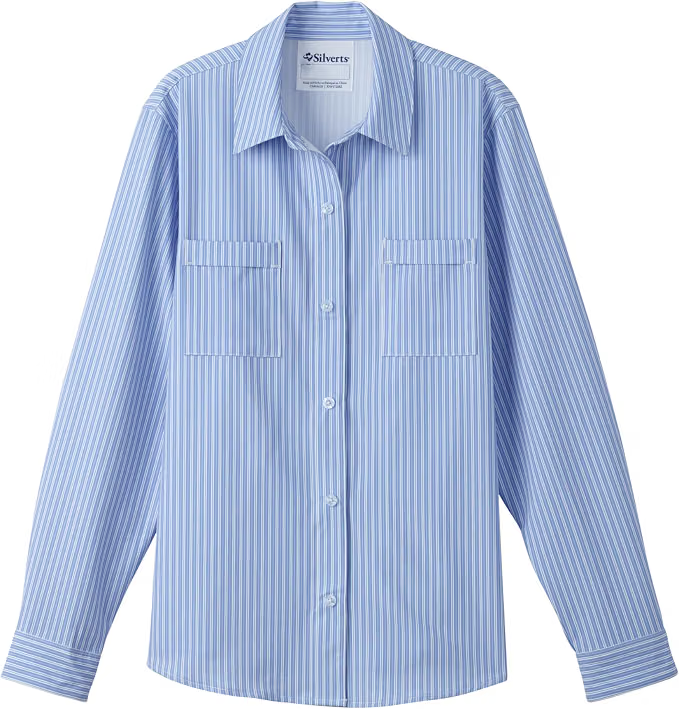
    10-minute read · Outdoors & Entryways · 5 picks compared

    The honest take: For most homes with one or two steps, buy the EZ-ACCESS Suitcase Trifold and be done the 800-pound solid deck handles a wheelchair, a scooter, and a parent walking beside it. Choose the Ruedamann telescoping tracks only if you need something that stores in a closet or dials to an odd rise. And do not buy any ramp until you’ve measured the total height from the ground to the door threshold — the number that measurement gives you decides everything else on this page.

    How we sorted through 40+ portable ramps in three weeks

    We started with more than forty portable ramps on Amazon and narrowed the field over about three weeks. We cross-referenced thousands of verified-buyer reviews, checked each manufacturer’s stated capacity and usable width against what buyers actually reported, and read Reddit caregiver threads in r/AgingParents where families describe what failed after a winter of daily use. We weighed every pick against the ADA’s 1:12 slope guideline, because a ramp that’s too short is the single most common regret in the reviews. Products that were out of stock, sold only through third-party listings with no clean product page, or that showed a pattern of “arrived bent” complaints were dropped before reaching this list.

    Who this guide is for

    This guide is for an adult child or caregiver setting up a parent’s home so a wheelchair, scooter, or rollator can get in and out safely — over a threshold, one or two steps, or a garage or van. If the obstacle is only a raised door sill under two inches, you likely want a small threshold ramp instead; we cover that below. A permanent ramp for four or more steps is a construction project, not a portable ramp — that’s a conversation with a contractor.

    At a glance

    Best Overall  EZ-ACCESS Suitcase Trifold (7′) — ~$300 · 800 lb solid deck for one to three steps.

    Best Budget  ORFORD 6FT Single-Fold — ~$110 · solid aluminum for a couple of steps.

    Best Adjustable  Ruedamann 6FT Telescoping Tracks — ~$135 · dials to the exact rise, stores small.

    Best for One Step  EZ-ACCESS Suitcase Singlefold (3′) — ~$130 · short, solid, 800 lb.

    Best Long Reach  Ruedamann 10FT Telescoping Tracks — ~$260 · higher rises, scooters, van loading.

    The question every family asks “how long a ramp do I need?” has a real answer. Measure the vertical height from the ground to the top of the step, then plan on roughly one foot of ramp per two inches of rise for a safe home slope (toward the gentler 1:12 ADA ratio if your parent self-propels a manual chair). A single 7-inch step wants three to four feet; two steps totaling 12 inches want six feet or more. Buy for the rise you measured — a too-steep ramp is how people tip backward.

    Best Overall EZ-ACCESS Suitcase Trifold

    ~$300 · Check price on Amazon →

    For the common case, a wheelchair or scooter clearing one to three steps at a front door or into a minivan this is the ramp most occupational therapists point families toward. It’s welded aircraft-grade aluminum rated to 800 pounds, folds into a suitcase-style case with a handle, and separates into two lighter sections via two hinge pins. Across thousands of verified reviews, the recurring praise is the solid, continuous deck: unlike track ramps, a parent on a walker or a caregiver alongside has a full surface underfoot. The slip-resistant tread and self-adjusting bottom plates draw repeat mention for holding up in wet weather, and it carries a rare lifetime warranty.

    The good

    • Solid continuous deck works for wheelchairs, scooters, walkers, and a caregiver walking beside.
    • 800 lb capacity and lifetime warranty — the sturdiest, longest-backed pick here.
    • Separates into two sections, so one person can move it in two trips instead of one heavy lift.

    The catch

    • Heavy, even split in two, each section is a real armful for a smaller caregiver.
    • Priced well above the budget picks; you’re paying for the brand and the warranty.

    This is right if… your parent’s entrance is one to three steps and you want a do-everything ramp you won’t second-guess.

    Look elsewhere if… you need to carry it far and often, or your obstacle is a single low threshold.

    Best Budget ORFORD 6FT Single-Fold Ramp

    ~$110 · Check price on Amazon →

    The ORFORD 6FT delivers a solid-deck folding ramp for close to a third of the premium brand’s price, and the review pattern is unusually consistent for a value product: buyers call it sturdier than the box number suggests. It’s aluminum with stainless-steel hinges that resist the rust that kills cheaper ramps, a slip-resistant painted surface, and a 600-pound capacity that covers a parent plus a power chair. ORFORD rates the 6-foot length for rises of roughly 6 to 18 inches — a realistic couple of steps. The honest weak spot buyers note is weight: at about 31 pounds it folds in half with a handle, but it’s not one a frail caregiver flips open one-handed. As a stay-by-the-door home ramp, it’s the value leader.

    The good

    • Solid deck and 600 lb capacity at roughly a third of premium-brand pricing.
    • Stainless hinges and painted non-skid surface hold up to weather better than bargain ramps.
    • Six feet suits the common 6–18 inch, one-to-two-step home rise.

    The catch

    • About 31 pounds fine as a stay-put ramp, tiring to carry repeatedly.
    • No lifetime warranty; a value brand, not a lifetime-buy.

    This is right if… you want a dependable everyday door ramp and would rather not spend $300.

    Look elsewhere if… the ramp will travel in a car trunk daily, where lighter tracks win.

    Best Adjustable Ruedamann 6FT Telescoping Tracks

    ~$135 · Check price on Amazon →

    Track ramps are two separate channels one under each wheel and the Ruedamann 6FT pair telescopes, so you extend them to the exact rise, lock them, then collapse them to store in a closet or trunk. Verified buyers pick these for two things solid ramps handle poorly: an odd, in-between rise, and storing the ramp out of sight between uses. The pair is rated to 600 pounds and, per Ruedamann, handles steps up to about 14 inches. The trade-off is baked into the format, and reviewers are candid: with a gap down the middle, a walker or rollator can’t cross the open center, and you have to line each wheel up on its channel. For a wheelchair or scooter that’s a non-issue; for a walker it’s the wrong tool.

    The good

    • Telescopes to the exact rise, then collapses small for closet or trunk storage.
    • Lightest format here — each track lifts easily, ideal for daily transport.
    • 600 lb pair capacity handles most power chairs and scooters.

    The catch

    • Two-track design won’t work for a walker or rollator — the center is open.
    • You must align each wheel on its channel every time; less forgiving than a solid deck.

    This is right if… your parent uses a wheelchair or scooter and you need the ramp to store away or travel.

    Look elsewhere if… a walker or rollator is ever crossing it — buy a solid deck instead.

    Best for One Step EZ-ACCESS Suitcase Singlefold (3′)

    ~$130 · Check price on Amazon →

    Not every entrance needs six feet of ramp. When the obstacle is a single step, a raised sliding-door threshold, or one riser into a garage, a short solid ramp is safer and far easier to handle and this 3-foot EZ-ACCESS Singlefold ships from and is sold by Amazon, so stock and returns are clean. It’s the same 800-pound welded-aluminum build as the trifold, with a self-adjusting plate that sits flat against uneven concrete. Verified buyers note how manageable it is: one person folds it, carries it by the handle, and sets it down alone. Match the length to a low rise — three feet suits a step near 6 inches; size up if yours is taller.

    The good

    • Right-sized and light for a single step or a raised threshold — no over-buying.
    • 800 lb solid deck and self-adjusting bottom plate for uneven concrete.
    • Ships from Amazon directly; the cleanest stock and return path of the picks.

    The catch

    • Three feet is too short for two or more steps — measure before ordering.
    • Premium per-foot pricing for a small ramp.

    This is right if… your parent’s barrier is one step or a threshold and you want easy, one-person setup.

    Look elsewhere if… you’re clearing more than a single step — size up to the trifold.

    Best Long Reach Ruedamann 10FT Telescoping Tracks

    ~$260 · Check price on Amazon →

    When the rise is genuinely high three steps, a tall porch, or loading a scooter into an SUV or van you need length to keep the slope safe, and short ramps turn dangerously steep. The Ruedamann 10FT telescoping pair reaches those higher rises while still collapsing for storage, which is why verified buyers grab it for vehicle loading and steep back-door landings. It’s the same track format as the 6-foot version: two channels, 600-pound pair capacity, non-skid surface, carry handles. The caveat applies twice over — wheeled devices only, and more to align and muscle into place. But for high-rise and van cases a solid ramp can’t reach without becoming unwieldy, this is the practical answer.

    The good

    • Ten-foot reach keeps the slope safe on tall rises and van loading.
    • Still collapses and telescopes — stores and travels despite the length.
    • Two-track scooter/wheelchair capacity of 600 lb per pair.

    The catch

    • Track format again rules out walkers and rollators.
    • At ten feet there’s more to align and lift than a shorter ramp.

    This is right if… you’re loading a scooter into a vehicle or clearing three tall steps.

    Look elsewhere if… your rise is low — a shorter ramp is lighter and easier to place.

    Side-by-side comparison

    Ramp Type Capacity Best for ~Price
    EZ-ACCESS Trifold 7′ Solid deck 800 lb 1–3 steps, all devices ~$300
    ORFORD 6FT Solid deck 600 lb Budget everyday door ramp ~$110
    Ruedamann 6FT Telescoping tracks 600 lb/pair Odd rise, compact storage ~$135
    EZ-ACCESS Singlefold 3′ Solid deck 800 lb One step / threshold ~$130
    Ruedamann 10FT Telescoping tracks 600 lb/pair Tall rises, van loading ~$260

    The conversation you’ll have

    A ramp at the front door is one of the most visible aging-in-place changes there is, and many parents resist it for that reason — it announces something to the neighbors. Frame it around independence, not decline. Instead of “we need a ramp because you can’t do the steps anymore,” try “this means you can get yourself in and out without waiting for anyone — and it folds away when you don’t want it out.” Lean on the portability: unlike poured concrete, these come inside or go in the trunk, so it needn’t be a permanent fixture the street sees. If the resistance is really pride, offer a two-week trial — a portable ramp makes “let’s just test it” an easy yes, because nothing is bolted down.

    Insurance and savings

    Set expectations honestly: original Medicare (Part B) does not cover home wheelchair ramps — it treats a ramp as a home modification, not “durable medical equipment,” so it’s an out-of-pocket purchase. Three avenues are worth checking. Many Medicare Advantage (Part C) plans now offer supplemental home-safety benefits that can include ramps — call and ask. A ramp prescribed as medically necessary can qualify as an FSA or HSA expense, and sometimes a deductible medical expense; keep the receipt and doctor’s note. And state Medicaid waivers and local Area Agency on Aging offices sometimes fund or loan ramps. None is guaranteed, but ask before assuming the cost isn’t recoverable.

    What to actually look for

    Measure the rise first, then buy the length

    Everything starts with one number: the vertical height from the ground to the top of the step. Aim for roughly a foot of ramp per two inches of rise for a gentle home slope, toward the ADA 1:12 ratio if your parent self-propels a manual chair. A ramp too short to keep the slope gentle is the most common and most dangerous mistake. If the whole obstacle is under two inches — just a raised door sill — you don’t need a full ramp; a small wedge is safer and cheaper, and we cover those in our guide to door threshold ramps for walkers and wheelchairs.

    Match the surface to the device

    Solid-deck ramps work for everything — wheelchairs, scooters, walkers, rollators, and a caregiver walking beside. Two-track ramps are lighter and store smaller but leave an open center, so they’re for wheeled devices only; a walker will catch the gap. Decide who and what is crossing before you choose the format. This is one of the room-by-room decisions we walk through in our room-by-room aging-in-place modification guide.

    Weight, width, and who has to carry it

    Confirm the capacity covers your parent plus the device — a power chair alone can run 150–250 pounds — and check usable width against the wheelchair’s wheelbase. Be realistic about who sets it up daily: a 30-pound ramp that stays by the door is fine, but if it rides in a trunk, a lighter telescoping pair a smaller caregiver can lift matters more than extra capacity. For where a ramp fits in the plan, start with our complete aging-in-place home safety checklist.

    Frequently asked questions

    How long should a wheelchair ramp be for three steps?

    Three standard steps total roughly 21 inches of rise. Following the safe home guideline of about one foot of ramp per two inches, you’d want a ramp near 10 feet; for the gentler ADA 1:12 slope, longer still. Measure your actual rise — step heights vary — and size up rather than down.

    What slope is safe for a home wheelchair ramp?

    The ADA standard is 1:12 — one foot of ramp for every inch of rise. Many homes use a steeper 1:8 (a foot per two inches) for short portable ramps where a caregiver assists. Steeper than that risks tipping backward going up and losing control coming down, especially for a self-propelled chair.

    Do portable ramps work for a single step or threshold?

    Yes. For one step, a short 2–3 foot solid ramp is ideal and easy for one person to handle. For just a raised door sill under two inches, skip the full ramp and use a small threshold wedge instead — it’s safer, cheaper, and doesn’t stick out into the walkway.

    How much weight can a portable wheelchair ramp hold?

    The ramps here are rated from 600 to 800 pounds, which covers a rider plus a power chair or scooter with margin to spare. Always confirm the stated capacity accounts for the combined weight of the person and the device, not the person alone, and stay well under the maximum.

    Do you need a permit for a portable wheelchair ramp?

    Portable ramps that aren’t permanently attached generally don’t require a permit, since they’re treated like equipment rather than construction. Permanent ramps bolted to the house often do. Rules vary by city and HOA, so if the ramp will stay in place long-term, a quick call to your local building department settles it.

    The shortlist

    Best Overall

    EZ-ACCESS Trifold 7′

    ~$300

    Check on Amazon →

    Best Budget

    ORFORD 6FT Single-Fold

    ~$110

    Check on Amazon →

    Best Adjustable

    Ruedamann 6FT Tracks

    ~$135

    Check on Amazon →

    Best for One Step

    EZ-ACCESS Singlefold 3′

    ~$130

    Check on Amazon →

    Best Long Reach

    Ruedamann 10FT Tracks

    ~$260

    Check on Amazon →

    What we’d do tomorrow

    If you’re starting this weekend, do three things in order. First, take a tape measure to the entrance and write down the total rise from ground to threshold that one number rules out most of this page and points to a single length. Second, decide who crosses the ramp: any walker or rollator means a solid deck, so the EZ-ACCESS Trifold for a couple of steps or the 3-foot Singlefold for one; a wheelchair or scooter that needs to store away means the telescoping Ruedamann tracks. Third, set it up and have your parent try it once with you spotting  that first run tells you instantly whether the length and slope are right.

    — Sarah
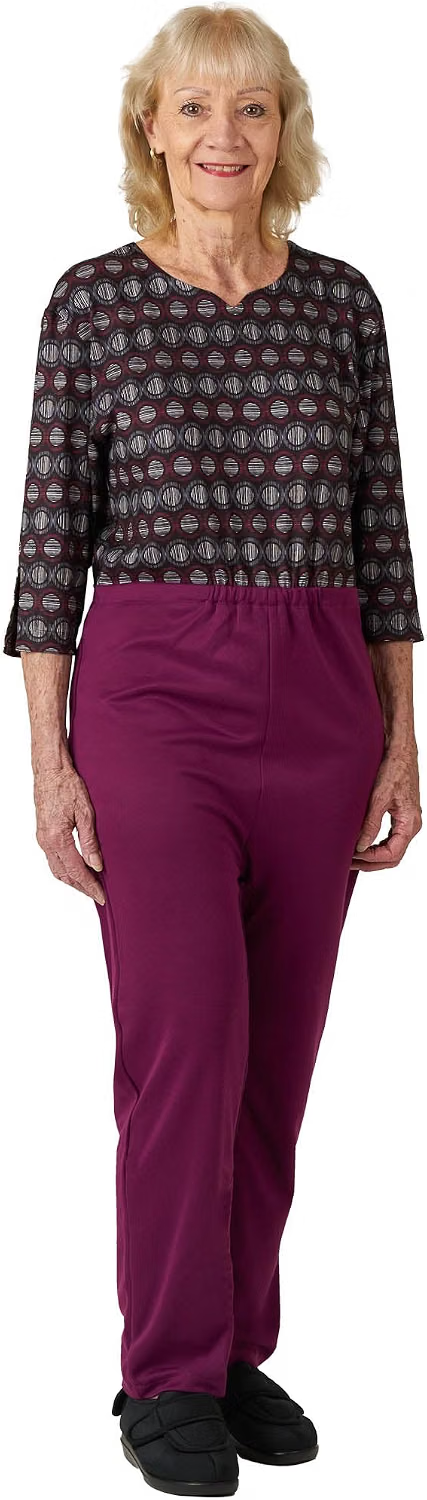
    BuyingForMom is a reader-supported site. As an Amazon Associate we earn from qualifying purchases. When you buy through links on this site, we may earn an affiliate commission at no additional cost to you. See our Affiliate Disclosure for details. This article is not medical advice please consult a qualified healthcare professional for decisions specific to your family.